REVIEW 5 major objections 4 minor 12 references
Communal Domain Learning for Registration in Drifted Image Spaces
T0 review · 5 major / 4 minor · reviewed 2026-08-14 · deepseek-v4-flash
Pith's one-line read The paper claims that registering drifted image pairs inside a learned communal subspace—shared by source and target domains—improves affine alignment of T1/T2 MRI and MR/CT over mutual-information baselines, with reported p<0.001 gains…
desk verdict Reasonable high-level idea, but the math is wrong in load-bearing places and the reported statistics are impossible; as written, not credible. read the letter →
The pith
A machine-rendered reading of the paper's core claim, the machinery that carries it, and where it could break.
The reading
What carries the argument
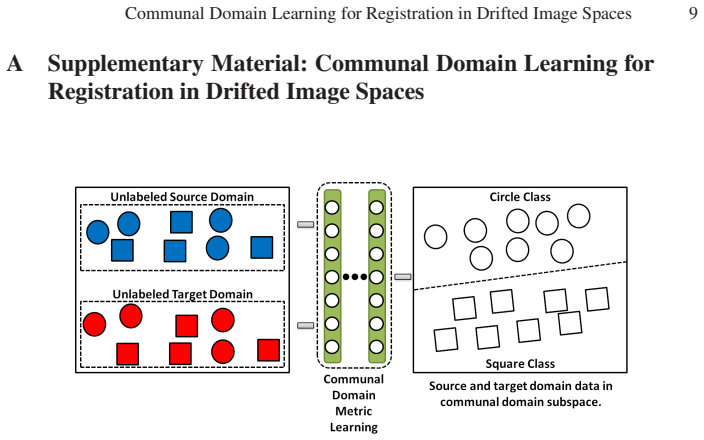
The load-bearing object is the CDL network, a fully connected network with sigmoid activations trained to learn the communal subspace W. Its loss combines three terms: an information term I(h_t^(M); h_s^(M)) approximated by the cross-correlation formula in eq. (3), a distribution-difference term D based on maximum mean discrepancy, and Frobenius and L2 regularization on weights and biases. The same cost function is reused at registration time, and its derivative with respect to the transformation parameters gives the search direction (eq. 11), so the learned subspace is not a preprocessing step but the space in which the alignment is decided. The paper's justification that eq. (3) is a valid stand-in for mutual information is the assumption that hierarchical tanh/sigmoid transforms preserve the Gaussianity of intensities.
What would settle it
Compute the exact probability density of tanh(x) and sigmoid(x) for Gaussian inputs with the mean and variance actually seen in the training volumes, and measure how far the result is from Gaussian, for example by KL divergence over the intensity range. If the divergence is large, or if replacing the true mutual information by the cross-correlation surrogate in eq. (3) changes the affine parameters found by the optimizer, the claimed guarantee that CDL maximizes shared information is refuted.
Extended reading notes
Core claim
The central claim is that whenever two domains image the same field of view they share a non-empty set of drift-invariant features, called the communal subspace W, and that a hierarchical nonlinear network can learn W from aligned training pairs. During training, the network output h(M) is optimized with the cost C = I - alpha*D - beta*regularization, where I is the mutual information approximated by the cross-correlation lower bound of eq. (3), and D is the maximum mean discrepancy between source and target outputs. At registration time, the same network is used as a feature extractor: the similarity term and the search direction for affine parameters are computed from h(M) and the same loss C. The paper reports that this beats MI-based registration for multisequence T1-T2 (Dice from 0.80 to 0.93 for the no-mask variant) and multimodal T1-CT (Dice from 0.83 to 0.96), with p<0.001.
Load-bearing premise
The method rests on the assumption that the network's nonlinear activations leave Gaussian-distributed intensities Gaussian enough that a simple cross-correlation formula can stand in for mutual information; if that assumption fails, the training objective is not actually maximizing shared information.
Editorial extensions
If this is right
- If the central claim is correct, registration across modalities and sequences reduces to a training problem: one CDL network per domain pair replaces hand-tuned similarity metrics and the choice of masking.
- Because the same loss and optimizer are used for both learning and registration, CDL should transfer to other transformation models, including nonrigid registration, without changing the metric or the subspace.
- Reported robustness to masking suggests the learned subspace does not depend on accurate background or brain extraction, which would make the method easier to deploy in clinical pipelines.
- The faster convergence shown in Fig. 3(b) implies that besides a better final alignment, registration in the communal subspace can reduce the number of optimizer iterations needed.
Reading between the lines
- Inference: The need for pre-aligned training pairs is the clear practical bottleneck; a self-supervised variant that generates pseudo-alignments from initial registrations would be the natural next test.
- Inference: The Gaussianity-preservation step is the theoretical hinge; a direct diagnostic on the actual distribution of network outputs would show whether eq. (3) is maximizing true mutual information or only a proxy.
- Inference: Since CDL is a learned representation rather than a metric, it could complement other learned or classical metrics; the question whether the benefits come from the subspace or from the cross-correlation surrogate could be tested by ablating each term in eq. (2).
Signed reviews
Editorial analysis
A structured set of objections, weighed in public.
Referee Report
Summary. The manuscript proposes Communal Domain Learning (CDL), a neural-network representation learned jointly from aligned source/target image pairs, followed by affine registration performed in the learned representation. The training objective (Eq. 2) combines a purported mutual-information term (Eq. 3), a distribution-difference term (Eq. 6), and weight regularization. The authors claim that a communal subspace is guaranteed to exist (Proposition 1), that hierarchical tanh/sigmoid transforms preserve Gaussianity (Supplementary B), and that CDL yields statistically significant Dice and Hausdorff distance improvements over MI baselines for T1-T2 and T1-CT registration (Table 1).
Significance. If the claims were valid, the paper would offer a generic learned representation for multi-sequence and multi-modal registration, a practically important goal. The authors are to be credited for evaluating on separate training and test sets and for comparing against several MI-based masking variants. However, the central theoretical mechanism is invalid: Eq. (3) is not mutual information, Supplementary B does not establish Gaussianity preservation, Eq. (6) is not the stated maximum mean discrepancy, and Proposition 1 is a near-tautological subspace statement. The empirical evidence is also internally questionable, with impossible standard deviations reported for some Dice scores. The central claims are therefore not supported by the manuscript as written.
major comments (5)
- [§2.1, Eq. (3)] Equation (3) is not mutual information and cannot justify the equality asserted immediately after it. For jointly Gaussian variables the correct mutual information is I = -1/2 ln(1 - rho^2), not -1/2(1 - rho); the two disagree numerically (e.g., rho = 0.9 gives I ≈ 0.83 while Eq. (3) gives -0.05). The inequality I ≥ -1/2(1 - rho) is vacuous because the right-hand side is non-positive for all |rho| ≤ 1. Since the CDL training objective, its gradients (4)-(5), and the registration search direction (11) all differentiate this surrogate, maximizing the cost in Eq. (2) is not maximizing shared information.
- [Supplementary B, Eqs. (14) and (16)] The densities in Eqs. (14) and (16) are not Gaussian densities: the Jacobian factors 1/(1-y^2) and 1/(y(1-y)) are nonconstant and the exponential arguments contain the nonlinear inverse activations. The Taylor expansions in Eqs. (15) and (17) are local approximations of the inverse functions, not a proof that the transformed variables are Gaussian; the statement that the expansions demonstrate Gaussianity is a non sequitur. The Gaussianity preservation premise is therefore unsupported, and with it the derivation of Eq. (3).
- [§2.1, Eq. (6)] Equation (6) is not the maximum mean discrepancy of Gretton et al.; MMD is defined as the RKHS norm of the difference between mean embeddings and requires a kernel. At best, Eq. (6) is a squared MMD for a linear kernel, which matches only first moments and says very little about the probability differences between the drifted domains. The distribution-difference term in the cost is therefore not what the paper claims it is.
- [§2.1-§2.2, Proposition 1 and Eq. (12)] Proposition 1 is a near-tautological statement about non-orthogonal vector spaces sharing a non-empty intersection; it does not establish that a drift-invariant subspace exists, nor that registration performed in any such subspace will be accurate. In addition, Eqs. (2) and (12) are the same objective, so the training procedure maximizes exactly the criterion used at registration time; this explains the favorable comparison to MI but does not validate the proposed subspace theory.
- [Table 1] Some reported Dice values are impossible for a score bounded on [0,1] if the ± entries are standard deviations (e.g., 0.76 ± 0.54 and 0.96 ± 0.26); at minimum, the table does not state what the error bars represent. The statistical claim p<0.001 is also incomplete: the test compares paired registration outcomes on the same image pairs, so a paired test such as Wilcoxon signed-rank would be appropriate, yet neither the test statistic nor the number of pairs per cell is reported. These issues prevent the reader from verifying the headline empirical claim.
minor comments (4)
- [Section 3.1] The text refers to Fig. 3(a) and Fig. 3(b), but the displayed figure is captioned Fig. 2; figure numbering should be made consistent.
- [Section 2, Algorithm 1] The free parameters α, β, λ, and M are introduced but no selection procedure or sensitivity analysis is reported, which is important because the method is advertised as generic.
- [Section 2] The statement that p(0) = d = 3 for volumetric images conflicts with the use of scalar image volumes as network inputs; the input dimension should be the number of voxels in the representation, not 3.
- [Section 2.1] The reference to Katyal et al. [7] is to a MICCAI grand challenge paper on fluid-tissue categorization; it is not sufficient support for the general claim that joint and marginal distributions of multi-sequence/multi-modal intensities are Gaussian.
Circularity Check
Partial circularity: the CDL training objective and the registration objective are the same cost function, so the learned-subspace benefit is partly by construction; the Dice evaluation is external and prevents a higher score.
-
self definitional
[Section 2.1, paragraph after eq (2); mirrored in Section 2.2, eq (12)]
"The typical cost function for registration ( µ̂ = arg maxµ C ( T µ x s , x t ) ) and (2) are equivalent owing to the way the registration framework is set up Fig. 1."
The CDL network is trained by maximizing the cost C in eq (2) over aligned source–target pairs; the paper then performs registration by maximizing the same C over transformation parameters µ in eq (12). Thus the 'communal subspace' is defined as the representation that maximizes C, and the registration objective is literally the same C. The statement that registering in the learned subspace is beneficial therefore restates the training objective rather than deriving an independent property. This is a self-definitional loop in the theoretical chain. The reported Dice and Hausdorff results are external to this chain, so the empirical claim is not fully forced; but the theoretical derivation of CDL's advantage is circular to this extent.
full rationale
The paper's derivation chain starts with Proposition 1, which defines a communal subspace W as a common subset of the two domains and then asserts, without proof, that such a subset carries drift-invariant features. The actual learning procedure maximizes eq (2) on aligned training pairs, and the registration search in eq (12) maximizes the same function over transformation parameters. This identity makes the theoretical justification partly self-definitional: the learned representation is chosen to optimize exactly the criterion used at registration time, so observing that the criterion favors the learned representation is not independent evidence. The empirical evaluation (Dice, Hausdorff) against MI baselines is external and could in principle demonstrate real improvement; however, the paper does not report the Wilcoxon test statistic and reports an impossible standard deviation for a Dice score (e.g., 0.76 ± 0.54), weakening that external check. No load-bearing self-citations were found; the mathematical flaw in eq (3) is a correctness issue rather than a circularity. Overall circularity is partial: the central theoretical claim reduces to a fit/identity, while the empirical claim retains independent content.
Assumptions & free parameters
free parameters (4)
- alpha =
0.1
- beta =
10
- learning rate lambda =
0.2, annealed by 0.95 per iteration
- network depth M =
2
assumptions (5)
- standard math A non-empty communal subspace W exists between registering domains when the domains are not perpendicular (Proposition 1).
- domain assumption Voxel intensities of aligned multisequence and multimodal images sharing the same field of view are Gaussian distributed.
- ad hoc to paper The sigmoid and tanh activations preserve Gaussianity of their inputs.
- ad hoc to paper Mutual information of Gaussian variables is lower-bounded by I >= -1/2(1 - Corr), with equality under joint Gaussianity.
- ad hoc to paper The registration cost function and the CDL training cost function are equivalent.
Cite this review
Pith. "Pith review of Communal Domain Learning for Registration in Drifted Image Spaces." pith.science (2026). https://pith.science/paper/DLCTDREO
@misc{pith2026190807646,
  author       = {Pith},
  title        = {Pith review of: Communal Domain Learning for Registration in Drifted Image Spaces},
  year         = {2026},
  howpublished = {\url{https://pith.science/paper/DLCTDREO}},
  note         = {Machine review of arXiv:1908.07646}
}
abstract
Designing a registration framework for images that do not share the same probability distribution is a major challenge in modern image analytics yet trivial task for the human visual system (HVS). Discrepancies in probability distributions, also known as \emph{drifts}, can occur due to various reasons including, but not limited to differences in sequences and modalities (e.g., MRI T1-T2 and MRI-CT registration), or acquisition settings (e.g., multisite, inter-subject, or intra-subject registrations). The popular assumption about the working of HVS is that it exploits a communal feature subspace exists between the registering images or fields-of-view that encompasses key drift-invariant features. Mimicking the approach that is potentially adopted by the HVS, herein, we present a representation learning technique of this invariant communal subspace that is shared by registering domains. The proposed communal domain learning (CDL) framework uses a set of hierarchical nonlinear transforms to learn the communal subspace that minimizes the probability differences and maximizes the amount of shared information between the registering domains. Similarity metric and parameter optimization calculations for registration are subsequently performed in the drift-minimized learned communal subspace. This generic registration framework is applied to register multisequence (MR: T1, T2) and multimodal (MR, CT) images. Results demonstrated generic applicability, consistent performance, and statistically significant improvement for both multi-sequence and multi-modal data using the proposed approach ($p$-value$<0.001$; Wilcoxon rank sum test) over baseline methods.
Figures


Reference graph
Works this paper leans on
-
[1]
IEEE transactions on medical imaging 32(7) (2013) 1153
Sotiras, A., Davatzikos, C., Paragios, N.: Deformable medical image registration: A survey. IEEE transactions on medical imaging 32(7) (2013) 1153
work page 2013
-
[2]
Medical image analysis 52 (2019) 128--143
de Vos, B.D., Berendsen, F.F., Viergever, M.A., Sokooti, H., Staring, M., I s gum, I.: A deep learning framework for unsupervised affine and deformable image registration. Medical image analysis 52 (2019) 128--143
work page 2019
-
[3]
In: International Workshop on Machine Learning in Medical Imaging, Springer (2018) 55--63
Cao, X., Yang, J., Wang, L., Xue, Z., Wang, Q., Shen, D.: Deep learning based inter-modality image registration supervised by intra-modality similarity. In: International Workshop on Machine Learning in Medical Imaging, Springer (2018) 55--63
work page 2018
-
[4]
Journal of Medical Imaging 5(2) (2018) 021204
Zheng, J., Miao, S., Wang, Z.J., Liao, R.: Pairwise domain adaptation module for cnn-based 2-d/3-d registration. Journal of Medical Imaging 5(2) (2018) 021204
work page 2018
-
[5]
IEEE Transactions on Image Processing 16(12) (2007) 2879--2890
Klein, S., Staring, M., Pluim, J.P.: Evaluation of optimization methods for nonrigid medical image registration using mutual information and B -splines. IEEE Transactions on Image Processing 16(12) (2007) 2879--2890
work page 2007
-
[6]
Proceedings of the National Academy of Sciences 106(21) (2009) 8748--8753
Zoccolan, D., Oertelt, N., DiCarlo, J.J., Cox, D.D.: A rodent model for the study of invariant visual object recognition. Proceedings of the National Academy of Sciences 106(21) (2009) 8748--8753
work page 2009
-
[7]
Proceedings of the MICCAI Grand Challenge on MR Brain Image Segmentation (2013)
Katyal, R., Paneri, S., Kuse, M.: Gaussian intensity model with neighborhood cues for fluid-tissue categorization of multisequence MR brain images. Proceedings of the MICCAI Grand Challenge on MR Brain Image Segmentation (2013)
work page 2013
-
[8]
Kleeman, R.: Information theory and dynamical system predictability. Entropy 13(3) (2011) 612--649
work page 2011
Show all 12 references
-
[9]
In: Advances in Neural Information Processing Systems
Gretton, A., Borgwardt, K.M., Rasch, M., Sch \"o lkopf, B., Smola, A.J.: A kernel method for the two-sample-problem. In: Advances in Neural Information Processing Systems. (2006) 513--520
2006
-
[10]
In: International Conference on Medical Image Computing and Computer-Assisted Intervention, Springer (2016) 10--18
Simonovsky, M., Guti \'e rrez-Becker, B., Mateus, D., Navab, N., Komodakis, N.: A deep metric for multimodal registration. In: International Conference on Medical Image Computing and Computer-Assisted Intervention, Springer (2016) 10--18
2016
-
[11]
In: Eleventh Annual Meeting of the Organization for Human Brain Mapping
Jenkinson, M., Pechaud, M., Smith, S.: BET2 : MR -based estimation of brain, skull and scalp surfaces. In: Eleventh Annual Meeting of the Organization for Human Brain Mapping. Volume 17., Toronto (2005) 167
2005
-
[12]
write newline
" write newline "" before.all 'output.state := FUNCTION fin.entry write newline FUNCTION new.block output.state before.all = 'skip after.block 'output.state := if FUNCTION stupid.colon after.authors 'output.state := FUNCTION insert.comma output.state before.all = 'skip between...
Reviewed August 14, 2026 · model on record in the stance chip above.
Discussion (0). Continue with ORCID to comment.