Pseudo-scalar dark matter from a broken gauged symmetry
Pith reviewed 2026-06-26 10:33 UTC · model grok-4.3
The pith
Broken U(1)_X gauge symmetry produces stable pseudo-scalar dark matter whose direct detection cross section is suppressed even at weak-scale masses.
A machine-rendered reading of the paper's core claim, the machinery that carries it, and where it could break.
Core claim
We propose a novel model for pseudo-scalar dark matter (PSDM) by extending the Standard Model (SM) with a dark gauged U(1)_X symmetry, but without dark charged fermions. We impose a Z2 symmetry to ensure the stability of pseudo-scalar dark matter and regard the U(1)_X symmetry as being broken dominantly by a large VEV of the singlet scalar field. The would-be Goldstone associated with the U(1)_X gauge boson is almost orthogonal to the direction of PSDM. As a result, PSDM appears as a stable pseudo-Nambu-Goldstone boson receiving the mass from the U(1)_X invariant mixing potential and the corresponding cross section for direct detection gets suppressed even for the weak-scale mass of PSDM. We
What carries the argument
The near-orthogonality between the PSDM direction and the would-be Goldstone boson of the broken U(1)_X, produced by the dominant singlet scalar VEV together with the Z2 symmetry, which lets the mixing potential set the mass while suppressing direct detection.
If this is right
- Direct detection remains suppressed at weak-scale masses because of the pseudo-Nambu-Goldstone character.
- The correct relic density follows from annihilations into Standard Model particles or light Higgs-like scalars.
- The parameter space satisfies existing limits from Higgs invisible decays, Higgs data, and indirect detection.
- No dark charged fermions are required for the construction.
Where Pith is reading between the lines
- The same orthogonality mechanism could be applied to other approximate-symmetry dark matter candidates in gauged extensions.
- The additional light scalars may produce observable effects in Higgs precision measurements or rare decays.
- The model structure allows the singlet VEV scale to be raised without reintroducing large direct detection rates.
Load-bearing premise
The would-be Goldstone boson eaten by the U(1)_X gauge field remains almost orthogonal to the pseudo-scalar dark matter direction.
What would settle it
A direct detection experiment measuring a scattering cross section at the level expected for an ordinary weak-scale scalar dark matter particle without the orthogonality suppression.
Figures
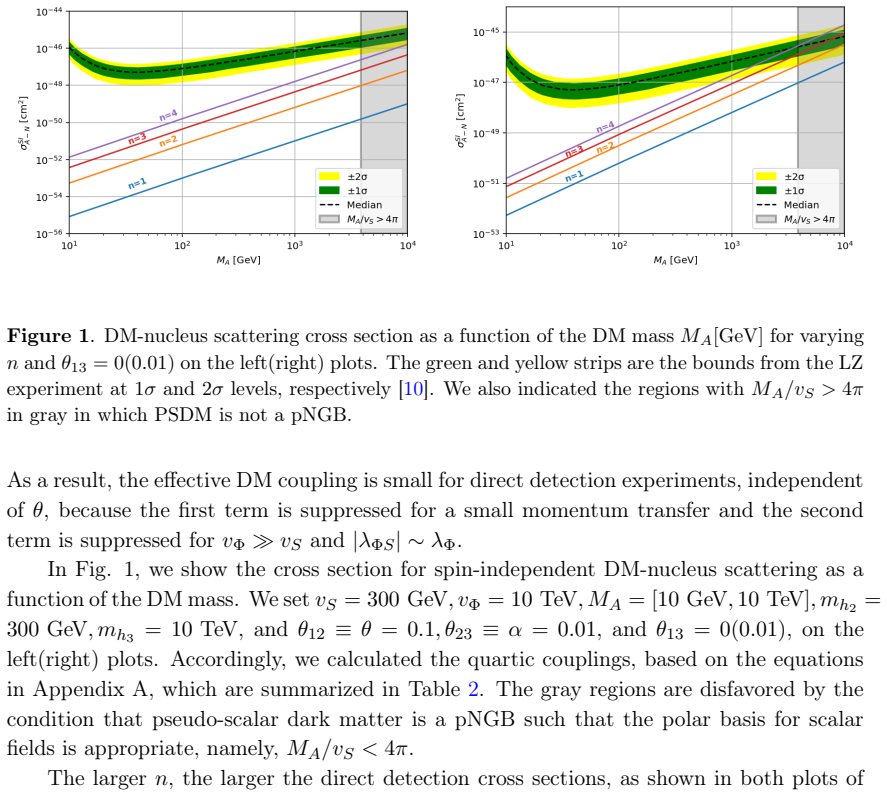
read the original abstract
We propose a novel model for pseudo-scalar dark matter (PSDM) by extending the Standard Model (SM) with a dark gauged $U(1)_X$ symmetry, but without dark charged fermions. We impose a $Z_2$ symmetry to ensure the stability of pseudo-scalar dark matter and regard the $U(1)_X$ symmetry as being broken dominantly by a large VEV of the singlet scalar field. The would-be Goldstone associated with the $U(1)_X$ gauge boson is almost orthogonal to the direction of PSDM. As a result, we show that PSDM appears as a stable pseudo-Nambu-Goldstone boson receiving the mass from the $U(1)_X$ invariant mixing potential and the corresponding cross section for direct detection gets suppressed even for the weak-scale mass of PSDM. We also show that the correct relic density can be explained by the PSDM annihilations into the SM particles or into a pair of light Higgs-like scalars, being compatible with the bounds from Higgs invisible decay, Higgs data and indirect detection.
Editorial analysis
A structured set of objections, weighed in public.
Referee Report
Summary. The manuscript proposes extending the SM with a gauged U(1)_X symmetry (broken dominantly by a singlet scalar VEV) plus a Z2 symmetry. The resulting pseudo-scalar dark matter is identified as a stable pseudo-Nambu-Goldstone boson whose mass is generated by a U(1)_X-invariant mixing potential; near-orthogonality between the PSDM direction and the U(1)_X Goldstone is claimed to suppress the direct-detection cross section even for weak-scale masses. Relic density is stated to be achievable via annihilations into SM particles or light Higgs-like scalars while remaining compatible with Higgs invisible-decay, Higgs-data, and indirect-detection bounds.
Significance. If the orthogonality and potential structure are shown to hold without additional tuning, the construction supplies a concrete realization of weak-scale pseudo-scalar DM with naturally suppressed direct detection, addressing a recurring tension in DM model building. The explicit compatibility checks with Higgs and indirect-detection constraints, if quantitatively demonstrated, would strengthen the phenomenological viability of the scenario.
major comments (2)
- [Abstract / symmetry-breaking paragraph] Abstract and the paragraph on symmetry breaking: the central claim that direct-detection suppression holds 'even for the weak-scale mass of PSDM' rests on the would-be Goldstone being 'almost orthogonal' to the PSDM direction. This orthogonality must be shown explicitly via the eigenvectors of the scalar mass matrix after diagonalization; without the explicit form of the mixing potential and the resulting mixing angles, the suppression cannot be verified as a structural feature rather than a parameter choice.
- [Abstract] Abstract (relic-density paragraph): the statement that 'the correct relic density can be explained by the PSDM annihilations' is presented as a result of the model, yet the description indicates that annihilation channels and couplings are selected to reproduce the observed value. This reduces the relic-density statement to a consistency check rather than an independent prediction; the manuscript should clarify whether any region of parameter space yields the observed density without additional tuning beyond the symmetry structure.
minor comments (2)
- Notation for the singlet scalar VEV and the U(1)_X gauge boson should be introduced consistently in the model-definition section to avoid ambiguity when referring to the breaking scale.
- The manuscript would benefit from a brief comparison table of the present construction against other pseudo-Goldstone DM models that also invoke gauged symmetries, to highlight the distinctive role of the dominant singlet VEV.
Simulated Author's Rebuttal
We thank the referee for the careful reading and constructive comments, which help clarify the presentation of our results. We address each major comment below and will revise the manuscript accordingly to strengthen the explicit demonstrations requested.
read point-by-point responses
-
Referee: [Abstract / symmetry-breaking paragraph] Abstract and the paragraph on symmetry breaking: the central claim that direct-detection suppression holds 'even for the weak-scale mass of PSDM' rests on the would-be Goldstone being 'almost orthogonal' to the PSDM direction. This orthogonality must be shown explicitly via the eigenvectors of the scalar mass matrix after diagonalization; without the explicit form of the mixing potential and the resulting mixing angles, the suppression cannot be verified as a structural feature rather than a parameter choice.
Authors: We agree that the abstract and introductory discussion would benefit from an explicit demonstration. The full manuscript derives the scalar potential (including the U(1)_X-invariant mixing terms) and the resulting mass matrix, but the eigenvectors and mixing angles are not displayed in sufficient detail. In the revised version we will add the explicit diagonalization of the CP-even and CP-odd scalar mass matrices, together with the resulting eigenvectors, to show that the near-orthogonality follows directly from the dominant singlet VEV and the structure of the mixing potential without additional parameter tuning. revision: yes
-
Referee: [Abstract] Abstract (relic-density paragraph): the statement that 'the correct relic density can be explained by the PSDM annihilations' is presented as a result of the model, yet the description indicates that annihilation channels and couplings are selected to reproduce the observed value. This reduces the relic-density statement to a consistency check rather than an independent prediction; the manuscript should clarify whether any region of parameter space yields the observed density without additional tuning beyond the symmetry structure.
Authors: The referee is correct that the observed relic density is obtained by choosing annihilation channels and couplings within the symmetry-allowed set. The model does not predict the relic density from first principles independent of parameters. In the revision we will clarify this point explicitly, add benchmark points and a brief parameter-space scan demonstrating that viable regions exist with O(1) couplings and without fine-tuning beyond the symmetry-imposed relations, and discuss the degree of tuning relative to generic WIMP models. revision: partial
Circularity Check
No significant circularity identified
full rationale
The paper constructs a model with gauged U(1)_X plus Z2, states that dominant singlet VEV breaking produces near-orthogonality between the would-be Goldstone and PSDM direction, derives PSDM mass from the U(1)_X-invariant mixing term, and shows relic-density compatibility via annihilation channels within Higgs and indirect-detection bounds. No quoted equation or step reduces by construction to a fitted input, self-citation chain, or renamed ansatz; the orthogonality and mass generation follow directly from the stated symmetry-breaking pattern. Relic-density statements are framed as 'can be explained' (compatibility), not as first-principles predictions forced by the inputs. The derivation remains self-contained against external benchmarks.
Axiom & Free-Parameter Ledger
free parameters (3)
- Singlet scalar VEV
- U(1)_X invariant mixing potential coefficients
- Annihilation couplings
axioms (2)
- standard math Standard Model gauge group and particle content form the base theory
- domain assumption Z2 symmetry ensures stability of the pseudo-scalar
invented entities (3)
-
U(1)_X gauge boson
no independent evidence
-
Singlet scalar field
no independent evidence
-
Pseudo-scalar dark matter field
no independent evidence
Reference graph
Works this paper leans on
-
[1]
J. Preskill, M. B. Wise and F. Wilczek, Phys. Lett. B120(1983), 127-132 doi:10.1016/0370-2693(83)90637-8 ; L. F. Abbott and P. Sikivie, Phys. Lett. B120(1983), 133-136 doi:10.1016/0370-2693(83)90638-X
-
[2]
H. M. Lee and M. S. Seo, Phys. Lett. B748(2015), 316-322 doi:10.1016/j.physletb.2015.07.013 [arXiv:1504.00745 [hep-ph]]
work page internal anchor Pith review Pith/arXiv arXiv doi:10.1016/j.physletb.2015.07.013 2015
-
[3]
H. M. Lee, S. Raby, M. Ratz, G. G. Ross, R. Schieren, K. Schmidt-Hoberg and P. K. S. Vaudrevange, Nucl. Phys. B850(2011), 1-30 doi:10.1016/j.nuclphysb.2011.04.009 [arXiv:1102.3595 [hep-ph]]
work page internal anchor Pith review Pith/arXiv arXiv doi:10.1016/j.nuclphysb.2011.04.009 2011
-
[4]
A cancellation mechanism for dark matter-nucleon interaction
C. Gross, O. Lebedev and T. Toma, Phys. Rev. Lett.119(2017) no.19, 191801 doi:10.1103/PhysRevLett.119.191801 [arXiv:1708.02253 [hep-ph]]
work page internal anchor Pith review Pith/arXiv arXiv doi:10.1103/physrevlett.119.191801 2017
-
[5]
Y. Abe, T. Toma and K. Tsumura, JHEP05(2020), 057 doi:10.1007/JHEP05(2020)057 [arXiv:2001.03954 [hep-ph]]
-
[6]
L. Bian, H. M. Lee and C. B. Park, Eur. Phys. J. C78(2018) no.4, 306 doi:10.1140/epjc/s10052-018-5777-1 [arXiv:1711.08930 [hep-ph]]
work page internal anchor Pith review Pith/arXiv arXiv doi:10.1140/epjc/s10052-018-5777-1 2018
-
[7]
Direct Detection of Vector Dark Matter
J. Hisano, K. Ishiwata, N. Nagata and M. Yamanaka, Prog. Theor. Phys.126(2011) 435 doi:10.1143/PTP.126.435 [arXiv:1012.5455 [hep-ph]]
work page internal anchor Pith review Pith/arXiv arXiv doi:10.1143/ptp.126.435 2011
-
[8]
High-precision determination of the pion-nucleon $\sigma$-term from Roy-Steiner equations
M. Hoferichter, J. Ruiz de Elvira, B. Kubis and U. G. Meißner, Phys. Rev. Lett.115 (2015), 092301 doi:10.1103/PhysRevLett.115.092301 [arXiv:1506.04142 [hep-ph]]
work page internal anchor Pith review Pith/arXiv arXiv doi:10.1103/physrevlett.115.092301 2015
-
[9]
The Scalar Strange Content of the Nucleon from Lattice QCD
P. Junnarkar and A. Walker-Loud, Phys. Rev. D87(2013), 114510 doi:10.1103/PhysRevD.87.114510 [arXiv:1301.1114 [hep-lat]]
work page internal anchor Pith review Pith/arXiv arXiv doi:10.1103/physrevd.87.114510 2013
-
[10]
Dark Matter Search Results from 4.2 Tonne-Years of Exposure of the LUX-ZEPLIN (LZ) Experiment
J. Aalberset al.[LZ], Phys. Rev. Lett.135(2025) no.1, 011802 doi:10.1103/4dyc-z8zf [arXiv:2410.17036 [hep-ex]]
work page internal anchor Pith review Pith/arXiv arXiv doi:10.1103/4dyc-z8zf 2025
-
[11]
M. Ackermannet al.[Fermi-LAT], Phys. Rev. Lett.115(2015) no.23, 231301 doi:10.1103/PhysRevLett.115.231301 [arXiv:1503.02641 [astro-ph.HE]]; A. McDaniel, M. Ajello, C. M. Karwin, M. Di Mauro, A. Drlica-Wagner and M. A. Sánchez-Conde, Phys. Rev. D109(2024) no.6, 063024 doi:10.1103/PhysRevD.109.063024 [arXiv:2311.04982 [astro-ph.HE]]
work page internal anchor Pith review Pith/arXiv arXiv doi:10.1103/physrevlett.115.231301 2015
-
[12]
Drlica-Wagneret al.[LSST Dark Matter Group], [arXiv:1902.01055 [astro-ph.CO]]
A. Drlica-Wagneret al.[LSST Dark Matter Group], [arXiv:1902.01055 [astro-ph.CO]]
Pith/arXiv arXiv 1902
-
[13]
A. Acharyyaet al.[CTA], JCAP01(2021), 057 doi:10.1088/1475-7516/2021/01/057 [arXiv:2007.16129 [astro-ph.HE]]
-
[14]
G. Aadet al.[ATLAS], Phys. Lett. B842(2023), 137963 doi:10.1016/j.physletb.2023.137963 [arXiv:2301.10731 [hep-ex]]; A. Tumasyanet al.[CMS], Eur. Phys. J. C83(2023) no.10, 933 doi:10.1140/epjc/s10052-023-11952-7 [arXiv:2303.01214 [hep-ex]]. – 18 –
discussion (0)
Sign in with ORCID, Apple, or X to comment. Anyone can read and Pith papers without signing in.