REVIEW 3 major objections 6 minor 84 references
Asymmetric coupling of nonchaotic Rulkov neurons: Fractal attractors, quasimultistability, and final state sensitivity
T0 review · 3 major / 6 minor · reviewed 2026-08-11 · deepseek-v4-flash
Pith's one-line read Two asymmetrically coupled nonchaotic Rulkov neurons produce a chaotic pseudo-attractor and a fractal basin boundary of dimension about 3.96, giving extreme sensitivity to initial conditions.
desk verdict A well-written numerical exploration of transient chaos in coupled Rulkov neurons, but the headline uncertainty exponent is a property of the chosen finite-time Lyapunov cutoff, not an invariant basin boundary. read the letter →
The pith
A machine-rendered reading of the paper's core claim, the machinery that carries it, and where it could break.
The reading
What carries the argument
The carrying object is the two-neuron slow-fast Rulkov map with a piecewise fast-variable function and asymmetric electrical coupling; its Jacobian is partitioned into five piecewise blocks so that Lyapunov spectra can be computed along orbits. The argument then runs on the uncertainty-exponent relation $u = n - d$, which converts the measured scaling of final-state uncertainty with initial uncertainty into a fractal dimension for the basin boundary. Basin membership is assigned by the sign of the finite-time maximal Lyapunov exponent after a fixed number of iterations, and the normalized-distance basin classification scheme $P(\xi) = P_0 \xi^{-\gamma}$ sorts the basins into classes by how their occupancy scales with distance from the attractor.
What would settle it
Compute the basin fractions and the four-dimensional uncertainty exponent using Lyapunov-evaluation horizons of $10^3$, $10^4$, $10^5$, and $10^6$ iterations while holding everything else fixed. If the uncertainty exponent rises toward 1 or the measured fraction of the chaotic pseudo-attractor basin falls toward zero as the horizon grows, the reported extreme sensitivity is a cutoff artifact; if the exponent stays near 0.037 and the fraction holds, the claim stands.
Extended reading notes
Core claim
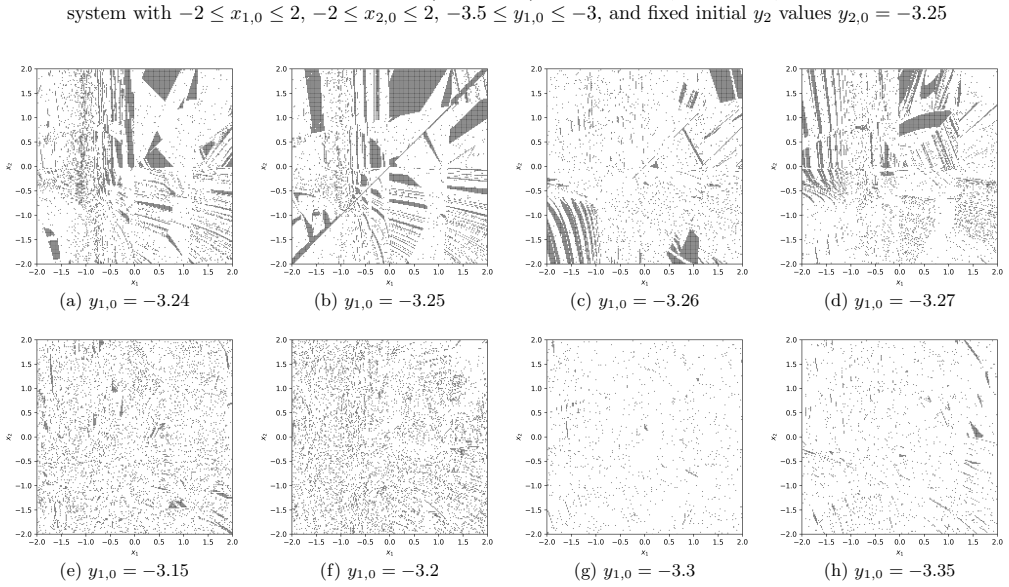
The system's true asymptotic behavior is a single nonchaotic spiking attractor, yet a chaotic spiking-bursting pseudo-attractor traps orbits for roughly ten thousand iterations, so the system behaves as if it were multistable. Treating this pseudo-attractor as a second attractor reveals two basins whose four-dimensional boundary is extremely fractal: the uncertainty exponent is $u_4 \approx 0.037$, giving a boundary dimension $d = 4 - u_4 \approx 3.963$ and requiring an initial-uncertainty reduction on the order of $10^{27}$ to shrink final-state uncertainty by a factor of 10. In a two-dimensional slice, the nonchaotic basin is a finite-measure Class 3 set concentrated near synchronization, while the chaotic pseudo-attractor basin fills the slice; in all of four-dimensional space both basins are Class 2, occupying fixed fractions of state space. The paper also reports that the pseudo-attractor's box-counting dimension ($\approx 1.84$) does not match its Lyapunov dimension ($\approx 2.07$), which it attributes to the transient, non-invariant nature of the pseudo-attractor.
Load-bearing premise
The whole analysis depends on labeling an initial state by whether its short-term chaos indicator is positive after a fixed number of steps (5,000 in the two-dimensional slice, 20,000 in four dimensions), even though every orbit eventually settles into the same nonchaotic spiking pattern; the reported basins and sensitivity numbers are tied to that chosen time cutoff.
Editorial extensions
If this is right
- If the central claim holds, a coupled pair of nonchaotic neurons can display chaos-like dynamics for tens of thousands of iterations even though its asymptotic state is a simple periodic spike.
- Final-state sensitivity of this degree means that short-term predictions of which firing pattern a neuron pair enters are practically impossible from initial-condition measurements alone.
- The basin classification implies that near the attractor slice the nonchaotic basin has finite measure, whereas in full four-dimensional space both basins occupy fixed fractions of state space.
- The mismatch between box-counting dimension and Lyapunov dimension for the pseudo-attractor is presented as a signature of transient chaos rather than a genuine strange attractor.
- Quasimultistability is proposed as a general phenomenon for small sets of coupled identical nonchaotic systems that can temporarily synchronize into periodic orbits.
Reading between the lines
- Beyond the paper: re-running the uncertainty-exponent measurement with longer Lyapunov-evaluation horizons (e.g., $10^5$ and $10^6$ iterations) would show whether the four-dimensional uncertainty exponent is stable or an artifact of the 20,000-iteration cutoff; because every orbit eventually reaches the nonchaotic attractor, the pseudo-attractor basin is a transient construct.
- Beyond the paper: varying the coupling asymmetry and the parameter mismatch between the two neurons would test whether the fractal boundary dimension and the $10^{27}$ sensitivity figure tune continuously with coupling, which would make the effect a tunable feature rather than a single-parameter accident.
- Beyond the paper: the same random-sampling pipeline could be applied to other slow-fast neuron models, including continuous-time ones, to see whether extreme final-state sensitivity is a general feature of small coupled neuron systems rather than specific to this parameter set.
Signed reviews
Editorial analysis
A structured set of objections, weighed in public.
Referee Report
Summary. The paper studies two asymmetrically electrically coupled nonchaotic Rulkov neurons and reports the coexistence of a true nonchaotic spiking attractor with a chaotic spiking-bursting 'pseudo-attractor' that captures orbits for long transient times (on the order of 10^4 iterations) before they eventually converge to the true spiking attractor. The authors call this quasimultistability. They compute box-counting and Lyapunov dimensions of the pseudo-attractor, classify basins of attraction in a two-dimensional slice and in four-dimensional state space using the Sprott-Xiong method, and use the uncertainty-exponent method to claim an extreme final-state sensitivity with u4 ≈ 0.037, a basin-boundary dimension d4 ≈ 3.963, and a required initial-uncertainty reduction of about 10^27 to improve final-state prediction by a factor of 10.
Significance. If the quantitative claims were robust, this would be a useful case study of long chaotic transients mimicking multistability in a discrete-time neuronal map, and the reported fractal basin geometry would be of genuine interest to the nlin.CD community. The paper is clearly written, gives explicit model equations, and honestly acknowledges that the chaotic object is not a true attractor and that all orbits eventually reach the nonchaotic spiking attractor. The central issue is that the headline quantitative results — the uncertainty exponent, the fractal dimension of the basin boundary, and the 10^27 factor — are defined with respect to a finite-time Lyapunov-sign classifier rather than invariant basins, and the paper does not test how these quantities depend on the classifier's time horizon.
major comments (3)
- [Sec. V, Eqs. (38)-(46)] The uncertainty-exponent method of McDonald et al. presupposes two coexisting attractors with invariant basins, but the paper itself concludes in Sec. II that the system is not multistable and that all orbits eventually converge to the nonchaotic spiking attractor. Basin membership is assigned by the sign of the finite-time maximal Lyapunov exponent after 5,000 iterations (Sec. IV A) or 20,000 iterations (Sec. IV B). Because the paper does not test how u4, the basin fractions, or the fractal dimensions vary with the classification horizon, the claim of 'extreme final state sensitivity' is conditional on an arbitrary numerical choice. Please add a systematic study of ϱ4(ϵ) and u4 for several horizons (e.g., T = 10^3, 5×10^3, 10^4, 2×10^4, 5×10^4) and, ideally, for an alternative classifier such as a threshold on a finite-time average of a voltage variable, and report whether u4 and d4 are robust or how they trend with the horizon.
- [Sec. III] The box-counting dimension d ≈ 1.84 is computed from only three box sizes ε = 1/20, 1/30, 1/40, which span a factor of only 2 in length scale; this is an insufficient range to establish a scaling exponent, and for a finite orbit segment the box-count N(ε) necessarily saturates for sufficiently small ε. Please extend the estimate to at least two decades of ε, report the scaling range, and state clearly that the result applies to the finite-time pseudo-attractor sample rather than to an invariant set.
- [Sec. V, Table III] The reported values of ϱ4(ϵ) show a plateau at small ϵ (from 0.349 at ϵ = 1/32 to 0.302 at ϵ = 1/2048), and the fitted exponent u4 ≈ 0.037 is strongly influenced by this flat tail. The fit uses all tabulated points without error bars, so the inferred dimension d4 ≈ 3.963 has no quantified uncertainty. Please provide bootstrap or Monte Carlo confidence intervals for u2 and u4, and report how the fitted exponents depend on the range of ϵ included (e.g., using only ϵ ≤ 1/8 versus all points).
minor comments (6)
- [Sec. IV B, Eqs. (35)-(36)] The regression equations are written as if Pw(ξ4) and Pb(ξ4) were linear in ξ4, but the text states that the regressions were performed on log-log plots; please rewrite these equations in terms of log2 P and log2 ξ4 to avoid confusion.
- [Sec. IV A] The text says 'we use an indirect method of determining which basin an initial state is in' based on a 5,000-iteration Lyapunov exponent; this is an explicit admission that the 'basin of the pseudo-attractor' is a finite-time basin. Please state this distinction more prominently in the abstract and introduction so that readers do not mistake the pseudo-attractor basin for an invariant basin.
- [Sec. IV B] The number of Monte Carlo samples used for the basin classification (Table I and Table II) is not reported; please include sample sizes so that the statistical significance of the P(ξ) estimates can be assessed.
- [Sec. VI] The conclusion that the results 'could have important applications in neurobiology' is speculative given that the central final-state sensitivity result is tied to a finite-time classifier; please temper this claim or condition it on the transient interpretation.
- [Sec. III] The Jacobian matrix rendering is deferred to the author's preprint [49]; if this matrix is important for reproducibility, consider including the explicit expression in the appendix rather than citing an unpublished source.
- [Figs. 6 and 7] The color maps of the maximal Lyapunov exponent would be easier to interpret with a color bar, and the basin plots would benefit from a legend explicitly labeling white and black regions.
Circularity Check
Central claim of extreme final state sensitivity is measured from the same finite-time Lyapunov-sign classifier used to define the pseudo-attractor basin; u4≈0.037 is cutoff-conditional.
-
self definitional
[Sec. IV A (basin classification) and Sec. V (uncertainty exponents)]
"we use an indirect method of determining which basin an initial state is in, saying that an initial state that has a positive maximal Lyapunov exponent after 5,000 iterations is attracted to the chaotic pseudo-attractor, while an initial state that has a negative λ1 after the same amount of time is attracted to the spiking attractor."
The 'basin of the chaotic pseudo-attractor' is not an invariant basin: the paper states that the spiking attractor is the only true attractor and that all chaotic orbits eventually converge to it. Basin membership is therefore defined by the sign of a finite-time maximal Lyapunov exponent after 5,000 (or 20,000) iterations. The same rule is used in Sec. V to assign basin membership when estimating ϱ4(ϵ), from which u4≈0.037, d4≈3.963, and the 10^27 improvement factor are obtained. Thus the measured 'basin boundary' is a level set of this finite-time classifier, and the uncertainty exponent quantifies the classifier's cutoff-dependence rather than an invariant boundary between competing final states.
-
other
[Sec. V, uncertainty-exponent formalism]
"Let A and C be the only two attractors of the dynamical system, and let ˆA and ˆC be their associated basins of attraction."
The uncertainty-exponent method of Eqs. (38)-(39) presupposes two genuine invariant attractors with basins, but the system has only one true attractor. The paper earlier concludes 'the spiking attractor is the only true attractor of the system' and treats the chaotic object only as a pseudo-attractor. Applying the invariant-basin formalism to a finite-time classifier renames a cutoff-dependent statistic as 'extreme final state sensitivity.' The quoted factor of 10^27 is thus a property of the chosen classification horizon, not a separately established dynamical invariant.
full rationale
The paper is transparent that the chaotic object is a pseudo-attractor and that the spiking attractor is the only true attractor, but that transparency exposes the circular structure. The pseudo-attractor basin has no invariant definition; it is operationalized as λ1>0 at a fixed iteration horizon. The uncertainty-exponent analysis in Sec. V uses exactly that operationalization to assign basin membership, so Eqs. (38)-(46) and the 10^27 factor quantify the fractal geometry of the finite-time classifier's boundary, not an invariant basin boundary. No test of cutoff dependence is reported, and the paper does not show that u4≈0.037 is stable as the 5,000- or 20,000-iteration threshold is varied. This is not a case of fitting parameters to a target result, and the self-citations (refs. 49 and 52) are numerical-implementation details that are not load-bearing. Still, because the headline result reduces by construction to the finite-time classification convention, a moderate circularity score is warranted.
Assumptions & free parameters
free parameters (3)
- Coupling strengths g_e^1, g_e^2 =
0.05, 0.25
- Rulkov parameters alpha, sigma, mu =
4.5, -0.5, 0.001
- Finite-time Lyapunov classification cutoff T =
5,000 iterations (2D slices), 20,000 iterations (4D space)
assumptions (6)
- domain assumption The system has exactly two relevant outcomes: nonchaotic spiking (negative lambda_1 after T) or chaotic bursting (positive lambda_1 after T), with no other asymptotic behaviors.
- ad hoc to paper All chaotic orbits eventually converge to the nonchaotic spiking attractor, so the chaotic object is a transient pseudo-attractor.
- standard math The Sprott-Xiong normalized power law P(xi)=P0 xi^gamma describes the basin slices in the large-xi limit.
- domain assumption The uncertainty exponent relation u = n - d (McDonald et al.) applies to the basin boundary between a true attractor and a transient pseudo-attractor basin.
- standard math Kaplan-Yorke conjecture relates Lyapunov dimension to fractal dimension for true attractors.
- domain assumption Slow-fast timescale separation causes far-away initial states to randomize fast variables before y reaches the attractor neighborhood.
invented entities (2)
-
Chaotic spiking-bursting pseudo-attractor
-
Quasimultistability
Cite this review
Pith. "Pith review of Asymmetric coupling of nonchaotic Rulkov neurons: Fractal attractors, quasimultistability, and final state sensitivity." pith.science (2026). https://pith.science/paper/DMBBFGPW
@misc{pith2026241216189,
  author       = {Pith},
  title        = {Pith review of: Asymmetric coupling of nonchaotic Rulkov neurons: Fractal attractors, quasimultistability, and final state sensitivity},
  year         = {2026},
  howpublished = {\url{https://pith.science/paper/DMBBFGPW}},
  note         = {Machine review of arXiv:2412.16189}
}
read the original abstract
Although neuron models have been well studied for their rich dynamics and biological properties, limited research has been done on the complex geometries that emerge from the basins of attraction and basin boundaries of multistable neuron systems. In this paper, we investigate the geometrical properties of the strange attractors, four-dimensional basins, and fractal basin boundaries of an asymmetrically electrically coupled system of two identical nonchaotic Rulkov neurons. We discover a quasimultistability in the system emerging from the existence of a chaotic spiking-bursting pseudo-attractor, and we classify and quantify the system's basins of attraction, which are found to have complex fractal geometries. Using the method of uncertainty exponents, we also find that the system exhibits extreme final state sensitivity, which results in a dynamical uncertainty that could have important applications in neurobiology.
Figures


Figures from the paper (6 more)


Reference graph
Works this paper leans on
-
[1]
These basins occupy all of state space (except perhaps a set of finite measure)
Class 1 basins have P0 = 1 and γ = 0. These basins occupy all of state space (except perhaps a set of finite measure)
-
[2]
These basins occupy a fixed fraction of state space
Class 2 basins have P0 < 1 and γ = 0. These basins occupy a fixed fraction of state space
-
[3]
These basins extend to infinity in some directions but occupy increasingly small fractions of state space further out
Class 3 basins have 0 < γ < n, where n is the dimension of the system’s state space. These basins extend to infinity in some directions but occupy increasingly small fractions of state space further out
-
[4]
effective mean
Class 4 basins have γ = n. These basins occupy a finite region of state space and have a well-defined relative size ξ0 = P 1/n 0 . It is worth noting that we use a shell method for the numerical classification of basins that circumvents the problem of potentially small P (ξ) values for large ξ [49]. Specifically, defining ∆P (2k) to be the probability tha...
-
[5]
F. Buchholtz, J. Golowasch, I. R. Epstein, and E. Marder, Mathematical model of an identified stomatogastric gan- glion neuron, Journal of Neurophysiology 67, 332 (1992)
work page 1992
-
[6]
For this reason, we can conclude that the black basin slice in S2 has finite measure since the line x1,0 = x2,0 doesn’t contribute to the measure of the two-dimensional black basin slice. To classify the white basin, we use the fact that Pw(ξ2) + Pb(ξ2) = 1 (31) by the definitions of the spiking attractor and chaotic pseudo-attractor: if an initial state ...
-
[7]
This essentially turns the initial state from S4 into a random initial state in S′ 2 (see Fig. 6). The important observation from Fig. 7b is that de- spite the angular variances in the distribution of white and black points, the distribution appears to remain the same regardless of the radial distance from the center. Even though the plot spans a large ra...
-
[8]
We have al- ready defined S′ 2 as a specific square-shaped subset of S2 (Eq. (22)), and we will similarly define S′ 4 ⊂ S4 to be the four-dimensional hypercube S′ 4 = {X : −2 < x1 < 2, −1 < y1 < −5, − 2 < x2 < 2, −1 < y2 < −5}. (40) First, let us examine the set Σ∩S′ 2, displayed in Fig. 6b as the boundary between the white and black basins. We denote the...
Show all 84 references
-
[9]
(39), the fractal dimension d2 of Σ ∩ S′ 2 is d2 = n − u2 ≈ 2 − 0.314 = 1.686
By Eq. (39), the fractal dimension d2 of Σ ∩ S′ 2 is d2 = n − u2 ≈ 2 − 0.314 = 1.686. (44) Observing the visualization of S′ 2 in Fig. 6b, we can see that some black regions have boundaries that appear to be smooth, meaning that these particular subsets of the basin boundary h...
-
[10]
Although the basin clas- sification method we used to classify the white and black basins of this asymmetrically coupled Rulkov neuron sys- tem doesn’t take into account basin boundaries, we con- jecture that u2 approaches 1 as the bounds of x1 and x2 are expanded away from th...
-
[11]
N. F. Rulkov, Modeling of spiking-bursting neural be- havior using two-dimensional map, Physical Review E 65 (2002)
2002
-
[12]
N. F. Rulkov, Regularization of synchronized chaotic bursts, Physical Review Letters 86, 183 (2001)
2001
-
[13]
A. L. Hodgkin and A. F. Huxley, A quantitative descrip- tion of membrane current and its application to conduc- tion and excitation in nerve, The Journal of Physiology 117, 500 (1952)
1952
-
[14]
T. R. Chay, Chaos in a three-variable model of an ex- citable cell, Physica D: Nonlinear Phenomena 16, 233 (1985)
1985
-
[15]
de Vries, Bursting as an emergent phenomenon in cou- pled chaotic maps, Physical Review E 64 (2001)
G. de Vries, Bursting as an emergent phenomenon in cou- pled chaotic maps, Physical Review E 64 (2001)
2001
-
[16]
E. M. Izhikevich, Simple model of spiking neurons, IEEE Transactions on Neural Networks 14, 1569 (2003)
2003
-
[17]
FitzHugh, Impulses and physiological states in theo- retical models of nerve membrane, Biophysical Journal 1, 445–466 (1961)
R. FitzHugh, Impulses and physiological states in theo- retical models of nerve membrane, Biophysical Journal 1, 445–466 (1961)
1961
-
[18]
Izhikevich, Which model to use for cortical spiking neurons?, IEEE Transactions on Neural Networks 15, 1063 (2004)
E. Izhikevich, Which model to use for cortical spiking neurons?, IEEE Transactions on Neural Networks 15, 1063 (2004)
2004
-
[19]
J. L. Hindmarsh and R. M. Rose, A model of neuronal bursting using three coupled first order differential equa- tions, Proceedings of the Royal Society B 221, 87 (1984)
1984
-
[20]
Rinzel, A Formal Classification of Bursting Mecha- nisms in Excitable Systems (Springer, Berlin, 1987) pp
J. Rinzel, A Formal Classification of Bursting Mecha- nisms in Excitable Systems (Springer, Berlin, 1987) pp. 267–281
1987
-
[21]
E. M. Izhikevich and F. Hoppensteadt, Classification of bursting mappings, International Journal of Bifurcation and Chaos 14, 3847 (2004)
2004
-
[22]
Courbage, V
M. Courbage, V. I. Nekorkin, and L. V. Vdovin, Chaotic oscillations in a map-based model of neural activity, Chaos 17 (2007)
2007
-
[23]
Omelchenko, M
I. Omelchenko, M. Rosenblum, and A. Pikovsky, Syn- chronization of slow-fast systems, The European Physical Journal Special Topics 191, 3 (2011)
2011
-
[24]
Ibarz, J
B. Ibarz, J. M. Casado, and M. A. F. Sanju´ an, Map-based models in neuronal dynamics, Physics Reports 501, 1 (2011)
2011
-
[25]
D. Ding, Y. Niu, Z. Yang, J. Wang, W. Wang, M. Wang, and F. Jin, Extreme multi-stability and microchaos of fractional-order memristive Rulkov neuron model con- sidering magnetic induction and its digital watermarking application, Nonlinear Dynamics 112 (2024)
2024
-
[26]
D. Luo, C. Wang, Q. Deng, and Y. Sun, Dynamics in a memristive neural network with three discrete heteroge- neous neurons and its application, Nonlinear Dynamics (2024)
2024
-
[27]
F. Min, G. Zhai, S. Yin, and J. Zhong, Switching bifurca- tion of a Rulkov neuron system with relu-type memristor, Nonlinear Dynamics 112 (2024)
2024
-
[28]
H. Bao, K. Li, J. Ma, Z. Hua, Q. Xu, and B. Bao, Memris- tive effects on an improved discrete Rulkov neuron model, Science China Technological Sciences 66 (2023)
2023
-
[29]
de Pontes, R
J. de Pontes, R. Viana, S. Lopes, C. Batista, and A. Batista, Bursting synchronization in non-locally cou- pled maps, Physica A: Statistical Mechanics and its Ap- plications 387 (2008)
2008
-
[30]
Wang and H
C. Wang and H. Cao, Stability and chaos of Rulkov map- based neuron network with electrical synapse, Commu- nications in Nonlinear Science and Numerical Simulation 20 (2015)
2015
-
[31]
Budzinski, S
R. Budzinski, S. Lopes, and C. Masoller, Symbolic anal- ysis of bursting dynamical regimes of Rulkov neural net- works, Neurocomputing 441 (2021)
2021
-
[32]
L´ opez, M
J. L´ opez, M. Coccolo, R. Cape´ ans, and M. A. Sanju´ an, Controlling the bursting size in the two-dimensional Rulkov model, Communications in Nonlinear Science and Numerical Simulation 120 (2023)
2023
-
[33]
Ge and H
P. Ge and H. Cao, Intermittent evolution routes to the periodic or the chaotic orbits in Rulkov map featured, Chaos 31 (2021)
2021
-
[34]
Z. T. Njitacke, C. N. Takembo, G. Sani, N. Marwan, R. Yamapi, and J. Awrejcewicz, Hidden and self-excited firing activities of an improved Rulkov neuron, and its application in information patterns, Nonlinear Dynamics 112 (2024)
2024
-
[35]
P. So, T. B. Luke, and E. Barreto, Networks of theta neu- rons with time-varying excitability: Macroscopic chaos, multistability, and final-state uncertainty, Physica D 267, 16 (2014)
2014
-
[36]
J. C. Sprott and A. Xiong, Classifying and quantifying basins of attraction, Chaos 25 (2015)
2015
-
[37]
Grebogi, S
C. Grebogi, S. W. McDonald, E. Ott, and J. A. Yorke, Final state sensitivity: an obstruction to predictability, Physics Letters A 99, 415 (1983)
1983
-
[38]
A. Daza, A. Wagemakers, M. A. F. Sanju´ an, and J. A. Yorke, Testing for basins of Wada, Scientific Reports 5 (2015)
2015
-
[39]
Kennedy and J
J. Kennedy and J. A. Yorke, Basins of Wada, Physica D: Nonlinear Phenomena 51, 213 (1991)
1991
-
[40]
H. E. Nusse and J. A. Yorke, Wada basin boundaries and basin cells, Physica D: Nonlinear Phenomena 90, 242 (1996)
1996
-
[41]
J. C. Alexander, J. A. Yorke, Z. You, and I. Kan, Riddled basins, International Journal of Bifurcation and Chaos 2, 795 (1992)
1992
-
[42]
E. Ott, J. C. Alexander, I. Kan, J. C. Sommerer, and J. A. Yorke, The transition to chaotic attractors with riddled basins, Physica D: Nonlinear Phenomena 76, 384 (1994)
1994
-
[43]
L. P. Shayer and S. A. Campbell, Stability, bifurcation, and multistability in a system of two coupled neurons with multiple time delays, SIAM Journal on Applied Mathematics 61, 673 (2000)
2000
-
[44]
H. Bao, J. Zhang, N. Wang, N. V. Kuznetsov, and B. C. Bao, Adaptive synapse-based neuron model with het- erogeneous multistability and riddled basins, Chaos 32 (2022)
2022
-
[45]
Marwan, V
M. Marwan, V. Dos Santos, M. Z. Abidin, and A. Xiong, Coexisting attractor in a gyrostat chaotic system via basin of attraction and synchronization of two noniden- tical mechanical systems, Mathematics 10, 1914 (2022)
2022
-
[46]
Bashkirtseva, A
I. Bashkirtseva, A. N. Pisarchik, and L. Ryashko, Multi- stability and stochastic dynamics of Rulkov neurons cou- pled via a chemical synapse, Communications in Nonlin- ear Science and Numerical Simulation 125 (2023)
2023
-
[47]
Q. Xu, T. Liu, S. Ding, H. Bao, Z. Li, and B. Chen, Extreme multistability and phase synchronization in a heterogeneous bi-neuron Rulkov network with memris- tive electromagnetic induction, Cognitive Neurodynam- ics 17, 755–766 (2023). 16
2023
-
[48]
Rakshit, A
S. Rakshit, A. Ray, B. K. Bera, and D. Ghosh, Synchro- nization and firing patterns of coupled Rulkov neuronal map, Nonlinear Dynamics 94, 785–805 (2018)
2018
-
[49]
Gotthans, J
T. Gotthans, J. C. Sprott, and J. Petrzela, Simple chaotic flow with circle and square equilibrium, International Journal of Bifurcation and Chaos 26, 1650137 (2016)
2016
-
[50]
C. Li, J. C. Sprott, A. Akgul, H. H. C. Iu, and Y. Zhao, A new chaotic oscillator with free control, Chaos27, 083101 (2017)
2017
-
[51]
J. C. Sprott and W. G. Hoover, Harmonic oscillators with nonlinear damping, International Journal of Bifurcation and Chaos 27, 1730037 (2017)
2017
-
[52]
Nazarimehr, B
F. Nazarimehr, B. Saedi, S. Jafari, and J. C. Sprott, Are perpetual points sufficient for locating hidden attrac- tors?, International Journal of Bifurcation and Chaos 27, 1750037 (2017)
2017
-
[53]
Nazarimehr and J
F. Nazarimehr and J. C. Sprott, Investigating chaotic attractor of the simplest chaotic system with a line of equilibria, The European Physical Journal Special Topics 229, 1289–1297 (2020)
2020
-
[54]
Nwachioma and J
C. Nwachioma and J. H. P´ erez-Cruz, Analysis of a new chaotic system, electronic realization and use in naviga- tion of differential drive mobile robot, Chaos, Solitons and Fractals 144, 110684 (2021)
2021
-
[55]
J. L. Kaplan and J. A. Yorke, Chaotic behavior of mul- tidimensional difference equations, Functional Differen- tial Equations and Approximation of Fixed Points 730, 204–227 (1979)
1979
-
[56]
S. W. McDonald, C. Grebogi, E. Ott, and J. A. Yorke, Fractal basin boundaries, Physica D: Nonlinear Phenom- ena 17, 125 (1985)
1985
-
[57]
In the original paper that introduces the Rulkov map [1], the parameter σ′ = σ + 1 is used, but we use the slightly modified form from [14]
-
[58]
[1] and [49]
For a more in-depth discussion, see Refs. [1] and [49]
-
[59]
B. B. Le and N. A. Gandhi, Exploring geometrical prop- erties of chaotic systems through an analysis of the Rulkov neuron maps, arXiv:2406.08385 [nlin.CD] (2024)
2024 arXiv
-
[60]
Eckmann and D
J.-P. Eckmann and D. Ruelle, Ergodic theory of chaos and strange attractors, Reviews of Modern Physics 57, 617 (1985)
1985
-
[61]
Sandri, Numerical calculation of Lyapunov exponents, The Mathematica Journal 6, 78 (1996)
M. Sandri, Numerical calculation of Lyapunov exponents, The Mathematica Journal 6, 78 (1996)
1996
-
[62]
Le, Describing chaotic systems, arXiv:2407.07919 [math.GM] (2024)
B. Le, Describing chaotic systems, arXiv:2407.07919 [math.GM] (2024)
2024 arXiv
-
[63]
Grebogi, E
C. Grebogi, E. Ott, S. Pelikan, and J. A. Yorke, Strange attractors that are not chaotic, Physica D: Nonlinear Phenomena 13, 261 (1984)
1984
-
[64]
Ott, Chaos in Dynamical Systems (Cambridge Uni- versity Press, Cambridge, 1993)
E. Ott, Chaos in Dynamical Systems (Cambridge Uni- versity Press, Cambridge, 1993)
1993
-
[65]
Heyward, M
P. Heyward, M. Ennis, A. Keller, and M. T. Shipley, Membrane bistability in olfactory bulb mitral cells, The Journal of Neuroscience 21 (2001)
2001
-
[66]
J. M. Nichols, M. D. Todd, M. Seaver, S. T. Trickey, L. M. Pecora, and L. Moniz, Controlling system dimension: A class of real systems that obey the Kaplan–Yorke conjec- ture, Proceedings of the National Academy of Sciences 100, 15299 (2003)
2003
-
[67]
J. D. Farmer, E. Ott, and J. A. Yorke, The dimension of chaotic attractors, Physica D: Nonlinear Phenomena 7, 153 (1983)
1983
-
[68]
We assume A is composed of an infinite number of points, but this method can be trivially altered for attractors of a finite number of points
-
[69]
In the asymmetrically coupled Rulkov neuron system, A4 could denote either the nonchaotic spiking attractor or the chaotic pseudo-attractor
-
[70]
L. E. Blumenson, A derivation of n-dimensional spherical coordinates, The American Mathematical Monthly 67, 63 (1960)
1960
-
[71]
Xiong, J
A. Xiong, J. C. Sprott, J. Lyu, and X. Wang, 3D print- ing—The basins of tristability in the Lorenz system, In- ternational Journal of Bifurcation and Chaos 27 (2017)
2017
-
[72]
We neglect the first two points because we are interested in the limit ϵ → 0
-
[73]
A. Daza, A. Wagemakers, B. Georgeot, D. Gu´ ery-Odelin, and M. A. F. Sanju´ an, Basin entropy: A new tool to ana- lyze uncertainty in dynamical systems, Scientific Reports 6 (2016)
2016
-
[74]
R. H. Lee and C. J. Heckman, Bistability in spinal mo- toneurons in vivo: systematic variations in persistent in- ward currents, Journal of Neurophysiology 80 (1998)
1998
-
[76]
Loewenstein, S
Y. Loewenstein, S. Mahon, P. Chadderton, K. Kitamura, H. Sompolinsky, Y. Yarom, and M. H¨ ausser, Bistability of cerebellar Purkinje cells modulated by sensory stimu- lation, Nature Neuroscience 8 (2005)
2005
-
[77]
A. N. Pisarchik and A. E. Hramov,Multistability in Phys- ical and Living Systems (Springer, Cham, 2022)
2022
-
[78]
Huang, I
S. Huang, I. Ernberg, and S. Kauffman, Cancer attrac- tors: A systems view of tumors from a gene network dy- namics and developmental perspective, Seminars in Cell and Developmental Biology 20 (2009)
2009
-
[79]
Q. Li, A. Wennborg, E. Aurell, E. Dekel, J.-Z. Zou, Y. Xu, S. Huang, and I. Ernberg, Dynamics inside the cancer cell attractor reveal cell heterogeneity, lim- its of stability, and escape, Proceedings of the National Academy of Sciences of the United States of America113 (2016)
2016
-
[80]
P. A. Tass, Phase Resetting in Medicine and Biol- ogy: Stochastic Modelling and Data Analysis (Springer, Berlin, 1999)
1999
-
[81]
Bergman, A
H. Bergman, A. Feingold, A. Nini, A. Raz, H. Slovin, M. Abeles, and E. Vaadia, Physiological aspects of in- formation processing in the basal ganglia of normal and Parkinsonian primates, Trends in Neurosciences 21 (1998)
1998
-
[82]
R. C. Elson, A. I. Selverston, R. Huerta, N. F. Rulkov, M. I. Rabinovich, and H. D. I. Abarbanel, Synchronous behavior of two coupled biological neurons, Physical Re- view Letters 81, 5692 (1998)
1998
-
[83]
H. D. I. Abarbanel, R. Huerta, M. I. Rabinovich, N. F. Rulkov, P. F. Rowat, and A. I. Selverston, Synchronized action of synaptically coupled chaotic model neurons, Neural Computation 8, 1567–1602 (1996)
1996
-
[84]
Varona, J
P. Varona, J. J. Torres, H. D. I. Abarbanel, M. I. Ra- binovich, and R. C. Elson, Dynamics of two electrically coupled chaotic neurons: Experimental observations and model analysis, Biological Cybernetics 84, 91 (2001)
2001
-
[1027]
(39), the fractal dimension d4 of the basin boundary Σ ∩ S′ 4 is d4 = n − u4 ≈ 4 − 0.037 = 3.963
By Eq. (39), the fractal dimension d4 of the basin boundary Σ ∩ S′ 4 is d4 = n − u4 ≈ 4 − 0.037 = 3.963. (46) This indicates that this basin boundary is extremely fractal; it has a comparable geometry to a true four-dimensional object even though it divides four- dimensional s...
Reviewed August 11, 2026 · model on record in the stance chip above.
Discussion (0). Continue with ORCID to comment.