REVIEW 3 major objections 4 minor 48 references
Universal momentum-to-real-space mapping of topological singularities
T0 review · 3 major / 4 minor · reviewed 2026-08-14 · deepseek-v4-flash
Pith's one-line read A vortex beam launched at a Dirac-like cone emerges with extra real-space topological charge, following the conversion rule l to l+2s.
desk verdict Clean derivation and a new Lieb-lattice experiment, but the topological-universality claim overreaches its stretched-lattice evidence. read the letter →
The pith
A machine-rendered reading of the paper's core claim, the machinery that carries it, and where it could break.
The reading
What carries the argument
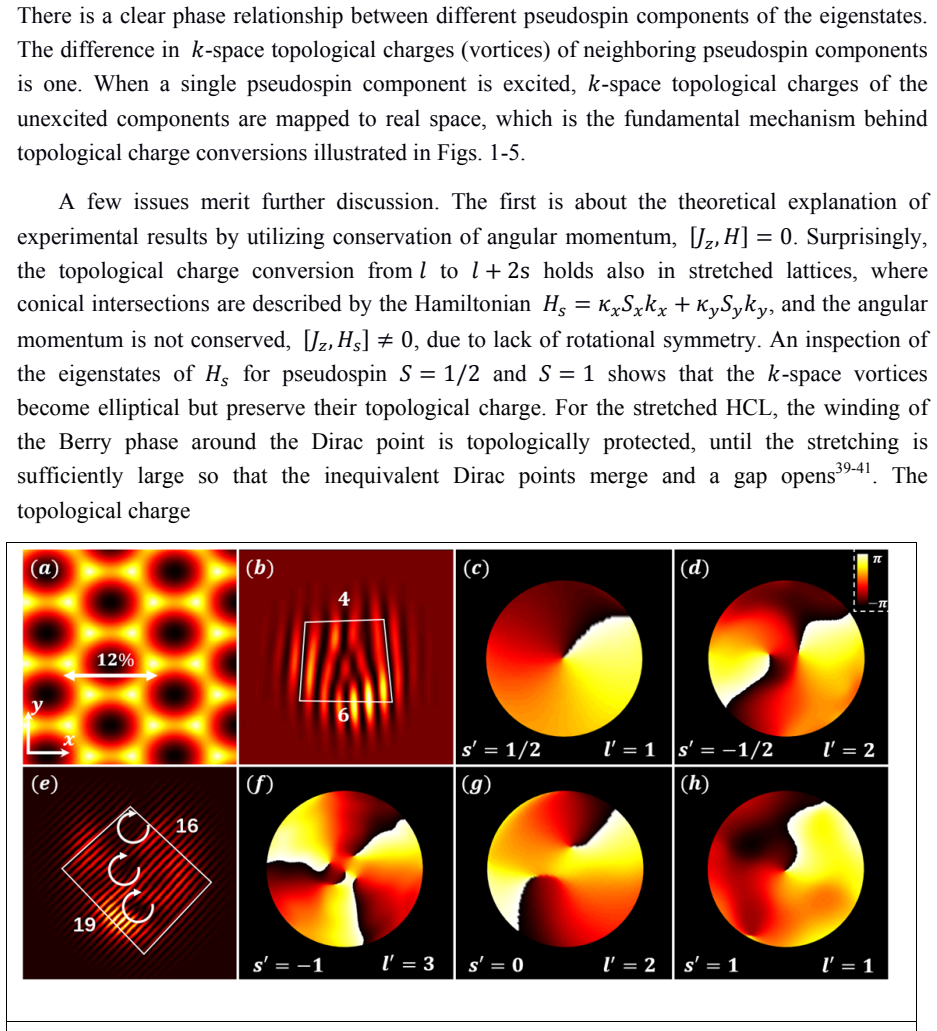
The central object is the pseudospin-orbit Hamiltonian $H = \kappa(k_x S_x + k_y S_y)$ for excitations near a conical intersection, where $\mathbf{S}$ is the lattice pseudospin, i.e., the sublattice-amplitude angular momentum ($S=1/2$ in the honeycomb lattice, $S=1$ in the Lieb lattice). The load-bearing identity is the eigenmode expansion coefficient, Eq. (5), whose phase winds in momentum space so that neighboring pseudospin components differ by one unit of topological charge. Because the probe excites only one pseudospin component, propagation under the Hamiltonian transfers that winding to real space, and the previously unexcited components emerge with additional vorticity. The mechanism is identified as topological rather than kinematic because it survives deformations that break conservation of total angular momentum, as long as the Dirac-point singularity itself persists.
What would settle it
Stretch a honeycomb lattice past the strain at which the two Dirac points merge and a gap opens, keep the same optimally aligned vortex excitation, and measure the output vorticity: the rule $l \to l+2s$ should switch off discontinuously at the merger if the mapping is carried by the momentum-space singularity, whereas any residual conversion would indicate a different origin.
Extended reading notes
Core claim
On its own terms, the paper claims that a conical intersection described by $H = \kappa(k_x S_x + k_y S_y)$ carries a topological singularity in momentum space: the eigenmode coefficients have a phase winding whose difference between neighboring pseudospin components is exactly one. Exciting a single pseudospin component with a broad vortex beam maps that winding onto the real-space phase of the unexcited components, producing the conversion $l \to l+2s$ for optimally aligned excitations. The conversion is observed in both a pseudospin-1/2 honeycomb lattice (output charge 2 from input charge 1) and a pseudospin-1 Lieb lattice (output charge 3 from input charge 1), with the unexcited pseudospin components carrying the extra vorticity. The paper shows by simulation that the conversion persists in stretched lattices without rotational symmetry, because the winding of the Berry phase around the Dirac point is topologically protected until the inequivalent points merge; it then predicts the analogous effect for a three-dimensional Weyl Hamiltonian, where a Gaussian input creates a vortex carrying the synthetic monopole's charge.
Load-bearing premise
The load-bearing assumption is that the probe beam is broad in real space and narrow in momentum space, so its evolution is completely described by the linear Hamiltonian $H = \kappa(k_x S_x + k_y S_y)$ around a single conical intersection, with negligible nonlinearity, disorder, and coupling to other bands.
Editorial extensions
If this is right
- The conversion rule $l \to l+2s$ makes the output vortex charge a direct experimental readout of the Berry-phase winding around a conical intersection.
- The mechanism provides a tunable way to generate high-order optical vortices: a charge-1 input becomes charge 3 in a pseudospin-1 Lieb lattice.
- Because the conversion survives stretching, it can serve as a probe of the topological transition at which inequivalent Dirac points merge and a gap opens.
- In a three-dimensional Weyl system, launching a Gaussian beam at the monopole should create a real-space vortex of unit charge, connecting the mechanism to vortex formation in electron beams passing a magnetic-monopole field.
- The derivation for arbitrary pseudospin $S$ implies the same rule should hold in any platform whose low-energy physics is a conical intersection, including cold-atom and electronic systems.
Reading between the lines
- Editorial inference: the same coefficient-winding argument suggests that any degeneracy whose eigenmode coefficients carry a winding difference of $\Delta m$ between pseudospin components should imprint $\Delta m$ units of vorticity into the unexcited components; testing this at quadratic or higher-order band touchings would separate the winding requirement from the specific linear Hamiltonian.
- Editorial inference: since the mapping survives broken rotational symmetry, the essential resource is the eigenmode phase structure rather than angular-momentum conservation; this raises the possibility of engineering anisotropic lattices that control where and how many real-space vortices appear, including studying what happens just before the singularity merges.
- Editorial inference: in ultracold atomic gases, a pulsed excitation at a Weyl point should create a quantized vortex without external stirring, offering a testable route to vortex generation in Bose-Einstein condensates.
Signed reviews
Editorial analysis
A structured set of objections, weighed in public.
Referee Report
Summary. The paper reports experiments in photonic honeycomb and Lieb lattices in which a vortex beam with topological charge l, optimally aligned to a pseudospin state s, excites modes near a conical intersection. The observed real-space output carries a net topological charge l+2s, a conversion the authors interpret as a universal mapping of the momentum-space topological singularity (Berry-phase winding at the Dirac cone) onto real-space vortices. The theoretical core is an eigenmode expansion of the linear pseudospin Hamiltonian H = κ(k_x S_x + k_y S_y), yielding the k-space phase structure of eigenstate coefficients and showing how the vortex of unexcited pseudospin components is transferred to real space. The paper further claims that the same conversion occurs in stretched lattices where total angular momentum is not conserved, and predicts an analogous effect for 3D Weyl monopoles.
Significance. If fully established, the result would provide a clean, parameter-free connection between band-topology singularities in momentum space and observable optical vortices in real space, with implications for vortex generation in photonic, atomic, and electron systems. The experimental demonstrations in two different pseudospin systems are compelling, and the analytical projection onto eigenmodes is transparent, involves no fitted parameters, and is consistent with the numerical simulations of the full paraxial equation. The main weakness is that the topological (as opposed to kinematical) nature of the conversion rests on the stretched-lattice case, and that case is asserted rather than derived.
major comments (3)
- [Eq. (5), Fig. 6, and the section 'A few issues merit further discussion'] The stretched-lattice claim is the load-bearing evidence for the topological origin of the conversion, but it is not derived. In the rotationally symmetric lattices, Eq. (2) (conservation of J_z = L_z + S_z) fully explains the observed l -> l+2s conversion as kinematics. The paper's reply is that the conversion also holds in stretched lattices where [H, J_z] != 0. However, Eq. (5) is explicitly derived for the isotropic Hamiltonian (1); for the stretched Hamiltonian H_s = κ(α k_x S_x + k_y S_y), the manuscript only states that the k-space vortices of the eigenstates become elliptical but preserve their topological charge. Preservation of eigenstate winding does not by itself imply that a finite broad wavepacket transfers that winding to real space with the same rule, because anisotropic propagation can mix OAM components and redistribute phase singularities. The authors should provide an explicit analytic calculation for H_s, or at minimum a systematic numerical study over strain values and beam widths, showing that the real-space output winding is exactly l+2s. Without this, the central claim that the mapping is topological rather than a consequence of angular-momentum conservation is not fully supported.
- [Fig. 6 and experimental sections] The stretched-lattice results are shown only as two numerical simulations (12% strain in the honeycomb lattice and 15% strain in the Lieb lattice), with no experimental verification and no quantitative measure of the output vorticity beyond the displayed phase structures. Since the universality and topological-origin claims depend on this case, the evidence base is thin. The authors should either add experimental data for at least one stretched lattice or clearly label the stretched-lattice conclusion as a numerical prediction rather than a demonstrated experimental fact.
- [Eq. (3)-(5) and the low-energy approximation] The derivation of the mapping assumes that the full lattice dynamics is well described by the linear pseudospin Hamiltonian H = κ(k_x S_x + k_y S_y) for the relevant excitation, which requires the probe to be broad in real space and narrow in momentum space so that only modes near the conical intersection are populated. The manuscript states this condition qualitatively but does not provide the beam-width, lattice-depth, or momentum-space filtering parameters used in the experiments, and does not quantify the possible contribution of nonlinearities in the biased SBN crystal. The authors should state these parameters in the main text or SM and demonstrate that the single-cone approximation is valid for the actual experimental beams.
minor comments (4)
- [Throughout] The typesetting of mathematical symbols in this version is corrupted, with many equations and inline symbols appearing as placeholders (for example, in the abstract and around Eqs. (1)-(6)). The authors should ensure that the final version renders all equations and symbols correctly.
- [Figs. 2, 4, and 5] The experimental topological charges are extracted by counting fringes in single interferograms, but no error bars, number of repeated measurements, or statistical measure of the extracted charges is reported. A brief statement of reproducibility would strengthen the experimental claims.
- [Abstract and conclusion] The rule is stated for arbitrary l, but the experiments and simulations only demonstrate l = ±1. A numerical example with a higher-order input charge (e.g., l = ±2) would make the universality of the rule more convincing.
- [Eq. (6) and the Weyl prediction] The 3D Weyl prediction is presented without a numerical simulation for a realistic optical-lattice or ultracold-atom implementation. A concrete example showing the predicted vortex for the specific system of Ref. 19 would make the extension more actionable.
Circularity Check
No circularity: the l to l+2s conversion is derived by expansion in eigenmodes of the low-energy Hamiltonian, and the stretched-lattice claim is an extrapolation with numerical support, not a fitted or self-cited input.
full rationale
The central claim is not circular. The paper derives the topological charge conversion by specifying a broad-in-space, narrow-in-momentum initial state that excites a single pseudospin component, expanding that state in the eigenmodes of H = kappa(k_x S_x + k_y S_y), and computing the phase winding of each output pseudospin component (Eqs. 3, 4, and the general coefficient formula Eq. 5). The output vorticity l' = l + s - s' emerges from the calculation rather than being inserted as an assumption, and no parameter is fitted to the data. The kinematic conservation law J_z = L_z + S_z (Eq. 2) is presented as a consistency check of the same dynamics, not as the source of the predicted rule. The stretched-lattice claim is the least analytically complete part: the paper does not rederive the full real-space wavefunction from the anisotropic Hamiltonian, but it does explicitly state that the k-space vortices of the eigenstates remain topologically charged under stretching and supports the conversion with numerical simulations. This is an extrapolation or a generality gap, not a circular reduction, because the output winding is not used as an input. The Weyl-monopole prediction is a separate calculation from the 3D Weyl Hamiltonian rather than an appeal to the paper's own conclusion. The self-citations (e.g., refs. 13, 15, 36) establish the photonic lattice platforms and excitation methods, but they do not carry the load of the conversion rule or the claimed universality. Therefore the derivation chain is self-contained with respect to its inputs, and no circularity step meets the evidentiary bar.
Assumptions & free parameters
assumptions (4)
- domain assumption Near conical intersections, lattice dynamics is governed by the linear pseudospin Hamiltonian H = κ(k_x S_x + k_y S_y).
- domain assumption The probe beam is broad in real space and narrow in momentum space, so only modes around the conical intersection are excited.
- domain assumption The k-space winding of the eigenmode coefficients is topologically protected under lattice deformation until the Dirac points merge and a gap opens.
- domain assumption The Weyl Hamiltonian models a synthetic magnetic monopole in momentum space and its dynamics follows the same first-quantized Schrodinger equation.
Cite this review
Pith. "Pith review of Universal momentum-to-real-space mapping of topological singularities." pith.science (2026). https://pith.science/paper/DMMMAIDR
@misc{pith2026190805633,
  author       = {Pith},
  title        = {Pith review of: Universal momentum-to-real-space mapping of topological singularities},
  year         = {2026},
  howpublished = {\url{https://pith.science/paper/DMMMAIDR}},
  note         = {Machine review of arXiv:1908.05633}
}
read the original abstract
Topological properties of materials, as manifested in the intriguing phenomena of quantum Hall effect and topological insulators, have attracted overwhelming transdisciplinary interest in recent years. Topological edge states, for instance, have been realized in versatile systems including electromagnetic-waves. Typically, topological properties are revealed in momentum space, using concepts such as Chern number and Berry phase. Here, we demonstrate a universal mapping of the topology of Dirac-like cones from momentum space to real space. We evince the mapping by exciting the cones in photonic honeycomb (pseudospin-1/2) and Lieb (pseudospin-1) lattices with vortex beams of topological charge l, optimally aligned for a chosen pseudospin state s, leading to direct observation of topological charge conversion that follows the rule of l to l+2s. The mapping is theoretically accounted for all initial excitation conditions with the pseudospin-orbit interaction and nontrivial Berry phases. Surprisingly, such a mapping exists even in a deformed lattice where the total angular momentum is not conserved, unveiling its topological origin. The universality of the mapping extends beyond the photonic platform and 2D lattices: equivalent topological conversion occurs for 3D Dirac-Weyl synthetic magnetic monopoles, which could be realized in ultracold atomic gases and responsible for mechanism behind the vortex creation in electron beams traversing a magnetic monopole field.
Figures


Figures from the paper (3 more)


Reference graph
Works this paper leans on
-
[1]
Klitzing, K. v., Dorda, G. & Pepper, M. New method for high-accuracy determination of the fine-structure constant based on quantized Hall resistance. Phys. Rev. Lett. 45, 494-497 (1980)
work page 1980
-
[2]
Kane, C. L. & Mele, E. J. Quantum spin Hall effect in graphene. Phys. Rev. Lett. 95, 226801 (2005)
2005
-
[3]
Lu, L., Joannopoulos, J. D. & Soljačić, M. Topological photonics. Nat. Photon. 8, 821-829 (2014)
work page 2014
- [4]
-
[5]
Ozawa, T. et al. Topological photonics. Rev. Mod. Phys. 91 (2019)
work page 2019
- [6]
-
[8]
Wang, Z., Chong, Y., Joannopoulos, J. D. & Soljacic, M. Observation of unidirectional backscattering-immune topological electromagnetic states. Nature 461, 772-775 (2009)
work page 2009
-
[9]
Rechtsman, M. C. et al. Photonic Floquet topological insulators. Nature 496, 196-200 (2013)
2013
Show all 48 references
-
[10]
Khanikaev, A. B. et al. Photonic topological insulators. Nat. Mater. 12, 233-239 (2013)
2013
-
[11]
& Taylor, J
Hafezi, M., Mittal, S., Fan, J., Migdall, A. & Taylor, J. M. Imaging topological edge states in silicon photonics. Nat. Photon. 7, 1001-1005 (2013)
2013
-
[12]
E., Lahini, Y., Ringel, Z., Verbin, M
Kraus, Y. E., Lahini, Y., Ringel, Z., Verbin, M. & Zilberberg, O. Topological States and adiabatic pumping in quasicrystals. Phys. Rev. Lett. 109, 106402 (2012)
2012
-
[13]
Song, D. et al. Unveiling pseudospin and angular momentum in photonic graphene. Nat. Commun. 6 (2015)
2015
-
[14]
L., Ye, W
Liu, J. L., Ye, W. M. & Zhang, S. Pseudospin-induced chirality with staggered optical graphene. Light Sci. Appl. 5 (2016)
2016
-
[15]
& Desyatnikov, A
Diebel, F., Leykam, D., Kroesen, S., Denz, C. & Desyatnikov, A. S. Conical diffraction and composite Lieb Bosons in photonic lattices. Phys. Rev. Lett. 116, 183902 (2016)
2016
-
[16]
Lu, L. et al. Experimental observation of Weyl points. Science 349, 622-624 (2015)
2015
-
[17]
Xu, S. Y. et al. Discovery of a Weyl fermion semimetal and topological Fermi arcs. Science 349, 613-617 (2015)
2015
-
[18]
Lv, B. Q. et al. Experimental discovery of Weyl Semimetal TaAs. Phys. Rev. X 5 (2015)
2015
-
[19]
Dubcek, T. et al. Weyl Points in three-dimensional optical lattices: synthetic magnetic monopoles in momentum space. Phys. Rev. Lett. 114, 225301 (2015)
2015
-
[20]
& Verbeeck, J
Béché, A., Van Boxem, R., Van Tendeloo, G. & Verbeeck, J. Magnetic monopole field exposed by electrons. Nat. Phys. 10, 26-29 (2013)
2013
-
[21]
The physics of electron beams illustrates many examples where spin-orbit coupling is integrated with topology 22
For instance, in condensed matter electronic systems, study of sp in-orbit interaction leads to disc overy of topological insulators, which have emerged as an important field for itself. The physics of electron beams illustrates many examples where spin-orbit coupling is integ...
2016
-
[22]
Berry, M. V. Quantal phase factors accompanying adiabatic changes. Proc. R. Soc. London A 392, 45-57 (1984)
1984
-
[23]
Bliokh, K. Y. et al. Theory and applications of free-electron vortex states. Phys. Rep. 690, 1-70 (2017)
2017
-
[24]
Y., Rodríguez-Fortuño, F
Bliokh, K. Y., Rodríguez-Fortuño, F. J., Nori, F. & Zayats, A. V. Spin–orbit interactions of light. Nat. Photon. 9, 796-808 (2015)
2015
-
[25]
& Hasman, E
Biener, G., Niv, A., Kleiner, V. & Hasman, E. Formation of helical beams by use of Pancharatnam–Berry phase optical elements. Opt. Lett. 27, 1875-1877 (2002)
2002
-
[26]
& Paparo, D
Marrucci, L., Manzo, C. & Paparo, D. Optical spin-to-orbital angular momentum conversion in inhomogeneous anisotropic media. Phys. Rev. Lett. 96, 163905 (2006)
2006
-
[27]
Karimi, E. et al. Generating optical orbital angular momentum at visible wavelengths using a plasmonic metasurface. Light Sci. Appl. 3, e167-e167 (2014)
2014
-
[28]
Y., Niv, A., Kleiner, V
Bliokh, K. Y., Niv, A., Kleiner, V. & Hasman, E. Geometrodynamics of spinning light. Nat. Photon. 2, 748-753 (2008)
2008
-
[29]
Wang, S. Ma, G. & Chan, C. T. Topological transport of sound mediated by spin-redirection geometric phase. Sci. Adv. 4, eaaq1475 (2018)
2018
-
[30]
& Nori, F., Quantum spin Hall effect of light
Bliokh, K.Y., Smirnova, D. & Nori, F., Quantum spin Hall effect of light. Science 348, 1448-1451 (2015)
2015
-
[31]
Mecklenburg, M., Regan, B. C. Spin and the honeycomb lattice: lessons from graphene. Phys. Rev. Lett. 106, 116803 (2011)
2011
-
[32]
& Heinz, T
Xu, X., Yao, W., Xiao, D. & Heinz, T. F. Sp in and pseudospins in layered transition metal dichalcogenides. Nat. Phys. 10, 343-350 (2014)
2014
-
[33]
Zhang, Z. et al. Particlelike Behavior of Topological Defects in Linear Wave Packets in Photonic Graphene, Phys. Rev. Lett. 122, 233905 (2019)
2019
-
[34]
Peleg, O. et al. Conical diffraction and gap solitons in honeycomb photonic lattices, Phys. Rev. Lett. 98, 103901 (2007)
2007
-
[35]
Vicencio, R. A. et al. Observation of localized states in Lieb Photonic lattices. Phys. Rev. Lett. 114, 245503 (2015)
2015
-
[36]
Mukherjee, S. et al. Observation of a localized flat-band state in a photonic Lieb lattice. Phys. Rev. Lett. 114, 245504 (2015)
2015
-
[37]
Xia, S. et al. Demonstration of flat-band image transmission in optically induced Lieb photonic lattices. Opt. Lett. 41, 1435-1438 (2016)
2016
-
[38]
Novoselov, K. S. et al. Unconventional quantum Hall effect and Berry’s phase of 2π in bilayer graphene. Nat. Phys. 2, 177-180 (2006)
2006
-
[39]
Duca, L. et al. An Aharonov-Bohm interferometer for determining Bloch band topology. Science 347, 288-292 (2015)
2015
-
[40]
Pereira, V. M. & Castro Neto, A. H. A tight-binding approach to uniaxial strain in graphene, Phys. Rev. B 80, 045401 (2009)
2009
-
[41]
Rechtsman, M. C. et al. Strain-induced pseudomagnetic field and photonic Landau levels in dielectric structures. Nat. Photon. 7, 153-158 (2013)
2013
-
[42]
Milićević, M. et al. Type-III and tilted Dirac cones emerging from flat bands in photonic orbital graphene. Phys. Rev. X 9, 031010 (2019)
2019
-
[43]
Leanhardt, A. E. et al. Imprinting vortices in a Bose-Einstein condensate using topological phases. Phys. Rev. Lett. 89, 190403 (2002)
2002
-
[44]
Mechelen, T. V. & Jacob, Z. Photonic Dirac monopoles and skyrmions: spin-1 quantization. Opt. Mater. Express. 9, 95-111 (2019)
2019
-
[45]
R., King, R
Dennis, M. R., King, R. P., Jack, B., O’Holleran, K. & Padgett, M. J. Isolated optical vortex knots. Nat. Phys. 6, 118-121 (2010)
2010
-
[46]
Pisanty, E. et al. Knotting fractional-order knots with the polarization state of light. Nat. Photon. 13, 569-574 (2019)
2019
-
[47]
Yan, Q. et al. Experimental discovery of nodal chains. Nat. Phys. 14, 461-464 (2018)
2018
-
[48]
& Fan, S
Lin, Q., Xiao, M., Yuan, L. & Fan, S. Photonic Weyl point in a two-dimensional resonator lattice with a synthetic frequency dimension. Nat. Commun. 7, 13731 (2016)
2016
-
[49]
Lustig, E. et al. Photonic topological insulator in synthetic dimensions, Nature 567, 356-371 (2019)
2019
Reviewed August 14, 2026 · model on record in the stance chip above.
Discussion (0). Continue with ORCID to comment.