REVIEW 5 major objections 4 minor 121 references
Quantum refrigerator embedded in spin-star environments: Scalings of temperature and refrigeration time
T0 review · 5 major / 4 minor · reviewed 2026-08-15 · deepseek-v4-flash
Pith's one-line read A three-qubit absorption refrigerator with spin-star baths cools deeper and faster than its Markovian counterpart, with optimal temperature and cooling time obeying power laws in the number of bath spins.
desk verdict A technically sound semi-analytic study of a three-qubit refrigerator with spin-star baths, whose headline scaling laws rest on an unjustified symmetric-sector initial state that is exponentially unlikely for a thermal bath. read the letter →
The pith
A machine-rendered reading of the paper's core claim, the machinery that carries it, and where it could break.
The reading
What carries the argument
The machinery is the decomposition of the total Hilbert space into invariant sectors labeled by $(m_1,m_2,m_3)$, where $\bar{h}m_i$ is the conserved eigenvalue of $S_i^z+J_i^z$ for each qubit-bath pair, together with conservation of each bath's total spin $J_i^2$. Restricting each bath to the fully symmetric Dicke sector $j_i=N_i/2$ reduces each bath Hilbert space from $2^{N_i}$ to $N_i+1$ dimensions, and within each sector the effective six-body interaction flips between two eight-dimensional basis states. The autonomous-refrigeration condition is the degeneracy $E_2-\varepsilon_2=E_1-\varepsilon_1+E_3-\varepsilon_3$ of those two states. This block structure turns the dynamics into a sum of small finite-dimensional unitary evolutions, which is what makes the reduced density matrices semi-analytically solvable and the scaling laws computable for large $N$.
What would settle it
Perform the same optimization but with each bath initialized in the full thermal state of $N$ distinguishable spins, so the initial state has weight in all total-spin sectors, and compare the minimum cold temperature and first-minimum time; if the optimal $T_1(N)$ deviates from $T_1^{\infty}+aN^{-b}$ by more than the reported fit standard deviation of 0.002, or the extrapolated limit moves away from about 0.457, the claimed scaling is an artifact of the symmetric-sector restriction.
Extended reading notes
Core claim
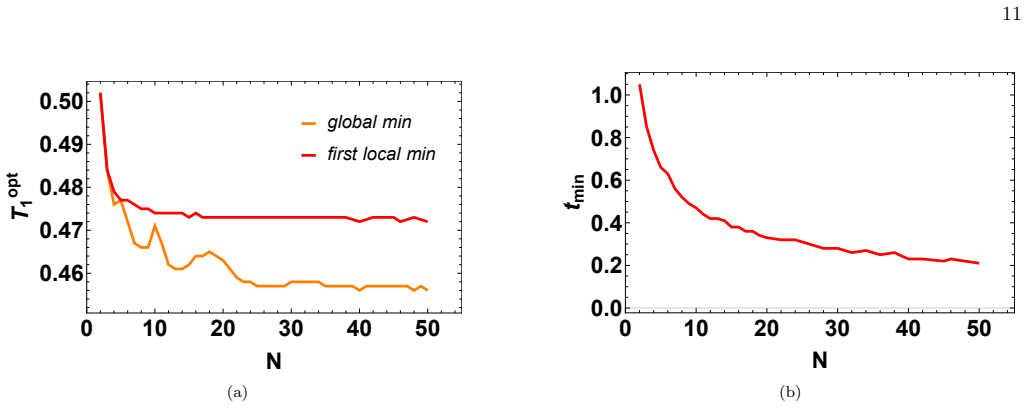
The paper's central claim is that finite-size spin-star environments, despite preventing steady-state thermalization, can be exploited for autonomous transient refrigeration, and that the resulting optimal cooling obeys precise scaling laws. Within the symmetric Dicke sector of each bath, the paper derives a semi-analytic expression for the cold-qubit reduced density matrix and defines its time-dependent temperature from the ground-state population. After numerical optimization over the coupling constants, the six-body interaction strength, and time, the minimum cold temperature fits $T_1^{\mathrm{fit}}(N)=T_1^{\infty}+aN^{-b}$ with $T_1^{\infty}\approx 0.457$, $a=0.096$, and $b=1.089$, and the time of the first local minimum fits $t_l^{\mathrm{fit}}(N)=t_l^{\infty}+xN^{-y}$ with $t_l^{\infty}\approx 0.10$, $x=1.5$, and $y=0.62$. In the Markovian limit the optimized refrigerator reaches $T_1=0.842$ only at $t=15.2$, whereas the central-spin version reaches about 0.46 in under one unit of time, so the paper concludes that non-Markovianity provides a real transient-cooling advantage.
Load-bearing premise
The load-bearing premise is that each spin bath can be initialized entirely in the fully symmetric Dicke sector of the bath ($j=N/2$, the states invariant under swapping bath spins); the paper states this restriction in Section III.B before Eq. (25) and makes no argument that such a state is preparable or that the reported scalings survive when other total-spin sectors are included.
Editorial extensions
If this is right
- If the scaling laws hold, the optimal cold temperature has a finite large-bath limit near $T_1^{\infty}\approx 0.457$, so adding bath spins beyond tens changes little; the exponent $b\approx 1.089$ quantifies the saturation rate.
- The optimal first-cooling time approaches about $t_l^{\infty}\approx 0.10$ as $N$ grows, with exponent $y\approx 0.62$, implying that larger finite baths cool at least as fast and asymptotically no slower.
- The spin-star refrigerator outperforms the Markovian three-qubit refrigerator both in depth (about 0.46 versus 0.842) and in speed (below 1 versus 15.2 time units), so non-Markovian environments are not merely a complication for autonomous cooling.
- Because all three bath heat currents can be simultaneously positive during the cooling window, the mechanism does not require the hot qubit to heat up, suggesting that autonomous transient refrigeration may work with fewer than three qubits.
- Stronger information backflow, as measured by the restricted Breuer-Laine-Piilo measure, correlates with lower transient minima across the sampled parameters, linking memory effects directly to cooling performance.
Reading between the lines
- The reported power laws are computed under the symmetric-Dicke-sector restriction; a natural test is to initialize each bath in the full thermal state of $N$ distinguishable spins and re-optimize, since lower total-spin sectors could alter both $T_1^{\infty}$ and the exponents.
- If the degeneracy condition $E_2-\varepsilon_2=E_1-\varepsilon_1+E_3-\varepsilon_3$ is the only resonant condition, then the asymptotic temperature $T_1^{\infty}$ may be expressible as a virtual-temperature relation between the two dressed transition states, which would give an analytic route to the 0.457 limit.
- The same invariant-sector method could be applied to two-qubit or one-qubit versions of the refrigerator, making the paper's fewer-than-three-qubits suggestion concrete and testable.
- Because the cooling-power interpretation of $\dot{Q}_{B1}$ relies on the six-body coupling $g$ being small, checking whether the scaling laws survive at larger $g$ would bound the regime where this interpretation is valid.
Signed reviews
Editorial analysis
A structured set of objections, weighed in public.
Referee Report
Summary. The paper introduces a three-qubit absorption refrigerator in which each qubit is the central spin of an independent finite spin-star environment, with the three qubit-bath units coupled by an effective six-body interaction. Exploiting the conserved quantum numbers (S_i^z+J_i^z) and J_i^2, the authors block-diagonalize the Hamiltonian and derive semi-analytic reduced dynamics for the cold qubit, valid for arbitrarily large symmetric Dicke-sector baths. They report transient cooling, study the heat currents of the three qubits and baths, and fit power laws for the optimal cold-qubit temperature and optimal cooling time as functions of the number of bath spins, T_opt(N) ~ 0.457 + 0.096 N^{-1.089} and t_l(N) ~ 0.10 + 1.5 N^{-0.62}. They then compare these results with a Markovian three-qubit refrigerator and claim significantly deeper and faster cooling. The abstract additionally promises a quantification of non-Markovianity via a restricted Breuer-Laine-Piilo information-backflow measure and a correlation with cooling performance.
Significance. If the symmetric-sector initialization is accepted, the paper offers a useful exactly solvable family of non-Markovian refrigerator models: the symmetry reduction from 2^N to N+1 bath dimensions is clean, the single-spin-star dynamics in Appendix A is analytically explicit, and the transient-cooling phenomenology is demonstrated. The claimed scaling laws would provide a concrete finite-size design rule for spin-star refrigerators, and the comparison with a Markovian benchmark is a legitimate external reference. However, the significance is conditional: the headline scalings and the advertised non-Markovianity quantification are not yet supported as presented, and the comparison is not controlled enough to attribute the advantage specifically to non-Markovianity.
major comments (5)
- [Sec. III.B (Eq. 25) and Sec. III.A (Eqs. 9-11)]
- [Abstract and Section I-VII]
- [Appendix B (Eq. B1)]
- [Sec. V.A and V.B]
- [Sec. VI]
minor comments (4)
- [Eq. (25)-(26)]
- [Sec. II.B around Eq. (20)-(22)]
- [Eq. (11) caption and Sec. III.A]
- [Fig. 1 caption]
Circularity Check
No significant circularity is found: the dynamics is solved exactly within the stated sector, the scaling curves are transparently presented as fits, and the Markovian comparison is an external benchmark.
full rationale
The central derivation is self-contained. The reduced dynamics of the cold qubit is obtained by exact block-diagonalization of the Hamiltonian into conserved (m1,m2,m3) sectors, with analytic matrix elements given in Appendices A and B, and the transient temperature T1(t) is computed from the time-dependent ground-state population via Eq. (32); no target result is fed into this derivation. The Markovian comparison is an independent external benchmark obtained from a separate global GKSL master equation with its own optimized parameters. The N-scaling curves in Sections V.A and V.B are least-squares fits to the model's own simulation data, with the asymptotic value taken from the tail of the same data, but the paper explicitly presents them as fits rather than as first-principles predictions; this is descriptive curve fitting, not circular derivation. The only self-citations are used for context and consistency and are not load-bearing. The restriction of each bath to the symmetric Dicke sector, stated in Section III.B before Eq. (25), is an explicit physical assumption that affects the numerical values and is a correctness risk if the full thermal state of distinguishable spins is intended, but it is not circular because the dynamics is solved exactly within the stated sector rather than derived from the paper's own conclusions.
Assumptions & free parameters
free parameters (10)
- Qubit energies ε1, ε2, ε3 =
1, 2, 1
- Bath energies E1, E2, E3 =
2, 4, 2
- Initial temperatures τ1, τ2, τ3 =
1, 1, 2
- System-bath couplings A1, A2, A3 =
Optimized in [0,1]; values not tabulated
- Six-body coupling g =
Optimized in [0,0.1]; values not tabulated
- Asymptotic cold temperature T∞_1 =
0.457 (power-law fit) or 0.454 (Neville)
- Temperature scaling parameters a, b =
a=0.096, b=1.089
- Asymptotic time t∞_l =
0.10
- Time scaling parameters x, y =
x=1.5, y=0.62
- Markovian benchmark couplings α1, α2, α3, g =
7.98e-6, 2.67e-5, 3.13e-5, 0.0999197
assumptions (5)
- domain assumption Each bath is initialized in the fully symmetric Dicke subspace j=N/2.
- ad hoc to paper The refrigerator operates via the effective six-body interaction Hint defined in Eq. (20)-(22).
- domain assumption The six-body coupling g is much smaller than all other Hamiltonian parameters.
- domain assumption The Markovian benchmark obeys a global GKSL master equation under Born-Markov-secular approximations.
- domain assumption The Markovian baths have Ohmic spectral density J_i(ω)=α_i ω exp(-ω/Ω).
invented entities (1)
-
Effective six-body interaction Hint
Cite this review
Pith. "Pith review of Quantum refrigerator embedded in spin-star environments: Scalings of temperature and refrigeration time." pith.science (2026). https://pith.science/paper/DND5TW2E
@misc{pith2026250504374,
  author       = {Pith},
  title        = {Pith review of: Quantum refrigerator embedded in spin-star environments: Scalings of temperature and refrigeration time},
  year         = {2026},
  howpublished = {\url{https://pith.science/paper/DND5TW2E}},
  note         = {Machine review of arXiv:2505.04374}
}
read the original abstract
We examine a quantum absorption refrigerator that comprises three qubits, each of which is connected with a separate spin-star environment, with the three qubit-bath units coupled through an effective six-body interaction. The refrigerator exhibits the feature of transient cooling, i.e., lowering of the temperature of the first qubit in sufficiently small timescales, rather than steady-state refrigeration. A key advantage of our model is that the symmetries of the Hamiltonian enable a semi-analytic solution of the reduced density matrices of the refrigerator qubits, even in the presence of a large number of environmental spins. We derive the condition for autonomous refrigeration and analyze how the optimal cold-qubit temperature scales with the number of bath spins. We find a power-law scaling towards a constant asymptotic value. We also find the scaling of the minimum time required for optimal cooling as a function of the number of bath spins. Furthermore, we quantify the non-Markovianity of the cold-qubit dynamics using a restricted Breuer-Laine-Piilo information-backflow measure and observe that stronger backflow correlates with lower transient minimum temperatures across the sampled parameter regime. The transient-cooling performance is found to be robust under broad parameter variations. Compared to a conventional Markovian three-qubit refrigerator, the CSQAR achieves lower cold-qubit temperatures on shorter timescales. We further analyze the heat currents associated with the three qubits and their respective baths.
Figures


Figures from the paper (4 more)



Reference graph
Works this paper leans on
-
[1]
Extrac- tion of work from a single thermal bath in the quantum regime,
A. E. Allahverdyan and T. M. Nieuwenhuizen, “Extrac- tion of work from a single thermal bath in the quantum regime,” Phys. Rev. Lett. 85, 1799–1802 (2000)
2000
-
[2]
+e −βε 2 e−βE(m− 1 2) +e βε 2 e−βE(mmin+ 1
-
[3]
(11) Sectors with different m values do not mix under time evolution due to the symmetry, [ H,Sz +Jz] = 0
+e −βε 2 e−βE(mmax− 1 2). (11) Sectors with different m values do not mix under time evolution due to the symmetry, [ H,Sz +Jz] = 0. Con- sequently, each m sector can be evolved separately by organizing the initial state in this manner. The Hamiltonian of the central spin model (8) takes the following form in the invariant basis, {|− 1/2⟩|m + 1/2⟩,|1/2⟩|m...
-
[4]
+e −βiεi 2 e−βiEi(mi− 1 2) +e βiεi 2 e−βiEi(mi;min+ 1
-
[5]
+e −βiεi 2 e−βiEi(mi;max− 1
-
[6]
ancestors
(28) Initially, i.e., at t = 0, each of the refrigerator qubits is in thermal equilibrium with its local bath. Thus, the initial temperatures of each qubit are equal to the initial temperature of the corresponding spin-environment, i.e. Ti(t = 0) = τi(t = 0) = 1 /βi. The quantities, Ti and τi, denote the temperatures of the ith qubit and bath respectively...
-
[7]
Quantum thermodynamics: A dynamical viewpoint,
R. Kosloff, “Quantum thermodynamics: A dynamical viewpoint,” Entropy 15, 2100–2128 (2013)
2013
-
[8]
Thermodynamic universality of quantum carnot engines,
B. Gardas and S. Deffner, “Thermodynamic universality of quantum carnot engines,” Phys. Rev. E 92, 042126 (2015)
2015
Show all 121 references
-
[9]
Thermodynamics of quantum systems under dynam- ical control,
D. Gelbwaser-Klimovsky, W. Niedenzu, and G. Kurizki, “Thermodynamics of quantum systems under dynam- ical control,” in Advances In Atomic, Molecular, and Optical Physics (Elsevier, 2015) p. 329–407
2015
-
[10]
Quantum r´ enyi relative entropies affirm universality of thermodynamics,
A. Misra, U. Singh, M. N. Bera, and A. K. Rajagopal, “Quantum r´ enyi relative entropies affirm universality of thermodynamics,” Phys. Rev. E 92, 042161 (2015)
2015
-
[11]
Perspective on quantum thermodynamics,
J. Millen and A. Xuereb, “Perspective on quantum thermodynamics,” New Journal of Physics 18, 011002 (2016)
2016
-
[12]
Quantum thermo- dynamics,
S. Vinjanampathy and J. Anders, “Quantum thermo- dynamics,” Contemporary Physics 57, 545–579 (2016)
2016
-
[13]
The role of quantum information in thermodynamics—a topical review,
J. Goold, M. Huber, A. Riera, L. del Rio, and P. Skrzypczyk, “The role of quantum information in thermodynamics—a topical review,” Journal of Physics A: Mathematical and Theoretical 49, 143001 (2016)
2016
-
[14]
Fundamental aspects of steady-state conversion of heat to work at the nanoscale,
G. Benenti, G. Casati, K. Saito, and R. S. Whitney, “Fundamental aspects of steady-state conversion of heat to work at the nanoscale,” Physics Reports 694, 1–124 (2017)
2017
-
[15]
Binder, L
F. Binder, L. A. Correa, C. Gogolin, J. Anders, and G. Adesso, eds., Thermodynamics in the Quantum Regime: Fundamental Aspects and New Directions , Fundamental Theories of Physics, Vol. 195 (Springer, 2018)
2018
-
[16]
Quantum thermodynam- ics: An introduction to the thermodynamics of quantum information,
S. Deffner and S. Campbell, “Quantum thermodynam- ics: An introduction to the thermodynamics of quantum information,” arXiv:1907.01596 (2019)
2019 arXiv
-
[17]
Quantum thermodynamic cooling cycle,
J. P. Palao, R. Kosloff, and J. M. Gordon, “Quantum thermodynamic cooling cycle,” Phys. Rev. E 64, 056130 (2001)
2001
-
[18]
Quantum four-stroke heat engine: Thermodynamic observables in a model with intrinsic friction,
T. Feldmann and R. Kosloff, “Quantum four-stroke heat engine: Thermodynamic observables in a model with intrinsic friction,” Phys. Rev. E 68, 016101 (2003)
2003
-
[19]
Equivalence of quantum heat machines, and quantum-thermodynamic signatures,
R. Uzdin, A. Levy, and R. Kosloff, “Equivalence of quantum heat machines, and quantum-thermodynamic signatures,” Phys. Rev. X 5, 031044 (2015)
2015
-
[20]
Quantum rotor engines,
S. Seah, S. Nimmrichter, A. Roulet, and V. Scarani, “Quantum rotor engines,” in Thermodynamics in the Quantum Regime (Springer International Publishing, 16
-
[21]
Quantum thermal absorption ma- chines: refrigerators, engines and clocks,
M. T. Mitchison, “Quantum thermal absorption ma- chines: refrigerators, engines and clocks,” Contempo- rary Physics 60, 164–187 (2019)
2019
-
[22]
Har- nessing energy extracted from heat engines to charge quantum batteries,
D. Saha, A. Bhattacharyya, K. Sen, and U. Sen, “Har- nessing energy extracted from heat engines to charge quantum batteries,” (2023)
2023
-
[23]
Entanglement boost for extractable work from ensembles of quantum batter- ies,
Robert Alicki and Mark Fannes, “Entanglement boost for extractable work from ensembles of quantum batter- ies,” Phys. Rev. E 87, 042123 (2013)
2013
-
[24]
Quantum batteries - review chapter,
F. Campaioli, F. A. Pollock, and S. Vin- janampathy, “Quantum batteries - review chapter,” arXiv:1805.05507 (2018)
2018 arXiv
-
[25]
Quantum thermal ma- chines and batteries,
S. Bhattacharjee and A. Dutta, “Quantum thermal ma- chines and batteries,” The European Physical Journal B 94 (2021)
2021
-
[26]
How small can thermal machines be? the smallest possible refrig- erator,
N. Linden, S. Popescu, and P. Skrzypczyk, “How small can thermal machines be? the smallest possible refrig- erator,” Phys. Rev. Lett. 105, 130401 (2010)
2010
-
[27]
The smallest refrigerators can reach maximal effi- ciency,
P. Skrzypczyk, N. Brunner, N. Linden, and S. Popescu, “The smallest refrigerators can reach maximal effi- ciency,” Journal of Physics A: Mathematical and Theo- retical 44, 492002 (2011)
2011
-
[28]
Virtual qubits, virtual temperatures, and the founda- tions of thermodynamics,
N. Brunner, N. Linden, S. Popescu, and P. Skrzypczyk, “Virtual qubits, virtual temperatures, and the founda- tions of thermodynamics,” Phys. Rev. E 85, 051117 (2012)
2012
-
[29]
Quantum absorption refriger- ator,
A. Levy and R. Kosloff, “Quantum absorption refriger- ator,” Phys. Rev. Lett. 108, 070604 (2012)
2012
-
[30]
Quantum heat engines and refrigerators: Continuous devices,
R. Kosloff and A. Levy, “Quantum heat engines and refrigerators: Continuous devices,” Annual Review of Physical Chemistry 65, 365–393 (2014)
2014
-
[31]
Unifying paradigms of quantum refrig- eration: A universal and attainable bound on cooling,
F. Clivaz, R. Silva, G. Haack, J. B. Brask, N. Brunner, and M. Huber, “Unifying paradigms of quantum refrig- eration: A universal and attainable bound on cooling,” Phys. Rev. Lett. 123, 170605 (2019)
2019
-
[32]
Quantum thermal transistor,
K. Joulain, J. Drevillon, Y. Ezzahri, and J. Ordonez- Miranda, “Quantum thermal transistor,” Phys. Rev. Lett. 116, 200601 (2016)
2016
-
[33]
Coulomb-coupled quantum-dot thermal tran- sistors,
Y. Zhang, Z. Yang, X. Zhang, B. Lin, G. Lin, and J. Chen, “Coulomb-coupled quantum-dot thermal tran- sistors,” Europhysics Letters 122, 17002 (2018)
2018
-
[34]
Quantum coherence thermal transistors,
S. Su, Y. Zhang, B. Andresen, and J. Chen, “Quantum coherence thermal transistors,” (2018)
2018
-
[35]
A review on the electroluminescence properties of quantum-dot light-emitting diodes,
Qilin Y., Ting W., Panlong Y., Hanzhuang Z., Han Z., and Wenyu J., “A review on the electroluminescence properties of quantum-dot light-emitting diodes,” Or- ganic Electronics 90, 106086 (2021)
2021
-
[36]
Performance bound for quantum absorption refrigera- tors,
L. A. Correa, J. P. Palao, G. Adesso, and D. Alonso, “Performance bound for quantum absorption refrigera- tors,” Phys. Rev. E 87, 042131 (2013)
2013
-
[37]
Entanglement enhances cooling in microscopic quantum refrigerators,
N. Brunner, M. Huber, N. Linden, S. Popescu, R. Silva, and P. Skrzypczyk, “Entanglement enhances cooling in microscopic quantum refrigerators,” Phys. Rev. E 89, 032115 (2014)
2014
-
[38]
Small quantum absorp- tion refrigerator in the transient regime: Time scales, enhanced cooling, and entanglement,
J. B. Brask and N. Brunner, “Small quantum absorp- tion refrigerator in the transient regime: Time scales, enhanced cooling, and entanglement,” Phys. Rev. E 92, 062101 (2015)
2015
-
[39]
H. P. Breuer and F. Petruccione, The theory of open quantum systems (Oxford University Press, 2002)
2002
-
[40]
Alicki and K
R. Alicki and K. Lendi, Quantum dynamical semigroup and applications (Springer, 2007)
2007
-
[41]
Rivas and S
A. Rivas and S. F. Huelga, Open Quantum Systems. An Introduction (Springer, 2012)
2012
-
[42]
Lecture notes on the theory of open quan- tum systems,
D. A. Lidar, “Lecture notes on the theory of open quan- tum systems,” arXiv:1902.00967 (2020)
2020 arXiv
-
[43]
Re-examining the self-contained quantum refrigerator in the strong-coupling regime,
C. Yu and Q. Zhu, “Re-examining the self-contained quantum refrigerator in the strong-coupling regime,” Phys. Rev. E 90, 052142 (2014)
2014
-
[44]
Small quan- tum absorption refrigerator with reversed couplings,
R. Silva, P. Skrzypczyk, and N. Brunner, “Small quan- tum absorption refrigerator with reversed couplings,” Phys. Rev. E 92, 012136 (2015)
2015
-
[45]
Enabling the self- contained refrigerator to work beyond its limits by fil- tering the reservoirs,
Z. He, X. Huang, and C. Yu, “Enabling the self- contained refrigerator to work beyond its limits by fil- tering the reservoirs,” Phys. Rev. E 96, 052126 (2017)
2017
-
[46]
Smallest quantum thermal ma- chine: The effect of strong coupling and distributed thermal tasks,
Z. Man and Y. Xia, “Smallest quantum thermal ma- chine: The effect of strong coupling and distributed thermal tasks,” Phys. Rev. E 96, 012122 (2017)
2017
-
[47]
Nonequilibrium quantum absorp- tion refrigerator,
J. Du and F. Zhang, “Nonequilibrium quantum absorp- tion refrigerator,” New Journal of Physics 20, 063005 (2018)
2018
-
[48]
Necessarily transient quantum refrigerator,
S. Das, A. Misra, A. K. Pal, A. Sen(De), and U. Sen, “Necessarily transient quantum refrigerator,” EPL (Eu- rophysics Letters) 125, 20007 (2019)
2019
-
[49]
Two-body quantum absorption refrigerators with optomechanical-like interactions,
M. T. Naseem, A. Misra, and O. E Mustecapli- oglu, “Two-body quantum absorption refrigerators with optomechanical-like interactions,” Quantum Science and Technology 5, 035006 (2020)
2020
-
[50]
Three-qubit refrigerator with two-body interactions,
A. Hewgill, J. O. Gonzalez, J. P. Palao, D. Alonso, A. Ferraro, and G. De Chiara, “Three-qubit refrigerator with two-body interactions,” Phys. Rev. E 101, 012109 (2020)
2020
-
[51]
Three qubits in less than three baths: Beyond two- body system-bath interactions in quantum refrigera- tors,
A. Ghoshal, S. Das, A. K. Pal, A. Sen(De), and U. Sen, “Three qubits in less than three baths: Beyond two- body system-bath interactions in quantum refrigera- tors,” Phys. Rev. A 104, 042208 (2021)
2021
-
[52]
Quantum thermodynamics ap- plied for quantum refrigerators cooling down a qubit,
H. Okane, S. Kamimura, S. Kukita, Y. Kondo, and Y. Matsuzaki, “Quantum thermodynamics ap- plied for quantum refrigerators cooling down a qubit,” arXiv:2210.02681 (2022)
2022 arXiv
-
[53]
Designing robust quantum refrigerators in disordered spin models,
T. K. Konar, S. Ghosh, A. K. Pal, and A. Sen(De), “Designing robust quantum refrigerators in disordered spin models,” Phys. Rev. A 105, 022214 (2022)
2022
-
[54]
Kerr-type nonlinear baths enhance cooling in quantum refrigerators,
T. Ray, S. Mondal, A. Bhattacharyya, A. Ghoshal, D. Rakshit, and U. Sen, “Kerr-type nonlinear baths enhance cooling in quantum refrigerators,” arXiv:2311.10499 (2023)
2023 arXiv
-
[55]
Cooling with fermionic thermal reservoirs,
G. G. Damas, R. J. de Assis, and N. G. de Almeida, “Cooling with fermionic thermal reservoirs,” Phys. Rev. E 107, 034128 (2023)
2023
-
[56]
Non- markovian dynamics in a spin star system: Exact solu- tion and approximation techniques,
H.P. Breuer, D. Burgarth, and F. Petruccione, “Non- markovian dynamics in a spin star system: Exact solu- tion and approximation techniques,” Phys. Rev. B 70, 045323 (2004)
2004
-
[57]
Non-markovian quantum dynamics: What is it good for?
C.-F. Li, G.-C. Guo, and J. Piilo, “Non-markovian quantum dynamics: What is it good for?” Europhysics Letters 128, 30001 (2020)
2020
-
[58]
Non-markovian thermal opera- tions boosting the performance of quantum heat en- gines,
Krzysztof Ptaszy´ nski, “Non-markovian thermal opera- tions boosting the performance of quantum heat en- gines,” Phys. Rev. E 106, 014114 (2022)
2022
-
[59]
Strong-coupling quantum thermodynamics far from equilibrium: Non- markovian transient quantum heat and work,
Wei-Ming Huang and Wei-Min Zhang, “Strong-coupling quantum thermodynamics far from equilibrium: Non- markovian transient quantum heat and work,” Phys. Rev. A 106, 032607 (2022)
2022
-
[60]
Non-markovian thermal operations boosting the performance of quantum heat engines,
K. Ptaszynski, “Non-markovian thermal operations boosting the performance of quantum heat engines,” Phys. Rev. E 106, 014114 (2022). 17
2022
-
[61]
Non-markovian effects on the performance of a quantum otto refrigerator,
A. El Allati, K. El Anouz, M. H. Ben Abdou Chak- our, and S. Al-Kuwari, “Non-markovian effects on the performance of a quantum otto refrigerator,” Physics Letters A 496, 129316 (2024)
2024
-
[62]
Dynamically emergent quantum thermo- dynamics: Non-markovian otto cycle,
Irene Ada Picatoste, Alessandra Colla, and Heinz- Peter Breuer, “Dynamically emergent quantum thermo- dynamics: Non-markovian otto cycle,” Phys. Rev. Res. 6, 013258 (2024)
2024
-
[63]
Tran- sient effects in quantum refrigerators with finite envi- ronments,
A. Bhattacharyya, A. Ghoshal, and U. Sen, “Tran- sient effects in quantum refrigerators with finite envi- ronments,” Phys. Rev. A 111, 012209 (2025)
2025
-
[64]
Coherence-assisted single-shot cooling by quan- tum absorption refrigerators,
M. T. Mitchison, M. P. Woods, J. Prior, and M. Hu- ber, “Coherence-assisted single-shot cooling by quan- tum absorption refrigerators,” New Journal of Physics 17, 115013 (2015)
2015
-
[65]
Electron spin decoherence in quantum dots due to interaction with nuclei,
A. Khaetskii, D. Loss, and L. Glazman, “Electron spin decoherence in quantum dots due to interaction with nuclei,” Phys. Rev. Lett. 88, 186802 (2002)
2002
-
[66]
Spin de- cay and quantum parallelism,
J. Schliemann, A. Khaetskii, and D. Loss, “Spin de- cay and quantum parallelism,” Phys. Rev. B 66, 245303 (2002)
2002
-
[67]
Elec- tron spin relaxation by nuclei in semiconductor quan- tum dots,
I. A. Merkulov, A. L. Efros, and M. Rosen, “Elec- tron spin relaxation by nuclei in semiconductor quan- tum dots,” Phys. Rev. B 65, 205309 (2002)
2002
-
[68]
Electron spin evolution induced by interaction with nuclei in a quan- tum dot,
A. Khaetskii, D. Loss, and L. Glazman, “Electron spin evolution induced by interaction with nuclei in a quan- tum dot,” Phys. Rev. B 67, 195329 (2003)
2003
-
[70]
Electron spin dynamics in quantum dots and related nanostruc- tures due to hyperfine interaction with nuclei,
J. Schliemann, A. Khaetskii, and D. Loss, “Electron spin dynamics in quantum dots and related nanostruc- tures due to hyperfine interaction with nuclei,” Journal of Physics: Condensed Matter 15, R1809 (2003)
2003
-
[71]
Hyperfine interaction in a quantum dot: Non-markovian electron spin dynam- ics,
W. A. Coish and Daniel Loss, “Hyperfine interaction in a quantum dot: Non-markovian electron spin dynam- ics,” Phys. Rev. B 70, 195340 (2004)
2004
-
[72]
Analytical solution of electron spin decoherence through hyperfine interaction in a quantum dot,
C. Deng and X. Hu, “Analytical solution of electron spin decoherence through hyperfine interaction in a quantum dot,” Phys. Rev. B 73, 241303 (2006)
2006
-
[73]
Spins in few-electron quan- tum dots,
R. Hanson, L. P. Kouwenhoven, J. R. Petta, S. Tarucha, and L. M. K. Vandersypen, “Spins in few-electron quan- tum dots,” Rev. Mod. Phys. 79, 1217–1265 (2007)
2007
-
[74]
Quantum many-body theory of qubit decoherence in a finite-size spin bath,
W. Yang and R. Liu, “Quantum many-body theory of qubit decoherence in a finite-size spin bath,” Phys. Rev. B 78, 085315 (2008)
2008
-
[75]
Quantum many-body theory of qubit decoherence in a finite-size spin bath. ii. ensemble dynamics,
W. Yang and R. Liu, “Quantum many-body theory of qubit decoherence in a finite-size spin bath. ii. ensemble dynamics,” Phys. Rev. B 79, 115320 (2009)
2009
-
[76]
Pure quantum dephasing of a solid-state electron spin qubit in a large nuclear spin bath coupled by long- range hyperfine-mediated interactions,
L. Cywinski, W. M. Witzel, and S. Das Sarma, “Pure quantum dephasing of a solid-state electron spin qubit in a large nuclear spin bath coupled by long- range hyperfine-mediated interactions,” Phys. Rev. B 79, 245314 (2009)
2009
-
[77]
Elec- tron spin dephasing due to hyperfine interactions with a nuclear spin bath,
L. Cywinski, W. M. Witzel, and S. Das Sarma, “Elec- tron spin dephasing due to hyperfine interactions with a nuclear spin bath,” Phys. Rev. Lett.102, 057601 (2009)
2009
-
[78]
Dephasing of electron spin qubits due to their interaction with nuclei in quantum dots,
L. Cywinski, “Dephasing of electron spin qubits due to their interaction with nuclei in quantum dots,” Acta Phys. Pol. A 119, 576 (2011)
2011
-
[79]
Nuclear spin physics in quantum dots: An optical investigation,
B. Urbaszek, X. Marie, T. Amand, O. Krebs, P. Voisin, P. Maletinsky, A. Hogele, and A. Imamoglu, “Nuclear spin physics in quantum dots: An optical investigation,” Rev. Mod. Phys. 85, 79–133 (2013)
2013
-
[80]
Competing inter- actions in semiconductor quantum dots,
R. van den Berg, G. P. Brandino, O. El Araby, R. M. Konik, V. Gritsev, and J. S. Caux, “Competing inter- actions in semiconductor quantum dots,” Phys. Rev. B 90, 155117 (2014)
2014
-
[81]
Quantum many-body theory for electron spin decoherence in nanoscale nu- clear spin baths,
W. Yang, W. Ma, and R. Liu, “Quantum many-body theory for electron spin decoherence in nanoscale nu- clear spin baths,” Reports on Progress in Physics 80, 016001 (2016)
2016
-
[82]
Coherent dynamics of coupled electron and nuclear spin qubits in diamond,
L. Childress, M. V. Gurudev Dutt, J. M. Taylor, A. S. Zibrov, F. Jelezko, J. Wrachtrup, P. R. Hemmer, and M. D. Lukin, “Coherent dynamics of coupled electron and nuclear spin qubits in diamond,” Science 314, 281– 285 (2006)
2006
-
[83]
Coherent dynamics of a single spin interacting with an adjustable spin bath,
R. Hanson, V. V. Dobrovitski, A. E. Feiguin, O. Gywat, and D. D. Awschalom, “Coherent dynamics of a single spin interacting with an adjustable spin bath,” Science 320, 352–355 (2008)
2008
-
[84]
Diamond nitrogen-vacancy center as a probe of random fluctuations in a nuclear spin ensemble,
A. Laraoui, J. S. Hodges, C. A. Ryan, and C. A. Mer- iles, “Diamond nitrogen-vacancy center as a probe of random fluctuations in a nuclear spin ensemble,” Phys. Rev. B 84, 104301 (2011)
2011
-
[85]
Anomalous decoher- ence effect in a quantum bath,
N. Zhao, Z. Wang, and R. Liu, “Anomalous decoher- ence effect in a quantum bath,” Phys. Rev. Lett. 106, 217205 (2011)
2011
-
[86]
Decoherence and dy- namical decoupling control of nitrogen vacancy center electron spins in nuclear spin baths,
N. Zhao, S. Ho, and R. Liu, “Decoherence and dy- namical decoupling control of nitrogen vacancy center electron spins in nuclear spin baths,” Phys. Rev. B 85, 115303 (2012)
2012
-
[87]
Detecting and polarizing nuclear spins with double resonance on a single electron spin,
P. London, J. Scheuer, J.-M. Cai, I. Schwarz, A. Ret- zker, M. B. Plenio, M. Katagiri, T. Teraji, S. Koizumi, J. Isoya, R. Fischer, L. P. McGuinness, B. Naydenov, and F. Jelezko, “Detecting and polarizing nuclear spins with double resonance on a single electron spin,” Phys. Re...
2013
-
[88]
Ana- lytic solutions to the central-spin problem for nitrogen- vacancy centers in diamond,
L. T. Hall, J. H. Cole, and L. C. L. Hollenberg, “Ana- lytic solutions to the central-spin problem for nitrogen- vacancy centers in diamond,” Phys. Rev. B 90, 075201 (2014)
2014
-
[89]
Robust optical polariza- tion of nuclear spin baths using hamiltonian engineering of nitrogen-vacancy center quantum dynamics,
I. Schwartz, J. Scheuer, B. Tratzmiller, S. Muller, Q. Chen, I. Dhand, Z. Wang, C. Muller, B. Naydenov, F. Jelezko, and M. B. Plenio, “Robust optical polariza- tion of nuclear spin baths using hamiltonian engineering of nitrogen-vacancy center quantum dynamics,” Science Advanc...
2018
-
[90]
Dynamics of two central spins immersed in spin baths,
D. Tiwari, S. Datta, S. Bhattacharya, and S. Banerjee, “Dynamics of two central spins immersed in spin baths,” Phys. Rev. A 106, 032435 (2022)
2022
-
[91]
Entan- glement and work extraction in the central-spin quan- tum battery,
J. Liu, H. Shi, Y. Shi, X. Wang, and W. Yang, “Entan- glement and work extraction in the central-spin quan- tum battery,” Phys. Rev. B 104, 245418 (2021)
2021
-
[92]
A photonic carnot engine powered by a spin-star network,
D. Turkpence, F. Altintas, M. Paternostro, and O. E. Mustecaplioglu, “A photonic carnot engine powered by a spin-star network,” EPL (Europhysics Letters) 117, 50002 (2017)
2017
-
[93]
Channel ca- pacities of an exactly solvable spin-star system,
N. Arshed, A. H. Toor, and D. A. Lidar, “Channel ca- pacities of an exactly solvable spin-star system,” Phys. Rev. A 81, 062353 (2010)
2010
-
[94]
Universal destabilization and slowing of spin-transfer functions by a bath of spins,
D. Burgarth and S. Bose, “Universal destabilization and slowing of spin-transfer functions by a bath of spins,” Phys. Rev. A 73, 062321 (2006)
2006
-
[95]
Quantum communication in spin star configuration,
H. Deng and X. Fang, “Quantum communication in spin star configuration,” Chinese Physics B 17, 702 (2008)
2008
-
[96]
Spin star as a switch for quantum networks,
M. Yung, “Spin star as a switch for quantum networks,” 18 Journal of Physics B: Atomic, Molecular and Optical Physics 44, 135504 (2011)
2011
-
[97]
Quantum phase transitions and quantum communication in a spin star system,
H. Deng and X. Fang, “Quantum phase transitions and quantum communication in a spin star system,” Journal of Physics B: Atomic, Molecular and Optical Physics41, 025503 (2008)
2008
-
[98]
Quantum phase transitions in spin star configuration,
H. Deng and X. Fang, “Quantum phase transitions in spin star configuration,” Communications in Theoreti- cal Physics 49, 1353 (2008)
2008
-
[99]
Collapse and revival structure of information backflow for a central spin coupled to a fi- nite spin bath,
J. Fan and S. Pang, “Collapse and revival structure of information backflow for a central spin coupled to a fi- nite spin bath,” Phys. Rev. A 107, 022209 (2023)
2023
-
[100]
Non-markovian dynamics in a spin star system: the failure of thermal- isation,
Z. H. Wang, Y. Guo, and D. L. Zhou, “Non-markovian dynamics in a spin star system: the failure of thermal- isation,” The European Physical Journal D 67 (2013), 10.1140/epjd/e2013-40099-0
2013 doi
-
[101]
Single-spin magnetic res- onance in the nitrogen-vacancy center of diamond,
D. Suter and F. Jelezko, “Single-spin magnetic res- onance in the nitrogen-vacancy center of diamond,” Progress in Nuclear Magnetic Resonance Spectroscopy 98-99, 50–62 (2017)
2017
-
[102]
Measure- ment of the excited-state transverse hyperfine coupling in nv centers via dynamic nuclear polarization,
F. Poggiali, P. Cappellaro, and N. Fabbri, “Measure- ment of the excited-state transverse hyperfine coupling in nv centers via dynamic nuclear polarization,” Phys. Rev. B 95, 195308 (2017)
2017
-
[103]
Temporal order in periodically driven spins in star- shaped clusters,
S. Pal, N. Nishad, T. S. Mahesh, and G. J. Sreejith, “Temporal order in periodically driven spins in star- shaped clusters,” Phys. Rev. Lett. 120, 180602 (2018)
2018
-
[104]
A ten-qubit solid-state spin register with quantum memory up to one minute,
C. E. Bradley, J. Randall, M. H. Abobeih, R. C. Berrevoets, M. J. Degen, M. A. Bakker, M. Markham, D. J. Twitchen, and T. H. Taminiau, “A ten-qubit solid-state spin register with quantum memory up to one minute,” Phys. Rev. X 9, 031045 (2019)
2019
-
[105]
Star-topology reg- isters: Nmr and quantum information perspectives,
T. S. Mahesh, D. Khurana, V. R. Krithika, G. J. Sree- jith, and C. S. Sudheer Kumar, “Star-topology reg- isters: Nmr and quantum information perspectives,” Journal of Physics: Condensed Matter 33, 383002 (2021)
2021
-
[106]
Control of open quantum systems: case study of the central spin model,
C. Arenz, G. Gualdi, and D. Burgarth, “Control of open quantum systems: case study of the central spin model,” New Journal of Physics 16, 065023 (2014)
2014
-
[107]
Non-markovian quantum otto refrigerator,
M. Wiedmann, J. T. Stockburger, and J. Ankerhold, “Non-markovian quantum otto refrigerator,” The Eu- ropean Physical Journal Special Topics 230, 851–857 (2021)
2021
-
[108]
Non-markovian refrigeration and heat flow in the quantum switch,
J. Cheong, A. Pradana, and L. Chew, “Non-markovian refrigeration and heat flow in the quantum switch,” Phys. Rev. A 110, 022220 (2024)
2024
-
[109]
Quan- tum information processing using quantum dot spins and cavity qed,
A. Immamoglu, D. D. Awschalom, G. Burkard, D. P. Di- Vincenzo, D. Loss, M. Sherwin, and A. Small, “Quan- tum information processing using quantum dot spins and cavity qed,” Phys. Rev. Lett. 83, 4204–4207 (1999)
1999
-
[110]
Entropy production for quantum dynami- cal semigroups,
H. Spohn, “Entropy production for quantum dynami- cal semigroups,” Journal of Mathematical Physics 19, 1227–1230 (1978)
1978
-
[111]
Irreversible thermody- namics for quantum systems weakly coupled to thermal reservoirs,
H. Spohn and J. L. Lebowitz, “Irreversible thermody- namics for quantum systems weakly coupled to thermal reservoirs,” in Advances in Chemical Physics (John Wi- ley & Sons, Ltd, 1978) pp. 109–142
1978
-
[112]
Thermodynamic power of non- markovianity,
B. Bylicka, M. Tukiainen, D. Chruscinski, J. Piilo, and S. Maniscalo, “Thermodynamic power of non- markovianity,” Sci. Rep. 6, 27989 (2016)
2016
-
[113]
Entropy production and non- markovian dynamical maps,
S. Marcantoni, S. Alipour, F. Benatti, R. Floreanini, and A. T. Rezakhani, “Entropy production and non- markovian dynamical maps,” Sci. Rep. 7, 12447 (2017)
2017
-
[114]
Exact master equation for a spin inter- acting with a spin bath: Non-markovianity and nega- tive entropy production rate,
S. Bhattacharya, A. Misra, C. Mukhopadhyay, and A. K. Pati, “Exact master equation for a spin inter- acting with a spin bath: Non-markovianity and nega- tive entropy production rate,” Phys. Rev. A 95, 012122 (2017)
2017
-
[115]
En- tropy production and correlations in a controlled non- markovian setting,
M. Popovic, B. Vacchini, and S. Campbell, “En- tropy production and correlations in a controlled non- markovian setting,” Phys. Rev. A 98, 012130 (2018)
2018
-
[116]
Non-markovianity and negative entropy production rates,
P. Strasberg and M. Esposito, “Non-markovianity and negative entropy production rates,” Phys. Rev. E 99, 012120 (2019)
2019
-
[117]
Compatibility of linear- response theory with the second law of thermodynam- ics and the emergence of negative entropy production rates,
P. Naze and M. V. S. Bonanca, “Compatibility of linear- response theory with the second law of thermodynam- ics and the emergence of negative entropy production rates,” Journal of Statistical Mechanics: Theory and Experiment 2020, 013206 (2020)
2020
-
[118]
Negative entropy production rates in drude-sommerfeld metals,
M. V. S. Bonaca, P. Naze, and S. Deffner, “Negative entropy production rates in drude-sommerfeld metals,” Phys. Rev. E 103, 012109 (2021)
2021
-
[119]
Heat current and entropy pro- duction rate in local non-markovian quantum dynam- ics of global markovian evolution,
A. Ghoshal and U. Sen, “Heat current and entropy pro- duction rate in local non-markovian quantum dynam- ics of global markovian evolution,” Phys. Rev. A 105, 022424 (2022)
2022
-
[120]
Multiparty spohn’s theo- rem for a combination of local markovian and non- markovian quantum dynamics,
A. Ghoshal and U. Sen, “Multiparty spohn’s theo- rem for a combination of local markovian and non- markovian quantum dynamics,” Phys. Rev. A 110, 012451 (2024)
2024
-
[121]
Quantum transistors for heat flux in and out of work- ing substance parts: harmonic vs transmon and kerr environs,
D. Bhargava, P. Chaki, A. Bhattacharyya, and U. Sen, “Quantum transistors for heat flux in and out of work- ing substance parts: harmonic vs transmon and kerr environs,” arXiv:2501.11629 (2025)
2025
-
[122]
Press, S
W. Press, S. Teukolski, W. Vetterling, and B. Flanery, Numerical Recipes (Cambridge University Press, 2007)
2007
Reviewed August 15, 2026 · model on record in the stance chip above.
Discussion (0). Continue with ORCID to comment.