REVIEW 2 major objections 4 minor 30 references
Phase transition in a 1d driven tracer model
T0 review · 2 major / 4 minor · reviewed 2026-08-14 · deepseek-v4-flash
Pith's one-line read A driven tracer in a one-dimensional lattice gas undergoes a continuous phase transition at a finite overtaking rate, separating a phase in which its velocity vanishes as 1/L from one in which it stays finite.
desk verdict A genuinely new continuous transition in a driven tracer model, supported by clean MF and simulations, but Eq. (20) and Eq. (2) contain typos that must be fixed. read the letter →
The pith
A machine-rendered reading of the paper's core claim, the machinery that carries it, and where it could break.
The reading
What carries the argument
The argument is carried by the mean-field rate equations for the bath occupation densities $\rho_\ell$ in the tracer's reference frame, obtained by neglecting correlations between occupations. Their stationary solution has the form $\rho_\ell = A + (\rho_1 - A)((2-c)/(2+c))^{\ell-1}$, where the parameter $c = v/(1+u/2)$ is set by the tracer's hop and exchange rates through the boundary equations and by the total particle number. The two phases correspond to two self-consistent scalings of $c$: $c_E = a/L$ in the extended phase, which leads to a continuum profile $\rho_E(x) = A + (\rho_1 - A)e^{-ax}$ and a transcendental equation for $a$; and a finite $c_L$ in the localized phase, which forces $A = \rho$ and gives an exponential profile. The critical manifolds are obtained by setting $c_L = 0$, and the critical scaling follows from a generalized ansatz $c = b/L^\alpha$, which self-consistently yields $\alpha = 1/2$.
What would settle it
Run the same model at the canonical rates on much larger rings (for example L = $10^{5}$) and measure the tracer velocity as a function of density: if in the purported extended phase v decays more slowly than 1/L, or if the density at which v vanishes drifts systematically away from the mean-field value with increasing L, then the continuous transition at a finite overtaking rate is not the true behavior.
Extended reading notes
Core claim
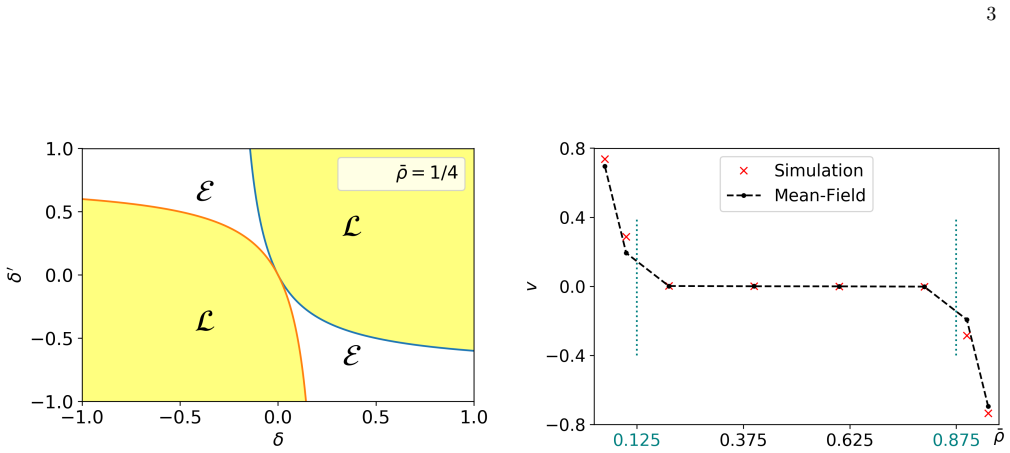
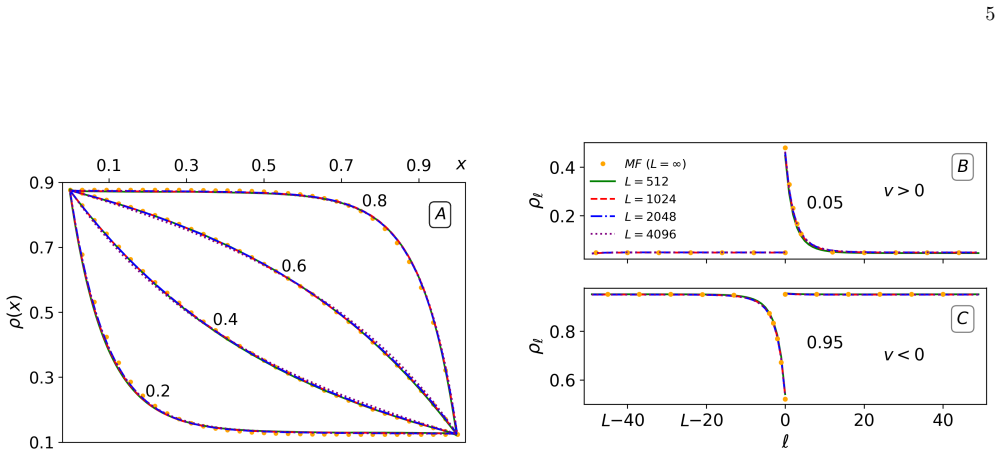
The paper's discovery is that allowing a driven tracer to exchange places with bath particles does not simply restore ordinary transport. For fixed hop and exchange biases, the model has two stable steady phases: an extended phase, where the stationary bath density profile in the tracer's frame is a macroscopic function of x = l/L and the tracer velocity scales as v ~ 1/L, and a localized phase, where the profile differs from the mean density only over O(1) sites ahead of the tracer and v approaches a finite constant. Mean-field theory yields two critical densities, $\rho_c^I = q'(p-q)/(pq'-qp')$ and $\rho_c^{II} = p'(p-q)/(pq'-qp')$, at which the tracer velocity vanishes linearly as the localized phase is entered, and predicts that at the transition the density profile becomes a function of $y = \ell/\sqrt{L}$ with the velocity scaling as $L^{-1/2}$. Numerical simulations for the canonical rates $p = q' = 1.75$, $q = p' = 0.25$ reproduce the mean-field phase boundaries and the profile collapse in both phases and at criticality.
Load-bearing premise
The main argument assumes that pairs of bath particles occupy sites independently of each other; if the actual correlations among bath particles matter enough to move the phase boundary or change the order of the transition, the central claim would fail.
Editorial extensions
If this is right
- For parameters in the extended phase, a tracer on a ring of length L has a mean velocity of order 1/L, so in the thermodynamic limit it does not move.
- In the localized phase the tracer reaches a finite mean velocity and drags a cloud of bath particles or holes of size O(1) with it.
- The phase transition is continuous: the tracer velocity grows linearly with the deviation of the bath density from its critical value, and the critical profile and velocity obey a scaling form with y = l/sqrt(L).
- Particle-hole symmetry implies a second transition at higher density, where the tracer moves in the opposite direction due to the exchange bias.
- At the exactly treatable rates p = q' = 1, q = p' = 0, the extended phase persists for all densities, so the transition is not universal in the rates.
Reading between the lines
- If the transition survives in quasi-1D channels of finite width, the overtaking rate becomes a practical control knob: small changes in channel width or bath density could switch a driven particle between a moving and a stationary state.
- The critical scaling v = L^{-1/2} g(sqrt(L) delta_rho) suggests a universality class that may be shared by other driven tracer models with exchange; testing the same scaling in models with different microscopic rules would map out that class.
- The authors' observation that multiple tracers attract and form a macroscopic condensate in the extended phase implies that the single-tracer transition may control a collective condensation phenomenon; a systematic study of the N-tracer case could connect this model to condensation transitions in transport.
Signed reviews
Editorial analysis
A structured set of objections, weighed in public.
Referee Report
Summary. The paper studies a one-dimensional lattice gas on a ring with one driven tracer particle and hard-core bath particles, allowing overtaking through tracer-bath exchange processes. Working in the tracer's reference frame, the authors derive mean-field rate equations and predict two stationary phases: an extended phase in which the tracer velocity vanishes as 1/L and the bath density profile is macroscopic, and a localized phase in which the velocity is O(1) and the density profile is localized near the tracer. They obtain two critical manifolds, characterize the velocity and profile in both phases, and propose a continuous transition with a characteristic sqrt(L) crossover scale at criticality. The analytic results are compared with Gillespie simulations for lattices up to L=4096, showing good agreement and data collapses.
Significance. If the results hold, this is a striking nonequilibrium phase transition in a simple exclusion model with overtaking, in contrast to the smooth crossover known for unbiased single-file diffusion. The paper's strengths are that the mean-field critical densities are derived analytically with no fitted parameters, the scaling predictions are explicit and falsifiable, and the simulations provide direct numerical support through velocity data and density-profile collapses. The special parameter choice reproducing an exact matrix-product result adds credibility. The main limitation is that the mean-field factorization of correlations is uncontrolled, and the authors themselves use the mean-field critical density when comparing to simulations; nevertheless, the numerical agreement with the mean-field phase diagram is persuasive.
major comments (2)
- [IV.B, Eq. (20)] The printed formula for the localized-phase boundary density rho^L_1 is inconsistent with the stationary boundary equation (5). Setting rho_{L-1}=rho_{L-2}=rho in Eq. (5) gives rho^L_1 = rho[p-(1-rho)(q-q')]/[p*rho + p'*(1-rho)], whereas Eq. (20) omits the factor rho multiplying (q-q'). For the canonical rates at rho=0.05, the printed expression yields rho^L_1 ≈ 4.65, which violates the exclusion constraint, while the corrected expression gives about 0.49. This error affects the derivation of the localized phase and its comparison with Fig. 5B. Please correct Eq. (20) and verify whether Eq. (21) and all localized-phase curves were computed with the corrected expression, and state this explicitly.
- [III, Eq. (2) vs. IV.C] The labels of the two critical manifolds are interchanged between Eq. (2) and the subsequent derivation. Eq. (2) assigns rho^I_c = q'(p-q)/(p q' - q p') and rho^II_c = p'(p-q)/(p q' - q p'), but Sec. IV.C and the text accompanying Fig. 6 identify rho^I_c with the p'-form (which equals 0.125 for the canonical rates) and rho^II_c with the q'-form. The discussion in Sec. III of the low-density transition also uses rho^I_c for the p'-value. This inconsistency makes the phase diagram in Fig. 1 ambiguous and must be fixed by making the notation uniform throughout the paper.
minor comments (4)
- [V] The simulation section states that each figure results from averaging 100 different realizations but does not specify how many independent runs and how many sweeps were used for each parameter point; please clarify the statistics to allow reproducibility.
- [IV.A, Eq. (17)] The text says that rho^E_1 and rho^E_{L-1} are recovered from the boundary equations, but the derivation is not shown; a brief explanation or reference would help the reader verify this step.
- [IV.D, Eq. (24)] The scaling c = b/L^alpha is introduced without explicitly stating that c is the quantity defined in Eq. (9); please connect the notation to avoid confusion.
- [I] There are minor typographical errors, e.g., 'microrehology' should be 'microrheology' and 'the analysis carries out' should be 'the analysis carried out' in Sec. IV.D.
Circularity Check
No significant circularity: the mean-field predictions are derived analytically from the microscopic rates and checked against independent Gillespie simulations.
full rationale
The central derivation is self-contained. Section IV writes the rate equations from the microscopic transition rates with an explicit, stated mean-field closure, namely `⟨τ_k(t)τ_m(t)⟩ ≈ ρ_k(t)ρ_m(t)`. The critical densities are then solved analytically from the stationary boundary equations, not fitted to simulation data: the extended-phase boundary values are `ρ_1^E ≈ q'(p−q)/(pq'−qp')`, `ρ_{L−1}^E ≈ p'(p−q)/(pq'−qp')`, and the localized-phase velocity vanishes at `ρ = p'(p−q)/(pq'−qp')`, giving the transition manifold. The simulations used for comparison are generated independently with the Gillespie algorithm described in Sec. V and contain no adjustable parameters, so Figs. 3–6 are genuine tests of the mean-field picture rather than a restatement of its inputs. The paper also explicitly acknowledges the mean-field value may differ from the exact value (`We take the MF value of ρ_c^I which may slightly differ from its exact value`), which is an honest statement about approximation error, not a fitted input. Self-citations in the introduction and discussion are contextual and not load-bearing for the transition claim. The exact comparison with the matrix-product ansatz [29] is independent external evidence for one special case. The internal MF algebra issues noted in review, such as the apparent typo in Eq. (20) and the labelling of the critical manifolds between Eq. (2) and Sec. IV.C, are correctness concerns rather than circularity: no prediction in the paper reduces by construction to an input of the calculation.
Assumptions & free parameters
assumptions (2)
- domain assumption Mean-field factorization of two-point correlations, <tau_k tau_m> approximately rho_k rho_m, closes the rate equations.
- domain assumption The system reaches a unique stationary state in the t >> L >> 1 limit.
Cite this review
Pith. "Pith review of Phase transition in a 1d driven tracer model." pith.science (2026). https://pith.science/paper/DNGALZVG
@misc{pith2026190809290,
  author       = {Pith},
  title        = {Pith review of: Phase transition in a 1d driven tracer model},
  year         = {2026},
  howpublished = {\url{https://pith.science/paper/DNGALZVG}},
  note         = {Machine review of arXiv:1908.09290}
}
read the original abstract
The effect of particle overtaking on transport in a narrow channel is studied using a 1d model of a driven tracer in a quiescent bath. In contrast with the well-studied non-driven case, where the tracer's long-time dynamics changes from sub-diffusive to diffusive whenever overtaking is allowed, the driven tracer is shown to exhibit a phase transition at a finite overtaking rate. The transition separates a phase in which the stationary bath density profile, as seen in the tracer's frame, is extended, as in the non-overtaking case, to a phase with a localized bath density profile. In the extended phase the tracer velocity vanishes in the thermodynamic limit while it remains finite in the localized phase. The phase diagram of the model, as well as the tracer velocity and the bath density profile in both phases, are studied, demonstrating their distinct features.
Figures


Figures from the paper (2 more)

Reference graph
Works this paper leans on
-
[1]
Dynamics of a simple many-body system of hard rods
DW Jepsen. Dynamics of a simple many-body system of hard rods. Journal of Mathematical Physics, 6(3):405– 413, 1965
work page 1965
-
[2]
Anomalous self-diffusion for one- dimensional hard cores
Jerome K Percus. Anomalous self-diffusion for one- dimensional hard cores. Physical Review A, 9(1):557, 1974
1974
-
[3]
Diffusion of labeled par- ticles on one-dimensional chains
S Alexander and P Pincus. Diffusion of labeled par- ticles on one-dimensional chains. Physical Review B, 18(4):2011, 1978
work page 2011
-
[4]
The crossover from single file to fickian diffusion.Faraday discussions, 144:285–299, 2010
Jimaan Sané, Johan T Padding, and Ard A Louis. The crossover from single file to fickian diffusion.Faraday discussions, 144:285–299, 2010
work page 2010
-
[5]
Ullrich Siems, Christian Kreuter, Artur Erbe, Nadine Schwierz, Surajit Sengupta, Paul Leiderer, and Peter Nielaba. Non-monotonic crossover from single-file to regular diffusion in micro-channels.Scientificreports, 2:1015, 2012
work page 2012
-
[6]
AV Anil Kumar. Crossover from normal diffusion to single-file diffusion of particles in a one-dimensional channel: Lj particles in zeolite zsm-22. Molecular 9 Physics, 113(11):1306–1310, 2015
work page 2015
-
[7]
Sheida Ahmadi and Richard K Bowles. Diffusion in quasi-one-dimensional channels: A small system n, p, t, transition state theory for hopping times.The Journal of chemical physics, 146(15):154505, 2017
work page 2017
-
[8]
Small- world rheology: an introduction to probe-based active microrheology
Laurence G Wilson and Wilson CK Poon. Small- world rheology: an introduction to probe-based active microrheology. Physical Chemistry Chemical Physics, 13(22):10617–10630, 2011
work page 2011
Show all 30 references
-
[9]
Micro-and nanoscale fluidmechanics: transport in microfluidicdevices
Brian J Kirby. Micro-and nanoscale fluidmechanics: transport in microfluidicdevices. Cambridge university press, 2010
2010
-
[10]
A revolution in optical manipulation
David G Grier. A revolution in optical manipulation. nature, 424(6950):810, 2003
2003
-
[11]
Flow guidance of magnetic particles by dipolar particle interaction
F Wittbracht, A Weddemann, A Auge, and A Hütten. Flow guidance of magnetic particles by dipolar particle interaction. In 2010 Fourth International Conference on Quantum, Nano and Micro Technologies, pages 102–
2010
-
[12]
Colloids dragged through a polymer solution: Experi- ment, theory, and simulation.The Journal of chemical physics, 129(8):084902, 2008
Christof Gutsche, Friedrich Kremer, Matthias Krüger, Markus Rauscher, Rudolf Weeber, and Jens Harting. Colloids dragged through a polymer solution: Experi- ment, theory, and simulation.The Journal of chemical physics, 129(8):084902, 2008
2008
-
[13]
Diffusion of a sphere in a dilute solution of polymer coils.The Journal of chemical physics, 131(9):094902, 2009
Matthias Krüger and Markus Rauscher. Diffusion of a sphere in a dilute solution of polymer coils.The Journal of chemical physics, 131(9):094902, 2009
2009
-
[14]
Holographic characterization of protein aggre- gates
Chen Wang, Xiao Zhong, David B Ruffner, Alexandra Stutt, Laura A Philips, Michael D Ward, and David G Grier. Holographic characterization of protein aggre- gates. Journal of pharmaceutical sciences, 105(3):1074– 1085, 2016
2016
-
[15]
Au- tocalibratedcolloidalinteractionmeasurementswithex- tended optical traps.Physical Review E, 77(5):051401, 2008
Marco Polin, Yohai Roichman, and David G Grier. Au- tocalibratedcolloidalinteractionmeasurementswithex- tended optical traps.Physical Review E, 77(5):051401, 2008
2008
-
[16]
Shear thin- ning and local melting of colloidal crystals
Roel PA Dullens and Clemens Bechinger. Shear thin- ning and local melting of colloidal crystals. Physical review letters, 107(13):138301, 2011
2011
-
[17]
Journey of an intruder through the fluidization and jamming transi- tions of a dense granular media
Raphaël Candelier and Olivier Dauchot. Journey of an intruder through the fluidization and jamming transi- tions of a dense granular media. Physical Review E, 81(1):011304, 2010
2010
-
[18]
Directed walk in a one-dimensional lattice gas
SF Burlatsky, GS Oshanin, AV Mogutov, and M Moreau. Directed walk in a one-dimensional lattice gas. Physics Letters A, 166(3-4):230–234, 1992
1992
-
[19]
Motion of a driven tracer particle in a one- dimensional symmetric lattice gas.Physical Review E, 54(4):3165, 1996
SF Burlatsky, G Oshanin, M Moreau, and WP Rein- hardt. Motion of a driven tracer particle in a one- dimensional symmetric lattice gas.Physical Review E, 54(4):3165, 1996
1996
-
[20]
Dynamics of a driven probe molecule in a liquid monolayer.EPL (Europhysics Letters), 38(7):527, 1997
J De Coninck, G Oshanin, and M Moreau. Dynamics of a driven probe molecule in a liquid monolayer.EPL (Europhysics Letters), 38(7):527, 1997
1997
-
[21]
Driven tracer par- ticle in one dimensional symmetric simple exclusion
C Landim, S Olla, and SB Volchan. Driven tracer par- ticle in one dimensional symmetric simple exclusion. Communications in mathematical physics, 192(2):287– 307, 1998
1998
-
[22]
Biased diffusion in a one-dimensional adsorbedmonolayer
O Bénichou, AM Cazabat, A Lemarchand, M Moreau, and G Oshanin. Biased diffusion in a one-dimensional adsorbedmonolayer. Journalofstatisticalphysics, 97(1- 2):351–371, 1999
1999
-
[23]
Active transport in dense diffusive single-file systems
P Illien, O Bénichou, C Mejía-Monasterio, G Os- hanin, and R Voituriez. Active transport in dense diffusive single-file systems. Physical review letters, 111(3):038102, 2013
2013
-
[24]
Exact gap statistics for the random average process on a ring with a tracer
Julien Cividini, Anupam Kundu, Satya N Majum- dar, and David Mukamel. Exact gap statistics for the random average process on a ring with a tracer. Journal of Physics A: Mathematical and Theoretical, 49(8):085002, 2016
2016
-
[25]
Correlation and fluctuation in a ran- dom average process on an infinite line with a driven tracer
J Cividini, A Kundu, Satya N Majumdar, and D Mukamel. Correlation and fluctuation in a ran- dom average process on an infinite line with a driven tracer. Journal of Statistical Mechanics: Theory and Experiment, 2016(5):053212, 2016
2016
-
[26]
Exact correlations in a single- file system with a driven tracer
A Kundu and J Cividini. Exact correlations in a single- file system with a driven tracer. EPL (Europhysics Letters), 115(5):54003, 2016
2016
-
[27]
Tracer diffusion in crowded narrow channels
O Bénichou, P Illien, G Oshanin, A Sarracino, and R Voituriez. Tracer diffusion in crowded narrow channels. Journal of Physics: Condensed Matter, 30(44):443001, 2018
2018
-
[28]
Biased tracer diffusion in hard-core lattice gases: Some notes on the validity of the einstein relation
G Oshanin, O Bénichou, SF Burlatsky, and M Moreau. Biased tracer diffusion in hard-core lattice gases: Some notes on the validity of the einstein relation. In Instabilities and Nonequilibrium Structures IX, pages 33–74. Springer, 2004
2004
-
[29]
Large devi- ation of the density profile in the steady state of the open symmetric simple exclusion process
B Derrida, JL Lebowitz, and ER Speer. Large devi- ation of the density profile in the steady state of the open symmetric simple exclusion process. Journal of statistical physics, 107(3-4):599–634, 2002
2002
-
[30]
Stochastic simulation of chemical kinetics
Daniel T Gillespie. Stochastic simulation of chemical kinetics. Annu. Rev. Phys. Chem., 58:35–55, 2007
2007
Reviewed August 14, 2026 · model on record in the stance chip above.
Discussion (0). Continue with ORCID to comment.