REVIEW 3 major objections 5 minor 1 cited by
Simultaneous emission from dust and gas in the planetary debris orbiting a white dwarf
T0 review · 3 major / 5 minor · reviewed 2026-08-11 · deepseek-v4-flash
Pith's one-line read Near-simultaneous observations of the polluted white dwarf WDJ2100+2122 show its circumstellar dust and calcium/magnesium gas brightening together in two flare epochs, evidence for a common collision origin.
desk verdict A valuable new simultaneous dust+gas monitoring dataset, but the claimed correlation doesn't survive a close look at the decline phases, so the collision-origin interpretation is not yet established. read the letter →
The pith
A machine-rendered reading of the paper's core claim, the machinery that carries it, and where it could break.
The reading
What carries the argument
The central object is WDJ2100+2122, a white dwarf whose atmosphere is polluted by accreted rocky material and which hosts both a warm dust disc and a Keplerian gas disc. The machinery is the paired time series: X-shooter line fluxes for Ca II, Mg I, O I, and Fe II together with HAWK-I JHKs differential photometry, sampled about every two weeks. The load-bearing comparison is the timing of the two strongest Ca II epochs against the Ks-band light curve, combined with the radial geometry from FWZI measurements, which put the flaring calcium gas farther out than the dust inner edge, and with the estimated Poynting-Robertson drag timescale of about 15 days. Together these make the case that the extra dust and gas appear at the same place and time, so their common origin is likely collisional vaporisation rather than sublimation.
What would settle it
Take nightly X-shooter spectra and HAWK-I photometry of WDJ2100+2122 through the next calcium flare. If a Ks-band brightening ever occurs without a calcium flare, or arrives more than about two weeks after the flare, the common-origin collision claim fails.
Extended reading notes
Core claim
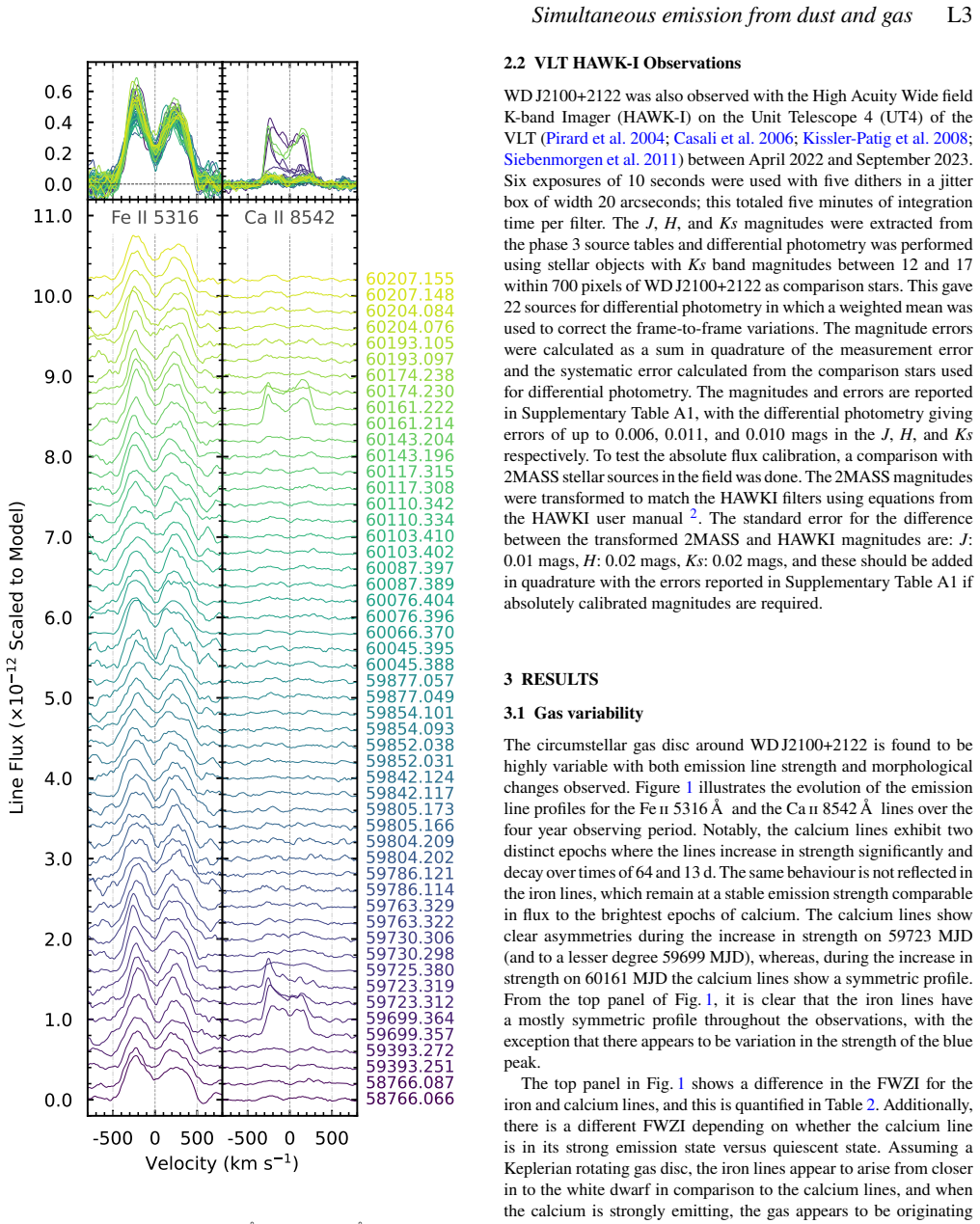
WDJ2100+2122 shows two flare events, peaking at MJD 59699 and 60161, in which the Ca II infrared triplet (8498, 8542, 8662 Å) and the Mg I 8806 Å line brighten severalfold while O I and Fe II lines remain nearly stable. On the same nights, HAWK-I photometry shows the Ks band brighter by up to 0.2 mags relative to its median, with weaker changes in J and H. The calcium-line flux and Ks flux are positively correlated (Pearson R = 0.8), and the calcium line flux decays over 64 days after the first event and 13 days after the second. The paper takes this as the first demonstration that circumstellar gas and dust emission are linked for any white dwarf, and argues that the simultaneous appearance is inconsistent with gas produced by sublimation of dust migrating inward under Poynting-Robertson drag, because that process predicts a delay of roughly 15 days. Collisions between planetesimals or between scattered material and the existing disc are presented as the natural common source.
Load-bearing premise
The paper's claim that dust and gas are produced together rests on two flare events chosen because the calcium lines were strongest, and the two-week observing cadence cannot rule out a delay of up to two weeks between the dust brightening and the gas brightening.
Editorial extensions
If this is right
- Each new correlated dust–gas burst around WDJ2100+2122 would confirm the collision origin and provide a direct measure of how often rocky material is delivered close to the white dwarf.
- The shortest-yet variability timescales, with Ks changes within a day and gas flux decaying within 13 days, imply that models of white dwarf debris discs must include stochastic, burst-like injection rather than steady-state evolution.
- The element-dependent flaring, with calcium and magnesium but not oxygen or iron, indicates a cooler outer disc region where collisions occur, while a hotter inner disc remains quiescent.
- Simultaneous optical spectroscopy and near-infrared photometry becomes a diagnostic tool for distinguishing collision vaporisation from sublimation-driven gas production around white dwarfs.
- For this object, the standard sublimation-based explanation of gas discs is disfavoured, so theoretical work on collisional cascades and impact vaporisation near white dwarfs becomes the relevant framework.
Reading between the lines
- If the collision origin generalizes, the rate of such flares around polluted white dwarfs could trace the rate of planetesimal impacts, offering a way to measure late-stage rocky delivery to white dwarfs over time.
- A testable extension is to search for a short time lag, hours to days, between dust and gas brightening at higher cadence; a zero lag would point to prompt vaporisation at the impact site, while a lag would locate where the debris is ground down.
- The 0.2-magnitude Ks brightening implies a modest increase in emitting dust area; combining that area change with the observed calcium line flux could quantify the collisional mass required per event.
- Observing other white dwarfs with both infrared excess and Ca II emission discs on a nightly cadence would show whether correlated flares are common or specific to WDJ2100+2122.
Signed reviews
Editorial analysis
A structured set of objections, weighed in public.
Referee Report
Summary. The paper reports a multi-epoch monitoring campaign of the polluted white dwarf WDJ2100+2122, combining VLT/X-shooter optical spectroscopy and VLT/HAWK-I near-infrared JHKs photometry obtained between 2019 and 2023. The calcium infrared triplet and the Mg I 8806 Å line show two strong flare-like episodes (at MJD 59699 and MJD 60161) with rises and decays on week-to-month timescales, while Fe II and O I lines remain comparatively stable. The near-infrared data show Ks-band brightenings of up to 0.2 mag at the same two epochs. The paper claims a positive correlation between the gas and dust emission (Pearson R = 0.8), interprets this as the first demonstration of near-simultaneous dust and gas production in a white dwarf debris disc, and argues that collisional production is more likely than steady sublimation of inflowing dust.
Significance. If the correlation claim holds, this is a genuinely new observational constraint on the debated origin of gas in white dwarf debris discs: it would show that gas and dust are generated in brief, linked events rather than by a steady sublimation flow, with implications for the collisional cascade scenario. The dataset itself is valuable: the X-shooter line fluxes and HAWK-I differential photometry are tabulated in full, the photometric errors are small (0.006–0.011 mag), and the paper is transparent about key limitations, including the statistically insignificant blackbody temperature changes and the two-week observing cadence. The central novelty, however, rests on a single correlation statistic that is not fully characterised, and the data contain epochs that complicate the simple simultaneous-burst picture.
major comments (3)
- [Section 3.3, Fig. 3, Tables A1/A2] The Pearson R = 0.8 between Ca line flux and Ks-band flux is reported without the number of paired epochs, a p-value, or a definition of which epochs enter the calculation. With roughly two dozen points and two dominant flare epochs, a rank or permutation test is needed to show the correlation is not driven solely by the two peak points. Moreover, the decline from the first event is inconsistent with a single linked burst: at MJD 59725 the Ca 8542 Å flux is still elevated (≈16 × 10−13 erg s−1 cm−2) while Ks = 15.308 mag, fainter than the median, and at MJD 59730 the Ca flux has returned to near-quiescence (≈8.5) while Ks has rebrightened to 15.212 mag. The paper should either quantify the correlation on all paired epochs with a significance test, or explicitly restrict the claim to the two peak epochs and justify that restriction.
- [Section 3.2 and 3.3] The paper notes that 'gas emission lines can occur in the near-infrared and may be contributing to a portion of the variability' (citing Owens et al. 2023), but it does not estimate the magnitude of this contamination in the J, H, and Ks bands. Because the central claim is that the near-infrared variability traces dust emission, the possibility that some of the Ks-band brightening arises from the same gaseous lines that are seen in the optical needs to be quantified or explicitly argued to be negligible using the line fluxes measured in the same campaign.
- [Section 4 (Discussion)] The text acknowledges that the two-week cadence leaves room for a delay of less than two weeks between dust and gas brightening, and that the PR-drag timescale for 0.1 μm dust is ≈15 days. Given that the dataset contains only two flare epochs and no high-cadence coverage of either event, the conclusion that the production is 'near-simultaneous' and that a common collisional origin is required goes beyond what the current data can establish. A delay of days, or even two independent but temporally close events, cannot be excluded; the paper should soften this claim or present a quantitative argument (e.g., a cross-correlation or a model of the decay light curve) that distinguishes simultaneity from coincidence.
minor comments (5)
- [Abstract and Section 4] The abstract uses 'near-simultaneous observations' to describe the spectroscopic and photometric data, while Section 4 defines 'simultaneous' as observations taken within a few hours. The two-week cadence of the campaign means that most paired epochs are separated by days, so the wording in the abstract should be clarified to distinguish the few same-night observations from the general sampling cadence.
- [Section 3.3] The statistic should be reported as 'Pearson r' rather than 'Pearson's R', and the sentence giving R = 0.8 should include the number of data points and the associated p-value or confidence interval.
- [Figures 2 and 3] The y-axis label 'Fx/Median(Fx)' is not defined in the text or caption; the reader must infer that Fx is the line flux or band flux. Please define the symbol in the caption.
- [Tables A1 and A2] Table A1 gives HAWK-I observation dates in calendar format while Table A2 uses MJD, making it unnecessarily difficult to match the photometry to the spectroscopy. Adding MJD columns to Table A1 (or dates to Table A2) would improve reproducibility.
- [References] The in-text citations 'Rogers et al. 2023' and 'Rogers et al. 2024' appear in the reference list as 'Rogers L. K., et al., 2023, MNRAS,' and 'Rogers L. K., et al., 2024, MNRAS,' without volume, page, or article identifier; these entries need to be completed.
Circularity Check
No significant circularity: the dust–gas correlation is an empirical observational claim supported by independent photometry and spectroscopy, not a fitted or self-citational construction.
full rationale
This paper reports an observational variability study, not a derivation in which an output is equivalent to an input by construction. The central claim—that the strongest dust and gas emission epochs are correlated—rests on independent HAWK-I near-infrared photometry and X-shooter optical spectroscopy, with the two data sets obtained on the same night during the peak epochs. No parameter is fitted to the correlation and then renamed a prediction; the blackbody temperatures fitted to the JHKs excesses are explicitly not used to support the conclusion, since the paper states that 'the median error on the temperature fits is 166K so a temperature increase in the emission peaks is not statistically significant.' The Pearson R value is a descriptive statistic computed from independent measurements, and any concern about its statistical robustness or the influence of the two bright epochs is a correctness or evidentiary issue, not a circularity issue. Citations to prior work by the authors supply stellar parameters, disc properties, and context, but the simultaneity claim is established from the new observations presented in this paper rather than by a load-bearing self-citation or an imported uniqueness theorem. Thus no step in the paper's argument reduces to its own inputs by definition or by citation.
Assumptions & free parameters
free parameters (1)
- Blackbody dust temperature and radius of the near-infrared excess =
T ~ 1190 K median, 1340/1280 K at the two peak epochs; radius ~23.5 R_WD
assumptions (4)
- domain assumption The model spectrum of WDJ2100+2122 from Rogers et al. (2023) is an accurate representation of the white dwarf photosphere, so subtracting it yields only circumstellar line flux.
- domain assumption Near-infrared JHKs variability is dominated by thermal dust emission, not by gas emission lines that fall in these bands.
- domain assumption The two bright epochs at MJD 59699 and 60161 are real astrophysical events whose alignment is not coincidence.
- domain assumption Keplerian rotation and the inclination from Owens et al. (2023) are adopted to convert FWZI measurements to orbital radii.
Cite this review
Pith. "Pith review of Simultaneous emission from dust and gas in the planetary debris orbiting a white dwarf." pith.science (2026). https://pith.science/paper/DO6UJEIT
@misc{pith2026241207647,
  author       = {Pith},
  title        = {Pith review of: Simultaneous emission from dust and gas in the planetary debris orbiting a white dwarf},
  year         = {2026},
  howpublished = {\url{https://pith.science/paper/DO6UJEIT}},
  note         = {Machine review of arXiv:2412.07647}
}
read the original abstract
There is increasing evidence for the presence and variability of circumstellar dust and gas around white dwarfs that are polluted with exoplanetary material, although the origin of this dust and gas remains debated. This paper presents the first near-simultaneous observations of both circumstellar dust (via broadband emission) and gas (via emission lines) around a polluted white dwarf. From the optical spectra the gaseous emission lines, notably the calcium infrared triplet and magnesium lines, show significant increases and decreases in their strength over timescales of weeks, while the oxygen and iron lines remain relatively stable. Near-infrared JHKs photometry reveals dust emission changes of up to 0.2 magnitudes in the Ks band over similar timescales, marking the shortest variability timescales observed to date. The two epochs with the strongest emission were correlated between the dust (Ks band brightening) and gas (strengthened calcium and magnesium lines), showing for the first time that the dust and gas must be produced near-simultaneously with a common origin, likely in collisions.
Figures


Forward citations
Cited by 1 Pith paper
-
The Effects of Magnetic Accretion on the Spatial Extent of White Dwarf Pollution
Magnetic channeling concentrates white dwarf pollution into small patches, makes metal lines vary as the star spins, and biases inferred accretion rates low.
Reference graph
Works this paper leans on
-
[1]
write newline
" write newline "" before.all 'output.state := FUNCTION fin.entry write newline FUNCTION new.block output.state before.all = 'skip after.block 'output.state := if FUNCTION new.sentence output.state after.block = 'skip output.state before.all = 'skip after.sentence 'output.state := if if FUNCTION not #0 #1 if FUNCTION and 'skip pop #0 if FUNCTION or pop #1...
-
[2]
E., Farihi J., Jura M., Song I., Weinberger A
Becklin E. E., Farihi J., Jura M., Song I., Weinberger A. J., Zuckerman B., 2005, @doi [ ] 10.1086/497826 , https://ui.adsabs.harvard.edu/abs/2005ApJ...632L.119B 632, L119
doi:10.1086/497826 2005
-
[3]
Blackman J. W., et al., 2021, @doi [ ] 10.1038/s41586-021-03869-6 , https://ui.adsabs.harvard.edu/abs/2021Natur.598..272B 598, 272
-
[4]
Brinkworth C. S., G \"a nsicke B. T., Girven J. M., Hoard D. W., Marsh T. R., Parsons S. G., Koester D., 2012, @doi [ ] 10.1088/0004-637X/750/1/86 , https://ui.adsabs.harvard.edu/abs/2012ApJ...750...86B 750, 86
-
[5]
Brouwers M. G., Bonsor A., Malamud U., 2022, @doi [ ] 10.1093/mnras/stab3009 , https://ui.adsabs.harvard.edu/abs/2022MNRAS.509.2404B 509, 2404
-
[6]
S., Iye M., eds, Society of Photo-Optical Instrumentation Engineers (SPIE) Conference Series Vol
Casali M., et al., 2006, in McLean I. S., Iye M., eds, Society of Photo-Optical Instrumentation Engineers (SPIE) Conference Series Vol. 6269, Ground-based and Airborne Instrumentation for Astronomy. p. 62690W, @doi 10.1117/12.670150
-
[7]
J., Tremblay P.-E., G \"a nsicke B
Cunningham T., Wheatley P. J., Tremblay P.-E., G \"a nsicke B. T., King G. W., Toloza O., Veras D., 2022, @doi [ ] 10.1038/s41586-021-04300-w , https://ui.adsabs.harvard.edu/abs/2022Natur.602..219C 602, 219
-
[8]
Debes J. H., Sigurdsson S., 2002, @doi [ ] 10.1086/340291 , https://ui.adsabs.harvard.edu/abs/2002ApJ...572..556D 572, 556
doi:10.1086/340291 2002
Show all 79 references
-
[9]
H., Kilic M., Faedi F., Shkolnik E
Debes J. H., Kilic M., Faedi F., Shkolnik E. L., Lopez-Morales M., Weinberger A. J., Slesnick C., West R. G., 2012, @doi [ ] 10.1088/0004-637X/754/1/59 , https://ui.adsabs.harvard.edu/abs/2012ApJ...754...59D 754, 59
2012 doi
-
[10]
C., Debes J
Dennihy E., Clemens J. C., Debes J. H., Dunlap B. H., Kilkenny D., O'Brien P. C., Fuchs J. T., 2017, @doi [ ] 10.3847/1538-4357/aa8ef2 , https://ui.adsabs.harvard.edu/abs/2017ApJ...849...77D 849, 77
2017 doi
-
[11]
C., Dunlap B
Dennihy E., Clemens J. C., Dunlap B. H., Fanale S. M., Fuchs J. T., Hermes J. J., 2018, @doi [ ] 10.3847/1538-4357/aaa89b , https://ui.adsabs.harvard.edu/abs/2018ApJ...854...40D 854, 40
2018 doi
-
[12]
Dennihy E., et al., 2020, @doi [ ] 10.3847/1538-4357/abc339 , https://ui.adsabs.harvard.edu/abs/2020ApJ...905....5D 905, 5
2020 doi
-
[13]
Dominik C., Decin G., 2003, @doi [ ] 10.1086/379169 , https://ui.adsabs.harvard.edu/abs/2003ApJ...598..626D 598, 626
2003 doi
-
[15]
Farihi J., et al., 2018, @doi [ ] 10.1093/mnras/sty2331 , https://ui.adsabs.harvard.edu/abs/2018MNRAS.481.2601F 481, 2601
2018 doi
-
[16]
Farihi J., et al., 2022, @doi [ ] 10.1093/mnras/stab3475 , https://ui.adsabs.harvard.edu/abs/2022MNRAS.511.1647F 511, 1647
2022 doi
-
[17]
M., Ballester P., Forchi V., Garc \' a-Dabl \'o C
Freudling W., Romaniello M., Bramich D. M., Ballester P., Forchi V., Garc \' a-Dabl \'o C. E., Moehler S., Neeser M. J., 2013, @doi [ ] 10.1051/0004-6361/201322494 , https://ui.adsabs.harvard.edu/abs/2013A&A...559A..96F 559, A96
2013 doi
-
[18]
T., Marsh T
G \"a nsicke B. T., Marsh T. R., Southworth J., Rebassa-Mansergas A., 2006, @doi [Science] 10.1126/science.1135033 , https://ui.adsabs.harvard.edu/abs/2006Sci...314.1908G 314, 1908
2006 doi
-
[19]
T., Marsh T
G \"a nsicke B. T., Marsh T. R., Southworth J., 2007, @doi [ ] 10.1111/j.1745-3933.2007.00343.x , https://ui.adsabs.harvard.edu/abs/2007MNRAS.380L..35G 380, L35
2007
-
[20]
T., Koester D., Marsh T
G \"a nsicke B. T., Koester D., Marsh T. R., Rebassa-Mansergas A., Southworth J., 2008, @doi [ ] 10.1111/j.1745-3933.2008.00565.x , https://ui.adsabs.harvard.edu/abs/2008MNRAS.391L.103G 391, L103
2008
-
[21]
T., et al., 2016, @doi [ ] 10.3847/2041-8205/818/1/L7 , https://ui.adsabs.harvard.edu/abs/2016ApJ...818L...7G 818, L7
G \"a nsicke B. T., et al., 2016, @doi [ ] 10.3847/2041-8205/818/1/L7 , https://ui.adsabs.harvard.edu/abs/2016ApJ...818L...7G 818, L7
2016 doi
-
[22]
T., Schreiber M
G \"a nsicke B. T., Schreiber M. R., Toloza O., Gentile Fusillo N. P., Koester D., Manser C. J., 2019, @doi [ ] 10.1038/s41586-019-1789-8 , https://ui.adsabs.harvard.edu/abs/2019Natur.576...61G 576, 61
2019 doi
-
[23]
P., et al., 2019, @doi [ ] 10.1093/mnras/sty3016 , https://ui.adsabs.harvard.edu/abs/2019MNRAS.482.4570G 482, 4570
Gentile Fusillo N. P., et al., 2019, @doi [ ] 10.1093/mnras/sty3016 , https://ui.adsabs.harvard.edu/abs/2019MNRAS.482.4570G 482, 4570
2019 doi
-
[24]
P., et al., 2021, @doi [ ] 10.1093/mnras/stab992 , https://ui.adsabs.harvard.edu/abs/2021MNRAS.504.2707G 504, 2707
Gentile Fusillo N. P., et al., 2021, @doi [ ] 10.1093/mnras/stab992 , https://ui.adsabs.harvard.edu/abs/2021MNRAS.504.2707G 504, 2707
2021 doi
-
[25]
A., Kutra T., Wu Y., 2024, @doi [ ] 10.3847/1538-3881/ad3216 , https://ui.adsabs.harvard.edu/abs/2024AJ....167..236G 167, 236
Goksu O. A., Kutra T., Wu Y., 2024, @doi [ ] 10.3847/1538-3881/ad3216 , https://ui.adsabs.harvard.edu/abs/2024AJ....167..236G 167, 236
2024 doi
-
[26]
A., Hermes J
Guidry J. A., Hermes J. J., De K., Ould Rouis L. B., Ewing B. B., Kaiser B. C., 2024, @doi [ ] 10.3847/1538-4357/ad5be7 , https://ui.adsabs.harvard.edu/abs/2024ApJ...972..126G 972, 126
2024 doi
-
[27]
Hartmann S., Nagel T., Rauch T., Werner K., 2011, @doi [ ] 10.1051/0004-6361/201116625 , https://ui.adsabs.harvard.edu/abs/2011A&A...530A...7H 530, A7
2011 doi
-
[28]
Hartmann S., Nagel T., Rauch T., Werner K., 2014, @doi [ ] 10.1051/0004-6361/201423690 , https://ui.adsabs.harvard.edu/abs/2014A&A...571A..44H 571, A44
2014 doi
-
[29]
Jura M., 2003, @doi [ ] 10.1086/374036 , https://ui.adsabs.harvard.edu/abs/2003ApJ...584L..91J 584, L91
2003 doi
-
[30]
Jura M., 2008, @doi [ ] 10.1088/0004-6256/135/5/1785 , https://ui.adsabs.harvard.edu/abs/2008AJ....135.1785J 135, 1785
2008 doi
-
[31]
D., 2014, @doi [Annual Review of Earth and Planetary Sciences] 10.1146/annurev-earth-060313-054740 , https://ui.adsabs.harvard.edu/abs/2014AREPS..42...45J 42, 45
Jura M., Young E. D., 2014, @doi [Annual Review of Earth and Planetary Sciences] 10.1146/annurev-earth-060313-054740 , https://ui.adsabs.harvard.edu/abs/2014AREPS..42...45J 42, 45
2014 doi
-
[32]
Jura M., Farihi J., Zuckerman B., 2007, @doi [ ] 10.1086/518767 , https://ui.adsabs.harvard.edu/abs/2007ApJ...663.1285J 663, 1285
2007 doi
-
[33]
J., Bromley B
Kenyon S. J., Bromley B. C., 2017a, @doi [ ] 10.3847/1538-4357/aa7b85 , https://ui.adsabs.harvard.edu/abs/2017ApJ...844..116K 844, 116
-
[34]
J., Bromley B
Kenyon S. J., Bromley B. C., 2017b, @doi [ ] 10.3847/1538-4357/aa9570 , https://ui.adsabs.harvard.edu/abs/2017ApJ...850...50K 850, 50
-
[35]
K., Winget D
Kilic M., von Hippel T., Leggett S. K., Winget D. E., 2006, @doi [ ] 10.1086/504682 , https://ui.adsabs.harvard.edu/abs/2006ApJ...646..474K 646, 474
2006 doi
-
[36]
Kissler-Patig M., et al., 2008, @doi [ ] 10.1051/0004-6361:200809910 , https://ui.adsabs.harvard.edu/abs/2008A&A...491..941K 491, 941
2008 doi
-
[37]
T., Farihi J., 2014, @doi [ ] 10.1051/0004-6361/201423691 , https://ui.adsabs.harvard.edu/abs/2014A&A...566A..34K 566, A34
Koester D., G \"a nsicke B. T., Farihi J., 2014, @doi [ ] 10.1051/0004-6361/201423691 , https://ui.adsabs.harvard.edu/abs/2014A&A...566A..34K 566, A34
2014 doi
-
[38]
Lai S., et al., 2021, @doi [ ] 10.3847/1538-4357/ac1354 , https://ui.adsabs.harvard.edu/abs/2021ApJ...920..156L 920, 156
2021 doi
-
[39]
A., Vanderburg A., Stevenson K
Limbach M. A., Vanderburg A., Stevenson K. B., Blouin S., Morley C., Lustig-Yaeger J., Soares-Furtado M., Janson M., 2022, @doi [ ] 10.1093/mnras/stac2823 , https://ui.adsabs.harvard.edu/abs/2022MNRAS.517.2622L 517, 2622
2022 doi
-
[40]
A., et al., 2024, @doi [ ] 10.3847/2041-8213/ad74ed , https://ui.adsabs.harvard.edu/abs/2024ApJ...973L..11L 973, L11
Limbach M. A., et al., 2024, @doi [ ] 10.3847/2041-8213/ad74ed , https://ui.adsabs.harvard.edu/abs/2024ApJ...973L..11L 973, L11
2024 doi
-
[41]
Malamud U., Grishin E., Brouwers M., 2021, @doi [ ] 10.1093/mnras/staa3940 , https://ui.adsabs.harvard.edu/abs/2021MNRAS.501.3806M 501, 3806
2021 doi
-
[42]
J., et al., 2016a, @doi [ ] 10.1093/mnras/stv2603 , https://ui.adsabs.harvard.edu/abs/2016MNRAS.455.4467M 455, 4467
Manser C. J., et al., 2016a, @doi [ ] 10.1093/mnras/stv2603 , https://ui.adsabs.harvard.edu/abs/2016MNRAS.455.4467M 455, 4467
-
[43]
J., G \"a nsicke B
Manser C. J., G \"a nsicke B. T., Koester D., Marsh T. R., Southworth J., 2016b, @doi [ ] 10.1093/mnras/stw1760 , https://ui.adsabs.harvard.edu/abs/2016MNRAS.462.1461M 462, 1461
-
[44]
J., et al., 2019, @doi [Science] 10.1126/science.aat5330 , https://ui.adsabs.harvard.edu/abs/2019Sci...364...66M 364, 66
Manser C. J., et al., 2019, @doi [Science] 10.1126/science.aat5330 , https://ui.adsabs.harvard.edu/abs/2019Sci...364...66M 364, 66
2019 doi
-
[45]
J., G \"a nsicke B
Manser C. J., G \"a nsicke B. T., Gentile Fusillo N. P., Ashley R., Breedt E., Hollands M., Izquierdo P., Pelisoli I., 2020, @doi [ ] 10.1093/mnras/staa359 , https://ui.adsabs.harvard.edu/abs/2020MNRAS.493.2127M 493, 2127
2020 doi
-
[46]
Melis C., Jura M., Albert L., Klein B., Zuckerman B., 2010, @doi [ ] 10.1088/0004-637X/722/2/1078 , https://ui.adsabs.harvard.edu/abs/2010ApJ...722.1078M 722, 1078
2010 doi
-
[47]
Melis C., et al., 2012, @doi [ ] 10.1088/2041-8205/751/1/L4 , https://ui.adsabs.harvard.edu/abs/2012ApJ...751L...4M 751, L4
2012 doi
-
[48]
E., Weinberger A., Zuckerman B., Dufour P., 2020, @doi [ ] 10.3847/1538-4357/abbdfa , https://ui.adsabs.harvard.edu/abs/2020ApJ...905...56M 905, 56
Melis C., Klein B., Doyle A. E., Weinberger A., Zuckerman B., Dufour P., 2020, @doi [ ] 10.3847/1538-4357/abbdfa , https://ui.adsabs.harvard.edu/abs/2020ApJ...905...56M 905, 56
2020 doi
-
[49]
Meng H. Y. A., et al., 2014, @doi [Science] 10.1126/science.1255153 , https://ui.adsabs.harvard.edu/abs/2014Sci...345.1032M 345, 1032
2014 doi
-
[50]
D., Rafikov R
Metzger B. D., Rafikov R. R., Bochkarev K. V., 2012, @doi [ ] 10.1111/j.1365-2966.2012.20895.x , https://ui.adsabs.harvard.edu/abs/2012MNRAS.423..505M 423, 505
2012
-
[51]
E., et al., 2024, @doi [ ] 10.3847/2041-8213/ad2348 , https://ui.adsabs.harvard.edu/abs/2024ApJ...962L..32M 962, L32
Mullally S. E., et al., 2024, @doi [ ] 10.3847/2041-8213/ad2348 , https://ui.adsabs.harvard.edu/abs/2024ApJ...962L..32M 962, L32
2024 doi
-
[52]
Owens D., et al., 2023, @doi [ ] 10.3847/1538-3881/accc25 , https://ui.adsabs.harvard.edu/abs/2023AJ....166....5O 166, 5
2023 doi
-
[53]
Pirard J.-F., et al., 2004, in Moorwood A. F. M., Iye M., eds, Society of Photo-Optical Instrumentation Engineers (SPIE) Conference Series Vol. 5492, Ground-based Instrumentation for Astronomy. pp 1763--1772, @doi 10.1117/12.578293
2004 doi
-
[54]
Poulsen S., et al., 2024, @doi [ ] 10.3847/1538-3881/ad374c , https://ui.adsabs.harvard.edu/abs/2024AJ....167..257P 167, 257
2024 doi
-
[55]
R., 2011, @doi [ ] 10.1111/j.1745-3933.2011.01096.x , https://ui.adsabs.harvard.edu/abs/2011MNRAS.416L..55R 416, L55
Rafikov R. R., 2011, @doi [ ] 10.1111/j.1745-3933.2011.01096.x , https://ui.adsabs.harvard.edu/abs/2011MNRAS.416L..55R 416, L55
2011
-
[56]
M., Torres S., 2019, @doi [ ] 10.1093/mnras/stz2423 , https://ui.adsabs.harvard.edu/abs/2019MNRAS.489.3990R 489, 3990
Rebassa-Mansergas A., Solano E., Xu S., Rodrigo C., Jim \'e nez-Esteban F. M., Torres S., 2019, @doi [ ] 10.1093/mnras/stz2423 , https://ui.adsabs.harvard.edu/abs/2019MNRAS.489.3990R 489, 3990
2019 doi
-
[57]
K., Xu S., Bonsor A., Hodgkin S., Su K
Rogers L. K., Xu S., Bonsor A., Hodgkin S., Su K. Y. L., von Hippel T., Jura M., 2020, @doi [ ] 10.1093/mnras/staa873 , https://ui.adsabs.harvard.edu/abs/2020MNRAS.494.2861R 494, 2861
2020 doi
-
[58]
K., et al., 2023, @doi [ ] 10.1093/mnras/stad3557 , https://ui.adsabs.harvard.edu/abs/2023MNRAS.tmp.3437R
Rogers L. K., et al., 2023, @doi [ ] 10.1093/mnras/stad3557 , https://ui.adsabs.harvard.edu/abs/2023MNRAS.tmp.3437R
2023 doi
-
[59]
K., et al., 2024, @doi [ ] 10.1093/mnras/stae1520 , https://ui.adsabs.harvard.edu/abs/2024MNRAS.tmp.1530R
Rogers L. K., et al., 2024, @doi [ ] 10.1093/mnras/stae1520 , https://ui.adsabs.harvard.edu/abs/2024MNRAS.tmp.1530R
2024 doi
-
[60]
Siebenmorgen R., Carraro G., Valenti E., Petr-Gotzens M., Brammer G., Garcia E., Casali M., 2011, The Messenger, https://ui.adsabs.harvard.edu/abs/2011Msngr.144....9S 144, 9
2011
-
[61]
Steele A., Debes J., Xu S., Yeh S., Dufour P., 2021, @doi [ ] 10.3847/1538-4357/abc262 , https://ui.adsabs.harvard.edu/abs/2021ApJ...911...25S 911, 25
2021 doi
-
[62]
G., 2019, MNRAS:L, 484, L109
Swan A., Farihi J., Wilson T. G., 2019, MNRAS:L, 484, L109
2019
-
[63]
G., Parsons S
Swan A., Farihi J., Wilson T. G., Parsons S. G., 2020, @doi [ ] 10.1093/mnras/staa1688 , https://ui.adsabs.harvard.edu/abs/2020MNRAS.496.5233S 496, 5233
2020 doi
-
[64]
J., Farihi J., Dennihy E., G \"a nsicke B
Swan A., Kenyon S. J., Farihi J., Dennihy E., G \"a nsicke B. T., Hermes J. J., Melis C., von Hippel T., 2021, @doi [ ] 10.1093/mnras/stab1738 , https://ui.adsabs.harvard.edu/abs/2021MNRAS.506..432S 506, 432
2021 doi
-
[65]
Swan A., Farihi J., Su K. Y. L., Desch S. J., 2024, @doi [ ] 10.1093/mnrasl/slad198 , https://ui.adsabs.harvard.edu/abs/2024MNRAS.529L..41S 529, L41
2024 doi
-
[66]
P., et al., 2021, @doi [ ] 10.3847/1538-4357/ac0822 , https://ui.adsabs.harvard.edu/abs/2021ApJ...917...41V 917, 41
Vanderbosch Z. P., et al., 2021, @doi [ ] 10.3847/1538-4357/ac0822 , https://ui.adsabs.harvard.edu/abs/2021ApJ...917...41V 917, 41
2021 doi
-
[67]
A., Rappaport S., Bieryla A., Irwin J., et al., 2015, Nature, 526, 546
Vanderburg A., Johnson J. A., Rappaport S., Bieryla A., Irwin J., et al., 2015, Nature, 526, 546
2015
-
[68]
Vanderburg A., et al., 2020, @doi [ ] 10.1038/s41586-020-2713-y , https://ui.adsabs.harvard.edu/abs/2020Natur.585..363V 585, 363
2020 doi
-
[69]
Vernet J., et al., 2011, @doi [ ] 10.1051/0004-6361/201117752 , https://ui.adsabs.harvard.edu/abs/2011A&A...536A.105V 536, A105
2011 doi
-
[70]
Wang T.-g., et al., 2019, @doi [ ] 10.3847/2041-8213/ab53ed , https://ui.adsabs.harvard.edu/abs/2019ApJ...886L...5W 886, L5
2019 doi
-
[71]
J., G \"a nsicke B
Wilson D. J., G \"a nsicke B. T., Koester D., Raddi R., Breedt E., Southworth J., Parsons S. G., 2014, @doi [ ] 10.1093/mnras/stu1876 , https://ui.adsabs.harvard.edu/abs/2014MNRAS.445.1878W 445, 1878
2014 doi
-
[72]
J., G \"a nsicke B
Wilson D. J., G \"a nsicke B. T., Koester D., Toloza O., Pala A. F., Breedt E., Parsons S. G., 2015, @doi [ ] 10.1093/mnras/stv1201 , https://ui.adsabs.harvard.edu/abs/2015MNRAS.451.3237W 451, 3237
2015 doi
-
[73]
G., Farihi J., G \"a nsicke B
Wilson T. G., Farihi J., G \"a nsicke B. T., Swan A., 2019, @doi [ ] 10.1093/mnras/stz1050 , https://ui.adsabs.harvard.edu/abs/2019MNRAS.487..133W 487, 133
2019 doi
-
[74]
Xu S., Jura M., 2014, @doi [ ] 10.1088/2041-8205/792/2/L39 , https://ui.adsabs.harvard.edu/abs/2014ApJ...792L..39X 792, L39
2014 doi
-
[75]
Xu S., Jura M., Dufour P., Zuckerman B., 2016, @doi [ ] 10.3847/2041-8205/816/2/L22 , https://ui.adsabs.harvard.edu/abs/2016ApJ...816L..22X 816, L22
2016 doi
-
[76]
Xu S., et al., 2018, @doi [ ] 10.3847/1538-4357/aadcfe , https://ui.adsabs.harvard.edu/abs/2018ApJ...866..108X 866, 108
2018 doi
-
[77]
Xu S., Lai S., Dennihy E., 2020, @doi [ ] 10.3847/1538-4357/abb3fc , https://ui.adsabs.harvard.edu/abs/2020ApJ...902..127X 902, 127
2020 doi
-
[78]
Xu S., et al., 2024, @doi [ ] 10.3847/1538-3881/ad3737 , https://ui.adsabs.harvard.edu/abs/2024AJ....167..248X 167, 248
2024 doi
-
[79]
N., H \"u nsch M., 2003, @doi [ ] 10.1086/377492 , https://ui.adsabs.harvard.edu/abs/2003ApJ...596..477Z 596, 477
Zuckerman B., Koester D., Reid I. N., H \"u nsch M., 2003, @doi [ ] 10.1086/377492 , https://ui.adsabs.harvard.edu/abs/2003ApJ...596..477Z 596, 477
2003 doi
-
[80]
Zuckerman B., Melis C., Klein B., Koester D., Jura M., 2010, @doi [ ] 10.1088/0004-637X/722/1/725 , https://ui.adsabs.harvard.edu/abs/2010ApJ...722..725Z 722, 725
2010 doi
Reviewed August 11, 2026 · model on record in the stance chip above.
Discussion (0). Continue with ORCID to comment.