REVIEW 4 major objections 3 minor 123 references
Considering contact forces during the formation of planetesimals by gravitational collapse: mutual orbits, spin states, and shapes
T0 review · 4 major / 3 minor · reviewed 2026-08-06 · deepseek-v4-flash
Pith's one-line read Simulating planetesimal collapse with contact physics yields first predictions of spins and shapes.
desk verdict First resolved spin/shape/tight-binary outcomes from SSDEM collapse are worth reading; the 1-AU-to-Kuiper-Belt scaling is the main caveat. read the letter →
The pith
A machine-rendered reading of the paper's core claim, the machinery that carries it, and where it could break.
The reading
What carries the argument
The soft-sphere discrete element method (SSDEM) within the PKDGRAV N-body integrator is the central tool. Instead of treating collisions as perfect mergers of inflated particles, SSDEM simulates contact forces with spring-dashpot models, friction, and restitution, allowing super-particles to rest, roll, bounce, and aggregate into realistic, volume-filling planetesimals. This enables the resolution of shapes, spins, and tight binary orbits, and the modeling of both accretion and decretion during collapse. The simulations use a small timestep of 4.7 s at 1 AU, with the cloud collapse timescale set by the heliocentric distance; they show that the choice of orbit does not affect outcomes because collision velocities scale with surface escape velocity.
What would settle it
A direct test would be to run the same gravitational-collapse simulations at a heliocentric distance of 30 AU (or with a different gas drag environment) and compare the resulting binary orbits, spins, and shapes to the 1 AU simulations; if the outcomes differ significantly, the assumption that orbit choice does not affect accreted properties is invalidated.
Extended reading notes
Core claim
The central claim is that SSDEM can model the collapse of a cloud of super-particles into planetesimals while tracking mutual orbits, spin states, and shapes, and that the resulting systems match and extend earlier perfect-merger results. Simulations produce many binary systems per cloud, with the most massive ones on tight, low-inclination orbits (a/RHill ~ 0.02–0.15, i ≲ 15°, e ≲ 0.40), while less massive systems span a wider range. Newly formed planetesimals spin with a mean period near 10 hours, with the largest objects rotating faster when formed from slowly rotating clouds. Six shape classes emerge—spherical, oblate, top-shaped, flattened, egg-shaped, and prolate—with the most massive planetesimals typically spherical or oblate. The shapes correspond to low internal friction angles (ϕ ≲ 10°), indicating relaxation toward a low-strength state during collapse.
Load-bearing premise
The load-bearing premise is that the exact heliocentric orbit of the collapsing cloud does not matter because collision velocities scale with surface escape velocity, so collapse simulations run at 1 AU correctly represent collapse in the Kuiper Belt at 30 AU.
Editorial extensions
If this is right
- If the method is accepted, the simulated spin and shape distributions become the first direct predictions of planetesimal properties from gravitational collapse, testable against asteroid and Kuiper Belt observations.
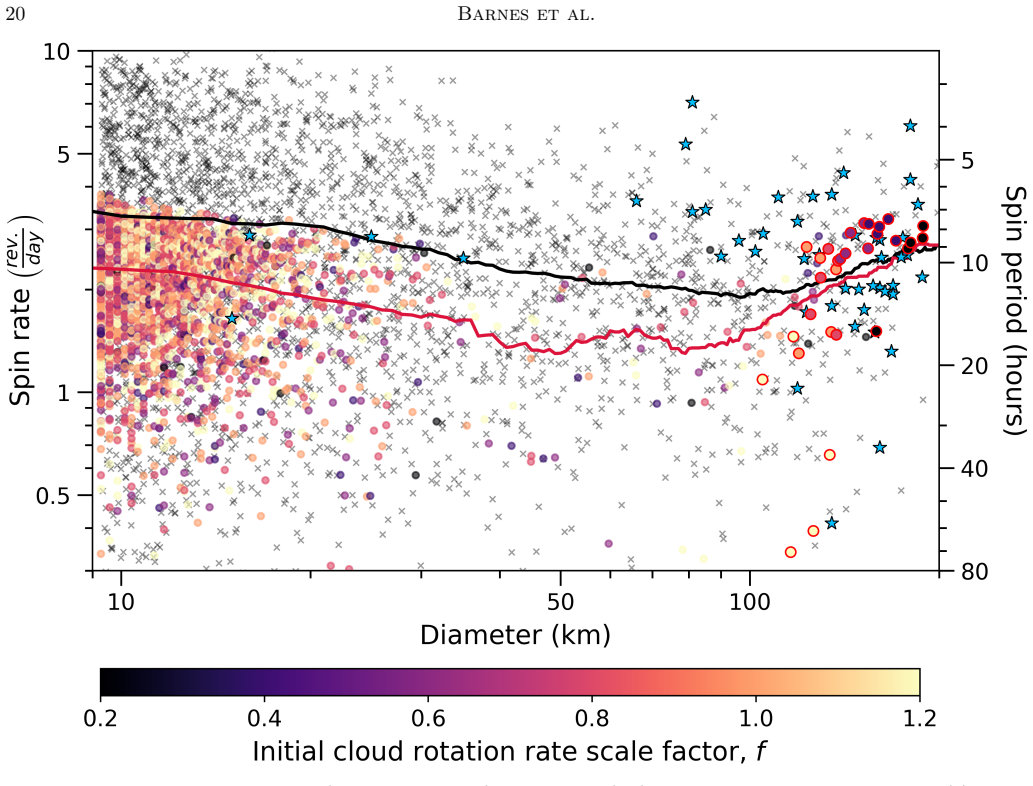
- The match between simulated large-planetesimal spins (7–70 hours) and observed large asteroid and trans-Neptunian spins supports the hypothesis that these spins are primordial, set at formation.
- The finding that small simulated planetesimals spin slower than comparable asteroids by about 5 hours implies that collisional evolution in the Main Belt has accelerated rotation over 4.5 Gyr.
- The prevalence of spherical and oblate shapes with low internal friction angles suggests that collapse assembles bodies near relaxed, low-strength states, informing theories of rubble-pile structure.
- The ability to form many tight binaries per cloud, inaccessible to perfect-merger models, strengthens the gravitational-collapse explanation for the binary fraction in the cold classical Kuiper Belt.
Reading between the lines
- The paper's use of a single cloud mass and orbit implies that spin and shape predictions depend primarily on cloud angular momentum, not location or mass; extending to a range of cloud masses and orbits would test whether the ~10-hour rotation scale is universal.
- The absence of simulated rotators with periods under about 6 hours, while observed small asteroids spin down to ~2.4 hours, could indicate a formation limit or a missing process; targeted simulations with different initial angular momentum distributions could distinguish these.
- The shape taxonomy relies on by-eye classification; a quantitative, unsupervised classification of the full 793-object sample would reveal whether the shape classes are discrete or continuous, sharpening comparisons to observed asteroids.
- The comparison to trans-Neptunian binaries implicitly assumes alignment of the mutual orbital plane with the cloud's angular momentum; real clouds may have a spread in orientations, which would broaden the inclination distributions.
Editorial analysis
A structured set of objections, weighed in public.
Referee Report
Summary. The paper applies the soft-sphere discrete element method (SSDEM) within PKDGRAV to simulate the gravitational collapse of 10^5 super-particle clouds at 1 AU, with the stated goal of predicting the mutual orbits, spin states, and shapes of newly formed planetesimals. Two simulation suites are run: one varying the initial cloud rotation scale factor f at fixed contact parameters, and one varying the coefficients of restitution and friction at two rotation rates. The authors report that SSDEM reproduces the binary mass ratios and accretion efficiencies of earlier perfect-merger models while additionally producing resolved spins, shapes, and tighter binary orbits. The simulated binary orbit properties are compared with observed trans-Neptunian binaries, and the spin and shape distributions are compared with asteroid and Kuiper Belt observations. The paper concludes that gravitational collapse can directly produce the observed ranges of binary orbits and that the simulated spin and shape statistics are the first direct predictions of these properties from this formation channel.
Significance. If the results hold, this is a substantial methodological advance: it is the first SSDEM treatment of pebble-cloud gravitational collapse that resolves planetesimal spins, shapes, and tight binary orbits, and it makes falsifiable predictions that can be compared with relict Kuiper Belt and asteroid populations. The work has concrete strengths: it explicitly validates against prior perfect-merger simulations, uses a well-established SSDEM code lineage, and compares rather than fits to observations, so there is no circularity in the central comparison. The paper also correctly identifies and discusses several limitations, including the lack of very tight observed binaries in the simulations and the absence of collisional evolution in the spin predictions. However, the external validity of the spin and shape predictions depends on an untested environmental assumption (1 AU vs 30 AU), and some of the headline reporting is internally inconsistent; these issues need to be addressed before the observational comparisons can be taken as secure.
major comments (4)
- [Section 2] The claim that "the choice of the cloud's heliocentric orbit does not have a significant effect on the accreted planetesimal properties" is load-bearing for the paper's comparisons to Kuiper Belt observations in Figures 8, 9, 11, and 16, yet it is supported only by the scaling argument that collision velocities scale with surface escape velocity. No simulation at 30 AU or with a controlled variation of heliocentric distance is presented, and the model omits gas drag and the changing ratio of the heliocentric tidal field to the cloud's self-gravity. Because the novel spin and shape predictions are the central contribution, this assumption needs a dedicated numerical test, even a single 30 AU run or a controlled variation of a_sun, or the observational comparisons must be explicitly qualified as conditional on the environment being dynamically equivalent.
- [Abstract and Section 3.5] The abstract states that "Newly-formed planetesimals exhibit 10-hr rotation periods on average," but Section 3.5 reports mean rotation periods of 12.9 hr (sigma = 8.8 hr) and 13.3 hr (sigma = 8.5 hr) for the two simulation suites. The 10-hr value appears to describe only the largest planetesimals, or the comparison populations, rather than the full simulated sample. The abstract should be corrected so that the headline number matches the reported statistics.
- [Section 3.6] The six shape categories and the frequencies in Table 4 are assigned "by eye" (stated twice in the text), with no quantitative decision rule and no reproducibility check. Because the shape frequencies are a novel headline result, the classification should be made reproducible—for example, by defining thresholds on the measured oblateness gamma and prolateness beta plus an additional metric for ridge or egg-like features—or by releasing the labeled dataset and classification code alongside the processed data.
- [Section 2.1] The normal spring constant is chosen so that maximum particle overlaps are about 20%, deliberately relaxing the <1% criterion used in prior SSDEM work (Schwartz et al. 2012). Since the paper's new spin and shape results emerge directly from contact-force resolution, a convergence test with a stiffer spring, at least for one representative rotation rate and contact-physics case, is needed to rule out an artifact of the soft contact model.
minor comments (3)
- [Figure 16] The text refers to "286958 Arrokoth" but the correct Minor Planet Center designation is 486958 Arrokoth.
- [Section 1] There is a small typo in the introduction: "so that the they can rest upon each other" should read "so that they can rest upon each other."
- [Section 3.5] The statement that the largest simulated planetesimals have a "similar mean spin period" to observed populations is based on a subset of the simulated population; please clarify in the text that the 10-hr figure refers to the largest bodies rather than the full sample.
Circularity Check
No significant circularity: spin, shape, and orbit statistics emerge from SSDEM dynamics and are compared, not fitted, to observations; code validation lineage is external and lab-tested.
full rationale
The paper's central outputs—planetesimal spins, shapes, mutual orbits, and multiplicities—are generated by forward SSDEM simulations whose initial conditions and contact parameters are chosen from prior modeling conventions or varied in a deliberate parameter sweep, not tuned to reproduce any observed spin, shape, or orbit statistic. The comparison to asteroids, trans-Neptunian objects, and Arrokoth is a posteriori benchmarking, and the text explicitly acknowledges mismatches (e.g., lack of sub-7-hour rotators, inability to reach the tightest observed binary orbits). The SSDEM implementation itself is cited to Schwartz et al. (2012), co-authored by one of the present authors, but the paper also cites validation by direct comparison to laboratory experiments (Schwartz et al. 2013), which is independent external evidence rather than a definitional loop. The reproduction of Nesvorny et al. (2010) and Robinson et al. (2020) experiments uses their initial-condition setup as a cross-check, but the resulting binary populations are compared, not fitted, to observations. The main physical assumption—that collapse at 1 AU reproduces Kuiper Belt collapse because collision velocities scale with surface escape velocity—is an unsupported and potentially risky approximation (gas drag and heliocentric tides differ), but it is a correctness concern, not a circularity: no observed quantity is encoded in the model to force the outcome. The by-eye shape classification is subjective but does not constitute a reduction of a prediction to an input. No fitted parameter is renamed as a prediction, and no load-bearing claim rests solely on a self-citation whose content is itself the target result. The derivation chain is therefore self-contained with respect to the empirical comparisons it makes.
Assumptions & free parameters
free parameters (5)
- normal spring constant k_n =
1e11 kg s^-2
- coefficients of normal and tangential restitution epsilon_n = epsilon_t =
0.5 or 0.9
- coefficients of static, rolling, and twisting friction mu_s = mu_r = mu_t =
0.0 or 0.5
- initial cloud rotation scale factor f =
0.2 to 1.2 in steps of 0.2 (Suite 1); 0.4 and 1.0 (Suite 2)
- minimum particle counts for planetesimal and shape classification =
10, 50, 100, and 300 particles
assumptions (7)
- standard math Newtonian gravity and the PKDGRAV leapfrog integrator with a k-d tree are accurate for this collapse timescale.
- domain assumption SSDEM spring-dashpot contact model with normal stiffness 1e11 kg/s^2, allowing roughly 20 percent particle overlap, captures aggregate-scale contact physics.
- domain assumption Super-particles represent sub-clouds of pebbles; effective contact coefficients need not match pebble-grain physics.
- domain assumption Initial clouds are uniform-density spheres of radius 0.6 Hill radius in solid-body rotation, following Nesvorny et al. (2010) and Robinson et al. (2020).
- domain assumption Gravitational collapse at 1 AU produces the same planetesimal properties as collapse at 30 AU.
- ad hoc to paper An aggregate of at least 10 particles is a planetesimal, and at least 50 particles are required for shape classification.
- domain assumption Mohr-Coulomb yield criterion without cohesion is a reasonable model for the shape limits of cohesionless aggregate planetesimals.
Cite this review
Pith. "Pith review of Considering contact forces during the formation of planetesimals by gravitational collapse: mutual orbits, spin states, and shapes." pith.science (2026). https://pith.science/paper/DODXQ7X3
@misc{pith2026250716739,
  author       = {Pith},
  title        = {Pith review of: Considering contact forces during the formation of planetesimals by gravitational collapse: mutual orbits, spin states, and shapes},
  year         = {2026},
  howpublished = {\url{https://pith.science/paper/DODXQ7X3}},
  note         = {Machine review of arXiv:2507.16739}
}
read the original abstract
In this work, we apply a soft-sphere discrete element method (SSDEM) within the PKDGRAV N-body integrator to investigate the formation of planetesimal systems through the gravitational collapse of clouds of super-particles. Previously published numerical models have demonstrated that the gravitational collapse of pebble clouds is an efficient pathway to produce binary planetesimal systems. However, such investigations were limited by their use of a perfect-merger and inflated-radii super-particle approach, which inhibits any analysis of planetesimal shapes and spin states, precludes the formation of the tightest binary orbits, and produces significantly under-dense planetesimals. The SSDEM enables super-particles to rest upon each other through mutual surface penetration and by simulating contact physics. Super-particles do not need to be inflated and collisions are not treated as perfect mergers; we can thus track the evolution of planetesimal shapes, spins, and tight binary orbits. We demonstrate that the SSDEM is an excellent method to model the collapse process, and is capable of producing many binary planetesimal systems from a single cloud. Our results confirm the findings of previously published perfect-merging models while also producing novel results about planetesimal spin and shape properties. Newly-formed planetesimals exhibit 10-hr rotation periods on average and can be characterized by a wide variety of shapes (spherical, oblate, top-shaped, flattened, egg-shaped, or prolate), with the most-massive planetesimals primarily forming as spheres and oblate-spheroids.
Figures


Figures from the paper (12 more)




Reference graph
Works this paper leans on
-
[1]
Agresti, A., & Coull, B. A. 1998, The American Statistician, 52, 119. http://www.jstor.org/stable/2685469
arXiv 1998
-
[2]
F., Zhang , Y., Richardson , D
Agrusa , H. F., Zhang , Y., Richardson , D. C., et al. 2024, The Planetary Science Journal, 5, 54, 10.3847/PSJ/ad206b
-
[3]
1964, , 3, 52, 10.1016/0019-1035(64)90030-2
Alfv \'e n , H. 1964, , 3, 52, 10.1016/0019-1035(64)90030-2
-
[4]
C., Michel , P., & Schwartz , S
Ballouz , R.-L., Richardson , D. C., Michel , P., & Schwartz , S. R. 2014, The Astrophysical Journal, 789, 158, 10.1088/0004-637X/789/2/158
-
[5]
Ballouz , R. L., Richardson , D. C., Michel , P., Schwartz , S. R., & Yu , Y. 2015, Planetary and Space Science, 107, 29, 10.1016/j.pss.2014.06.003
-
[6]
Barnouin , O. S., Daly , M. G., Palmer , E. E., et al. 2019, Nature Geoscience, 12, 247, 10.1038/s41561-019-0330-x
-
[7]
Benecchi , S. D., Noll , K. S., Grundy , W. M., et al. 2009, Icarus, 200, 292, 10.1016/j.icarus.2008.10.025
-
[8]
2008, Galactic Dynamics: Second Edition (Princeton University Press)
Binney , J., & Tremaine , S. 2008, Galactic Dynamics: Second Edition (Princeton University Press)
2008
Show all 123 references
-
[9]
P., Farinella, P., Zappala, V., & Cellino, A
Binzel, R. P., Farinella, P., Zappala, V., & Cellino, A. 1989, Asteroids II, 416–441
1989
-
[10]
P., & Nesvorn \'y , D
Bottke , William F., J., Vokrouhlick \'y , D., Rubincam , D. P., & Nesvorn \'y , D. 2006, Annual Review of Earth and Planetary Sciences, 34, 157, 10.1146/annurev.earth.34.031405.125154
2006
-
[11]
F., Bro z , M., O'Brien , D
Bottke , W. F., Bro z , M., O'Brien , D. P., et al. 2015, in Asteroids IV, ed. P. Michel , F. E. DeMeo , & W. F. Bottke , 701--724, 10.2458/azu_uapress_9780816532131-ch036
2015 doi
-
[12]
F., Durda , D
Bottke , W. F., Durda , D. D., Nesvorn \'y , D., et al. 2005, , 175, 111, 10.1016/j.icarus.2004.10.026
2005 doi
-
[13]
W., Zangari , A
Buie , M. W., Zangari , A. M., Marchi , S., Levison , H. F., & Mottola , S. 2018, , 155, 245, 10.3847/1538-3881/aabd81
2018 doi
-
[14]
M., Anderson , K
Campbell , H. M., Anderson , K. E., & Kaib , N. A. 2025, Nature Astronomy, 9, 75, 10.1038/s41550-024-02388-4
2025 doi
-
[15]
M., Stone , L
Campbell , H. M., Stone , L. R., & Kaib , N. A. 2023, , 165, 19, 10.3847/1538-3881/aca08e
2023 doi
-
[16]
Cibulkov \'a , H., D urech , J., Vokrouhlick \'y , D., Kaasalainen , M., & Oszkiewicz , D. A. 2016, , 596, A57, 10.1051/0004-6361/201629192
2016 doi
-
[17]
1978, Computer modelling of jointed rock masses (Dames and Moore)
Cundall, P., Marti, J., Beresford, P., Last, N., & Asgian, M. 1978, Computer modelling of jointed rock masses (Dames and Moore)
1978
-
[18]
D., & Stadel, J
Dikaiakos, M. D., & Stadel, J. 1996, in Proceedings of the 10th International Conference on Supercomputing, ICS '96 (New York, NY, USA: Association for Computing Machinery), 94--101, 10.1145/237578.237590
1996
-
[19]
2016, Astronomy and Astrophysics, 594, A105, 10.1051/0004-6361/201628983
Drazkowska , J., Alibert , Y., & Moore , B. 2016, Astronomy and Astrophysics, 594, A105, 10.1051/0004-6361/201628983
2016 doi
-
[20]
D., Bottke , W
Durda , D. D., Bottke , W. F., Enke , B. L., et al. 2004, Icarus, 167, 382, 10.1016/j.icarus.2003.09.017
2004 doi
-
[21]
C., Bannister , M
Fraser , W. C., Bannister , M. T., Pike , R. E., et al. 2017, Nature Astronomy, 1, 0088, 10.1038/s41550-017-0088
2017 doi
-
[22]
C., Benecchi , S
Fraser , W. C., Benecchi , S. D., Kavelaars , J. J., et al. 2021, The Planetary Science Journal, 2, 90, 10.3847/PSJ/abf04a
2021 doi
-
[23]
2023, Flagstaff, AZ: Lowell Observatory
Grundy , W. 2023, Flagstaff, AZ: Lowell Observatory. http://www2.lowell.edu/users/grundy/tnbs/orbits.html
2023
-
[24]
M., Noll , K
Grundy , W. M., Noll , K. S., Roe , H. G., et al. 2019, Icarus, 334, 62, 10.1016/j.icarus.2019.03.035
2019 doi
-
[25]
M., Bird , M
Grundy , W. M., Bird , M. K., Britt , D. T., et al. 2020, Science, 367, aay3705, 10.1126/science.aay3705
2020 doi
-
[26]
W., & Dullemond , C
G \"u ttler , C., Blum , J., Zsom , A., Ormel , C. W., & Dullemond , C. P. 2010, Astronomy and Astrophysics, 513, A56, 10.1051/0004-6361/200912852
2010 doi
-
[27]
Harris , A. W. 1979, , 40, 145, 10.1016/0019-1035(79)90059-9
1979 doi
-
[28]
W., Fahnestock , E
Harris , A. W., Fahnestock , E. G., & Pravec , P. 2009, , 199, 310, 10.1016/j.icarus.2008.09.012
2009 doi
-
[29]
1981, Progress of Theoretical Physics Supplement, 70, 35, 10.1143/PTPS.70.35
Hayashi , C. 1981, Progress of Theoretical Physics Supplement, 70, 35, 10.1143/PTPS.70.35
1981 doi
-
[30]
2015, Monthly Notices of the Royal Astronomical Society, 454, 2249, 10.1093/mnras/stv2017
Hirabayashi , M. 2015, Monthly Notices of the Royal Astronomical Society, 454, 2249, 10.1093/mnras/stv2017
2015 doi
-
[31]
P., & Scheeres , D
Hirabayashi , M., S \'a nchez , D. P., & Scheeres , D. J. 2015, The Astrophysical Journal, 808, 63, 10.1088/0004-637X/808/1/63
2015 doi
-
[32]
Hirabayashi , M., & Scheeres , D. J. 2019, Icarus, 317, 354, 10.1016/j.icarus.2018.08.003
2019 doi
-
[33]
Holsapple , K. A. 2001, , 154, 432, 10.1006/icar.2001.6683
2001
-
[34]
A., & Michel , P
Holsapple , K. A., & Michel , P. 2006, , 183, 331, 10.1016/j.icarus.2006.03.013
2006 doi
-
[35]
M., Tyson , J
Ivezi \'c , Z ., Kahn , S. M., Tyson , J. A., et al. 2019, , 873, 111, 10.3847/1538-4357/ab042c
2019 doi
-
[36]
Jacobson , S., & Margot , J. L. 2007, in AAS/Division for Planetary Sciences Meeting Abstracts, Vol. 39, AAS/Division for Planetary Sciences Meeting Abstracts \#39, 52.11
2007
-
[37]
2015, Science Advances, 1, 1500109, 10.1126/sciadv.1500109
Johansen , A., Mac Low , M.-M., Lacerda , P., & Bizzarro , M. 2015, Science Advances, 1, 1500109, 10.1126/sciadv.1500109
2015 doi
-
[38]
S., Mac Low , M.-M., et al
Johansen , A., Oishi , J. S., Mac Low , M.-M., et al. 2007, Nature, 448, 1022, 10.1038/nature06086
2007 doi
-
[39]
2007, The Astrophysical Journal, 662, 627, 10.1086/516730
Johansen , A., & Youdin , A. 2007, The Astrophysical Journal, 662, 627, 10.1086/516730
2007 doi
-
[40]
T., Porter , S
Keane , J. T., Porter , S. B., Beyer , R. A., et al. 2022, Journal of Geophysical Research (Planets), 127, e07068, 10.1029/2021JE007068
2022 doi
-
[41]
2007, , 192, 223, 10.1016/j.icarus.2007.06.008
Kryszczy \'n ska , A., La Spina , A., Paolicchi , P., et al. 2007, , 192, 223, 10.1016/j.icarus.2007.06.008
2007 doi
-
[42]
M., & Richardson , D
Leinhardt , Z. M., & Richardson , D. C. 2005, The Astrophysical Journal, 625, 427, 10.1086/429402
2005 doi
-
[43]
M., Richardson , D
Leinhardt , Z. M., Richardson , D. C., Lufkin , G., & Haseltine , J. 2009, Monthly Notices of the Royal Astronomical Society, 396, 718, 10.1111/j.1365-2966.2009.14769.x
2009
-
[44]
F., Olkin , C
Levison , H. F., Olkin , C. B., Noll , K. S., et al. 2021, , 2, 171, 10.3847/PSJ/abf840
2021 doi
-
[45]
N., & Simon , J
Li , R., Youdin , A. N., & Simon , J. B. 2019, The Astrophysical Journal, 885, 69, 10.3847/1538-4357/ab480d
2019 doi
-
[46]
M., Young , L
Lisse , C. M., Young , L. A., Cruikshank , D. P., et al. 2021, Icarus, 356, 114072, 10.1016/j.icarus.2020.114072
2021
-
[47]
2024, , 683, A38, 10.1051/0004-6361/202347742
Lorek , S., & Johansen , A. 2024, , 683, A38, 10.1051/0004-6361/202347742
2024 doi
-
[48]
N., & Johansen , A
Lyra , W., Youdin , A. N., & Johansen , A. 2021, , 356, 113831, 10.1016/j.icarus.2020.113831
2021
-
[49]
2019, , 489, 3003, 10.1093/mnras/stz2380
Mashchenko , S. 2019, , 489, 3003, 10.1093/mnras/stz2380
2019 doi
-
[50]
C., Michel , P., Schwartz , S
Matsumura , S., Richardson , D. C., Michel , P., Schwartz , S. R., & Ballouz , R.-L. 2014, Monthly Notices of the Royal Astronomical Society, 443, 3368, 10.1093/mnras/stu1388
2014 doi
-
[51]
C., Michel , P., & Schwartz , S
Maurel , C., Ballouz , R.-L., Richardson , D. C., Michel , P., & Schwartz , S. R. 2017, Monthly Notices of the Royal Astronomical Society, 464, 2866, 10.1093/mnras/stw2641
2017 doi
-
[52]
C., & Burns , J
McAdoo , D. C., & Burns , J. A. 1973, Icarus, 18, 285, 10.1016/0019-1035(73)90211-X
1973 doi
-
[53]
B., Richardson , D
McKinnon , W. B., Richardson , D. C., Marohnic , J. C., et al. 2020, Science, 367, aay6620, 10.1126/science.aay6620
2020 doi
-
[54]
Michel , P., Benz , W., Tanga , P., & Richardson , D. C. 2001, Science, 294, 1696, 10.1126/science.1065189
2001 doi
-
[55]
L., Barnouin , O
Michel , P., Ballouz , R. L., Barnouin , O. S., et al. 2020, Nature Communications, 11, 2655, 10.1038/s41467-020-16433-z
2020 doi
-
[56]
W., et al
Mottola , S., Hellmich , S., Buie , M. W., et al. 2020, , 1, 73, 10.3847/PSJ/abb942
2020 doi
- [57]
-
[58]
D., & Dermott , S
Murray , C. D., & Dermott , S. F. 1999, Solar System Dynamics (Cambridge University), 10.1017/CBO9781139174817
1999 doi
-
[59]
1986, Icarus, 67, 375, 10.1016/0019-1035(86)90121-1
Nakagawa , Y., Sekiya , M., & Hayashi , C. 1986, Icarus, 67, 375, 10.1016/0019-1035(86)90121-1
1986 doi
-
[60]
B., et al
Nesvorn \'y , D., Li , R., Simon , J. B., et al. 2021, The Planetary Science Journal, 2, 27, 10.3847/PSJ/abd858
2021 doi
-
[61]
N., Simon , J
Nesvorn \'y , D., Li , R., Youdin , A. N., Simon , J. B., & Grundy , W. M. 2019, Nature Astronomy, 3, 808, 10.1038/s41550-019-0806-z
2019 doi
-
[62]
2019, , 331, 49, 10.1016/j.icarus.2019.04.030
Nesvorn \'y , D., & Vokrouhlick \'y , D. 2019, , 331, 49, 10.1016/j.icarus.2019.04.030
2019 doi
-
[63]
F., Levison , H
Nesvorn \'y , D., Vokrouhlick \'y , D., Bottke , W. F., Levison , H. F., & Grundy , W. M. 2020 a , The Astrophysical Journal, 893, L16, 10.3847/2041-8213/ab8311
2020 doi
-
[64]
Nesvorn \'y , D., Vokrouhlick \'y , D., & Fraser , W. C. 2022, , 163, 137, 10.3847/1538-3881/ac4bc9
2022 doi
-
[65]
N., Marschall , R., & Richardson , D
Nesvorn \'y , D., Youdin , A. N., Marschall , R., & Richardson , D. C. 2020 b , The Astrophysical Journal, 895, 63, 10.3847/1538-4357/ab89a1
2020 doi
-
[66]
N., & Richardson , D
Nesvorn \'y , D., Youdin , A. N., & Richardson , D. C. 2010, The Astronomical Journal, 140, 785, 10.1088/0004-6256/140/3/785
2010 doi
-
[67]
M., Nesvorn \'y , D., & Thirouin , A
Noll , K., Grundy , W. M., Nesvorn \'y , D., & Thirouin , A. 2020, in The Trans-Neptunian Solar System, ed. D. Prialnik , M. A. Barucci , & L. Young (Elsevier), 201--224, 10.1016/B978-0-12-816490-7.00009-6
2020 doi
-
[68]
S., Grundy , W
Noll , K. S., Grundy , W. M., Stephens , D. C., Levison , H. F., & Kern , S. D. 2008, Icarus, 194, 758, 10.1016/j.icarus.2007.10.022
2008 doi
- [69]
-
[70]
H., & Kavelaars , J
Parker , A. H., & Kavelaars , J. J. 2012, , 744, 139, 10.1088/0004-637X/744/2/139
2012 doi
-
[71]
H., Kavelaars , J
Parker , A. H., Kavelaars , J. J., Petit , J.-M., et al. 2011, , 743, 1, 10.1088/0004-637X/743/1/1
2011 doi
-
[72]
M., & Mousis , O
Petit , J. M., & Mousis , O. 2004, , 168, 409, 10.1016/j.icarus.2003.12.013
2004 doi
-
[73]
B., Benecchi , S
Porter , S. B., Benecchi , S. D., Verbiscer , A. J., et al. 2024, , 5, 143, 10.3847/PSJ/ad3f19
2024 doi
-
[74]
B., Singer , K
Porter , S. B., Singer , K. N., Schenk , P. M., et al. in rev., The Planetary Science Journal
-
[75]
Pravec , P., & Harris , A. W. 2000, , 148, 12, 10.1006/icar.2000.6482
2000
-
[76]
W., & Michalowski , T
Pravec , P., Harris , A. W., & Michalowski , T. 2002, in Asteroids III (University of Arizona Press), 113--122
2002
-
[77]
C., Elankumaran , P., & Sanderson , R
Richardson , D. C., Elankumaran , P., & Sanderson , R. E. 2005, , 173, 349, 10.1016/j.icarus.2004.09.007
2005 doi
-
[78]
C., Quinn, T., Stadel, J., & Lake, G
Richardson, D. C., Quinn, T., Stadel, J., & Lake, G. 2000, Icarus, 143, 45, https://doi.org/10.1006/icar.1999.6243
2000
-
[79]
C., Walsh , K
Richardson , D. C., Walsh , K. J., Murdoch , N., & Michel , P. 2011, , 212, 427, 10.1016/j.icarus.2010.11.030
2011 doi
-
[80]
Q., Duchene , A., Murdoch , N., et al
Robin , C. Q., Duchene , A., Murdoch , N., et al. 2024, Nature Communications, 15, 6203, 10.1038/s41467-024-50147-w
2024 doi
-
[81]
E., Fraser , W
Robinson , J. E., Fraser , W. C., Fitzsimmons , A., & Lacerda , P. 2020, Astronomy and Astrophysics, 643, A55, 10.1051/0004-6361/202037456
2020 doi
-
[82]
2019, Astronomy and Astrophysics, 629, A65, 10.1051/0004-6361/201834331
Ros , K., Johansen , A., Riipinen , I., & Schlesinger , D. 2019, Astronomy and Astrophysics, 629, A65, 10.1051/0004-6361/201834331
2019 doi
-
[83]
1987, Icarus, 70, 37, 10.1016/0019-1035(87)90073-X
Salo , H. 1987, Icarus, 70, 37, 10.1016/0019-1035(87)90073-X
1987 doi
-
[84]
S \'a nchez , P., & Scheeres , D. J. 2016, Icarus, 271, 453, 10.1016/j.icarus.2016.01.016
2016 doi
-
[85]
Schoonenberg , D., & Ormel , C. W. 2017, Astronomy and Astrophysics, 602, A21, 10.1051/0004-6361/201630013
2017 doi
-
[86]
R., Michel , P., & Richardson , D
Schwartz , S. R., Michel , P., & Richardson , D. C. 2013, Icarus, 226, 67, 10.1016/j.icarus.2013.05.007
2013 doi
-
[87]
R., Richardson, D
Schwartz, S. R., Richardson, D. C., & Michel, P. 2012, Granular Matter, 14, 363
2012
-
[88]
T., & Burns , J
Sharma , I., Jenkins , J. T., & Burns , J. A. 2009, , 200, 304, 10.1016/j.icarus.2008.11.003
2009 doi
- [89]
- [90]
-
[91]
R., Benecchi , S
Showalter , M. R., Benecchi , S. D., Buie , M. W., et al. 2021, , 356, 114098, 10.1016/j.icarus.2020.114098
2021
- [92]
-
[93]
R., Stern , S
Spencer , J. R., Stern , S. A., Moore , J. M., et al. 2020, Science, 367, aay3999, 10.1126/science.aay3999
2020 doi
-
[94]
Squire , J., & Hopkins , P. F. 2020, Monthly Notices of the Royal Astronomical Society, 498, 1239, 10.1093/mnras/staa2311
2020 doi
-
[95]
Stadel , J. G. 2001, PhD thesis, University of Washington, Seattle
2001
-
[96]
2015, , 149, 124, 10.1088/0004-6256/149/4/124
Steinberg , E., & Sari , R. 2015, , 149, 124, 10.1088/0004-6256/149/4/124
2015 doi
-
[97]
A., Weaver , H
Stern , S. A., Weaver , H. A., Spencer , J. R., et al. 2019, Science, 364, aaw9771, 10.1126/science.aaw9771
2019 doi
-
[98]
R., & Kaib, N
Stone, L. R., & Kaib, N. A. 2021, Monthly Notices of the Royal Astronomical Society: Letters, 505, L31, 10.1093/mnrasl/slab044
2021 doi
-
[99]
2014, in Protostars and Planets VI, ed
Testi , L., Birnstiel , T., Ricci , L., et al. 2014, in Protostars and Planets VI, ed. H. Beuther , R. S. Klessen , C. P. Dullemond , & T. Henning , 339--361, 10.2458/azu_uapress_9780816531240-ch015
2014 doi
-
[100]
S., Ortiz Moreno , J
Thirouin , A., Noll , K. S., Ortiz Moreno , J. L., & Morales , N. 2014, in AAS/Division for Planetary Sciences Meeting Abstracts, Vol. 46, AAS/Division for Planetary Sciences Meeting Abstracts \#46, 421.09
2014
-
[101]
L., Duffard , R., et al
Thirouin , A., Ortiz , J. L., Duffard , R., et al. 2010, , 522, A93, 10.1051/0004-6361/200912340
2010 doi
-
[102]
Thirouin , A., & Sheppard , S. S. 2018, , 155, 248, 10.3847/1538-3881/aac0ff
2018 doi
-
[103]
2019 a , , 158, 53, 10.3847/1538-3881/ab27bc
---. 2019 a , , 158, 53, 10.3847/1538-3881/ab27bc
2019 doi
-
[104]
2019 b , , 157, 228, 10.3847/1538-3881/ab18a9
---. 2019 b , , 157, 228, 10.3847/1538-3881/ab18a9
2019 doi
- [105]
-
[106]
2014, , 564, A35, 10.1051/0004-6361/201322416
Vilenius , E., Kiss , C., M \"u ller , T., et al. 2014, , 564, A35, 10.1051/0004-6361/201322416
2014 doi
-
[107]
Vokrouhlick \'y , D., Nesvorn \'y , D., & Bottke , W. F. 2003, , 425, 147, 10.1038/nature01948
2003 doi
-
[108]
2019, , 158, 64, 10.3847/1538-3881/ab2639
Volk , K., & Malhotra , R. 2019, , 158, 64, 10.3847/1538-3881/ab2639
2019 doi
-
[109]
J., Richardson , D
Walsh , K. J., Richardson , D. C., & Michel , P. 2008, Nature, 454, 188, 10.1038/nature07078
2008 doi
-
[110]
2012, Icarus, 220, 514, 10.1016/j.icarus.2012.04.029
---. 2012, Icarus, 220, 514, 10.1016/j.icarus.2012.04.029
2012 doi
-
[111]
2009, Icarus, 202, 134
Warner, B., Harris, A., & Pravec, P. 2009, Icarus, 202, 134. http://www.MinorPlanet.info/php/lcdb.php
2009
-
[112]
Weidenschilling , S. J. 1977, Monthly Notices of the Royal Astronomical Society, 180, 57, 10.1093/mnras/180.2.57
1977 doi
-
[113]
W., & Dullemond , C
Windmark , F., Birnstiel , T., Ormel , C. W., & Dullemond , C. P. 2012, Astronomy and Astrophysics, 544, L16, 10.1051/0004-6361/201220004
2012 doi
-
[114]
2007, The Astrophysical Journal, 662, 613, 10.1086/516729
Youdin , A., & Johansen , A. 2007, The Astrophysical Journal, 662, 613, 10.1086/516729
2007 doi
-
[115]
N., & Goodman , J
Youdin , A. N., & Goodman , J. 2005, The Astrophysical Journal, 620, 459, 10.1086/426895
2005 doi
-
[116]
N., & Lithwick , Y
Youdin , A. N., & Lithwick , Y. 2007, Icarus, 192, 588, 10.1016/j.icarus.2007.07.012
2007 doi
-
[117]
C., Michel , P., Schwartz , S
Yu , Y., Richardson , D. C., Michel , P., Schwartz , S. R., & Ballouz , R.-L. 2014, Icarus, 242, 82, 10.1016/j.icarus.2014.07.027
2014 doi
-
[118]
C., & Schwartz , S
Zhang , Y., Baoyin , H., Li , J., Richardson , D. C., & Schwartz , S. R. 2015, Astrophysics and Space Science, 360, 30, 10.1007/s10509-015-2536-8
2015 doi
-
[119]
2021, Astrodynamics, 5, 293, 10.1007/s42064-021-0128-7
Zhang , Y., & Michel , P. 2021, Astrodynamics, 5, 293, 10.1007/s42064-021-0128-7
2021 doi
-
[120]
C., Barnouin , O
Zhang , Y., Richardson , D. C., Barnouin , O. S., et al. 2018, , 857, 15, 10.3847/1538-4357/aab5b2
2018 doi
-
[121]
2017, , 294, 98, 10.1016/j.icarus.2017.04.027
---. 2017, , 294, 98, 10.1016/j.icarus.2017.04.027
2017 doi
-
[122]
2021, Nature Astronomy, 5, 139, 10.1038/s41550-020-01218-7
Zhao , Y., Rezac , L., Skorov , Y., et al. 2021, Nature Astronomy, 5, 139, 10.1038/s41550-020-01218-7
2021 doi
-
[123]
W., G \"u ttler , C., Blum , J., & Dullemond , C
Zsom , A., Ormel , C. W., G \"u ttler , C., Blum , J., & Dullemond , C. P. 2010, Astronomy and Astrophysics, 513, A57, 10.1051/0004-6361/200912976
2010 doi
Reviewed August 6, 2026 · model on record in the stance chip above.
Discussion (0). Continue with ORCID to comment.