Lifting Effective-Field-Theory Degeneracies in Semileptonic Heavy-Baryon Decays
Pith reviewed 2026-06-27 16:04 UTC · model grok-4.3
The pith
Tau polarization in Lambda_b to Lambda_c tau nu lifts effective field theory degeneracies unresolved by R(D) and R(D*) data.
A machine-rendered reading of the paper's core claim, the machinery that carries it, and where it could break.
Core claim
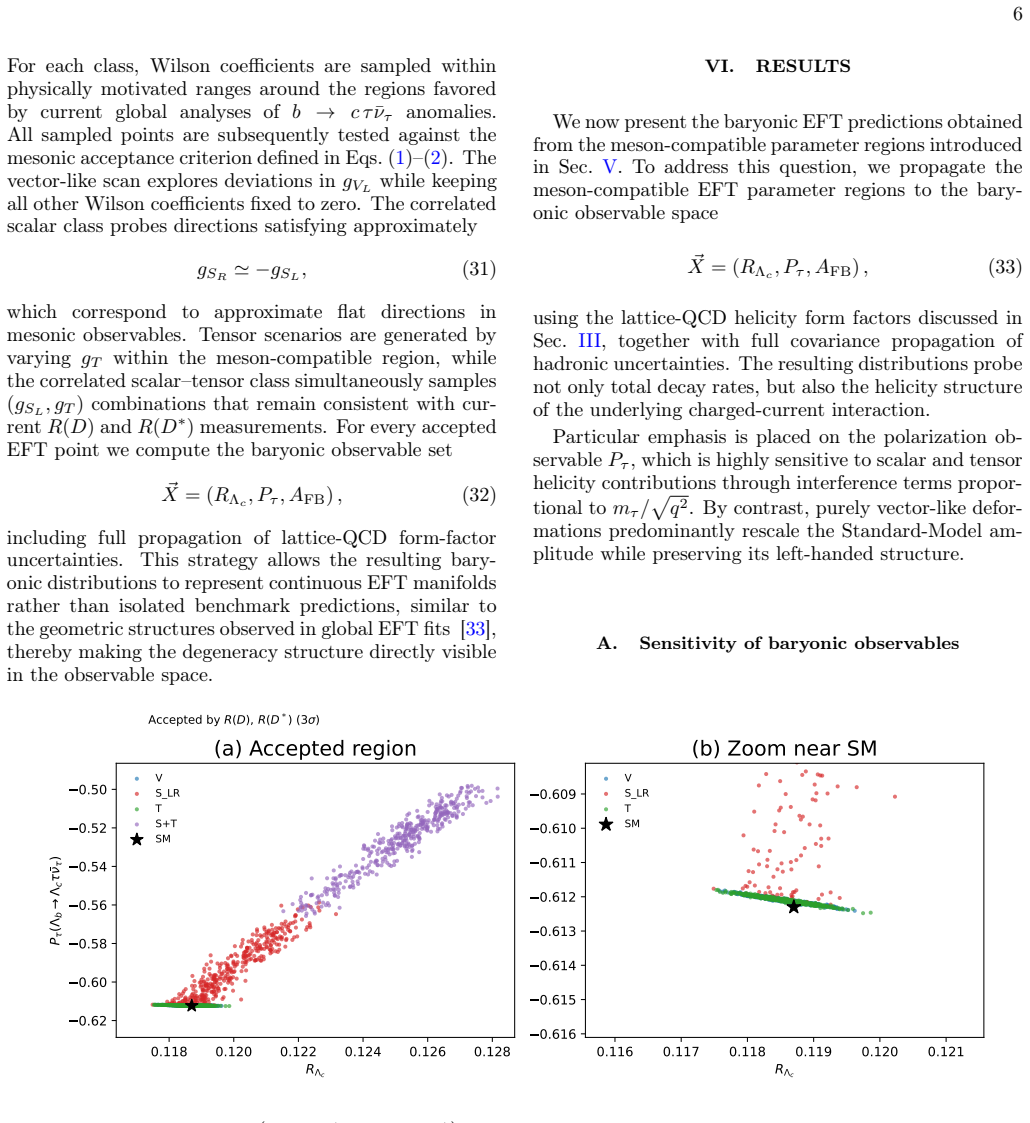
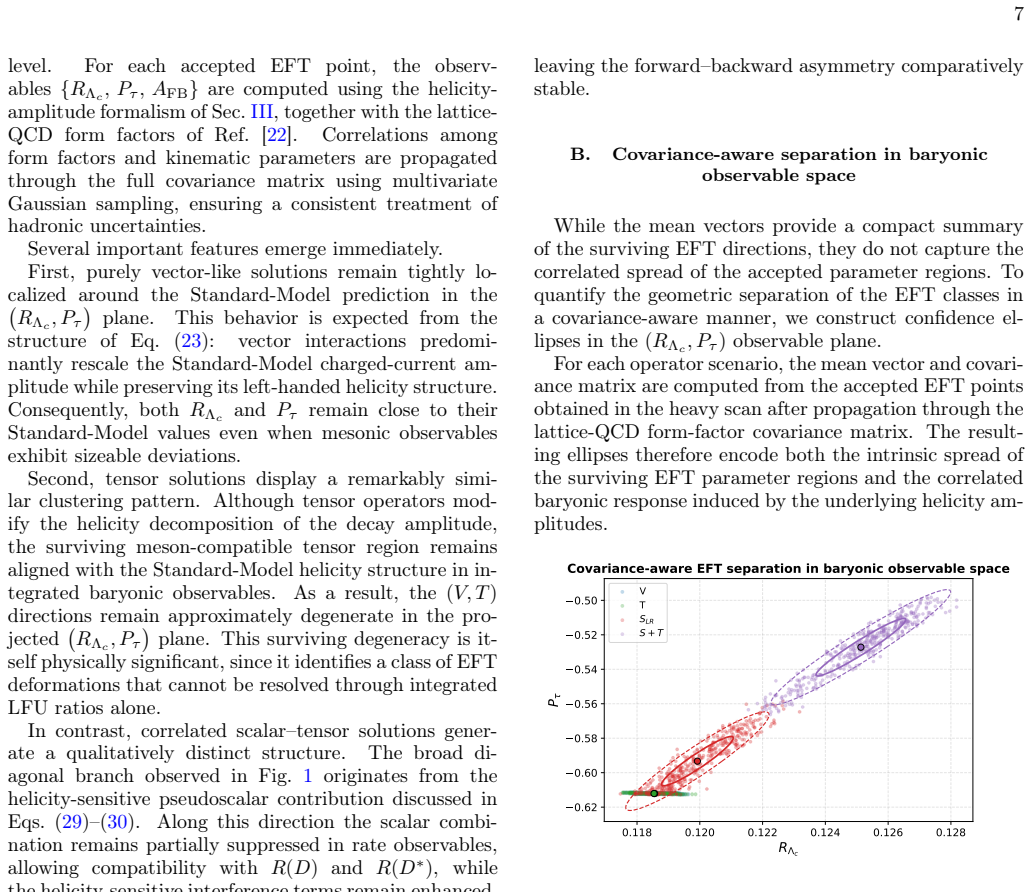
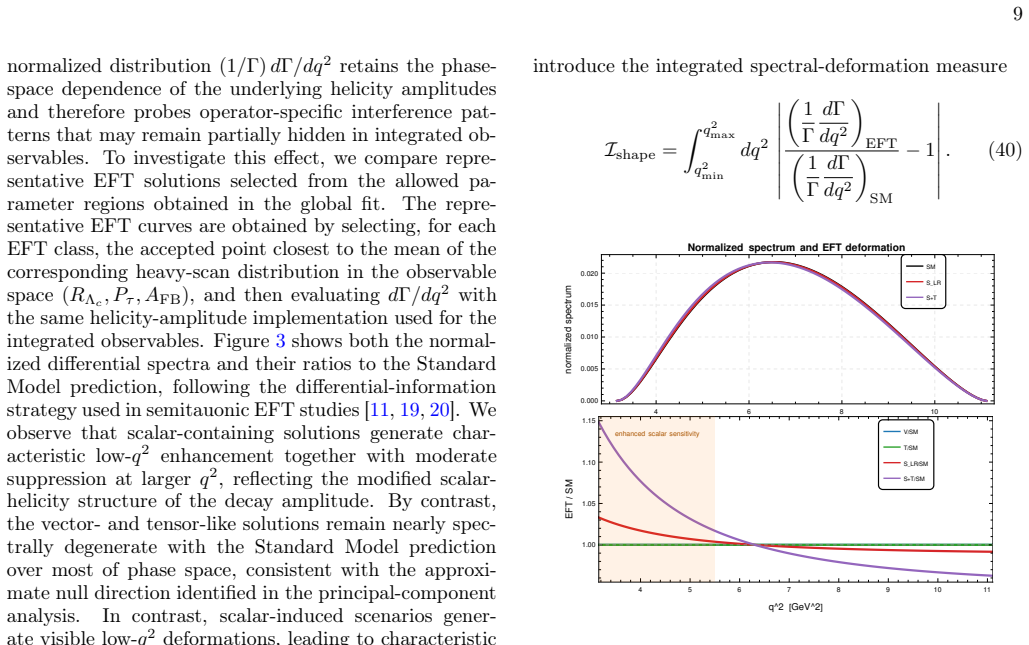
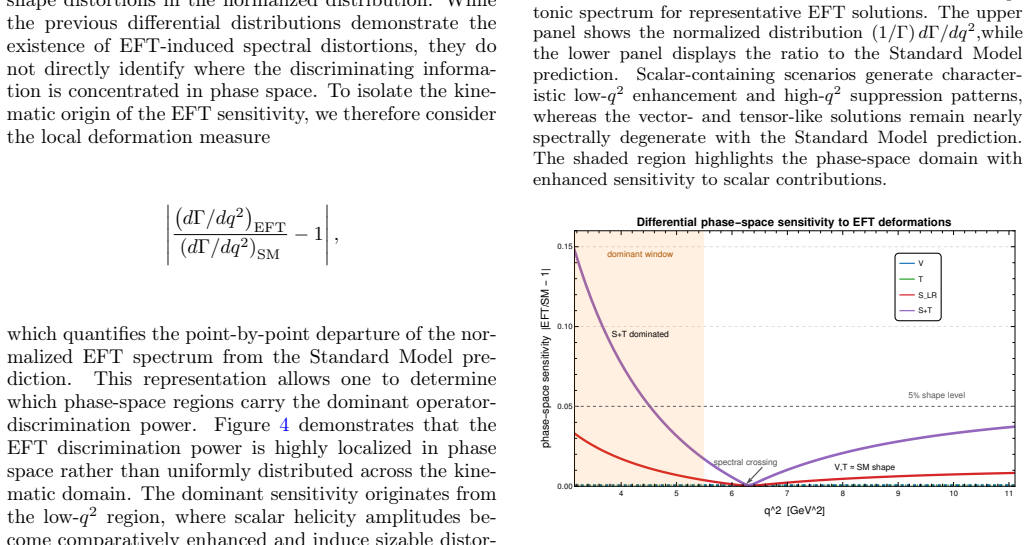
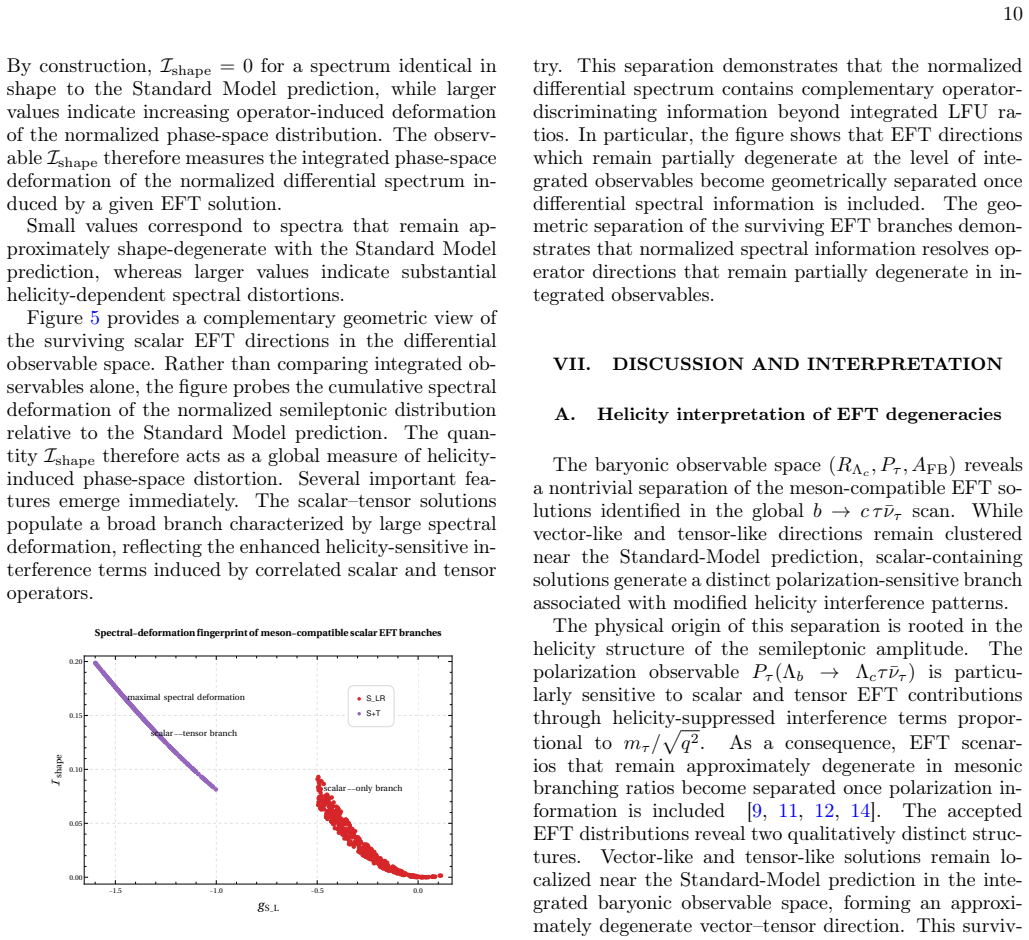
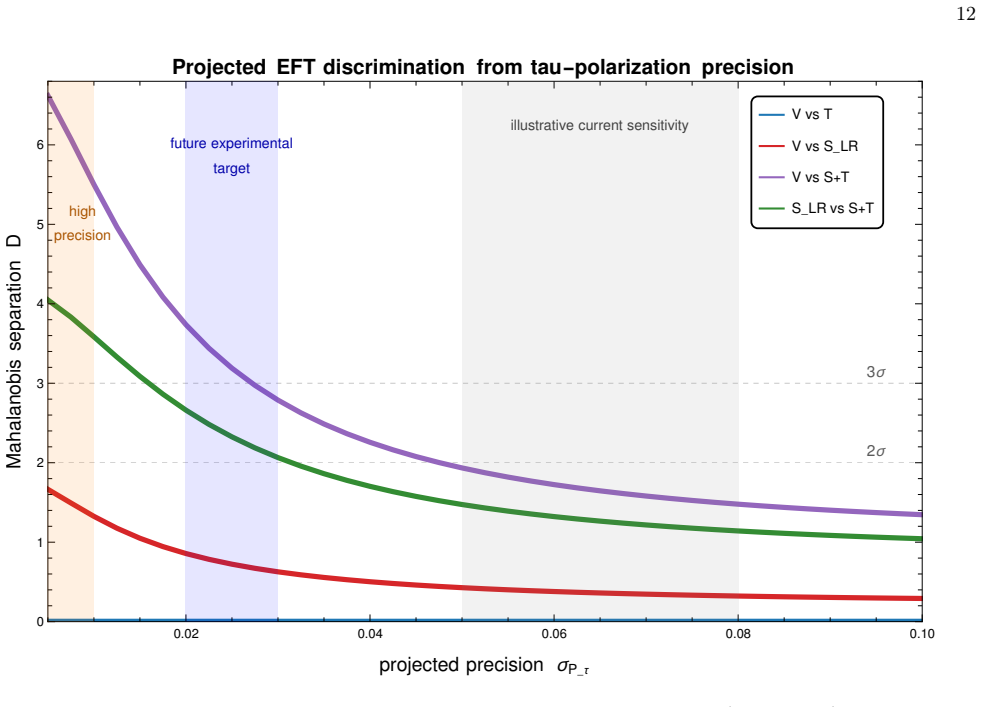
In an effective field theory analysis of Lambda_b to Lambda_c tau nu_bar using lattice QCD helicity form factors, propagating meson-compatible solutions into the baryonic observable space shows that tau polarization provides the leading source of sensitivity for lifting EFT degeneracies that remain unresolved in current measurements of R(D) and R(D*). Vector-like and tensor-like solutions remain clustered near the Standard Model prediction, whereas scalar-containing directions produce large polarization displacements and characteristic low-q^2 deformations of the normalized differential spectrum. A covariance-aware analysis demonstrates that baryonic polarization and differential observables
What carries the argument
Propagation of meson-compatible EFT solutions into baryonic observables R_Lambda_c, P_tau and A_FB, using lattice QCD helicity form factors with covariance propagation, where P_tau supplies the dominant distinguishing power.
If this is right
- Scalar-containing EFT solutions produce large displacements in tau polarization P_tau.
- These solutions also generate characteristic deformations in the normalized differential spectrum at low q^2.
- Vector-like and tensor-like solutions cluster near the Standard Model prediction in the baryonic observables.
- Polarization and differential observables supply complementary and independent information on the Lorentz structure.
- Future measurements of P_tau and the low-q^2 spectrum at LHCb can test semitauonic flavor anomalies.
Where Pith is reading between the lines
- Prioritizing tau polarization measurements in baryon decays at LHCb could separate scalar from non-scalar explanations of the anomalies.
- Applying the same propagation method to other heavy baryon modes would test whether operator mixing remains negligible across channels.
- The low-q^2 spectral deformations offer an observable signature that can be checked independently of overall rate ratios.
Load-bearing premise
Meson-compatible effective field theory solutions apply directly to baryonic decays without additional baryon-specific constraints or operator mixing that would change the degeneracy structure.
What would settle it
A measurement of P_tau in Lambda_b to Lambda_c tau nu that remains consistent with the Standard Model prediction while R(D) and R(D*) show deviations would show that scalar directions are not realized or that the direct propagation step fails.
Figures
read the original abstract
Semileptonic heavy-baryon decays provide a sensitive probe of the helicity structure underlying possible lepton-flavor universality violation in $b\to c\,\tau\bar\nu_\tau$ transitions. We perform an effective-field-theory analysis of $\Lambda_b\to\Lambda_c\tau\bar\nu_\tau$ and related baryonic modes using lattice-QCD helicity form factors with full covariance propagation. Propagating meson-compatible EFT solutions into the baryonic observable space$(R_{\Lambda_c},\,P_\tau,\,A_{\rm FB})$, we show that tau polarization provides the leading source of sensitivity for lifting EFT degeneracies that remain unresolved in current measurements of $R(D)$ and $R(D^\ast)$. Vector-like and tensor-like solutions remain clustered near theStandard-Model prediction, whereas scalar-containing directions produce large polarization displacements and characteristic low-$q^2$ deformations of the normalized differential spectrum. A covariance-aware analysis demonstrates that baryonic polarization and differential observables provide complementary and independent information on the Lorentz structure of semileptonic new physics. $P_\tau(\Lambda_b\to\Lambda_c\tau\bar\nu_\tau)$ and the low-$q^2$ spectrum as particularly powerful probes for future tests of semitauonic flavor anomalies at LHCb and future flavor facilities.
Editorial analysis
A structured set of objections, weighed in public.
Referee Report
Summary. The manuscript performs an effective-field-theory analysis of semileptonic heavy-baryon decays Λ_b → Λ_c τ ν_τ (and related modes) using lattice-QCD helicity form factors with full covariance propagation. It propagates meson-compatible EFT Wilson-coefficient solutions into the baryonic observable space (R_Λc, P_τ, A_FB) and shows that tau polarization supplies the dominant sensitivity for lifting degeneracies that persist in current R(D) and R(D*) measurements; vector- and tensor-like directions remain near the SM while scalar-containing directions produce large P_τ displacements and low-q² spectral deformations.
Significance. If the central results hold, the work supplies concrete, falsifiable predictions for polarization and differential observables that are complementary to meson data and directly testable at LHCb and future facilities. The explicit use of lattice helicity form factors together with covariance propagation is a methodological strength that improves the robustness of the degeneracy-lifting claims relative to analyses that treat form-factor uncertainties less systematically.
minor comments (4)
- [Abstract] Abstract, final sentence: the clause beginning 'A covariance-aware analysis demonstrates...' is grammatically incomplete and should be rephrased for clarity.
- [§4.2] §4.2, around Eq. (18): the definition of the normalized differential spectrum dΓ/dq² / Γ should be stated explicitly so that the reported low-q² deformations can be reproduced without ambiguity.
- [Table 2] Table 2: the caption does not specify whether the quoted uncertainties include only statistical or also systematic lattice errors; this affects the interpretation of the P_τ sensitivity.
- [Figure 4] Figure 4: the color coding for the different EFT directions (vector, scalar, tensor) is not described in the caption or legend, making the clustering near the SM difficult to verify visually.
Simulated Author's Rebuttal
We thank the referee for the positive assessment of our work, the recognition of its methodological strengths, and the recommendation for minor revision. No major comments are listed in the report, so we have no specific points requiring point-by-point rebuttal. We will address any minor editorial or presentational suggestions in the revised manuscript.
Circularity Check
No significant circularity; derivation uses external inputs for new predictions
full rationale
The paper takes EFT solutions fitted to meson data (R(D), R(D*)) as external inputs and propagates them through independent lattice-QCD helicity form factors to compute baryonic observables (R_Lambda_c, P_tau, A_FB). This produces new predictions about which directions lift degeneracies, without any step reducing by construction to the meson inputs or to a self-citation. No self-definitional, fitted-input-renamed-as-prediction, or ansatz-smuggled patterns appear. The central claim remains independent of the meson fits once the form-factor computation is performed.
Axiom & Free-Parameter Ledger
free parameters (1)
- EFT Wilson coefficients
axioms (2)
- domain assumption Lattice-QCD helicity form factors with full covariance accurately describe the baryonic transitions
- domain assumption The effective-field-theory framework remains valid across meson and baryon systems without additional operator mixing
Reference graph
Works this paper leans on
-
[1]
Evidence for an excess of ¯B→D (∗)τ −¯ντ decays,
J. P. Lees et al. [BaBar Collaboration], “Evidence for an excess of ¯B→D (∗)τ −¯ντ decays,” Phys. Rev. Lett.109, 101802 (2012), arXiv:1205.5442
Pith/arXiv arXiv 2012
-
[2]
Measurement of the branching ratio of ¯B→D (∗)τ −¯ντ relative to ¯B→D (∗)ℓ−¯νℓ decays,
M. Huschle et al. [Belle Collaboration], “Measurement of the branching ratio of ¯B→D (∗)τ −¯ντ relative to ¯B→D (∗)ℓ−¯νℓ decays,” Phys. Rev. D92, 072014 (2015), arXiv:1507.03233
Pith/arXiv arXiv 2015
-
[3]
Measurement of the ratio of branching fractionsB(¯B0 →D ∗+τ −¯ντ)/B( ¯B0 → D∗+µ−¯νµ),
R. Aaij et al. [LHCb Collaboration], “Measurement of the ratio of branching fractionsB(¯B0 →D ∗+τ −¯ντ)/B( ¯B0 → D∗+µ−¯νµ),” Phys. Rev. Lett.115, 111803 (2015), arXiv:1506.08614
arXiv 2015
-
[4]
Measure- ment ofR(D)andR(D ∗)with a semileptonic tagging method,
A. Abdesselam et al. [Belle Collaboration], “Measure- ment ofR(D)andR(D ∗)with a semileptonic tagging method,” arXiv:1904.08794
Pith/arXiv arXiv 1904
-
[5]
Measurement of lepton universality parameters inB 0 →D ∗−τ+ντ and B0 →D ∗−µ+νµ decays,
R. Aaij et al. [LHCb Collaboration], “Measurement of lepton universality parameters inB 0 →D ∗−τ+ντ and B0 →D ∗−µ+νµ decays,” Phys. Rev. Lett.131, 111802 (2023)
2023
-
[6]
Averages ofb-hadron,c-hadron, andτ-lepton properties as of 2023,
S. Banerjee et al. [Heavy Flavor Averaging Group (HFLAV)], “Averages ofb-hadron,c-hadron, andτ-lepton properties as of 2023,” Phys. Rev. D113, 012008 (2026), arXiv:2411.18639
Pith/arXiv arXiv 2023
-
[7]
Semitauonicb-hadron decays: A lepton fla- vor universality laboratory,
F. U. Bernlochner, M. F. Sevilla, D. J. Robinson, and G. Wormser, “Semitauonicb-hadron decays: A lepton fla- vor universality laboratory,” Rev. Mod. Phys.94, 015003 (2022), arXiv:2101.08326
arXiv 2022
-
[8]
Semi- leptonicB-physics anomalies: a general EFT analysis withinU(2) n flavor symmetry,
M. Bordone, G. Isidori and S. Trifinopoulos, “Semi- leptonicB-physics anomalies: a general EFT analysis withinU(2) n flavor symmetry,” Phys. Rev. D96, 015038 (2017), arXiv:1702.07238
Pith/arXiv arXiv 2017
-
[9]
Testing leptoquark models in¯B→D (∗)τ¯ν,
Y. Sakaki, M. Tanaka, A. Tayduganov, R. Watanabe, “Testing leptoquark models in¯B→D (∗)τ¯ν,” Phys. Rev. D88, 094012 (2013), arXiv:1309.0301
Pith/arXiv arXiv 2013
-
[10]
Flavor mod- els for ¯B→D (∗)τ¯ν,
M. Freytsis, Z. Ligeti, and J. T. Ruderman, “Flavor mod- els for ¯B→D (∗)τ¯ν,” Phys. Rev. D92, 054018 (2015), arXiv:1506.08896
Pith/arXiv arXiv 2015
-
[11]
New physics in the kinematic distributions of ¯B→D (∗)τ ν,
R. Alonso, A. Kobach, J. Martin Camalich, “New physics in the kinematic distributions of ¯B→D (∗)τ ν,” Phys. Rev. D95, 095006 (2017), arXiv:1702.07364
Pith/arXiv arXiv 2017
-
[12]
Sensitivity to new physics inB→D (∗)τ νdecays,
A. Celis, M. Jung, X.-Q. Li, A. Pich, “Sensitivity to new physics inB→D (∗)τ νdecays,” JHEP04, 053 (2017), arXiv:1612.07757
Pith/arXiv arXiv 2017
-
[13]
Revisiting lepton flavor universality inBdecays,
F. Feruglio, P. Paradisi, A. Pattori, “Revisiting lepton flavor universality inBdecays,” Phys. Rev. Lett.118, 011801 (2017), arXiv:1606.00524
Pith/arXiv arXiv 2017
-
[14]
Global fit to b→cτ νanomalies as of Spring 2024,
S. Iguro, T. Kitahara, and R. Watanabe, “Global fit to b→cτ νanomalies as of Spring 2024,” Phys. Rev. D110, 075005 (2024), arXiv:2405.06062
arXiv 2024
-
[15]
Global fit tob→cτ νtransitions: interplay between semilep- tonic and leptonic observables,
C. Murgui, A. Peñuelas, M. Jung and A. Pich, “Global fit tob→cτ νtransitions: interplay between semilep- tonic and leptonic observables,” JHEP09, 103 (2019), doi:10.1007/JHEP09(2019)103, arXiv:1904.09311 [hep- ph]
-
[16]
Constraining new physics inb→cℓνtransitions,
M. Jung and D. M. Straub, “Constraining new physics inb→cℓνtransitions,” JHEP01, 009 (2019), arXiv:1801.01112 [hep-ph]
Pith/arXiv arXiv 2019
-
[17]
Exclusive nonleptonic charm baryon decays,
J. G. Körner, M. Krämer, “Exclusive nonleptonic charm baryon decays,” Z. Phys. C55, 659 (1992)
1992
-
[18]
Semileptonic decays ofΛb baryons in the relativistic quark model,
T. Gutsche et al., “Semileptonic decays ofΛb baryons in the relativistic quark model,” Phys. Rev. D91, 074001 (2015), arXiv:1502.04864
Pith/arXiv arXiv 2015
-
[20]
Precise predictions forΛ b →Λ c semileptonic decays,
F. U. Bernlochner, Z. Ligeti, D. J. Robinson, and W. L. Sutcliffe, “Precise predictions forΛ b →Λ c semileptonic decays,” Phys. Rev. D99, 055008 (2019), arXiv:1812.07593
Pith/arXiv arXiv 2019
-
[21]
Baryons in the heavy quark effective theory,
T. Mannel, W. Roberts and Z. Ryzak, “Baryons in the heavy quark effective theory,” Nucl. Phys. B355, 38 (1991)
1991
-
[22]
Λb →p ℓ −¯νℓ andΛ b →Λ c ℓ−¯νℓ form factors from lattice QCD,
W. Detmold, C. Lehner and S. Meinel, “Λb →p ℓ −¯νℓ andΛ b →Λ c ℓ−¯νℓ form factors from lattice QCD,” Phys. Rev. D92, 034503 (2015), arXiv:1503.01421 [hep-lat]
Pith/arXiv arXiv 2015
-
[23]
Measurement of the shape of theΛ0 b →Λ + c µ−¯νµ differential decay rate,
R. Aaij et al. [LHCb Collaboration], “Measurement of the shape of theΛ0 b →Λ + c µ−¯νµ differential decay rate,” Phys. Rev. D96, 112005 (2017), arXiv:1709.01920
Pith/arXiv arXiv 2017
-
[24]
Observation of the decayΛ 0 b →Λ + c τ −¯ντ,
R. Aaij et al. [LHCb Collaboration], “Observation of the decayΛ 0 b →Λ + c τ −¯ντ,” Phys. Rev. Lett.128, 191803 (2022)
2022
-
[25]
Physics case for an LHCb Upgrade II,
R. Aaij et al. [LHCb Collaboration], “Physics case for an LHCb Upgrade II,” CERN-LHCC-2018-027, arXiv:1808.08865
Pith/arXiv arXiv 2018
-
[26]
Renor- malization Group Evolution of the Standard Model Dimension Six Operators,
E. E. Jenkins, A. V. Manohar and M. Trott, “Renor- malization Group Evolution of the Standard Model Dimension Six Operators,” JHEP10, 087 (2013), arXiv:1308.2627
arXiv 2013
-
[27]
Renormalization Group Evolution of the Standard Model Dimension Six Operators III,
R. Alonso, E. E. Jenkins, A. V. Manohar and M. Trott, “Renormalization Group Evolution of the Standard Model Dimension Six Operators III,” JHEP04, 159 (2014), arXiv:1312.2014
arXiv 2014
-
[28]
Renormalization of scalar and tensor operators in semileptonic decays,
M. González-Alonso, J. Martin Camalich and K. Mi- mouni, “Renormalization of scalar and tensor operators in semileptonic decays,” Phys. Lett. B772, 777 (2017), arXiv:1706.00410
Pith/arXiv arXiv 2017
-
[29]
Angular analysis ofΛb →Λ c(→Λπ)ℓ¯ν,
P. Böer, A. Kokulu, J.-N. Toelstede and D. van Dyk, “Angular analysis ofΛb →Λ c(→Λπ)ℓ¯ν,” JHEP12, 082 (2019), arXiv:1907.12554
arXiv 2019
-
[30]
Tau longitudinal polariza- tion in semileptonicBdecays,
M. Tanaka and R. Watanabe, “Tau longitudinal polariza- tion in semileptonicBdecays,” Phys. Rev. D82, 034027 (2010), arXiv:1005.4306
Pith/arXiv arXiv 2010
-
[31]
Angular analyses in semileptonic heavy-flavor decays,
M. Duraisamy and A. Datta, “Angular analyses in semileptonic heavy-flavor decays,” JHEP09, 059 (2013), arXiv:1302.7031
Pith/arXiv arXiv 2013
-
[32]
Review of Particle Physics,
S. Navas et al. [Particle Data Group], “Review of Particle Physics,” Phys. Rev. D110, 030001 (2024)
2024
-
[33]
Global interpretations of semileptonic EFT anomalies,
W. Altmannshofer et al., “Global interpretations of semileptonic EFT anomalies,” Phys. Rev. D106, 055008 (2022), arXiv:2205.12280
arXiv 2022
-
[34]
Optimal- observable analysis of possible new physics in B→D (∗)τ ντ,
S. Bhattacharya, S. Nandi and S. K. Patra, “Optimal- observable analysis of possible new physics in B→D (∗)τ ντ,” Phys. Rev. D93, 034011 (2016), arXiv:1509.07259. 15
Pith/arXiv arXiv 2016
-
[35]
Angular anal- ysis of the decayΛb →Λ(→N π)ℓ +ℓ−,
P. Böer, T. Feldmann and D. van Dyk, “Angular anal- ysis of the decayΛb →Λ(→N π)ℓ +ℓ−,” JHEP01, 155 (2015), arXiv:1410.2115
Pith/arXiv arXiv 2015
-
[36]
Theory deter- mination of semileptonic heavy-flavor observables,
M. Bordone, M. Jung and D. van Dyk, “Theory deter- mination of semileptonic heavy-flavor observables,” Eur. Phys. J. C80, 74 (2020), arXiv:1908.09398
arXiv 2020
-
[37]
S. Iguro and R. Watanabe, “Bayesian fit analysis to full distribution data of ¯B→D (∗)ℓ¯ν:|V cb|determination and new physics constraints,” JHEP08, 006 (2020), arXiv:2004.10208
arXiv 2020
-
[38]
Scalar contributions in semileptonic heavy-flavor spectra,
D. Bečirević et al., “Scalar contributions in semileptonic heavy-flavor spectra,” Phys. Rev. D100, 035025 (2019), arXiv:1904.04153
Pith/arXiv arXiv 2019
-
[39]
Das ist der HAMMER: Consistent new physics interpretations of semileptonic decays,
F. U. Bernlochner, S. Duell, Z. Ligeti, M. Papucci and D. J. Robinson, “Das ist der HAMMER: Consistent new physics interpretations of semileptonic decays,” Eur. Phys. J. C80, 883 (2020), arXiv:2002.00020
arXiv 2020
-
[40]
Precise predictions forΛb →Λ c semileptonic decays,
F. U. Bernlochner, Z. Ligeti, D. J. Robinson, W. L. Sang, “Precise predictions forΛb →Λ c semileptonic decays,” Phys. Rev. D97, 075011 (2018), arXiv:1801.08367
Pith/arXiv arXiv 2018
-
[41]
Phenomenol- ogy ofΛb →Λ cτ¯νusing lattice QCD calculations,
A.Datta, S.Kamali, S.Meinel, A.Rashed, “Phenomenol- ogy ofΛb →Λ cτ¯νusing lattice QCD calculations,” JHEP 08, 131 (2017), arXiv:1702.02243. 16 Appendix A: Helicity amplitudes In this appendix we collect the explicit expressions for the helicity amplitudes entering the observables discussed in the main text. The amplitudes are expressed in terms of the hel...
Pith/arXiv arXiv 2017
-
[42]
(12) and (13)
Vector and axial-vector helicity amplitudes The vector and axial-vector helicity amplitudes are defined in Eqs. (12) and (13). The helicity amplitudes are obtained by contracting the hadronic matrix elements with the polarization vectors of the off-shellW∗ boson in the dilepton rest frame. ForλΛc = + 1 2 they read H V + 1 2 ,0 = s λ(q2) q2 (mΛb +m Λc)f +(...
-
[43]
Scalar helicity amplitudes The scalar and pseudoscalar helicity amplitudes are not independent structures, but follow from the contraction of the vector and axial currents with the momentum transferqµ = (pΛb −p Λc)µ together with the quark equations of motion, qµ ¯cγµb= (m b −m c) ¯c b, q µ ¯cγµγ5b= (m b +m c) ¯c γ5b.(A9) The scalar and pseudoscalar helic...
-
[44]
(14) read
Tensor helicity amplitudes The tensor helicity amplitudes defined in Eq. (14) read. The tensor indices(+,−)and(0, t)denote transverse and longitudinal–timelike polarization projections of the antisymmetric tensor current, respectively. H T + 1 2 ,+− = p 2λ(q 2)h ⊥(q2),(A13) H T + 1 2 ,0t = s λ(q2) q2 (mΛb +m Λc)h +(q2).(A14) The remaining tensor amplitude...
-
[45]
Angular-coefficient decomposition All differential decay rates, polarization observables, and angular asymmetries discussed in the main text are constructed from bilinear combinations of the helicity amplitudes listed above. The EFT sensitivity of the observables therefore originates from interference among vector, axial, scalar, and tensor helicity struc...
discussion (0)
Sign in with ORCID, Apple, or X to comment. Anyone can read and Pith papers without signing in.