REVIEW 3 major objections 7 minor 1 cited by
Surrogate modeling of gravitational waves microlensed by spherically symmetric potentials
T0 review · 3 major / 7 minor · reviewed 2026-08-10 · deepseek-v4-flash
Pith's one-line read Surrogate modeling reproduces microlensed gravitational-wave amplification factors for point-mass and singular isothermal sphere lenses, with mismatches below $5\times10^{-4}$ and evaluation near 100 ms.
desk verdict A solid proof-of-principle that surrogates can speed up evaluation of the time-domain microlensing amplification factor; the main caveat is that the training truth itself is a reconstructed quantity, though it is anchored to analytic PML and SIS results. read the letter →
The pith
A machine-rendered reading of the paper's core claim, the machinery that carries it, and where it could break.
The reading
What carries the argument
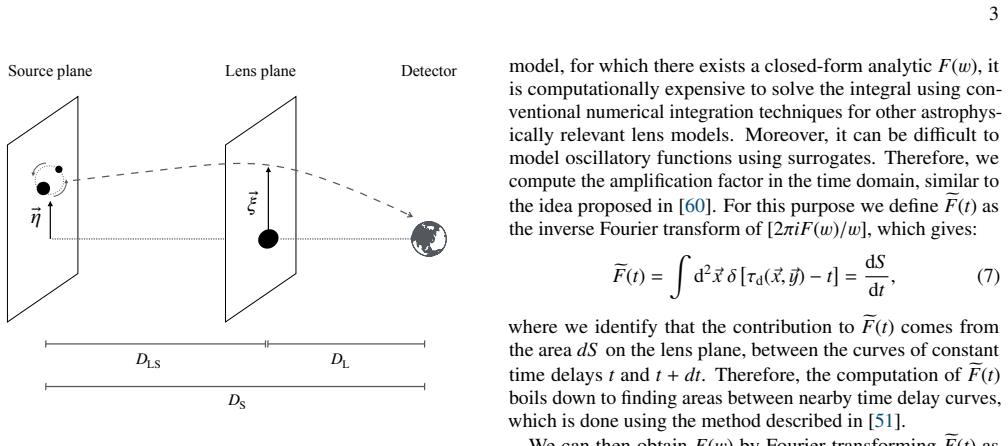
Two constructions do the work. First, the amplification factor is computed and modeled in the time domain: $\widetilde F(t)=dS/dt$, the rate of change of the area on the lens plane between curves of constant time delay, which avoids the rapidly oscillating Kirchhoff integrand. Second, the surrogate itself is a reduced-basis and empirical-interpolation model: a greedy algorithm selects a small set of representative waveforms, empirical interpolation chooses sparse time nodes at which the waveform must be known, and Gaussian-process regressions fit the dependence on the impact parameter $y$ at those nodes. Two preprocessing steps make interpolation accurate near the saddle-image peak: the peak is reconstructed by splicing a rescaled analytic logarithmic approximation over an empirically chosen $\pm5\%$ window around $t_{\mathrm{peak}}$, and the regularization $\bar F(t)=1-\exp[-\pi(\widetilde F(t)-1)/\sqrt{\mu_-}]$ removes the logarithmic divergence so the interpolation target is smooth. The lens mass $M_L$ only sets the time scale, so each model is a single-parameter surrogate in $y$.
What would settle it
Take the point-mass-lens surrogate and compare its frequency-domain amplification factor directly with the exact analytic expression of Eq. (A6) at the upper end of the next-generation detector band (for example $M_L=10^3\,M_\odot$ and $y=0.1$), instead of comparing with the reconstructed numerical reference. If the mismatch there exceeds the reported $\sim5\times10^{-4}$, the peak-reconstructed training reference is biased at high dimensionless frequency and the surrogate's advertised accuracy is not the true error. The same check can be run for the SIS surrogate against the high-order summation form of Eq. (A13).
Extended reading notes
Core claim
The paper's central claim is that the time-domain amplification factor $\widetilde F(t)$, defined by $\widetilde F(t)=\int d^2x\,\delta(\tau_d(x,y)-t)$ and computed as the area swept out between neighboring constant-time-delay curves, is a suitable surrogate-modeling target even though the frequency-domain factor $F(w)$ is highly oscillatory. For a point-mass lens over impact parameters $y\in[0.1,2]$ and a singular isothermal sphere over $y\in[0.01,0.95]$ (the two-image regime), the authors first reconstruct the logarithmic peak contributed by the saddle image using the analytic near-peak form of Ref. [60], then apply the regularization $\bar F=1-\exp[-\pi(\widetilde F-1)/\sqrt{\mu_-}]$, and build reduced-basis surrogates with 27 and 15 basis vectors at a basis tolerance of $5\times10^{-4}$. After inverse regularizing and Fourier transforming, the surrogate amplification factor is multiplied into unlensed binary-black-hole waveforms; the resulting mismatches against the numerical reference are below $5\times10^{-4}$ across the tested $M_L$-$y$ grid and for binary total masses from $20$ to $100\,M_\odot$, with frequency-domain waveform evaluation times of order $10^{-2}$-$10^{-1}$ s. The claim is that this makes surrogate modeling a viable route to fast, accurate microlensed templates in regimes where no analytic amplification factor exists.
Load-bearing premise
The reference waveforms used to train and test the surrogate are not direct solutions of the Kirchhoff diffraction integral: they come from the area-between-time-delay-curves formula of Eq. (7), with the logarithmic peak replaced by a rescaled analytic approximation over an empirically chosen $\pm5\%$ matching window. If that reconstructed reference is biased at high frequencies, or if the 5% window is not robust across parameter space, the reported mismatches understate the surrogate's true error against the actual lensed waveform.
Editorial extensions
If this is right
- Large-scale Bayesian parameter estimation of microlensed gravitational-wave signals becomes computationally feasible, since surrogate templates evaluate in about 100 ms rather than seconds.
- The same time-domain prescription, compute $\widetilde F(t)$, reconstruct and regularize the peak, and build a reduced-basis surrogate, extends to any lensing potential for which numerical time-delay solutions can be produced, without needing an analytic $F(f)$.
- For the point-mass lens the surrogate is faster than the existing lookup-table interpolation used in current searches while remaining fully wave-optics based.
- The singular-isothermal-sphere surrogate demonstrates that a logarithmic divergence in $\widetilde F(t)$ does not block accurate interpolation when the peak is handled analytically before surrogate construction.
Reading between the lines
- A direct high-frequency validation against the analytic point-mass result, rather than the reconstructed reference, would sharpen the accuracy claim, since the paper's own discussion identifies peak resolution as the main high-frequency error source.
- Because the lens mass only rescales time, the single-parameter-in-$y$ surrogates can be extended to a two-parameter $(M_L,y)$ model simply by rescaling the time axis, which would make them directly usable in parameter estimation.
- For asymmetric or multi-lens configurations the paper notes that caustics split parameter space into regions with different image counts; separate surrogates per region are a plausible path, but the caustic geometry itself would need to be modeled.
- The rate-determining step is the Fourier transform, not the surrogate evaluation, so faster FFT algorithms or direct frequency-domain interpolation would push the total cost well below 100 ms.
Editorial analysis
A structured set of objections, weighed in public.
Referee Report
Summary. The paper proposes constructing surrogate models of the time-domain gravitational-wave microlensing amplification factor \tilde F(t) for two spherically symmetric lens models, the point-mass lens (PML) and the singular isothermal sphere (SIS), and then obtaining fast microlensed waveforms by Fourier transforming the surrogate amplification factor and multiplying by an unlensed frequency-domain waveform. The training data are generated from the area-between-time-delay-curves expression of Eq. (7), with the logarithmic peak reconstructed from the analytic near-peak formula Eq. (12) inside an empirically chosen 5% matching window, followed by the regularization of Eq. (13). The surrogate itself uses reduced-basis greedy selection, empirical interpolation, and Gaussian process regression. The authors report mismatches \lesssim 5 \times 10^{-4} against the numerical microlensed waveforms across the tested ML-y grids, evaluation times of about 100 ms, and speedups between 5 and 10^3 relative to the underlying lensing models.
Significance. If the accuracy claim holds, the paper supplies a practically useful ingredient for parameter estimation of microlensed gravitational waves, and the methodology is in principle extendable to more complex, asymmetric lens models. The internal validation is careful in several respects: training and test lens parameters are disjoint, mismatches are computed with a standard detector-weighted match using the Einstein Telescope PSD, the greedy convergence curves in Fig. 5 plateau, and speed is measured against a lookup table for PML and against direct numerics for SIS. The main unresolved risk is that the validation truth is itself a reconstructed numerical reference; the manuscript does not supply a calibration error map, an SIS series-convergence check, or a sensitivity study of the empirical 5% reconstruction window. These omissions directly affect the central accuracy claim rather than the speed claim.
major comments (3)
- [Section II B and Section III] The central accuracy claim is validated only against a training/validation truth that is itself reconstructed: \tilde F(t) from Eq. (7) is not a direct Kirchhoff-integral solution, and the logarithmic peak is replaced by the analytic approximation Eq. (12) inside an empirically chosen 5% matching window. Section III states that the numerical amplification factors are calibrated to the analytic PML form (Eq. A6) and the SIS series (Eq. A13) so that the maximum mismatch is < 10^{-4}, but no calibration error map, no convergence study for the n=500 SIS series truncation, and no sensitivity of the 5% window width are shown. If the reconstruction bias is larger than 10^{-4} at the high dimensionless frequencies sampled at the largest lens masses, the reported surrogate mismatches, which are also computed against this reconstructed reference, would understate the error relative to the true lensed waveform. Please add a calibration error map for both lens models, a convergence test for the SIS series, and a variation of the matching window width (for example 2% and 10%) with the resulting mismatch values.
- [Section III, Fig. 7] Because the PML has the closed-form F(w) in Eq. (A6), the final surrogate should be compared directly against this analytic solution, not only against the calibrated numerical pipeline. Such a comparison would remove the reconstructed-reference issue for the PML entirely and would directly support the headline claim that the surrogate reproduces the original lens model. As it stands, Figs. 7 and 8 only compare against the numerical method that was used to construct the surrogate, so the validation does not independently confirm the accuracy claim for the one model where an exact reference is available.
- [Section II D 3 and Fig. 5] The greedy search is stopped when the normalized L2 error in the regularized time domain is below 10^{-2}, while the basis tolerance is 5 \times 10^{-4}, but the relation between these thresholds and the advertised frequency-domain mismatches below 5 \times 10^{-4} is not established. The final mismatches are computed separately, so this is not an internal contradiction, but the manuscript should clarify whether the reported mismatches are sensitive to the L2 stopping criterion and the basis tolerance; a small variation of these two parameters with the resulting mismatch statistics would make the empirical choices in the greedy loop less opaque.
minor comments (7)
- [Eq. (13)] The symbol \mu_- is signed negative for the saddle image in Eq. (A8), but Eq. (13) takes its square root; the formula should use |\mu_-|, or \mu_- should be redefined as the absolute magnification.
- [Eqs. (15) and (20)] The summation indices in Eqs. (15) and (20) appear as 'i=i' and 'j=i'; these should be 'i=1' and 'j=1'.
- [Eq. (23)] The set C in min_{c_i \in C} is not defined; presumably it is \mathbb{R}^m, and this should be stated for clarity.
- [Section III] The relationship between the number of basis vectors (27 for PML, 15 for SIS) and the number of greedy training parameters (35 for PML, 100 for SIS) should be clarified; the text is easy to misread as saying the basis is built from all 35 or 100 greedy points.
- [Abstract and Section IV] The abstract states mismatches \lesssim 5 \times 10^{-4}, the introduction mentions O(10^{-7}-10^{-3}), and Section IV reports 10^{-8}-10^{-4}; these ranges should be made consistent with the summary statistics behind Fig. 8.
- [Fig. 8, top-right panel] The histogram of evaluation times is described as comparing the surrogate with the lookup table, but the caption does not state whether the surrogate time includes the FFT that the text identifies as the rate-limiting step; please specify.
- [General] A data and code availability statement would improve reproducibility, since the numerical method and the peak-reconstruction procedure involve several implementation choices that are only described at a high level.
Circularity Check
No significant circularity: the surrogate's accuracy is benchmarked against independently calibrated numerical references, not against its own training outputs.
full rationale
The paper's central claim is that a surrogate model can rapidly and accurately reproduce the time-domain microlensing amplification factor. The surrogate is an interpolant, so it is by construction close to the training set; however, the reported accuracy is evaluated at lens parameters different from those used to construct the surrogate, as stated: 'We ensure that the lensing parameters used for training the model, and those used for testing (i.e, evaluating the mismatches), are different.' The mismatches are therefore generalization errors, not identities. The numerical reference used for training and validation is independently anchored: the paper states that 'the numerical amplification factors used to train the model for PML and SIS are calibrated to the analytic form given in Eq. (A6) for PML and the summation form given in Eq. (A13) for SIS, such that the maximum mismatch (1−M) between the numerically computed lensed waveform and the analytically obtained lensed waveform is < 10−4 for all possible points in the parameter space.' The analytic PML expression and the SIS series are external results (Peters 1974; Matsunaga and Yamamoto 2006), not outputs of this paper. The peak reconstruction uses the analytic logarithmic approximation of Eq. (12) from Ulmer and Goodman, with image magnifications and time delays from the lens models themselves; the 5% matching window is empirical but it is a preprocessing choice, not a fitted parameter used to force the final mismatches. The paper does cite prior work with overlapping authorship for the area-between-time-delay-curves numerical method ([51]) and for surrogate modeling techniques ([61], [62], [69]), but these citations are methodological, not load-bearing for the validation claim: the accuracy chain terminates in externally known analytic or series solutions. The empirically tuned peak-matching window and the truncated SIS series are legitimate accuracy concerns, but they are correctness risks about the reference truth, not circularity. No step in the derivation defines the predicted quantity in terms of the fitted result or imports a conclusion exclusively from a self-citation. The result is a standard interpolation benchmark with independent anchoring, so the circularity score is 0.
Assumptions & free parameters
free parameters (3)
- peak reconstruction window =
5% of tpeak on each side
- reduced basis tolerance =
5e-4
- greedy L2 stopping threshold =
1e-2
assumptions (4)
- domain assumption Thin-lens approximation and scalar Kirchhoff diffraction integral (Eq. 5) describe microlensed GW propagation.
- domain assumption The time-domain factor Ftilde(t) can be obtained as area between time-delay contours (Eq. 7) following Ulmer and Goodman.
- domain assumption The logarithmic peak behavior near the saddle image is given by Eq. (12) with magnifications and tpeak from geometric optics (Eqs. A8/A9 for PML, A15/A16 for SIS).
- domain assumption The SIS lens is restricted to y<1 so exactly two images exist; no caustic crossing is modeled.
Cite this review
Pith. "Pith review of Surrogate modeling of gravitational waves microlensed by spherically symmetric potentials." pith.science (2026). https://pith.science/paper/DOKAGGXV
@misc{pith2026250102974,
  author       = {Pith},
  title        = {Pith review of: Surrogate modeling of gravitational waves microlensed by spherically symmetric potentials},
  year         = {2026},
  howpublished = {\url{https://pith.science/paper/DOKAGGXV}},
  note         = {Machine review of arXiv:2501.02974}
}
abstract
The anticipated observation of the gravitational microlensing of gravitational waves (GWs) promises to shed light on a host of astrophysical and cosmological questions. However, extracting the parameters of the lens from the modulated GWs requires accurate modeling of the lensing amplification factor, accounting for wave-optics effects. Analytic solutions to the lens equation have not been found to date, except for a handful of simplistic lens models. While numerical solutions to this equation have been developed, the time and computational resources required to evaluate the amplification factor numerically make large-scale parameter estimation of the lens (and source) parameters prohibitive. On the other hand, surrogate modeling of GWs has proven to be a powerful tool to accurately, and rapidly, produce GW templates at arbitrary points in parameter space, interpolating from a finite set of available waveforms at discrete parameter values. In this work, we demonstrate that surrogate modeling can also effectively be applied to the evaluation of the time-domain microlensing amplification factor $\widetilde{F}(t)$. We show this by constructing $\widetilde{F}(t)$ for two lens models, viz. point-mass lens, and singular isothermal sphere, which notably includes logarithmic divergence behaviour. We find both surrogates reproduce the original lens models accurately, with mismatches $\lesssim 5 \times 10^{-4}$ across a range of plausible microlensed binary black hole sources observed by the Einstein Telescope. This surrogate is between 5 and $10^3$ times faster than the underlying lensing models, and can be evaluated in about 100 ms. The accuracy and efficiency attained by our surrogate models will enable practical parameter estimation analyses of microlensed GWs.
Figures


Figures from the paper (5 more)


Forward citations
Cited by 1 Pith paper
-
Chase Orbits, not Time: A Scalable Paradigm for Long-Duration Eccentric Gravitational-Wave Surrogates
Eccentric inspiral waveforms are modeled against mean anomaly rather than time, yielding an order-of-magnitude compression and a 2.77e6 M surrogate that is ~20x faster to evaluate.
Reference graph
Works this paper leans on
-
[1]
II and III of Ref
Surrogate modeling basics We follow the methods described in Sec. II and III of Ref. [61] and refer the reader to it for a detailed overview of building a surrogate model. In the following, we briefly outline building a surrogate model
-
[2]
Given a known set of solutions (also called the training set), the RB is found using a greedy search algorithm
The first step is to find a minimal set of solutions called the reduced basis (RB) [84] in terms of which solutions at other parameters can be expressed. Given a known set of solutions (also called the training set), the RB is found using a greedy search algorithm. For example, with a RB with m basis elements,{ei}m i=1, a solution eF(t; λ) in the training...
-
[3]
The next step is to find the most representative times, the empirical times or nodes{Ti}m i=1 to construct an in- terpolant in time using empirical interpolant method (EIM) [61, 85–88] for a given parameter λ: Im[eF](t; λ) = mX i=i Ci(λ) ei(t). (15) The coefficients Ci(λ) are defined by requiring that the interpolant becomes equal to the value of the solu...
-
[4]
(20) at hand, we need to know the values of the solutions at the empirical nodes{Ti}m i=1
With the interpolantIm[eF](t; λ) in Eq. (20) at hand, we need to know the values of the solutions at the empirical nodes{Ti}m i=1. Therefore, the third step is to construct parametric fits at each empirical node across the param- eter space
-
[5]
Finally, the surrogate model prediction at a new parame- ter λ∗ outside the training data set is computed by first using the parametric fits (constructed in the third step) to evaluate the values ofeF(t; λ∗) at the empirical nodes {Ti}m i=1 and then building the interpolantIm[eF](t; λ) us- ing Eq. (20). The first three steps are performed offline (i.e, pr...
-
[6]
How- ever, since the effect of microlensing is a frequency-dependent modulation of the GW amplitude as explained in Sec
Surrogate for microlensed waveforms We apply the technique of surrogate modeling to obtain a model of the GWs waveform undergoing microlensing. How- ever, since the effect of microlensing is a frequency-dependent modulation of the GW amplitude as explained in Sec. II A, one needs only to model this amplification factor provided a fast, unlensed model exis...
-
[7]
lookup table
Surrogate modeling setup The RB is found by using a greedy algorithm that guarantees that the error σm≡ max λ min ci∈C eF(.; λ)− mX i=1 ci(λ) ei(.) , (23) associated with the approximation in Eq. (14) (minimized over the coefficients ci and maximized over the parameter λ) is less than a desired value, usually called the basis tolerance. Here, we have defi...
2023
-
[8]
J. Aasi et al. (LIGO Scientific), “Advanced LIGO,” Class. Quant. Grav. 32, 074001 (2015), arXiv:1411.4547 [gr-qc]
arXiv 2015
Show all 105 references
-
[9]
Advanced Virgo: a second-generation interferometric gravitational wave detector,
F. Acerneseet al. (Virgo), “Advanced Virgo: a second-generation interferometric gravitational wave detector,” Class. Quant. Grav. 32, 024001 (2015), arXiv:1408.3978 [gr-qc]
2015 arXiv
-
[10]
Overview of KAGRA: Detector design and construction history,
T. Akutsu et al. (KAGRA), “Overview of KAGRA: Detector design and construction history,” PTEP 2021, 05A101 (2021), arXiv:2005.05574 [physics.ins-det]
2021
-
[11]
GWTC-1: A Gravitational-Wave Transient Catalog of Compact Binary Mergers Observed by LIGO and Virgo during the First and Second Observing Runs,
B. P. Abbott et al. (LIGO Scientific, Virgo), “GWTC-1: A Gravitational-Wave Transient Catalog of Compact Binary Mergers Observed by LIGO and Virgo during the First and Second Observing Runs,” Phys. Rev. X 9, 031040 (2019), arXiv:1811.12907 [astro-ph.HE]
2019 arXiv
-
[12]
GWTC-2: Compact Binary Coalescences Observed by LIGO and Virgo During the First Half of the Third Observing Run,
R. Abbott et al. (LIGO Scientific, Virgo), “GWTC-2: Compact Binary Coalescences Observed by LIGO and Virgo During the First Half of the Third Observing Run,” Phys. Rev. X11, 021053 (2021), arXiv:2010.14527 [gr-qc]
2021 arXiv
-
[13]
GWTC-2.1: Deep extended catalog of compact binary coalescences observed by LIGO and Virgo during the first half of the third observing run,
R. Abbott et al. (LIGO Scientific, VIRGO), “GWTC-2.1: Deep extended catalog of compact binary coalescences observed by LIGO and Virgo during the first half of the third observing run,” Phys. Rev. D 109, 022001 (2024), arXiv:2108.01045 [gr-qc]
2024 arXiv
-
[14]
GWTC- 3: Compact Binary Coalescences Observed by LIGO and Virgo during the Second Part of the Third Observing Run,
R. Abbott et al. (KAGRA, VIRGO, LIGO Scientific), “GWTC- 3: Compact Binary Coalescences Observed by LIGO and Virgo during the Second Part of the Third Observing Run,” Phys. Rev. X 13, 041039 (2023), arXiv:2111.03606 [gr-qc]
2023 arXiv
-
[15]
GW170817: Observation of Gravitational Waves from a Binary Neu- tron Star Inspiral,
Benjamin P. Abbottet al. (LIGO Scientific, Virgo), “GW170817: Observation of Gravitational Waves from a Binary Neu- tron Star Inspiral,” Phys. Rev. Lett. 119, 161101 (2017), arXiv:1710.05832 [gr-qc]
2017 arXiv
-
[16]
GW190425: Ob- servation of a Compact Binary Coalescence with Total Mass ∼ 3.4M⊙,
B.P. Abbott et al. (LIGO Scientific, Virgo), “GW190425: Ob- servation of a Compact Binary Coalescence with Total Mass ∼ 3.4M⊙,” Astrophys. J. Lett. 892, L3 (2020), arXiv:2001.01761 [astro-ph.HE]
2020 arXiv
-
[17]
Obser- vation of Gravitational Waves from Two Neutron Star–Black Hole Coalescences,
R. Abbott et al. (LIGO Scientific, KAGRA, VIRGO), “Obser- vation of Gravitational Waves from Two Neutron Star–Black Hole Coalescences,” Astrophys. J. Lett. 915, L5 (2021), arXiv:2106.15163 [astro-ph.HE]
2021 arXiv
-
[18]
Tests of General Relativity with GWTC-3,
R. Abbott et al. (LIGO Scientific, VIRGO, KAGRA), “Tests of General Relativity with GWTC-3,” (2021), arXiv:2112.06861 [gr-qc]
2021 arXiv
-
[19]
Constraints on the Cosmic Expansion History from GWTC–3,
R. Abbott et al. (LIGO Scientific, Virgo, KAGRA), “Constraints on the Cosmic Expansion History from GWTC–3,” Astrophys. J. 949, 76 (2023), arXiv:2111.03604 [astro-ph.CO]
2023 arXiv
-
[20]
Popula- tion of Merging Compact Binaries Inferred Using Gravitational Waves through GWTC-3,
R. Abbott et al. (KAGRA, VIRGO, LIGO Scientific), “Popula- tion of Merging Compact Binaries Inferred Using Gravitational Waves through GWTC-3,” Phys. Rev. X 13, 011048 (2023), arXiv:2111.03634 [astro-ph.HE]
2023 arXiv
-
[21]
GW170817: Mea- surements of neutron star radii and equation of state,
B. P. Abbott et al. (LIGO Scientific, Virgo), “GW170817: Mea- surements of neutron star radii and equation of state,” Phys. Rev. Lett. 121, 161101 (2018), arXiv:1805.11581 [gr-qc]
2018 arXiv
-
[22]
Search for gravitational-lensing signatures in the full third observing run of the LIGO-Virgo network,
R. Abbott et al. (LIGO Scientific, VIRGO, KAGRA), “Search for gravitational-lensing signatures in the full third observing run of the LIGO-Virgo network,” (2023), arXiv:2304.08393 [gr-qc]
2023 arXiv
-
[23]
Gravita- tional lensing of gravitational waves from merging neutron star binaries,
Yun Wang, Albert Stebbins, and Edwin L. Turner, “Gravita- tional lensing of gravitational waves from merging neutron star binaries,” Phys. Rev. Lett.77, 2875–2878 (1996)
1996
-
[24]
On the waveforms of gravitationally lensed gravitational waves,
Liang Dai and Tejaswi Venumadhav, “On the waveforms of gravitationally lensed gravitational waves,” (2017), arXiv:1702.04724 [gr-qc]
2017 arXiv
-
[25]
Phase e ffects from strong gravita- tional lensing of gravitational waves,
Jose María Ezquiaga, Daniel E. Holz, Wayne Hu, Macarena Lagos, and Robert M. Wald, “Phase e ffects from strong gravita- tional lensing of gravitational waves,” Phys. Rev. D103, 064047 (2021)
2021
-
[26]
Precise ligo lensing rate predictions for binary black holes,
Ken K. Y . Ng, Kaze W. K. Wong, Tom Broadhurst, and Tjonnie G. F. Li, “Precise ligo lensing rate predictions for binary black holes,” Phys. Rev. D97, 023012 (2018)
2018
-
[27]
Gravitational lensing of gravitational waves: A statistical per- spective,
Shun-Sheng Li, Shude Mao, Yuetong Zhao, and Youjun Lu, “Gravitational lensing of gravitational waves: A statistical per- spective,” Monthly Notices of the Royal Astronomical Society 476, 2220–2229 (2018)
2018
-
[28]
E ffect of gravitational lensing on the dis- tribution of gravitational waves from distant binary black hole mergers,
Masamune Oguri, “E ffect of gravitational lensing on the dis- tribution of gravitational waves from distant binary black hole mergers,” Monthly Notices of the Royal Astronomical Society 480, 3842–3855 (2018)
2018
-
[29]
What if ligo’s gravita- tional wave detections are strongly lensed by massive galaxy clusters?
Graham P Smith, Mathilde Jauzac, John Veitch, Will M Farr, Richard Massey, and Johan Richard, “What if ligo’s gravita- tional wave detections are strongly lensed by massive galaxy clusters?” Monthly Notices of the Royal Astronomical Society 475, 3823–3828 (2018)
2018
-
[30]
Massively parallel bayesian inference for transient gravitational- wave astronomy,
Rory JE Smith, Gregory Ashton, Avi Vajpeyi, and Colm Talbot, “Massively parallel bayesian inference for transient gravitational- wave astronomy,” Monthly Notices of the Royal Astronomical Society 498, 4492–4502 (2020)
2020
-
[31]
Discovery of Strongly-lensed Gravi- tational Waves - Implications for the LSST Observing Strategy,
Graham P. Smith, Andrew Robertson, Matteo Bianconi, and Mathilde Jauzac (LSST), “Discovery of Strongly-lensed Gravi- tational Waves - Implications for the LSST Observing Strategy,” (2019), arXiv:1902.05140 [astro-ph.HE]
2019 arXiv
-
[32]
What does strong gravitational lensing? the mass and redshift distribution of high-magnification lenses,
Andrew Robertson, Graham P Smith, Richard Massey, Vincent Eke, Mathilde Jauzac, Matteo Bianconi, and Dan Ryczanowski, “What does strong gravitational lensing? the mass and redshift distribution of high-magnification lenses,” Monthly Notices of the Royal Astronomical Society 49...
2020
-
[33]
On building a cluster watchlist for identifying strongly lensed supernovae, gravitational waves and kilonovae,
Dan Ryczanowski, Graham P Smith, Matteo Bianconi, Richard Massey, Andrew Robertson, and Mathilde Jauzac, “On building a cluster watchlist for identifying strongly lensed supernovae, gravitational waves and kilonovae,” Monthly Notices of the Royal Astronomical Society 495, 1666...
2020
-
[34]
Wave effects in gravi- tational lensing of electromagnetic radiation,
Shuji Deguchi and William D. Watson, “Wave effects in gravi- tational lensing of electromagnetic radiation,” Phys. Rev. D34, 1708–1718 (1986)
1986
-
[35]
Gravitational lensing of gravitational waves from inspiraling binaries by a point mass lens,
Takahiro T. Nakamura, “Gravitational lensing of gravitational waves from inspiraling binaries by a point mass lens,” Phys. Rev. Lett. 80, 1138–1141 (1998)
1998
-
[36]
Wave e ffects in the gravitational lensing of gravitational waves from chirping binaries,
Ryuichi Takahashi and Takashi Nakamura, “Wave e ffects in the gravitational lensing of gravitational waves from chirping binaries,” The Astrophysical Journal 595, 1039 (2003)
2003
-
[37]
Gravitational lens- ing effects on parameter estimation in gravitational wave detec- tion with advanced detectors,
Zhoujian Cao, Li-Fang Li, and Yan Wang, “Gravitational lens- ing effects on parameter estimation in gravitational wave detec- tion with advanced detectors,” Phys. Rev. D90, 062003 (2014)
2014
-
[38]
Discov- ering intermediate-mass black hole lenses through gravitational wave lensing,
Kwun-Hang Lai, Otto A. Hannuksela, Antonio Herrera-Martín, Jose M. Diego, Tom Broadhurst, and Tjonnie G. F. Li, “Discov- ering intermediate-mass black hole lenses through gravitational wave lensing,” Phys. Rev. D98, 083005 (2018)
2018
-
[39]
De- tecting stellar lensing of gravitational waves with ground-based observatories,
Pierre Christian, Salvatore Vitale, and Abraham Loeb, “De- tecting stellar lensing of gravitational waves with ground-based observatories,” Phys. Rev. D98, 103022 (2018)
2018
-
[40]
Detecting lensing-induced diffraction in astrophysical gravitational waves,
Liang Dai, Shun-Sheng Li, Barak Zackay, Shude Mao, and You- jun Lu, “Detecting lensing-induced diffraction in astrophysical gravitational waves,” Phys. Rev. D98, 104029 (2018)
2018
-
[41]
Constraining the abundance of primordial black holes with gravitational lensing of gravitational waves at ligo 14 frequencies,
Jose M. Diego, “Constraining the abundance of primordial black holes with gravitational lensing of gravitational waves at ligo 14 frequencies,” Phys. Rev. D101, 123512 (2020)
2020
-
[42]
De- tectability of microlensed gravitational waves,
Simon M. C. Yeung, Mark H. Y . Cheung, Eungwang Seo, Joseph A. J. Gais, Otto A. Hannuksela, and Tjonnie G. F. Li, “De- tectability of microlensed gravitational waves,” Mon. Not. Roy. Astron. Soc. 526, 2230–2240 (2023), arXiv:2112.07635 [gr-qc]
2023 arXiv
-
[43]
Improving Detection of Gravitational-wave Microlensing Using Repeated Signals Induced by Strong Lensing,
Eungwang Seo, Otto A. Hannuksela, and Tjonnie G. F. Li, “Improving Detection of Gravitational-wave Microlensing Using Repeated Signals Induced by Strong Lensing,” Astrophys. J.932, 50 (2022), arXiv:2110.03308 [astro-ph.HE]
2022 arXiv
-
[44]
Gravelamps: Gravita- tional Wave Lensing Mass Profile Model Selection,
Mick Wright and Martin Hendry, “Gravelamps: Gravita- tional Wave Lensing Mass Profile Model Selection,” (2021), 10.3847/1538-4357/ac7ec2, arXiv:2112.07012 [astro-ph.HE]
2021 arXiv
-
[45]
Exploring the hidden Universe: a novel phenomenological approach for recovering arbitrary gravitational-wave millilensing configura- tions,
Anna Liu, Isaac C. F. Wong, Samson H. W. Leong, Anupreeta More, Otto A. Hannuksela, and Tjonnie G. F. Li, “Exploring the hidden Universe: a novel phenomenological approach for recovering arbitrary gravitational-wave millilensing configura- tions,” Mon. Not. Roy. Astron. Soc. 5...
2023 arXiv
-
[46]
Gear up for the action replay: Leveraging lensing for enhanced gravitational-wave early warning,
Sourabh Magare, Shasvath J Kapadia, Anupreeta More, Mukesh Kumar Singh, Parameswaran Ajith, and AN Ram- prakash, “Gear up for the action replay: Leveraging lensing for enhanced gravitational-wave early warning,” The Astrophysical Journal Letters 955, L31 (2023)
2023
-
[47]
Multimessenger time delays from lensed gravitational waves,
Tessa Baker and Mark Trodden, “Multimessenger time delays from lensed gravitational waves,” Phys. Rev. D 95, 063512 (2017)
2017
-
[48]
Testing the speed of grav- itational waves over cosmological distances with strong gravita- tional lensing,
Thomas E. Collett and David Bacon, “Testing the speed of grav- itational waves over cosmological distances with strong gravita- tional lensing,” Phys. Rev. Lett.118, 091101 (2017)
2017
-
[49]
Speed of gravi- tational waves from strongly lensed gravitational waves and electromagnetic signals,
Xi-Long Fan, Kai Liao, Marek Biesiada, Aleksandra Piórkowska-Kurpas, and Zong-Hong Zhu, “Speed of gravi- tational waves from strongly lensed gravitational waves and electromagnetic signals,” Phys. Rev. Lett.118, 091102 (2017)
2017
-
[50]
Testing the nature of gravitational-wave polarizations using strongly lensed signals,
Srashti Goyal, K. Haris, Ajit Kumar Mehta, and Parameswaran Ajith, “Testing the nature of gravitational-wave polarizations using strongly lensed signals,” Phys. Rev. D103, 024038 (2021)
2021
-
[51]
Gravitational wave lensing beyond general relativity: Birefringence, echoes, and shadows,
Jose María Ezquiaga and Miguel Zumalacárregui, “Gravitational wave lensing beyond general relativity: Birefringence, echoes, and shadows,” Phys. Rev. D102, 124048 (2020)
2020
-
[52]
Cosmography with strong lensing of lisa gravitational wave sources,
M Sereno, Ph Jetzer, Alberto Sesana, and Marta V olonteri, “Cosmography with strong lensing of lisa gravitational wave sources,” Monthly Notices of the Royal Astronomical Society 415, 2773–2781 (2011)
2011
-
[53]
Precision cosmology from future lensed grav- itational wave and electromagnetic signals,
Kai Liao, Xi-Long Fan, Xuheng Ding, Marek Biesiada, and Zong-Hong Zhu, “Precision cosmology from future lensed grav- itational wave and electromagnetic signals,” Nature Communi- cations 8, 1148 (2017)
2017
-
[54]
Direct test of the flrw metric from strongly lensed gravitational wave observations,
Shuo Cao, Jingzhao Qi, Zhoujian Cao, Marek Biesiada, Jin Li, Yu Pan, and Zong-Hong Zhu, “Direct test of the flrw metric from strongly lensed gravitational wave observations,” Scientific Reports 9, 11608 (2019)
2019
-
[55]
Constraining cosmolog- ical parameters in the flrw metric with lensed gw+ em signals,
Yufeng Li, Xilong Fan, and Lijun Gou, “Constraining cosmolog- ical parameters in the flrw metric with lensed gw+ em signals,” The Astrophysical Journal 873, 37 (2019)
2019
-
[56]
Localizing merging black holes with sub- arcsecond precision using gravitational-wave lensing,
Otto A Hannuksela, Thomas E Collett, Mesut Çalı¸ skan, and Tjonnie GF Li, “Localizing merging black holes with sub- arcsecond precision using gravitational-wave lensing,” Monthly Notices of the Royal Astronomical Society 498, 3395–3402 (2020)
2020
-
[57]
Cosmography using strongly lensed grav- itational waves from binary black holes,
Souvik Jana, Shasvath J. Kapadia, Tejaswi Venumadhav, and Parameswaran Ajith, “Cosmography using strongly lensed grav- itational waves from binary black holes,” Phys. Rev. Lett.130, 261401 (2023)
2023
-
[58]
Probing charge of compact objects with gravitational microlensing of gravitational waves,
Uddeepta Deka, Sumanta Chakraborty, Shasvath J. Kapadia, Md Arif Shaikh, and Parameswaran Ajith, “Probing charge of compact objects with gravitational microlensing of gravitational waves,” (2024), arXiv:2401.06553 [gr-qc]
2024 arXiv
-
[59]
Constraints on Compact Dark Matter from Gravi- tational Wave Microlensing,
S. Basak, A. Ganguly, K. Haris, S. Kapadia, A. K. Mehta, and P. Ajith, “Constraints on Compact Dark Matter from Gravi- tational Wave Microlensing,” Astrophys. J. 926, L28 (2022), arXiv:2109.06456 [gr-qc]
2022 arXiv
-
[60]
Constraints on Compact Dark Matter from the Nonobservation of Gravitational-wave Strong Lensing,
A. Barsode, S. J. Kapadia, and P. Ajith, “Constraints on Compact Dark Matter from the Nonobservation of Gravitational-wave Strong Lensing,” Astrophys. J. 975, 48 (2024), arXiv:2405.15878 [gr-qc]
2024 arXiv
-
[61]
Search for gravitational lensing signa- tures in ligo-virgo binary black hole events,
OA Hannuksela, K Haris, KKY Ng, S Kumar, AK Mehta, D Kei- tel, TGF Li, and P Ajith, “Search for gravitational lensing signa- tures in ligo-virgo binary black hole events,” The Astrophysical Journal Letters 874, L2 (2019)
2019
-
[62]
Gravitational lensing of gravitational waves: wave nature and prospects for detec- tion,
Ashish Kumar Meena and J. S. Bagla, “Gravitational lensing of gravitational waves: wave nature and prospects for detec- tion,” Mon. Not. Roy. Astron. Soc. 492, 1127–1134 (2020), arXiv:1903.11809 [astro-ph.CO]
2020 arXiv
-
[63]
Observational signatures of mi- crolensing in gravitational waves at ligo/virgo frequencies,
José María Diego, Otto A Hannuksela, Patrick L Kelly, G Pagano, Tom Broadhurst, K Kim, Tjonnie Guang Feng Li, and George Fitzgerald Smoot, “Observational signatures of mi- crolensing in gravitational waves at ligo/virgo frequencies,” As- tronomy & Astrophysics 627, A130 (2019)
2019
-
[64]
lens- inggw: a python package for lensing of gravitational waves,
Giulia Pagano, Otto A Hannuksela, and Tjonnie GF Li, “lens- inggw: a python package for lensing of gravitational waves,” Astronomy & Astrophysics 643, A167 (2020)
2020
-
[65]
Stellar-mass microlensing of gravitational waves,
Mark HY Cheung, Joseph Gais, Otto A Hannuksela, and Tjon- nie GF Li, “Stellar-mass microlensing of gravitational waves,” Monthly Notices of the Royal Astronomical Society 503, 3326– 3336 (2021)
2021
-
[66]
Gravitational lensing of gravi- tational waves: effect of microlens population in lensing galax- ies,
Anuj Mishra, Ashish Kumar Meena, Anupreeta More, Sukanta Bose, and Jasjeet Singh Bagla, “Gravitational lensing of gravi- tational waves: effect of microlens population in lensing galax- ies,” Mon. Not. Roy. Astron. Soc. 508, 4869–4886 (2021), arXiv:2102.03946 [astro-ph.CO]
2021 arXiv
-
[67]
Femtolensing: Beyond the Semiclassical Approximation,
Andrew Ulmer and Jeremy Goodman, “Femtolensing: Beyond the Semiclassical Approximation,” Astrophys. J. 442, 67 (1995), arXiv:astro-ph/9406042 [astro-ph]
1995 arXiv
-
[68]
Fast prediction and evaluation of gravi- tational waveforms using surrogate models,
Scott E. Field, Chad R. Galley, Jan S. Hesthaven, Jason Kaye, and Manuel Tiglio, “Fast prediction and evaluation of gravi- tational waveforms using surrogate models,” Phys. Rev. X 4, 031006 (2014), arXiv:1308.3565 [gr-qc]
2014 arXiv
-
[69]
A surrogate model of gravitational waveforms from numerical relativity simulations of precessing binary black hole mergers,
Jonathan Blackman, Scott E. Field, Mark A. Scheel, Chad R. Galley, Daniel A. Hemberger, Patricia Schmidt, and Rory Smith, “A surrogate model of gravitational waveforms from numerical relativity simulations of precessing binary black hole mergers,” Physical Review D 95 (2017), ...
2017 doi
-
[70]
Numerical rela- tivity waveform surrogate model for generically precessing bi- nary black hole mergers,
Jonathan Blackman, Scott E. Field, Mark A. Scheel, Chad R. Galley, Christian D. Ott, Michael Boyle, Lawrence E. Kid- der, Harald P. Pfei ffer, and Béla Szilágyi, “Numerical rela- tivity waveform surrogate model for generically precessing bi- nary black hole mergers,” Phys. Rev...
2017 arXiv
-
[71]
Surrogate models for precessing binary black hole simulations with unequal masses,
Vijay Varma, Scott E. Field, Mark A. Scheel, Jonathan Black- man, Davide Gerosa, Leo C. Stein, Lawrence E. Kidder, and Harald P. Pfeiffer, “Surrogate models for precessing binary black hole simulations with unequal masses,” Phys. Rev. Research.1, 033015 (2019), arXiv:1905.0930...
2019 arXiv
-
[72]
Eccentric binary black hole surrogate models for the gravitational waveform and remnant properties: comparable mass, nonspinning case,
Tousif Islam, Vijay Varma, Jackie Lodman, Scott E. Field, Gau- rav Khanna, Mark A. Scheel, Harald P. Pfeiffer, Davide Gerosa, and Lawrence E. Kidder, “Eccentric binary black hole surrogate models for the gravitational waveform and remnant properties: comparable mass, nonspinni...
2021 arXiv
-
[73]
Targeted large mass ratio numerical relativity surrogate waveform model for GW190814,
Jooheon Yoo, Vijay Varma, Matthew Giesler, Mark A. Scheel, Carl-Johan Haster, Harald P. Pfeiffer, Lawrence E. Kidder, and Michael Boyle, “Targeted large mass ratio numerical relativity surrogate waveform model for GW190814,” Phys. Rev. D106, 044001 (2022), arXiv:2203.10109 [gr-qc]
2022 arXiv
-
[74]
Numerical relativity surrogate model with memory effects and post-Newtonian hybridization,
Jooheon Yoo et al., “Numerical relativity surrogate model with memory effects and post-Newtonian hybridization,” Phys. Rev. D 108, 064027 (2023), arXiv:2306.03148 [gr-qc]
2023 arXiv
-
[75]
Black-hole kicks from numerical-relativity surrogate models,
Davide Gerosa, François Hébert, and Leo C. Stein, “Black-hole kicks from numerical-relativity surrogate models,” Phys. Rev. D 97, 104049 (2018), arXiv:1802.04276 [gr-qc]
2018 arXiv
-
[76]
High-accuracy mass, spin, and recoil predictions of generic black-hole merger remnants,
Vijay Varma, Davide Gerosa, Leo C. Stein, François Hébert, and Hao Zhang, “High-accuracy mass, spin, and recoil predictions of generic black-hole merger remnants,” Phys. Rev. Lett. 122, 011101 (2019), arXiv:1809.09125 [gr-qc]
2019 arXiv
-
[77]
Remnant black hole properties from numerical-relativity-informed pertur- bation theory and implications for waveform modeling,
Tousif Islam, Scott E. Field, and Gaurav Khanna, “Remnant black hole properties from numerical-relativity-informed pertur- bation theory and implications for waveform modeling,” Phys. Rev. D 108, 064048 (2023), arXiv:2301.07215 [gr-qc]
2023 arXiv
-
[78]
Gravitational wave surrogate model for spinning, intermediate mass ratio binaries based on perturba- tion theory and numerical relativity,
Katie Rink, Ritesh Bachhar, Tousif Islam, Nur E. M. Rifat, Kevin Gonzalez-Quesada, Scott E. Field, Gaurav Khanna, Scott A. Hughes, and Vijay Varma, “Gravitational wave surrogate model for spinning, intermediate mass ratio binaries based on perturba- tion theory and numerical r...
2024 arXiv
-
[79]
Field, Scott A
Tousif Islam, Scott E. Field, Scott A. Hughes, Gaurav Khanna, Vijay Varma, Matthew Giesler, Mark A. Scheel, Lawrence E. Kidder, and Harald P. Pfei ffer, “Surrogate model for gravita- tional wave signals from nonspinning, comparable-to large-mass- ratio black hole binaries buil...
2022 doi
-
[80]
Waveform Modelling for the Laser Interferometer Space Antenna,
Niayesh Afshordi et al. (LISA Consortium Waveform Work- ing Group), “Waveform Modelling for the Laser Interferometer Space Antenna,” (2023), arXiv:2311.01300 [gr-qc]
2023 arXiv
-
[81]
A numerical-relativity surrogate model for hyperbolic encounters of black holes: challenges in parameter estimation,
Joan Fontbuté, Tomas Andrade, Raimon Luna, Juan Calderón Bustillo, Gonzalo Morrás, Santiago Jaraba, Juan García-Bellido, and Germán López Izquierdo, “A numerical-relativity surrogate model for hyperbolic encounters of black holes: challenges in parameter estimation,” (2024), a...
2024 arXiv
-
[82]
Schneider, J
P. Schneider, J. Ehlers, and E.E. Falco,Gravitational Lenses, As- tronomy and Astrophysics Library (Springer Berlin Heidelberg, 2013)
2013
-
[83]
Fast and Accurate Prediction of Numerical Rel- ativity Waveforms from Binary Black Hole Coalescences Us- ing Surrogate Models,
Jonathan Blackman, Scott E. Field, Chad R. Galley, Béla Szilágyi, Mark A. Scheel, Manuel Tiglio, and Daniel A. Hemberger, “Fast and Accurate Prediction of Numerical Rel- ativity Waveforms from Binary Black Hole Coalescences Us- ing Surrogate Models,” Phys. Rev. Lett. 115, 1211...
2015 arXiv
-
[84]
Reduced order and sur- rogate models for gravitational waves,
Manuel Tiglio and Aarón Villanueva, “Reduced order and sur- rogate models for gravitational waves,” Living Rev. Rel.25, 2 (2022), arXiv:2101.11608 [gr-qc]
2022 arXiv
-
[85]
Frequency domain reduced order models for gravitational waves from aligned-spin compact binaries,
Michael Pürrer, “Frequency domain reduced order models for gravitational waves from aligned-spin compact binaries,” Class. Quant. Grav. 31, 195010 (2014), arXiv:1402.4146 [gr-qc]
2014 arXiv
-
[86]
Frequency domain reduced order model of aligned-spin e ffective-one-body waveforms with generic mass-ratios and spins,
Michael Pürrer, “Frequency domain reduced order model of aligned-spin e ffective-one-body waveforms with generic mass-ratios and spins,” Phys. Rev. D 93, 064041 (2016), arXiv:1512.02248 [gr-qc]
2016 arXiv
-
[87]
Fre- quency domain reduced order model of aligned-spin effective- one-body waveforms with higher-order modes,
Roberto Cotesta, Sylvain Marsat, and Michael Pürrer, “Fre- quency domain reduced order model of aligned-spin effective- one-body waveforms with higher-order modes,” Phys. Rev. D 101, 124040 (2020), arXiv:2003.12079 [gr-qc]
2020 arXiv
-
[88]
Fully precessing higher-mode sur- rogate model of effective-one-body waveforms,
Bhooshan Gadre, Michael Pürrer, Scott E. Field, Serguei Os- sokine, and Vijay Varma, “Fully precessing higher-mode sur- rogate model of effective-one-body waveforms,” Phys. Rev. D 110, 124038 (2024), arXiv:2203.00381 [gr-qc]
2024 arXiv
-
[89]
Gravitational-wave surrogate models powered by artificial neural networks,
Sebastian Khan and Rhys Green, “Gravitational-wave surrogate models powered by artificial neural networks,” Phys. Rev. D103, 064015 (2021), arXiv:2008.12932 [gr-qc]
2021 arXiv
-
[90]
Ac- celerating multimodal gravitational waveforms from precessing compact binaries with artificial neural networks,
Lucy M. Thomas, Geraint Pratten, and Patricia Schmidt, “Ac- celerating multimodal gravitational waveforms from precessing compact binaries with artificial neural networks,” Phys. Rev. D 106, 104029 (2022), arXiv:2205.14066 [gr-qc]
2022 arXiv
-
[91]
Reduced basis catalogs for gravitational wave templates,
Scott E. Field, Chad R. Galley, Frank Herrmann, Jan S. Hes- thaven, Evan Ochsner, and Manuel Tiglio, “Reduced basis catalogs for gravitational wave templates,” Phys. Rev. Lett.106, 221102 (2011), arXiv:1101.3765 [gr-qc]
2011 arXiv
-
[92]
An ‘empirical interpolation’ method: appli- cation to efficient reduced-basis discretization of partial differen- tial equations,
Maxime Barrault, Yvon Maday, Ngoc Cuong Nguyen, and Anthony T Patera, “An ‘empirical interpolation’ method: appli- cation to efficient reduced-basis discretization of partial differen- tial equations,” Comptes Rendus Mathematique 339, 667–672 (2004)
2004
-
[93]
A general multipurpose interpolation procedure: the magic points,
Yvon Maday, Ngoc Cuong Nguyen, Anthony T. Patera, and S. H. Pau, “A general multipurpose interpolation procedure: the magic points,” (2009)
2009
-
[94]
Efficient greedy algorithms for high-dimensional parameter spaces with applications to empirical interpolation and reduced basis meth- ods,
Jan S. Hesthaven, Benjamin Stamm, and Shun Zhang, “Efficient greedy algorithms for high-dimensional parameter spaces with applications to empirical interpolation and reduced basis meth- ods,” ESAIM: Mathematical Modelling and Numerical Analysis 48, 259–283 (2014)
2014
-
[95]
Discrete empiri- cal interpolation for nonlinear model reduction,
Saifon Chaturantabut and Danny C Sorensen, “Discrete empiri- cal interpolation for nonlinear model reduction,” in Proceedings of the 48h IEEE Conference on Decision and Control (CDC) held jointly with 2009 28th Chinese Control Conference (IEEE,
2009
-
[96]
A guide to LIGO–Virgo detector noise and extraction of transient gravitational-wave signals,
Benjamin P Abbott et al. (LIGO Scientific, Virgo), “A guide to LIGO–Virgo detector noise and extraction of transient gravitational-wave signals,” Class. Quant. Grav. 37, 055002 (2020), arXiv:1908.11170 [gr-qc]
2020 arXiv
-
[97]
gwastro/pycbc: v2.0.4 release of pycbc,
Alex Nitz, Ian Harry, Duncan Brown, Christopher M. Biwer, Josh Willis, Tito Dal Canton, Collin Capano, Thomas Dent, Larne Pekowsky, Andrew R. Williamson, Soumi De, Miriam Cabero, Bernd Machenschalk, Duncan Macleod, Prayush Ku- mar, Steven Reyes, Francesco Pannarale, Gareth S C...
2022
-
[98]
Sensitivity Studies for Third-Generation Gravi- tational Wave Observatories,
S. Hild et al., “Sensitivity Studies for Third-Generation Gravi- tational Wave Observatories,” Class. Quant. Grav.28, 094013 (2011), arXiv:1012.0908 [gr-qc]
2011 arXiv
-
[99]
Array programming with NumPy,
Charles R. Harris et al., “Array programming with NumPy,” Nature 585, 357–362 (2020), arXiv:2006.10256 [cs.MS]
2020 arXiv
-
[100]
Computationally e fficient models for the dominant and subdominant harmonic modes of precess- ing binary black holes,
Geraint Pratten et al., “Computationally e fficient models for the dominant and subdominant harmonic modes of precess- ing binary black holes,” Phys. Rev. D 103, 104056 (2021), arXiv:2004.06503 [gr-qc]
2021 arXiv
-
[101]
Lensing of gravitational waves: Effi- cient wave-optics methods and validation with symmetric lenses,
Giovanni Tambalo, Miguel Zumalacárregui, Liang Dai, and Mark Ho-Yeuk Cheung, “Lensing of gravitational waves: Effi- cient wave-optics methods and validation with symmetric lenses,” Phys. Rev. D 108, 043527 (2023)
2023
-
[102]
Probing minihalo lenses with diffracted gravitational waves,
Mark Ho-Yeuk Cheung, Ken K. Y . Ng, Miguel Zumalacár- regui, and Emanuele Berti, “Probing minihalo lenses with diffracted gravitational waves,” Phys. Rev. D109, 124020 (2024), arXiv:2403.13876 [gr-qc]
2024 arXiv
-
[103]
GLoW: novel methods for wave-optics phenomena in gravitational lensing,
Hector Villarrubia-Rojo, Stefano Savastano, Miguel Zumalacár- 16 regui, Lyla Choi, Srashti Goyal, Liang Dai, and Giovanni Tam- balo, “GLoW: novel methods for wave-optics phenomena in gravitational lensing,” (2024), arXiv:2409.04606 [gr-qc]
2024 arXiv
-
[104]
Index of refraction for scalar, electromagnetic, and gravitational waves in weak gravitational fields,
P. C. Peters, “Index of refraction for scalar, electromagnetic, and gravitational waves in weak gravitational fields,” Phys. Rev. D9, 2207–2218 (1974)
1974
-
[105]
The finite source size effect and the wave optics in gravitational lensing,
Norihito Matsunaga and Kazuhiro Yamamoto, “The finite source size effect and the wave optics in gravitational lensing,” JCAP 01, 023 (2006), arXiv:astro-ph/0601701
2006 arXiv
Reviewed August 10, 2026 · model on record in the stance chip above.
Discussion (0). Continue with ORCID to comment.