REVIEW 2 major objections 5 minor 69 references
AI-Powered Browsers Are Broadly Accurate News Summarizers That Reduce Political Bias and Negative Affect
T0 review · 2 major / 5 minor · reviewed 2026-08-01 · deepseek-v4-flash
Pith's one-line read Browser-based AI summarizers are broadly accurate news condensors (82.8% of summary sentences supported by the source) that consistently reduce ideological bias, partisan stances, negativity, anger, and fear, while increasing clarity—across
desk verdict First real-browser audit of AI news summarizers at scale; the accuracy finding holds up reasonably well, but the bias/affect attenuation may partly be an artifact of LLM judges rating compressed text as more neutral. read the letter →
The pith
A machine-rendered reading of the paper's core claim, the machinery that carries it, and where it could break.
The reading
What carries the argument
The central object is the article–summary pair: 13,777 political articles from 15 U.S. outlets, each paired with the summary its browser actually produced in the deployed Chrome, Edge, or Comet interface, collected via an automated pipeline that invoked each browser's default summarization action on live webpages. The measurement machinery is a two-step LLM accuracy pipeline (decomposing each summary into decontextualized sentences, then labeling each as supported/contradicted/unverifiable) plus LLM- and transformer-based classifiers for ideological bias, partisan stance, negativity, anger, fear, and four writing-quality dimensions, all validated against human annotation on small samples (88
What would settle it
Take, say, 200 article–summary pairs from the paper's corpus and have two trained human coders re-annotate ideological bias, partisan stance, negativity, anger, and fear using the paper's own coding schemes. If the human-annotated measures show summary-versus-article differences substantially smaller than the paper's LLM-based figures (beyond the reported validation margins), the central attenuation claim would fail. A faster computational check: feed the same LLM judge summaries whose source articles are known to be polarized but with the polarity deliberately obscured, and see whether 'neutr
Extended reading notes
Core claim
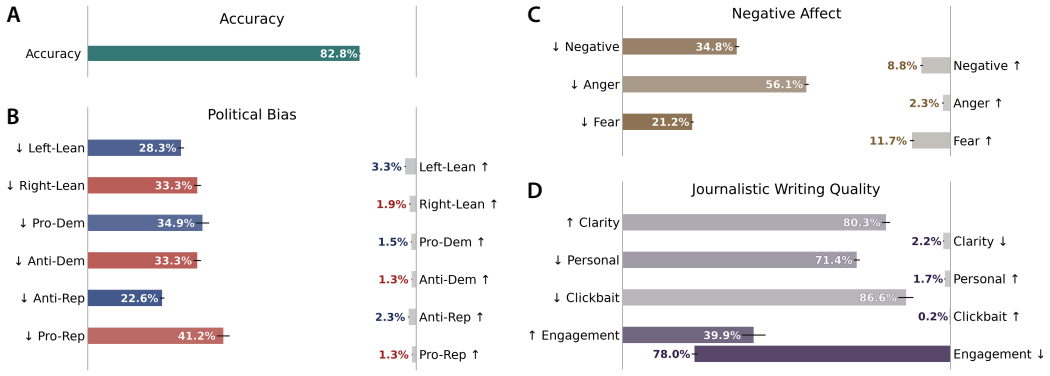
Across 41,331 summaries generated from 13,777 articles by three deployed browser summarizers, the paper's central discovery is that AI news summarization is broadly faithful and consistently de-intensifying: 82.8% of summary sentences are supported by the source (2.5% contradicted, 14.7% unverifiable), errors are mostly wording or attribution slips rather than fabrication, and bias/affect attenuation strongly outweighs introduction (e.g., 56.1% of anger-expressing articles get neutral summaries versus 2.3% introduction; ideological neutrality is preserved in ~95% of cases). The de-intensification is not uniform — Edge tempers right-leaning and pro-Republican content more aggressively, fear i
Load-bearing premise
The entire finding that summaries are less biased and less negative rests on the accuracy of the LLM judges and classifiers that scored both articles and summaries: those instruments were validated against human labels on only 25 articles plus 75 summaries (and 880 sentences for accuracy), so if the judges systematically rate condensed or neutral-sounding text as more neutral regardless of content, the reported attenuation is an artifact of the measuring stick.
Editorial extensions
If this is right
- If AI browsers keep attenuating bias and affect, heavy news consumers using these tools may encounter a calmer, more neutral news diet than the outlets' own editorial voice — potentially lowering affective polarization and news avoidance, but also flattening the distinct voice of journalism.
- Because accuracy is high but not perfect, readers who rely on summaries alone will occasionally absorb unverifiable or misattributed claims; the paper estimates that about 0.9% of summary sentences contain fully fabricated facts.
- The asymmetry — pro-Republican and anti-Democratic stances attenuated more, with Edge the most aggressive — means the de-biasing effect is not politically symmetric, which could matter for perceptions of algorithmic fairness.
- If the trend holds as models update, browsers become a standardized editorial layer that consistently overrides outlet-specific framing, changing the competitive dynamics of news production: journalists' framing choices get systematically filtered before reaching readers.
- The opposite directions for clarity (up) and engagement (down) imply summaries may increase comprehension but reduce the stickiness of news, with downstream effects on attention and memory that the paper leaves to experimental work.
Reading between the lines
- The paper's asymmetry finding suggests a testable hypothesis the authors do not pursue: if safety or neutrality instructions in Edge's system prompt are the cause, then varying the prompt wording should produce graded attenuation; a controlled prompt-ablation study on the same corpus would test this directly.
- Extending beyond the U.S., the finding implies that in more polarized or more emotional media systems, the same browser models could produce larger (or smaller) de-intensification effects; a comparative multilingual audit would reveal whether the attenuation is a property of English-language training or a universal summarization bias.
- The high rate of unverifiable sentences (14.7%) warrants scrutiny: if readers treat a summary as authoritative, unverifiable-but-true additions inflate perceived accuracy; a reader-facing experiment testing how people handle unverifiable statements would clarify the practical risk.
- The study measures content rather than audience response, so the democratic value of attenuation is open; our editorial inference is that the net effect likely depends on the reader's prior — for heavy partisan news consumers, de-intensification may be beneficial, while for centrist readers, it may blur outlet distinctions and erode trust.
Editorial analysis
A structured set of objections, weighed in public.
Referee Report
Summary. The paper presents a large-scale audit of three browser-based AI news summarizers (Google Chrome/Gemini, Microsoft Edge/Copilot, and Perplexity Comet) on 13,777 U.S. political news articles, yielding 41,331 article–summary pairs. The authors report four core findings: (1) summaries are broadly accurate, with 82.8% of sentences supported by the source article, 2.5% contradicted, and 14.7% unverifiable; (2) summarizers reduce ideological bias, partisan stance, negativity, anger, and fear; (3) they improve journalistic writing quality by increasing clarity and reducing personal tone and clickbait, while flattening engagement; and (4) these patterns are broadly consistent across browsers, outlet leanings, and topics. Measurements use LLM annotators (GPT-5.2/GPT-5.5) and transformer classifiers, with human validation reported in Appendix A.2. The paper interprets the findings as evidence that AI-powered browsers act as a new class of editorial intermediaries that systematically transform news content.
Significance. If the attenuation findings hold, the paper identifies a consequential new form of algorithmic mediation in everyday news consumption, with implications for democratic discourse, AI governance, and our understanding of how LLM-based tools reshape political information. The scale and ecological validity are major strengths: real browser features rather than custom prompts, a paired article–summary design, three independent systems, and robustness checks across outlets and topics. The accuracy claim is well supported by human validation on 880 sentences (94% agreement, F1=.91). The paper is also transparent about asymmetries and limitations, including qualitative analyses of Edge's behavior and of sources of inaccuracy. However, the central bias/affect attenuation claim rests on a measurement-invariance assumption—that the same LLM annotator rates articles and summaries on the same scale—which is not adequately tested. The validation sample is small and aggregated, so the paper cannot rule out a summary-specific annotation bias. The reproducibility materials (Zenodo data, detailed appendices) are a further strength.
major comments (2)
- [Appendix A.2 / Results ('AI news summarizers reduce political bias' and 'reduce negative affect')] The central attenuation claim depends on GPT-5.2 labeling both source articles and summaries, but the human validation (25 articles + 75 summaries) is too small and too coarsely reported to establish measurement invariance across text formats. Agreement is reported only in aggregate; it is not broken down by article vs. summary, and for ideological bias the macro-F1 is only .47 (O1=.90), for anger F1=.53. If the LLM annotator is systematically more likely to assign 'center'/'neutral' to condensed, decontextualized summary text, the reported reductions (ideological bias 30.8%, anger 56.1%, etc.) could be an artifact even if the summaries preserved the original slant and emotion. This is load-bearing for the paper's second and third core findings. Please report human–LLM agreement and confusion matrices separately for articles and summaries, and/or conduct a larger paired human-coding stud
- [Appendix B.2 (Fig. B.13, 'partisan shift' and issue ownership)] The interpretation that topic-specific partisan shifts 'appear to align with issue ownership' is not directly tested. The partisan-shift metric is itself derived from the LLM labels, and the issue-ownership attribution is based on selected topics (Gender & DEI, Abortion, Israel-Mideast, Guns, Religion, Economy) with Immigration acknowledged as a counterexample. This claim is presented as suggestive and is not central to the paper's headline, but if retained it should be framed more explicitly as an exploratory hypothesis or supported with an independent measure of issue ownership.
minor comments (5)
- [Materials and Methods, 'Measurement and validation' / Fig. 1A] The accuracy metric counts unverifiable sentences as not supported, so the 82.8% figure treats 14.7% unverifiable sentences as inaccurate. This is a defensible definition, but it would help to state explicitly in the main text that unverifiable sentences are counted against accuracy and to report a robustness analysis that excludes unverifiable sentences from the denominator (or treats them as a separate category).
- [Appendix A.2, 'Journalistic writing quality'] The transformer-based writing-quality classifier is described as 'previously developed' with a citation to unpublished work. Since this classifier is used for four of the eleven outcome measures, please provide a public reference, a detailed architecture description, or a link to the model so that readers can assess and reproduce the measurements.
- [Appendix B.2, 'Qualitative analysis of Edge's political bias'] The evidence for Edge's distinctive attenuation of pro-Republican content rests on 15 summary sets and a small prevalence difference (6.6% vs. 1.9% for the 'neutral' opening variant). This is suggestive but thin; consider increasing the qualitative sample or providing a more systematic quantitative analysis of the 'neutral' wording across browsers and stances.
- [Appendix A.1, Table A.3] The table has two rows labeled 'Comet — Wave 2'. Please relabel the second row (likely 'Comet — Wave 3' or a continuation) to avoid confusion.
- [Appendix A.2, validation metrics] The ideological bias F1 of .47 is reported alongside O1=.90. This deserves more prominence in the main text; readers should know that a substantial portion of the 'reduction' in ideological bias could stem from near-neighbor changes (e.g., far-left to left) rather than shifts to neutral. The current presentation is honest but buried in an appendix.
Circularity Check
No significant circularity: the audit's claims rest on human-validated measurements, not on fitted parameters or self-citation chains.
full rationale
The paper is an observational audit, not a derivation. Its central claims (82.8% accuracy; reductions in ideological bias, partisan stance, negativity, anger, fear; increases in clarity) are empirical comparisons between source articles and browser-generated summaries. The measurements use GPT-5.2/GPT-5.5 annotators and transformer classifiers, but these instruments were validated against human annotations (e.g., 94% agreement and F1=.91 for accuracy on 880 sentences; 80-99% accuracy for bias/affect/writing-quality measures on 25 articles and 75 summaries). No parameter is fitted to the article-vs-summary differences and then reported as a prediction; no equation defines the outcome in terms of the input. The cited prior work (e.g., refs. 24, 25, 41) is contextual rather than load-bearing, and the self-citations (e.g., ref. 34) support background claims about algorithmic audits, not the central result. The concern that LLM judges may systematically rate compressed summary text as more neutral is a measurement-validity threat, not circularity: it does not make the article-summary comparison true by construction, and the paper's human validation is independent evidence against it. The issue-ownership interpretation in Appendix B.2 is explicitly presented as post hoc and does not feed back into the measurement. Hence no circular step is identifiable.
Assumptions & free parameters
free parameters (3)
- Outlet leaning classification cut-off (MBFC ±3.5)
- Topic model hyperparameters (UMAP n_neighbors=15, n_components=5, random_state=42; HDBSCAN min_cluster_size=20, leaf clu
- LLM prompt templates for measuring bias, affect, and accuracy
assumptions (4)
- domain assumption Human-annotated validation samples (25 articles/75 summaries for bias/affect; 880 sentences for accuracy) generalize to the full 13,777-article corpus.
- domain assumption Classifiers trained on full news articles measure the same constructs when applied to AI-generated summaries.
- domain assumption The set of articles summarized by all three browsers is representative of political news.
- domain assumption The supported/contradicted/unverifiable trichotomy operationalizes factual accuracy, with unverifiable treated as neither accurate nor inaccurate.
Cite this review
Pith. "Pith review of AI-Powered Browsers Are Broadly Accurate News Summarizers That Reduce Political Bias and Negative Affect." pith.science (2026). https://pith.science/paper/DONRSN6A
@misc{pith2026260718931,
  author       = {Pith},
  title        = {Pith review of: AI-Powered Browsers Are Broadly Accurate News Summarizers That Reduce Political Bias and Negative Affect},
  year         = {2026},
  howpublished = {\url{https://pith.science/paper/DONRSN6A}},
  note         = {Machine review of arXiv:2607.18931}
}
read the original abstract
Web browsers now provide AI-generated news summaries for millions of users. Despite their popularity and influence, we lack a systematic understanding of how these systems transform news before people read it. Through a large-scale audit, we investigate the factual accuracy of browser-based AI summarizers and how they alter the political bias, negative affect, and journalistic writing quality of news. Drawing on 13,777 articles from 15 U.S. news outlets, we evaluate their 41,331 summaries generated by three leading AI-powered browsers: Google Chrome (Gemini), Microsoft Edge (Copilot), and Perplexity Comet. We find that browser-based AI summarizers are broadly accurate. Furthermore, they consistently transform news by attenuating ideological bias, partisan stances, negativity, anger, and fear, while increasing clarity and reducing personal tone. With some variations, these patterns hold across browsers, outlet ideologies, and topics. Our findings identify AI-powered browsers as a new class of editorial intermediaries that systematically reshape news, with implications for democratic discourse and AI governance.
Figures


Figures from the paper (1 more)

Reference graph
Works this paper leans on
-
[1]
OECD, Ai use by individuals surges across the OECD as adoption by firms continues to expand,https://www.oe cd.org/en/about/news/announcements/2026/01 /ai-use-by-individuals-surges-across-the-o ecd-as-adoption-by-firms-continues-to-expan d.html(2026)
2026
-
[2]
Microsoft AI Economy Institute, Global AI adoption 2025,https://www.microsoft.com/en-us/corpor ate-responsibility/topics/ai-economy-insti tute/reports/global-ai-adoption-2025/(2026)
2025
-
[3]
Sidoti, C
O. Sidoti, C. McClain, 34% of u.s. adults have used Chat- GPT, about double the share in 2023,https://www.pe wresearch.org/short-reads/2025/06/25/34-o f-us-adults-have-used-chatgpt-about-doubl e-the-share-in-2023/(2025)
2023
-
[4]
Eurostat, 32.7% of EU people used generative AI tools in 2025,https://ec.europa.eu/eurostat/web/prod ucts-eurostat-news/w/ddn-20251216-3(2025)
2025
-
[5]
Google, Go behind the browser with Chrome’s new AI features,https://blog.google/products-and-pla tforms/products/chrome/new-ai-features-for -chrome/, accessed: 2026-06-10 (2025)
2026
-
[6]
Microsoft, Meet Copilot mode in Edge: Your AI browser, https://blogs.windows.com/msedgedev/2025/1 0/23/meet-copilot-mode-in-edge-your-ai-bro wser/, accessed: 2026-06-10 (2025)
2025
-
[7]
Newman, A
N. Newman, A. Ross Arguedas, C. T. Robertson, R. K. Nielsen, R. Fletcher, Reuters institute digital news report 2025,https://reutersinstitute.politics.ox.a c.uk/digital-news-report/2025(2025)
2025
-
[8]
Wojcieszak, E
M. Wojcieszak, E. Menchen-Trevino, J. F. Goncalves, B. Weeks, Avenues to news and diverse news exposure online: Comparing direct navigation, social media, news aggregators, search queries, and article hyperlinks, The International Journal of Press/Politics 27 (4) (2022) 860– 886
2022
Show all 69 references
-
[9]
Stier, F
S. Stier, F. Mangold, M. Scharkow, J. Breuer, Post post- broadcast democracy? news exposure in the age of on- line intermediaries, American Political Science Review 116 (2) (2022) 768–774
2022
-
[10]
I. O. Gallegos, R. A. Rossi, J. Barrow, M. M. Tanjim, S. Kim, F. Dernoncourt, T. Yu, R. Zhang, N. K. Ahmed, Bias and fairness in large language models: A survey, Computational linguistics 50 (3) (2024) 1097–1179
2024
-
[11]
Navigli, S
R. Navigli, S. Conia, B. Ross, Biases in large language models: origins, inventory, and discussion, ACM Journal of Data and Information Quality 15 (2) (2023) 1–21
2023
-
[12]
Hofmann, P
V . Hofmann, P. R. Kalluri, D. Jurafsky, S. King, Ai gener- ates covertly racist decisions about people based on their dialect, Nature 633 (8028) (2024) 147–154
2024
-
[13]
A. Abid, M. Farooqi, J. Zou, Persistent anti-muslim bias in large language models, in: Proceedings of the 2021 AAAI/ACM Conference on AI, Ethics, and Society, 2021, pp. 298–306
2021
-
[14]
Kotek, R
H. Kotek, R. Dockum, D. Sun, Gender bias and stereo- types in large language models, in: Proceedings of the ACM collective intelligence conference, 2023, pp. 12–24
2023
-
[15]
Rozado, The political preferences of llms, PloS one 19 (7) (2024) e0306621
D. Rozado, The political preferences of llms, PloS one 19 (7) (2024) e0306621
2024
-
[16]
M. Buyl, A. Rogiers, S. Noels, G. Bied, I. Dominguez- Catena, E. Heiter, I. Johary, A.-C. Mara, R. Romero, J. Li- jffijt, et al., Large language models reflect the ideology of their creators, npj Artificial Intelligence 2 (1) (2026) 7
2026
-
[17]
Maynez, S
J. Maynez, S. Narayan, B. Bohnet, R. McDonald, On faithfulness and factuality in abstractive summarization, in: Proceedings of the 58th annual meeting of the associ- ation for computational linguistics, 2020, pp. 1906–1919
2020
-
[18]
Z. Ji, N. Lee, R. Frieske, T. Yu, D. Su, Y . Xu, E. Ishii, Y . J. Bang, A. Madotto, P. Fung, Survey of hallucination in natural language generation, ACM computing surveys 55 (12) (2023) 1–38
2023
-
[19]
Fisher, S
J. Fisher, S. Feng, R. Aron, T. Richardson, Y . Choi, D. W. Fisher, J. Pan, Y . Tsvetkov, K. Reinecke, Biased llms can influence political decision-making, in: Proceedings of the 63rd Annual Meeting of the Association for Compu- tational Linguistics (V olume 1: Long Papers), 2...
2025
-
[20]
X. Bai, A. Wang, I. Sucholutsky, T. L. Griffiths, Explicitly unbiased large language models still form biased associ- ations, Proceedings of the National Academy of Sciences 122 (8) (2025) e2416228122
2025
-
[21]
Potter, S
Y . Potter, S. Lai, J. Kim, J. Evans, D. Song, Hidden per- suaders: Llms’ political leaning and their influence on vot- ers, in: Proceedings of the 2024 Conference on Empiri- cal Methods in Natural Language Processing, 2024, pp. 4244–4275
2024
-
[22]
H. Lin, G. Czarnek, B. Lewis, J. P. White, A. J. Berinsky, T. Costello, G. Pennycook, D. G. Rand, Persuading voters using human–artificial intelligence dialogues 648 (8093) 394–401.doi:10.1038/s41586-025-09771-9. URLhttps://www.nature.com/articles/s41586 -025-09771-9 9
-
[23]
Pew Research Center, Google users are less likely to click on links when an AI summary appears in the results,ht tps://www.pewresearch.org/short-reads/2025/ 07/22/google-users-are-less-likely-to-click -on-links-when-an-ai-summary-appears-in-the -results/(2025)
2025
-
[24]
Elliott, P
O. Elliott, P. Archer, Representation of BBC news content in AI assistants, Tech. rep., BBC (2025). URLhttps://www.bbc.co.uk/aboutthebbc/docu ments/bbc-research-into-ai-assistants.pdf
2025
-
[25]
rep., European Broadcasting Union (2025)
EBU, BBC, News integrity in AI assistants: An interna- tional public service media study, Tech. rep., European Broadcasting Union (2025). URLhttps://www.ebu.ch/files/live/sites/eb u/files/Publications/MIS/open/EBU-MIS-BBC_N ews_Integrity_in_AI_Assistants_Report_2025 .pdf
2025
-
[26]
Presenc AI, Perplexity Comet Usage Statistics 2026,ht tps://presenc.ai/research/comet-usage-stati stics-2026, accessed: 2026-06-09 (2026)
2026
-
[27]
Mason, Uncivil agreement: How politics became our identity, University of Chicago Press, 2022
L. Mason, Uncivil agreement: How politics became our identity, University of Chicago Press, 2022
2022
-
[28]
N. P. Kalmoe, L. Mason, Radical American partisan- ship: Mapping violent hostility, its causes, and the con- sequences for democracy, University of Chicago Press, 2022
2022
-
[29]
X. Yu, M. Wojcieszak, Us partisan media criticize the out- party more than they praise the in-party, Political Behavior (2026) 1–22
2026
-
[30]
M. S. Levendusky, Why do partisan media polarize view- ers?, American journal of political science 57 (3) (2013) 611–623
2013
-
[31]
Wertz, M
E. Wertz, M. Wojcieszak, Correlates of and counterstrate- gies to news non-use: systematic review and prescriptive framework, Annals of the International Communication Association (2026) wlag023
2026
-
[32]
Villi, T
M. Villi, T. Aharoni, K. Tenenboim-Weinblatt, P. J. Boczkowski, K. Hayashi, E. Mitchelstein, A. Tanaka, N. Kligler-Vilenchik, Taking a break from news: A five- nation study of news avoidance in the digital era, Digital Journalism 10 (1) (2022) 148–164
2022
-
[33]
Ibrahim, N
H. Ibrahim, N. AlDahoul, S. Lee, T. Rahwan, Y . Zaki, YouTube’s recommendation algorithm is left-leaning in the united states, PNAS Nexus 2 (8) (2023) pgad264. doi:10.1093/pnasnexus/pgad264. URLhttps://doi.org/10.1093/pnasnexus/pgad 264
2023 doi
-
[34]
Haroon, M
M. Haroon, M. Wojcieszak, A. Chhabra, X. Liu, P. Moha- patra, Z. Shafiq, Auditing youtube’s recommendation sys- tem for ideologically congenial, extreme, and problematic recommendations, Proceedings of the National Academy of Sciences 120 (50) (2023) e2213020120.doi:10.107 3/p...
2023 doi
-
[35]
M. Lutz, S. Gadaginmath, N. Vairavan, P. Mui, Exam- ining political bias within YouTube search and recom- mendation algorithms, in: 2021 IEEE Symposium Se- ries on Computational Intelligence (SSCI), 2021, pp. 1–7. doi:10.1109/SSCI50451.2021.9660012. URLhttps://ieeexplore.ieee....
2021
-
[36]
D. Bär, F. Pierri, G. De Francisci Morales, S. Feuerriegel, Systematic discrepancies in the delivery of political ads on facebook and instagram, PNAS nexus 3 (7) (2024) pgae247
2024
-
[37]
Huszár, S
F. Huszár, S. I. Ktena, C. O’Brien, L. Belli, A. Schlaikjer, M. Hardt, Algorithmic amplification of politics on twitter, Proceedings of the National Academy of Sciences 119 (1) (2022) e2025334119.doi:10.1073/pnas.202533411 9. URLhttps://www.pnas.org/doi/abs/10.1073/p nas.2025334119
2022 doi
- [38]
-
[39]
Westwood, J
S. Westwood, J. Grinner, A. B. Hall, Measuring perceived slant in large language models through user evaluations (2025). URLhttps://www.gsb.stanford.edu/faculty-r esearch/working-papers/measuring-perceived -slant-large-language-models-through-user
2025
-
[40]
Y . Bang, D. Chen, N. Lee, P. Fung, Measuring political bias in large language models: What is said and how it is said, in: L.-W. Ku, A. Martins, V . Srikumar (Eds.), Pro- ceedings of the 62nd Annual Meeting of the Association for Computational Linguistics (V olume 1: Long Pap...
2024 doi
-
[41]
Savgira, E
P. Savgira, E. Kreiss, H. Hosseinmardi, What stays and what goes: Auditing the impact of llm summarization on news partisanship, in: Proceedings of the Extended Ab- stracts of the 2026 CHI Conference on Human Factors in Computing Systems, 2026, pp. 1–8
2026
-
[42]
Suzgun, E
M. Suzgun, E. Shen, F. Bianchi, A. Spangher, T. Icard, D. E. Ho, D. Jurafsky, J. Zou, Evaluating commer- cial ai chatbots as news intermediaries, arXiv preprint arXiv:2605.22785 (2026). 10
2026 arXiv
-
[43]
Alessa, P
A. Alessa, P. Somane, A. T. Lakshminarasimhan, J. Skirzynski, J. McAuley, J. M. Echterhoff, Quantify- ing cognitive bias induction in llm-generated content, in: Proceedings of the 14th International Joint Conference on Natural Language Processing and the 4th Conference of the ...
2025
-
[44]
Muñoz-Ortiz, C
A. Muñoz-Ortiz, C. Gómez-Rodríguez, D. Vilares, Con- trasting linguistic patterns in human and llm-generated news text, Artificial Intelligence Review 57 (10) (2024) 265
2024
-
[45]
Reinhart, B
A. Reinhart, B. Markey, M. Laudenbach, K. Pantusen, R. Yurko, G. Weinberg, D. W. Brown, Do llms write like humans? variation in grammatical and rhetorical styles, Proceedings of the National Academy of Sciences 122 (8) (2025) e2422455122
2025
-
[46]
Markey, D
B. Markey, D. W. Brown, M. Laudenbach, A. Kohler, Dense and disconnected: Analyzing the sedimented style of chatgpt-generated text at scale, Written Communica- tion 41 (4) (2024) 571–600
2024
-
[47]
Rozado, R
D. Rozado, R. Hughes, J. Halberstadt, Longitudinal anal- ysis of sentiment and emotion in news media headlines us- ing automated labelling with transformer language mod- els, Plos one 17 (10) (2022) e0276367
2022
-
[48]
H. A. Semetko, P. M. Valkenburg, Framing european poli- tics: A content analysis of press and television news, Jour- nal of communication 50 (2) (2000) 93–109
2000
-
[49]
Levendusky, Partisan media exposure and attitudes toward the opposition, Political communication 30 (4) (2013) 565–581
M. Levendusky, Partisan media exposure and attitudes toward the opposition, Political communication 30 (4) (2013) 565–581
2013
-
[50]
Boukes, R
M. Boukes, R. Vliegenthart, News consumption and its unpleasant side effect, Journal of Media Psychology (2017)
2017
-
[51]
Hanitzsch, F
T. Hanitzsch, F. Hanusch, C. Mellado, M. Anikina, R. Berganza, I. Cangoz, M. Coman, B. Hamada, M. Elena Hernández, C. D. Karadjov, S. Virginia Mor- eira, P. G. Mwesige, P. L. Plaisance, Z. Reich, J. Seethaler, E. A. Skewes, D. Vardiansyah Noor, E. Kee Wang Yuen, Mapping Journa...
2011
-
[52]
Talaga, Erc newsuse-political,https://huggingf ace.co/sztal/erc-newsuse-political, accessed: 2026-07-09 (2025)
S. Talaga, Erc newsuse-political,https://huggingf ace.co/sztal/erc-newsuse-political, accessed: 2026-07-09 (2025)
2026
-
[53]
Roberts, R
H. Roberts, R. Bhargava, L. Valiukas, D. Jen, M. M. Malik, C. S. Bishop, E. B. Ndulue, A. Dave, J. Clark, B. Etling, et al., Media cloud: Massive open source col- lection of global news on the open web, in: Proceedings of the International AAAI Conference on Web and Social Med...
2021
-
[54]
Kubinec, Ordered beta regression: a parsimonious, well-fitting model for continuous data with lower and up- per bounds, Political analysis 31 (4) (2023) 519–536
R. Kubinec, Ordered beta regression: a parsimonious, well-fitting model for continuous data with lower and up- per bounds, Political analysis 31 (4) (2023) 519–536
2023
-
[55]
M. E. Brooks, K. Kristensen, K. J. van Benthem, A. Mag- nusson, C. W. Berg, A. Nielsen, H. J. Skaug, M. Mach- ler, B. M. Bolker, glmmtmb balances speed and flexibil- ity among packages for zero-inflated generalized linear mixed modeling, The R Journal 9 (2) (2017) 378–400
2017
-
[56]
H. Lin, J. Lasser, S. Lewandowsky, R. Cole, A. Gully, D. G. Rand, G. Pennycook, High level of correspondence across different news domain quality rating sets, PNAS nexus 2 (9) (2023) pgad286
2023
-
[57]
L. Derczynski, Complementarity, F-score, and NLP Evaluation, in: Proceedings of the Tenth International Conference on Language Resources and Evaluation ({LREC}‘16), European Language Resources Associa- tion (ELRA), Portoro{\v{z}}, Slovenia, 2016, pp. 261– 266
2016
-
[58]
Talaga, Erc newsuse-negativity,https://huggingf ace.co/sztal/erc-newsuse-negativity, accessed: 2026-07-09 (2025)
S. Talaga, Erc newsuse-negativity,https://huggingf ace.co/sztal/erc-newsuse-negativity, accessed: 2026-07-09 (2025)
2026
-
[59]
Conneau, K
A. Conneau, K. Khandelwal, N. Goyal, V . Chaudhary, G. Wenzek, F. Guzmán, E. Grave, M. Ott, L. Zettlemoyer, V . Stoyanov, Unsupervised Cross-lingual Representation Learning at Scale (Apr. 2020).arXiv:1911.02116
2020 arXiv
-
[60]
Grootendorst, Bertopic: Neural topic modeling with a class-based tf-idf procedure, arXiv preprint arXiv:2203.05794 (2022)
M. Grootendorst, Bertopic: Neural topic modeling with a class-based tf-idf procedure, arXiv preprint arXiv:2203.05794 (2022)
2022 arXiv
-
[61]
J. R. Petrocik, Issue ownership in presidential elections, with a 1980 case study, American Journal of Political Sci- ence 40 (3) (1996) 825–850.doi:10.2307/2111797. URLhttps://www.jstor.org/stable/2111797
1980
-
[62]
Walgrave, J
S. Walgrave, J. Lefevere, A. Tresch, The associative di- mension of issue ownership, Public Opinion Quarterly 76 (4) (2012) 771–782.doi:10.1093/poq/nfs023. URLhttps://doi.org/10.1093/poq/nfs023
2012 doi
-
[63]
J. M. Wright, S. Clifford, E. N. Simas, The limits of issue ownership in a polarized era, American Politics Research 50 (5) (2022) 694–706.doi:10.1177/1532673X2211 06435. URLhttps://doi.org/10.1177/1532673X221106 435
2022 doi
-
[64]
hard” paywall indicates that full article text is inaccessible without a subscription, and a“soft
A. Yang, D. Williams, Striking while the iron is hot: Exploring the impact of issue ownership and issue salience on donations to political organizations in the 2020 US presidential election, The International Journal of Press/Politics 31 (3) (2026) 754–780.doi:10.1177/ 1940161...
2020 doi
-
[65]
*Input* The summary you have to convert: {summary} Figure A.5.Prompt for decomposing summaries into sentences
Third sentence. *Input* The summary you have to convert: {summary} Figure A.5.Prompt for decomposing summaries into sentences. Political bias.We used GPT-5.2-2025-12-11 to annotate each news article and summary forideological bias,stance toward Democrats, andstance toward Repu...
2025
-
[66]
Reasoning:
Label: ... Reasoning:
-
[67]
Negativity.We annotated the negativity of each news article and summary using a transformer-based classifier (58)
*Input* Article: {title} (from {domain}, published {date}) {article} The sentences you have to label: {sentences} Figure A.6.Prompt for evaluating the accuracy of summary sentences. Negativity.We annotated the negativity of each news article and summary using a transformer-bas...
2025
-
[68]
- Social dimension: Framing that supports immigration, reproductive rights, LGBTQ+rights, and climate change mitigation
Left and far-left reporting (typically from a liberal perspective): - Economic dimension: Framing that favors economic redistribution, government spending on public welfare and social services, and policies promoting equality. - Social dimension: Framing that supports immigrat...
-
[69]
A said X
Right and far-right reporting (typically from a conservative perspective): - Economic dimension: Framing that favors limited government intervention, free-market principles, lower taxes, and reduced public spending on social programs (often alongside support for increased mili...
2020
Reviewed August 1, 2026 · model on record in the stance chip above.
Discussion (0). Sign in to comment.