DA-Studio: An Agentic System for End-to-End Data Analysis
Pith reviewed 2026-07-01 03:20 UTC · model grok-4.3
The pith
DA-Studio turns natural-language requests and raw files into complete, executable data analysis workflows through repeated LLM-driven action generation and sandbox execution.
A machine-rendered reading of the paper's core claim, the machinery that carries it, and where it could break.
Core claim
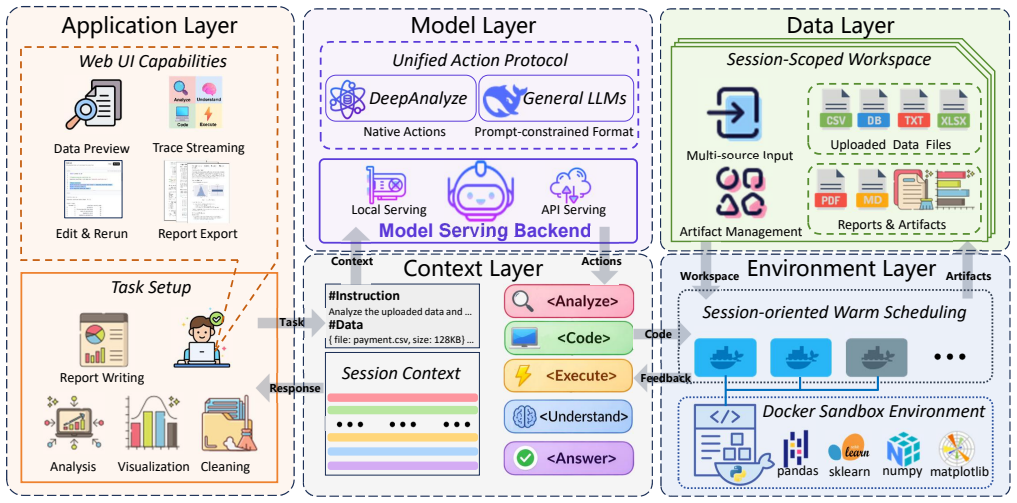
DA-Studio is an interactive web-based system that integrates an action-structured analysis backend, a sandboxed execution workspace, and a browser interface; through iterative action generation, code execution, and feedback incorporation, it constructs executable analysis steps from raw files and natural-language requests while exposing intermediate results and artifacts throughout the process.
What carries the argument
The action-structured analysis backend that generates, executes, and refines discrete analysis actions inside a sandboxed workspace while streaming traces and artifacts to the browser interface.
If this is right
- Users can inspect and rerun any intermediate step without restarting the entire analysis.
- Analysis reports can be exported directly from the accumulated artifacts and traces.
- The same backend can be extended to new data formats by adding action primitives that the LLM can invoke.
- Sandbox isolation limits the damage from any incorrect code generated during iteration.
Where Pith is reading between the lines
- If the action generation loop proves stable, similar architectures could be applied to other multi-step domains such as scientific simulation pipelines or automated reporting.
- The visible artifact trail may reduce the need for separate provenance tracking tools in collaborative settings.
- Performance would likely improve if the system cached successful action sequences for reuse on similar inputs.
Load-bearing premise
LLM-driven iterative action generation can reliably produce correct, executable multi-step workflows from heterogeneous inputs with only occasional human correction.
What would settle it
A sequence of ten varied raw-file-plus-request inputs where the system requires repeated manual code fixes or fails to complete an end-to-end workflow in more than half the cases.
Figures
read the original abstract
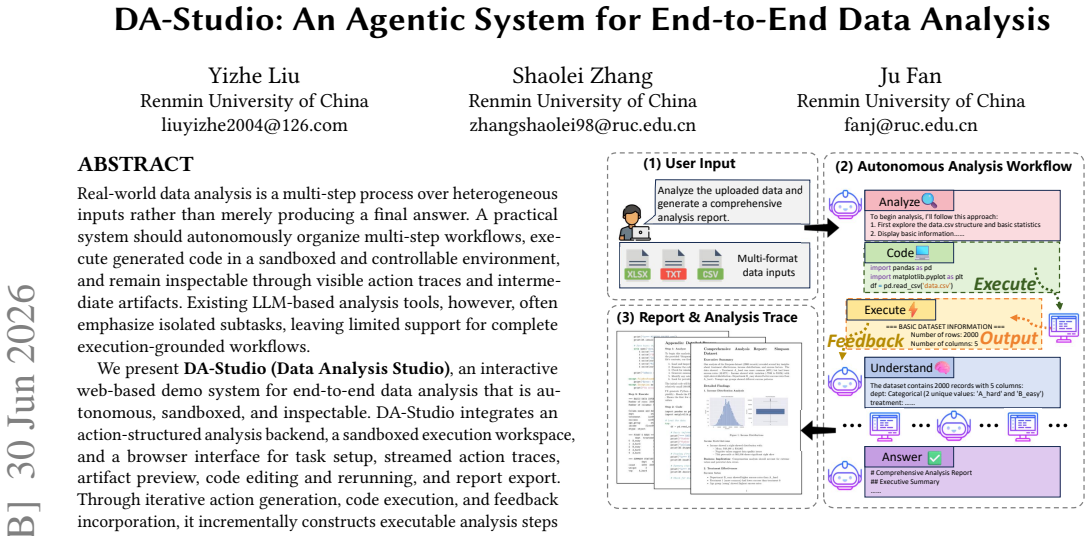
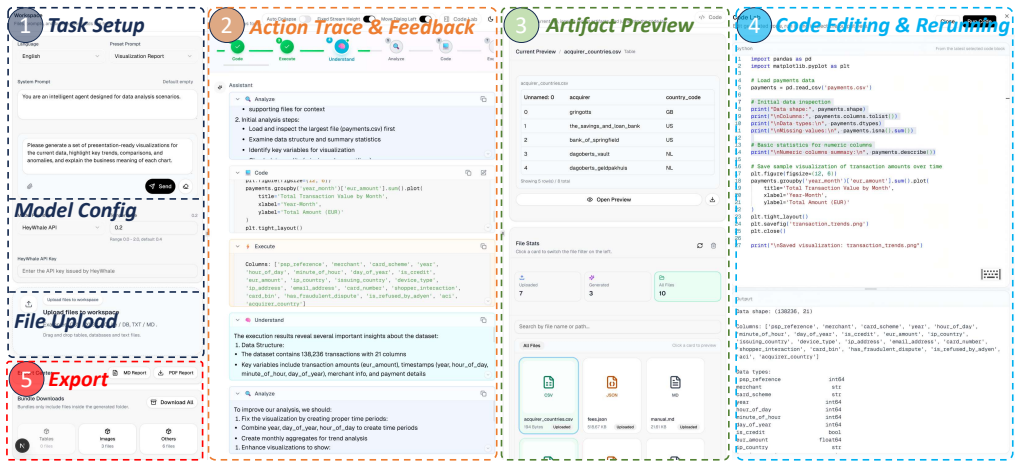
Real-world data analysis is a multi-step process over heterogeneous inputs rather than merely producing a final answer. A practical system should autonomously organize multi-step workflows, execute generated code in a sandboxed and controllable environment, and remain inspectable through visible action traces and intermediate artifacts. Existing LLM-based analysis tools, however, often emphasize isolated subtasks, leaving limited support for complete execution-grounded workflows. We present DA-Studio (Data Analysis Studio), an interactive web-based demo system for end-to-end data analysis that is autonomous, sandboxed, and inspectable. DA-Studio integrates an action-structured analysis backend, a sandboxed execution workspace, and a browser interface for task setup, streamed action traces, artifact preview, code editing and rerunning, and report export. Through iterative action generation, code execution, and feedback incorporation, it incrementally constructs executable analysis steps from raw files and natural-language requests while exposing intermediate results and artifacts throughout the process.
Editorial analysis
A structured set of objections, weighed in public.
Referee Report
Summary. The paper presents DA-Studio, an interactive web-based demo system for end-to-end data analysis. It integrates an action-structured analysis backend, a sandboxed execution workspace, and a browser interface to support autonomous multi-step workflows from raw files and natural-language requests via iterative action generation, code execution, and feedback, while exposing intermediate results.
Significance. The described architecture for sandboxed, inspectable agentic data analysis could offer a useful framework for building transparent data analysis tools if the claimed capabilities are validated. However, without any reported evaluations, the significance remains primarily in the system design rather than demonstrated performance.
major comments (1)
- [Abstract] Abstract: The central claim that the system 'incrementally constructs executable analysis steps from raw files and natural-language requests' through iterative action generation, code execution, and feedback incorporation is stated as fact, yet the manuscript supplies no evaluations, success metrics, case studies, or failure analyses to substantiate autonomous end-to-end operation.
Simulated Author's Rebuttal
We thank the referee for the review and the opportunity to respond. We address the single major comment below.
read point-by-point responses
-
Referee: [Abstract] Abstract: The central claim that the system 'incrementally constructs executable analysis steps from raw files and natural-language requests' through iterative action generation, code execution, and feedback incorporation is stated as fact, yet the manuscript supplies no evaluations, success metrics, case studies, or failure analyses to substantiate autonomous end-to-end operation.
Authors: DA-Studio is presented as an interactive web-based demo system whose primary contribution is the architecture integrating an action-structured backend, sandboxed workspace, and browser interface. The abstract describes the functionality of the implemented system, which supports the stated iterative process from raw files and natural-language requests. As a systems/demo paper, substantiation lies in the design choices that enable sandboxed execution, visible traces, and artifact exposure rather than in quantitative success rates or failure analyses. Similar contributions in the literature are accepted on the basis of the system description and demo availability. We therefore maintain that no evaluations are required to support the claims about the system's design and operation. revision: no
Circularity Check
No significant circularity identified
full rationale
The paper is a descriptive presentation of a system architecture (action-structured backend, sandboxed workspace, inspectable UI) for end-to-end data analysis. It contains no mathematical derivations, equations, fitted parameters, predictions of quantitative outcomes, or load-bearing self-citations. The central claim reduces to the statement that the described components enable incremental construction of workflows from raw inputs; this is an architectural assertion that does not rely on any self-referential reduction or ansatz smuggled via citation. No steps qualify under the enumerated circularity patterns.
Axiom & Free-Parameter Ledger
Reference graph
Works this paper leans on
-
[1]
Do you think it should or should not be the government's responsibility to provide [program]?
Zhang, Shaolei and Fan, Ju and Fan, Meihao and Li, Guoliang and Du, Xiaoyong , year =. doi:10.48550/arXiv.2510.16872 , url =. 2510.16872 , archivePrefix =
-
[2]
2023 , doi =
Maddigan, Paula and Susnjak, Teo , journal =. 2023 , doi =
2023
-
[3]
Dibia, Victor , booktitle =. 2023 , address =. doi:10.18653/v1/2023.acl-demo.11 , url =
-
[4]
IEEE Transactions on Visualization and Computer Graphics , volume =
Data Formulator: AI-Powered Concept-Driven Visualization Authoring , author =. IEEE Transactions on Visualization and Computer Graphics , volume =. 2024 , doi =
2024
-
[5]
2023 , publisher =
Gao, Luyu and Madaan, Aman and Zhou, Shuyan and Alon, Uri and Liu, Pengfei and Yang, Yiming and Callan, Jamie and Neubig, Graham , booktitle =. 2023 , publisher =
2023
-
[6]
TaskWeaver: A code-first agent framework.arXiv preprint arXiv:2311.17541, 2023
Qiao, Bo and Li, Liqun and Zhang, Xu and He, Shilin and Kang, Yu and Zhang, Chaoyun and Yang, Fangkai and Dong, Hang and Zhang, Jue and Wang, Lu and Ma, Minghua and Zhao, Pu and Qin, Si and Qin, Xiaoting and Du, Chao and Xu, Yong and Lin, Qingwei and Rajmohan, Saravan and Zhang, Dongmei , year =. doi:10.48550/arXiv.2311.17541 , url =. 2311.17541 , archivePrefix =
-
[7]
Proceedings of the 2025 CHI Conference on Human Factors in Computing Systems , year =
Data Formulator 2: Iterative Creation of Data Visualizations, with AI Transforming Data Along the Way , author =. Proceedings of the 2025 CHI Conference on Human Factors in Computing Systems , year =
2025
-
[8]
Ouyang, Geliang and Chen, Jingyao and Nie, Zhihe and Gui, Yi and Wan, Yao and Zhang, Hongyu and Chen, Dongping , booktitle =. 2025 , address =. doi:10.18653/v1/2025.acl-long.960 , url =
discussion (0)
Sign in with ORCID, Apple, or X to comment. Anyone can read and Pith papers without signing in.