REVIEW 3 major objections 4 minor 56 references
Pairing in two-dimensional Fermi gases with a coordinate-space potential
T0 review · 3 major / 4 minor · reviewed 2026-08-14 · deepseek-v4-flash
Pith's one-line read A two-dimensional Fermi gas's pairing gap is suppressed relative to mean-field BCS theory across the BEC-BCS crossover.
desk verdict Useful finite-range BCS check and larger-N DMC data, but the headline gap suppression rests on an uncontrolled average of two finite-N points and needs a real extrapolation before the benchmarks can be trusted. read the letter →
The pith
A machine-rendered reading of the paper's core claim, the machinery that carries it, and where it could break.
The reading
What carries the argument
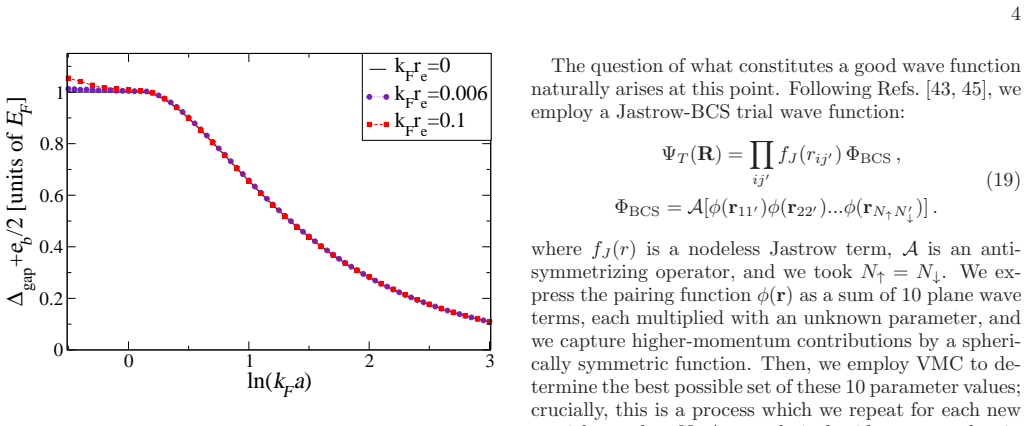
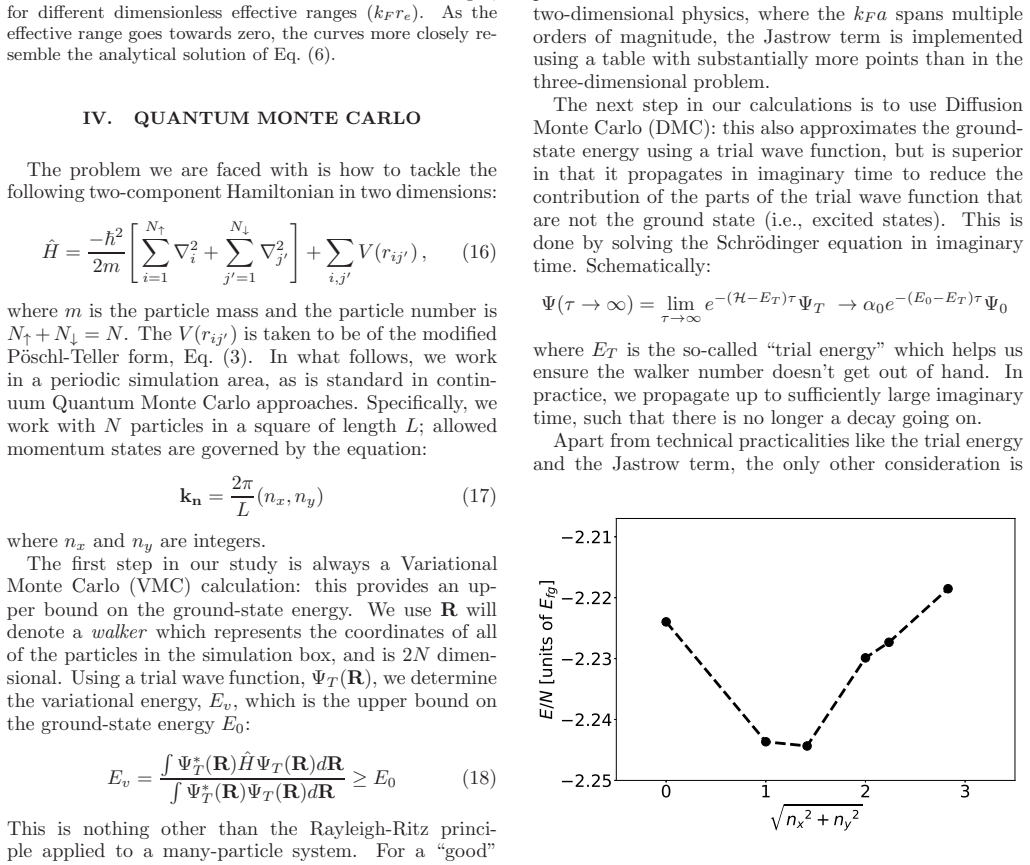
The load-bearing analytic object is the two-dimensional BCS gap equation for a coordinate-space potential, derived by expanding the gap function and the potential in angular momentum eigenstates and Bessel functions, Eq. (14): $\Delta_l(k) = -\int_0^\infty dk'\, k' V_l(k,k') \Delta_l(k') / (2 E(k'))$, where $V_l(k,k')$ is the Bessel-transformed partial-wave potential and $E(k)$ is the quasiparticle energy. This equation is solved self-consistently with the density equation to show that $k_F r_e = 0.006$ reproduces the zero-range analytic gap. The many-body extraction machinery is a Jastrow-BCS trial wave function with 10 optimized plane-wave pairing orbitals, propagated in imaginary time by fixed-node diffusion Monte Carlo, combined with the odd-even staggering formula Eq. (20) applied to closed-shell particle numbers N = 10, 18, 26, 42, 50, 58 and their neighbors.
What would settle it
Run the same trial wave function and DMC procedure at larger closed shells such as N=74 or N=90 and extrapolate $\Delta(N)$ in $1/N$; if the extrapolated value moves outside the statistical errors of the N=50/N=58 average, the thermodynamic-limit claim is not settled.
Extended reading notes
Core claim
The paper's main claim is that the zero-temperature pairing gap in a two-dimensional Fermi gas, obtained from fixed-node diffusion Monte Carlo energies via $\Delta(N)=E(N+1)-\frac{1}{2}[E(N+2)+E(N)]$, is smaller than the mean-field BCS prediction on the BCS side of the crossover, with the suppression growing as $\ln(k_F a)$ increases. The extracted gaps at $\eta = 0.5, 1.0, 1.5, 2.0, 3.0$ are compared with the analytic zero-range BCS result, and the DMC points fall below that curve, consistent in shape with the suppression predicted by a standard many-body perturbation theory. The paper also argues that the finite effective range of the interatomic potential, $k_F r_e \approx 0.006$, is irrelevant at the two-body and mean-field levels, so the DMC results can be interpreted as zero-range physics. The new ingredient that makes this statement non-trivial is that previous small-system DMC calculations found gaps larger than mean-field BCS on the BCS side; the larger particle numbers used here reverse that trend.
Load-bearing premise
The load-bearing premise is that the odd-even staggering of diffusion Monte Carlo energies at N=50 and N=58, averaged together, already equals the infinite-system pairing gap; if finite-size or fixed-node errors shift these energy differences, the reported suppression could change.
Editorial extensions
If this is right
- If the DMC gaps are correct, they provide thermodynamic-limit benchmarks across the two-dimensional BEC-BCS crossover that other many-body methods can be tested against.
- On the BCS side, the suppression relative to mean-field BCS indicates that mean-field theory overestimates pairing in two dimensions, and the magnitude of the effect agrees qualitatively with the standard many-body correction.
- The newly derived finite-range gap equation shows that coordinate-space potentials with $k_F r_e \lesssim 0.1$ can be used in quantum Monte Carlo without corrupting the zero-range physics for $\eta \ge 0$.
- The odd-even staggering at N=50 and N=58 gives a smaller gap than earlier N=26 calculations, so finite-size effects in two-dimensional pairing gaps are significant and must be handled by going to larger systems.
Reading between the lines
- A direct corollary the paper leaves implicit: the same coordinate-space BCS equation could be applied to neutron-star crust pairing, where the effective range of the nuclear interaction is not negligible, to check how much finite-range effects change the gap.
- The paper's finite-size analysis suggests that non-interacting-gas shell structure can be used to design a systematic $1/N$ extrapolation of the pairing gap; implementing such an extrapolation at say N=74 or N=90 would test the thermodynamic-limit claim.
- If cold-atom experiments in quasi-2D geometries can measure the pairing gap directly, the predicted suppression could be tested against experiment; agreement would confirm that beyond-mean-field corrections are essential in two dimensions.
Signed reviews
Editorial analysis
A structured set of objections, weighed in public.
Referee Report
Summary. The paper studies pairing in two-dimensional Fermi gases across the BEC-BCS crossover. The authors first derive and solve the mean-field BCS gap equation for a finite-range coordinate-space potential (modified Pöschl-Teller), showing that for the small effective ranges used in their Quantum Monte Carlo simulations (k_F r_e ≈ 0.006) the finite-range corrections are negligible compared with the zero-range analytical result. They then perform variational and diffusion Monte Carlo calculations for particle numbers N = 10, 18, 26, 42, 50, 58 and their N+1, N+2 neighbors, at interaction strengths η = ln(k_F a) from 0.5 to 3.0. The pairing gap is extracted from the odd-even energy staggering of Eq. (20), and the thermodynamic-limit gap is approximated by averaging the N = 50 and N = 58 values. The central physical claim is that on the BCS side of the crossover the DMC pairing gap is suppressed relative to the mean-field BCS prediction, in qualitative agreement with Gorkov-Melik-Barkhudarov theory, and that these results provide thermodynamic-limit benchmarks.
Significance. If the extracted gaps are reliable, the paper provides valuable microscopic benchmarks for pairing in 2D Fermi gases, a system of direct experimental relevance. The finite-range BCS derivation in Sec. III is a clean, useful contribution, and the systematic DMC energy calculations for many particle numbers at several interaction strengths go beyond earlier work that used only N = 26. The authors are also transparent that the variational property does not apply to the energy differences used in Eq. (20), and their two-body binding-energy check in Fig. 1 gives a sensible justification for neglecting finite-range effects. The comparison with Gorkov-Melik-Barkhudarov theory and with the dynamical-cluster results of Vitali et al. frames the main physics claim appropriately. However, the quantitative benchmark status of the DMC gaps is not yet secured because the thermodynamic-limit extraction and the associated uncertainties are not controlled.
major comments (3)
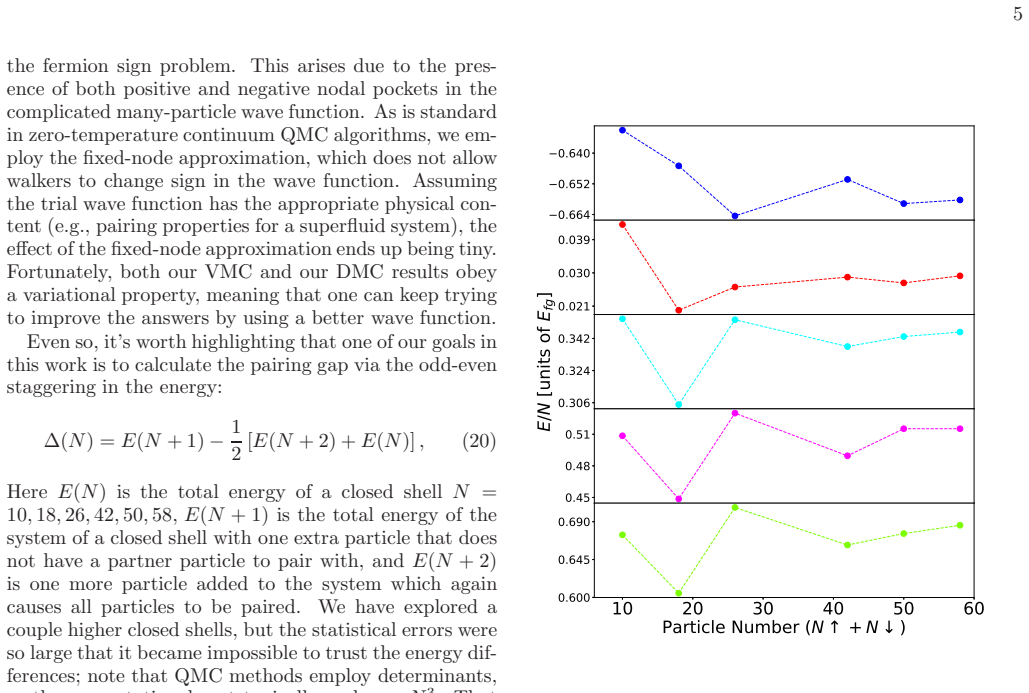
- [Section V, Eq. (20), Figs. 9-10] The central claim of BCS-side suppression is carried by the DMC gaps shown in Figs. 9 and 10, but these gaps are presented without any statistical or systematic uncertainty estimate. The text states in Sec. IV that the statistical errors in the DMC energies of Figs. 7 and 8 are smaller than the symbols, yet no error bars or confidence intervals are propagated through Eq. (20) into the final gap values. Without quantified uncertainties, the reader cannot judge whether the suppression relative to mean-field BCS, which is the paper's main conclusion, is statistically significant.
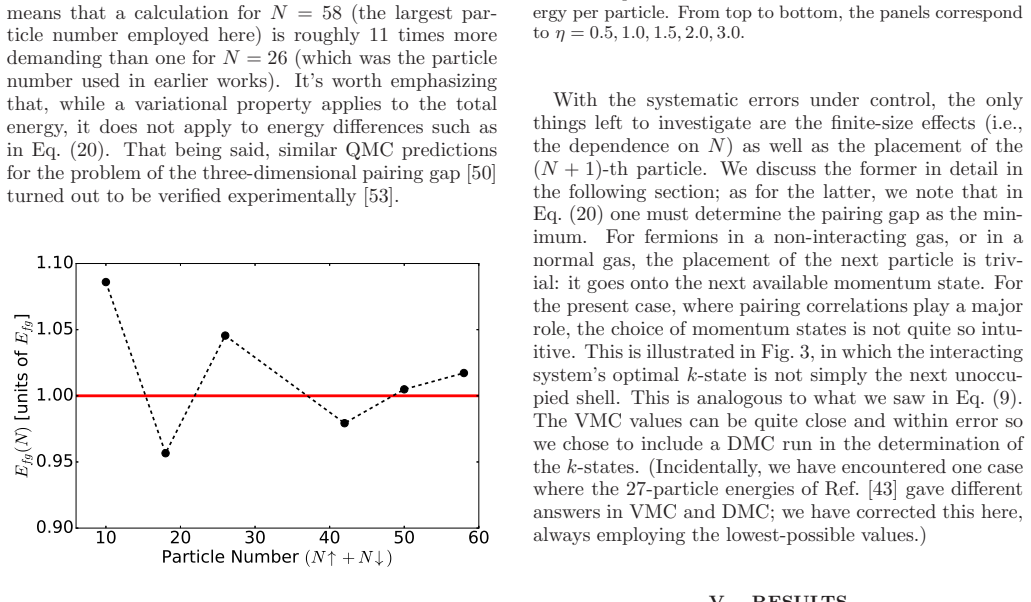
- [Section V, paragraph beginning 'To re-cap'] The thermodynamic-limit gap is approximated as 'the average of our best two sets of points,' namely the odd-even staggering at N = 50 and N = 58. This is not a controlled finite-size extrapolation: the two particle numbers are adjacent closed shells with the same shell structure, so averaging them does not remove a common finite-size bias. The non-interacting finite-size behavior shown in Fig. 6 is discussed qualitatively but is not subtracted from the interacting gaps, and no sensitivity test (e.g., using N = 42 or including a free-gas-based correction) is reported. The resulting systematic bias could be comparable in magnitude to the claimed suppression, so the benchmark values in Fig. 9 require a more robust extrapolation or an explicit error band.
- [Section IV, discussion following Eq. (20)] The paper correctly notes that a variational property applies to the total DMC energy but not to the energy difference of Eq. (20). This is a real limitation for the gap extraction: the fixed-node error may differ between the closed-shell even systems and the open-shell odd systems, and no test of this nodal-error imbalance is provided. A practical check would be to compare VMC and DMC estimates of the staggering, or to vary the pairing-orbital parameters and observe the stability of the gap. As it stands, neither the fixed-node error nor the finite-size error in the gap is controlled, and both could affect the qualitative conclusion of BCS-side suppression.
minor comments (4)
- [General] The manuscript contains numerous typographical errors that should be corrected, including 'inticate' (Sec. III), 'eaqulity' (Eq. (13) derivation), 'p aticle' and 'N mber' (Fig. 5 axis), 'uni s' (Fig. 10 axis), and '/uni0394fg' (Fig. 6 axis).
- [Eq. (20) and surrounding text] The notation ∆(N) in Eq. (20) is used for the odd-even staggering, while the physical pairing gap is denoted ∆_gap and ∆(k) appears in the BCS section. Please clarify the relation between these quantities to avoid confusion when reading Figs. 9 and 10.
- [References] Reference [52] is incomplete as printed, and reference [27] appears to duplicate [22]. Please update these entries.
- [Fig. 6] The caption of Fig. 6 says the pairing gap applied to the non-interacting gas is zero in the large-system limit, but the finite values for small systems are finite-size artifacts. Since this figure is used to motivate the choice of N = 50 and N = 58, it would be helpful to show the numerical values of ∆_fg(N) in a table or in the text.
Circularity Check
No circularity: the DMC pairing gap is an extracted energy-difference observable, not a fit, and self-citations are methodological only.
full rationale
The paper's main quantitative claim—suppression of the pairing gap relative to mean-field BCS—is obtained from Eq. (20), the odd-even energy staggering of DMC total energies, with the thermodynamic limit approximated by averaging the N=50 and N=58 sets. The trial wave function parameters are optimized by VMC against the total energy, not against the gap; the potential parameters are tuned to the scattering length and effective range in the two-body problem (Eqs. (3)-(5) and accompanying text), not to the pairing gap. The mean-field BCS comparison in Eq. (6) is derived from the same two-body binding energy, but the DMC gap is an independent many-body observable, so the comparison is not a reduction by construction. Self-citations to Refs. [43,45] supply the Jastrow-BCS trial wave function and the partial-wave two-body formalism; these are inherited methodology, and the present paper tests the relevant finite-range and finite-size assumptions rather than importing the target result. The BCS-side suppression is an output of the DMC energy differences and is compared with external results (Vitali et al., Gorkov-Melik-Barkhudarov), so the central claim has independent content. The uncontrolled finite-size approximation in Section V is a robustness/correctness concern, not a circularity: no equation or fit reproduces the gap by definition.
Assumptions & free parameters
free parameters (4)
- Pöschl-Teller potential depth v0 =
not reported; tuned to target scattering length and effective range
- Pöschl-Teller potential range parameter ν =
not reported; tuned to target k_F a and k_F r_e
- Ten plane-wave coefficients in the pairing orbital φ(r) =
optimized by VMC for each N; values not given
- High-momentum supplement parameters in φ(r) =
not given
assumptions (5)
- domain assumption The BCS gap equation is applied with a free single-particle spectrum, omitting normal-state self-energy corrections.
- domain assumption The fixed-node approximation errors are negligible because the trial wave function contains the relevant pairing correlations.
- domain assumption The pairing gap can be extracted from odd-even energy staggering in a finite periodic box, Eq. (20).
- ad hoc to paper The thermodynamic-limit gap is approximated by averaging the N=50 and N=58 staggering values.
- domain assumption The Pöschl-Teller potential with k_F r_e ≈ 0.006 represents the zero-range limit for the DMC interactions.
Cite this review
Pith. "Pith review of Pairing in two-dimensional Fermi gases with a coordinate-space potential." pith.science (2026). https://pith.science/paper/DPIPSUSJ
@misc{pith2026190804782,
  author       = {Pith},
  title        = {Pith review of: Pairing in two-dimensional Fermi gases with a coordinate-space potential},
  year         = {2026},
  howpublished = {\url{https://pith.science/paper/DPIPSUSJ}},
  note         = {Machine review of arXiv:1908.04782}
}
read the original abstract
In this work we theoretically study pairing in two-dimensional Fermi gases, a system which is experimentally accessible using cold atoms. We start by deriving the mean-field pairing gap equation for a coordinate-space potential with a finite interaction range, and proceed to solve this numerically. We find that for sufficiently short effective ranges the answer is identical to the zero-range one. We then use Diffusion Monte Carlo to evaluate the total energy for many distinct particle numbers; we employ several variational parameters to produce a good ground-state energy and then use these results to extract the pairing gap across a number of interaction strengths in the strongly interacting two-dimensional crossover. Extracting the gap via the odd-even energy staggering, our microscopic results can be used as benchmarks for other theoretical approaches.
Figures

Figures from the paper (6 more)


Reference graph
Works this paper leans on
-
[1]
Bloch, J
I. Bloch, J. Dalibard, and W. Zwerger, Rev. Mod. Phys. 80, 885 (2008)
2008
-
[2]
S. Giorgini, L. P. Pitaevskii, and S. Stringari, Rev. Mod . Phys. 80, 1215 (2008)
work page 2008
- [3]
-
[4]
J. Carlson, S.Y. Chang, V. R. Pandharipande, and K. E. Schmidt, Phys. Rev. Lett. 91, 050401 (2003)
work page 2003
-
[5]
S. Y. Chang, V. R. Pandharipande, J. Carlson, and K. E. Schmidt, Phys. Rev. A 70, 043602 (2004)
work page 2004
-
[6]
G. E. Astrakharchik, J. Boronat, J. Casulleras, and and S. Giorgini, Phys. Rev. Lett. 93, 200404 (2004)
work page 2004
-
[7]
M. M. Forbes, S. Gandolfi, and A. Gezerlis, Phys. Rev. Lett. 106, 235303 (2011)
work page 2011
- [8]
Show all 56 references
-
[9]
M. M. Forbes, S. Gandolfi, and A. Gezerlis, Phys. Rev. A 86, 053603 (2012)
2012
-
[10]
Carlson, S
J. Carlson, S. Gandolfi, and A. Gezerlis, Prog. Theor. Exp. Phys. 01A209 (2012)
2012
-
[11]
Pilati, I
S. Pilati, I. Zintchenko, and M. Troyer, Phys. Rev. Lett . 112, 015301 (2014)
2014
-
[12]
L. M. Schonenberg, G. J. Conduit, Phys. Rev. A 95, 013633 (2017)
2017
-
[13]
Dawkins and A
W. Dawkins and A. Gezerlis, Phys. Rev. A 96, 043619 (2017)
2017
-
[14]
G¨ unter, T
K. G¨ unter, T. St¨ oferle, H. Moritz, M. K¨ ohl, and T. Esslinger, Phys. Rev. Lett. 95, 230401 (2005)
2005
-
[15]
Martiyanov, V
K. Martiyanov, V. Makhalov, and A. Turlapov, Phys. Rev. Lett. 105, 030404 (2010)
2010
-
[16]
Fr¨ ohlich, M
B. Fr¨ ohlich, M. Feld, E. Vogt, M. Koschorreck, W. Zw- erger, and M. K¨ ohl, Phys. Rev. Lett.106, 105301 (2011)
2011
-
[17]
M. Feld, B. Fr¨ ohlich, E. Vogt, M. Koschorreck, and M. K¨ ohl, Nature.480, 75-78 (2011)
2011
-
[18]
A. A. Orel, P. Dyke, M. Delehaye, C. J. Vale, and H. Hu, New J. Phys. 13, 113032 (2011)
2011
-
[19]
P. Dyke, E. D. Kuhnle, S. Whitlock, H. Hu, M. Mark, S. Hoinka, M. Lingham, P. Hannaford, and C. J. Vale, Phys. Rev. Lett. 106, 105304 (2011)
2011
-
[20]
A. T. Sommer, L. W. Cheuk, M. J. H. Ku, W. S. Bakr, and M. W. Zwierlein, Phys. Rev. Lett. 108, 045302 (2012)
2012
-
[21]
Makhalov, K
V. Makhalov, K. Martiyanov, and A. Turlapov, Phys. Rev. Lett. 112, 045301 (2014)
2014
-
[23]
Ong, C.-Y
W. Ong, C.-Y. Cheng, I. Arakelyan, and J. E. Thomas, Phys. Rev. Lett. 114, 110403 (2015)
2015
-
[24]
P. A. Murthy, I. Boettcher, L. Bayha, M. Holzmann, D. Kedar, M. Neidig, M. G. Ries, A. N. Wenz, G. Z¨ urn, and S. Jochim, Phys. Rev. Lett. 115, 010401 (2015)
2015
-
[25]
M. G. Ries, A. N. Wenz, G. Z¨ urn, L. Bayha, I. Boettcher, D. Kedar, P. A. Murthy, M. Neidig, T. Lompe, and S. Jochim, Phys. Rev. Lett. 114, 230401 (2015)
2015
-
[26]
Fenech, P
K. Fenech, P. Dyke, T. Peppler, M. G. Lingham, S. Hoinka, H. Hu, and C. J. Vale, Phys. Rev. Lett. 116, 045302 (2016)
2016
-
[27]
Boettcher, L
I. Boettcher, L. Bayha, D. Kedar, P. A. Murthy, M. Nei- dig, M. G. Ries, A. N. Wenz, G. Z¨ urn, S. Jochim, and T. Enss, Phys. Rev. Lett. 116, 045303 (2016)
2016
-
[28]
Martiyanov, T
K. Martiyanov, T. Barmashova, V. Makhalov, and A. Turlapov, Phys. Rev. A 93, 063622 (2016)
2016
-
[29]
Cheng, J
C. Cheng, J. Kangara, I. Arakelyan, and J. E. Thomas, Phys. Rev. A 94, 031606 (2016)
2016
-
[30]
Luciuk, S
C. Luciuk, S. Smale, F. Bttcher, H. Sharum, B. A. Olsen, S. Trotzky, T. Enss, and J. H. Thywissen, Phys. Rev. Lett. 118, 130405 (2017)
2017
-
[31]
Toniolo, B
U. Toniolo, B. C. Mulkerin, C. J. Vale, X.-J. Liu, H. Hu, Phys. Rev. A 96, 041604(R) (2017)
2017
-
[32]
Nishida and S
Y. Nishida and S. Tan, Phys. Rev. Lett. 101, 170401 (2008). 9
2008
-
[33]
X.-J. Liu, H. Hu, and P. D. Drummond, Phys. Rev. B 82, 054524 (2010)
2010
-
[34]
Valiente, N
M. Valiente, N. T. Zinner, and K. Molmer, Phys. Rev. A 84, 063626 (2011)
2011
-
[35]
Bertaina and S
G. Bertaina and S. Giorgini, Phys. Rev. Lett. 106, 110403 (2011)
2011
-
[36]
Werner and Y
F. Werner and Y. Castin, Phys. Rev. A 86, 013626 (2012)
2012
-
[37]
Bauer, M
M. Bauer, M. M. Parish, and T. Enss, Phys. Rev. Lett. 112, 135302 (2014)
2014
-
[38]
H. Shi, S. Chiesa, and S. Zhang, Phys. Rev. A 92, 033603 (2015)
2015
-
[39]
E. R. Anderson and J. E. Drut, Phys. Rev. Lett. 115, 115301 (2015)
2015
-
[40]
L. He, H. L¨ u, G. Cao, H. Hu, X.-J. Liu, Phys. Rev. A 92, 023620 (2015)
2015
-
[41]
Rammelm¨ uller, W
L. Rammelm¨ uller, W. J. Porter and J. E. Drut, Phys. Rev. A, 93, 033639 (2016)
2016
-
[42]
L. He, Ann. Phys. (N.Y.) 373, 470 (2016)
2016
-
[43]
Galea, H
A. Galea, H. Dawkins, S. Gandolfi, and A. Gezerlis, Phys. Rev. A 93, 023602 (2016)
2016
-
[44]
Klawunn, Phys
M. Klawunn, Phys. Lett. A. 380, 34 (2016)
2016
-
[45]
Galea, T
A. Galea, T. Zielinski, S. Gandolfi, and A. Gezerlis, J Low Temp Phys 189, 451 (2017)
2017
-
[46]
Vitali, H
E. Vitali, H. Shi, M. Qin, S. Zhang, Phys. Rev. A 96, 061601(R) (2017)
2017
-
[47]
L. M. Schonenberg, P. C. Verpoort, G. J. Conduit, Phys. Rev. A 96, 023619 (2017)
2017
-
[48]
J. E. Drut, J. R. McKenney, W. S. Daza, C. L. Lin, C. R. Ordez, Phys. Rev. Lett. 120, 243002 (2018)
2018
-
[49]
Jeszenszki, A
P. Jeszenszki, A. Alavi, J. Brand, Phys. Rev. A 99, 033608 (2019)
2019
-
[50]
Gezerlis and J
A. Gezerlis and J. Carlson, Phys. Rev. C 77, 032801 (2008)
2008
-
[51]
Gandolfi, A
S. Gandolfi, A. Gezerlis, and J. Carlson, Ann. Rev. Nucl. Part. Sci. 65, 303 (2015)
2015
-
[52]
Buraczynski and A
M. Buraczynski and A. Gezerlis, Rev. Lett. 116, (2016)
2016
-
[53]
Horikoshi, M
M. Horikoshi, M. Koashi, H. Tajima, Y. Ohashi, and M. Kuwata-Gonokami, Phys. Rev. X 7, 041004 (2017)
2017
-
[54]
Miyake, Prog
K. Miyake, Prog. Theor. Phys. 69, 1794 (1983)
1983
-
[55]
Randeria, J.-M
M. Randeria, J.-M. Duan, and L.-Y. Shieh, Phys. Rev. Lett. 62, 981 (1989); Phys. Rev. B 41, 327 (1990)
1989
-
[56]
D. S. Petrov, M. A. Baranov, and G. V. Shlyapnikov, Phys. Rev. A 67, 031601(R) (2003)
2003
-
[57]
L. P. Gorkov and T. K. Melik-Barkhudarov, JETP, 40, 1452 (1961) [Soviet Phys. JETP 13, 1018 (1961)]
1961
Reviewed August 14, 2026 · model on record in the stance chip above.
Discussion (0). Continue with ORCID to comment.