REVIEW 4 major objections 7 minor 108 references
Instance-dependent Early Stopping
T0 review · 4 major / 7 minor · reviewed 2026-08-08 · deepseek-v4-flash
Pith's one-line read The paper claims that an instance is mastered when the second-order difference of its loss stays near zero, and that skipping such instances in backpropagation cuts computation by 10-50% with no accuracy loss.
desk verdict Useful empirical paper on adaptive data pruning, but the 'mastered' criterion actually flags locally linear loss decreases, not plateaus, so the central story needs rework. read the letter →
The pith
A machine-rendered reading of the paper's core claim, the machinery that carries it, and where it could break.
The reading
What carries the argument
The core object is the IES stopping rule built on the second-order loss difference. It defines $\Delta^2 L_i(w(t))$, a forward-pass-only estimator of whether instance $i$'s loss has flattened over the last three epochs, and compares its absolute value to a single threshold $\delta$. The algorithm keeps a dynamic active set $D^{(t)} = D^{(0)} \setminus M^{(t)}$ of not-yet-mastered instances, recomputed each epoch from forward passes, and runs backpropagation only on that set; removed instances can re-enter if their second-order difference grows again, which the paper argues prevents catastrophic forgetting.
What would settle it
On a long-tailed or noisy dataset, compute for every instance whether $|\Delta^2 L_i(w(t))| < \delta$ holds at the same time that the model's accuracy on that instance stops improving; if many mastered instances later show loss increases and re-enter training, or if savings collapse toward zero on clean data when the unified threshold is used, the criterion is not tracking stable instance-level mastery.
Extended reading notes
Core claim
The central claim is that instance-level mastery can be read off the curvature of the loss trajectory: with $\Delta^2 L_i(w(t)) = L_i(w(t)) - 2L_i(w(t-1)) + L_i(w(t-2))$, an instance is mastered when $|\Delta^2 L_i(w(t))| < \delta$ for a single $\delta$ shared across all instances. The paper argues this criterion is better than using raw loss because optimal loss levels differ across instances (due to noise, class imbalance, ambiguity), while second-order differences concentrate near zero for learned instances late in training, allowing one universal threshold. Excluding mastered instances from backprop concentrates updates on not-yet-learned examples with larger gradient norms, lowering training loss and Hessian sharpness faster, which the paper presents as the mechanism behind maintained or improved generalization and transferability.
Load-bearing premise
The load-bearing premise is that a single scalar threshold $\delta$ on the second-order difference of an instance's loss marks it as mastered across all samples, datasets, optimizers, and training stages; the paper's own Limitation section concedes that a theoretical analysis of why this criterion works is still open.
Editorial extensions
If this is right
- IES reduces backpropagation instances by 10-55% on CIFAR and ImageNet-1k with test accuracy matching full-data training, giving about 1.2-1.4x wall-clock speedups.
- Models pretrained with IES transfer better: fine-tuning ImageNet-1k features on CIFAR-10, CIFAR-100, and Caltech-101 beats the full-data baseline by up to roughly 2.5 points after one epoch.
- IES is schedule-free: it needs no preset removal rate or curriculum, and the fraction of dropped samples adapts automatically as training proceeds.
- At matched 2x and 3x speedup targets, IES compares favorably with InfoBatch, importance sampling, and curriculum-learning baselines on CIFAR-10 and CIFAR-100.
- If a 1% test-accuracy drop is tolerated, savings grow to as much as 80% on CIFAR-10 and about 40% on ImageNet-1k.
Reading between the lines
- The unified-threshold claim is the fragile part; the paper's own Limitation section concedes that a theoretical analysis of the second-order criterion is open, so a natural test is whether one $\delta$ transfers across datasets with very different per-instance difficulty distributions.
- Under typical label-noise settings the paper itself reports zero savings (Appendix G), which means the benefit is concentrated in clean or mildly noisy regimes; a noise-robust version of the mastery criterion would be a direct extension.
- Because the criterion uses only per-sample losses already computed during the forward pass, IES is a candidate drop-in for large-scale training pipelines that log loss values, with no extra gradient computation.
- The reversibility of removals (samples re-enter when their second-order difference spikes) connects IES to continual-learning and forgetting analyses beyond what the paper's appendix tracks.
Editorial analysis
A structured set of objections, weighed in public.
Referee Report
Summary. The paper proposes Instance-dependent Early Stopping (IES), a dynamic per-sample training method. IES computes the second-order difference of each sample's loss over three consecutive epochs, labels an instance as 'mastered' when that difference falls below a fixed threshold delta (Eq. (3)), and removes mastered instances from backpropagation while still evaluating forward passes on the full dataset. The authors report a 10-50% reduction in backpropagated mini-batch instances across CIFAR, ImageNet-1k, object detection, and segmentation, with test accuracy essentially unchanged and small improvements in transfer learning; they attribute the speedup to focusing parameter updates on not-yet-mastered instances with larger gradient norms.
Significance. If the empirical results hold, IES is a simple and broadly applicable training accelerator with little or no accuracy cost on common vision benchmarks. The paper's strengths are the wide evaluation grid (multiple architectures, optimizers, learning-rate schedulers, datasets, and high-level tasks), the robustness study over delta, the public implementation, and the explicit limitation statement. The central conceptual claim is nonetheless fragile: the criterion in Eq. (3) is not a plateau detector, since it vanishes for any linearly changing loss. The contribution is therefore better characterized as an empirically driven pruning heuristic than as a principled mastery criterion, and the manuscript should be revised so that the claims match the actual criterion.
major comments (4)
- [Sec. 3.1, Eq. (3)] The criterion in Eq. (3) does not implement the plateau detector described in Sec. 3.1. Equation (2) defines Delta^2 L_i = L_i(t) - 2 L_i(t-1) + L_i(t-2), so |Delta^2 L_i| < delta is a bound on the change of the per-epoch loss decrement, not on the size of that decrement. A sample whose loss decreases by the same amount in three consecutive epochs has Delta^2 L_i = 0 and will be marked as mastered even though its loss is still changing substantially. This contradicts the motivation that a mastered instance's loss is 'flat and insensitive to parameter updates.' The failure mode can occur in steady-learning phases and under exponential LR decay, and Appendix H's re-inclusion statistics (Table 13: average 13.14 re-inclusions) are consistent with the criterion firing on samples that are still being learned. Please either change the criterion to one that directly measures flatness (e.g., a bound on |Delta L_i| with a slope check) or explicitly reframe IES as a loss-trajectory heuristic and add an experiment measuring how many removed samples still have large first-order loss changes at the moment of removal.
- [Alg. 1, line 5] The definition of the mastered set is ambiguous. Line 5 of Algorithm 1 writes M(t) = { i in D(0) : |Delta^2 L_i(w(t'))| < delta } with an undefined t', while Sec. 3.1 speaks of the 'sum of the absolute values' over k epochs and Eq. (3) has no summation or window parameter. This ambiguity affects the re-inclusion dynamics and the reported Mini-batch Saved numbers: whether the condition is evaluated on the latest epoch only or as an accumulated statistic changes which samples are removed and when. Please state the exact condition used in all experiments and make Eq. (3), Algorithm 1, and the text mutually consistent.
- [Table 2] The ImageNet-1k results in Table 2 come from a single run. The claim of 'lossless acceleration' at this scale rests on differences such as 68.8% vs. 69.0% and 74.3% vs. 74.1%, which are within typical run-to-run variation for ImageNet training. Without multiple seeds or error bars, the paper cannot support the strong statement that IES maintains accuracy on ImageNet. Please report repeated runs for at least a subset of the Table 2 configurations, or temper the claim to say that IES achieves comparable accuracy in single-run comparisons.
- [Sec. 3.3, 'Larger Gradient Norms'] The mechanism claim in Sec. 3.3 is partly circular. Removing samples whose losses change slowly will mechanically increase the average gradient norm of the retained mini-batch, so Figure 4's observation that IES 'focuses on instances with larger gradient norms' restates the selection rule rather than explains faster convergence. The paper should provide a direct test of the mechanism, for example by comparing IES against a control that removes the same fraction of samples at random but reweights the retained gradients to match the IES gradient-norm distribution, or by reporting full-set training loss at equal wall-clock time rather than only the retained-set trajectory.
minor comments (7)
- [Sec. 4.1] The phrase 'unified threshold' is used for a fixed delta within a dataset, but the base delta differs by three orders of magnitude between CIFAR (1e-3) and ImageNet (1). Please clarify that the unification is across instances within a dataset and explain how the scale of the losses determines the appropriate delta.
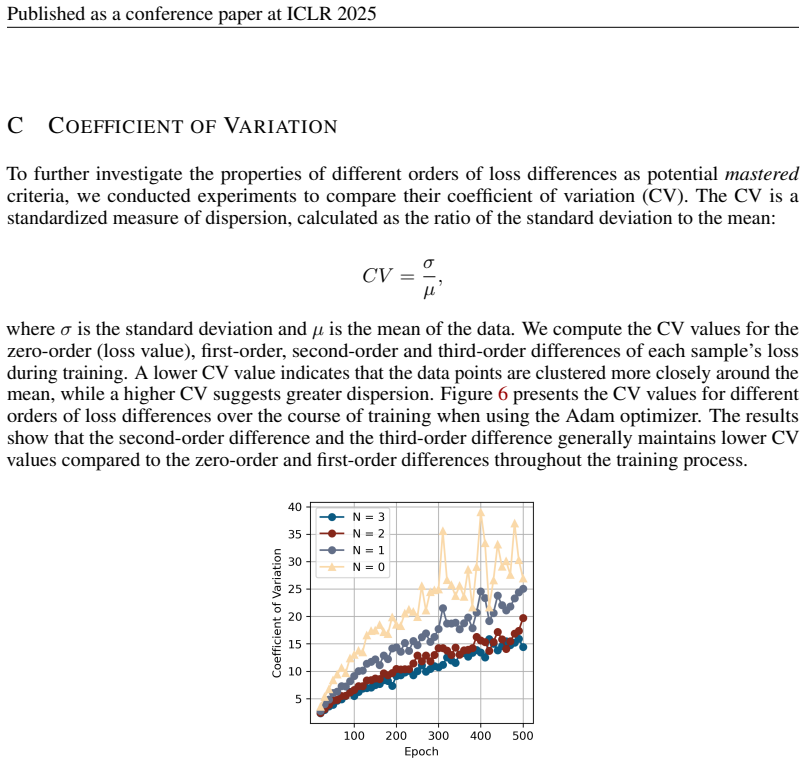
- [Fig. 3 and Appendix C] The coefficient-of-variation argument is weak because the CV is unstable for quantities whose mean approaches zero; the lower CV of second-order differences may reflect the scale of the values rather than a more consistent learning status. The empirical robustness to delta in Figure 5 is more convincing and should be the primary justification for a unified threshold.
- [Eq. (1)] Equation (1) states the mastered condition without an absolute value, whereas Eq. (3) and Algorithm 1 use |Delta^2 L_i(w(t))|. Since second-order differences can be negative, the absolute value should appear consistently in the formal definition.
- [Table 4 and Appendix F] At the target 2x and 3x speedups, IES loses 0.6/2.1 percentage points (2x) and 1.1/4.0 percentage points (3x) on CIFAR-10/CIFAR-100 relative to the full-data baseline. Sentences such as 'while maintaining model performance' should therefore be qualified to reflect the magnitude of the degradation in these high-speedup comparisons.
- [Appendix I] The fairness discussion is internally inconsistent: it first states that IES 'may introduce or amplify certain biases' and then concludes that 'the overall fairness is slightly improved.' These statements should be reconciled, and the paper should not claim an improvement on the basis of a 0.007 difference in DPD.
- [Sec. 2 vs. Sec. 4.1] The Related Work section states that IES eliminates the need for 'pre-set training schedules or removal rates,' yet Sec. 4.1 follows Qin et al. (2023) in annealing to full data for the last 10% of ImageNet epochs. Please clarify how this preset schedule is compatible with that claim.
- [Throughout] There are minor typographical errors, including 'an unified' (Abstract and Section 1) and 'sharpnes' (Section 3.3), that should be corrected.
Circularity Check
No circular derivation found: IES's savings and accuracy claims are empirical comparisons against baselines, and the second-order-difference criterion is an input definition rather than a result derived from the target claims.
full rationale
Walking the claimed derivation chain, none of the load-bearing steps reduces to the paper's own inputs. The mastered criterion in Sec. 3.1-3.2 is a stipulated operational definition (Eq. 3), not a fitted parameter or a prediction derived from the test-accuracy results; the claim that it supports a unified threshold is supported by coefficient-of-variation measurements in Fig. 3 and Appendix C, which are independent empirical observations. The headline results (10-50% backpropagation savings with comparable or slightly better accuracy, Tables 1-3) are obtained by running Algorithm 1 against a no-removal baseline; the savings are emergent outcomes, not enforced by tuning delta to a target removal rate. The 'larger gradient norms' and 'faster sharpness reduction' discussion in Sec. 3.3 is a post-hoc mechanism explanation rather than a derivation of the accuracy results, and even if the gradient-norm statement is near-tautological, it does not make the reported comparisons circular. Self-citations (e.g., Yuan et al. 2024, Lin et al. 2024a;b;c) appear only as background related work, not as load-bearing justifications, and no uniqueness theorem or ansatz is imported from prior work by the same authors. The Limitation section explicitly concedes that a comprehensive theoretical analysis of the criterion's superiority remains an open question, which is inconsistent with a circular derivation. The skeptic's concern that the second-order difference can vanish for a linearly decreasing loss is a correctness or robustness issue about whether the criterion matches the 'plateau' motivation, not a circularity issue.
Assumptions & free parameters
free parameters (1)
- delta (mastered threshold) =
1e-3 for CIFAR, 1 for ImageNet
assumptions (3)
- domain assumption Small second-order difference of loss implies the instance is mastered and can be removed from backpropagation.
- domain assumption Removed instances stay mastered without repeated backpropagation.
- domain assumption The full forward pass over the entire dataset is acceptable overhead, so savings come mainly from skipping backpropagation.
Cite this review
Pith. "Pith review of Instance-dependent Early Stopping." pith.science (2026). https://pith.science/paper/DPYSJLRX
@misc{pith2026250207547,
  author       = {Pith},
  title        = {Pith review of: Instance-dependent Early Stopping},
  year         = {2026},
  howpublished = {\url{https://pith.science/paper/DPYSJLRX}},
  note         = {Machine review of arXiv:2502.07547}
}
read the original abstract
In machine learning practice, early stopping has been widely used to regularize models and can save computational costs by halting the training process when the model's performance on a validation set stops improving. However, conventional early stopping applies the same stopping criterion to all instances without considering their individual learning statuses, which leads to redundant computations on instances that are already well-learned. To further improve the efficiency, we propose an Instance-dependent Early Stopping (IES) method that adapts the early stopping mechanism from the entire training set to the instance level, based on the core principle that once the model has mastered an instance, the training on it should stop. IES considers an instance as mastered if the second-order differences of its loss value remain within a small range around zero. This offers a more consistent measure of an instance's learning status compared with directly using the loss value, and thus allows for a unified threshold to determine when an instance can be excluded from further backpropagation. We show that excluding mastered instances from backpropagation can increase the gradient norms, thereby accelerating the decrease of the training loss and speeding up the training process. Extensive experiments on benchmarks demonstrate that IES method can reduce backpropagation instances by 10%-50% while maintaining or even slightly improving the test accuracy and transfer learning performance of a model.
Figures


Figures from the paper (3 more)


Reference graph
Works this paper leans on
-
[1]
Variance reduction in sgd by distributed importance sampling
Guillaume Alain, Alex Lamb, Chinnadhurai Sankar, Aaron Courville, and Yoshua Bengio. Variance reduction in sgd by distributed importance sampling. arXiv preprint arXiv:1511.06481, 2015
arXiv 2015
-
[2]
Towards understanding sharpness-aware minimization
Maksym Andriushchenko and Nicolas Flammarion. Towards understanding sharpness-aware minimization. In Kamalika Chaudhuri, Stefanie Jegelka, Le Song, Csaba Szepesvari, Gang Niu, and Sivan Sabato (eds.), Proceedings of the 39th ICML, volume 162 of Proceedings of Machine Learning Research, pp.\ 639--668. PMLR, 17--23 Jul 2022
2022
-
[3]
A closer look at memorization in deep networks
Devansh Arpit, Stanis aw Jastrz e bski, Nicolas Ballas, David Krueger, Emmanuel Bengio, Maxinder S Kanwal, Tegan Maharaj, Asja Fischer, Aaron Courville, Yoshua Bengio, et al. A closer look at memorization in deep networks. In ICML, pp.\ 233--242. PMLR, 2017
2017
-
[4]
Reconciling modern machine-learning practice and the classical bias--variance trade-off
Mikhail Belkin, Daniel Hsu, Siyuan Ma, and Soumik Mandal. Reconciling modern machine-learning practice and the classical bias--variance trade-off. Proceedings of the National Academy of Sciences, 116 0 (32): 0 15849--15854, 2019
2019
-
[5]
Curriculum learning
Yoshua Bengio, J \'e r \^o me Louradour, Ronan Collobert, and Jason Weston. Curriculum learning. In Proceedings of the 26th annual ICML, pp.\ 41--48, 2009
2009
-
[6]
The power of uniform sampling for coresets
Vladimir Braverman, Vincent Cohen-Addad, H-C Shaofeng Jiang, Robert Krauthgamer, Chris Schwiegelshohn, Mads Bech Toftrup, and Xuan Wu. The power of uniform sampling for coresets. In 2022 IEEE 63rd Annual Symposium on Foundations of Computer Science (FOCS), pp.\ 462--473. IEEE, 2022
2022
-
[7]
Language models are few-shot learners
Tom Brown, Benjamin Mann, Nick Ryder, Melanie Subbiah, Jared D Kaplan, Prafulla Dhariwal, Arvind Neelakantan, Pranav Shyam, Girish Sastry, Amanda Askell, et al. Language models are few-shot learners. NeurIPS, 33: 0 1877--1901, 2020
1901
-
[8]
Learning imbalanced datasets with label-distribution-aware margin loss
Kaidi Cao, Colin Wei, Adrien Gaidon, Nikos Arechiga, and Tengyu Ma. Learning imbalanced datasets with label-distribution-aware margin loss. NeurIPS, 32, 2019
2019
Show all 108 references
-
[9]
Overfitting in neural nets: Backpropagation, conjugate gradient, and early stopping
Rich Caruana, Steve Lawrence, and C Giles. Overfitting in neural nets: Backpropagation, conjugate gradient, and early stopping. NeurIPS, 13, 2000
2000
-
[10]
Active bias: Training more accurate neural networks by emphasizing high variance samples
Haw-Shiuan Chang, Erik Learned-Miller, and Andrew McCallum. Active bias: Training more accurate neural networks by emphasizing high variance samples. NeurIPS, 30, 2017
2017
-
[11]
Rethinking atrous convolution for semantic image segmentation
Liang-Chieh Chen. Rethinking atrous convolution for semantic image segmentation. arXiv preprint arXiv:1706.05587, 2017
2017 arXiv
-
[12]
Importance sampling for minibatches
Dominik Csiba and Peter Richt \'a rik. Importance sampling for minibatches. Journal of Machine Learning Research, 19 0 (27): 0 1--21, 2018
2018
-
[13]
Class-balanced loss based on effective number of samples
Yin Cui, Menglin Jia, Tsung-Yi Lin, Yang Song, and Serge Belongie. Class-balanced loss based on effective number of samples. In CVPR, pp.\ 9268--9277, 2019
2019
-
[14]
Identifying and attacking the saddle point problem in high-dimensional non-convex optimization
Yann N Dauphin, Razvan Pascanu, Caglar Gulcehre, Kyunghyun Cho, Surya Ganguli, and Yoshua Bengio. Identifying and attacking the saddle point problem in high-dimensional non-convex optimization. NeurIPS, 27, 2014
2014
-
[15]
Imagenet: A large-scale hierarchical image database
Jia Deng, Wei Dong, Richard Socher, Li-Jia Li, Kai Li, and Li Fei-Fei. Imagenet: A large-scale hierarchical image database. In 2009 IEEE conference on computer vision and pattern recognition, pp.\ 248--255. Ieee, 2009
2009
-
[16]
Sharp minima can generalize for deep nets
Laurent Dinh, Razvan Pascanu, Samy Bengio, and Yoshua Bengio. Sharp minima can generalize for deep nets. In ICML, pp.\ 1019--1028. PMLR, 2017
2017
-
[17]
Everingham, L
M. Everingham, L. Van Gool, C. K. I. Williams, J. Winn, and A. Zisserman. The PASCAL V isual O bject C lasses C hallenge 2007 (VOC2007) R esults. http://www.pascal-network.org/challenges/VOC/voc2007/workshop/index.html, a
2007
-
[18]
Everingham, L
M. Everingham, L. Van Gool, C. K. I. Williams, J. Winn, and A. Zisserman. The PASCAL V isual O bject C lasses C hallenge 2012 (VOC2012) R esults. http://www.pascal-network.org/challenges/VOC/voc2012/workshop/index.html, b
2012
-
[19]
Sharpness-aware minimization for efficiently improving generalization
Pierre Foret, Ariel Kleiner, Hossein Mobahi, and Behnam Neyshabur. Sharpness-aware minimization for efficiently improving generalization. arXiv preprint arXiv:2010.01412, 2020
2010 arXiv
-
[20]
Cascast: Skillful high-resolution precipitation nowcasting via cascaded modelling
Junchao Gong, Lei Bai, Peng Ye, Wanghan Xu, Na Liu, Jianhua Dai, Xiaokang Yang, and Wanli Ouyang. Cascast: Skillful high-resolution precipitation nowcasting via cascaded modelling. arXiv preprint arXiv:2402.04290, 2024
2024 arXiv
-
[21]
Deep learning
Ian Goodfellow, Yoshua Bengio, and Aaron Courville. Deep learning. MIT press, 2016
2016
-
[22]
On calibration of modern neural networks
Chuan Guo, Geoff Pleiss, Yu Sun, and Kilian Q Weinberger. On calibration of modern neural networks. In ICML, pp.\ 1321--1330. PMLR, 2017
2017
-
[23]
On the power of curriculum learning in training deep networks
Guy Hacohen and Daphna Weinshall. On the power of curriculum learning in training deep networks. In ICML, pp.\ 2535--2544. PMLR, 2019
2019
-
[24]
Deep residual learning for image recognition
Kaiming He, Xiangyu Zhang, Shaoqing Ren, and Jian Sun. Deep residual learning for image recognition. In Proceedings of the IEEE conference on computer vision and pattern recognition, pp.\ 770--778, 2016
2016
-
[25]
Large-scale dataset pruning with dynamic uncertainty
Muyang He, Shuo Yang, Tiejun Huang, and Bo Zhao. Large-scale dataset pruning with dynamic uncertainty. arXiv preprint arXiv:2306.05175, 2023
2023 arXiv
-
[26]
Deep learning scaling is predictable, empirically
Joel Hestness, Sharan Narang, Newsha Ardalani, Gregory Diamos, Heewoo Jun, Hassan Kianinejad, Md Mostofa Ali Patwary, Yang Yang, and Yanqi Zhou. Deep learning scaling is predictable, empirically. arXiv preprint arXiv:1712.00409, 2017
2017 arXiv
-
[27]
Flat minima
Sepp Hochreiter and J \"u rgen Schmidhuber. Flat minima. Neural computation, 9 0 (1): 0 1--42, 1997
1997
-
[28]
Ridge regression: Biased estimation for nonorthogonal problems
Arthur E Hoerl and Robert W Kennard. Ridge regression: Biased estimation for nonorthogonal problems. Technometrics, 12 0 (1): 0 55--67, 1970
1970
-
[29]
Improving non-transferable representation learning by harnessing content and style
Ziming Hong, Zhenyi Wang, Li Shen, Yu Yao, Zhuo Huang, Shiming Chen, Chuanwu Yang, Mingming Gong, and Tongliang Liu. Improving non-transferable representation learning by harnessing content and style. In ICLR, 2024
2024
-
[30]
Densely connected convolutional networks
Gao Huang, Zhuang Liu, Laurens Van Der Maaten, and Kilian Q Weinberger. Densely connected convolutional networks. In Proceedings of the IEEE conference on computer vision and pattern recognition, pp.\ 4700--4708, 2017
2017
-
[31]
Epsilon-coresets for clustering (with outliers) in doubling metrics
Lingxiao Huang, Shaofeng H-C Jiang, Jian Li, and Xuan Wu. Epsilon-coresets for clustering (with outliers) in doubling metrics. In 2018 IEEE 59th Annual Symposium on Foundations of Computer Science (FOCS), pp.\ 814--825. IEEE, 2018
2018
-
[32]
Harnessing out-of-distribution examples via augmenting content and style
Zhuo Huang, Xiaobo Xia, Li Shen, Bo Han, Mingming Gong, Chen Gong, and Tongliang Liu. Harnessing out-of-distribution examples via augmenting content and style. arXiv preprint arXiv:2207.03162, 2022
2022 arXiv
-
[33]
Robust generalization against photon-limited corruptions via worst-case sharpness minimization
Zhuo Huang, Miaoxi Zhu, Xiaobo Xia, Li Shen, Jun Yu, Chen Gong, Bo Han, Bo Du, and Tongliang Liu. Robust generalization against photon-limited corruptions via worst-case sharpness minimization. In CVPR, pp.\ 16175--16185, 2023
2023
-
[34]
Winning prize comes from losing tickets: Improve invariant learning by exploring variant parameters for out-of-distribution generalization
Zhuo Huang, Muyang Li, Li Shen, Jun Yu, Chen Gong, Bo Han, and Tongliang Liu. Winning prize comes from losing tickets: Improve invariant learning by exploring variant parameters for out-of-distribution generalization. International Journal of Computer Vision, pp.\ 1--19, 2024
2024
-
[35]
Coresets for scalable bayesian logistic regression
Jonathan Huggins, Trevor Campbell, and Tamara Broderick. Coresets for scalable bayesian logistic regression. NeurIPS, 29, 2016
2016
-
[36]
Do we need zero training loss after achieving zero training error? arXiv preprint arXiv:2002.08709, 2020
Takashi Ishida, Ikko Yamane, Tomoya Sakai, Gang Niu, and Masashi Sugiyama. Do we need zero training loss after achieving zero training error? arXiv preprint arXiv:2002.08709, 2020
2002 arXiv
-
[37]
Accelerating deep learning by focusing on the biggest losers
Angela H Jiang, Daniel L-K Wong, Giulio Zhou, David G Andersen, Jeffrey Dean, Gregory R Ganger, Gauri Joshi, Michael Kaminksy, Michael Kozuch, Zachary C Lipton, et al. Accelerating deep learning by focusing on the biggest losers. arXiv preprint arXiv:1910.00762, 2019
1910 arXiv
-
[38]
Mentornet: Learning data-driven curriculum for very deep neural networks on corrupted labels
Lu Jiang, Zhengyuan Zhou, Thomas Leung, Li-Jia Li, and Li Fei-Fei. Mentornet: Learning data-driven curriculum for very deep neural networks on corrupted labels. In ICML, pp.\ 2304--2313. PMLR, 2018
2018
-
[39]
Scaling laws for neural language models
Jared Kaplan, Sam McCandlish, Tom Henighan, Tom B Brown, Benjamin Chess, Rewon Child, Scott Gray, Alec Radford, Jeffrey Wu, and Dario Amodei. Scaling laws for neural language models. arXiv preprint arXiv:2001.08361, 2020
2001 arXiv
-
[40]
Biased importance sampling for deep neural network training
Angelos Katharopoulos and Fran c ois Fleuret. Biased importance sampling for deep neural network training. arXiv preprint arXiv:1706.00043, 2017
2017 arXiv
-
[41]
Not all samples are created equal: Deep learning with importance sampling
Angelos Katharopoulos and Fran c ois Fleuret. Not all samples are created equal: Deep learning with importance sampling. In ICML, pp.\ 2525--2534. PMLR, 2018
2018
-
[42]
On large-batch training for deep learning: Generalization gap and sharp minima
Nitish Shirish Keskar, Dheevatsa Mudigere, Jorge Nocedal, Mikhail Smelyanskiy, and Ping Tak Peter Tang. On large-batch training for deep learning: Generalization gap and sharp minima. arXiv preprint arXiv:1609.04836, 2016
2016 arXiv
-
[43]
Uniform convergence of rank-weighted learning
Justin Khim, Liu Leqi, Adarsh Prasad, and Pradeep Ravikumar. Uniform convergence of rank-weighted learning. In ICML, pp.\ 5254--5263. PMLR, 2020
2020
-
[44]
Grad-match: Gradient matching based data subset selection for efficient deep model training
Krishnateja Killamsetty, Sivasubramanian Durga, Ganesh Ramakrishnan, Abir De, and Rishabh Iyer. Grad-match: Gradient matching based data subset selection for efficient deep model training. In ICML, pp.\ 5464--5474. PMLR, 2021 a
2021
-
[45]
Glister: Generalization based data subset selection for efficient and robust learning
Krishnateja Killamsetty, Durga Sivasubramanian, Ganesh Ramakrishnan, and Rishabh Iyer. Glister: Generalization based data subset selection for efficient and robust learning. In Proceedings of the AAAI Conference on Artificial Intelligence, volume 35, pp.\ 8110--8118, 2021 b
2021
-
[46]
Adam: A method for stochastic optimization
Diederik P Kingma. Adam: A method for stochastic optimization. arXiv preprint arXiv:1412.6980, 2014
2014 arXiv
-
[47]
Learning multiple layers of features from tiny images
Alex Krizhevsky, Geoffrey Hinton, et al. Learning multiple layers of features from tiny images. 2009
2009
-
[48]
Self-paced learning for latent variable models
M Kumar, Benjamin Packer, and Daphne Koller. Self-paced learning for latent variable models. NeurIPS, 23, 2010
2010
-
[49]
Caltech 101, 2022
Fei-Fei Li, Marco Andreeto, Marc'Aurelio Ranzato, and Pietro Perona. Caltech 101, 2022
2022
-
[50]
Towards realistic model selection for semi-supervised learning
Muyang Li, Xiaobo Xia, Runze Wu, Fengming Huang, Jun Yu, Bo Han, and Tongliang Liu. Towards realistic model selection for semi-supervised learning. In ICML, 2023 a
2023
-
[51]
Stochastic modified equations and adaptive stochastic gradient algorithms
Qianxiao Li, Cheng Tai, and E Weinan. Stochastic modified equations and adaptive stochastic gradient algorithms. In ICML, pp.\ 2101--2110. PMLR, 2017
2017
-
[52]
Loftq: Lora-fine-tuning-aware quantization for large language models
Yixiao Li, Yifan Yu, Chen Liang, Pengcheng He, Nikos Karampatziakis, Weizhu Chen, and Tuo Zhao. Loftq: Lora-fine-tuning-aware quantization for large language models. arXiv preprint arXiv:2310.08659, 2023 b
2023 arXiv
-
[53]
Enhancing the reliability of out-of-distribution image detection in neural networks
Shiyu Liang, Yixuan Li, and Rayadurgam Srikant. Enhancing the reliability of out-of-distribution image detection in neural networks. arXiv preprint arXiv:1706.02690, 2017
2017 arXiv
-
[54]
On the over-memorization during natural, robust and catastrophic overfitting
Runqi Lin, Chaojian Yu, Bo Han, and Tongliang Liu. On the over-memorization during natural, robust and catastrophic overfitting. In ICLR, 2024 a
2024
-
[55]
Layer-aware analysis of catastrophic overfitting: Revealing the pseudo-robust shortcut dependency
Runqi Lin, Chaojian Yu, Bo Han, Hang Su, and Tongliang Liu. Layer-aware analysis of catastrophic overfitting: Revealing the pseudo-robust shortcut dependency. arXiv preprint arXiv:2405.16262, 2024 b
2024 arXiv
-
[56]
Eliminating catastrophic overfitting via abnormal adversarial examples regularization
Runqi Lin, Chaojian Yu, and Tongliang Liu. Eliminating catastrophic overfitting via abnormal adversarial examples regularization. NeurIPS, 36, 2024 c
2024
-
[57]
Cs-isolate: Extracting hard confident examples by content and style isolation
Yexiong Lin, Yu Yao, Xiaolong Shi, Mingming Gong, Xu Shen, Dong Xu, and Tongliang Liu. Cs-isolate: Extracting hard confident examples by content and style isolation. NeurIPS, 36, 2023
2023
-
[58]
Learning the latent causal structure for modeling label noise
Yexiong Lin, Yu Yao, and Tongliang Liu. Learning the latent causal structure for modeling label noise. In The Thirty-eighth Annual Conference on Neural Information Processing Systems, 2024 d
2024
-
[59]
Online batch selection for faster training of neural networks
Ilya Loshchilov and Frank Hutter. Online batch selection for faster training of neural networks. arXiv preprint arXiv:1511.06343, 2015
2015 arXiv
-
[60]
Decoupled weight decay regularization
Ilya Loshchilov and Frank Hutter. Decoupled weight decay regularization. arXiv preprint arXiv:1711.05101, 2017
2017 arXiv
-
[61]
o ren Mindermann, Jan M Brauner, Muhammed T Razzak, Mrinank Sharma, Andreas Kirsch, Winnie Xu, Benedikt H \
S \"o ren Mindermann, Jan M Brauner, Muhammed T Razzak, Mrinank Sharma, Andreas Kirsch, Winnie Xu, Benedikt H \"o ltgen, Aidan N Gomez, Adrien Morisot, Sebastian Farquhar, et al. Prioritized training on points that are learnable, worth learning, and not yet learnt. In ICML, pp...
2022
-
[62]
o sung. ZAMM-Journal of Applied Mathematics and Mechanics/Zeitschrift f \
RV Mises and Hilda Pollaczek-Geiringer. Praktische verfahren der gleichungsaufl \"o sung. ZAMM-Journal of Applied Mathematics and Mechanics/Zeitschrift f \"u r Angewandte Mathematik und Mechanik , 9 0 (1): 0 58--77, 1929
1929
-
[63]
Deep double descent: Where bigger models and more data hurt
Preetum Nakkiran, Gal Kaplun, Yamini Bansal, Tristan Yang, Boaz Barak, and Ilya Sutskever. Deep double descent: Where bigger models and more data hurt. Journal of Statistical Mechanics: Theory and Experiment, 2021 0 (12): 0 124003, 2021
2021
-
[64]
Exploring generalization in deep learning
Behnam Neyshabur, Srinadh Bhojanapalli, David McAllester, and Nati Srebro. Exploring generalization in deep learning. NeurIPS, 30, 2017
2017
-
[65]
Deep learning on a data diet: Finding important examples early in training
Mansheej Paul, Surya Ganguli, and Gintare Karolina Dziugaite. Deep learning on a data diet: Finding important examples early in training. NeurIPS, 34: 0 20596--20607, 2021
2021
-
[66]
Some methods of speeding up the convergence of iteration methods
Boris T Polyak. Some methods of speeding up the convergence of iteration methods. Ussr computational mathematics and mathematical physics, 4 0 (5): 0 1--17, 1964
1964
-
[67]
Early stopping-but when? In Neural Networks: Tricks of the trade, pp.\ 55--69
Lutz Prechelt. Early stopping-but when? In Neural Networks: Tricks of the trade, pp.\ 55--69. Springer, 2002
2002
-
[68]
Infobatch: Lossless training speed up by unbiased dynamic data pruning
Ziheng Qin, Kai Wang, Zangwei Zheng, Jianyang Gu, Xiangyu Peng, Zhaopan Xu, Daquan Zhou, Lei Shang, Baigui Sun, Xuansong Xie, et al. Infobatch: Lossless training speed up by unbiased dynamic data pruning. arXiv preprint arXiv:2303.04947, 2023
2023 arXiv
-
[69]
Accelerating deep learning with dynamic data pruning
Ravi S Raju, Kyle Daruwalla, and Mikko Lipasti. Accelerating deep learning with dynamic data pruning. arXiv preprint arXiv:2111.12621, 2021
2021 arXiv
-
[70]
Early stopping and non-parametric regression: an optimal data-dependent stopping rule
Garvesh Raskutti, Martin J Wainwright, and Bin Yu. Early stopping and non-parametric regression: an optimal data-dependent stopping rule. The Journal of Machine Learning Research, 15 0 (1): 0 335--366, 2014
2014
-
[71]
Faster r-cnn: Towards real-time object detection with region proposal networks
Shaoqing Ren. Faster r-cnn: Towards real-time object detection with region proposal networks. arXiv preprint arXiv:1506.01497, 2015
2015 arXiv
-
[72]
Overfitting in adversarially robust deep learning
Leslie Rice, Eric Wong, and Zico Kolter. Overfitting in adversarially robust deep learning. In ICML, pp.\ 8093--8104. PMLR, 2020
2020
-
[73]
A stochastic approximation method
Herbert Robbins and Sutton Monro. A stochastic approximation method. The annals of mathematical statistics, pp.\ 400--407, 1951
1951
-
[74]
An investigation of why overparameterization exacerbates spurious correlations
Shiori Sagawa, Aditi Raghunathan, Pang Wei Koh, and Percy Liang. An investigation of why overparameterization exacerbates spurious correlations. In ICML, pp.\ 8346--8356. PMLR, 2020
2020
-
[75]
Data parameters: A new family of parameters for learning a differentiable curriculum
Shreyas Saxena, Oncel Tuzel, and Dennis DeCoste. Data parameters: A new family of parameters for learning a differentiable curriculum. NeurIPS, 32, 2019
2019
-
[76]
Prioritized experience replay
Tom Schaul, John Quan, Ioannis Antonoglou, and David Silver. Prioritized experience replay. arXiv preprint arXiv:1511.05952, 2015
2015 arXiv
-
[77]
Diversity-aware batch active learning for dependency parsing
Tianze Shi, Adrian Benton, Igor Malioutov, and Ozan Irsoy. Diversity-aware batch active learning for dependency parsing. arXiv preprint arXiv:2104.13936, 2021
2021 arXiv
-
[78]
Very deep convolutional networks for large-scale image recognition
Karen Simonyan and Andrew Zisserman. Very deep convolutional networks for large-scale image recognition. arXiv preprint arXiv:1409.1556, 2014
2014 arXiv
-
[79]
Beyond neural scaling laws: beating power law scaling via data pruning
Ben Sorscher, Robert Geirhos, Shashank Shekhar, Surya Ganguli, and Ari Morcos. Beyond neural scaling laws: beating power law scaling via data pruning. NeurIPS, 35: 0 19523--19536, 2022
2022
-
[80]
Regression shrinkage and selection via the lasso
Robert Tibshirani. Regression shrinkage and selection via the lasso. Journal of the Royal Statistical Society Series B: Statistical Methodology, 58 0 (1): 0 267--288, 1996
1996
-
[81]
An empirical study of example forgetting during deep neural network learning
Mariya Toneva, Alessandro Sordoni, Remi Tachet des Combes, Adam Trischler, Yoshua Bengio, and Geoffrey J Gordon. An empirical study of example forgetting during deep neural network learning. arXiv preprint arXiv:1812.05159, 2018
2018 arXiv
-
[82]
Kakurenbo: Adaptively hiding samples in deep neural network training
Thao Nguyen Truong, Balazs Gerofi, Edgar Josafat Martinez-Noriega, Fran c ois Trahay, and Mohamed Wahib. Kakurenbo: Adaptively hiding samples in deep neural network training. In Thirty-seventh Conference on Neural Information Processing Systems, 2023
2023
-
[83]
Normalized flat minima: Exploring scale invariant definition of flat minima for neural networks using pac-bayesian analysis
Yusuke Tsuzuku, Issei Sato, and Masashi Sugiyama. Normalized flat minima: Exploring scale invariant definition of flat minima for neural networks using pac-bayesian analysis. In ICML, pp.\ 9636--9647. PMLR, 2020
2020
-
[84]
Optimizing data usage via differentiable rewards
Xinyi Wang, Hieu Pham, Paul Michel, Antonios Anastasopoulos, Jaime Carbonell, and Graham Neubig. Optimizing data usage via differentiable rewards. In ICML, pp.\ 9983--9995. PMLR, 2020
2020
-
[85]
Computation-efficient deep learning for computer vision: A survey
Yulin Wang, Yizeng Han, Chaofei Wang, Shiji Song, Qi Tian, and Gao Huang. Computation-efficient deep learning for computer vision: A survey. Cybernetics and Intelligence, 2024 a
2024
-
[86]
Efficienttrain++: Generalized curriculum learning for efficient visual backbone training
Yulin Wang, Yang Yue, Rui Lu, Yizeng Han, Shiji Song, and Gao Huang. Efficienttrain++: Generalized curriculum learning for efficient visual backbone training. IEEE Transactions on Pattern Analysis and Machine Intelligence, 2024 b
2024
-
[87]
Minimal effort back propagation for convolutional neural networks
Bingzhen Wei, Xu Sun, Xuancheng Ren, and Jingjing Xu. Minimal effort back propagation for convolutional neural networks. arXiv preprint arXiv:1709.05804, 2017
2017 arXiv
-
[88]
Self-filtering: A noise-aware sample selection for label noise with confidence penalization
Qi Wei, Haoliang Sun, Xiankai Lu, and Yilong Yin. Self-filtering: A noise-aware sample selection for label noise with confidence penalization. In European Conference on Computer Vision, pp.\ 516--532. Springer, 2022
2022
-
[89]
Curriculum learning by transfer learning: Theory and experiments with deep networks
Daphna Weinshall, Gad Cohen, and Dan Amir. Curriculum learning by transfer learning: Theory and experiments with deep networks. In ICML, pp.\ 5238--5246. PMLR, 2018
2018
-
[90]
Benign overfitting in classification: Provably counter label noise with larger models
Kaiyue Wen, Jiaye Teng, and Jingzhao Zhang. Benign overfitting in classification: Provably counter label noise with larger models. arXiv preprint arXiv:2206.00501, 2022
2022 arXiv
-
[91]
Sharpness minimization algorithms do not only minimize sharpness to achieve better generalization
Kaiyue Wen, Zhiyuan Li, and Tengyu Ma. Sharpness minimization algorithms do not only minimize sharpness to achieve better generalization. NeurIPS, 36, 2024
2024
-
[92]
When do curricula work?, 2021
Xiaoxia Wu, Ethan Dyer, and Behnam Neyshabur. When do curricula work?, 2021
2021
-
[93]
Mitigating label noise on graphs via topological sample selection
Yuhao Wu, Jiangchao Yao, Xiaobo Xia, Jun Yu, Ruxin Wang, Bo Han, and Tongliang Liu. Mitigating label noise on graphs via topological sample selection. In ICLR, 2024
2024
-
[94]
Robust early-learning: Hindering the memorization of noisy labels
Xiaobo Xia, Tongliang Liu, Bo Han, Chen Gong, Nannan Wang, Zongyuan Ge, and Yi Chang. Robust early-learning: Hindering the memorization of noisy labels. In ICLR, 2020 a
2020
-
[95]
Part-dependent label noise: Towards instance-dependent label noise
Xiaobo Xia, Tongliang Liu, Bo Han, Nannan Wang, Mingming Gong, Haifeng Liu, Gang Niu, Dacheng Tao, and Masashi Sugiyama. Part-dependent label noise: Towards instance-dependent label noise. NeurIPS, 33: 0 7597--7610, 2020 b
2020
-
[96]
Moderate coreset: A universal method of data selection for real-world data-efficient deep learning
Xiaobo Xia, Jiale Liu, Jun Yu, Xu Shen, Bo Han, and Tongliang Liu. Moderate coreset: A universal method of data selection for real-world data-efficient deep learning. In ICLR, 2022
2022
-
[97]
Refined coreset selection: Towards minimal coreset size under model performance constraints
Xiaobo Xia, Jiale Liu, Shaokun Zhang, Qingyun Wu, Hongxin Wei, and Tongliang Liu. Refined coreset selection: Towards minimal coreset size under model performance constraints. In Forty-first International Conference on Machine Learning, 2024
2024
-
[98]
Rethinking bias-variance trade-off for generalization of neural networks
Zitong Yang, Yaodong Yu, Chong You, Jacob Steinhardt, and Yi Ma. Rethinking bias-variance trade-off for generalization of neural networks. In ICML, pp.\ 10767--10777. PMLR, 2020
2020
-
[99]
Dual t: Reducing estimation error for transition matrix in label-noise learning
Yu Yao, Tongliang Liu, Bo Han, Mingming Gong, Jiankang Deng, Gang Niu, and Masashi Sugiyama. Dual t: Reducing estimation error for transition matrix in label-noise learning. Advances in neural information processing systems, 33: 0 7260--7271, 2020
2020
-
[100]
Instance-dependent label-noise learning under a structural causal model
Yu Yao, Tongliang Liu, Mingming Gong, Bo Han, Gang Niu, and Kun Zhang. Instance-dependent label-noise learning under a structural causal model. Advances in Neural Information Processing Systems, 34: 0 4409--4420, 2021
2021
-
[101]
Late stopping: Avoiding confidently learning from mislabeled examples
Suqin Yuan, Lei Feng, and Tongliang Liu. Late stopping: Avoiding confidently learning from mislabeled examples. In Proceedings of the IEEE/CVF International Conference on Computer Vision, pp.\ 16079--16088, 2023
2023
-
[102]
Early stopping against label noise without validation data
Suqin Yuan, Lei Feng, and Tongliang Liu. Early stopping against label noise without validation data. In ICLR, 2024
2024
-
[103]
Understanding deep learning (still) requires rethinking generalization
Chiyuan Zhang, Samy Bengio, Moritz Hardt, Benjamin Recht, and Oriol Vinyals. Understanding deep learning (still) requires rethinking generalization. Communications of the ACM, 64 0 (3): 0 107--115, 2021
2021
-
[104]
Curriculum learning by dynamic instance hardness
Tianyi Zhou, Shengjie Wang, and Jeffrey Bilmes. Curriculum learning by dynamic instance hardness. NeurIPS, 33: 0 8602--8613, 2020
2020
-
[105]
write newline
" write newline "" before.all 'output.state := FUNCTION n.dashify 't := "" t empty not t #1 #1 substring "-" = t #1 #2 substring "--" = not "--" * t #2 global.max substring 't := t #1 #1 substring "-" = "-" * t #2 global.max substring 't := while if t #1 #1 substring * t #2 gl...
-
[106]
@esa (Ref
\@ifxundefined[1] #1\@undefined \@firstoftwo \@secondoftwo \@ifnum[1] #1 \@firstoftwo \@secondoftwo \@ifx[1] #1 \@firstoftwo \@secondoftwo [2] @ #1 \@temptokena #2 #1 @ \@temptokena \@ifclassloaded agu2001 natbib The agu2001 class already includes natbib coding, so you should ...
-
[107]
\@lbibitem[] @bibitem@first@sw\@secondoftwo \@lbibitem[#1]#2 \@extra@b@citeb \@ifundefined br@#2\@extra@b@citeb \@namedef br@#2 \@nameuse br@#2\@extra@b@citeb \@ifundefined b@#2\@extra@b@citeb @num @parse #2 @tmp #1 NAT@b@open@#2 NAT@b@shut@#2 \@ifnum @merge>\@ne @bibitem@firs...
-
[108]
" 3 머 Xqp/ n2:,#,HVRJ tIm649i&9Yz B G!
@open @close @open @close and [1] URL: #1 \@ifundefined chapter * \@mkboth \@ifxundefined @sectionbib * \@mkboth * \@mkboth\@gobbletwo \@ifclassloaded amsart * \@ifclassloaded amsbook * \@ifxundefined @heading @heading NAT@ctr thebibliography [1] @ \@biblabel @NAT@ctr \@bibset...
Reviewed August 8, 2026 · model on record in the stance chip above.
Discussion (0). Continue with ORCID to comment.