REVIEW 1 minor 23 references
Kendall and Spearman bounds for Chatterjee's rank correlation under positive dependence
T0 review · 0 major / 1 minor · reviewed 2026-06-26 · grok-4.3
Pith's one-line read For stochastically increasing copulas, Chatterjee's rank correlation satisfies ξ(C) ≤ τ(C), with equality attained by ordinal sums of product copulas.
desk verdict The paper gives sharp, attainable bounds ξ ≤ τ under stochastic increasing and ξ ≤ ρ under joint LTD+RTI, with clean equality cases and directional counterexamples. read the letter →
The pith
A machine-rendered reading of the paper's core claim, the machinery that carries it, and where it could break.
The reading
What carries the argument
Sharp order-violation bound for two stochastically ordered distribution functions, which controls conditional order-violation probabilities in τ and ρ by the cross-rank variance terms in ξ.
What would settle it
A single stochastically increasing copula C for which ξ(C) > τ(C), or a copula satisfying both LTD and RTI for which ξ(C) > ρ(C) outside the independence and comonotonicity cases.
Extended reading notes
Core claim
A sharp order-violation bound for two stochastically ordered distribution functions controls the conditional order-violation probabilities in Kendall's tau by the cross-rank variance functionals of Chatterjee's rank correlation. Consequently, ξ(C) ≤ τ(C) holds for every stochastically increasing copula C, and the bound is attained by ordinal sums of product copulas. Under the weaker joint LTD and RTI conditions, ξ(C) ≤ ρ(C) holds, with equality if and only if C is the independence copula or the comonotonicity copula.
Load-bearing premise
The copula must satisfy stochastic increasingness for the Kendall bound or the joint left-tail decreasing and right-tail increasing properties for the Spearman bound.
Editorial extensions
If this is right
- The Kendall bound ξ(C) ≤ τ(C) holds for every stochastically increasing copula and is attained by ordinal sums of product copulas.
- The Spearman bound ξ(C) ≤ ρ(C) holds under joint LTD and RTI, with equality only for the independence and comonotonicity copulas.
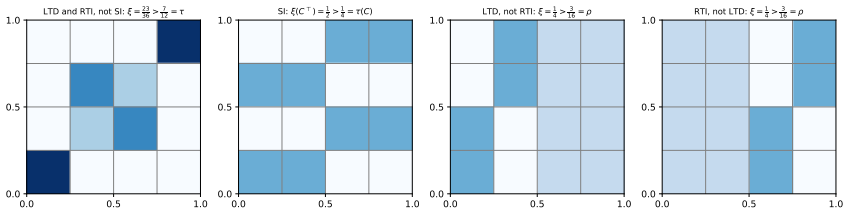
- LTD alone or RTI alone is insufficient to guarantee ξ(C) ≤ ρ(C).
- Joint LTD and RTI is insufficient to guarantee ξ(C) ≤ τ(C).
- Both inequalities are one-directional for ξ.
Reading between the lines
- The equality-attaining ordinal sums may serve as test cases when comparing rank correlations numerically.
- The local order-violation bound could be checked directly on empirical conditional distributions to test applicability of the inequalities to data.
- The directional nature of the bounds suggests that ξ tends to be smaller than the classical coefficients precisely when positive dependence is present.
- Checkerboard constructions provide explicit counter-examples that could be used to probe the necessity of the dependence assumptions in other rank-correlation inequalities.
Editorial analysis
A structured set of objections, weighed in public.
Referee Report
Summary. The paper establishes sharp inequalities relating Chatterjee's rank correlation ξ to Kendall's τ and Spearman's ρ for bivariate copulas under positive dependence. The central technical result is a sharp bound on conditional order-violation probabilities for stochastically ordered distribution functions; this local inequality is integrated to yield ξ(C) ≤ τ(C) for every stochastically increasing copula C, with equality attained by ordinal sums of product copulas. Under the joint LTD and RTI conditions the authors obtain the weaker bound ξ(C) ≤ ρ(C), with equality if and only if C is the independence or comonotonicity copula. Checkerboard constructions demonstrate that the bounds are directional and that the individual tail conditions are insufficient.
Significance. If the derivations hold, the results supply the first sharp comparisons of ξ with the classical rank correlations under explicit positive-dependence hypotheses on copulas. The identification of equality cases and the counter-examples for weaker conditions add precision to the literature on dependence measures. The local order-violation inequality itself appears to be a reusable technical tool.
minor comments (1)
- The abstract states that the bound is 'best possible' via ordinal sums of product copulas; a brief explicit construction or reference to the relevant section would help readers locate the equality case immediately.
Simulated Author's Rebuttal
We thank the referee for the positive assessment of the manuscript, the recognition of its technical contributions, and the recommendation to accept. There are no major comments requiring a point-by-point reply.
Circularity Check
No significant circularity; derivation is self-contained from stochastic ordering assumptions
full rationale
The paper establishes a local sharp bound on order-violation probabilities for stochastically ordered distributions, then integrates it under the SI (or joint LTD+RTI) assumptions to obtain the global inequalities ξ ≤ τ and ξ ≤ ρ. The equality-attaining constructions (ordinal sums of product copulas, independence and comonotonicity) are exhibited explicitly and verified directly from the definitions. No parameter fitting, self-referential definitions, load-bearing self-citations, or renaming of known results occurs; the central claims follow from the stated premises and the local inequality without reduction to inputs by construction.
Assumptions & free parameters
assumptions (2)
- domain assumption Stochastically increasing copulas satisfy the positive dependence condition needed to bound order-violation probabilities
- domain assumption LTD and RTI conditions on copulas jointly control the relevant tail behaviors for the Spearman comparison
Cite this review
Pith. "Pith review of Kendall and Spearman bounds for Chatterjee's rank correlation under positive dependence." pith.science (2026). https://pith.science/paper/DQAEEC2H
@misc{pith2026260622074,
  author       = {Pith},
  title        = {Pith review of: Kendall and Spearman bounds for Chatterjee's rank correlation under positive dependence},
  year         = {2026},
  howpublished = {\url{https://pith.science/paper/DQAEEC2H}},
  note         = {Machine review of arXiv:2606.22074}
}
abstract
We compare Chatterjee's rank correlation $\xi$ with Kendall's $\tau$ and Spearman's $\rho$ under positive-dependence assumptions on bivariate copulas. Our main technical contribution is a sharp order-violation bound for two stochastically ordered distribution functions. This local inequality controls each conditional order-violation probability appearing in Kendall's tau by the cross-rank variance functionals that determine Chatterjee's rank correlation. As a consequence, we prove the sharp Kendall bound $\xi(C)\leq \tau(C)$ for every stochastically increasing copula $C$. The bound is best possible: ordinal sums of product copulas attain equality. We also prove that the weaker left-tail decreasing (LTD) and right-tail increasing (RTI) conditions jointly imply the Spearman bound $\xi(C)\leq \rho(C)$, with equality if and only if $C$ is either the independence or comonotonicity copula. Finally, checkerboard examples show that LTD or RTI alone does not imply $\xi(C)\leq\rho(C)$, that LTD and RTI together do not imply $\xi(C)\leq\tau(C)$, and that both bounds are directional for $\xi$.
Figures

Reference graph
Works this paper leans on
-
[1]
On continuity of Chatterjee’s rank correlation and related dependence measures.Bernoulli, 2026
Jonathan Ansari and Sebastian Fuchs. On continuity of Chatterjee’s rank correlation and related dependence measures.Bernoulli, 2026. Accepted for publication
2026
-
[2]
Dependence properties of bivariate copula families
Jonathan Ansari and Marcus Rockel. Dependence properties of bivariate copula families. Depend. Model., 12:36, 2024
2024
-
[3]
The exact region and an inequality between Chatterjee’s and Spearman’s rank correlations.J
Jonathan Ansari and Marcus Rockel. The exact region and an inequality between Chatterjee’s and Spearman’s rank correlations.J. Multivariate Anal., 214:19, 2026. Id/No 105630
2026
-
[4]
Anniversary edition.Hoboken, NJ: John Wiley & Sons, 2012
Patrick Billingsley.Probability and measure. Anniversary edition.Hoboken, NJ: John Wiley & Sons, 2012
2012
-
[5]
V. I. Bogachev.Measure theory. Vol. I and II. Berlin: Springer, 2007
2007
-
[6]
Spearman’sρis larger than Kendall’sτfor positively dependent random variables.J
Philippe Cap´ era` a and Christian Genest. Spearman’sρis larger than Kendall’sτfor positively dependent random variables.J. Nonparametr. Stat., 2(2):183–194, 1993
1993
-
[7]
A new coefficient of correlation.J
Sourav Chatterjee. A new coefficient of correlation.J. Am. Statist. Assoc., 116(536):2009– 2022, 2021
2009
-
[8]
Darsow, Bao Nguyen, and Elwood T
William F. Darsow, Bao Nguyen, and Elwood T. Olsen. Copulas and Markov processes. Illinois J. Math., 36(4):600–642, 1992
1992
Show all 23 references
-
[9]
Siburg, and Pavel A
Holger Dette, Karl F. Siburg, and Pavel A. Stoimenov. A copula-based non-parametric mea- sure of regression dependence.Scand. J. Stat., 40(1):21–41, 2013
2013
-
[10]
Boca Raton, FL: CRC Press, 2016
Fabrizio Durante and Carlo Sempi.Principles of Copula Theory. Boca Raton, FL: CRC Press, 2016
2016
-
[11]
Fuchs and M
S. Fuchs and M. Tschimpke. Total positivity of copulas from a Markov kernel perspective.J. Math. Anal. Appl., 518(1):21, 2023. Id/No 126629
2023
-
[12]
A novel positive dependence property and its impact on a popular class of concordance measures.J
Sebastian Fuchs and Marco Tschimpke. A novel positive dependence property and its impact on a popular class of concordance measures.J. Multivariate Anal., 200:21, 2024. ISSN 0047- 259X. doi: 10.1016/j.jmva.2023.105259. Id/No 105259
2024 doi
-
[13]
In 2 volumes, volume 99 ofProbab
Olav Kallenberg.Foundations of modern probability. In 2 volumes, volume 99 ofProbab. Theory Stoch. Model.Cham: Springer, 3rd revised and expanded edition edition, 2021. ISBN 978-3-030-61870-4; 978-3-030-61873-5; 978-3-030-61871-1
2021
-
[14]
M. G. Kendall. A new measure of rank correlation.Biometrika, 30:81–93, 1938
1938
-
[15]
E. L. Lehmann. Some concepts of dependence.Ann. Math. Stat., 37:1137–1153, 1966
1966
-
[16]
The bivariate normal copula.Commun
Christian Meyer. The bivariate normal copula.Commun. Stat., Theory Methods, 42(13): 2402–2422, 2013
2013
-
[17]
Nelsen.An Introduction to Copulas
Roger B. Nelsen.An Introduction to Copulas. 2nd ed.New York, NY: Springer, 2006
2006
-
[18]
Measures of association for approximating copulas.arXiv preprint arXiv:2505.08045, 2025
Marcus Rockel. Measures of association for approximating copulas.arXiv preprint arXiv:2505.08045, 2025
2025 arXiv
-
[19]
On measures of concordance.Stochastica, 8:201–218, 1984
Marco Scarsini. On measures of concordance.Stochastica, 8:201–218, 1984
1984
-
[20]
George Shantikumar.Stochastic orders
Moshe Shaked and J. George Shantikumar.Stochastic orders. Springer Ser. Stat. New York, NY: Springer, 2007. ISBN 0-387-32915-3
2007
-
[21]
Stochastic monotonicity and the Markov product for copulas.J
Karl Friedrich Siburg and Christopher Strothmann. Stochastic monotonicity and the Markov product for copulas.J. Math. Anal. Appl., 503(2):14, 2021
2021
-
[22]
The proof and measurement of association between two things.The American Journal of Psychology, 15(1):72–101, 1904
Charles Spearman. The proof and measurement of association between two things.The American Journal of Psychology, 15(1):72–101, 1904
1904
-
[23]
Ziegler.Lectures on polytopes, volume 152 ofGrad
G¨ unter M. Ziegler.Lectures on polytopes, volume 152 ofGrad. Texts Math.Berlin: Springer- Verlag, 1995. 18
1995
Reviewed June 26, 2026 · model on record in the stance chip above.
Discussion (0). Continue with ORCID to comment.