REVIEW 4 major objections 4 minor 43 references
Improving Disentangled Representation Learning with the Beta Bernoulli Process
T0 review · 4 major / 4 minor · reviewed 2026-08-14 · deepseek-v4-flash
Pith's one-line read The paper claims that a latent density which stays independent but grows in capacity improves VAE disentanglement, and demonstrates it with an Indian Buffet Process prior.
desk verdict Worth reading for the clinical nuisance-factor experiments and the independence-vs-capacity framing, but the ELBO as written is not a valid objective—the Concrete q and Bernoulli prior make the KL infinite, so the stated mechanism is unverified. read the letter →
The pith
A machine-rendered reading of the paper's core claim, the machinery that carries it, and where it could break.
The reading
What carries the argument
The machinery is the Beta-Bernoulli process, also called the Indian Buffet Process, used as a nonparametric prior over an unbounded binary feature matrix $Z$, combined with a Gaussian magnitude matrix $A$ through the elementwise product $Y = Z \odot A$. This construction keeps latent dimensions independent while allowing a richer marginal density than an isotropic Gaussian. Inference uses a mean-field variational family with a Concrete relaxation for the Bernoulli variables, a Kumaraswamy relaxation for the Beta stick-breaking weights, and a Gaussian $q(A|X)$. The argument runs through the ELBO decomposition into reconstruction, total correlation, dimension-wise KL, and index-code mutual information: richer capacity lowers the dimension-wise KL competition, so independence and reconstruction improve together.
What would settle it
Train IBP-VAE on dSprites with the truncation $K$ set to a small value (for example 10) and again with a large value (for example 200), and measure MIG and total correlation at identical $\beta$. If the small-$K$ model matches the large-$K$ model, the claim that the process grows with data complexity is not load-bearing. A second check: replace the IBP mask with a fixed finite set of independently learned Bernoulli probabilities of the same dimension; if disentanglement remains unchanged, then the nonparametric prior itself is not what drives the improvement.
Extended reading notes
Core claim
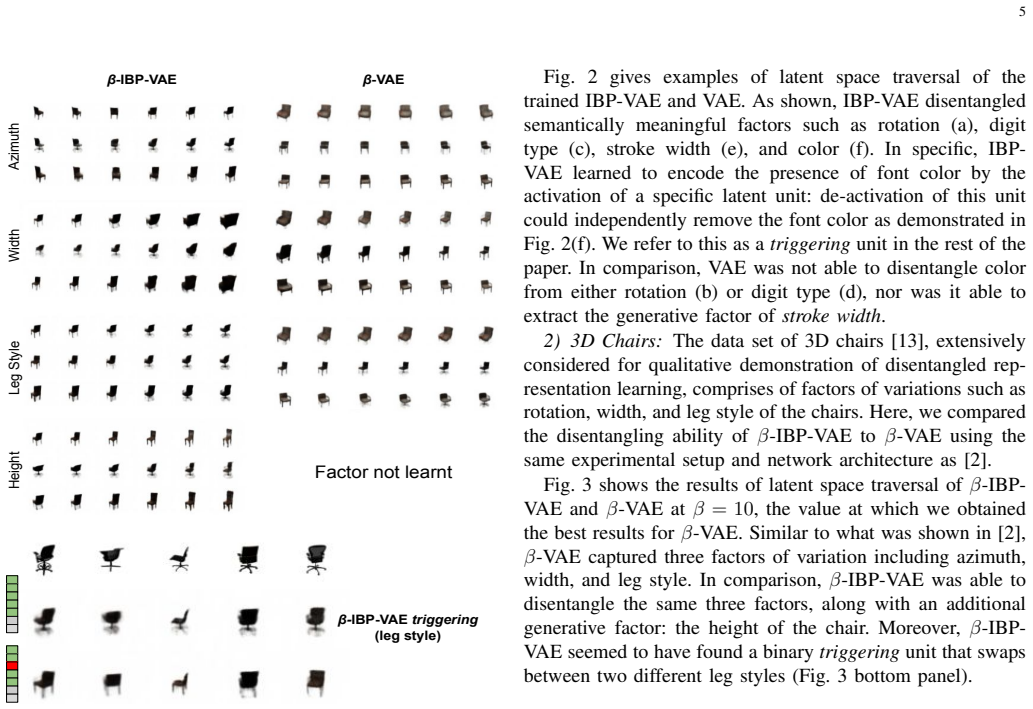
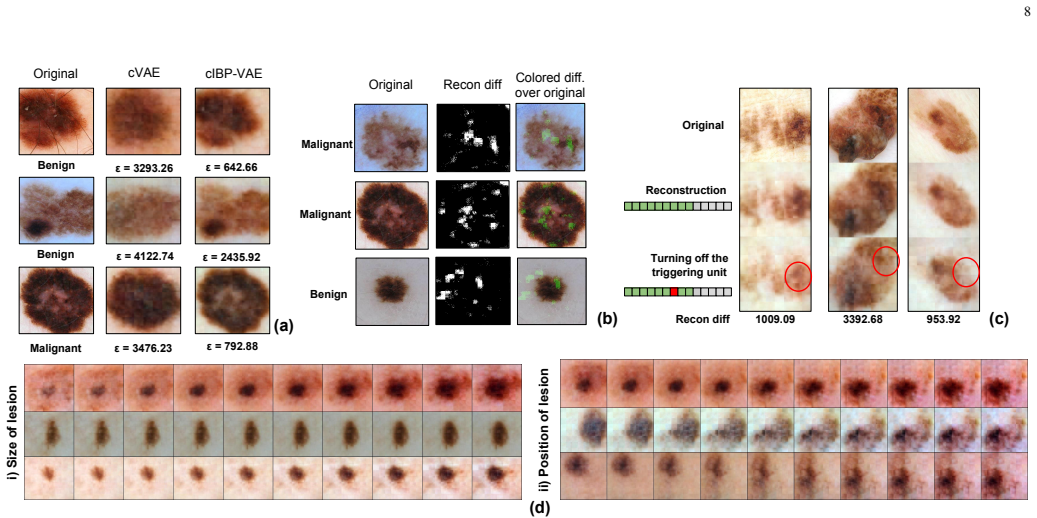
The central claim is that preserving independence among latent factors while increasing the modeling capacity of the posterior density will improve disentangled representation learning in VAEs, especially when generative factors are complex. The paper instantiates this with a latent representation $Y = Z \odot A$, where $Z$ is a binary feature-allocation matrix drawn from a Beta-Bernoulli process (the Indian Buffet Process in the infinite limit) and $A$ is drawn independently from an isotropic Gaussian. Because each data point's active latent features are inferred rather than fixed, the model can in principle grow with the data. On dSprites, IBP-VAE reaches mutual information gap (MIG) 0.5477 at $\beta=5$, above $\beta$-VAE (0.4786) and $\beta$-VampPrior (0.4848), and its total-correlation versus distortion trade-off is better than both; on skin-lesion and ECG data, the supervised variant cIBP-VAE improves task accuracy over a supervised CNN and over c-VAE, and learns 'triggering' latent units that localize nuisance factors such as lesion color or pacing artifacts.
Load-bearing premise
The results rest on the assumption that, after the Concrete and Kumaraswamy relaxations, the elementwise product of the binary mask and the Gaussian magnitudes still yields latent dimensions that are truly independent, and that a truncated finite number of features behaves like an unbounded process on the datasets used; if either fails, the improved scores could come from extra capacity alone rather than from the independence-preserving growth the paper describes.
Editorial extensions
If this is right
- IBP-VAE should keep an advantage over Gaussian-prior VAEs as the number or complexity of generative factors grows, because the latent factor count is inferred rather than preset.
- Combining unsupervised nuisance disentangling with a supervised task (cIBP-VAE) should help in domains with many unlabeled nuisance factors, such as medical images or signals, where a plain supervised network struggles.
- The learned triggering units provide a concrete interpretability mechanism: deactivating one latent unit removes a single semantic factor (font color, leg style, lesion color, ECG pacing artifact) from reconstructions.
- The total-correlation versus distortion analysis is a reusable diagnostic for whether a VAE's posterior capacity is limiting disentanglement.
Reading between the lines
- A direct testable extension is to sweep the truncation level $K$: if the IBP's infinity is doing the work, performance should improve with $K$ up to a point and then plateau, whereas a finite independent Bernoulli mask of the same total capacity should not match it.
- The paper's framing suggests that other nonparametric or flexible independent priors, for example normalizing flows with factorized marginals, could reproduce the same gains, which would show that the growth property rather than the specific IBP is what matters.
- In clinical settings, the triggering-unit mechanism could be turned into a hypothesis-generation tool: units that localize lesion color or ECG artifacts can be correlated with patient metadata to find novel confounders, though the paper does not test this.
Signed reviews
Editorial analysis
A structured set of objections, weighed in public.
Referee Report
Summary. The paper proposes IBP-VAE, in which the latent representation is generated from a Beta-Bernoulli process via Y = Z ⊙ A, and cIBP-VAE, which augments this model with a supervised classification loss for task-relevant representations. The central hypothesis is that a richer but independent posterior density improves disentangled representation learning by reducing competition between the reconstruction and independence terms in the ELBO. Experiments on colored MNIST, 3D Chairs, dSprites, skin lesion images, and 12-lead ECG report qualitative and quantitative improvements, including a MIG of 0.5477 at β=5 on dSprites versus 0.4786 for β-VAE and 0.4848 for β-VampPrior, and improved clinical classification over supervised baselines.
Significance. If valid, the paper makes a useful conceptual contribution by separating the independence of a latent density from its modeling capacity, and by demonstrating a nonparametric construction that can in principle grow with data complexity. The interpretability analyses on clinical data, including triggering units and label-swap reconstructions, are informative and address an underexplored application area. The paper also provides architectural details and paired statistical tests for the clinical results. However, the theoretical objective as written is not a well-defined ELBO, and the quantitative disentanglement evidence rests on a single benchmark with limited controls, so the central claim is only partially supported.
major comments (4)
- [III-C3, Eq. (6)] The KL term KL(q(Z|ν,X) || p(Z|ν)) in Eq. (6) is not finite as written. q(Z|ν,X) is a Concrete distribution on [0,1]^K (Eq. (5) and Appendix A-A), while p(Z|ν) is a product of Bernoulli distributions with point masses at 0 and 1 (Eq. (4)). With respect to any common base measure, the Concrete density is absolutely continuous and the Bernoulli prior is singular, so the KL divergence is infinite or undefined. The paper never states that p(Z|ν) is relaxed to a Concrete prior or that a surrogate KL (e.g., a straight-through estimator with Bernoulli KL) is used. Because the mechanism claimed in Section III-B rests on optimizing the ELBO in Eqs. (3)-(6), this is a load-bearing gap: the actual training objective may differ from the derived one, and the reported improvements cannot be attributed to the IBP ELBO without specifying the actual objective.
- [III-C1, IV-A, IV-C] The generative model is defined in the K→∞ limit in Eq. (4), and the paper claims that the latent density 'is able to grow with the complexity of the data' (Section I). However, all experiments use fixed finite truncations: K=100 for colored MNIST, K=50 for the skin lesion data, and K=50 for the ECG data, with no sensitivity analysis over K or the concentration parameter α. A finite truncation with fixed hyperparameters does not by itself establish unbounded growth, and the claim that the model grows with data complexity is not directly tested. Please add truncation-sensitivity experiments or substantially temper the nonparametric-growth claim.
- [IV-B, Table I, Fig. 4] The only quantitative disentanglement metric, MIG, is reported on dSprites, with single runs and no standard deviations or significance tests. The values of β are varied over {1,5,10}, but the selection procedure is not described, creating a risk of best-reported selection. In addition, the 'best result reported in literature' for β-TCVAE in Fig. 4 is taken from another paper, so that comparison is not controlled for architecture, latent dimension, or training budget. These limitations do not invalidate the qualitative results or the internal comparison with β-VAE and β-VampPrior, but they weaken the central empirical claim that IBP-VAE improves over state of the art. Please provide error bars, multiple seeds, and ideally an additional benchmark or metric.
- [III-C1, III-C2] The claim that the latent representation is independent across dimensions holds for the generative model conditional on ν, but the variational posterior q(Z|ν,X) in Eq. (5) is specified conditional on the shared Kumaraswamy variable ν, and after marginalizing ν and applying the Concrete relaxation the marginal q(Z|X) is not obviously a product of independent factors. If the relaxed binary variables couple dimensions through ν, the 'reduced competition' mechanism in Eq. (3) may not hold for the actual posterior. Please state explicitly whether independence is intended for the conditional posterior q(Z,A|ν,X) or for the marginal q(Z,A|X), and discuss the implications for the stated mechanism.
minor comments (4)
- [III-B, Eq. (3)] The index-code mutual information term is written as '-(log N - E_q(y)[H[q(n|y)]]))' with an apparent mismatched parenthesis, and the aggregated posterior q(y) is never explicitly defined as (1/N) Σ_n q(y|x_n). Please define q(y) and correct the formula.
- [Fig. 2 caption] The caption lists subfigures (a)-(e) in the text but also refers to panel (f), and the list in the caption is incomplete. Please make the caption consistent with the figure.
- [Table II caption] The caption contains a typo: 'classification accuray' should be 'classification accuracy'.
- [IV-B, Fig. 5] The TC-D analysis does not state how the total-correlation term is estimated from the trained models. Without an explicit estimator, the curves in Fig. 5 are not reproducible; please add the estimation procedure.
Circularity Check
No circularity identified: the central claim is an empirical hypothesis tested against external metrics and benchmarks, and no prediction reduces to its own inputs by construction.
full rationale
The paper's central assertion is that an independent latent-factor model with increased posterior capacity improves disentanglement, and this is investigated by comparing IBP-VAE against beta-VAE and beta-VampPrior on external benchmarks. The quantitative disentanglement measure, MIG, is computed from ground-truth factors of variation and is not a term in the optimized objective; the TC-D analysis is a post-hoc decomposition of learned latents, not a training objective. The ELBO decomposition in Eq. (3) is borrowed from prior work and used only as motivation, not as the metric that confirms the claim. Some self-citations exist: [32] is a same-group prior paper used for ECG preprocessing, and [17] is a dataset paper co-authored by two clinical co-authors, but neither is load-bearing for the central derivation. The Concrete-versus-Bernoulli KL in Eq. (6) is a correctness concern about the written objective, not a circular reduction of a prediction to its inputs. No fitted parameter is renamed as a prediction, no uniqueness theorem is imported from the authors' prior work, and no known result is merely relabeled. Accordingly, no significant circularity is present.
Assumptions & free parameters
free parameters (3)
- alpha (IBP concentration hyperparameter) =
30 (colored MNIST), 10 (dSprites), 20 (ECG)
- beta (KL regularization coefficient) =
1, 5, 10 (grid; best reported at 5)
- zeta (supervised loss weight in cIBP-VAE) =
5 (skin, with warm-up); {0.5, 0.8, 1} (ECG, best selected)
assumptions (3)
- standard math The ELBO decomposition in Eq. (3) separates total correlation, dimension-wise KL, and index-code mutual information so that these terms can be treated as independently controllable.
- domain assumption Y = Z⊙A is independent across feature dimensions because Z and A are each independent per dimension.
- domain assumption A truncated stick-breaking construction with Concrete and Kumaraswamy relaxations accurately approximates the infinite IBP and preserves the claimed capacity growth.
Cite this review
Pith. "Pith review of Improving Disentangled Representation Learning with the Beta Bernoulli Process." pith.science (2026). https://pith.science/paper/DQEABYJQ
@misc{pith2026190901839,
  author       = {Pith},
  title        = {Pith review of: Improving Disentangled Representation Learning with the Beta Bernoulli Process},
  year         = {2026},
  howpublished = {\url{https://pith.science/paper/DQEABYJQ}},
  note         = {Machine review of arXiv:1909.01839}
}
read the original abstract
To improve the ability of VAE to disentangle in the latent space, existing works mostly focus on enforcing independence among the learned latent factors. However, the ability of these models to disentangle often decreases as the complexity of the generative factors increases. In this paper, we investigate the little-explored effect of the modeling capacity of a posterior density on the disentangling ability of the VAE. We note that the independence within and the complexity of the latent density are two different properties we constrain when regularizing the posterior density: while the former promotes the disentangling ability of VAE, the latter -- if overly limited -- creates an unnecessary competition with the data reconstruction objective in VAE. Therefore, if we preserve the independence but allow richer modeling capacity in the posterior density, we will lift this competition and thereby allow improved independence and data reconstruction at the same time. We investigate this theoretical intuition with a VAE that utilizes a non-parametric latent factor model, the Indian Buffet Process (IBP), as a latent density that is able to grow with the complexity of the data. Across three widely-used benchmark data sets and two clinical data sets little explored for disentangled learning, we qualitatively and quantitatively demonstrated the improved disentangling performance of IBP-VAE over the state of the art. In the latter two clinical data sets riddled with complex factors of variations, we further demonstrated that unsupervised disentangling of nuisance factors via IBP-VAE -- when combined with a supervised objective -- can not only improve task accuracy in comparison to relevant supervised deep architectures but also facilitate knowledge discovery related to task decision-making. A shorter version of this work will appear in the ICDM 2019 conference proceedings.
Figures


Figures from the paper (6 more)




Reference graph
Works this paper leans on
-
[1]
Interpretability of deep learning models: a survey of results,
Supriyo Chakraborty, Richard Tomsett, Ramya Raghavendra, Daniel Harborne, Moustafa Alzantot, Federico Cerutti, Mani Srivastava, Alun Preece, Simon Julier, Raghuveer M Rao, et al., “Interpretability of deep learning models: a survey of results,” in IEEE Smart World Congress 2017 Workshop: DAIS, 2017
work page 2017
-
[2]
beta-vae: Learning basic visual concepts with a constrained variational framework,
Irina Higgins, Loic Matthey, Arka Pal, Christopher Burgess, Xavier Glorot, Matthew Botvinick, Shakir Mohamed, and Alexander Lerchner, “beta-vae: Learning basic visual concepts with a constrained variational framework,” 2016. 10 Reconstruction (c) (d) Turning off the triggering unitOriginal Sample (b) Task Nuisance Task Nuisance (a) Fig. 10: [Best viewed i...
work page 2016
-
[3]
Isolating sources of disentanglement in variational autoencoders,
Tian Qi Chen, Xuechen Li, Roger B Grosse, and David K Duvenaud, “Isolating sources of disentanglement in variational autoencoders,” in Advances in Neural Information Processing Systems 31 . 2018
work page 2018
-
[4]
Hyunjik Kim and Andriy Mnih, “Disentangling by factorising,” in International Conference on Machine Learning , 2018, pp. 2654–2663
work page 2018
-
[5]
Vari- ational inference of disentangled latent concepts from unlabeled obser- vations,
Abhishek Kumar, Prasanna Sattigeri, and Avinash Balakrishnan, “Vari- ational inference of disentangled latent concepts from unlabeled obser- vations,” arXiv preprint arXiv:1711.00848 , 2017
arXiv 2017
-
[6]
Xi Chen, Yan Duan, Rein Houthooft, John Schulman, Ilya Sutskever, and Pieter Abbeel, “Infogan: Interpretable representation learning by information maximizing generative adversarial nets,” in Advances in Neural Information Processing Systems , 2016, pp. 2172–2180
work page 2016
-
[7]
Auto-encoding variational bayes,
Diederik P Kingma and Max Welling, “Auto-encoding variational bayes,” in Proceedings of the 2nd International Conference on Learning Representations (ICLR), 2013, number 2014
work page 2013
-
[8]
Stochastic backpropagation and approximate inference in deep gen- erative models,
Danilo Jimenez Rezende, Shakir Mohamed, and Daan Wierstra, “Stochastic backpropagation and approximate inference in deep gen- erative models,” in Proceedings of the 31th International Conference on Machine Learning, ICML 2014, Beijing, China, 21-26 June 2014 , 2014, pp. 1278–1286
work page 2014
Show all 43 references
-
[9]
V AE with a vampprior,
Jakub M. Tomczak and Max Welling, “V AE with a vampprior,” in International Conference on Artificial Intelligence and Statistics, AISTATS, 2018
2018
-
[10]
Improved variational inference with in- verse autoregressive flow,
Durk P Kingma, Tim Salimans, Rafal Jozefowicz, Xi Chen, Ilya Sutskever, and Max Welling, “Improved variational inference with in- verse autoregressive flow,” inAdvances in neural information processing systems, 2016, pp. 4743–4751
2016
-
[11]
The indian buffet process: An introduction and review,
Thomas L Griffiths and Zoubin Ghahramani, “The indian buffet process: An introduction and review,” Journal of Machine Learning Research , vol. 12, no. Apr, pp. 1185–1224, 2011
2011
-
[12]
Gradient-based learning applied to document recognition,
Yann LeCun, L ´eon Bottou, Yoshua Bengio, and Patrick Haffner, “Gradient-based learning applied to document recognition,” Proceedings of the IEEE , vol. 86, no. 11, pp. 2278–2324, 1998
1998
-
[13]
Seeing 3d chairs: exemplar part-based 2d-3d alignment using a large dataset of cad models,
Mathieu Aubry, Daniel Maturana, Alexei A Efros, Bryan C Russell, and Josef Sivic, “Seeing 3d chairs: exemplar part-based 2d-3d alignment using a large dataset of cad models,” in Proceedings of the IEEE conference on computer vision and pattern recognition, 2014, pp. 3762– 3769
2014
-
[14]
dsprites: Disentanglement testing sprites dataset,
Loic Matthey, Irina Higgins, Demis Hassabis, and Alexander Lerchner, “dsprites: Disentanglement testing sprites dataset,” https://github.com/deepmind/dsprites-dataset/, 2017
2017
-
[15]
David Gutman, Noel CF Codella, Emre Celebi, Brian Helba, Michael Marchetti, Nabin Mishra, and Allan Halpern, “Skin lesion analysis toward melanoma detection: A challenge at the international symposium on biomedical imaging (isbi) 2016, hosted by the international skin imaging ...
2016 arXiv
-
[16]
Giuseppe Argenziano, Gabriella Fabbrocini, Paolo Carli, Vincenzo De Giorgi, Elena Sammarco, and Mario Delfino, “Epiluminescence microscopy for the diagnosis of doubtful melanocytic skin lesions: comparison of the abcd rule of dermatoscopy and a new 7-point checklist based on pa...
1998
-
[17]
Real-time localization of ventricular tachycardia origin from the 12-lead electrocardiogram,
John L Sapp, Meir Bar-Tal, Adam J Howes, Jonathan E Toma, Ahmed El-Damaty, James W Warren, Paul J MacInnis, Shijie Zhou, and B Milan Hor´aˇcek, “Real-time localization of ventricular tachycardia origin from the 12-lead electrocardiogram,” JACC: Clinical Electrophysiology, vol....
2017
-
[18]
Gen- erative adversarial nets,
Ian Goodfellow, Jean Pouget-Abadie, Mehdi Mirza, Bing Xu, David Warde-Farley, Sherjil Ozair, Aaron Courville, and Yoshua Bengio, “Gen- erative adversarial nets,” in Advances in neural information processing systems, 2014, pp. 2672–2680
2014
-
[19]
Elbo surgery: yet another way to carve up the variational evidence lower bound,
Matthew D Hoffman and Matthew J Johnson, “Elbo surgery: yet another way to carve up the variational evidence lower bound,” in Workshop in Advances in Approximate Bayesian Inference, NIPS , 2016
2016
-
[20]
Fixing a broken elbo,
Alexander Alemi, Ben Poole, Ian Fischer, Joshua Dillon, Rif A Saurous, and Kevin Murphy, “Fixing a broken elbo,” in International Conference on Machine Learning , 2018, pp. 159–168
2018
-
[21]
Importance weighted autoencoders,
Yuri Burda, Roger Grosse, and Ruslan Salakhutdinov, “Importance weighted autoencoders,” arXiv preprint arXiv:1509.00519 , 2015
2015 arXiv
-
[22]
Deep unsupervised clustering with gaussian mixture variational autoencoders,
Nat Dilokthanakul, Pedro AM Mediano, Marta Garnelo, Matthew CH Lee, Hugh Salimbeni, Kai Arulkumaran, and Murray Shanahan, “Deep unsupervised clustering with gaussian mixture variational autoencoders,” arXiv preprint arXiv:1611.02648 , 2016
2016 arXiv
-
[23]
Variational lossy autoencoder,
Xi Chen, Diederik P Kingma, Tim Salimans, Yan Duan, Prafulla Dhari- wal, John Schulman, Ilya Sutskever, and Pieter Abbeel, “Variational lossy autoencoder,” arXiv preprint arXiv:1611.02731 , 2016
2016 arXiv
-
[24]
Stick-breaking variational autoen- coders,
Eric Nalisnick and Padhraic Smyth, “Stick-breaking variational autoen- coders,” arXiv preprint arXiv:1605.06197 , 2016
2016 arXiv
-
[25]
Nonparametric variational auto-encoders for hierarchical representation learning.,
Prasoon Goyal, Zhiting Hu, Xiaodan Liang, Chenyu Wang, Eric P Xing, and Carnegie Mellon, “Nonparametric variational auto-encoders for hierarchical representation learning.,” in ICCV, 2017, pp. 5104–5112
2017
-
[26]
Indian buffet process deep generative models,
Sotirios P Chatzis, “Indian buffet process deep generative models,” arXiv preprint arXiv:1402.3427, 2014
2014 arXiv
-
[27]
Structured varia- tional autoencoders for the beta-bernoulli process,
Rachit Singh, Jeffrey Ling, and Finale Doshi-Velez, “Structured varia- tional autoencoders for the beta-bernoulli process,”NIPS 2017 Workshop on Advances in Approximate Bayesian Inference , 2017
2017
-
[28]
Learning fair representations,
Rich Zemel, Yu Wu, Kevin Swersky, Toni Pitassi, and Cynthia Dwork, “Learning fair representations,” in International Conference on Machine Learning, 2013
2013
-
[29]
The variational fair autoencoder,
Christos Louizos, Kevin Swersky, Yujia Li, Max Welling, and Richard Zemel, “The variational fair autoencoder,” arXiv preprint arXiv:1511.00830, 2015
2015 arXiv
-
[30]
Fair deep learning prediction for healthcare applications with confounder filtering,
Zhenglin Wu, Haohan Wang, Mingze Cao, Yin Chen, and Eric P Xing, “Fair deep learning prediction for healthcare applications with confounder filtering,” arXiv preprint arXiv:1803.07276 , 2018
2018 arXiv
-
[31]
Stick-breaking construction for the indian buffet process,
Yee Whye Teh, Dilan Gr ¨ur, and Zoubin Ghahramani, “Stick-breaking construction for the indian buffet process,” in Artificial Intelligence and Statistics, 2007, pp. 556–563
2007
-
[32]
Disentangling inter-subject variations: Automatic localization of ventricular tachycardia origin from 12-lead electrocardiograms,
Shuhang Chen, Prashnna K Gyawali, Huafeng Liu, B Milan Horacek, John L Sapp, and Linwei Wang, “Disentangling inter-subject variations: Automatic localization of ventricular tachycardia origin from 12-lead electrocardiograms,” in Biomedical Imaging (ISBI 2017), 2017 IEEE 14th I...
2017
-
[33]
Categorical reparameterization with gumbel-softmax,
Eric Jang, Shixiang Gu, and Ben Poole, “Categorical reparameterization with gumbel-softmax,” arXiv preprint arXiv:1611.01144 , 2016
2016 arXiv
-
[34]
The concrete distribution: A continuous relaxation of discrete random variables,
Chris J Maddison, Andriy Mnih, and Yee Whye Teh, “The concrete distribution: A continuous relaxation of discrete random variables,” arXiv preprint arXiv:1611.00712 , 2016
2016 arXiv
-
[35]
Semi-supervised learning with deep generative models,
Diederik P Kingma, Shakir Mohamed, Danilo Jimenez Rezende, and Max Welling, “Semi-supervised learning with deep generative models,” 11 in Advances in Neural Information Processing Systems, 2014, pp. 3581– 3589
2014
-
[36]
Adam: A method for stochastic optimization,
Diederik Kingma and Jimmy Ba, “Adam: A method for stochastic optimization,” arXiv preprint arXiv:1412.6980 , 2014
2014 arXiv
-
[37]
Three-point checklist of dermoscopy,
H Peter Soyer, Giuseppe Argenziano, Iris Zalaudek, Rosamaria Corona, Francesco Sera, Renato Talamini, Filomena Barbato, Adone Baroni, Lorenza Cicale, Alessandro Di Stefani, et al., “Three-point checklist of dermoscopy,” Dermatology, vol. 208, no. 1, pp. 27–31, 2004
2004
-
[38]
Skin lesion analysis towards melanoma detection using deep learning network,
Yuexiang Li and Linlin Shen, “Skin lesion analysis towards melanoma detection using deep learning network,” Sensors, vol. 18, no. 2, pp. 556, 2018
2018
-
[39]
One weird trick for parallelizing convolutional neural networks,
Alex Krizhevsky, “One weird trick for parallelizing convolutional neural networks,” arXiv preprint arXiv:1404.5997 , 2014
2014 arXiv
-
[40]
Generating sentences from a continuous space,
Samuel R Bowman, Luke Vilnis, Oriol Vinyals, Andrew M Dai, Rafal Jozefowicz, and Samy Bengio, “Generating sentences from a continuous space,” Proceedings of the 20th SIGNLL Conference on Computational Natural Language Learning, CoNLL , 2016
2016
-
[41]
Robert Plonsey, Bioelectric phenomena, Wiley Online Library, 1969
1969
-
[42]
Localization of origins of premature ventricular contraction by means of convolutional neural network from 12-lead ecg,
Ting Yang, Long Yu, Qi Jin, Liqun Wu, and Bin He, “Localization of origins of premature ventricular contraction by means of convolutional neural network from 12-lead ecg,” IEEE Transactions on Biomedical Engineering, vol. 65, no. 7, pp. 1662–1671, 2018
2018
-
[43]
Challenging common assumptions in the unsupervised learning of disentangled representations,
Francesco Locatello, Stefan Bauer, Mario Lucic, Sylvain Gelly, Bernhard Sch¨olkopf, and Olivier Bachem, “Challenging common assumptions in the unsupervised learning of disentangled representations,” arXiv preprint arXiv:1811.12359, 2018
2018 arXiv
Reviewed August 14, 2026 · model on record in the stance chip above.
Discussion (0). Continue with ORCID to comment.