REVIEW 3 major objections 5 minor 300 references
Binary neutron stars in the next-generation era: Multi-messenger detection prospects and constraints on the equation of state, mass distribution, and cosmology
T0 review · 3 major / 5 minor · reviewed 2026-07-31 · grok-4.5
Pith's one-line read Next-generation GW detectors plus kilonovae can pin the neutron-star radius to ~0.2 km and H0 to ~1 km/s/Mpc in an ideal year of multi-messenger BNS events.
desk verdict Solid end-to-end ET/CE multi-messenger forecast plus real hierarchical Bayesian joint inference; the ~0.2 km / ~1 km s−1 Mpc−1 numbers are explicitly ideal-scenario and should be read that way. read the letter →
The pith
A machine-rendered reading of the paper's core claim, the machinery that carries it, and where it could break.
The reading
What carries the argument
Joint hierarchical Bayesian inference on equation-of-state, mass-distribution, and cosmological hyperparameters, with per-event posteriors represented by normalizing flows so the population likelihood can be evaluated efficiently and selection effects reweighted after sampling.
What would settle it
After one year of real ET (or ET+CE) multi-messenger binary neutron star detections, measure whether the hierarchical posterior on R1.4 is actually at the ~0.2 km level and H0 at the ~1 km s−1 Mpc−1 level when independent nuclear or X-ray radius priors and independent H0 anchors are compared, or whether systematics in waveforms and ejecta models broaden or bias those intervals beyond the ideal forecast.
Extended reading notes
Core claim
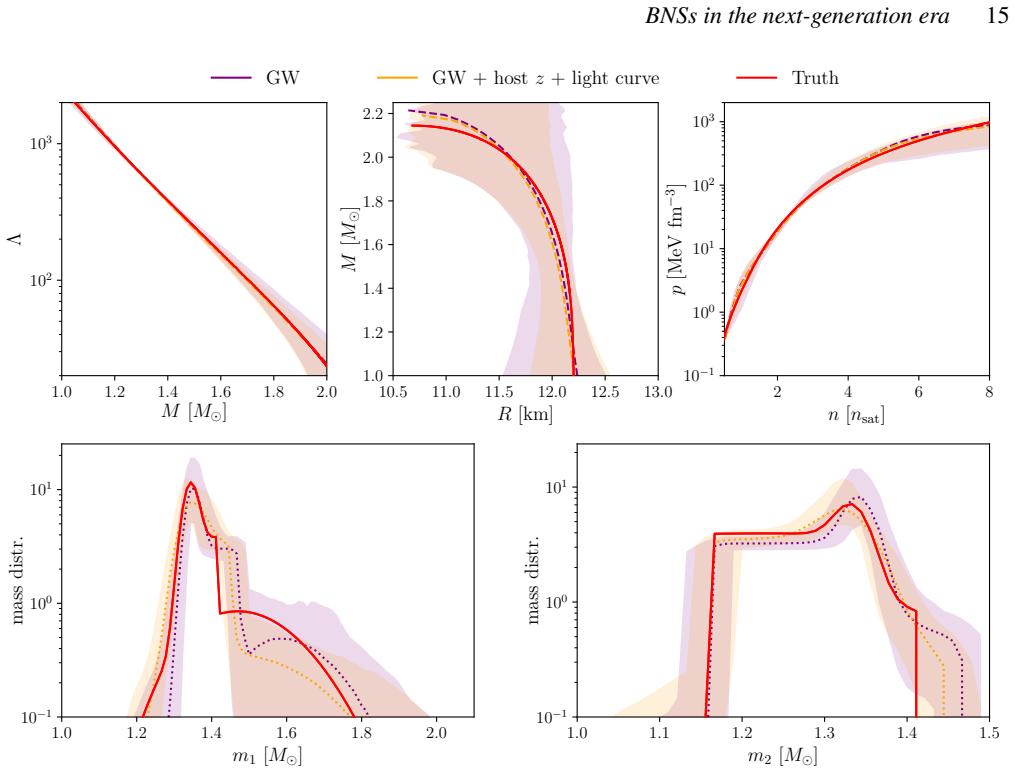
In an ideal injection-recovery campaign focused on ET, the multi-messenger sample of kilonova-associated binary neutron stars can constrain the canonical neutron-star radius R1.4 to within about 0.2 km and H0 to within about 1 km s−1 Mpc−1 while recovering the main features of the mass distribution; kilonova light-curve posteriors have negligible impact on the equation of state once gravitational-wave tidal information is included, but they improve cosmological parameter recovery.
Load-bearing premise
The quoted radius and Hubble precisions assume perfect knowledge of the gravitational-wave waveform and kilonova emission models, with injection and recovery done with identical models and fitting formulae, so real model mismatch is set to zero.
Editorial extensions
If this is right
- ET alone should deliver tens of multi-messenger BNS events per year at the assumed merger rate, enough for sub-kilometer radius and percent-level H0 constraints in the ideal case.
- Adding Cosmic Explorer multiplies the multi-messenger yield by several times, mainly through tighter sky localizations that enable more successful follow-up.
- Equation-of-state inference will be driven by the handful of highest-SNR events with clear tides, not by sheer event count.
- Kilonova light curves are more valuable for cosmology (distance/inclination and bias control) than for further tightening the dense-matter equation of state once GW tides are precise.
- Late-time radio surveys can still recover tens of afterglows even when early optical counterparts are missed.
Reading between the lines
- If waveform or ejecta-model systematics remain at the levels the paper flags, the real R1.4 and H0 errors will be set by those systematics rather than by the statistical floor of ~0.2 km and ~1 km/s/Mpc.
- The strong dependence of counterpart counts on the mass distribution (narrow versus wide, via prompt-collapse fraction) means an early multi-messenger sample will itself diagnose whether the Galactic narrow distribution or a broader one is closer to truth.
- Because selection effects and inclination bias are hard to model exactly, cosmological analyses may need light-curve or jet information even when gravitational-wave SNRs are high.
- Microphysical nuclear parameters (beyond bulk pressure near a few times saturation) will stay loosely constrained unless nuclear theory priors are folded in.
Editorial analysis
A structured set of objections, weighed in public.
Referee Report
Summary. The paper forecasts multi-messenger BNS detection rates with ET and CE under two mass distributions and a fixed local merger rate of 106.6 Gpc^{-3} yr^{-1}, using a staged mock follow-up algorithm for prompt GRBs, UVOIR counterparts, and late afterglows. It then performs fully Bayesian hierarchical injection-recovery on the identified KN events (ET-only) to jointly constrain the EOS, mass distribution, and cosmology. In an ideal scenario with identical inject/recover models, the authors report R_{1.4} constrained to ~0.2 km and H_0 to ~1 km s^{-1} Mpc^{-1}, with KN light curves having negligible impact on the EOS but helping cosmological inference via inclination–distance constraints.
Significance. This is a substantial and timely contribution that unifies population synthesis, multi-messenger detection modeling, and hierarchical Bayesian inference in one framework. Strengths include the use of full Bayesian single-event posteriors (not FIM approximations) with normalizing flows, direct microphysical EOS sampling via jester/TOV solutions, publicly available analysis scripts, and an explicit comparison of GW-only versus multi-messenger hierarchical posteriors. The detection-rate tables and the ideal-scenario precision forecasts will be useful benchmarks for ET/CE science cases, provided the idealizations are kept clearly in view.
major comments (3)
- [Abstract; Sec. 4.4; Apps. D–E] Sec. 4.4 and Apps. D–E state that GW waveforms and KN/ejecta models are identical at injection and recovery, and that the same NR-informed ejecta–mass fits used to build the catalogues are reused in the hierarchical likelihood (Eqs. 35–38). The headline R_{1.4} ≲ 0.2 km and H_0 ≲ 1 km s^{-1} Mpc^{-1} claims (abstract; Sec. 5) are therefore calibrated only under zero model mismatch. The paper already cites waveform systematics, ≳50% atomic/thermalization ejecta errors, and NR-fit differences as real-data failure modes. These caveats should be elevated into the abstract and conclusion so that the quoted intervals are not read as robust forecasts; a short quantitative stress test (e.g., one mismatched KN morphology or one alternate ejecta fit) would substantially strengthen the claim.
- [Appendix G; Sec. 4.2.2; Tables 6–7] Appendix G approximates p_det(λ) with a neural-network SNR cut plus a single Rubin i-band magnitude threshold, then clips extreme weights. The text notes that this imperfect reweighting leaves residual bias in mass-distribution hyperparameters (e.g., α and m_u for the narrow model; m_max for the wide model; Tables 6–7). Because selection correction is load-bearing for population and cosmology inference (less so for R_{1.4}, which is dominated by a few high-SNR tides), the paper should either (i) demonstrate that EOS/H_0 intervals are stable under alternate p_det prescriptions, or (ii) more clearly separate which quoted constraints are robust to the App. G approximation.
- [Sec. 2.3; Fig. 3; Table 4] Sec. 2.3 tunes the Blandford–Znajek fudge factor η_0 so that the synthetic Fermi/GBM fluence distribution matches observations (Fig. 3). GRB and afterglow detection counts in Table 4 and Fig. 5 therefore partly reflect this calibration rather than an ab initio jet model. The paper should state more explicitly which science conclusions (especially afterglow rates and the fraction of UVOIR counterparts that are pure GRB afterglows) inherit from this tuning, versus those driven by the KN channel alone.
minor comments (5)
- [Table 4] Table 4 bracketed afterglow numbers (late-time surveys without prior UVOIR) are useful but easy to misread; a one-sentence clarification in the caption would help.
- [Sec. 4.2.2; Fig. 6] The modest radius bias toward smaller R at fixed tight M–Λ (Sec. 4.2.2, Fig. 6) is attributed to CSE flexibility; a brief note on whether a different high-density extension would remove the bias would aid interpretation.
- [Sec. 4.2.1; Eq. (39)] Eq. (39) replaces the Puecher & Dietrich classifier with a simple k_coll cut for jax compatibility. State the fraction of catalogue events for which the two criteria disagree, if available.
- [Sec. 3.1; Sec. 4.3] Several typos and notation nits: “s (PSDs)” → “PSDs” (Sec. 3.1); “the proposed the proposed cosmology” (Sec. 4.3); inconsistent use of Ω_0 vs Ω_m.
- [Fig. 5] Fig. 5 orange/green patches distinguishing KN vs GRB-afterglow contributions are valuable; ensure the 30% flux criterion is restated in the caption.
Circularity Check
Standard next-gen injection–recovery forecast; only mild circularity is η0 tuned to Fermi short-GRB fluences. Central R1.4/H0 widths are conditional ideal-scenario results, not forced by definition.
-
fitted input called prediction
[Sec. 2.3, Eqs. (18)–(19), Fig. 3]
"Moreover, we have tuned the fudge factor in Eq. (19a) to η0 = 0.016, so that the resulting fluence distribution matches the Fermi/GBM short GRB samples (Colombo et al. 2022; Loffredo et al. 2025), more details are provided below. ... To ensure consistency between our ad-hoc prescriptions for the gamma-ray energy Eγ and the observed short GRB population, we tuned η0 in such a way that our results roughly agree with the fluence distribution of short Fermi/GBM GRBs"
η0 is adjusted until the synthetic bolometric fluence histogram reproduces the observed Fermi/GBM short-GRB sample (Fig. 3, including the 0.6 duty-cycle rescaling). Projected prompt-GRB and GRB-afterglow detection counts therefore partly inherit that calibration by construction rather than arising as independent first-principles forecasts. This does not force the paper’s headline R1.4 or H0 intervals, which come from KN-selected GW hierarchical runs, but it does make the GRB multi-messenger rate panels non-predictive for the tuned observable.
full rationale
The paper is a forward population-synthesis and hierarchical injection–recovery study. Detection counts and hierarchical posteriors are generated from explicit mock catalogues (fixed local rate 106.6 Gpc−3 yr−1, two mass models, QMC-RMF3 EOS) and a mock EM follow-up algorithm; the abstract and Sec. 4 explicitly label the R1.4 ≲ 0.2 km and H0 ≲ 1 km s−1 Mpc−1 figures as an “ideal scenario.” Recovered precision is not algebraically equal to any fitted input: it is set by network SNRs, number of KN-selected events, and tidal information content under matched inject/recover models (disclosed in Sec. 4.4 and Apps. D–E). Self-citations (possis/fiesta surrogates, jester, prior multi-messenger pipelines) supply tools and priors, not load-bearing uniqueness theorems. The sole clear fitted-input step is the Blandford–Znajek fudge factor η0, tuned so the synthetic short-GRB fluence histogram matches Fermi/GBM; that forces intermediate GRB rate/fluence plots (Fig. 3) but does not determine the EOS or H0 hierarchical widths, which are driven by GW tides plus host redshifts (and secondarily KN light curves). Selection-effect reweighting (App. G) is approximate and visibly biases some mass-distribution hyperparameters, but that is a modelling limitation, not a circular reduction of the central claims. Overall circularity is minor and proportionate to score 2.
Assumptions & free parameters
free parameters (7)
- local merger rate density Rn / R(0) =
R(0)=106.6 Gpc−3 yr−1
- Blandford–Znajek fudge factor η0 =
η0=0.016
- wind-to-disk mass fraction ζ distributions =
prompt: TN(0.2,0.1); remnant: TN(0.5,0.2)
- gamma-ray efficiency ηγ =
U(0.01,0.15)
- ISM density prior for afterglows =
U(−5,0) in log10 cm−3
- instrument ΔΩ and dL follow-up thresholds =
network-dependent cuts in App. B
- EM systematic magnitude floor σsys =
U(0.3,1) mag
assumptions (8)
- domain assumption Source-frame merger rate follows Madau–Dickinson SFR convolved with exponential delay-time distribution independent of mass/spin.
- domain assumption Single EOS (QMC-RMF3) and perfect spin–orbit alignment for all catalogue events.
- domain assumption Prompt collapse and ejecta masses given by specified NR fits / ML classifier (or k_coll MTOV proxy in inference).
- domain assumption GW detection if network SNR>12; 90% sky area from Fisher matrix (gwfish), 100% duty cycle.
- ad hoc to paper Counterpart 'detected' after ≥2 filter/epoch/instrument flags with no impostor contamination and random tiling order.
- domain assumption Host cosmological redshift known to 1% Gaussian error; flat ΛCDM with only H0, Ω0 free in cosmology runs.
- ad hoc to paper Hierarchical likelihood uses NF density estimates of single-event posteriors and approximate p_det reweighting with clipping.
- ad hoc to paper Injected and recovered GW/KN models are identical (no waveform or radiative-transfer mismatch).
invented entities (2)
-
Mock multi-messenger follow-up algorithm (staged UVOIR + late afterglow surveys)
-
Extended possis ML surrogate geometry for wide ejecta parameter space
Cite this review
Pith. "Pith review of Binary neutron stars in the next-generation era: Multi-messenger detection prospects and constraints on the equation of state, mass distribution, and cosmology." pith.science (2026). https://pith.science/paper/DQW74DN6
@misc{pith2026260728438,
  author       = {Pith},
  title        = {Pith review of: Binary neutron stars in the next-generation era: Multi-messenger detection prospects and constraints on the equation of state, mass distribution, and cosmology},
  year         = {2026},
  howpublished = {\url{https://pith.science/paper/DQW74DN6}},
  note         = {Machine review of arXiv:2607.28438}
}
abstract
Next-generation gravitational-wave (GW) observatories will provide crucial insights into the nature of neutron star (NS) matter and the cosmological expansion history. We estimate the number of multi-messenger detections from binary neutron stars (BNS) with the Einstein Telescope (ET) and Cosmic Explorer (CE), and project the resulting constraints on the equation of state (EOS), BNS mass distribution, and cosmology via joint hierarchical Bayesian inference. Assuming a local merger rate of 106.6 Gpc$^{-3}$ yr$^{-1}$ and considering two different mass functions, a narrow one centred around 1.4 $M_\odot$ and a wide one ranging between 1.1--2 $M_\odot$, we find that for ET, our mock follow-up algorithm results in at least $\sim40$ and up to $\sim100$ successfully identified electromagnetic counterparts per year, depending on the detector layout and mass distribution. In a joint network with CE, the number of multi-messenger detections can range from $\sim 200$ to $\sim500$. Additionally, several more afterglows from gamma-ray bursts or KNe could be found with dedicated late-time observations. Based on the identified multi-messenger events, we perform an injection campaign to hierarchically constrain the EOS, mass distribution, and cosmology in a fully Bayesian framework. Focussing on ET alone, we show how in an ideal scenario, GW signals, KNe, and host galaxy redshifts can constrain the canonical NS radius $R_{1.4}$ within $\sim 0.2$ km and the Hubble constant $H_0$ within $\sim 1$ km s$^{-1}$ Mpc$^{-1}$, while recovering the essential features of the mass distribution. By comparing inference results that rely solely on GW data and those that incorporate light curve information, we find that while KN light-curve posteriors have a negligible impact on the EOS constraints, they can benefit the inference of cosmological parameters.
Figures


Figures from the paper (9 more)




Reference graph
Works this paper leans on
-
[1]
Abac, Adrian and Dietrich, Tim and Buonanno, Alessandra and Steinhoff, Jan and Ujevic, Maximiliano. New and robust gravitational-waveform model for high-mass-ratio binary neutron star systems with dynamical tidal effects. Phys. Rev. D. 2024. doi:10.1103/PhysRevD.109.024062. arXiv:2311.07456
arXiv 2024
-
[2]
Inferring Prompt Black-Hole Formation in Neutron Star Mergers from Gravitational-Wave Data
Agathos, Michalis and Zappa, Francesco and Bernuzzi, Sebastiano and Perego, Albino and Breschi, Matteo and Radice, David. Inferring Prompt Black-Hole Formation in Neutron Star Mergers from Gravitational-Wave Data. Phys. Rev. D. 2020. doi:10.1103/PhysRevD.101.044006. arXiv:1908.05442
arXiv 2020
-
[3]
Aksulu, M. D. and Wijers, R. A. M. J. and van Eerten, H. J. and van der Horst, A. J. Exploring the GRB population: robust afterglow modelling. Mon. Not. Roy. Astron. Soc. 2022. doi:10.1093/mnras/stac246. arXiv:2106.14921
arXiv 2022
-
[4]
Alexander, K. D. and others. The Electromagnetic Counterpart of the Binary Neutron Star Merger LIGO/VIRGO GW170817. VI. Radio Constraints on a Relativistic Jet and Predictions for Late-Time Emission from the Kilonova Ejecta. Astrophys. J. Lett. 2017. doi:10.3847/2041-8213/aa905d. arXiv:1710.05457
arXiv 2017
-
[5]
and Brodie, Liam and Haber, Alexander and Tews, Ingo
Alford, Mark G. and Brodie, Liam and Haber, Alexander and Tews, Ingo. Relativistic mean-field theories for neutron-star physics based on chiral effective field theory. Phys. Rev. C. 2022. doi:10.1103/PhysRevC.106.055804. arXiv:2205.10283
arXiv 2022
-
[6]
and Brodie, Liam and Haber, Alexander and Tews, Ingo
Alford, Mark G. and Brodie, Liam and Haber, Alexander and Tews, Ingo. Tabulated equations of state from models informed by chiral effective field theory. Phys. Scripta. 2023. doi:10.1088/1402-4896/ad03c8. arXiv:2304.07836
arXiv 2023
-
[7]
and Anand, Shreya and Alqassimi, Khalid and Guessoum, Nidhal and Singer, Leo P
Almualla, Mouza and Coughlin, Michael W. and Anand, Shreya and Alqassimi, Khalid and Guessoum, Nidhal and Singer, Leo P. Dynamic scheduling: target of opportunity observations of gravitational wave events. Mon. Not. Roy. Astron. Soc. 2020. doi:10.1093/mnras/staa1498. arXiv:2003.09718
arXiv 2020
-
[8]
Andreoni, I. and others. Follow up of GW170817 and its electromagnetic counterpart by Australian-led observing programs. Publ. Astron. Soc. Austral. 2017. doi:10.1017/pasa.2017.65. arXiv:1710.05846
arXiv 2017
Show all 300 references
-
[9]
Target-of-opportunity Observations of Gravitational-wave Events with Vera C
Andreoni, Igor and others. Target-of-opportunity Observations of Gravitational-wave Events with Vera C. Rubin Observatory. Astrophys. J. Supp. 2022. doi:10.3847/1538-4365/ac617c. arXiv:2111.01945
2022 arXiv
-
[10]
Enabling kilonova science with Nancy Grace Roman Space Telescope
Andreoni, Igor and others. Enabling kilonova science with Nancy Grace Roman Space Telescope. Astropart. Phys. 2024. doi:10.1016/j.astropartphys.2023.102904. arXiv:2307.09511
2024
-
[11]
Rubin ToO 2024: Envisioning the Vera C
Andreoni, Igor and others. Rubin ToO 2024: Envisioning the Vera C. Rubin Observatory LSST Target of Opportunity program. 2024. arXiv:2411.04793
2024 arXiv
-
[12]
Optical Follow-up of Gravitational-wave Events with Las Cumbres Observatory
Arcavi, Iair and others. Optical Follow-up of Gravitational-wave Events with Las Cumbres Observatory. Astrophys. J. Lett. 2017. doi:10.3847/2041-8213/aa910f. arXiv:1710.05842
2017 arXiv
-
[13]
BILBY: A user-friendly Bayesian inference library for gravitational-wave astronomy
Ashton, Gregory and others. BILBY: A user-friendly Bayesian inference library for gravitational-wave astronomy. Astrophys. J. Suppl. 2019. doi:10.3847/1538-4365/ab06fc. arXiv:1811.02042
2019 arXiv
-
[14]
arXiv e-prints , keywords =
JWST's GLIMPSE: an overview of the deepest probe of early galaxy formation and cosmic reionization. arXiv e-prints , keywords =. doi:10.48550/arXiv.2511.07542 , archivePrefix =. 2511.07542 , primaryClass =
-
[15]
Overlapping signals in next-generation gravitational wave observatories: A recipe for selecting the best parameter estimation technique
Baka, Tomasz and Narola, Harsh and Janquart, Justin and Samajdar, Anuradha and Dietrich, Tim and Van Den Broeck, Chris. Overlapping signals in next-generation gravitational wave observatories: A recipe for selecting the best parameter estimation technique. Phys. Rev. D. 2025. ...
2025
-
[16]
Makai and Lasky, Paul D
Baker, A. Makai and Lasky, Paul D. and Thrane, Eric and Golomb, Jacob. Significant challenges for astrophysical inference with next-generation gravitational-wave observatories. Phys. Rev. D. 2025. doi:10.1103/n6t6-5wn3. arXiv:2503.04073
2025
-
[17]
Pre-merger alert to detect prompt emission in very-high-energy gamma-rays from binary neutron star mergers: Einstein Telescope and Cherenkov Telescope Array synergy
Banerjee, Biswajit and others. Pre-merger alert to detect prompt emission in very-high-energy gamma-rays from binary neutron star mergers: Einstein Telescope and Cherenkov Telescope Array synergy. Astron. Astrophys. 2023. doi:10.1051/0004-6361/202345850. arXiv:2212.14007
2023 arXiv
-
[18]
and Dietrich, Tim and Groom, Steven L
Barna, Tyler and Reed, Brandon and Andreoni, Igor and Coughlin, Michael W. and Dietrich, Tim and Groom, Steven L. and Laz, Theophile Jegou du and Pang, Peter T. H. and Purdum, Josiah N. and Rusholme, Ben. An online framework for fitting fast transient light curves. Mon. Not. R...
2024 arXiv
-
[19]
IIb or not IIb: A Catalog of ZTF Kilonova Imposters
Barna, Tyler and others. IIb or not IIb: A Catalog of ZTF Kilonova Imposters. Publ. Astron. Soc. Pac. 2025. doi:10.1088/1538-3873/adf578. arXiv:2506.15900
2025 arXiv
-
[20]
Barthelmy, S. D. and others. The Burst Alert Telescope (BAT) on the Swift MIDEX mission. Space Sci. Rev. 2005. doi:10.1007/s11214-005-5096-3. arXiv:astro-ph/0507410
2005 arXiv
-
[21]
and Baumgarte, T
Bauswein, A. and Baumgarte, T. W. and Janka, H. -T. Prompt merger collapse and the maximum mass of neutron stars. Phys. Rev. Lett. 2013. doi:10.1103/PhysRevLett.111.131101. arXiv:1307.5191
2013 arXiv
-
[22]
The effect of spin mismodelling on gravitational-wave measurements of the binary neutron star mass distribution
Biscoveanu, Sylvia and Talbot, Colm and Vitale, Salvatore. The effect of spin mismodelling on gravitational-wave measurements of the binary neutron star mass distribution. Mon. Not. Roy. Astron. Soc. 2022. doi:10.1093/mnras/stac347. arXiv:2111.13619
2022 arXiv
-
[23]
Simultaneously constraining the neutron star equation of state and mass distribution through multimessenger observations and nuclear benchmarks
Biswas, Bhaskar and Rosswog, Stephan. Simultaneously constraining the neutron star equation of state and mass distribution through multimessenger observations and nuclear benchmarks. Phys. Rev. D. 2025. doi:10.1103/8lv3-1ywb. arXiv:2408.15192
2025 arXiv
-
[24]
The role of peculiar velocity uncertainties in standard siren cosmology
Blake, Chris and Turner, Ryan J. The role of peculiar velocity uncertainties in standard siren cosmology. 2025. arXiv:2509.03101
2025
-
[25]
Blandford, R. D. and Znajek, R. L. Electromagnetic extractions of energy from Kerr black holes. Mon. Not. Roy. Astron. Soc. 1977. doi:10.1093/mnras/179.3.433
1977 doi
-
[26]
Bellm, E. C. and others. The Zwicky Transient Facility: System Overview, Performance, and First Results. Publ. Astron. Soc. Pac. doi:10.1088/1538-3873/aaecbe , archivePrefix =
-
[27]
Energies of GRB blast waves and prompt efficiencies as implied by modelling of X-ray and GeV afterglows
Beniamini, Paz and Nava, Lara and Barniol Duran, Rodolfo and Piran, Tsvi. Energies of GRB blast waves and prompt efficiencies as implied by modelling of X-ray and GeV afterglows. Mon. Not. Roy. Astron. Soc. 2015. doi:10.1093/mnras/stv2033. arXiv:1504.04833
2015 arXiv
-
[28]
A revised analysis of gamma-ray bursts prompt efficiencies
Beniamini, Paz and Nava, Lara and Piran, Tsvi. A revised analysis of gamma-ray bursts prompt efficiencies. Mon. Not. Roy. Astron. Soc. 2016. doi:10.1093/mnras/stw1331. arXiv:1606.00311
2016 arXiv
-
[29]
Ready, Set, Launch: Time Interval between a Binary Neutron Star Merger and Short Gamma-Ray Burst Jet Formation
Beniamini, Paz and Duran, Rodolfo Barniol and Petropoulou, Maria and Giannios, Dimitrios. Ready, Set, Launch: Time Interval between a Binary Neutron Star Merger and Short Gamma-Ray Burst Jet Formation. Astrophys. J. Lett. 2020. doi:10.3847/2041-8213/ab9223. arXiv:2001.00950
2020 arXiv
-
[30]
Long-lived neutron-star remnants from asymmetric binary neutron star mergers: element formation, kilonova signals and gravitational waves
Bernuzzi, Sebastiano and Magistrelli, Fabio and Jacobi, Maximilian and Logoteta, Domenico and Perego, Albino and Radice, David. Long-lived neutron-star remnants from asymmetric binary neutron star mergers: element formation, kilonova signals and gravitational waves. Mon. Not. ...
2025 arXiv
-
[31]
and Vergani, S
Bisero, S. and Vergani, S. D. and Loffredo, E. and Branchesi, M. and Hazra, N. and Dupletsa, U. and Anderson, R. I. Multi-messenger observations of binary neutron star mergers: Synergies between next-generation gravitational wave interferometers and wide-field, high-multiplex ...
2026
-
[32]
and others
Bonaldi, A. and others. Square Kilometre Array Science Data Challenge 1: analysis and results. Mon. Not. Roy. Astron. Soc. 2020. doi:10.1093/mnras/staa3023. arXiv:2009.13346
2020 arXiv
-
[33]
Science with the Einstein Telescope: a comparison of different designs
Branchesi, Marica and others. Science with the Einstein Telescope: a comparison of different designs. JCAP. 2023. doi:10.1088/1475-7516/2023/07/068. arXiv:2303.15923
2023 arXiv
-
[34]
Anticipated Performance of the Square Kilometre Array -- Phase 1 (SKA1)
Braun, Robert and Bonaldi, Anna and Bourke, Tyler and Keane, Evan and Wagg, Jeff. Anticipated Performance of the Square Kilometre Array -- Phase 1 (SKA1). 2019. arXiv:1912.12699
2019 arXiv
-
[35]
Constraints on the Maximum Densities of Neutron Stars from Postmerger Gravitational Waves with Third-Generation Observations
Breschi, Matteo and Bernuzzi, Sebastiano and Godzieba, Daniel and Perego, Albino and Radice, David. Constraints on the Maximum Densities of Neutron Stars from Postmerger Gravitational Waves with Third-Generation Observations. Phys. Rev. Lett. 2022. doi:10.1103/PhysRevLett.128....
2022 arXiv
-
[36]
Impact of Systematic Modeling Uncertainties on Kilonova Property Estimation
Brethauer, Daniel and Kasen, Daniel and Margutti, Raffaella and Chornock, Ryan. Impact of Systematic Modeling Uncertainties on Kilonova Property Estimation. Astrophys. J. 2024. doi:10.3847/1538-4357/ad7d83. arXiv:2408.02731
2024 arXiv
-
[37]
POSSIS: predicting spectra, light curves and polarization for multi-dimensional models of supernovae and kilonovae
Bulla, Mattia. POSSIS: predicting spectra, light curves and polarization for multi-dimensional models of supernovae and kilonovae. Mon. Not. Roy. Astron. Soc. 2019. doi:10.1093/mnras/stz2495. arXiv:1906.04205
2019 arXiv
-
[38]
The critical role of nuclear heating rates, thermalization efficiencies, and opacities for kilonova modelling and parameter inference
Bulla, Mattia. The critical role of nuclear heating rates, thermalization efficiencies, and opacities for kilonova modelling and parameter inference. Mon. Not. Roy. Astron. Soc. 2023. doi:10.1093/mnras/stad232. arXiv:2211.14348
2023 arXiv
-
[39]
and Goldstein, Adam and Pelassa, Veronique and Troja, Eleonora
Burns, Eric and Connaughton, Valerie and Zhang, Bin-Bin and Lien, Amy and Briggs, Michael S. and Goldstein, Adam and Pelassa, Veronique and Troja, Eleonora. Do the Fermi Gamma-Ray Burst Monitor and Swift Burst Alert Telescope see the Same Short Gamma-Ray Bursts?. Astrophys. J....
2016 arXiv
-
[40]
Cabezas, Alberto and Corenflos, Adrien and Lao, Junpeng and Louf, Rémi and others , title = ". 2024. arXiv:2402.10797
2024 arXiv
-
[41]
Exploiting the Einstein Telescope to solve the Hubble tension
Califano, Matteo and de Martino, Ivan and Vernieri, Daniele and Capozziello, Salvatore. Exploiting the Einstein Telescope to solve the Hubble tension. Phys. Rev. D. 2023. doi:10.1103/PhysRevD.107.123519. arXiv:2208.13999
2023 arXiv
-
[42]
Camisasca, A. E. and Steele, I. A. and Bulla, M. and Guidorzi, C. and Shrestha, M. Optimizing the observation of optical kilonovae with medium-size telescopes. Mon. Not. Roy. Astron. Soc. 2023. doi:10.1093/mnras/stad1102. arXiv:2307.04031
2023 arXiv
-
[43]
Lensing bias on cosmological parameters from bright standard sirens
Canevarolo, Sofia and Chisari, Nora Elisa. Lensing bias on cosmological parameters from bright standard sirens. Mon. Not. Roy. Astron. Soc. 2024. doi:10.1093/mnras/stae1713. arXiv:2310.12764
2024 arXiv
-
[44]
and others
Capote, E. and others. Advanced LIGO detector performance in the fourth observing run. Phys. Rev. D. 2025. doi:10.1103/PhysRevD.111.062002. arXiv:2411.14607
2025 arXiv
-
[45]
CE DCC document T2000017-v9
Kuns, Kevin and Fulda, Paul and Barsotti, Lisa and Evans, Matthew. CE DCC document T2000017-v9. 2025
2025
-
[46]
and Perkins, Scott and Yagi, Kent and Yunes, Nicol \'a s
Chatterjee, Deep and Hegade K R, Abhishek and Holder, Gilbert and Holz, Daniel E. and Perkins, Scott and Yagi, Kent and Yunes, Nicol \'a s. Cosmology with Love: Measuring the Hubble constant using neutron star universal relations. Phys. Rev. D. 2021. doi:10.1103/PhysRevD.104.0...
2021 arXiv
-
[47]
doi:10.5281/zenodo.14809193 , url =
Chatterjee, Debarati and Davis, Philip and Dexheimer, Veronica and Ishizuka, Chikako and Klähn, Thomas and Mancini, Marco and Oertel, Micaela and Novak, Jêrome and Pais, Helena and Providência, Constança and Raduta, Adriana R and Servillat, Mathieu and Tolos, Laura and Typel, ...
-
[48]
A two per cent Hubble constant measurement from standard sirens within five years
Chen, Hsin-Yu and Fishbach, Maya and Holz, Daniel E. A two per cent Hubble constant measurement from standard sirens within five years. Nature. 2018. doi:10.1038/s41586-018-0606-0. arXiv:1712.06531
2018 arXiv
-
[49]
Systematic Uncertainty of Standard Sirens from the Viewing Angle of Binary Neutron Star Inspirals
Chen, Hsin-Yu. Systematic Uncertainty of Standard Sirens from the Viewing Angle of Binary Neutron Star Inspirals. Phys. Rev. Lett. 2020. doi:10.1103/PhysRevLett.125.201301. arXiv:2006.02779
2020 arXiv
-
[50]
Mitigating the Counterpart Selection Effect for Standard Sirens
Chen, Hsin-Yu and Talbot, Colm and Chase, Eve A. Mitigating the Counterpart Selection Effect for Standard Sirens. Phys. Rev. Lett. 2024. doi:10.1103/PhysRevLett.132.191003. arXiv:2307.10402
2024 arXiv
-
[51]
An Overview of CHIME, the Canadian Hydrogen Intensity Mapping Experiment
Amiri, Mandana and others. An Overview of CHIME, the Canadian Hydrogen Intensity Mapping Experiment. Astrophys. J. Supp. 2022. doi:10.3847/1538-4365/ac6fd9. arXiv:2201.07869
2022 arXiv
-
[52]
Magnetically Driven Baryon Winds from Binary Neutron Star Merger Remnants and the Blue Kilonova of 2017 August
Ciolfi, Riccardo and Kalinani, Jay Vijay. Magnetically Driven Baryon Winds from Binary Neutron Star Merger Remnants and the Blue Kilonova of 2017 August. Astrophys. J. Lett. 2020. doi:10.3847/2041-8213/abb240. arXiv:2004.11298
2017 arXiv
-
[53]
and Yakut, Kadri and Giacomazzo, Bruno
C okluk, Kutay A. and Yakut, Kadri and Giacomazzo, Bruno. General relativistic simulations of high-mass binary neutron star mergers: rapid formation of low-mass stellar black holes. Mon. Not. Roy. Astron. Soc. 2023. doi:10.1093/mnras/stad3752. arXiv:2301.09635
2023 arXiv
-
[54]
Multi-messenger Observations of Binary Neutron Star Mergers in the O4 Run
Colombo, Alberto and Salafia, Om Sharan and Gabrielli, Francesco and Ghirlanda, Giancarlo and Giacomazzo, Bruno and Perego, Albino and Colpi, Monica. Multi-messenger Observations of Binary Neutron Star Mergers in the O4 Run. Astrophys. J. 2022. doi:10.3847/1538-4357/ac8d00. ar...
2022 arXiv
-
[55]
and Nava, Lara and Giacomazzo, Bruno and Colpi, Monica
Colombo, Alberto and Salafia, Om Sharan and Ghirlanda, Giancarlo and Iacovelli, Francesco and Mancarella, Michele and Broekgaarden, Floor S. and Nava, Lara and Giacomazzo, Bruno and Colpi, Monica. Multi-messenger observations in the Einstein Telescope era: Binary neutron star ...
2025
-
[56]
Astro2020 Science White Paper: Radio Counterparts of Compact Object Mergers in the Era of Gravitational-Wave Astronomy
Corsi, Alessandra and others. Astro2020 Science White Paper: Radio Counterparts of Compact Object Mergers in the Era of Gravitational-Wave Astronomy. 2019. arXiv:1903.10589
2019 arXiv
-
[57]
Cowperthwaite, P. S. and others. The Electromagnetic Counterpart of the Binary Neutron Star Merger LIGO/Virgo GW170817. II. UV, Optical, and Near-infrared Light Curves and Comparison to Kilonova Models. Astrophys. J. Lett. 2017. doi:10.3847/2041-8213/aa8fc7. arXiv:1710.05840
2017 arXiv
-
[58]
and others
Coughlin, Michael W. and others. Optimizing searches for electromagnetic counterparts of gravitational wave triggers. Mon. Not. Roy. Astron. Soc. 2018. doi:10.1093/mnras/sty1066. arXiv:1803.02255
2018 arXiv
-
[59]
and Dietrich, Tim and Margalit, Ben and Metzger, Brian D
Coughlin, Michael W. and Dietrich, Tim and Margalit, Ben and Metzger, Brian D. Multimessenger Bayesian parameter inference of a binary neutron star merger. Mon. Not. Roy. Astron. Soc. 2019. doi:10.1093/mnrasl/slz133. arXiv:1812.04803
2019 arXiv
-
[60]
and others
Coughlin, Michael W. and others. Optimizing multitelescope observations of gravitational-wave counterparts. Mon. Not. Roy. Astron. Soc. 2019. doi:10.1093/mnras/stz2485. arXiv:1909.01244
2019 arXiv
-
[61]
Coulter, D. A. and others. Swope Supernova Survey 2017a (SSS17a), the Optical Counterpart to a Gravitational Wave Source. Science. 2017. doi:10.1126/science.aap9811. arXiv:1710.05452
2017 arXiv
-
[62]
Magnetar Central Engines in Gamma-Ray Bursts Follow the Universal Relation of Accreting Magnetic Stars
Dall'Osso, Simone and Stratta, Giulia and Perna, Rosalba and de Cesare, Giovanni and Stella, Luigi. Magnetar Central Engines in Gamma-Ray Bursts Follow the Universal Relation of Accreting Magnetic Stars. Astrophys. J. Lett. 2023. doi:10.3847/2041-8213/acccec. arXiv:2305.00029
2023 arXiv
-
[63]
GLADE: A galaxy catalogue for multimessenger searches in the advanced gravitational-wave detector era
D \'a lya, Gergely and Galg \'o czi, G \'a bor and Dobos, L \'a szl \'o and Frei, Zsolt and Heng, Ik Siong and Macas, Ronaldas and Messenger, Christopher and Raffai, P \'e ter and de Souza, Rafael S. GLADE: A galaxy catalogue for multimessenger searches in the advanced gravita...
2018 arXiv
-
[64]
and others
D'Avanzo, P. and others. The evolution of the X-ray afterglow emission of GW 170817/ GRB 170817A in XMM-Newton observations. Astron. Astrophys. 2018. doi:10.1051/0004-6361/201832664. arXiv:1801.06164
2018 arXiv
-
[65]
and others
Soares-Santos, M. and others. The Electromagnetic Counterpart of the Binary Neutron Star Merger LIGO/Virgo GW170817. I. Discovery of the Optical Counterpart Using the Dark Energy Camera. Astrophys. J. Lett. 2017. doi:10.3847/2041-8213/aa9059. arXiv:1710.05459
2017 arXiv
-
[66]
and others
Scolnic, D. and others. How Many Kilonovae Can Be Found in Past, Present, and Future Survey Data Sets?. Astrophys. J. Lett. 2018. doi:10.3847/2041-8213/aa9d82. arXiv:1710.05845
2018 arXiv
-
[67]
and others
Bom, Clecio R. and others. Designing an Optimal Kilonova Search Using DECam for Gravitational-wave Events. Astrophys. J. 2024. doi:10.3847/1538-4357/ad0462. arXiv:2302.04878
2024 arXiv
-
[68]
Constraining Binary Neutron Star Populations using Short Gamma-Ray Burst Observations
De Santis, Alessio Ludovico and Ronchini, Samuele and Santoliquido, Filippo and Branchesi, Marica. Constraining Binary Neutron Star Populations using Short Gamma-Ray Burst Observations. 2026. arXiv:2602.13391
2026 arXiv
-
[69]
and Ott, C
Dessart, L. and Ott, C. D. and Burrows, A. and Rosswog, S. and Livne, E. Neutrino signatures and the neutrino-driven wind in Binary Neutron Star Mergers. Astrophys. J. 2009. doi:10.1088/0004-637X/690/2/1681. arXiv:0806.4380
2009 arXiv
-
[70]
Distinguishing prompt-collapse binary neutron star mergers from binary black Holes: Tidal effects and remnant properties
Dhani, Arnab and Camilletti, Alessandro and Radice, David and Kashyap, Rahul and Sathyaprakash, Bangalore and Logoteta, Domenico and Perego, Albino. Distinguishing prompt-collapse binary neutron star mergers from binary black Holes: Tidal effects and remnant properties. Phys. ...
2025 doi
-
[71]
Gravitational waves and mass ejecta from binary neutron star mergers: Effect of the stars' rotation
Dietrich, Tim and Bernuzzi, Sebastiano and Ujevic, Maximiliano and Tichy, Wolfgang. Gravitational waves and mass ejecta from binary neutron star mergers: Effect of the stars' rotation. Phys. Rev. D. 2017. doi:10.1103/PhysRevD.95.044045. arXiv:1611.07367
2017 arXiv
-
[72]
and Pang, Peter T
Dietrich, Tim and Coughlin, Michael W. and Pang, Peter T. H. and Bulla, Mattia and Heinzel, Jack and Issa, Lina and Tews, Ingo and Antier, Sarah. Multimessenger constraints on the neutron-star equation of state and the Hubble constant. Science. 2020. doi:10.1126/science.abb431...
2020 arXiv
-
[73]
and Murphy, T
Dobie, D. and Murphy, T. and Kaplan, D. L. and Ghosh, S. and Bannister, K. W. and Hunstead, R. W. An optimised gravitational wave follow-up strategy with the Australian Square Kilometre Array Pathfinder. Publ. Astron. Soc. Austral. 2019. doi:10.1017/pasa.2019.9. arXiv:1903.01481
2019 arXiv
-
[74]
and Hotokezaka, Kenta and Ataides, Juan Pablo Bonilla and Mahony, Elizabeth K
Dobie, Dougal and Murphy, Tara and Kaplan, David L. and Hotokezaka, Kenta and Ataides, Juan Pablo Bonilla and Mahony, Elizabeth K. and Sadler, Elaine M. Radio afterglows from compact binary coalescences: prospects for next-generation telescopes. Mon. Not. Roy. Astron. Soc. 202...
2021 arXiv
-
[75]
Evolution and afterglow emission of gamma-ray burst jets from binary neutron star mergers
Dreas, Emma and Salafia, Om Sharan and Pavan, Andrea and Ciolfi, Riccardo and Celotti, Annalisa. Evolution and afterglow emission of gamma-ray burst jets from binary neutron star mergers. 2026. arXiv:2601.08714
2026
-
[76]
Drout, M. R. and others. Light Curves of the Neutron Star Merger GW170817/SSS17a: Implications for R-Process Nucleosynthesis. Science. 2017. doi:10.1126/science.aaq0049. arXiv:1710.05443
2017 arXiv
-
[77]
A systematic study of binary neutron star merger rate density history using simulated gravitational wave and short gamma-ray burst observations
Du, Yun-Fei and Yorgancioglu, Emre Seyit and Yi, Shu-Xu and Cao, Tian-Yong and Zhang, Shuang-Nan. A systematic study of binary neutron star merger rate density history using simulated gravitational wave and short gamma-ray burst observations. 2025. arXiv:2507.04019
2025 arXiv
-
[78]
and Quataert, Eliot and Kasen, Daniel and Klion, Hannah
Duffell, Paul C. and Quataert, Eliot and Kasen, Daniel and Klion, Hannah. Jet Dynamics in Compact Object Mergers: GW170817 Likely had a Successful Jet. Astrophys. J. 2018. doi:10.3847/1538-4357/aae084. arXiv:1806.10616
2018 arXiv
-
[79]
gwfish: A simulation software to evaluate parameter-estimation capabilities of gravitational-wave detector networks
Dupletsa, Ulyana and Harms, Jan and Banerjee, Biswajit and Branchesi, Marica and Goncharov, Boris and Maselli, Andrea and Oliveira, Ana Carolina Silva and Ronchini, Samuele and Tissino, Jacopo. gwfish: A simulation software to evaluate parameter-estimation capabilities of grav...
2023
-
[80]
and Paschalidis, Vasileios and Pretorius, Frans and Tsokaros, Antonios
East, William E. and Paschalidis, Vasileios and Pretorius, Frans and Tsokaros, Antonios. Binary neutron star mergers: Effects of spin and post-merger dynamics. Phys. Rev. D. 2019. doi:10.1103/PhysRevD.100.124042. arXiv:1906.05288
2019 arXiv
-
[81]
Prompt black hole formation in binary neutron star mergers
Ecker, Christian and Topolski, Konrad and J. Prompt black hole formation in binary neutron star mergers. Phys. Rev. D. 2025. doi:10.1103/PhysRevD.111.023001. arXiv:2402.11013
2025 arXiv
-
[82]
and others
Davies, R. and others. MICADO: The Multi-Adaptive Optics Camera for Deep Observations. The Messenger. 2021. doi:10.18727/0722-6691/5217
2021 doi
-
[83]
The Jet Opening Angle and Event Rate Distributions of Short Gamma-Ray Bursts from Late-time X-Ray Afterglows
Escorial, Alicia Rouco and others. The Jet Opening Angle and Event Rate Distributions of Short Gamma-Ray Bursts from Late-time X-Ray Afterglows. Astrophys. J. 2023. doi:10.3847/1538-4357/acf830. arXiv:2210.05695
2023 arXiv
-
[84]
Einstein Telescope sensitivity curves used for CoBA Science study (ET-0291A-22)
Danilishin, Stefan and Zhang, Teng. Einstein Telescope sensitivity curves used for CoBA Science study (ET-0291A-22). 2023
2023
-
[85]
Evans, P. A. and others. Swift and NuSTAR observations of GW170817: detection of a blue kilonova. Science. 2017. doi:10.1126/science.aap9580. arXiv:1710.05437
2017 arXiv
-
[86]
A Horizon Study for Cosmic Explorer: Science, Observatories, and Community
Evans, Matthew and others. A Horizon Study for Cosmic Explorer: Science, Observatories, and Community. 2021. arXiv:2109.09882
2021 arXiv
-
[87]
Long-term 3D MHD simulations of black hole accretion discs formed in neutron star mergers
Fahlman, Steven and Fern \'a ndez, Rodrigo. Long-term 3D MHD simulations of black hole accretion discs formed in neutron star mergers. Mon. Not. Roy. Astron. Soc. 2022. doi:10.1093/mnras/stac948. arXiv:2204.03005
2022 arXiv
-
[88]
Accuracy Requirements for Empirically-Measured Selection Functions
Farr, Will M. Accuracy Requirements for Empirically-Measured Selection Functions. Research Notes of the AAS. 2019. doi:10.3847/2515-5172/ab1d5f. arXiv:1904.10879
2019 arXiv
-
[89]
The mass distribution of Galactic double neutron stars
Farrow, Nicholas and Zhu, Xing-Jiang and Thrane, Eric. The mass distribution of Galactic double neutron stars. Astrophys. J. 2019. doi:10.3847/1538-4357/ab12e3. arXiv:1902.03300
2019 arXiv
-
[90]
and Peiris, Hiranya V
Feeney, Stephen M. and Peiris, Hiranya V. and Williamson, Andrew R. and Nissanke, Samaya M. and Mortlock, Daniel J. and Alsing, Justin and Scolnic, Dan. Prospects for resolving the Hubble constant tension with standard sirens. Phys. Rev. Lett. 2019. doi:10.1103/PhysRevLett.122...
2019 arXiv
-
[91]
Ferdman, R. D. and others. The double pulsar: evidence for neutron star formation without an iron core-collapse supernova. Astrophys. J. 2013. doi:10.1088/0004-637X/767/1/85. arXiv:1302.2914
2013 arXiv
-
[92]
FERMIGBRST - Fermi GBM Burst Catalog
NASA , year = 2026, url =. FERMIGBRST - Fermi GBM Burst Catalog
2026
-
[93]
Electromagnetic Signatures of Neutron Star Mergers in the Advanced LIGO Era
Fern \'a ndez, Rodrigo and Metzger, Brian D. Electromagnetic Signatures of Neutron Star Mergers in the Advanced LIGO Era. Ann. Rev. Nucl. Part. Sci. 2016. doi:10.1146/annurev-nucl-102115-044819. arXiv:1512.05435
2016 arXiv
-
[94]
Long-term GRMHD simulations of neutron star merger accretion discs: implications for electromagnetic counterparts
Fern \'a ndez, Rodrigo and Tchekhovskoy, Alexander and Quataert, Eliot and Foucart, Francois and Kasen, Daniel. Long-term GRMHD simulations of neutron star merger accretion discs: implications for electromagnetic counterparts. Mon. Not. Roy. Astron. Soc. 2019. doi:10.1093/mnra...
2019 arXiv
-
[95]
and Brown, Duncan A
Finstad, Daniel and White, Laurel V. and Brown, Duncan A. Prospects for a Precise Equation of State Measurement from Advanced LIGO and Cosmic Explorer. Astrophys. J. 2023. doi:10.3847/1538-4357/acf12f. arXiv:2211.01396
2023 arXiv
-
[96]
Fong, Wen-fai and Berger, Edo and Margutti, Raffaella and Zauderer, B. Ashley. A Decade of Short-duration Gamma-ray Burst Broadband Afterglows: Energetics, Circumburst Densities, and jet Opening Angles. Astrophys. J. 2015. doi:10.1088/0004-637X/815/2/102. arXiv:1509.02922
2015 arXiv
-
[97]
Fulton, M. D. and others. Results from the Pan-STARRS search for kilonovae: contamination by massive stellar outbursts. Mon. Not. Roy. Astron. Soc. 2025. doi:10.1093/mnras/staf1165. arXiv:2506.07082
2025 arXiv
-
[98]
Waveform systematics in the gravitational-wave inference of tidal parameters and equation of state from binary neutron star signals
Gamba, Rossella and Breschi, Matteo and Bernuzzi, Sebastiano and Agathos, Michalis and Nagar, Alessandro. Waveform systematics in the gravitational-wave inference of tidal parameters and equation of state from binary neutron star signals. Phys. Rev. D. 2021. doi:10.1103/PhysRe...
2021 arXiv
-
[99]
and Kanner, Jonah and Kasliwal, Mansi M
Gehrels, Neil and Cannizzo, John K. and Kanner, Jonah and Kasliwal, Mansi M. and Nissanke, Samaya and Singer, Leo P. Galaxy Strategy for LIGO-Virgo Gravitational Wave Counterpart Searches. Astrophys. J. 2016. doi:10.3847/0004-637X/820/2/136. arXiv:1508.03608
2016 arXiv
-
[100]
Gravitational-wave selection effects using neural-network classifiers
Gerosa, Davide and Pratten, Geraint and Vecchio, Alberto. Gravitational-wave selection effects using neural-network classifiers. Phys. Rev. D. 2020. doi:10.1103/PhysRevD.102.103020. arXiv:2007.06585
2020 arXiv
-
[101]
Quick recipes for gravitational-wave selection effects
Gerosa, Davide and Bellotti, Malvina. Quick recipes for gravitational-wave selection effects. Class. Quant. Grav. 2024. doi:10.1088/1361-6382/ad4509. arXiv:2404.16930
2024 arXiv
-
[102]
and others
Ghirlanda, G. and others. Compact radio emission indicates a structured jet was produced by a binary neutron star merger. Science. 2019. doi:10.1126/science.aau8815. arXiv:1808.00469
2019 arXiv
-
[103]
Joint Inference of Population, Cosmology, and Neutron Star Equation of State from Gravitational Waves of Dark Binary Neutron Stars
Ghosh, Tathagata and Biswas, Bhaskar and Bose, Sukanta and Kapadia, Shasvath J. Joint Inference of Population, Cosmology, and Neutron Star Equation of State from Gravitational Waves of Dark Binary Neutron Stars. Astrophys. J. Suppl. 2025. doi:10.3847/1538-4365/ae0472. arXiv:2407.16669
2025
-
[104]
Gillanders, J. H. and others. Pan-STARRS Follow-up of the Gravitational-wave Event S250818k and the Light Curve of SN2025ulz. Astrophys. J. Lett. 2025. doi:10.3847/2041-8213/ae2125. arXiv:2510.01142
2025
-
[105]
Gittins, Fabian and Narola, Harsh and Wouters, Thibeau and Pang, Peter T. H. and Hinderer, Tanja and Van Den Broeck, Chris. Detecting Tidal Resonances in Binary Neutron Stars. 2026. arXiv:2606.06376
2026 arXiv
-
[106]
and others
Goldstein, A. and others. An Ordinary Short Gamma-Ray Burst with Extraordinary Implications: Fermi-GBM Detection of GRB 170817A. Astrophys. J. Lett. 2017. doi:10.3847/2041-8213/aa8f41. arXiv:1710.05446
2017 arXiv
-
[107]
Hierarchical Inference of Binary Neutron Star Mass Distribution and Equation of State with Gravitational Waves
Golomb, Jacob and Talbot, Colm. Hierarchical Inference of Binary Neutron Star Mass Distribution and Equation of State with Gravitational Waves. Astrophys. J. 2022. doi:10.3847/1538-4357/ac43bc. arXiv:2106.15745
2022 arXiv
-
[108]
Interplay of astrophysics and nuclear physics in determining the properties of neutron stars
Golomb, Jacob and Legred, Isaac and Chatziioannou, Katerina and Landry, Philippe. Interplay of astrophysics and nuclear physics in determining the properties of neutron stars. Phys. Rev. D. 2025. doi:10.1103/PhysRevD.111.023029. arXiv:2410.14597
2025
-
[109]
and Foucart, Francois and Ramirez-Ruiz, Enrico
Gottlieb, Ore and Metzger, Brian D. and Foucart, Francois and Ramirez-Ruiz, Enrico. A Unified Model of Kilonovae and Gamma-Ray Bursts in Binary Mergers Establishes Neutron Stars as the Central Engines of Short GRBs. Astrophys. J. 2025. doi:10.3847/1538-4357/adc577. arXiv:2411.13657
2025 arXiv
-
[110]
Revisiting the Galactic Double Neutron Star merger and LIGO detection rates
Grunthal, Kathrin and Kramer, Michael and Desvignes, Gregory. Revisiting the Galactic Double Neutron Star merger and LIGO detection rates. Mon. Not. Roy. Astron. Soc. 2021. doi:10.1093/mnras/stab2198. arXiv:2107.13307
2021 arXiv
-
[111]
Gupta, Anuradha and Fox, Derek and Sathyaprakash, B. S. and Schutz, B. F. Calibrating the cosmic distance ladder using gravitational-wave observations. Astrophys. J. 2019. doi:10.3847/1538-4357/ab4c92. arXiv:1907.09897
2019 arXiv
-
[112]
Gupta, Pawan Kumar and Puecher, Anna and Pang, Peter T. H. and Janquart, Justin and Koekoek, Gideon and Broeck Van Den, Chris. Determining the equation of state of neutron stars with Einstein Telescope using tidal effects and r-mode excitations from a population of binary insp...
2022 arXiv
-
[113]
Optimal Gravitational-wave Follow-up Tiling Strategies Using a Genetic Algorithm
Gupte, Nihar and Bartos, Imre. Optimal Gravitational-wave Follow-up Tiling Strategies Using a Genetic Algorithm. Phys. Rev. D. 2020. doi:10.1103/PhysRevD.101.123008. arXiv:2003.04839
2020 arXiv
-
[114]
and others
Hall, Xander J. and others. AT2025ulz and S250818k: Investigating early time observations of a subsolar mass gravitational-wave binary neutron star merger candidate. 2025. arXiv:2510.24620
2025
-
[115]
and others
Hallinan, G. and others. A Radio Counterpart to a Neutron Star Merger. Science. 2017. doi:10.1126/science.aap9855. arXiv:1710.05435
2017 arXiv
-
[116]
and others
Hallinan, G. and others. The DSA-2000 -- A Radio Survey Camera. 2019. arXiv:1907.07648
2000 arXiv
-
[117]
Multi-messenger standard-siren cosmology for third-generation gravitational-wave detectors: forecasts considering observations of gamma-ray bursts and kilonovae
Han, Tao and Zhang, Jing-Fei and Zhang, Xin. Multi-messenger standard-siren cosmology for third-generation gravitational-wave detectors: forecasts considering observations of gamma-ray bursts and kilonovae. Eur. Phys. J. C. 2026. doi:10.1140/epjc/s10052-025-15114-9. arXiv:2504.17741
2026
-
[118]
and Kalogera, Vicky and Bradley Cenko, S
Haggard, Daryl and Nynka, Melania and Ruan, John J. and Kalogera, Vicky and Bradley Cenko, S. and Evans, Phil and Kennea, Jamie A. A Deep Chandra X-ray Study of Neutron Star Coalescence GW170817. Astrophys. J. Lett. 2017. doi:10.3847/2041-8213/aa8ede. arXiv:1710.05852
2017 arXiv
-
[119]
Jet from Binary Neutron Star Merger with Prompt Black Hole Formation
Hayashi, Kota and Kiuchi, Kenta and Kyutoku, Koutarou and Sekiguchi, Yuichiro and Shibata, Masaru. Jet from Binary Neutron Star Merger with Prompt Black Hole Formation. Phys. Rev. Lett. 2025. doi:10.1103/PhysRevLett.134.211407. arXiv:2410.10958
2025 arXiv
-
[120]
Study of the agreement between binary neutron star ejecta models derived from numerical relativity simulations
Henkel, Amelia and Foucart, Francois and Raaijmakers, Geert and Nissanke, Samaya. Study of the agreement between binary neutron star ejecta models derived from numerical relativity simulations. Phys. Rev. D. 2023. doi:10.1103/PhysRevD.107.063028. arXiv:2207.07658
2023 arXiv
-
[121]
The impact of binary neutron star outflow mass models on kilonova parameter estimation
Henkel, Amelia and Foucart, Francois and Melfor, Selah and Nissanke, Samaya and Wernersson, Alexandra and Bhardwaj, Uddipta. The impact of binary neutron star outflow mass models on kilonova parameter estimation. 2025. arXiv:2504.03900
2025 arXiv
-
[122]
and Tanvir, Nial R
Hjorth, Jens and Levan, Andrew J. and Tanvir, Nial R. and Lyman, Joe D. and Wojtak, Rados and Schr der, Sophie L. and Mandel, Ilya and Gall, Christa and Bruun, Sofie H. The Distance to NGC 4993: The Host Galaxy of the Gravitational-wave Event GW170817. Astrophys. J. Lett. 2017...
2017 arXiv
-
[123]
Astronomische Nachrichten , keywords =
Design of the Pan-STARRS telescopes. Astronomische Nachrichten , keywords =. doi:10.1002/asna.200410300 , adsurl =
-
[124]
and Deller, Adam
Hotokezaka, Kenta and Nakar, Ehud and Gottlieb, Ore and Nissanke, Samaya and Masuda, Kento and Hallinan, Gregg and Mooley, Kunal P. and Deller, Adam. T. A Hubble constant measurement from superluminal motion of the jet in GW170817. Nature Astron. 2019. doi:10.1038/s41550-019-0...
2019 arXiv
-
[125]
Standard siren speeds: improving velocities in gravitational-wave measurements of H_0
Howlett, Cullan and Davis, Tamara M. Standard siren speeds: improving velocities in gravitational-wave measurements of H_0. Mon. Not. Roy. Astron. Soc. 2020. doi:10.1093/mnras/staa049. arXiv:1909.00587
2020 arXiv
-
[126]
Optical observations of LIGO source GW 170817 by the Antarctic Survey Telescopes at Dome A, Antarctica
Hu, Lei and others. Optical observations of LIGO source GW 170817 by the Antarctic Survey Telescopes at Dome A, Antarctica. Sci. Bull. 2017. doi:10.1016/j.scib.2017.10.006. arXiv:1710.05462
2017 arXiv
-
[127]
Hussenot-Desenonges, Thomas and Pillas, Marion and Antier, Sarah and Hello, Patrice and Pang, Peter T. H. Kilonova modelling and parameter inference: Understanding uncertainties and evaluating compatibility between observations and models. 2025. arXiv:2505.21392
2025 arXiv
-
[128]
Jhawar, Sahil and Wouters, Thibeau and Pang, Peter T. H. and Bulla, Mattia and Coughlin, Michael W. and Dietrich, Tim. Data-driven approach for modeling the temporal and spectral evolution of kilonova systematic uncertainties. Phys. Rev. D. 2025. doi:10.1103/PhysRevD.111.04304...
2025 arXiv
-
[129]
J-GEM observations of an electromagnetic counterpart to the neutron star merger GW170817
Utsumi, Yousuke and others. J-GEM observations of an electromagnetic counterpart to the neutron star merger GW170817. Publ. Astron. Soc. Jap. 2017. doi:10.1093/pasj/psx118. arXiv:1710.05848
2017 arXiv
-
[130]
and Ciolfi, Riccardo and Campanelli, Manuela and Giacomazzo, Bruno and Pavan, Andrea and Wen, Allen and Zlochower, Yosef
Kalinani, Jay V. and Ciolfi, Riccardo and Campanelli, Manuela and Giacomazzo, Bruno and Pavan, Andrea and Wen, Allen and Zlochower, Yosef. Jet-environment interaction after delayed collapse in binary neutron star mergers. 2025. arXiv:2505.09426
2025
-
[131]
Numerical relativity simulations of prompt collapse mergers: Threshold mass and phenomenological constraints on neutron star properties after GW170817
Kashyap, Rahul and others. Numerical relativity simulations of prompt collapse mergers: Threshold mass and phenomenological constraints on neutron star properties after GW170817. Phys. Rev. D. 2022. doi:10.1103/PhysRevD.105.103022. arXiv:2111.05183
2022 arXiv
-
[132]
Kasliwal, M. M. and others. Illuminating Gravitational Waves: A Concordant Picture of Photons from a Neutron Star Merger. Science. 2017. doi:10.1126/science.aap9455. arXiv:1710.05436
2017 arXiv
-
[133]
and others
Kasliwal, Mansi M. and others. ZTF25abjmnps (AT2025ulz) and S250818k: A Candidate Superkilonova from a Subthreshold Subsolar Gravitational-wave Trigger. Astrophys. J. Lett. 2025. doi:10.3847/2041-8213/ae2000. arXiv:2510.23732
2025
-
[134]
Observable Features of GW170817 Kilonova Afterglow
Kathirgamaraju, Adithan and Giannios, Dimitrios and Beniamini, Paz. Observable Features of GW170817 Kilonova Afterglow. Mon. Not. Roy. Astron. Soc. 2019. doi:10.1093/mnras/stz1564. arXiv:1901.00868
2019 arXiv
-
[135]
Detecting prompt and afterglow jet emission of gravitational wave events from LIGO/Virgo/KAGRA and next generation detectors
Kaur, Ravjit and O'Connor, Brendan and Palmese, Antonella and Kunnumkai, Keerthi. Detecting prompt and afterglow jet emission of gravitational wave events from LIGO/Virgo/KAGRA and next generation detectors. 2024. arXiv:2410.10579
2024
-
[136]
Diversity of kilonova light curves
Kawaguchi, Kyohei and Shibata, Masaru and Tanaka, Masaomi. Diversity of kilonova light curves. 2019. arXiv:1908.05815
2019 arXiv
-
[137]
Precise and accurate neutron star radius measurements with next-generation gravitational wave detectors
Khadkikar, Sanika and Gupta, Ish and Kashyap, Rahul and Chandra, Koustav and Gamba, Rossella and Sathyaprakash, Bangalore S. Precise and accurate neutron star radius measurements with next-generation gravitational wave detectors. Phys. Rev. D. 2025. doi:10.1103/h6rl-mcjm. arXi...
2025 arXiv
-
[138]
and De, Soumi and Korobkin, Oleg and Coughlin, Michael W
King, Brendan L. and De, Soumi and Korobkin, Oleg and Coughlin, Michael W. and Pang, Peter T. H. and Strother, Terrance T. Inferring Neutron Star Merger Ejecta Morphology with Kilonovae. Publ. Astron. Soc. Pac. 2025. doi:10.1088/1538-3873/ae10df. arXiv:2505.16876
2025 arXiv
-
[139]
Revisiting the lower bound on tidal deformability derived by AT 2017gfo
Kiuchi, Kenta and Kyutoku, Koutarou and Shibata, Masaru and Taniguchi, Keisuke. Revisiting the lower bound on tidal deformability derived by AT 2017gfo. Astrophys. J. Lett. 2019. doi:10.3847/2041-8213/ab1e45. arXiv:1903.01466
2019 arXiv
-
[140]
Koehn, Hauke and Wouters, Thibeau and Pang, Peter T. H. and Bulla, Mattia and Rose, Henrik and Wichern, Hannah and Dietrich, Tim. Efficient Bayesian analysis of kilonovae and gamma ray burst afterglows with FIESTA. Astron. Astrophys. 2025. doi:10.1051/0004-6361/202556626. arXi...
2025
-
[141]
Investigating the mass-ratio dependence of the prompt-collapse threshold with numerical-relativity simulations
K. Investigating the mass-ratio dependence of the prompt-collapse threshold with numerical-relativity simulations. Phys. Rev. D. 2022. doi:10.1103/PhysRevD.106.044026. arXiv:2112.11851
2022 arXiv
-
[142]
Estimates for Disk and Ejecta Masses Produced in Compact Binary Mergers
Kr. Estimates for Disk and Ejecta Masses Produced in Compact Binary Mergers. Phys. Rev. D. 2020. doi:10.1103/PhysRevD.101.103002. arXiv:2002.07728
2020 arXiv
-
[143]
and Forteza, Xisco Jim \'e nez
Kumar, Sumit and Nitz, Alexander H. and Forteza, Xisco Jim \'e nez. Parameter Estimation with Nonstationary Noise in Gravitational-wave Data. Astrophys. J. 2025. doi:10.3847/1538-4357/adb973. arXiv:2202.12762
2025 arXiv
-
[144]
Kunert, Nina and Pang, Peter T. H. and Tews, Ingo and Coughlin, Michael W. and Dietrich, Tim. Quantifying modeling uncertainties when combining multiple gravitational-wave detections from binary neutron star sources. Phys. Rev. D. 2022. doi:10.1103/PhysRevD.105.L061301. arXiv:...
2022 arXiv
-
[145]
and Levan, Andrew J
Lamb, Gavin P. and Levan, Andrew J. and Tanvir, Nial R. GRB170817A as a Refreshed Shock Afterglow Viewed Off-axis. Astrophys. J. 2020. doi:10.3847/1538-4357/aba75a. arXiv:2005.12426
2020 arXiv
-
[146]
The Mass Distribution of Neutron Stars in Gravitational-wave Binaries
Landry, Philippe and Read, Jocelyn S. The Mass Distribution of Neutron Stars in Gravitational-wave Binaries. Astrophys. J. Lett. 2021. doi:10.3847/2041-8213/ac2f3e. arXiv:2107.04559
2021 arXiv
-
[147]
Leeney, S. A. K. and Handley, W. J. and Bevins, H. T. J. and Acedo, E. de Lera. Bayesian Anomaly Detection for Ia Cosmology: Automating SALT3 Data Curation. 2025. arXiv:2509.13394
2025
-
[148]
Li, X. Q. and others. Inflight performance of the GECAM Gamma-ray and Charge particle Detectors. 2021. arXiv:2112.04772
2021 arXiv
-
[149]
Abbott, B. P. and others. A gravitational-wave standard siren measurement of the Hubble constant. Nature. 2017. doi:10.1038/nature24471. arXiv:1710.05835
2017 arXiv
-
[150]
Lipunov, V. M. and others. MASTER Optical Detection of the First LIGO/Virgo Neutron Star Binary Merger GW170817. Astrophys. J. Lett. 2017. doi:10.3847/2041-8213/aa92c0. arXiv:1710.05461
2017 arXiv
-
[151]
Abbott, B. P. and others. GW170817: Observation of Gravitational Waves from a Binary Neutron Star Inspiral. PRL. 2017. doi:10.1103/PhysRevLett.119.161101. arXiv:1710.05832
2017 arXiv
-
[152]
Abbott, B. P. and others. Multi-messenger Observations of a Binary Neutron Star Merger. Astrophys. J. Lett. 2017. doi:10.3847/2041-8213/aa91c9. arXiv:1710.05833
2017 arXiv
-
[153]
Abbott, B. P. and others. Gravitational Waves and Gamma-rays from a Binary Neutron Star Merger: GW170817 and GRB 170817A. Astrophys. J. Lett. 2017. doi:10.3847/2041-8213/aa920c. arXiv:1710.05834
2017 arXiv
-
[154]
Abac, A. G. and others. GWTC-4.0: Population Properties of Merging Compact Binaries. 2025. arXiv:2508.18083
2025 arXiv
-
[155]
GWTC-5.0: Population Properties of Merging Compact Binaries
Abac, None and others. GWTC-5.0: Population Properties of Merging Compact Binaries. 2026. arXiv:2605.27226
2026 arXiv
-
[156]
and others
Loffredo, E. and others. Prospects for optical detections from binary neutron star mergers with the next-generation multi-messenger observatories. Astron. Astrophys. 2025. doi:10.1051/0004-6361/202452863. arXiv:2411.02342
2025 arXiv
-
[157]
Lyman, J. D. and others. The optical afterglow of the short gamma-ray burst associated with GW170817. Nature Astron. 2018. doi:10.1038/s41550-018-0511-3. arXiv:1801.02669
2018 arXiv
-
[158]
Cosmic Star Formation History
Madau, Piero and Dickinson, Mark. Cosmic Star Formation History. Ann. Rev. Astron. Astrophys. 2014. doi:10.1146/annurev-astro-081811-125615. arXiv:1403.0007
2014 arXiv
-
[159]
and Gair, Jonathan R
Mandel, Ilya and Farr, Will M. and Gair, Jonathan R. Extracting distribution parameters from multiple uncertain observations with selection biases. Mon. Not. Roy. Astron. Soc. 2019. doi:10.1093/mnras/stz896. arXiv:1809.02063
2019 arXiv
-
[160]
Equation of state for dense nucleonic matter from metamodeling
Margueron, J \'e r \^o me and Hoffmann Casali, Rudiney and Gulminelli, Francesca. Equation of state for dense nucleonic matter from metamodeling. I. Foundational aspects. Phys. Rev. C. 2018. doi:10.1103/PhysRevC.97.025805. arXiv:1708.06894
2018 arXiv
-
[161]
Equation of state for dense nucleonic matter from metamodeling
Margueron, J \'e r \^o me and Hoffmann Casali, Rudiney and Gulminelli, Francesca. Equation of state for dense nucleonic matter from metamodeling. II. Predictions for neutron star properties. Phys. Rev. C. 2018. doi:10.1103/PhysRevC.97.025806. arXiv:1708.06895
2018 arXiv
-
[162]
An approach to robust Bayesian regression in astronomy
Martin, William and Mortlock, Daniel. An approach to robust Bayesian regression in astronomy. RAS Techniques and Instruments. 2025. 2411.02380 , archivePrefix =
2025 arXiv
-
[163]
Gamma-Ray Bursts Afterglow Physics and the VHE Domain
Miceli, Davide and Nava, Lara. Gamma-Ray Bursts Afterglow Physics and the VHE Domain. Galaxies. 2022. doi:10.3390/galaxies10030066. arXiv:2205.12146
2022 arXiv
-
[164]
and Parkinson, David
Mitra, Ayan and Mifsud, Jurgen and Mota, David F. and Parkinson, David. Cosmology with the Einstein Telescope: No Slip Gravity Model and Redshift Specifications. Mon. Not. Roy. Astron. Soc. 2021. doi:10.1093/mnras/stab165. arXiv:2010.00189
2021 arXiv
-
[165]
Science Case for the Einstein Telescope
Maggiore, Michele and others. Science Case for the Einstein Telescope. JCAP. 2020. doi:10.1088/1475-7516/2020/03/050. arXiv:1912.02622
2020 arXiv
-
[166]
The Science of the Einstein Telescope
Abac, Adrian and others. The Science of the Einstein Telescope. JCAP. 2026. doi:10.1088/1475-7516/2026/03/081. arXiv:2503.12263
2026 arXiv
-
[167]
Mock catalogs for the extragalactic X-ray sky: simulating AGN surveys with Athena and with the AXIS probe
Marchesi, Stefano and others. Mock catalogs for the extragalactic X-ray sky: simulating AGN surveys with Athena and with the AXIS probe. Astron. Astrophys. 2020. doi:10.1051/0004-6361/202038622. arXiv:2008.09133
2020 arXiv
-
[168]
The Electromagnetic Counterpart of the Binary Neutron Star Merger LIGO/VIRGO GW170817
Margutti, Raffaella and others. The Electromagnetic Counterpart of the Binary Neutron Star Merger LIGO/VIRGO GW170817. V. Rising X-ray Emission from an Off-Axis Jet. Astrophys. J. Lett. 2017. doi:10.3847/2041-8213/aa9057. arXiv:1710.05431
2017 arXiv
-
[169]
and others
Margutti, R. and others. The Binary Neutron Star Event LIGO/Virgo GW170817 160 Days after Merger: Synchrotron Emission across the Electromagnetic Spectrum. Astrophys. J. Lett. 2018. doi:10.3847/2041-8213/aab2ad. arXiv:1801.03531
2018 arXiv
-
[170]
The Fermi Gamma-Ray Burst Monitor
Meegan, Charles and others. The Fermi Gamma-Ray Burst Monitor. Astrophys. J. 2009. doi:10.1088/0004-637X/702/1/791. arXiv:0908.0450
2009 arXiv
-
[171]
and Bauswein, Andreas and Goriely, Stephane and Kasen, Daniel
Metzger, Brian D. and Bauswein, Andreas and Goriely, Stephane and Kasen, Daniel. Neutron-powered precursors of kilonovae. Mon. Not. Roy. Astron. Soc. 2015. doi:10.1093/mnras/stu2225. arXiv:1409.0544
2015 arXiv
-
[172]
and Beniamini, Paz and Giannios, Dimitrios
Metzger, Brian D. and Beniamini, Paz and Giannios, Dimitrios. Effects of Fallback Accretion on Protomagnetar Outflows in Gamma-Ray Bursts and Superluminous Supernovae. Astrophys. J. 2018. doi:10.3847/1538-4357/aab70c. arXiv:1802.07750
2018 arXiv
-
[173]
Coleman and Miller, Jon M
Miller, M. Coleman and Miller, Jon M. The Masses and Spins of Neutron Stars and Stellar-Mass Black Holes. Phys. Rept. 2014. doi:10.1016/j.physrep.2014.09.003. arXiv:1408.4145
2014 arXiv
-
[174]
Mooley, K. P. and others. A mildly relativistic wide-angle outflow in the neutron star merger GW170817. Nature. 2018. doi:10.1038/nature25452. arXiv:1711.11573
2018 arXiv
-
[175]
Accelerating parameter estimation of gravitational waves from compact binary coalescence using adaptive frequency resolutions
Morisaki, Soichiro. Accelerating parameter estimation of gravitational waves from compact binary coalescence using adaptive frequency resolutions. Phys. Rev. D. 2021. doi:10.1103/PhysRevD.104.044062. arXiv:2104.07813
2021 arXiv
-
[176]
The afterglow of GW170817 from every angle: prospects for detecting the afterglows of binary neutron star mergers
Morsony, Brian James and Santos, Ryan De Los and Hernandez, Rubin and Bustamante, Joshua and Yassuiae, Brandon and Astorga, German and Parra, Juan and Workman, Jared C. The afterglow of GW170817 from every angle: prospects for detecting the afterglows of binary neutron star me...
2024 arXiv
-
[177]
and Papenfort, L
Most, Elias R. and Papenfort, L. Jens and Tsokaros, Antonios and Rezzolla, Luciano. Impact of high spins on the ejection of mass in GW170817. Astrophys. J. 2019. doi:10.3847/1538-4357/ab3ebb. arXiv:1904.04220
2019 arXiv
-
[178]
and Williamson, Andrew R
Mozzon, Simone and Ashton, Gregory and Nuttall, Laura K. and Williamson, Andrew R. Does nonstationary noise in LIGO and Virgo affect the estimation of H0?. Phys. Rev. D. 2022. doi:10.1103/PhysRevD.106.043504. arXiv:2110.11731
2022 arXiv
-
[179]
and Jasche, Jens and Wandelt, Benjamin D
Mukherjee, Suvodip and Lavaux, Guilhem and Bouchet, Fran c ois R. and Jasche, Jens and Wandelt, Benjamin D. and Nissanke, Samaya M. and Leclercq, Florent and Hotokezaka, Kenta. Velocity correction for Hubble constant measurements from standard sirens. Astron. Astrophys. 2021. ...
2021 arXiv
-
[180]
Be Careful in Multimessenger Inference of the Hubble Constant: A Path Forward for Robust Inference
M. Be Careful in Multimessenger Inference of the Hubble Constant: A Path Forward for Robust Inference. Astrophys. J. Lett. 2024. doi:10.3847/2041-8213/ad8dd1. arXiv:2406.11965
2024 arXiv
-
[181]
The Properties of Short gamma-ray burst Jets Triggered by neutron star mergers
Murguia-Berthier, Ariadna and Ramirez-Ruiz, Enrico and Montes, Gabriela and De Colle, Fabio and Rezzolla, Luciano and Rosswog, Stephan and Takami, Kentaro and Perego, Albino and Lee, William H. The Properties of Short gamma-ray burst Jets Triggered by neutron star mergers. Ast...
2017 arXiv
-
[182]
Radio Remnants of Compact Binary Mergers - the Electromagnetic Signal that will follow the Gravitational Waves
Nakar, Ehud and Piran, Tsvi. Radio Remnants of Compact Binary Mergers - the Electromagnetic Signal that will follow the Gravitational Waves. Nature. 2011. doi:10.1038/nature10365. arXiv:1102.1020
2011 arXiv
-
[183]
The NANOGrav 15 yr Data Set: Observations and Timing of 68 Millisecond Pulsars
Agazie, Gabriella and others. The NANOGrav 15 yr Data Set: Observations and Timing of 68 Millisecond Pulsars. Astrophys. J. Lett. 2023. doi:10.3847/2041-8213/acda9a. arXiv:2306.16217
2023 arXiv
-
[184]
Null-stream-based third-generation-ready glitch mitigation for gravitational wave measurements
Narola, Harsh and others. Null-stream-based third-generation-ready glitch mitigation for gravitational wave measurements. Phys. Rev. D. 2025. doi:10.1103/l6tp-ykxp. arXiv:2411.15506
2025 arXiv
-
[185]
Spiral-wave wind for the blue kilonova
Nedora, Vsevolod and Bernuzzi, Sebastiano and Radice, David and Perego, Albino and Endrizzi, Andrea and Ortiz, N \'e stor. Spiral-wave wind for the blue kilonova. Astrophys. J. Lett. 2019. doi:10.3847/2041-8213/ab5794. arXiv:1907.04872
2019 arXiv
-
[186]
Mapping dynamical ejecta and disk masses from numerical relativity simulations of neutron star mergers
Nedora, Vsevolod and Schianchi, Federico and Bernuzzi, Sebastiano and Radice, David and Daszuta, Boris and Endrizzi, Andrea and Perego, Albino and Prakash, Aviral and Zappa, Francesco. Mapping dynamical ejecta and disk masses from numerical relativity simulations of neutron st...
2022 arXiv
-
[187]
Long-term simulations of dynamical ejecta: Homologous expansion and kilonova properties
Neuweiler, Anna and Dietrich, Tim and Bulla, Mattia and Chaurasia, Swami Vivekanandji and Rosswog, Stephan and Ujevic, Maximiliano. Long-term simulations of dynamical ejecta: Homologous expansion and kilonova properties. Phys. Rev. D. 2023. doi:10.1103/PhysRevD.107.023016. arX...
2023 arXiv
-
[188]
General-relativistic radiation magnetohydrodynamics simulations of binary neutron star mergers: The influence of spin on the multimessenger picture
Neuweiler, Anna and others. General-relativistic radiation magnetohydrodynamics simulations of binary neutron star mergers: The influence of spin on the multimessenger picture. Phys. Rev. D. 2026. doi:10.1103/mxlf-8sbm. arXiv:2510.14850
2026
-
[189]
Multi-physics framework for fast modeling of gamma-ray burst afterglows
Nedora, Vsevolod and Menegazzi, Ludovica Crosato and Peretti, Enrico and Dietrich, Tim and Shibata, Masaru. Multi-physics framework for fast modeling of gamma-ray burst afterglows. 2024. arXiv:2409.16852
2024 arXiv
-
[190]
ngVLA Performance Estimates (December 2021)
NRAO , year = 2021, url =. ngVLA Performance Estimates (December 2021)
2021
-
[191]
and Ridley, Evan J
Nicholl, Matt and Margalit, Ben and Schmidt, Patricia and Smith, Graham P. and Ridley, Evan J. and Nuttall, James. Tight multimessenger constraints on the neutron star equation of state from GW170817 and a forward model for kilonova light-curve synthesis. Mon. Not. Roy. Astron...
2021 arXiv
-
[192]
Pang, Peter T. H. and others. An updated nuclear-physics and multi-messenger astrophysics framework for binary neutron star mergers. Nature Commun. 2023. doi:10.1038/s41467-023-43932-6. arXiv:2205.08513
2023 arXiv
-
[193]
Interstellar dust from the Milky Way to the Magellanic Clouds
Pei, Yichuan C. Interstellar dust from the Milky Way to the Magellanic Clouds. Astrophys. J. 1992. doi:10.1086/171637
1992 doi
-
[194]
and Rosswog, Stephan and Cabez
Perego, A. and Rosswog, Stephan and Cabez. Neutrino-driven winds from neutron star merger remnants. Mon. Not. Roy. Astron. Soc. 2014. doi:10.1093/mnras/stu1352. arXiv:1405.6730
2014 arXiv
-
[195]
Athena synergies in the multi-messenger and transient universe
Piro, Luigi and others. Athena synergies in the multi-messenger and transient universe. Exper. Astron. 2022. doi:10.1007/s10686-022-09865-6. arXiv:2110.15677
2022 arXiv
-
[196]
and others
Aghanim, N. and others. Planck 2018 results. VI. Cosmological parameters. Astron. Astrophys. 2020. doi:10.1051/0004-6361/201833910. arXiv:1807.06209
2018 arXiv
-
[197]
Setting the cornerstone for a family of models for gravitational waves from compact binaries: The dominant harmonic for nonprecessing quasicircular black holes
Pratten, Geraint and Husa, Sascha and Garcia-Quiros, Cecilio and Colleoni, Marta and Ramos-Buades, Antoni and Estelles, Hector and Jaume, Rafel. Setting the cornerstone for a family of models for gravitational waves from compact binaries: The dominant harmonic for nonprecessin...
2020 arXiv
-
[198]
and Poelarends, A
Podsiadlowski, Philipp and Langer, N. and Poelarends, A. J. T. and Rappaport, S. and Heger, A. and Pfahl, E. The effects of binary evolution on the dynamics of core collapse and neutron - star kicks. Astrophys. J. 2004. doi:10.1086/421713. arXiv:astro-ph/0309588
2004 arXiv
-
[199]
An Updated Galactic Double Neutron Star Merger Rate Based on Radio Pulsar Populations
Pol, Nihan and McLaughlin, Maura and Lorimer, Duncan. An Updated Galactic Double Neutron Star Merger Rate Based on Radio Pulsar Populations. Res. Notes AAS. 2020. doi:10.3847/2515-5172/ab7307. arXiv:2002.10225
2020 arXiv
-
[200]
Craig and Grossan, Bruce
Pooley, David and Kumar, Pawan and Wheeler, J. Craig and Grossan, Bruce. GW170817 Most Likely Made a Black Hole. Astrophys. J. Lett. 2018. doi:10.3847/2041-8213/aac3d6. arXiv:1712.03240
2018 arXiv
-
[201]
and Minaev, Pavel Yu
Pozanenko, Alexei and Barkov, Maxim V. and Minaev, Pavel Yu. and Volnova, Alina A. and Mazaeva, Elena D. and Moskvitin, Alexander S. and Krugov, Maxim A. and Samodurov, Vladimir A. and Loznikov, Vladimir M. and Lyutikov, Maxim. GRB 170817A Associated with GW170817: Multi-frequ...
2018 arXiv
-
[202]
Machine-learning classifier for the postmerger remnant of binary neutron stars
Puecher, Anna and Dietrich, Tim. Machine-learning classifier for the postmerger remnant of binary neutron stars. Phys. Rev. D. 2024. doi:10.1103/PhysRevD.110.123038. arXiv:2408.10678
2024 arXiv
-
[203]
and others
Punturo, M. and others. The Einstein Telescope: A third-generation gravitational wave observatory. Class. Quant. Grav. 2010. doi:10.1088/0264-9381/27/19/194002
2010 doi
-
[204]
The Challenges Ahead for Multimessenger Analyses of Gravitational Waves and Kilonova: A Case Study on GW190425
Raaijmakers, Geert and others. The Challenges Ahead for Multimessenger Analyses of Gravitational Waves and Kilonova: A Case Study on GW190425. Astrophys. J. 2021. doi:10.3847/1538-4357/ac222d. arXiv:2102.11569
2021 arXiv
-
[205]
and Greif, S
Raaijmakers, G. and Greif, S. K. and Hebeler, K. and Hinderer, T. and Nissanke, S. and Schwenk, A. and Riley, T. E. and Watts, A. L. and Lattimer, J. M. and Ho, W. C. G. Constraints on the Dense Matter Equation of State and Neutron Star Properties from NICER s Mass Radius Esti...
2021 arXiv
-
[206]
GW170817: Joint Constraint on the Neutron Star Equation of State from Multimessenger Observations
Radice, David and Perego, Albino and Zappa, Francesco and Bernuzzi, Sebastiano. GW170817: Joint Constraint on the Neutron Star Equation of State from Multimessenger Observations. Astrophys. J. Lett. 2018. doi:10.3847/2041-8213/aaa402. arXiv:1711.03647
2018 arXiv
-
[207]
and Bernuzzi, Sebastiano and Roberts, Luke F
Radice, David and Perego, Albino and Hotokezaka, Kenta and Fromm, Steven A. and Bernuzzi, Sebastiano and Roberts, Luke F. Binary Neutron Star Mergers: Mass Ejection, Electromagnetic Counterparts and Nucleosynthesis. Astrophys. J. 2018. doi:10.3847/1538-4357/aaf054. arXiv:1809.11161
2018 arXiv
-
[208]
and Most, Elias R
Raithel, Carolyn A. and Most, Elias R. Phys. Rev. D. 2023. doi:10.1103/PhysRevD.108.023010. arXiv:2208.04295
2023 arXiv
-
[209]
A Mock Data Challenge for the Einstein Gravitational-Wave Telescope
Regimbau, Tania and others. A Mock Data Challenge for the Einstein Gravitational-Wave Telescope. Phys. Rev. D. 2012. doi:10.1103/PhysRevD.86.122001. arXiv:1201.3563
2012 arXiv
-
[210]
Cosmic Explorer: The U.S
Reitze, David and others. Cosmic Explorer: The U.S. Contribution to Gravitational-Wave Astronomy beyond LIGO. Bull. Am. Astron. Soc. 2019. arXiv:1907.04833
2019 arXiv
-
[211]
and others
Reynolds, Christopher S. and others. Overview of the advanced x-ray imaging satellite (AXIS). Proc. SPIE Int. Soc. Opt. Eng. 2023. doi:10.1117/12.2677468. arXiv:2311.00780
2023 arXiv
-
[212]
Roman Space Telescope - Scientific Observatory Details
NASA , year = 2026, url =. Roman Space Telescope - Scientific Observatory Details
2026
-
[213]
Perspectives for multimessenger astronomy with the next generation of gravitational-wave detectors and high-energy satellites
Ronchini, Samuele and Branchesi, Marica and Oganesyan, Gor and Banerjee, Biswajit and Dupletsa, Ulyana and Ghirlanda, Giancarlo and Harms, Jan and Mapelli, Michela and Santoliquido, Filippo. Perspectives for multimessenger astronomy with the next generation of gravitational-wa...
2022 arXiv
-
[214]
and Torrey, Paul and Lee, K
Rose, Jonah C. and Torrey, Paul and Lee, K. H. and Bartos, I. Where binary neutron stars merge: predictions from IllustrisTNG. Astrophys. J. 2021. doi:10.3847/1538-4357/abe405. arXiv:2101.10343
2021 arXiv
-
[215]
and Diener, P
Rosswog, S. and Diener, P. and Torsello, F. and Tauris, T. M. and Sarin, N. Mergers of double NSs with one high-spin component: brighter kilonovae and fallback accretion, weaker gravitational waves. Mon. Not. Roy. Astron. Soc. 2024. doi:10.1093/mnras/stae454. arXiv:2310.15920
2024 arXiv
-
[216]
and Nynka, Melania and Haggard, Daryl and Kalogera, Vicky and Evans, Phil
Ruan, John J. and Nynka, Melania and Haggard, Daryl and Kalogera, Vicky and Evans, Phil. Brightening X-Ray Emission from GW170817/GRB 170817A: Further Evidence for an Outflow. Astrophys. J. Lett. 2018. doi:10.3847/2041-8213/aaa4f3. arXiv:1712.02809
2018 arXiv
-
[217]
Normalizing Flows for Hierarchical Bayesian Analysis: A Gravitational Wave Population Study
Ruhe, David and Wong, Kaze and Cranmer, Miles and Forr \'e , Patrick. Normalizing Flows for Hierarchical Bayesian Analysis: A Gravitational Wave Population Study. 2022. arXiv:2211.09008
2022 arXiv
-
[218]
Subphotospheric Emission from Short Gamma-Ray Bursts: Protons Mold the Multimessenger Signals
Rudolph, Annika and Tamborra, Irene and Gottlieb, Ore. Subphotospheric Emission from Short Gamma-Ray Bursts: Protons Mold the Multimessenger Signals. Astrophys. J. Lett. 2024. doi:10.3847/2041-8213/ad1525. arXiv:2309.08667
2024 arXiv
-
[219]
and Tsokaros, Antonios
Ruiz, Milton and Shapiro, Stuart L. and Tsokaros, Antonios. Multimessenger Binary Mergers Containing Neutron Stars: Gravitational Waves, Jets, and -Ray Bursts. Front. Astron. Space Sci. 2021. doi:10.3389/fspas.2021.656907. arXiv:2102.03366
2021
-
[220]
Gamma-Ray Burst Afterglows in the Multimessenger Era: Numerical Models and Closure Relations
Ryan, Geoffrey and van Eerten, Hendrik and Piro, Luigi and Troja, Eleonora. Gamma-Ray Burst Afterglows in the Multimessenger Era: Numerical Models and Closure Relations. Astrophys. J. 2020. doi:10.3847/1538-4357/ab93cf. arXiv:1909.11691
2020 arXiv
-
[221]
An Early-warning System for Electromagnetic Follow-up of Gravitational-wave Events
Sachdev, Surabhi and others. An Early-warning System for Electromagnetic Follow-up of Gravitational-wave Events. Astrophys. J. Lett. 2020. doi:10.3847/2041-8213/abc753. arXiv:2008.04288
2020 arXiv
-
[222]
Monthly Notices of the Royal Astronomical Society , author =
Non-thermal emission from mildly relativistic dynamical ejecta of neutron star mergers , volume =. Monthly Notices of the Royal Astronomical Society , author =. 2023 , pages =. doi:10.1093/mnras/stac3260 , abstract =
2023 doi
-
[223]
Monthly Notices of the Royal Astronomical Society , author =
Non-thermal emission from mildly relativistic dynamical ejecta of neutron star mergers: spectrum and sky image , volume =. Monthly Notices of the Royal Astronomical Society , author =. 2024 , note =. doi:10.1093/mnras/stae1286 , abstract =
2024 doi
-
[224]
Monthly Notices of the Royal Astronomical Society , author =
Late-time non-thermal emission from mildly relativistic tidal ejecta of compact objects merger , volume =. Monthly Notices of the Royal Astronomical Society , author =. 2024 , pages =. doi:10.1093/mnras/stae2561 , abstract =
2024 doi
-
[225]
Synchrotron
Sadeh, Gilad , month = dec, year =. Synchrotron. The Astrophysical Journal , publisher =. doi:10.3847/1538-4357/ad9684 , abstract =
-
[226]
Sadeh, Gilad and Waxman, Eli , month = jul, year =. The. The Astrophysical Journal , publisher =. doi:10.3847/1538-4357/ade150 , abstract =
-
[227]
Salafia, O. S. and Ghisellini, G. and Pescalli, A. and Ghirlanda, G. and Nappo, F. Structure of Gamma-Ray Burst jets: intrinsic versus apparent properties. Mon. Not. Roy. Astron. Soc. 2015. doi:10.1093/mnras/stv766. arXiv:1502.06608
2015 arXiv
-
[228]
Where and When: Optimal Scheduling of the Electromagnetic Follow-up of Gravitational-wave Events Based on Counterpart Light-curve Models
Salafia, Om Sharan and Colpi, Monica and Branchesi, Marica and Chassande-Mottin, Eric and Ghirlanda, Giancarlo and Ghisellini, Gabriele and Vergani, Susanna. Where and When: Optimal Scheduling of the Electromagnetic Follow-up of Gravitational-wave Events Based on Counterpart L...
2017 arXiv
-
[229]
Salafia, O. S. and Ghirlanda, G. and Ascenzi, S. and Ghisellini, G. On-axis view of GRB 170817A. Astron. Astrophys. 2019. doi:10.1051/0004-6361/201935831. arXiv:1905.01190
2019 arXiv
-
[230]
and Giacomazzo, Bruno
Salafia, Om S. and Giacomazzo, Bruno. Accretion-to-jet energy conversion efficiency in GW170817 (Corrigendum). Astron. Astrophys. 2021. doi:10.1051/0004-6361/202038590. arXiv:2006.07376
2021 arXiv
-
[231]
Salafia, O. S. and Colombo, A. and Gabrielli, F. and Mandel, I. Constraints on the merging binary neutron star mass distribution and equation of state based on the incidence of jets in the population. Astron. Astrophys. 2022. doi:10.1051/0004-6361/202243260. arXiv:2202.01656
2022 arXiv
-
[232]
Mitigating the Binary Viewing Angle Bias for Standard Sirens
Salvarese, Alberto and Chen, Hsin-Yu. Mitigating the Binary Viewing Angle Bias for Standard Sirens. Astrophys. J. Lett. 2024. doi:10.3847/2041-8213/ad7bbc. arXiv:2406.11126
2024 arXiv
-
[233]
Waveform systematics for binary neutron star gravitational wave signals: effects of the point-particle baseline and tidal descriptions
Samajdar, Anuradha and Dietrich, Tim. Waveform systematics for binary neutron star gravitational wave signals: effects of the point-particle baseline and tidal descriptions. Phys. Rev. D. 2018. doi:10.1103/PhysRevD.98.124030. arXiv:1810.03936
2018 arXiv
-
[234]
Waveform systematics for binary neutron star gravitational wave signals: Effects of spin, precession, and the observation of electromagnetic counterparts
Samajdar, Anuradha and Dietrich, Tim. Waveform systematics for binary neutron star gravitational wave signals: Effects of spin, precession, and the observation of electromagnetic counterparts. Phys. Rev. D. 2019. doi:10.1103/PhysRevD.100.024046. arXiv:1905.03118
2019 arXiv
-
[235]
Biases in parameter estimation from overlapping gravitational-wave signals in the third-generation detector era
Samajdar, Anuradha and Janquart, Justin and Van Den Broeck, Chris and Dietrich, Tim. Biases in parameter estimation from overlapping gravitational-wave signals in the third-generation detector era. Phys. Rev. D. 2021. doi:10.1103/PhysRevD.104.044003. arXiv:2102.07544
2021 arXiv
-
[236]
The evolution of binary neutron star post-merger remnants: a review
Sarin, Nikhil and Lasky, Paul D. The evolution of binary neutron star post-merger remnants: a review. Gen. Rel. Grav. 2021. doi:10.1007/s10714-021-02831-1. arXiv:2012.08172
2021 arXiv
-
[237]
Cautionary Tales on Heating-rate Prescriptions in Kilonovae
Sarin, Nikhil and Rosswog, Stephan. Cautionary Tales on Heating-rate Prescriptions in Kilonovae. Astrophys. J. Lett. 2024. doi:10.3847/2041-8213/ad739d. arXiv:2404.07271
2024 arXiv
-
[238]
and others
Savchenko, V. and others. INTEGRAL Detection of the First Prompt Gamma-Ray Signal Coincident with the Gravitational-wave Event GW170817. ApJL. 2017. doi:10.3847/2041-8213/aa8f94. arXiv:1710.05449
2017 arXiv
-
[239]
Black-hole formation in binary neutron star mergers: The impact of spin on the prompt-collapse scenario
Schianchi, Federico and Ujevic, Maximiliano and Neuweiler, Anna and Gieg, Henrique and Markin, Ivan and Dietrich, Tim. Black-hole formation in binary neutron star mergers: The impact of spin on the prompt-collapse scenario. Phys. Rev. D. 2024. doi:10.1103/PhysRevD.109.123011. ...
2024 arXiv
-
[240]
Shappee, B. J. and others. Early Spectra of the Gravitational Wave Source GW170817: Evolution of a Neutron Star Merger. Science. 2017. doi:10.1126/science.aaq0186. arXiv:1710.05432
2017 arXiv
-
[241]
and others
Shvartzvald, Y. and others. ULTRASAT: A Wide-field Time-domain UV Space Telescope. Astrophys. J. 2024. doi:10.3847/1538-4357/ad2704. arXiv:2304.14482
2024 arXiv
-
[242]
Shikauchi, Minori and Cannon, Kipp and Lin, Haoxiang and Totani, Tomonori and Shaw, J. Richard. On the Use of CHIME to Detect Long-duration Radio Transients from Neutron Star Mergers. Astrophys. J. 2022. doi:10.3847/1538-4357/ac540d. arXiv:2107.09475
2022 arXiv
-
[243]
and Metzger, Brian D
Siegel, Daniel M. and Metzger, Brian D. Three-Dimensional General-Relativistic Magnetohydrodynamic Simulations of Remnant Accretion Disks from Neutron Star Mergers: Outflows and r -Process Nucleosynthesis. Phys. Rev. Lett. 2017. doi:10.1103/PhysRevLett.119.231102. arXiv:1705.05473
2017 arXiv
-
[244]
Exploring compact binary populations with the Einstein Telescope
Singh, Neha and Bulik, Tomasz and Belczynski, Krzysztof and Askar, Abbas. Exploring compact binary populations with the Einstein Telescope. Astron. Astrophys. 2022. doi:10.1051/0004-6361/202142856. arXiv:2112.04058
2022 arXiv
-
[245]
SKA Telescope Specifications
SKAO , year = 2025, url =. SKA Telescope Specifications
2025
-
[246]
Smartt, S. J. and others. A kilonova as the electromagnetic counterpart to a gravitational-wave source. Nature. 2017. doi:10.1038/nature24303. arXiv:1710.05841
2017 arXiv
-
[247]
Investigating signatures of phase transitions in neutron-star cores
Somasundaram, Rahul and Tews, Ingo and Margueron, J \'e r \^o me. Investigating signatures of phase transitions in neutron-star cores. Phys. Rev. C. 2023. doi:10.1103/PhysRevC.107.025801. arXiv:2112.08157
2023 arXiv
-
[248]
dynesty: a dynamic nested sampling package for estimating Bayesian posteriors and evidences
Speagle, Joshua S. dynesty: a dynamic nested sampling package for estimating Bayesian posteriors and evidences. Mon. Not. Roy. Astron. Soc. 2020. doi:10.1093/mnras/staa278. arXiv:1904.02180
2020 arXiv
-
[249]
and others
Spergel, D. and others. Wide-Field InfrarRed Survey Telescope-Astrophysics Focused Telescope Assets WFIRST-AFTA 2015 Report. 2015. arXiv:1503.03757
2015 arXiv
-
[250]
and Thorsett, S
Stairs, Ingrid H. and Thorsett, S. E. and Arzoumanian, Z. Measurement of gravitational spin-orbit coupling in a binary pulsar system. Phys. Rev. Lett. 2004. doi:10.1103/PhysRevLett.93.141101. arXiv:astro-ph/0408457
2004 arXiv
-
[251]
Binary Neutron Star Mergers: Multi-Messenger Systematics and Prospects with Next-Generation Facilities
Steinle, Nathan and Safi-Harb, Samar and Nicholl, Matt and Worssam, Isabelle and Gompertz, Benjamin P. Binary Neutron Star Mergers: Multi-Messenger Systematics and Prospects with Next-Generation Facilities. 2025. arXiv:2507.20258
2025
-
[252]
and Eldridge, Jan J
Stevance, Heloise F. and Eldridge, Jan J. and Stanway, Elizabeth R. and Lyman, Joe and McLeod, Anna F. and Levan, Andrew J. End-to-end study of the host galaxy and genealogy of the first binary neutron star merger. Nature Astron. 2023. doi:10.1038/s41550-022-01873-y. arXiv:2301.05236
2023 arXiv
-
[253]
Strategy for Identifying Vera C
Stevenson, Simon and M. Strategy for Identifying Vera C. Rubin Observatory Kilonova Candidates for Targeted Gravitational-wave Searches. Astrophys. J. 2026. doi:10.3847/1538-4357/ae244e. arXiv:2510.12932
2026
-
[254]
and others
Ray, Paul S. and others. STROBE-X: X-ray Timing and Spectroscopy on Dynamical Timescales from Microseconds to Years. 2019. arXiv:1903.03035
2019 arXiv
-
[255]
Quasiuniversal relations in the context of future neutron star detections
Suleiman, Lami and Read, Jocelyn. Quasiuniversal relations in the context of future neutron star detections. Phys. Rev. D. 2024. doi:10.1103/PhysRevD.109.103029. arXiv:2402.01948
2024 arXiv
-
[256]
Tanvir, N. R. and others. The Emergence of a Lanthanide-Rich Kilonova Following the Merger of Two Neutron Stars. Astrophys. J. Lett. 2017. doi:10.3847/2041-8213/aa90b6. arXiv:1710.05455
2017 arXiv
-
[257]
Black Hole Spin and the Radio Loud/Quiet Dichotomy of Active Galactic Nuclei
Tchekhovskoy, Alexander and Narayan, Ramesh and McKinney, Jonathan C. Black Hole Spin and the Radio Loud/Quiet Dichotomy of Active Galactic Nuclei. Astrophys. J. 2010. doi:10.1088/0004-637X/711/1/50. arXiv:0911.2228
2010 arXiv
-
[258]
and Margueron, J
Tews, I. and Margueron, J. and Reddy, S. Critical examination of constraints on the equation of state of dense matter obtained from GW170817. Phys. Rev. C. 2018. doi:10.1103/PhysRevC.98.045804. arXiv:1804.02783
2018 arXiv
-
[259]
D \' az, M. C. and others. Observations of the first electromagnetic counterpart to a gravitational wave source by the TOROS collaboration. Astrophys. J. Lett. 2017. doi:10.3847/2041-8213/aa9060. arXiv:1710.05844
2017 arXiv
-
[260]
and others
Troja, E. and others. The X-ray counterpart to the gravitational wave event GW 170817. Nature. 2017. doi:10.1038/nature24290. arXiv:1710.05433
2017 arXiv
-
[261]
and Yang, Sheng and Cappellaro, Enrico and Tartaglia, Leonardo and Corsi, Alessandra and Jha, Saurabh W
Valenti, Stefano and Sand, David J. and Yang, Sheng and Cappellaro, Enrico and Tartaglia, Leonardo and Corsi, Alessandra and Jha, Saurabh W. and Reichart, Daniel E. and Haislip, Joshua and Kouprianov, Vladimir. The discovery of the electromagnetic counterpart of GW170817: kilo...
2017 arXiv
-
[262]
van Putten, Maurice H. P. M. and Della Valle, Massimo. Central engine of GRB170817A: Neutron star versus Kerr black hole based on multimessenger calorimetry and event timing. Astron. Astrophys. 2023. doi:10.1051/0004-6361/202142974. arXiv:2212.03295
2023 arXiv
-
[263]
LYNX X-ray Observatory Concept Study Report
Vikhlinin, Alexey and. LYNX X-ray Observatory Concept Study Report. 2022
2022
-
[264]
Ashley and others
Villar, V. Ashley and others. The Combined Ultraviolet, Optical, and Near-Infrared Light Curves of the Kilonova Associated with the Binary Neutron Star Merger GW170817: Unified Data Set, Analytic Models, and Physical Implications. Astrophys. J. Lett. 2017. doi:10.3847/2041-821...
2017 arXiv
-
[265]
Beyond the long wavelength approximation: Next-generation gravitational-wave detectors and frequency-dependent antenna patterns
Virtuoso, Andrea and Milotti, Edoardo. Beyond the long wavelength approximation: Next-generation gravitational-wave detectors and frequency-dependent antenna patterns. Phys. Rev. D. 2025. doi:10.1103/PhysRevD.111.064058. arXiv:2412.01693
2025 arXiv
-
[266]
and others
von Kienlin, A. and others. The Fourth Fermi-GBM Gamma-Ray Burst Catalog: A Decade of Data. Astrophys. J. 2020. doi:10.3847/1538-4357/ab7a18. arXiv:2002.11460
2020 arXiv
-
[267]
Wade, Leslie and Creighton, Jolien D. E. and Ochsner, Evan and Lackey, Benjamin D. and Farr, Benjamin F. and Littenberg, Tyson B. and Raymond, Vivien. Systematic and statistical errors in a bayesian approach to the estimation of the neutron-star equation of state using advance...
2014 arXiv
-
[268]
Precision constraints on the neutron star equation of state with third-generation gravitational-wave observatories
Walker, Kris and Smith, Rory and Thrane, Eric and Reardon, Daniel J. Precision constraints on the neutron star equation of state with third-generation gravitational-wave observatories. Phys. Rev. D. 2024. doi:10.1103/PhysRevD.110.043013. arXiv:2401.02604
2024
-
[269]
How bad or Good are the External Forward Shock Afterglow Models of Gamma-ray Bursts?
Wang, Xiang-Gao and others. How bad or Good are the External Forward Shock Afterglow Models of Gamma-ray Bursts?. Astrophys. J. Suppl. 2015. doi:10.1088/0067-0049/219/1/9. arXiv:1503.03193
2015 arXiv
-
[270]
Multimessenger parameter estimation of GW170817: from jet structure to the Hubble constant
Wang, Hao and Giannios, Dimitrios. Multimessenger parameter estimation of GW170817: from jet structure to the Hubble constant. Astrophys. J. 2021. doi:10.3847/1538-4357/abd39c. arXiv:2009.04427
2021 arXiv
-
[271]
2026 , doi =
FlowJAX: Distributions and Normalizing Flows in Jax , author =. 2026 , doi =
2026
-
[272]
and Cordier, B
Wei, J. and Cordier, B. The Deep and Transient Universe in the SVOM Era: New Challenges and Opportunities - Scientific prospects of the SVOM mission. 2016. arXiv:1610.06892
2016 arXiv
-
[273]
and Dietrich, Tim
Williams, Natalie and Puecher, Anna and Grams, Guilherme and Flores, C \'e sar V. and Dietrich, Tim. Investigating the impact of quasi-universal relations on neutron star constraints in third-generation detectors. 2026. arXiv:2602.14659
2026
-
[274]
Wong, Kaze W. k. and Gabri \'e , Marylou and Foreman-Mackey, Daniel. flowMC: Normalizing flow enhanced sampling package for probabilistic inference in JAX. J. Open Source Softw. 2023. doi:10.21105/joss.05021. arXiv:2211.06397
2023 arXiv
-
[275]
Wouters, Thibeau and Pang, Peter T. H. and Koehn, Hauke and Rose, Henrik and Somasundaram, Rahul and Tews, Ingo and Dietrich, Tim and Van Den Broeck, Chris. Leveraging differentiable programming in the inverse problem of neutron stars. Phys. Rev. D. 2025. doi:10.1103/v2y8-kxvx...
2025
-
[276]
Inferring the neutron star equation of state simultaneously with the population of merging neutron stars
Wysocki, Daniel and O'Shaughnessy, Richard and Wade, Leslie and Lange, Jacob. Inferring the neutron star equation of state simultaneously with the population of merging neutron stars. 2020. arXiv:2001.01747
2020 arXiv
-
[277]
Approximate Universal Relations for Neutron Stars and Quark Stars
Yagi, Kent and Yunes, Nicol \'a s. Approximate Universal Relations for Neutron Stars and Quark Stars. Phys. Rept. 2017. doi:10.1016/j.physrep.2017.03.002. arXiv:1608.02582
2017 arXiv
-
[278]
and Stoppa, Fiorenzo and Rossi, Elena M
Yi, Shu-Xu and Nelemans, Gijs and Brinkerink, Christiaan and Kostrzewa-Rutkowska, Zuzanna and Timmer, Sjoerd T. and Stoppa, Fiorenzo and Rossi, Elena M. and Portegies Zwart, Simon F. The Gravitational Wave Universe Toolbox - A software package to simulate observations of the g...
2022 arXiv
-
[279]
Science objectives of the Einstein Probe mission
Yuan, Weimin and others. Science objectives of the Einstein Probe mission. Sci. China Phys. Mech. Astron. 2025. doi:10.1007/s11433-024-2600-3. arXiv:2501.07362
2025 arXiv
-
[280]
Model-independent measurement of the absolute magnitude of Type Ia Supernovae with gravitational-wave sources
Zhao, Wen and Santos, Larissa. Model-independent measurement of the absolute magnitude of Type Ia Supernovae with gravitational-wave sources. JCAP. 2019. doi:10.1088/1475-7516/2019/11/009. arXiv:1710.10055
2019 arXiv
-
[281]
A model-independent constraint on the Hubble constant with gravitational waves from the Einstein Telescope
Zhang, Sixuan and Cao, Shuo and Zhang, Jia and Liu, Tonghua and Liu, Yuting and Geng, Shuaibo and Lian, Yujie. A model-independent constraint on the Hubble constant with gravitational waves from the Einstein Telescope. 2020. arXiv:2009.04204
2020 arXiv
-
[282]
Inferring the population properties of binary neutron stars with gravitational-wave measurements of spin
Zhu, Xingjiang and Thrane, Eric and Oslowski, Stefan and Levin, Yuri and Lasky, Paul D. Inferring the population properties of binary neutron stars with gravitational-wave measurements of spin. Phys. Rev. D. 2018. doi:10.1103/PhysRevD.98.043002. arXiv:1711.09226
2018 arXiv
-
[283]
Characterizing Astrophysical Binary Neutron Stars with Gravitational Waves
Zhu, Xing-Jiang and Ashton, Gregory. Characterizing Astrophysical Binary Neutron Stars with Gravitational Waves. Astrophys. J. Lett. 2020. doi:10.3847/2041-8213/abb6ea. arXiv:2007.08198
2020 arXiv
-
[284]
Nuclear physics constraints from binary neutron star mergers in the Einstein Telescope era
Iacovelli, Francesco and Mancarella, Michele and Mondal, Chiranjib and Puecher, Anna and Dietrich, Tim and Gulminelli, Francesca and Maggiore, Michele and Oertel, Micaela. Nuclear physics constraints from binary neutron star mergers in the Einstein Telescope era. Phys. Rev. D....
2023 arXiv
-
[285]
Handbook of Markov chain Monte Carlo , volume=
Introduction to Markov chain Monte Carlo , author=. Handbook of Markov chain Monte Carlo , volume=. 2011 , publisher=
2011
-
[286]
Nested Sampling
Skilling, John. Nested Sampling. AIP Conf. Proc. 2004. doi:10.1063/1.1835238
2004 doi
-
[287]
Nested sampling for general Bayesian computation
Skilling, John. Nested sampling for general Bayesian computation. Bayesian Analysis. 2006. doi:10.1214/06-BA127
2006 doi
-
[288]
Kobyzev, Ivan and Prince, Simon J. D. and Brubaker, Marcus A. Normalizing Flows: An Introduction and Review of Current Methods. IEEE Trans. Pattern Anal. Machine Intell. 2021. doi:10.1109/tpami.2020.2992934. arXiv:1908.09257
2021
-
[289]
Normalizing Flows for Probabilistic Modeling and Inference
Papamakarios, George and Nalisnick, Eric and Rezende, Danilo Jimenez and Mohamed, Shakir and Lakshminarayanan, Balaji. Normalizing Flows for Probabilistic Modeling and Inference. J. Machine Learning Res. 2021. doi:10.5555/3546258.3546315. arXiv:1912.02762
2021
-
[290]
and Haensel, P
Douchin, F. and Haensel, P. A unified equation of state of dense matter and neutron star structure. Astron. Astrophys. 2001. doi:10.1051/0004-6361:20011402. arXiv:astro-ph/0111092
2001 arXiv
-
[291]
and Drischler, C
Somasundaram, R. and Drischler, C. and Tews, I. and Margueron, J. Constraints on the nuclear symmetry energy from asymmetric-matter calculations with chiral NN and 3N interactions. Phys. Rev. C. 2021. doi:10.1103/PhysRevC.103.045803. arXiv:2009.04737
2021 arXiv
-
[292]
and Somasundaram, R
Grams, G. and Somasundaram, R. and Margueron, J. and Reddy, S. Properties of the neutron star crust: Quantifying and correlating uncertainties with improved nuclear physics. Phys. Rev. C. 2022. doi:10.1103/PhysRevC.105.035806. arXiv:2110.00441
2022 arXiv
-
[293]
Journal of the Royal Statistical Society Series B: Statistical Methodology , volume=
Sequential monte carlo samplers , author=. Journal of the Royal Statistical Society Series B: Statistical Methodology , volume=. 2006 , publisher=
2006
-
[294]
2020 , publisher=
An introduction to sequential Monte Carlo , author=. 2020 , publisher=
2020
-
[295]
Impact of the Einstein Telescope's duty cycle on the estimation of binary black holes parameters
Negri, Luca and others. Impact of the Einstein Telescope's duty cycle on the estimation of binary black holes parameters. 2026. arXiv:2606.19201
2026 arXiv
-
[296]
Mitigating Systematic Errors in Parameter Estimation of Binary Black Hole Mergers in O1-O3 LIGO-Virgo Data
Kumar, Sumit and Melching, Max and Ohme, Frank and Narola, Harsh and Dooney, Tom and Van Den Broeck, Chris. Mitigating Systematic Errors in Parameter Estimation of Binary Black Hole Mergers in O1-O3 LIGO-Virgo Data. 2026. arXiv:2604.21859
2026 arXiv
-
[297]
and Harms, Jan
Goncharov, Boris and Nitz, Alexander H. and Harms, Jan. Utilizing the null stream of the Einstein Telescope. Phys. Rev. D. 2022. doi:10.1103/PhysRevD.105.122007. arXiv:2204.08533
2022 arXiv
-
[298]
Wong, Isaac C. F. and Cireddu, Francesco and Wils, Milan and Colemont, Tom and Narola, Harsh and Van Den Broeck, Chris and Li, Tjonnie G. F. Bayesian Calibration of Gravitational-Wave Detectors Using Null Streams Without Waveform Assumptions. 2025. arXiv:2510.06327
2025
-
[299]
Use and abuse of the Fisher information matrix in the assessment of gravitational-wave parameter-estimation prospects
Vallisneri, Michele. Use and abuse of the Fisher information matrix in the assessment of gravitational-wave parameter-estimation prospects. Phys. Rev. D. 2008. doi:10.1103/PhysRevD.77.042001. arXiv:gr-qc/0703086
2008 arXiv
-
[300]
and Farr, Benjamin and Farr, Will M
Rodriguez, Carl L. and Farr, Benjamin and Farr, Will M. and Mandel, Ilya. Inadequacies of the Fisher Information Matrix in gravitational-wave parameter estimation. Phys. Rev. D. 2013. doi:10.1103/PhysRevD.88.084013. arXiv:1308.1397
2013 arXiv
Reviewed July 31, 2026 · model on record in the stance chip above.
Discussion (0). Continue with ORCID to comment.