REVIEW 3 major objections 5 minor 37 references
Cache Subsidies for an Optimal Memory for Bandwidth Tradeoff in the Access Network
T0 review · 3 major / 5 minor · reviewed 2026-08-14 · deepseek-v4-flash
Pith's one-line read Access network operators should pay content providers a direct subsidy proportional to realized savings: the paper derives a cost-sharing rule and distributed algorithm under which provider self-interest achieves the global…
desk verdict The game-theoretic core is sound, but the implemented subsidy scheme leans on CP-reported shares, so the advertised optimal tradeoff is not yet an equilibrium of the implemented game. read the letter →
The pith
A machine-rendered reading of the paper's core claim, the machinery that carries it, and where it could break.
The reading
What carries the argument
The central object is the pair formed by the cost-sharing rule of Theorem IV.1 and the Lagrangian decomposition of the placement integer linear program (ILP). The rule (10) sets ANO $a$'s share of the cost of storing content $f$ at the central-office cache to $\eta_a(f)=\lambda_a^f/\sum_{n\in S}\lambda_n^f$; with this rule the CP's subsidy-maximizing choice is exactly the contents for which $\sum_{a\in S}\lambda_a^f > s/b$, which is also the per-content uncapacitated facility-location optimum, and the resulting distribution lies in the core of the ANO coalition game. The algorithm side relaxes the storage and bandwidth constraints of ILP (15)-(21): each CP solves independent uncapacitated facility-location problems on the tree, choosing which nodes should store each file to minimize storage plus transport cost, given shadow prices $\beta_n$ and $\sigma_l$; each ANO moves those prices along the sub-gradient until capacity binds; and an orchestrator updates bounds and Polyak step sizes. The mechanism's work is to make privately held demand data elicit the network-optimal placement through prices and subsidies, without any party disclosing its data.
What would settle it
A concrete check is to run the day-ahead placement on the toy two-ANO, two-CP network of Sec. V-E with a content provider whose private forecast $\lambda_a^f$ is deliberately distorted, say a permuted popularity ranking or inflated weight on low-value files, and compare the resulting cache placement with the solution of the integer program (15)-(21) under the true demand. If the two placements differ, the claim that subsidy-maximizing self-interest realizes the global memory-for-bandwidth optimum is falsified.
Extended reading notes
Core claim
On the paper's own terms, the discovery is that the memory-for-bandwidth tradeoff in a hierarchical access network can be decentralized even though the party who must choose placements, the content provider, is not the party who pays for the infrastructure. Each ANO pays each CP a negotiated fraction of the savings its placement actually produces, computed from measured traffic, fixed unit prices, and shadow prices; the CP then maximizes its subsidy by caching exactly the files it would cache if it owned the network. The load-bearing identity is Theorem IV.1: when the central-office cache cost is shared across ANOs with per-content fractions $\eta_a(f)=\lambda_a^f/\sum_{n\in S}\lambda_n^f$, the CP's subsidy-maximizing set is exactly the files that satisfy $\sum_{a\in S}\lambda_a^f > s/b$, the same condition that defines the optimal placement for each file, and the share distribution is in the core of the ANO coalition game. A distributed Lagrangian algorithm turns this into a procedure: CPs solve per-file facility-location problems while ANOs adjust shadow prices to meet capacity limits, so the access network converges to the optimal memory-for-bandwidth tradeoff without anyone revealing private demand data.
Load-bearing premise
The load-bearing premise, which the paper itself flags in Sec. IV-C and again in Sec. VII, is that each content provider truthfully reports the demand shares that determine its subsidy; because those shares are not verifiable by ANOs, a provider that misreports or miscalculates can make the realized placement differ from the network optimum.
Editorial extensions
If this is right
- Operators can realize the memory-for-bandwidth tradeoff without ever seeing CP demand data: CPs place content to maximize subsidies, and the network ends at the same placement the ILP optimum would choose.
- The placement decided by the subsidy mechanism is neutral with respect to the negotiated subsidy fractions; bargaining power affects how savings are split, not where content is stored.
- Cost sharing based on Theorem IV.1 is in the core of the ANO coalition game, so no coalition of ANOs gains by defecting to its own cache.
- With representative parameters from mobile access networks, the optimal tradeoff can remove more than seventy percent of combined storage-and-bandwidth cost, which translates into billions of dollars per year for large operators.
- Shadow prices produced by the distributed algorithm measure the marginal value of base-station storage and intermediate-link bandwidth, giving ANOs a direct signal for capacity dimensioning.
Reading between the lines
- An immediate stress test the paper leaves open is strategic reporting: since the optimal cost shares depend on private demand shares but are admitted to be unverifiable, simulating a CP that biases its reported popularities toward its own high-margin content would quantify how far the realized placement can drift from the ILP optimum.
- The same subsidy logic transfers to any setting with asymmetric placement data, such as edge caches run by cloud providers, multi-tenant CDNs, or federated caches, wherever the party that controls the data does not pay the capacity bill.
- The approximate-verification result points to a practical hybrid: settle with the verifiable traffic-weighted shares while bounding the error against the optimal rule; a worst-case analysis over correlated demand forecasts would turn the paper's low-error numerics into an implementable guarantee.
- If gaming turns out to be the binding constraint, adding a third party that audits only aggregate traffic, or settling on ex-post measured demand as the paper already does for charges, could preserve optimality without requiring demand disclosure.
Signed reviews
Editorial analysis
A structured set of objections, weighed in public.
Referee Report
Summary. The paper proposes that access network operators (ANOs) pay content providers (CPs) subsidies proportional to the cost savings generated by placing content in access-network caches, arguing that CPs alone hold demand data and lack natural incentives to reduce ANO costs. It develops a coalition-game cost-sharing rule for a central-office cache shared by multiple ANOs (Theorem IV.1), shows that the optimal rule depends on unverifiable demand distributions, proposes and numerically tests a verifiable approximation (Prop. IV.2, Sec. IV-D), formulates the hierarchical cache-placement problem as an ILP (15)-(21), and gives a Lagrangian-decomposition algorithm (Algorithm 1) with a settlement formula (34). A toy numerical example illustrates the effect of link and leaf capacities on utilities and subsidies. The paper's main claim is that the combination of subsidies and the distributed algorithm allows ANOs and CPs to collectively realize the optimal memory-for-bandwidth tradeoff.
Significance. If the main claim were fully established, the paper would make a useful contribution to network economics and caching: it identifies a concrete incentive gap, gives a clean game-theoretic characterization of cost sharing, and provides a distributed optimization architecture with explicit settlement rules. The paper's strengths are the crisp derivation of the optimal content set (Prop. IV.1), the uniqueness and core-membership result for the cost-sharing rule (Theorem IV.1), and the honest numerical evaluation of the verifiable approximation. However, the contribution as stated is weakened by two load-bearing gaps: the implemented settlement is not incentive-compatible under private demand information, and the distributed algorithm has no established optimality guarantee for the integer program. With appropriate qualifications and additional analysis, the subsidy framework remains valuable as a planning benchmark and as a starting point for mechanism design.
major comments (3)
- [Sec. IV-C and Sec. V-D] The transition from the optimal sharing rule (10) to the implemented settlement (34) is not incentive-compatible. Theorem IV.1 requires cost shares η_a(f)=λ_a^f/Σ_{n∈S}λ_n^f, but Sec. IV-C explicitly states that these demand distributions are "unfortunately not verifiable by the ANOs." In Algorithm 1, line 3, the CP communicates the share ζ_a^k defined by (25), and the settlement formula (34) subtracts ζ_a^k C_0^k s_0 from the ANO's savings base. Since the CP's subsidy is strictly decreasing in the reported ζ_a^k, a CP can inflate its transfer by under-reporting its share of the CO storage cost; the placement that maximizes the manipulated subsidy need not satisfy the condition Σ_a λ_a^f > s/b of Proposition IV.1, so the realized placement is not the ILP optimum. The paper lists gaming as future work in Sec. VII, but this is a load-bearing gap relative to the abstract's unqualified claim that the scheme lets ANOs and CPs "collectively realize the optimal memory for bandwidth tradeoff."
- [Sec. V-C and Sec. VII] Algorithm 1 is presented as realizing the optimal tradeoff, but no convergence or optimality guarantee for the primal ILP is provided. The Lagrangian relaxation (28)-(29) of an integer program need not have zero duality gap, and the subgradient method converges to the optimal dual value, not necessarily to an optimal primal placement. The paper itself states in Sec. VII that convergence speed and optimality gap are not thoroughly evaluated, and Sec. V-C only says that feasible solutions after a certain number of iterations are "likely to be satisfactory." The distributed algorithm should therefore be presented as a heuristic with empirical evaluation, or its optimality claim should be conditioned on a certification mechanism such as the LB-UB gap and on instances where the Lagrangian relaxation is tight.
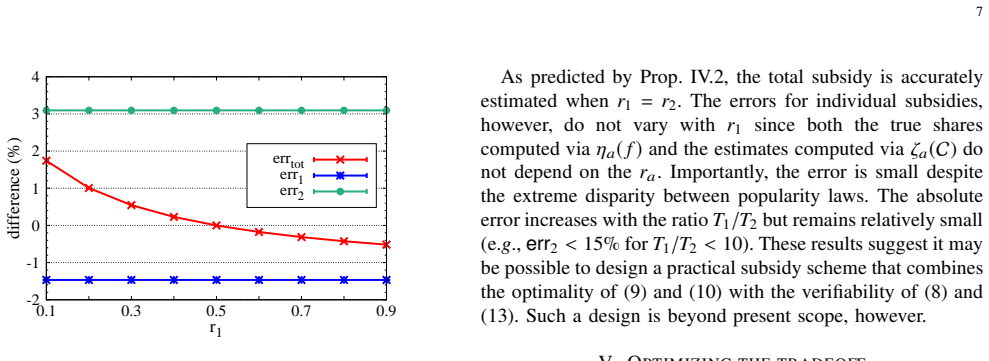
- [Sec. IV-D] The verifiable approximation (13) is optimal only when all ANOs have the same popularity distribution or when all subsidy fractions r_a are equal, as Proposition IV.2 shows. In the general case the CP is not maximizing global savings, and the numerical check in Fig. 4 is a single two-ANO example rather than a bound or a larger numerical study. The paper correctly states that a practical design combining optimality and verifiability is "beyond present scope," but this means the abstract's optimality claim is supported only in the unverifiable case, which is a substantial scope limitation for the proposed settlement mechanism.
minor comments (5)
- [Sec. II-C] The notation in Eq. (1) is dense; the reader must infer that the range l≼m≺n refers to links on the path from leaf l to node n. A one-sentence definition of this path notation would improve readability.
- [Sec. IV-B] The sentence "any r∈(0,1) brings positive gain to both players and might be considered a suitable outcome" is informal; it would be more precise to say that the core is nonempty and consists exactly of these splits.
- [Sec. II-D, Fig. 3 caption] The cost factor Γ is defined using a generic tier index i, but the figure compares savings for different tier combinations; the caption should clarify which tier's parameters define Γ in each curve.
- [Sec. V-D, Eq. (34)] Eq. (34) uses ζ_a^k as an input to the settlement, while Eq. (25) defines ζ_a^k in terms of CP-private demand estimates; the text should state explicitly whether the ANO receives ζ_a^k from the CP or computes it from measured traffic, since this directly affects the incentive properties discussed in the major comments.
- [Abstract] The abstract's claim that the scheme allows ANOs and CPs to "collectively realize the optimal memory for bandwidth tradeoff" should be qualified to reflect the limitations stated in Sec. VII, for example by adding "under truthful reporting" and "for instances where the Lagrangian gap is zero."
Circularity Check
No significant circularity: the subsidy mechanism is constructed to align CP incentives with an independently defined optimal placement problem.
full rationale
The paper's central derivation is a mechanism design construction rather than a circular argument. The global optimum is defined independently in Sec. II-C via the uncapacitated facility location problem (Eq. 1) and in Sec. V-A via the integer linear program (Eqs. 15-21). The paper then designs a subsidy rule such that a CP maximizing its subsidy will choose exactly that independently defined optimal placement. Theorem IV.1 derives the cost-sharing shares η_a(f) = λ_a^f / Σ_n λ_n^f by requiring that the CP's subsidy-maximizing condition (12) coincides with the independent optimality condition (5); this is a construction of the incentive scheme, not a definition of optimality in terms of the subsidy. Proposition IV.1 characterizes the optimal content set directly from the saving function (4), and Theorem IV.1 uses that characterization to engineer the shares. The distributed algorithm is a standard Lagrangian relaxation of the ILP, with the CP solving UFL subproblems and ANOs updating shadow prices; it does not fit parameters and then rename them predictions. The paper does cite prior work by one of its authors (Elayoubi and Roberts [2]) for cost parameters and cache performance, but those inputs are external cost estimates, not the load-bearing derivation, and the subsidy/game-theoretic contribution is not premised on a self-citation chain. The unverifiability of the shares and the possibility of gaming, which the paper explicitly admits in Sec. VII, is a correctness or incentive-compatibility limitation, not circularity: the theoretical optimality claim is conditional on truthful reporting and correct demand estimates, and it is not equivalent to its inputs by construction. No fitted input is relabeled as a prediction, no known result is merely renamed, and no unique solution is imported from the authors' prior work to force a conclusion. The paper's derivation is self-contained with respect to its own stated assumptions, so the appropriate circularity score is 0.
Assumptions & free parameters
assumptions (8)
- domain assumption Ideal cache model: hit probability h(C) = sum_{f<=C} q_f achieved by proactive placement of the most popular items.
- domain assumption Zipf(0.8) popularity law over a useful catalogue F between 1 TB and 1 PB.
- domain assumption Demand is independent of content placement.
- domain assumption Linear storage and bandwidth costs with known fixed unit rates, and unlimited capacity at the central office.
- domain assumption Content providers are rational profit maximizers who place content to maximize their subsidy and do not game the mechanism.
- domain assumption ANOs can measure realized traffic and cache sizes to settle payments.
- domain assumption Content providers have accurate private demand forecasts lambda_f^l.
- domain assumption Moving a cache from a PoP to an access-network node has negligible impact on perceived QoE, so CPs have no QoE incentive to do so.
Cite this review
Pith. "Pith review of Cache Subsidies for an Optimal Memory for Bandwidth Tradeoff in the Access Network." pith.science (2026). https://pith.science/paper/DR6IJBDJ
@misc{pith2026190806659,
  author       = {Pith},
  title        = {Pith review of: Cache Subsidies for an Optimal Memory for Bandwidth Tradeoff in the Access Network},
  year         = {2026},
  howpublished = {\url{https://pith.science/paper/DR6IJBDJ}},
  note         = {Machine review of arXiv:1908.06659}
}
read the original abstract
While the cost of the access network could be considerably reduced by the use of caching, this is not currently happening because content providers (CPs), who alone have the detailed demand data required for optimal content placement, have no natural incentive to use them to minimize access network operator (ANO) expenditure. We argue that ANOs should therefore provide such an incentive in the form of direct subsidies paid to the CPs in proportion to the realized savings. We apply coalition game theory to design the required subsidy framework and propose a distributed algorithm, based on Lagrangian decomposition, allowing ANOs and CPs to collectively realize the optimal memory for bandwidth tradeoff. The considered access network is a cache hierarchy with per-CP central office caches, accessed by all ANOs, at the apex, and per-ANO dedicated bandwidth and storage resources at the lower levels, including wireless base stations, that must be shared by multiple CPs.
Figures


Figures from the paper (1 more)

Reference graph
Works this paper leans on
-
[1]
Central office re-architec ted as a data center,
L. Peterson, A. Al-Shabibi, T. Anshutz, S. Baker, A. Bavi er, S. Das, J. Hart, G. Palukar, and W. Snow, “Central office re-architec ted as a data center,” IEEE Commun. Mag. , vol. 54, no. 10, pp. 96–101, 2016
work page 2016
-
[2]
Performance and cost eff ectiveness of caching in mobile access networks,
S.-E. Elayoubi and J. Roberts, “Performance and cost eff ectiveness of caching in mobile access networks,” in Proc. 2nd ACM Conf. on Information-Centric Netw. (ICN) , 2015, pp. 79–88
work page 2015
-
[3]
C. Imbrenda, L. Muscariello, and D. Rossi, “Analyzing ca cheable traffic in ISP access networks for micro CDN applications via conten t-centric networking,” in Proc. 1st ACM Conf. on Information-Centric Netw. (ICN), 2014, pp. 57–66
work page 2014
-
[4]
An inverse problem approach f or content popularity estimation,
F. Olmos and B. Kauffmann, “An inverse problem approach f or content popularity estimation,” in Proc. 9th EAI Int. Conf. on Performance Evaluation Methodologies and Tools , ser. V ALUETOOLS’15. ICST, 2016, pp. 33–40
work page 2016
-
[5]
Exploring the memory-bandwidt h tradeoff in an information-centric network,
J. Roberts and N. Sbihi, “Exploring the memory-bandwidt h tradeoff in an information-centric network,” in Proc. 25th Int. Teletraffic Congress (ITC). IEEE, 2013, pp. 1–9
work page 2013
- [6]
-
[7]
G. Cornu´ ejols, G. Nemhauser, and L. Wolsey, The Uncapicitated Facility Location Problem, ser. Discrete Location Theory. John Wiley and Sons Inc., 1991, pp. 119–171, in P Mirchandani and R Francis edito rs. 12
work page 1991
-
[8]
R. Shah and M. Farach-Colton, “Undiscretized dynamic pr ogramming: faster algorithms for facility location and related proble ms on trees,” in Proc. 13th annual ACM-SIAM symposium on Discrete algorithm s. Society for Industrial and Applied Mathematics, 2002, pp. 1 08–115
work page 2002
Show all 37 references
-
[9]
Panel d ataset descrip- tion for econometric analysis of the isp-ott relationship i n the years 2008-2013,
C. Perillo, A. Antonopoulos, and C. V erikoukis, “Panel d ataset descrip- tion for econometric analysis of the isp-ott relationship i n the years 2008-2013,” arXiv preprint arXiv:1612.06451 , 2016
2008 arXiv
-
[10]
The global internet phenomena report,
“The global internet phenomena report,” White Paper, S andvine, October 2018
2018
-
[11]
Two-sided markets: a progr ess report,
J.-C. Rochet and J. Tirole, “Two-sided markets: a progr ess report,” The RAND J. of Economics , vol. 37, no. 3, pp. 645–667, 2006
2006
-
[12]
On cooperative settlement between content, transit, and eyeb all internet service providers,
R. T. Ma, D. M. Chiu, J. C. Lui, V . Misra, and D. Rubenstein , “On cooperative settlement between content, transit, and eyeb all internet service providers,” IEEE/ACM Trans. Netw. , vol. 19, no. 3, pp. 802– 815, 2011
2011
-
[13]
Open connect everywhere: A glimpse at the internet ecosystem through the lens of the netflix cdn,
T. B¨ ottger, F. Cuadrado, G. Tyson, I. Castro, and S. Uhlig, “Open connect everywhere: A glimpse at the internet ecosystem through the lens of the netflix cdn,” ACM SIGCOMM Computer Communication Review , vol. 48, no. 1, pp. 28–34, 2018
2018
-
[14]
Taking the edge off with espresso: Scale, reliability and programmability for global internet peering,
K.-K. Y ap, M. Motiwala, J. Rahe, S. Padgett, M. Holliman , G. Baldus, M. Hines, T. Kim, A. Narayanan, A. Jain et al. , “Taking the edge off with espresso: Scale, reliability and programmability for global internet peering,” in Proc. Conf. of the ACM Special Interest Group on ...
2017
-
[15]
Leveraging interconnections for performance: the servin g infrastructure of a large cdn,
F. Wohlfart, N. Chatzis, C. Dabanoglu, G. Carle, and W. W illinger, “Leveraging interconnections for performance: the servin g infrastructure of a large cdn,” in Proc. Conf. of the ACM Special Interest Group on Data Communication, 2018, pp. 206–220
2018
-
[16]
What will 5g be?
J. G. Andrews, S. Buzzi, W. Choi, S. V . Hanly, A. Lozano, A . C. K. Soong, and J. C. Zhang, “What will 5g be?” IEEE J. Sel. Areas Commun., vol. 32, no. 6, pp. 1065–1082, 2014
2014
-
[17]
A decom position framework for optimal edge-cache leasing,
J. Krolikowski, A. Giovanidis, and M. Di Renzo, “A decom position framework for optimal edge-cache leasing,” IEEE J. Sel. Areas Com- mun., vol. 36, no. 6, pp. 1345–1359, 2018
2018
-
[18]
Coalitional game theory for communication networks,
W. Saad, Z. Han, M. Debbah, A. Hjorungnes, and T. Basar, “ Coalitional game theory for communication networks,” IEEE Signal Process. Mag. , vol. 26, no. 5, pp. 77–97, 2009
2009
-
[19]
Ca ching games between content providers and internet service providers,
V . G. Douros, S. E. Elayoubi, E. Altman, and Y . Hayel, “Ca ching games between content providers and internet service providers, ” Performance Evaluation, vol. 113, pp. 13–25, 2017
2017
-
[20]
On weighted shapley values,
E. Kalai and D. Samet, “On weighted shapley values,” Int. J. of Game Theory, vol. 16, no. 3, pp. 205–222, 1987
1987
-
[21]
On the complexity of op timal content placement in hierarchical caching networks,
K. Poularakis and L. Tassiulas, “On the complexity of op timal content placement in hierarchical caching networks,” IEEE Trans. Commun. , vol. 64, no. 5, pp. 2092–2103, 2016
2016
-
[22]
The lagrangian relaxation method for sol ving integer programming problems,
M. L. Fisher, “The lagrangian relaxation method for sol ving integer programming problems,” Management Science, vol. 27, no. 1, pp. 1–18, 1981
1981
-
[23]
The role of caching in future communication systems and network s,
G. S. Paschos, G. Iosifidis, M. Tao, D. Towsley, and G. Cai re, “The role of caching in future communication systems and network s,” IEEE J. Sel. Areas Commun. , vol. 36, no. 6, pp. 1111–1125, 2018
2018
-
[24]
Distributed caching a lgorithms for content distribution networks,
S. Borst, V . Gupta, and A. Walid, “Distributed caching a lgorithms for content distribution networks,” in Proc. IEEE INFOCOM, 2010, pp. 1–9
2010
-
[25]
A two-sided market analysis of provider investment incentives with an applica tion to the net-neutrality issue,
J. Musacchio, G. Schwartz, and J. Walrand, “A two-sided market analysis of provider investment incentives with an applica tion to the net-neutrality issue,” Review of Network Economics , vol. 8, pp. 22–39, 2009
2009
-
[26]
Regulating monopolistic isps with out neutrality,
J. Tang and R. T. Ma, “Regulating monopolistic isps with out neutrality,” IEEE J. Sel. Areas Commun. , vol. 37, no. 7, pp. 1666–1680, 2019
2019
-
[27]
Media d elivery competition with edge cloud, remote cloud and networking,
X. Hu, G. Kesidis, B. Heidarpour, and Z. Dziong, “Media d elivery competition with edge cloud, remote cloud and networking,” Network Games, Control, and Optimization , pp. 71–87, 2019
2019
-
[28]
Optimal web cache sizing: Scala ble methods for exact solutions,
T. Kelly and D. Reeves, “Optimal web cache sizing: Scala ble methods for exact solutions,” Computer Communications, vol. 24, no. 2, pp. 163– 173, 2001
2001
-
[29]
Optimal allocation of electronic content,
I. Cidon, S. Kutten, and R. Soffer, “Optimal allocation of electronic content,” Computer Networks , vol. 40, no. 2, pp. 205–218, 2002
2002
-
[30]
To cache or not to cache: The 3g case,
J. Erman, A. Gerber, M. Hajiaghayi, D. Pei, S. Sen, and O. Spatscheck, “To cache or not to cache: The 3g case,” IEEE Internet Comput., vol. 15, no. 2, pp. 27–34, 2011
2011
-
[31]
The econ omics of cdns and their impact on service fairness,
E. Gourdin, P . Maill´ e, G. Simon, and B. Tuffin, “The econ omics of cdns and their impact on service fairness,” IEEE Trans. Network Service Management, vol. 14, no. 1, pp. 22–33, 2017
2017
-
[32]
Emerging internet conte nt and service providers’ relationships: Models and analyses of engineer ing, business and policy impact,
D. Mitra, Q. Wang, and A. Hong, “Emerging internet conte nt and service providers’ relationships: Models and analyses of engineer ing, business and policy impact,” in Proc. IEEE INFOCOM , 2017, pp. 1–9
2017
-
[33]
The case for formation of isp-c ontent providers consortiums by nash bargaining for internet content delive ry,
D. Mitra and A. Sridhar, “The case for formation of isp-c ontent providers consortiums by nash bargaining for internet content delive ry,” in Proc. IEEE INFOCOM , 2019
2019
-
[34]
Sharing cache resources among content providers: A utility-based a pproach,
M. Dehghan, W. Chu, P . Nain, D. Towsley, and Z.-L. Zhang, “Sharing cache resources among content providers: A utility-based a pproach,” IEEE/ACM Trans. Netw. , vol. 27, no. 2, pp. 477–490, 2019
2019
-
[35]
Caching encrypted con tent via stochastic cache partitioning,
A. Araldo, G. D´ an, and D. Rossi, “Caching encrypted con tent via stochastic cache partitioning,” IEEE/ACM Trans. Netw. , vol. 26, no. 1, pp. 548–561, 2018
2018
-
[36]
Rate control fo r communi- cation networks: shadow prices, proportional fairness and stability,
F. P . Kelly, A. K. Maulloo, and D. K. Tan, “Rate control fo r communi- cation networks: shadow prices, proportional fairness and stability,” J. of the Operational Research society , vol. 49, no. 3, pp. 237–252, 1998
1998
-
[37]
Netw ork pricing and rate allocation with content provider participation,
P . Hande, M. Chiang, R. Calderbank, and S. Rangan, “Netw ork pricing and rate allocation with content provider participation,” in Proc. IEEE INFOCOM, 2009, pp. 990–998
2009
Reviewed August 14, 2026 · model on record in the stance chip above.
Discussion (0). Continue with ORCID to comment.