REVIEW 3 major objections 4 minor 139 references
Effects of universal extra dimensions on top-quark electromagnetic interactions
T0 review · 3 major / 4 minor · reviewed 2026-08-14 · deepseek-v4-flash
Pith's one-line read Kaluza-Klein effects on the top quark's magnetic moment and radiative flavor-changing decays are at least three orders of magnitude below Standard Model predictions for compactification scales from 1.4 to 5 TeV.
desk verdict A complete KK-mode calculation of the top AMM and radiative FCNC decays whose main negative conclusion is solid, despite a slightly overstated '3 orders' claim and the lack of independent verification of the KK Feynman rules. read the letter →
The pith
A machine-rendered reading of the paper's core claim, the machinery that carries it, and where it could break.
The reading
What carries the argument
The KK mass-eigenfield basis of the 5D Standard Model is the load-bearing object: after compactification on $S^1/Z_2$, gauge, scalar, and fermion fields expand into infinite KK towers, and bilinear mixings in the scalar and fermion sectors are diagonalized by angles $\xi^{(k)}=\tan^{-1}(m_{W^{(0)}}/m_{(k)})$, $\eta^{(k)}=\tan^{-1}(m_{Z^{(0)}}/m_{(k)})$, and $\theta_f^{(k)}$. The calculation runs on the Feynman rules built from these mass eigenfields, together with nonstandard gauge-fixing functions $f^{(k)j}$ and $f^{(k)}$ that cancel unphysical couplings such as $A$-$W$-$G$. The argument then uses the Passarino-Veltman reduction to express the one-loop form factors in terms of $B_0$ and $C_0$ functions, whose divergences cancel in differences, and expands at large $R^{-1}$ so that each KK sum becomes a Riemann zeta function, giving the $R^2$ and $R^4$ suppression pattern.
What would settle it
Recompute the exact one-loop form factors in Eqs. (A19)-(A22) and (B5)-(B12) using an independent implementation of the KK effective theory with a different gauge choice, such as Feynman-'t Hooft gauge for the zero modes; if the physical on-shell amplitudes for $a_t$ or $\text{Br}(t\to c\gamma)$ change by more than the stated order of magnitude, the central claim fails.
Extended reading notes
Core claim
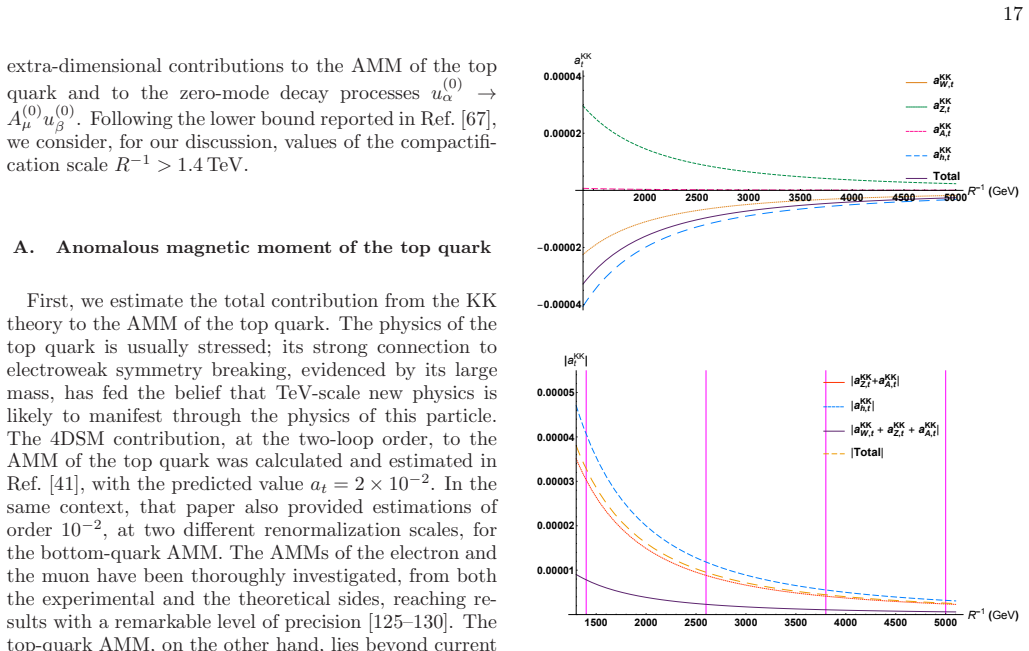
At the paper's core is a complete one-loop calculation of the Kaluza-Klein contributions to the quark-photon vertex in the minimal five-dimensional Standard Model. The authors first construct the mass-eigenfield basis of the KK theory---vectors, scalars, pseudo-Goldstone bosons, and the two fermion towers per flavor---and use a nonstandard gauge-fixing sector to eliminate unphysical couplings. They then evaluate the full set of one-loop diagrams with KK excited modes in the loop, reduce the tensor integrals to Passarino-Veltman scalar functions, and show that the magnetic and electric form factors are ultraviolet finite because all divergent two-point functions enter only through differences. Expanding at large compactification scale, each KK level contributes powers of $(R/k)^2$, and the KK sums become Riemann zeta functions, so the leading new-physics effects scale as $R^2$ and $R^4$; the GIM mechanism then removes the leading $R^2$ terms from vector and pseudo-Goldstone contributions to flavor-changing decays, leaving physical-scalar diagrams dominant. The numerical consequence is that within $1.4\ \text{TeV} < R^{-1} < 5\ \text{TeV}$, both the top-quark anomalous magnetic moment and the branching ratios of $t\to c\gamma$, $t\to u\gamma$, and $c\to u\gamma$ receive KK corrections three to four orders of magnitude smaller than the corresponding Standard Model predictions.
Load-bearing premise
The whole calculation rests on the KK mass-eigenfield Feynman rules being exactly right---specifically the gauge-fixing functions $f^{(k)j}$ and $f^{(k)}$, the cancellations that remove $A$-$W$-$G$ and $A$-$W_s$-$G$ couplings, and the fermion mixing angles $\theta_f^{(k)}$; any slip in these rules would change the one-loop amplitudes, even if the overall decoupling pattern survived.
Editorial extensions
If this is right
- For any compactification scale above 1.4 TeV, the top quark's anomalous magnetic moment remains indistinguishable from the Standard Model value; current and near-future measurements of $a_t$ will not see minimal universal extra dimensions.
- The branching ratio $\text{Br}(t\to c\gamma)$ receives KK corrections far below the Standard Model value of about $2.3\times 10^{-13}$ in the 1.4 to 5 TeV window, so searches for this decay are sensitive to the Standard Model, not to KK physics.
- The same suppression applies to $t\to u\gamma$ and $c\to u\gamma$, meaning flavor-changing radiative top decays cannot be used to constrain the compactification scale.
- Because individual KK contributions scale as $(R/k)^2$ and $(R/k)^4$, increasing $R^{-1}$ makes them decouple quickly; only the lowest KK levels matter numerically.
- In this model the total KK contribution to the top anomalous magnetic moment is negative, dominated by Higgs-KK diagrams, which is a distinctive sign prediction of the minimal 5D Standard Model.
Reading between the lines
- A natural extension not pursued here is to repeat the calculation with more than one extra dimension; the KK sums would then run over multi-indices and the effective suppression powers would change, so the three-to-four-order gap might shrink or grow.
- If minimal universal extra dimensions are truly invisible in these top-quark electromagnetic observables, the model's discovery potential would rest on channels the paper does not analyze, such as missing-energy signatures, Higgs couplings, or $B\to X_s\gamma$.
- An independent check would rerun the exact loop integrals in a different gauge and compare the physical form factors; agreement would confirm the gauge-fixing machinery, while disagreement would expose an error in the KK Feynman rules.
- The paper's decoupling structure suggests that measuring the top quark's anomalous magnetic moment, even with the improved precision expected at future colliders, would not constrain $R^{-1}$; constraints would have to come from other observables.
Signed reviews
Editorial analysis
A structured set of objections, weighed in public.
Referee Report
Summary. The paper computes one-loop Kaluza-Klein (KK) contributions from the 5-dimensional Standard Model with one universal extra dimension to the anomalous magnetic moment (AMM) of u-type quarks, focusing on the top quark, and to the flavor-changing electromagnetic decays u(0)_α -> A(0)_μ u(0)_β, in particular t -> c γ. The calculation uses the KK effective Lagrangian developed by the same group, exact Passarino-Veltman expressions given in appendices, and leading large-compactification-scale expansions. The authors find that for R^{-1} between 1.4 TeV and 5 TeV the KK contributions are 3 to 4 orders of magnitude below the Standard-Model predictions, implying that minimal UED is effectively invisible in these observables.
Significance. If the calculation is correct, the paper provides a clean null result for minimal universal extra dimensions in top-quark electromagnetic observables, which is useful for the future top-quark precision program. The manuscript has several genuine strengths: the analytic treatment is ultraviolet finite and manifestly decoupling, the GIM mechanism is implemented in the quark-flavor sums, and the comparison of the t -> c γ branching ratio with the independent calculation in Ref. [44] is a valuable external cross-check. The paper also reproduces the known Standard-Model loop rates using loop-tools, which adds credibility to the numerical pipeline. These features make the central physical conclusion plausible, but two load-bearing points need to be fixed before the results can be regarded as established.
major comments (3)
- [Abstract and Section V] The headline claim that KK contributions are 'at least 3 orders of magnitude below Standard-Model predictions' is not supported by the paper's own numbers for the top-quark AMM. Table I gives a^KK_t = -3.3 x 10^-5 at R^{-1} = 1.4 TeV, while Section IV A quotes a^SM_t = 2 x 10^-2; the ratio is 1.65 x 10^-3, i.e. about 2.8 orders of magnitude, not 3. The same wording appears in the final paragraph of Section V. Since this quantitative statement is the central assertion of the paper, the abstract and conclusions should either be reworded to 'about 3 orders' with an explicit endpoint caveat, or the numerical analysis should show that the full one-loop result, rather than the leading R^{-2} approximation, brings the ratio below 10^-3 at 1.4 TeV.
- [Section II B and Section III, Figs. 1-3] The ghost sector L_G_KK is introduced in Section II B but never appears in the one-loop diagrams that define the electromagnetic vertex. Because the gauge-fixing functions f^(k)j and f^(k), Eqs. (12)-(13), are R_xi-type functions depending on ξ, and the selected couplings in Eqs. (25)-(27) explicitly contain 1/ξ terms, the KK one-loop amplitude in a general R_xi gauge receives contributions from charged KK ghost loops. The manuscript does not state the value of ξ used for the KK excited modes, nor does it prove that the sum of diagrams in Figs. 1-3 is ξ-independent without ghosts. Unless the authors specify that they work in the unitary gauge for the KK excited sector, or include the ghost loops, the exact form factors in Appendices A and B may be gauge dependent. This issue should be resolved before the numerical results can be considered reliable.
- [Appendices A and B] The exact one-loop expressions span many pages and are not machine-checkable from the text; no ancillary code, Mathematica notebook, or numerical table of the Passarino-Veltman inputs is provided. The paper states that the ultraviolet finiteness, the θ-angle cancellation leading to Eq. (38), and the elimination of the A-W-G and A-W_s-G couplings have been verified, but a referee cannot reproduce these checks from the manuscript alone. Given that the central numerical statements rely on these expressions, I ask that the authors supply a reproducible code or notebook, or alternatively a compactly derived leading-order expansion for each contribution that enters Table I and Figs. 4-11, so that the calculation can be verified.
minor comments (4)
- [Eq. (A19)] Equation (A19) contains the typographical expressions 'mu0α4' and 'sW 4'; these should read m_{u(0)_α}^4 and s_W^4.
- [References] Reference [86] lists the year as '9172'; it should be 1972. Reference [115] misspells 'Passarino' as 'Passatino'.
- [Fig. 5] In the lower graph of Fig. 5, the vertical axis is labeled a_t, but the two curves are a_t^SM and a_t^SM + a_t^KK; the axis label should be clarified.
- [Fig. 6 and Eqs. (44)-(45)] The notation S-hat and S-tilde in Eqs. (44)-(45) and in Fig. 6 is not defined in the figure caption; a brief reminder of which contribution corresponds to d^(k)_(1,γ) versus d^(k)_(2,γ) would help the reader.
Circularity Check
No circularity: the KK contributions are genuine one-loop outputs with no fitted parameters.
full rationale
The paper computes the KK contributions to the top-quark anomalous magnetic moment and to flavor-changing electromagnetic decays from the 5D Standard Model Lagrangian via standard one-loop Passarino-Veltman reduction. The compactification scale R^-1 is scanned over the externally bounded range 1.4-5 TeV, not fitted to the target observables. The SM inputs (quark masses, CKM elements, a_t^SM from Ref. [41], and Br(t->c gamma)_SM from Ref. [43]) are external; the SM branching ratio is independently reproduced with LoopTools, and the KK result for Br(t->c gamma) is compared to Ref. [44]. The GIM suppression is implemented through unitarity of the CKM matrix, a standard identity, and the decoupling behavior follows from the explicit R^2/R^4 structure of the one-loop integrals. The KK effective Lagrangian and gauge-fixing functions are taken from the authors' previous papers, but those papers do not contain the target results, and the present work re-derives the needed couplings in Eqs. (25)-(37), displays the exact Passarino-Veltman expressions in Appendices A and B, and verifies UV finiteness and decoupling. No equation in the derivation is equivalent to its input by construction, and no fitted parameter is renamed as a prediction. The abstract's 'at least 3 orders' is slightly stronger than the Table I ratio at R^-1=1.4 TeV (about 2.8 orders for the top AMM), but this is an overstatement of the numerical result, not circularity.
Assumptions & free parameters
free parameters (2)
- compactification scale R^{-1} =
1.4-5 TeV (scanned)
- number of extra dimensions n =
1
assumptions (4)
- domain assumption The 5D Standard Model on S1/Z2 with the stated parity assignments reproduces the 4D SM at zero mode and gives a consistent KK effective theory.
- domain assumption The standard and nonstandard gauge structures allow independent gauge fixing; the BRST quantization of the KK theory is consistent.
- domain assumption The gamma5 redefinition of Ref [97] correctly resolves the wrong-sign KK fermion mass terms.
- standard math Passarino-Veltman reduction and dimensional regularization with B0 differences yield finite form factors.
Cite this review
Pith. "Pith review of Effects of universal extra dimensions on top-quark electromagnetic interactions." pith.science (2026). https://pith.science/paper/DRE62TN2
@misc{pith2026190806226,
  author       = {Pith},
  title        = {Pith review of: Effects of universal extra dimensions on top-quark electromagnetic interactions},
  year         = {2026},
  howpublished = {\url{https://pith.science/paper/DRE62TN2}},
  note         = {Machine review of arXiv:1908.06226}
}
read the original abstract
Universal extra dimensions, presumably observable at some high-energy scale, would modify low-energy observables, being particularly relevant for physical processes forbidden at tree level by the Standard Model. We address the Kaluza-Klein contributions from the 5-dimensional Standard Model to the anomalous magnetic moment and to branching ratios of electromagnetic decays of the top quark. In accordance with present bounds on the compactification scale, contributions to both quantities are found to be at least 3 orders of magnitude below Standard-Model predictions.
Figures


Figures from the paper (6 more)


Reference graph
Works this paper leans on
-
[44]
U. K. Dey and T. Jha, Rare top decays in minimal and nonminimal universal extra dimension models , Phys. Rev. D 94, 056011 (2016)
2016
-
[1]
Nordstr¨ om,On the possibility of unifying the elec- tromagnetic and gravitational fields , Phys
G. Nordstr¨ om,On the possibility of unifying the elec- tromagnetic and gravitational fields , Phys. Z. 15, 504 (1914)
1914
-
[2]
Kaluza, Zum Unit¨ atsproblem der Physik, Sitzungs- ber
T. Kaluza, Zum Unit¨ atsproblem der Physik, Sitzungs- ber. Preuss. Akad. Wiss. Berlin (Math. Phys.) 1921, 966 (1921)
1921
-
[3]
Klein, Quantentheorie und f¨ unfdimensionale Rela- tivit¨ atstheorie, Z
O. Klein, Quantentheorie und f¨ unfdimensionale Rela- tivit¨ atstheorie, Z. Phys. 37 895 (1926)
1926
-
[4]
Veneziano, Construction of a crossing-simmetric, Regge-behaved amplitude for linearly rising trajectories , Nuovo Cim
G. Veneziano, Construction of a crossing-simmetric, Regge-behaved amplitude for linearly rising trajectories , Nuovo Cim. A 57, 190 (1968)
1968
-
[5]
H. B. Nielsen, An Almost Physical Interpretation of the Dual N-Point Function , Nordita Report, unpublished 1969
1969
-
[6]
Koba and H
Z. Koba and H. B. Nielsen, Reaction amplitude for n-mesons a generalization of the Veneziano-Bardak¸ ci- Ruegg-Virasoro model, Nucl. Phys. B 10, 633 (1969)
1969
-
[7]
Koba and H
Z. Koba and H. B. Nielsen, Manifestly crossing- invariant parametrization of n-meson amplitude , Nucl. Phys. B 12, 517 (1969)
1969
Show all 139 references
-
[8]
Nambu, Quark Model and the Factorization of the Veneziano Amplitude , in Symmetries and Quark Mod- els, ed
Y. Nambu, Quark Model and the Factorization of the Veneziano Amplitude , in Symmetries and Quark Mod- els, ed. R. Chand, p. 269, Gordon and Breach NY, 1970; Lectures at Copenhagen Symposium, 1970
1970
-
[9]
Susskind, Structure of Hadrons Implied by Duality , Phys
L. Susskind, Structure of Hadrons Implied by Duality , Phys. Rev. D 1, 1182 (1970)
1970
-
[10]
Susskind, Dual-symmetric theory of hadrons.-I , Nuovo
L. Susskind, Dual-symmetric theory of hadrons.-I , Nuovo. Cim. A 69, 457 (1970)
1970
-
[11]
Lovelace, Pomeron form factors and dual Regge cuts , Phys
C. Lovelace, Pomeron form factors and dual Regge cuts , Phys. Lett B 34, 500 (1971)
1971
-
[12]
Ramond, Dual Theory for Free Fermions , Phys
P. Ramond, Dual Theory for Free Fermions , Phys. Rev. D 3, 2415 (1971)
1971
-
[13]
Wess and B
J. Wess and B. Zumino, Supergauge transformations in four dimensions , Nucl. Phys. B 70, 39 (1974)
1974
-
[14]
Scherk and J
J. Scherk and J. H. Schwarz, Dual models for non- hadrons, Nucl. Phys. B 81, 118 (1974)
1974
-
[15]
J. H. Schwarz, Physical states and pomeron poles in the dual pion model , Nucl. Phys. B 46, 61 (1972)
1972
-
[16]
M. B. Green and J. H. Schwarz, Anomaly cancellations in supersymmetric D =10 gauge theory and superstring theory, Phys. Lett. B 149 (1984) 117
1984
-
[17]
M. B. Green and J. H. Schwarz, Supersymmetrical string theories, Phys. Lett. B 109, 444 (1982)
1982
-
[18]
D. J. Gross, J. A. Harvey, E. Martinec, and R. Rohm, Heterotic String , Phys. Rev. Lett. 54, 502 (1985)
1985
-
[19]
D. J. Gross, J. A. Harvey, E. Martinec, and R. Rohm, Heterotic string theory (I). The free heterotic string , Nucl. Phys. B 256, 253 (1985)
1985
-
[20]
D. J. Gross, J. A. Harvey, E. Martinec, and R. Rohm, Heterotic string theory: (II). The interacting heterotic string, Nucl. Phys. B 267, 75 (1986)
1986
-
[21]
S. -T. Yau, On the Ricci curvature of a compact K¨ ahler manifold and the complex Monge-Amp` ere equation. I , Commun. Pure Appl. Math. 31, 339 (1978)
1978
-
[22]
Candelas, G
P. Candelas, G. T. Horowitz, A. Strominger, and E. Witten, Vacuum configurations for superstrings , Nucl. Phys. B 258, 46 (1985)
1985
-
[23]
Witten, String theory dynamics in various dimen- sions, Nucl
E. Witten, String theory dynamics in various dimen- sions, Nucl. Phys. B 443, 85 (1995)
1995
-
[24]
Polchinski, Dirichlet Branes and Ramond-Ramond Charges, Phys
J. Polchinski, Dirichlet Branes and Ramond-Ramond Charges, Phys. Rev. Lett. 75, 4724 (1995)
1995
-
[25]
Hoˇ rava and E
P. Hoˇ rava and E. Witten, Heterotic and Type I string dynamics from eleven dimensions , Nucl. Phys. B 460, 506 (1996)
1996
-
[26]
Hoˇ rava and E
P. Hoˇ rava and E. Witten, Eleven-dimensional super- gravity on a manifold with boundary , Nucl. Phys. B 475, 94 (1996)
1996
-
[27]
Maldacena, The Large-N Limit of Superconformal Field Theories and Supergravity , Int
J. Maldacena, The Large-N Limit of Superconformal Field Theories and Supergravity , Int. J.of Theor. Phys. 38, 1113 (1999)
1999
-
[28]
Antoniadis, Phys
I. Antoniadis, Phys. Lett. B 246, 377 (1990)
1990
-
[29]
Arkani-Hamed, S
N. Arkani-Hamed, S. Dimopoulos, and G. R. Dvali, Phys. Lett. B 429, 263 (1998)
1998
-
[30]
Antoniadis, N
I. Antoniadis, N. Arkani-Hamed, S. Dimopoulos, and G. R. Dvali, Phys. Lett. B 436, 257 (1998)
1998
-
[31]
Randall and R
L. Randall and R. Sundrum, Large Mass Hierarchy from a Small Extra Dimension , Phys. Rev. Lett. 83, 3370 (1999)
1999
-
[32]
Randall and R
L. Randall and R. Sundrum, An Alternative to Com- pactification, Phys. Rev. Lett. 83, 4690 (1999)
1999
-
[33]
Appelquist, H
T. Appelquist, H. -C. Cheng, and B. Dobrescu, Bounds on universal extra dimensions , Phys. Rev. D 64, 035002 (2001)
2001
-
[34]
Hooper and s
D. Hooper and s. Profumo, Dark matter and collider phenomenology of universal extra dimensions , Phys. Rept. 453, 29 (2007)
2007
-
[35]
Servant, Status report on universal extra dimensions after LHC8 , Mod
G. Servant, Status report on universal extra dimensions after LHC8 , Mod. Phys. Lett A 30, 1540011 (2015)
2015
-
[36]
H. -C. Cheng, K. T. Matchev, and M. Schmaltz, Bosonic supersymmetry? Getting fooled at the CERN LHC , Phys. Rev. D 66, 056006 (2002)
2002
-
[37]
K. R. Dienes, E. Dudas, and T. Gherghetta, Grand uni- fication at intermediate mass scales through extra di- mensions, Nucl. Phys. B 537, 47 (1999)
1999
-
[38]
Servant and T
G. Servant and T. M. P. Tait, Is the lightest Kaluza- Klein particle a viable dark matter candidate? , Nucl. Phys. B 650, 391 (2003)
2003
-
[39]
Servant and T
G. Servant and T. M. P. Tait, Elastic scattering and direct detection of Kaluza-Klein dark matter , New J. Phys. 4, 99 (2002)
2002
-
[40]
Cordero-Cid, M
A. Cordero-Cid, M. G´ omez-Bock, H. Novales-S´ anchez, and J. J. Toscano, The Standard Model with one uni- versal extra dimension , Pramana 80, 369 (2013)
2013
-
[41]
Bernreuther, R
W. Bernreuther, R. Bonciani, T. Gehrmann, R. Heinesch, T. Leineweber, P. Mastrolia, and E. Remiddi, QCD Corrections to Static Heavy-Quark Form Factors , Phys. Rev. Lett. 95, 261802 (2005)
2005
-
[42]
S. L. Glashow, J. Iliopoulos, and L. Maiani, Weak In- teractions with Lepton-Hadron Symmetry , Phys. Rev. D 2, 1285 (1970)
1970
-
[43]
Eilam, J
G. Eilam, J. L. Hewett, and A. Soni, Rare decays of the top quark in the standard and two-Higgs-doublet models , Phys. Rev. D 44, 1473 (1991)
1991
-
[45]
Wudka, Electroweak effective lagrangians , Int
J. Wudka, Electroweak effective lagrangians , Int. J. Mod. Phys. A 9, 2301 (1994)
1994
-
[46]
V. A. Kosteleck´ y and S. Samuel, Spontaneous breaking of Lorentz symmetry in string theory , Phys. Rev. D 39, 683 (1989)
1989
-
[47]
V. A. Kosteleck´ y and R. Potting, CPT and strings , 29 Nucl. Phys. B 359, 545 (1991)
1991
-
[48]
S. M. Carroll, J. A. Harvey, V. A. Kosteleck´ y, C. D. Lane, and T. Okamoto, Noncommutative Field The- ory and Lorentz Violation , Phys. Rev. Lett. 87, 141601 (2001)
2001
-
[49]
Colladay and V
D. Colladay and V. A. Kosteleck´ y, CPT violation and the standard model , Phys. Rev. D 55, 6760 (1997)
1997
-
[50]
Colladay and V
D. Colladay and V. A. Kosteleck´ y,Lorentz-violating ex- tension of the standard model , Phys. Rev. D 58, 116002 (1998)
1998
-
[51]
V. A. Kosteleck´ y, Gravity, Lorentz violation, and the standard model, Phys. Rev. D 69, 105009 (2004)
2004
-
[52]
J. C. Pati and A. Salam, Lepton number as the fourth “color”, Phys. Rev. D 10, 275 (1974)
1974
-
[53]
isoconjugate
R. N. Mohapatra and J. C. Pati, Left-right gauge sym- metry and an “isoconjugate” model of CP violation , Phys. Rev. D 11, 566 (1975)
1975
-
[54]
Natural left-right sym- metry
R. N. Mohapatra and J. C. Pati, “Natural left-right sym- metry”, Phys. Rev. D 11, 2558 (1975)
1975
-
[55]
Senjanovic and R
G. Senjanovic and R. N. Mohapatra, Exact left-right symmetry and spontaneous violation of parity , Phys. Rev. D 12, 1502 (1975)
1975
-
[56]
R. N. Mohapatra and G. Senjanovi´ c,Neutrino Mass and Spontaneous Parity Nonconservation , Phys. Rev. Lett. 44, 912 (1980)
1980
-
[57]
R. N. Mohapatra and G. Senjanovi´ c, Neutrino masses and mixings in gauge models with spontaneous parity violation, Phys. Rev. D 23, 165 (1981)
1981
-
[58]
Pisano and V
F. Pisano and V. Pleitez, SU (3) ⊗ U (1) model for elec- troweak interactions, Phys. Rev. D 46, 410 (1992)
1992
-
[59]
P. H. Frampton, Chiral dilepton model and the flavor question, Phys. Rev. Lett. 69, 2889 (1992)
1992
-
[60]
Georgi and S
H. Georgi and S. L. Glashow, Unity of All Elementary- Particle Forces, Phys. Rev. Lett. 32, 438 (1974)
1974
-
[61]
Georgi, H
H. Georgi, H. R. Quinn, and S. Weinberg, Hierarchy of Interactions in Unified Gauge Theories , Phys. Rev. Lett. 33, 451 (1974)
1974
-
[62]
G. F. Torres del Castillo, 3-D Spinors, Spin- Weighted Functions and Their Applications (Springer Science+Business Media, New York, 2003)
2003
-
[63]
G. F. Torres del Castillo, Spinors in Four-Dimensional Spaces (Birkh¨ auser, Boston, 2010)
2010
-
[64]
Novales-S´ anchez and J
H. Novales-S´ anchez and J. J. Toscano, Gauge invari- ance and quantization of Yang-Mills theories in extra dimensions, Phys. Rev. D 82, 116012 (2010)
2010
-
[65]
M. A. L´ opez-Osorio, E. Mart ´ ınez-Pascual, H. Novales- S´ anchez, J. J. Toscano, Hidden symmetries induced by a canonical transformation and gauge structure of com- pactified Yang-Mills theories , Phys. Rev. D 88, 036015 (2013)
2013
-
[66]
M. A. L´ opez-Osorio, E. Mart ´ ınez-Pascual, H. Novales- S´ anchez, J. J. Toscano,Yang-Mills theories with an ar- bitrary number of compactified extra dimensions Phys. Rev. D 89, 116015 (2014)
2014
-
[67]
Deutschmann, T
N. Deutschmann, T. Flacke, and J. S. Kim, Current LHC constraints on minimal universal extra dimen- sions, Phys. Lett B 771, 515 (2017)
2017
-
[68]
Beuria, A
J. Beuria, A. Datta, D. Debnath, and K. T. Matchev, LHC collider phenomenology of minimal universal extra dimensions, Comput. Phys. Commun. 226, 187 (2018)
2018
-
[69]
B´ elanger, M
G. B´ elanger, M. Kakizaki, and A. Pukhov, Dark matter in UED: the role of the second KK level , JCAP 2011, 009 (2011)
2011
-
[70]
B´ elanger, A
G. B´ elanger, A. Belyaev, M. Brown, M. Kakizaki, and A Pukhov, Testing minimal universal extra dimensions using Higgs boson searchas at the LHC , Phys. Rev. D 87, 016008 (2013)
2013
-
[71]
Haisch and A
U. Haisch and A. Weiler, Bound on minimal universal extra dimensions from ¯B → Xsγ, Phys. Rev. D 76, 034014 (2007)
2007
-
[72]
Dvali, G
G. Dvali, G. Gabadadze, M. Kolanovi´ c, and F. Nitti, Power of brane-induced gravity , Phys. Rev. D 64, 084004 (2001)
2001
-
[73]
Carena, T
M. Carena, T. M. P. Tait, and C. E. M. Wagner, Branes and orbifolds are opaque , Acta Phys. Polon. B 33, 2355 (2002)
2002
-
[74]
del Aguila, M
F. del Aguila, M. P´ erez-Victoria, and J. Santiago, Ef- fective description of brane terms in extra dimensions , JHEP 0610, 056 (2006)
2006
-
[75]
Flacke, D
T. Flacke, D. W. Kang, K. Kong, G. Mohlabeng, and S. C. Park, Electroweak Kaluza-Klein dark matter , JHEP 04, 041 (2017)
2017
-
[76]
B. A. Dobrescu and E. Pont´ on, Chiral compactification on a square , JHEP 03, 071 (2004)
2004
-
[77]
Nielse, Classification of 1D and 2D Orbifolds , AIP
L. Nielse, Classification of 1D and 2D Orbifolds , AIP. Conf. Proc. 903, 411 (2007)
2007
-
[78]
Cacciapaglia, A
G. Cacciapaglia, A. Deandrea, J. Llodra-Perez, A dark matter candidate from Lorentz invariance in 6D , JHEP 1003, 083 (2010)
2010
-
[79]
N. Maru, T. Nomura, J. Sato, and M. Yamanaka, the universal extra dimensional model with S2/Z 2 extra- space, Nucl. Phys. B 830, 414 (2010)
2010
-
[80]
Cacciapaglia, A
G. Cacciapaglia, A. Deandrea, and N. Deutschmann, Dark matter adn localised fermions from spherical orb- ifolds?, JHEP 1604, 083 (2016)
2016
-
[81]
M. E. Peskin and D. V. Schroeder, An Introduction to Quantum Field Theory (Perseus, Reading, 1995)
1995
-
[82]
Englert and R
F. Englert and R. Brout, Broken Symmetry and the Mass of Gauge Vector Mesons , Phys. Rev. Lett. 13 321 (1964)
1964
-
[83]
P. W. Higgs, Broken symmetries, massless particles and gauge fields , Phys. Lett. 12 132 (1964)
1964
-
[84]
P. W. Higgs, Broken Symmetries and the Masses of Gauge Bosons , Phys. Rev. Lett. 13 508 (1964)
1964
-
[85]
Henneaux and C
M. Henneaux and C. Teitelboim, Quantization of Gauge Systems (Princeton University Press, Princeton, 1992)
1992
-
[86]
Fujikawa, B
K. Fujikawa, B. W. Lee, and A. I. Sanda, Gener- alized Renormalizable Gauge Formulation of Sponta- neously Broken Gauge Theories , Phys. Rev. D 6, 2923 (9172)
-
[87]
Gomis, J
J. Gomis, J. Paris, and S. Samuel, Antibracket, anti- fields and gauge-theory quantization , Phys. Rep. 259, 1 (1995)
1995
-
[88]
I. A. Batalin and G. A. Vilkovisky, Gauge algebra and quantization, Phys. Lett. B 102, 27 (1981)
1981
-
[89]
I. A. Batalin and G. A. Vilkovisky, Feynman rules for reducible gauge theories , Phys. Lett. B 120, 166 (1983)
1983
-
[90]
I. A. Batalin and G. A. Vilkovisky, Quantization of gauge theories with linearly dependent generators , Phys. Rev. D 28, 2567 (1983); 30, 508(E) (1984)
1983
-
[91]
I. A. Batalin and G. A. Vilkovisky, Closure of the gauge algebra, generalized lie equations and Feynman rules , Nucl. Phys. B 234, 106 (1984)
1984
-
[92]
I. A. Batalin and G. A. Vilkovisky, Existence theorem for gauge algebra , J. Math. Phys. 26, 172 (1985)
1985
-
[93]
Becchi, A
C. Becchi, A. Rouet, and R. Stora, Renormalization of the abelian Higgs-Kibble model , Commun. Math. Phys. 42, 127 (1975). 30
1975
-
[94]
Becchi, A
C. Becchi, A. Rouet, and R. Stora, Renormalization of gauge theories , Ann. Phys. 98, 287 (1976)
1976
-
[95]
I. V. Tyutin and P. N. Lebedev, Physical Institute of the USSR Academy of Science Report No. 39, 1975 (to be published)
1975
-
[96]
Giunti and C.W
C. Giunti and C.W. Kim, Fundamentals of Neutrino Physics and Astrophysics (Oxford University Press, New York, 2007)
2007
-
[97]
Papavassiliou and A
J. Papavassiliou and A. Santamaria, Chiral fermions and gauge fixing in five-dimensional theories , Phys. Rev. D 63, 125014 (2001)
2001
-
[98]
Cabibbo, Unitary Symmetry and Leptonic Decays , Phys
N. Cabibbo, Unitary Symmetry and Leptonic Decays , Phys. Rev. Lett. 10, 531 (1963)
1963
-
[99]
Kobayashi and T
M. Kobayashi and T. Maskawa, CP-Violation in the Renormalizable Theory of Weak Interaction , Prog. Theor. Phys. 49, 652 (1973)
1973
-
[100]
Wolfenstein, Parametrization of the Kobayashi- Maskawa Matrix , Phys
L. Wolfenstein, Parametrization of the Kobayashi- Maskawa Matrix , Phys. Rev. Lett. 51, 1945 (1983)
1983
-
[101]
Chau and W.-Y
L.-L. Chau and W.-Y. Keung, Comments on the Parametrization of the Kobayashi-Maskawa Matrix , Phys. Rev. Lett. 53, 1802 (1984)
1984
-
[102]
Tanabashi et al
M. Tanabashi et al. (Particle Data Group), Review of Particle Physics , Phys. Rev. D 98, 030001 (2018)
2018
-
[103]
Pontecorvo, Mesonium and anti-mesonium, Sov
B. Pontecorvo, Mesonium and anti-mesonium, Sov. Phys. JETP 6, 429 (1957)
1957
-
[104]
Fukuda et al
Y. Fukuda et al. (Super-Kamiokande Collaboration), Evidence for Oscillation of Atmospheric Neutrinos , Phys. Rev. Lett. 81, 1562 (1998)
1998
-
[105]
Q. R. Ahmad et al. (SNO Collaboration), Direct Evidence for Neutrino Flavor Transformation from Neutral-Current Interactions in the Sudbury Neutrino Observatory, Phys. Rev. Lett. 89, 011301 (2002)
2002
-
[106]
F. P. An et al. , Observation of Electron-Antineutrino Disappearance at Daya Bay , Phys. Rev. Lett. 108, 171803 (2012)
2012
-
[107]
J. K. Ahn et al. (RENO Collaboration), Observa- tion of Reactor Electron Antineutrinos Disappearance in the RENO Experiment , Phys. Rev. Lett. 108, 191802 (2012)
2012
-
[108]
A. D. Sakharov, Violation of CP invariance, C asym- metry, and baryon asymmetry of the universe , Pisma Zh. Eksp. Teor. Fiz. 5, 32 (1967) [JETP Lett. 5, 24 (1967)] [Violation ofCPin variance,Casymmetry, and baryon asymmetry of the universe, Sov. Phys. Usp. 34, 392 (1991)] [Usp...
1967
-
[109]
Cheng and L.-F
T.-P. Cheng and L.-F. Li, Gauge theory of elementary particle physics (Oxford University Press, Oxford,1988)
1988
-
[110]
Langacker, The Standard Model and Beyond (Taylor & Francis Group, Boca Raton, 2010)
P. Langacker, The Standard Model and Beyond (Taylor & Francis Group, Boca Raton, 2010)
2010
-
[111]
Appelquist and B
T. Appelquist and B. A. Dobrescu, Universal extra di- mensions and the muon magnetic moment , Phys. Lett. B 516, 85 (2001)
2001
-
[112]
Agashe, N
K. Agashe, N. G. Deshpande, and G. -H. Wu, Universal extra dimensions and b → sγ, Phys. Lett. B 514, 309 (2001)
2001
-
[113]
Petriello, Kaluza-Klein Effects on Higgs Physics in Universal Extra Dimensions , JHEP 0205, 003 (2002)
F. Petriello, Kaluza-Klein Effects on Higgs Physics in Universal Extra Dimensions , JHEP 0205, 003 (2002)
2002
-
[114]
Novales-S´ anchez and J
H. Novales-S´ anchez and J. J. Toscano, About gauge in- variance in compactified extra dimensions , Phys. Rev. D 84, 057901 (2011)
2011
-
[115]
Passatino and M
G. Passatino and M. Veltman, One-loop corrections for e+e− annihilation into µ +µ − in the Weinberg model , Nucl. Phys. B 160, 151 (1979)
1979
-
[116]
Mertig, M
R. Mertig, M. B¨ ohm, and A. Denner, Feyn Calc - Computer-algebraic calculation of Feynman amplitudes , Comput. Phys. Commun. 64, 345 (1991)
1991
-
[117]
Nowakowski, E
M. Nowakowski, E. A. Paschos, and J. M. Rodr ´ ıguez, All electromagnetic form factors , Eur. J. Phys. 26, 545 (2005)
2005
-
[118]
Broggini, C
C. Broggini, C. Giunti, and A. Studenikin, Electromag- netic properties of neutrinos , Adv. High Energy Phys. 2012, 459526 (2012)
2012
-
[119]
Moyotl, H
A. Moyotl, H. Novales-S´ anchez, J. J. Toscano, and E. S. Tututi, Gauge invariant electromagnetic properties of fermions induced by CPT-violation in the Standard Model Extension , Int. J. Mod. Phys. A 29, 1450039 (2014)
2014
-
[120]
Moyotl, H
A. Moyotl, H. Novales-S´ anchez, J. J. Toscano, and E. S. Tututi, One-loop nonbirefringent effects on the electro- magnetic vertex in the Standard Model Extension , Int. J. Mod. Phys. A 29, 1450107 (2014)
2014
-
[121]
Hollik, J
W. Hollik, J. I. Illana, S. Rigolin, C. Schappacher, and D. St¨ ockinger,Top dipole form factors and loop-induced CP violation in supersymmetry , Nucl. Phys. B 551, 3 (1999)
1999
-
[122]
D Schwartz, Quantum Field Theory and the Stan- dard Model (Cambridge University Press, New York, 2014)
M. D Schwartz, Quantum Field Theory and the Stan- dard Model (Cambridge University Press, New York, 2014)
2014
-
[123]
’t Hooft and M
G. ’t Hooft and M. Veltman, Scalar one-loop integrals , Nucl. Phys. B 153, 365 (1979)
1979
-
[124]
C. G. Bollini and J. J. Giambiagi, Dimensional renormali- zation: The number of dimensions as a reg- ularizing param- eter , Nuovo Cim. B 12, 20 (1972)
1972
-
[125]
G. W. Bennett et al. (Muon (g-2) Collaboration), Mea- surement of the Negative Muon Anomalous Magnetic Moment to 0.7 ppm , Phys. Rev. Lett. 92, 161802 (2004)
2004
-
[126]
Hanneke, S
D. Hanneke, S. Fogwell, and G. Gabrielse, New Mea- surement of the Electron Magnetic Moment and the Fine Structure Constant , Phys. Rev. Lett. 100, 120801 (2008)
2008
-
[127]
Hanneke, S
D. Hanneke, S. Fogwell Hoogerheide, and G. Gabrielse, Cavity control of a single-electron quantum cyclotron: Measuring the electron magnetic moment , Phys. Rev. A 83, 052122 (2011)
2011
-
[128]
Aoyama, M
T. Aoyama, M. Hayakawa, T. Kinoshita, and M. Nio, Tenth-Order QED Contribution to the Electron g − 2 and an Improved Value of the Fine Structure Constant , Phys. Rev. Lett. 109, 111807 (2012)
2012
-
[129]
Aoyama, M
T. Aoyama, M. Hayakawa, T. Kinoshita, and M. Nio, Complete Tenth-Order QED Contribution to the Muon g − 2, Phys. Rev. Lett. 109, 111808 (2012)
2012
-
[130]
Kinoshita, Tenth-order QED contribution to the elec- tron g − 2 and high precision test of quantum electrody- namics, Int
T. Kinoshita, Tenth-order QED contribution to the elec- tron g − 2 and high precision test of quantum electrody- namics, Int. J. Mod. Phys. A 29, 1430003 (2014)
2014
-
[131]
Aaltonen et al
T. Aaltonen et al. (CDF Collaboration), Evidence for t¯tγ production and measurement of σ t¯tγ /σ t¯t, Phys. Rev. D 84, 031140(R) (2011)
2011
-
[132]
A. O. Bouzas and F. Larios, Electromagnetic dipole mo- ments of the top quark , Phys. Rev. D 87, 074015 (2013)
2013
-
[133]
U. Baur, A. Juste, L. H. Orr, and D. Rainwater, Prob- ing electroweak top quark couplings at hadron colliders , Phys. Rev. D 71, 054013 (2005)
2005
-
[134]
A. O. Bouzas and F. Larios, Probing ttγ and ttZ cou- plings at the LHeC , Phys. Rev. D 88, 094007 (2013)
2013
-
[135]
Fael and T
M. Fael and T. Gehrmann, Probing top quark electro- magnetic dipole moments in single-top-plus-photon pro- duction, Phys. Rev. D 88, 033003 (2013)
2013
-
[136]
Fayazbakhsh, S
Sh. Fayazbakhsh, S. Taheri Monfred, and M. Moham- 31 madi Najafabadi, Top quark anomalous electromagnetic couplings in photon-photon scattering at the LHC , Phys. Rev. D 92, 014006 (2015)
2015
-
[137]
K¨ oksal, A
M. K¨ oksal, A. A. Billur, and A. Guti´ errez-Rodr ´ ıguez, Bounds on the Electromagnetic Dipole Moments through the Single Top Production at the CLIC , Adv. High En- ergy Phys. 2017, 6738409 (2017)
2017
-
[138]
Hahn and M
T. Hahn and M. P´ erez-Victoria, Automated one-loop calculation in four and D dimensions , Comput. Phys. Commun. 118, 153 (1999)
1999
-
[139]
G. J. Oldenborgh and J. A. M. Vermaseren, New algo- rithms for one-loop integrals , Z. Phys. C 46, 425 (1990). Only zero modes (4DSM) Interference Only KK excited modes 2000 3000 4000 5000 R-1 (GeV) 10-23 10-21 10-19 10-17 10-15 10- Br(t( )→γ( )u(¡ ))
1990
Reviewed August 14, 2026 · model on record in the stance chip above.
Discussion (0). Continue with ORCID to comment.