REVIEW 3 major objections 4 minor 41 references
Quantum correlation dynamics and in-medium 3$\leftrightarrow$3 collisions of fermions
T0 review · 3 major / 4 minor · reviewed 2026-08-07 · deepseek-v4-flash
Pith's one-line read The paper derives an in-medium three-body collision term for fermions and shows it cuts nuclear relaxation times by up to a factor of 3, implying standard 2-body transport underestimates stopping.
desk verdict A careful first derivation of an on-shell 3↔3 fermion collision integral with a credible 2-body benchmark, but the factor-of-~3 stopping claim rests on an untested sequential on-shell approximation. read the letter →
The pith
A machine-rendered reading of the paper's core claim, the machinery that carries it, and where it could break.
The reading
What carries the argument
The load-bearing object is the on-shell three-body collision integral $I^3_{\alpha\alpha}(t)$, constructed in a natural single-particle basis that diagonalizes the one-body density matrix. The derivation proceeds from the cluster decomposition of the reduced density matrices $\rho_2$, $\rho_3$, $\rho_4$ into antisymmetrized products plus correlations $c_2$ and $c_3$; from the equation of motion for $c_3$ in leading order; and from the Markovian on-shell approximation that replaces each time integral in the correlation chain by $-i\pi$ times an energy-conserving delta function $\delta(\epsilon_\alpha+\epsilon_\beta-\epsilon_\gamma-\epsilon_\delta)$ per interaction vertex. The final collision term is a sum over products of on-shell matrix elements of the same two-body interaction $v$, multiplied by occupation-number and Pauli-blocking functions $N$, with energy-momentum conservation enforced at every vertex. This makes the relative enhancement of three-body over two-body effects a prediction of the formalism rather than an input.
What would settle it
Run the periodic-box model without the on-shell delta-function reduction, keeping the finite time integrals in the correlation functions, and compare the resulting relaxation times; a large difference would show that the factor-of-3 reduction is an artifact of the Markovian approximation. Alternatively, measure the angular distribution of nucleons above 60 MeV in central 97Rh+97Rh collisions at 40 A·MeV with high statistics: if the distribution stays forward-peaked under conditions where stopping is enhanced, the predicted forward-to-sideward flip is ruled out.
Extended reading notes
Core claim
On its own terms, the central discovery is a first-principles derivation of the on-shell three-body collision integral for identical fermions, built entirely from the same two-body interaction in leading order within quantum correlation dynamics. The integral conserves particle number and total energy-momentum, keeps full antisymmetry under particle exchange, and avoids double counting with the two-body term. In a finite periodic box with shifted Fermi spheres, the 3↔3 term accelerates the decay of the quadrupole moment in momentum space, shortening relaxation times by up to about a factor of 3 at 130 A·MeV compared to the two-body-only case, while the two-body-only box results match continuum-limit BUU transport to within a few percent. The paper also claims that this enhanced stopping shows up in the angular distribution of energetic nucleons (>60 MeV) in central 97Rh+97Rh collisions at 40 A·MeV, flipping it from a slightly forward-peaked distribution to a slightly sideward-peaked one.
Load-bearing premise
The whole quantitative prediction rests on the Markovian on-shell approximation that turns each time integral in the three-body correlation into an energy-conserving delta function per interaction vertex; the paper itself says this is 'invalid for short time intervals,' and if the approximation is not quantitatively accurate, the factor-of-3 relaxation-time reduction and the angular-distribution flip would change or disappear.
Editorial extensions
If this is right
- In the periodic-box model, adding the 3↔3 term shortens relaxation times by about a factor of 1.5 at 32 A·MeV and by up to about a factor of 3 at 130 A·MeV, relative to two-body-only transport.
- The on-shell three-body collision integral conserves particle number and total energy-momentum to numerical accuracy (about $10^{-6}$) and requires no explicit three-body force.
- Two-body-only box results agree with continuum-limit BUU transport at the few-percent level, so the 3↔3 term is a genuine correction rather than a replacement of the established binary-collision description.
- In central 97Rh+97Rh collisions at 40 A·MeV, an enhanced stopping power modeled by a 5/3 to 2 times larger elastic cross section changes the angular distribution of nucleons above 60 MeV from slightly forward-peaked to slightly sideward-peaked, offering an experimentally controllable signature.
Reading between the lines
- If the factor-of-3 reduction holds, transport codes whose in-medium two-body cross sections are fitted to stopping and flow data have implicitly absorbed three-body effects into the fitted two-body cross section; those effective cross sections would then not be directly comparable to G-matrix two-body T-matrices.
- A natural testable extension is a systematic BUU scan of the forward-to-sideward flip in fast-nucleon angular distributions across bombarding energies and system sizes; the paper presents only one system, so the extent of the effect is otherwise unconstrained.
- The same correlation-dynamics machinery should apply more strongly to bosonic systems, where three-body processes are enhanced rather than suppressed by quantum statistics, so an analogous 3↔3 term may matter for pion or cluster gases even where it is marginal for nucleons.
- The author leaves higher-order terms (of order $v c_2 c_2$) unexplored; evaluating them in the same box model would show whether the factor-of-3 reduction is robust or an upper bound.
Editorial analysis
A structured set of objections, weighed in public.
Referee Report
Summary. The paper derives a closed on-shell 3↔3 collision integral for identical fermions from the equation-of-motion (BBGKY-type) hierarchy truncated at three-body correlations, using the same two-body interaction that generates the 2↔2 collision term and no fitted three-body interaction. The 2-body sector is first reviewed and benchmarked in a periodic box against BUU transport, with relaxation times agreeing to a few percent. The new 3-body term is then evaluated for shifted Fermi spheres, and the paper reports that including 3-body collisions reduces relaxation times by factors of about 1.5 at 32 A·MeV up to about 3 at 130 A·MeV. Finally, BUU simulations with enhanced two-body cross sections are used to argue that this enhanced stopping would change the angular distribution of >60 MeV nucleons in central 97Rh+97Rh collisions at 40 A·MeV from slightly forward to slightly sideward peaked.
Significance. If the central quantitative claim is correct, the paper fills a genuine gap: no in-medium 3↔3 collision term for identical fermions has been formulated in this transport framework. The strengths are substantial: the derivation is explicit, maintains full antisymmetry, preserves particle number and energy-momentum conservation, uses the same two-body interaction for both 2↔2 and 3↔3 processes, and the 2-body sector is validated against an independent (BUU) calculation to a few percent. The proposed angular-distribution signature is falsifiable and could give experimental access to three-body stopping. However, the numerical factor of ~3 reduction rests on the Markovian on-shell replacement of three nested time integrals in the 3-body correlation, an approximation the author explicitly states is invalid for short time intervals. Because Section 5 imports this factor into BUU as an enhanced 2-body cross section, the experimental prediction inherits the same uncertainty. The leading-order truncation of the correlation hierarchy is a further, acknowledged source of uncertainty that is not quantified.
major comments (3)
- [Section 3.2, Eqs. (114)–(118)] The central quantitative result rests on replacing the three nested time integrals in the 3-body correlation by products of energy-conserving delta functions. Immediately after Eq. (114) the author states that this approximation 'might be questioned' and is 'invalid for short time intervals'; no validation is supplied. The 2-body benchmark of Fig. 6 tests only a single delta function and cannot certify the sequential on-shell reduction of a three-vertex chain, in which the intermediate state eta of Eq. (116) propagates off-shell and the finite duration of a 3-body encounter is neglected. In the box calculation the relaxation times are about 5–30 fm/c (Fig. 9), so the t → infinity limit used to derive the delta functions is not approached. A quantitative test is needed: for representative bombarding energies, compare the Markovian result of Eqs. (115)–(118) with the finite-time integration of Eqs. (108), (111), and (113), or broaden the delta functions by a width ~1/tau and show that the extracted relaxation time in Fig. 9 is stable. Until such a test is provided, the factor-of-3 reduction and the Section 5 prediction both remain uncontrolled.
- [Section II.C and Section 4.2] The 3-body collision term is derived in leading order only: near Eq. (80) terms of order v c2 c2 are discarded, and the v rho c3 corrections to the c3 propagator are omitted. The author later acknowledges that higher-order terms 'might change the present results and also reduce the net interaction cross section.' Since the stated aim is a quantitative factor (up to about 3) for relaxation times, an estimate of the size of the omitted terms is required. A useful check would be to include a subset of the v c2 c2 terms in a simplified model, or to vary V0 and verify that the 3-body contribution scales as expected and that the omitted terms are subleading at the densities considered.
- [Section 5, Fig. 11] The experimental prediction is made by importing the Section 4 enhancement into BUU as a multiplication of the 2-body elastic cross section by factors 1.6 and 2.0, whereas the actual 3-body collision integral has a different phase-space and Pauli-blocking structure. The text mostly uses the word 'modeled,' but the abstract and Section 6 state more strongly that enhanced stopping by 3↔3 collisions 'shows up' in the angular distribution. The paper should explicitly qualify Fig. 11 as an illustrative surrogate, rather than as the direct result of the derived 3-body collision integral, or else justify the equivalence quantitatively.
minor comments (4)
- [Abstract and Section 3.1] The phrase 'out-off equilibrium' appears in the abstract and introduction; after Eq. (94), 'taken the limit' should be 'taking the limit.' These typos should be corrected.
- [Section 5, Fig. 11] The figure uses factors 1.6 and 2.0 times sigma_el, while the text says the expected factor at 40 A·MeV is about 5/3; the relation between 5/3 and the plotted 1.6 should be stated explicitly.
- [Section 4, Appendix] No numerical code or detailed implementation algorithm for the 3-body sums is provided. Given the reported CPU-time increase by a factor of about 2 x 10^5 compared with the 2-body case, reproducibility would be greatly aided by a code repository or a pseudo-code description of the pre-calculated final states and the summation order in Eqs. (142)–(143).
- [Throughout] Section numbering is inconsistent: the text alternates between 'Section 2', 'Section 3.1', and 'Section III.A'. The notation 's.p. energies' in Section 3.2 should also be harmonized with the earlier notation for single-particle energies.
Circularity Check
No significant circularity: the 3-body collision integral is derived from the two-body interaction and benchmarked externally; the flagged on-shell and leading-order limitations are accuracy risks, not circularity.
full rationale
No circular step is present. The 3-body collision integral is derived from the BBGKY/cluster-expansion equations of motion using the same two-body interaction in leading order, and the 3-body outcome is not fitted to the relaxation-time reduction or to the Section 5 angular-distribution flip. The 2-body part is benchmarked against BUU transport with the same isotropic cross section; agreement to a few percent is an independent implementation check of the 2-body on-shell collision integral. Self-citations ([10,11,20,31-34]) supply the framework, the equations-of-motion method, and the BUU code, but the central algebraic derivation is reproduced in the paper itself: the equations for rho, c2, and c3 are written out explicitly, and the on-shell 3-body collision term follows by time integration and delta-function reduction, not by invoking a self-citation as the source of the result. Section 5 is a sensitivity study: it multiplies the elastic Cugnon cross section by 5/3 or 2 in BUU and shows that an enhanced stopping flips the quadrupole moment; this is an illustrative consequence of the model calculation, not a fitted parameter renamed as a prediction. The paper explicitly flags its weakest assumptions - 'Although one might question this approximation, which is invalid for short time intervals' (after Eq. 114) and 'the leading order approximation for the 3-body interactions might be questioned' (Section 4B) - and these are legitimate accuracy limitations concerning the Markovian on-shell reduction and truncation, not definitional circularity. No Eq. X equals Eq. Y by construction and no fitted quantity is relabeled as a prediction.
Assumptions & free parameters
free parameters (2)
- V0 (delta-interaction strength) =
300 MeV fm^3 (corresponding to sigma_el = 32.4 mb)
- sigma_el multiplier in BUU (5/3 or 2) =
5/3 and 2.0
assumptions (4)
- domain assumption Nonrelativistic dynamics with a two-body Hamiltonian and no explicit three-body force.
- domain assumption BBGKY hierarchy truncated at the three-body correlation level, with c4 = 0.
- domain assumption Markovian on-shell approximation replacing time integrals with delta functions.
- ad hoc to paper Interaction is a zero-range delta force, spin/isospin independent with degeneracy factor 3/4.
Cite this review
Pith. "Pith review of Quantum correlation dynamics and in-medium 3$\leftrightarrow$3 collisions of fermions." pith.science (2026). https://pith.science/paper/DREYN5T4
@misc{pith2026250521683,
  author       = {Pith},
  title        = {Pith review of: Quantum correlation dynamics and in-medium 3$\leftrightarrow$3 collisions of fermions},
  year         = {2026},
  howpublished = {\url{https://pith.science/paper/DREYN5T4}},
  note         = {Machine review of arXiv:2505.21683}
}
abstract
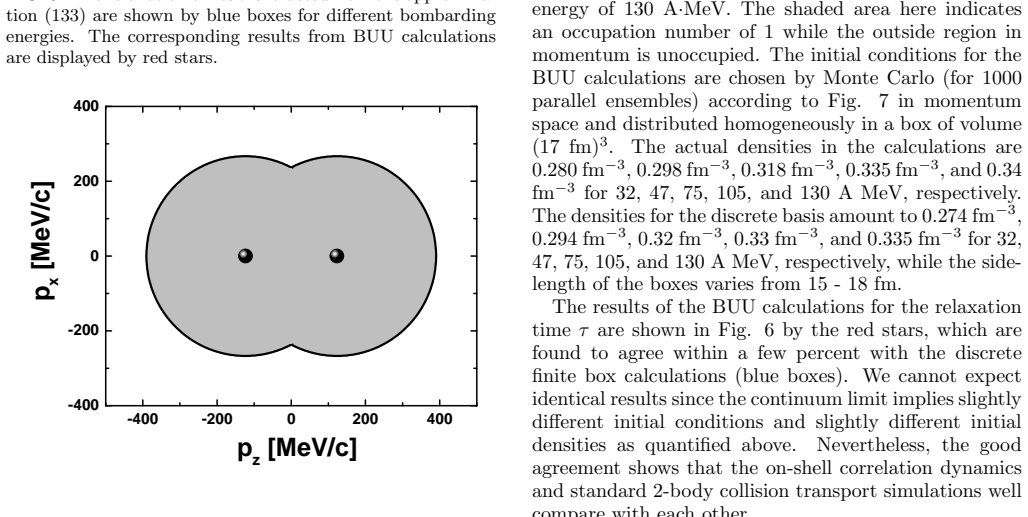
In this study we aim for quantifying the role of in-medium 3$\leftrightarrow$3 collisions for systems of fermions which initially are out-off equilibrium. The formulation of the 3-body dynamics is based on the equations of motion method for identical fermions -- also denoted as quantum correlation dynamics -- and presented in detail. The on-shell 2-body collision integral is briefly reviewed and the on-shell 3-body collision integral is derived on the basis of the same two-body interaction in leading order. The resulting equations obey particle number as well as energy-momentum conservation. For a quantification of the relative impact of 3-body interactions we employ a model study for a homogeneous system in space in a finite box with periodic boundary conditions. We address spin-isospin symmetric nuclear matter systems with momentum distributions that are given by shifted Fermi spheres (without overlap) as encountered in the initial phase of nucleus-nucleus collisions after contact. The results for the relaxation times -- employing an effective 2-body interaction -- are compared to Boltzmann-Uehling-Uhlenbeck (BUU) transport calculations in the continuum limit for the same bombarding energies and are found to agree on the level of a few percent. We find that the additional 3-body interactions reduce the relaxation times up to a factor of 3 at 130 A$\cdot$MeV. Furthermore, it is shown in BUU transport calculations that an enhanced stopping by 3$\leftrightarrow$3 collisions shows up in the angular distribution of energetic nucleons ($>$ 60 MeV) e.g. in central $^{97}_{45}Rh$ collisions at 40 A$\cdot$MeV that lead to the formation of a compound nucleus. The angular distribution of the energetic nucleons changes from a slightly forward peaked angular distribution to a slightly sidewards peaked angular distribution which might be controlled experimentally.
Figures


Figures from the paper (6 more)




Reference graph
Works this paper leans on
- [1]
-
[2]
J. W. Negele, Rev. Mod. Phys. 54, 913 (1982)
work page 1982
-
[3]
M. Tohyama and M. Gong, Zeitschrift f¨ ur Physik A Atomic Nuclei 332, 269 (1989)
work page 1989
-
[4]
M. Gong and M. Tohyama, Zeitschrift f¨ ur Physik A Atomic Nuclei 335, 153 (1990)
work page 1990
-
[5]
L. W. Nordheim, Proc. Roy. Soc. (London) 119, 689–698 (1928)
work page 1928
-
[6]
E. A. Uehling and G. Uhlenbeck, Physical Review 43, 552 (1933)
work page 1933
-
[7]
in case the shifted Fermi- spheres just touch each other in momentum space or are fully separated
and give a nucleon density which at most gives twice nuclear matter density, i.e. in case the shifted Fermi- spheres just touch each other in momentum space or are fully separated. On the other hand screening effects by e.g. by mesons reduce the probability for 3-body fermion scattering such that the geometrical estimates at higher density have to be take...
-
[8]
G. F. Bertsch, H. Kruse, and S. D. Gupta, Phys. Rev. C 29, 673 (1984), [Erratum: Phys.Rev.C 33, 1107–1108 (1986)]
work page 1984
Show all 41 references
-
[9]
Aichelin and G
J. Aichelin and G. Bertsch, Phys. Rev. C31, 1730 (1985)
1985
-
[10]
G. F. Bertsch and S. Das Gupta, Phys. Rept. 160, 189 (1988)
1988
-
[11]
Cassing, Lect
W. Cassing, Lect. Notes Phys. 989, pp. (2021)
2021
-
[12]
Cassing, V
W. Cassing, V. Metag, U. Mosel, and K. Niita, Phys. Rept. 188, 363 (1990)
1990
-
[13]
L. P. Kadanoff and G. Baym, Quantum Statistical me- chanics (W. A. Benjamin, Inc., New York, 1962)
1962
-
[14]
Danielewicz, Annals Phys
P. Danielewicz, Annals Phys. 152, 305 (1984)
1984
-
[15]
C. M. Ko, Q. Li, and R.-C. Wang, Phys. Rev. Lett. 59, 1084 (1987)
1987
-
[16]
Blattel, V
B. Blattel, V. Koch, W. Cassing, and U. Mosel, Phys. Rev. C 38, 1767 (1988)
1988
-
[17]
Botermans and R
W. Botermans and R. Malfliet, Phys. Rept. 198, 115 (1990)
1990
-
[18]
Wolter et al
H. Wolter et al. (TMEP), Prog. Part. Nucl. Phys. 125, 103962 (2022), arXiv:2202.06672 [nucl-th]
2022
-
[19]
Cassing, Nucl
W. Cassing, Nucl. Phys. A 700, 618 (2002), arXiv:nucl- th/0105069
2002
-
[20]
S. M. Dawid, Z. T. Draper, A. D. Hanlon, B. H¨ orz, C. Morningstar, F. Romero-L´ opez, S. R. Sharpe, and S. Skinner, (2025), arXiv:2502.14348 [hep-lat]
2025 arXiv
-
[21]
S. J. Wang and W. Cassing, Annals Phys. 159, 328 (1985)
1985
-
[22]
Balescu, John Wiley & Sons, Chichester, New York, Sydney, Toronto , 742 (1975)
R. Balescu, John Wiley & Sons, Chichester, New York, Sydney, Toronto , 742 (1975)
1975
-
[23]
Krieg, University of Erlangen, unpublished, Ph.D
R. Krieg, University of Erlangen, unpublished, Ph.D. the- sis (1991)
1991
-
[24]
Gherega, R
T. Gherega, R. Krieg, P. G. Reinhard, and C. Toepffer, Nucl. Phys. A 560, 166 (1993)
1993
-
[25]
Tohyama and P
M. Tohyama and P. Schuck, Eur. Phys. J. A 45, 257 (2010), arXiv:1003.0246 [nucl-th]
2010 arXiv
-
[26]
Tohyama and P
M. Tohyama and P. Schuck, Eur. Phys. J. A 50, 77 (2014), arXiv:1312.3703 [nucl-th]
2014 arXiv
-
[27]
Schuck, D
P. Schuck, D. S. Delion, J. Dukelsky, M. Jemai, E. Litvi- nova, G. Roepke, and M. Tohyama, Phys. Rept. 929, 1 (2021), arXiv:2009.00591 [nucl-th]
2021 arXiv
-
[28]
Litvinova and P
E. Litvinova and P. Schuck, Phys. Rev. C 100, 064320 (2019), [Erratum: Phys.Rev.C 107, 029903 (2023)], arXiv:1908.05384 [nucl-th]
2019 arXiv
-
[29]
Tohyama and P
M. Tohyama and P. Schuck, Eur. Phys. J. A 55, 74 (2019), arXiv:1904.06780 [nucl-th]
2019 arXiv
-
[30]
Tohyama and P
M. Tohyama and P. Schuck, Eur. Phys. J. A 53, 186 (2017), arXiv:1708.00569 [nucl-th]
2017 arXiv
-
[31]
Schuck and M
P. Schuck and M. Tohyama, Phys. Rev. B 93, 165117 (2016), arXiv:1603.08276 [cond-mat.str-el]
2016 arXiv
-
[32]
Cassing and S
W. Cassing and S. Wang, Zeitschrift f¨ ur Physik A Atomic Nuclei 328, 423 (1987)
1987
-
[33]
Cassing, K
W. Cassing, K. Niita, and S. Wang, Zeitschrift f¨ ur Physik A Atomic Nuclei 331, 439 (1988)
1988
-
[34]
Cassing and A
W. Cassing and A. Pfitzner, Zeitschrift f¨ ur Physik A Atomic Nuclei 337, 175 (1990)
1990
-
[35]
Cassing and A
W. Cassing and A. Pfitzner, Zeitschrift f¨ ur Physik A Hadrons and Nuclei 342, 161 (1992)
1992
-
[36]
De Blasio, W
F. De Blasio, W. Cassing, M. Tohyama, P. Bortignon, and R. Broglia, Physical Review Letters 68, 1663 (1992)
1992
-
[37]
B. D. Day, Rev. Mod. Phys. 50, 495 (1978)
1978
-
[38]
K. A. Brueckner, Phys. Rev. 97, 1353 (1955)
1955
-
[39]
Cugnon, T
J. Cugnon, T. Mizutani, and J. Vandermeulen, Nucl. Phys. A 352, 505 (1981)
1981
-
[40]
A. Lang, H. Babovsky, W. Cassing, U. Mosel, H.- G. Reusch, and K. Weber, Journal of Computational Physics 106, 391 (1993)
1993
-
[41]
Linnyk, E
O. Linnyk, E. L. Bratkovskaya, and W. Cassing, Prog. Part. Nucl. Phys. 87, 50 (2016), arXiv:1512.08126 [nucl- th]
2016 arXiv
Reviewed August 7, 2026 · model on record in the stance chip above.
Discussion (0). Sign in to comment.