X-ray Fourier lag-frequency spectra modulated by stochastic turbulent acceleration in the jets of high-frequency-peaked BL Lac
Pith reviewed 2026-07-03 08:14 UTC · model grok-4.3
The pith
A one-zone leptonic model shows stochastic turbulent acceleration unifies diverse X-ray time lags in HBL jets.
A machine-rendered reading of the paper's core claim, the machinery that carries it, and where it could break.
Core claim
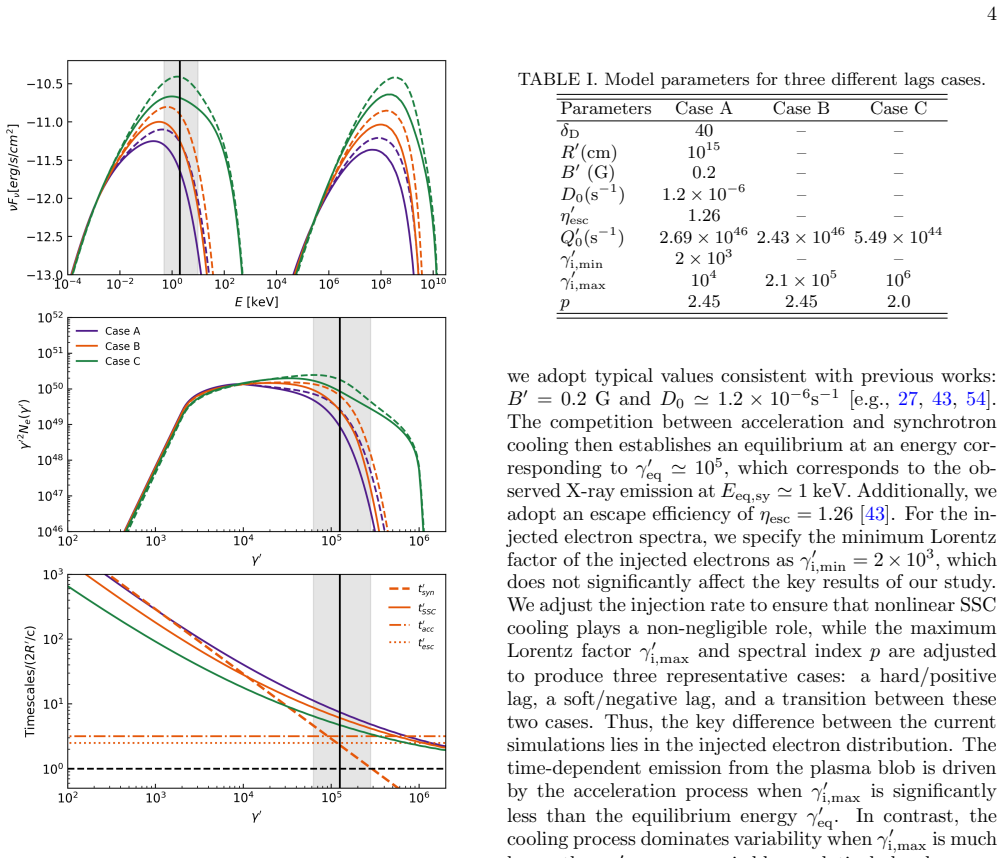
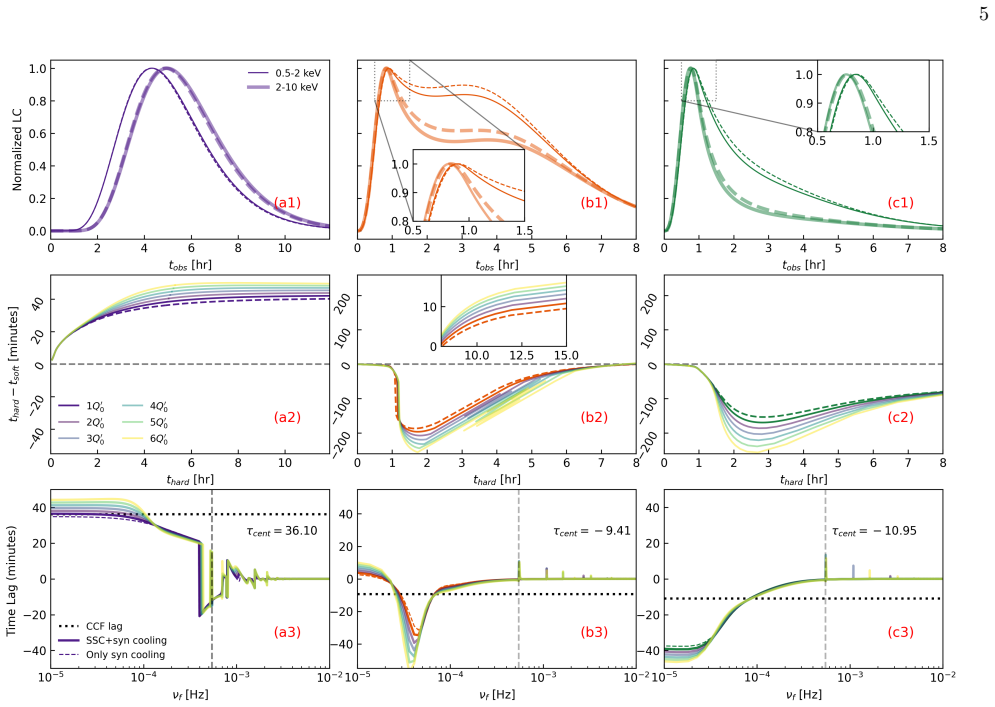
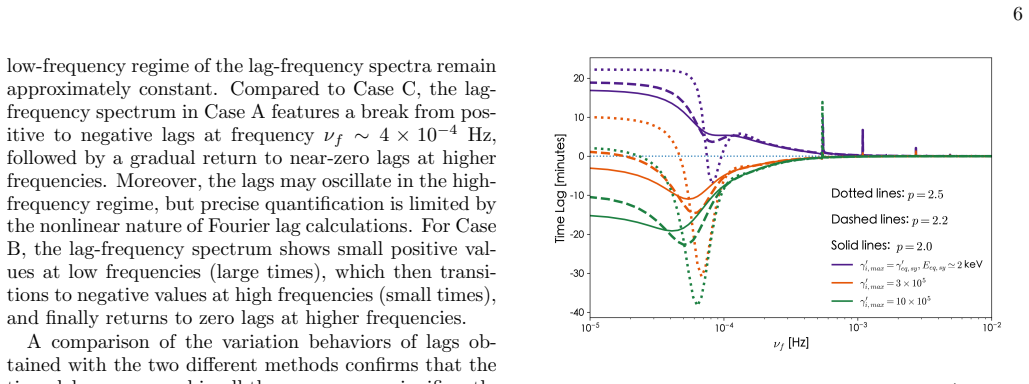
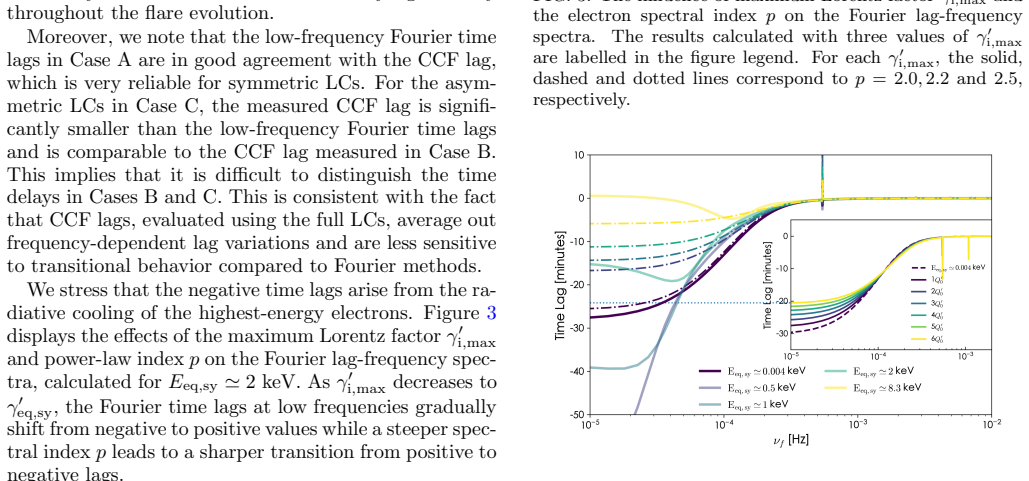
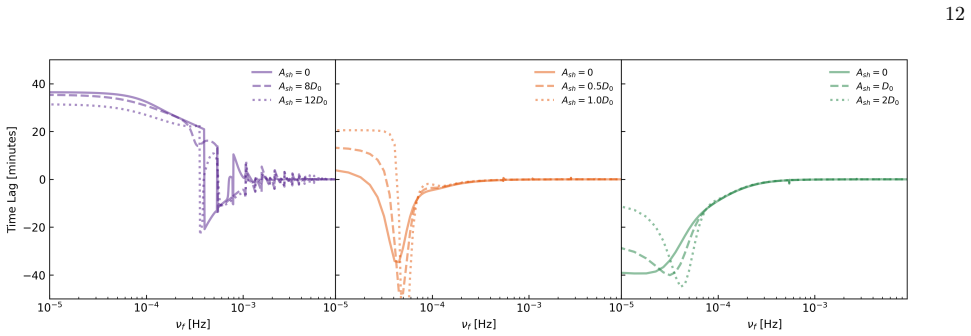
The competition between stochastic turbulent acceleration, radiative cooling, and escape processes not only gives rise to two well-defined time-lag regimes—hard/positive and soft/negative lags—but also reveals the existence of a transition between the two regimes. Time lags in the transitional and soft-lag regimes can be clearly amplified and modified by STA's suppression of high-energy electron cooling, and nonlinear synchrotron self-Compton cooling can further amplify the emergence of time lags, offering a unifying quantitative framework for interpreting the diverse time-lag signatures observed in the X-ray flares of HBLs.
What carries the argument
stochastic turbulent acceleration (STA) competing with radiative cooling and escape processes inside a one-zone leptonic model, which shapes the emitted photon spectra and the resulting Fourier lag-frequency spectra.
If this is right
- STA suppression of high-energy electron cooling amplifies lags in transitional and soft-lag regimes.
- Nonlinear SSC cooling further amplifies the emergence of time lags.
- The model accounts for relatively large lags observed in TeV-bright flares.
- Larger flare duration corresponds to larger lag amplitude.
- The framework interprets the full range of observed time-lag signatures in HBL X-ray flares.
Where Pith is reading between the lines
- Single-zone models may suffice for many HBL lag spectra if multi-zone effects prove secondary.
- The transition frequency between lag regimes could serve as an observable diagnostic of the balance between acceleration and cooling timescales.
- Similar lag patterns might appear in other blazar subclasses if turbulent acceleration operates comparably.
- Monitoring lag amplitude versus flare duration across more events would provide a direct test of the SSC contribution.
Load-bearing premise
The competition between stochastic turbulent acceleration, radiative cooling, and escape processes dominates the shape of the lag-frequency spectra, with no significant contribution from multi-zone structure or additional acceleration mechanisms.
What would settle it
An observed X-ray lag-frequency spectrum in an HBL flare whose shape and amplitude cannot be reproduced by any combination of relative strengths for STA, cooling, and escape within a single zone.
Figures
read the original abstract
X-ray interband time lags are key diagnostics of jet physics and are frequently detected in high-frequency peaked BL Lac (HBL) objects at different epochs with various X-ray telescopes. In this work, we theoretically investigate Fourier lag-frequency spectra using a generic one-zone leptonic model incorporating the stochastic turbulent acceleration (STA), which plays a crucial role in shaping the emitted photon spectra. We demonstrate that the competition between STA, radiative cooling, and escape processes not only gives rise to two well-defined time-lag regimes: hard/positive and soft/negative lags, but also reveals the existence of a transition between the two regimes. Our results indicate that time lags in the transitional and soft-lag regimes can be clearly amplified and modified by STA's suppression of high-energy electron cooling, and nonlinear synchrotron self-Compton (SSC) cooling can further amplify the emergence of time lags. We conclude that the adopted model offers a unifying quantitative framework for interpreting the diverse time-lag signatures observed in the X-ray flares of HBLs. Additionally, SSC cooling effects can account for the relatively large lags observed in TeV-bright flares, as well as the observed trend between lag amplitude and flare duration: the larger the flare duration, the larger the lag.
Editorial analysis
A structured set of objections, weighed in public.
Referee Report
Summary. The manuscript develops a generic one-zone leptonic model incorporating stochastic turbulent acceleration (STA) to compute X-ray Fourier lag-frequency spectra for high-frequency-peaked BL Lacs. It claims that competition among STA, radiative cooling, and escape produces well-defined hard/positive-lag and soft/negative-lag regimes separated by a transition, that STA amplifies lags in the transitional and soft regimes by suppressing high-energy electron cooling, and that nonlinear SSC cooling further enhances lags, thereby providing a unifying quantitative framework for observed X-ray lags in HBL flares; additionally, SSC effects are invoked to explain larger lags in TeV-bright flares and the positive correlation between lag amplitude and flare duration.
Significance. If the central derivation holds, the work supplies a microphysical mechanism linking STA to observable timing signatures and offers a single framework capable of reproducing the diversity of lag-frequency spectra reported for HBLs. The explicit connection drawn between SSC cooling, flare duration, and lag amplitude constitutes a testable prediction that could be checked against existing multi-epoch X-ray monitoring data.
major comments (2)
- [model description / one-zone kinetic equation] The central claim that the one-zone kinetic-equation solution unifies observed lag regimes (abstract and concluding paragraph) rests on the premise that multi-zone light-travel-time delays are negligible compared with the local STA, cooling, and escape timescales. No quantitative estimate or test of this assumption appears in the model section; if propagation delays are comparable to or larger than the modeled microphysical timescales, the predicted hard-lag, soft-lag, and transition regimes would not map directly to data.
- [results / comparison with data] The abstract states that the model is fitted to observations to reproduce lag amplitudes and the lag-versus-duration trend, yet the manuscript supplies no explicit list of free parameters, their priors, or a demonstration that the lag amplitudes are independent predictions rather than values set by tuning the STA rate and efficiency to match the photon spectra (see reader's circularity note).
minor comments (2)
- [abstract] The abstract refers to 'two well-defined time-lag regimes' and 'a transition' without citing the specific frequency ranges or the functional form of the lag-frequency spectrum that defines these regimes.
- [model section] Notation for the stochastic acceleration rate and the escape timescale is introduced without an accompanying table of symbols or reference to the governing Fokker-Planck equation.
Simulated Author's Rebuttal
We thank the referee for their careful and constructive review of our manuscript. We address each major comment below and have revised the manuscript to incorporate the suggested improvements.
read point-by-point responses
-
Referee: [model description / one-zone kinetic equation] The central claim that the one-zone kinetic-equation solution unifies observed lag regimes (abstract and concluding paragraph) rests on the premise that multi-zone light-travel-time delays are negligible compared with the local STA, cooling, and escape timescales. No quantitative estimate or test of this assumption appears in the model section; if propagation delays are comparable to or larger than the modeled microphysical timescales, the predicted hard-lag, soft-lag, and transition regimes would not map directly to data.
Authors: We agree that an explicit justification of the one-zone approximation is required. In the revised manuscript we have added a new paragraph in Section 2 that compares the light-crossing time R/c (with R in the range 10^15–10^16 cm adopted for HBLs) against the STA, synchrotron/SSC cooling, and escape timescales derived from the kinetic equation. For the fiducial parameters the light-travel delay is shorter by at least a factor of ten, confirming that the predicted lag regimes can be compared directly with the data. revision: yes
-
Referee: [results / comparison with data] The abstract states that the model is fitted to observations to reproduce lag amplitudes and the lag-versus-duration trend, yet the manuscript supplies no explicit list of free parameters, their priors, or a demonstration that the lag amplitudes are independent predictions rather than values set by tuning the STA rate and efficiency to match the photon spectra (see reader's circularity note).
Authors: We note that the abstract as written does not claim an explicit fit to lag amplitudes; it presents the model as a unifying framework whose predictions are compared with observed trends. Nevertheless, to remove any ambiguity we have added Table 1 listing all free parameters together with the values used and the spectral constraints that fix them. A new paragraph in Section 4 explains that the STA acceleration rate and efficiency are determined solely from the photon spectrum, after which the lag-frequency spectra are computed as forward predictions without additional tuning. This demonstrates that the reported lag amplitudes and the lag–duration correlation are genuine model outputs. revision: yes
Circularity Check
No circularity: forward model predictions from kinetic equation solutions
full rationale
The paper constructs a one-zone leptonic transport model that includes STA, radiative cooling, and escape as independent microphysical processes. Lag-frequency spectra are computed as direct numerical outputs from solving the time-dependent kinetic equation under varying parameter regimes; these are not obtained by fitting lag data and then re-deriving the same quantities. No self-citation is invoked to establish uniqueness of the STA term or to smuggle an ansatz, and the one-zone assumption is stated explicitly rather than derived from prior author work. The unifying-framework conclusion follows from the model's ability to generate hard-lag, soft-lag, and transition regimes, which remain falsifiable against external observations.
Axiom & Free-Parameter Ledger
free parameters (1)
- stochastic turbulent acceleration rate and efficiency parameters
axioms (2)
- domain assumption One-zone leptonic emission region with uniform properties
- standard math Fourier transform applied to light curves yields lag-frequency spectra
Reference graph
Works this paper leans on
-
[1]
hard-sphere
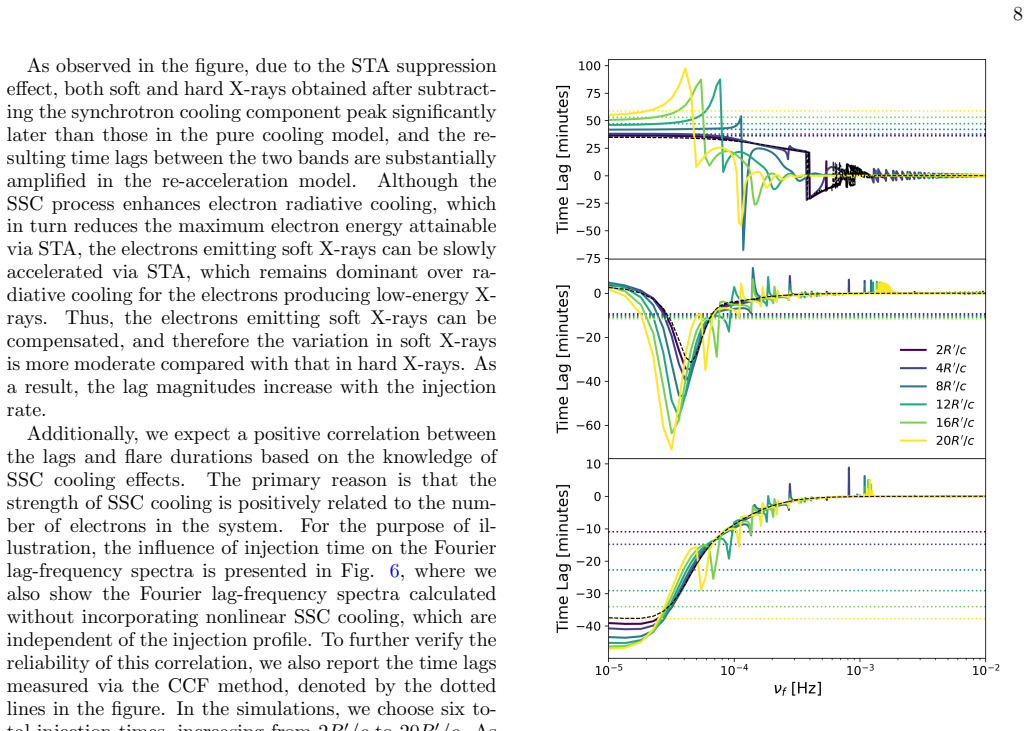
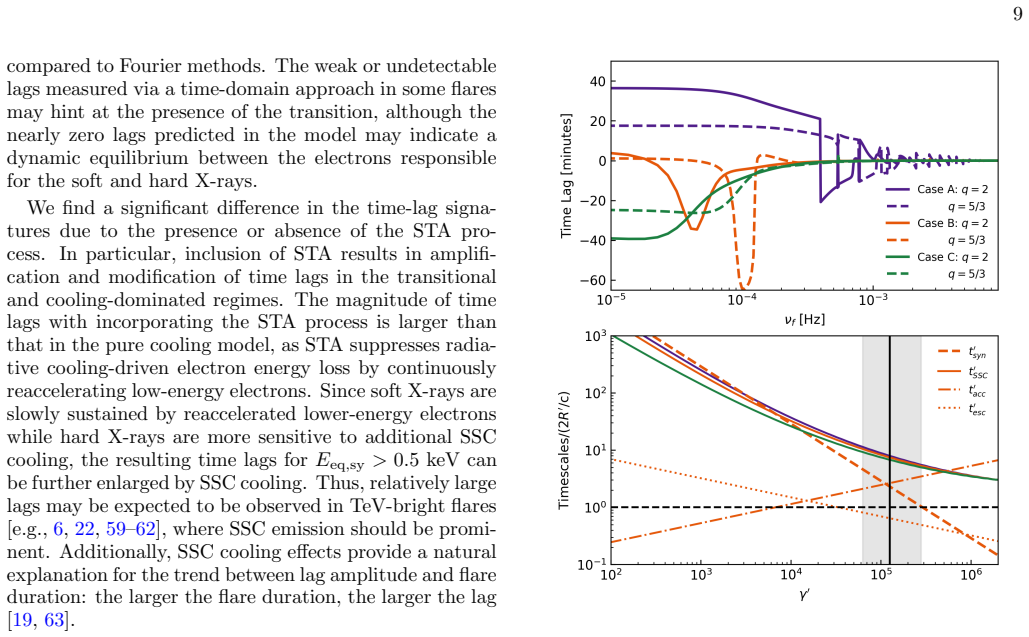
further extended the approach by focusing on the generalized transport equation that takes into account particle acceleration. We note that to explore the global properties of the Fourier transform-related quantities, the electron trans- port equation in the Fourier domain is solved analytically, and therefore SSC cooling is not included, since it is in- ...
-
[2]
higher than those derived with consideration of both syn- chrotron and SSC cooling processes
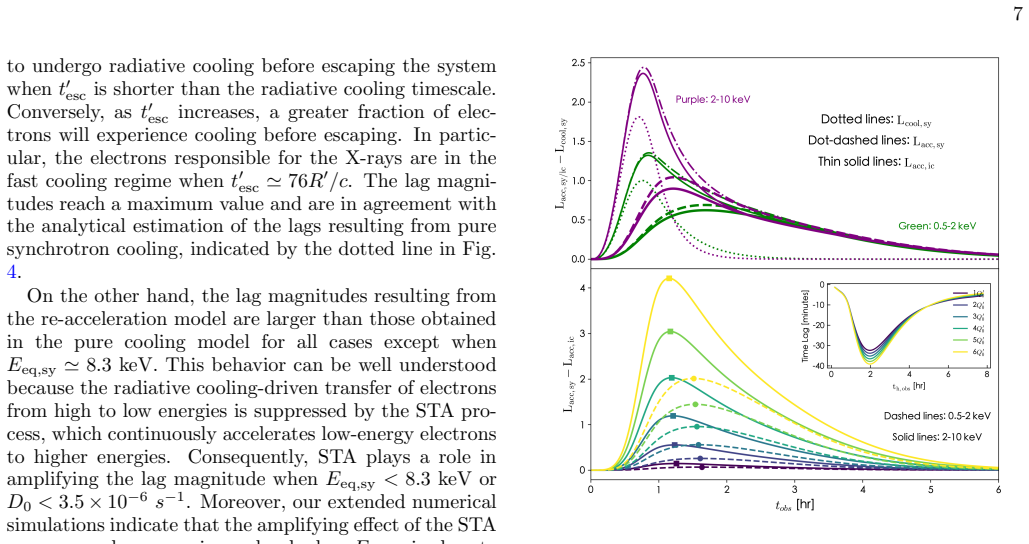
The corresponding instantaneous lags are presented in the middle panels. higher than those derived with consideration of both syn- chrotron and SSC cooling processes. These results verify that nonlinear SSC cooling for our adopted parameter sets plays a non-negligible role in producing the X-rays, though the electrons responsible for X-rays are domi- nate...
-
[3]
In the bottom panel, we display the differencesL acc,ic −L acc,sy, representing the contribu- tion from SSC cooling
In the upper panel of the figure, we show the dif- ferencesL acc,sy/ic −L cool,sy, whereL acc,sy/ic denotes the LCs produced by the re-acceleration model without and with incorporating nonlinear SSC cooling, respectively, andL cool,sy denotes the LCs produced in the pure syn- chrotron cooling model. In the bottom panel, we display the differencesL acc,ic ...
-
[4]
It is clearly seen that the contribution from SSC cooling increases with the injection rate, and the decline phase of soft X- ray emission is slower than that of hard X-ray emission. The time lags between the soft and hard X-ray bands in- crease with the injection rate, with maximum lags occur- ring at∼2 hr and instantaneous time delays presented in the p...
2013
-
[5]
C. M. Urry and P. Padovani, Publ. Astron. Soc. Pac. 107, 803 (1995), arXiv:astro-ph/9506063 [astro-ph]. 3 https://www.the-athena-x-ray-observatory.eu/es
work page internal anchor Pith review Pith/arXiv arXiv 1995
-
[6]
An evolutionary scenario for blazar unification
M. B¨ ottcher and C. D. Dermer, Astrophys. J.564, 86 (2002), arXiv:astro-ph/0106395 [astro-ph]
work page internal anchor Pith review Pith/arXiv arXiv 2002
-
[7]
The blazar sequence: a new perspective
G. Ghisellini and F. Tavecchio, Mon. Not. R. Astron. Soc. 387, 1669 (2008), arXiv:0802.1918 [astro-ph]
work page internal anchor Pith review Pith/arXiv arXiv 2008
-
[8]
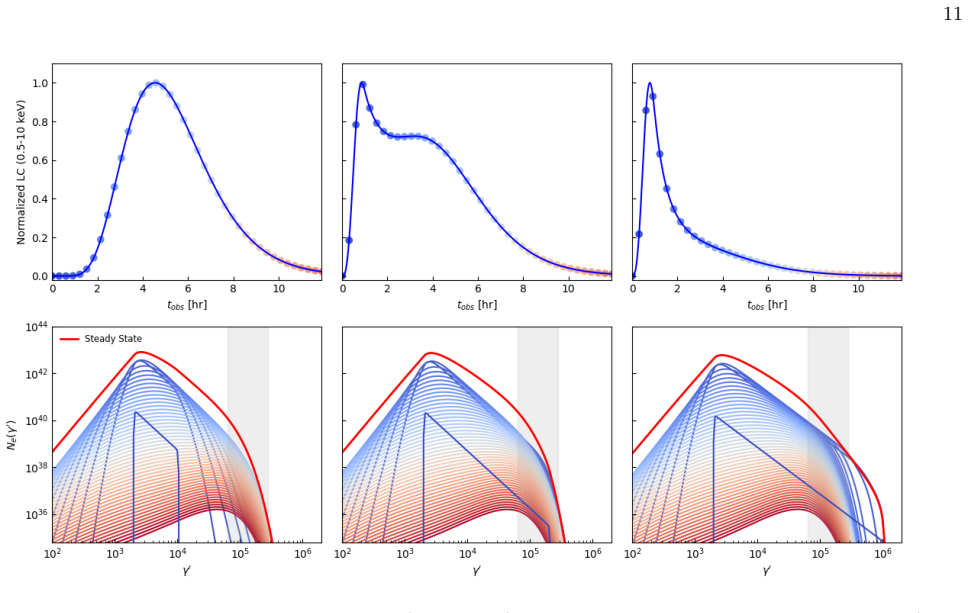
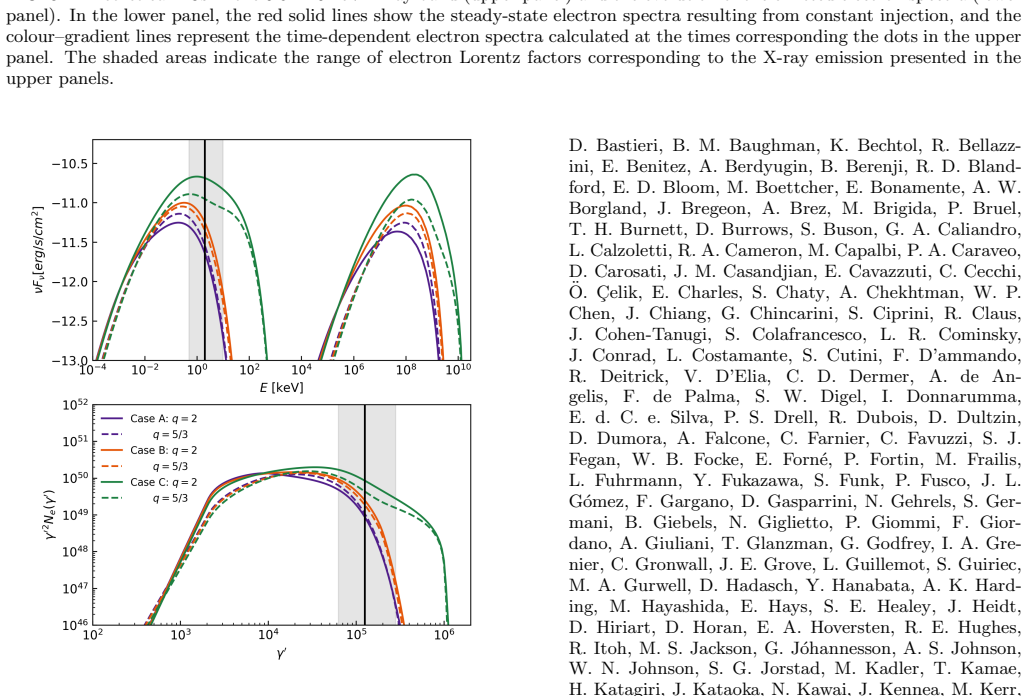
A. A. Abdo, M. Ackermann, I. Agudo, M. Ajello, H. D. Aller, M. F. Aller, E. Angelakis, A. A. Arkharov, M. Ax- elsson, U. Bach, L. Baldini, J. Ballet, G. Barbiellini, 11 FIG. 8. Theoretical LCs in the 0.5−10 keV X-ray band (upper panel) and the evolution of the emitted electron spectra (lower panel). In the lower panel, the red solid lines show the steady-...
work page internal anchor Pith review Pith/arXiv arXiv 2010
-
[9]
F. Aharonian, A. G. Akhperjanian, G. Anton, U. Bar- res de Almeida, A. R. Bazer-Bachi, Y. Becherini, B. Be- hera, W. Benbow, K. Bernl¨ ohr, C. Boisson, A. Bochow, V. Borrel, E. Brion, J. Brucker, P. Brun, R. B¨ uhler, T. Bulik, I. B¨ usching, T. Boutelier, P. M. Chadwick, A. Charbonnier, R. C. G. Chaves, A. Cheesebrough, L. M. Chounet, A. C. Clapson, G. C...
work page internal anchor Pith review Pith/arXiv arXiv 2009
-
[10]
H. E. S. S. Collaboration, A. Abramowski, F. Acero, F. Aharonian, A. G. Akhperjanian, G. Anton, A. Balzer, A. Barnacka, U. Barres de Almeida, Y. Becherini, J. Becker, B. Behera, W. Benbow, K. Bernl¨ ohr, A. Bo- chow, C. Boisson, J. Bolmont, P. Bordas, T. Bouteilier, J. Brucker, F. Brun, P. Brun, T. Bulik, I. B¨ usching, S. Carrigan, S. Casanova, M. Cerrut...
work page internal anchor Pith review Pith/arXiv arXiv 2012
-
[11]
MAGIC Collaboration, H. Abe, S. Abe, J. Abhir, V. A. Acciari, I. Agudo, T. Aniello, S. Ansoldi, L. A. An- tonelli, A. Arbet Engels, C. Arcaro, M. Artero, K. Asano, D. Baack, A. Babi´ c, A. Baquero, U. Barres de Almeida, I. Batkovi´ c, J. Baxter, J. Becerra Gonz´ alez, E. Bernar- dini, J. Bernete, A. Berti, J. Besenrieder, C. Bigongiari, A. Biland, O. Blan...
-
[12]
Variability in the synchrotron self-Compton model of blazar emission
A. Mastichiadis and J. G. Kirk, Astron. Astrophys.320, 19 (1997), arXiv:astro-ph/9610058 [astro-ph]
work page internal anchor Pith review Pith/arXiv arXiv 1997
-
[13]
E. Massaro, M. Perri, P. Giommi, and R. Nesci, Astron. Astrophys.413, 489 (2004), arXiv:astro-ph/0312260 [astro-ph]
work page internal anchor Pith review Pith/arXiv arXiv 2004
-
[14]
E. Massaro, M. Perri, P. Giommi, R. Nesci, and F. Ver- recchia, Astron. Astrophys.422, 103 (2004), arXiv:astro- ph/0405152 [astro-ph]
-
[15]
X-ray Flux and Spectral Variability of Six TeV Blazars with \textit{NuSTAR}
A. Pandey, A. C. Gupta, and P. J. Wiita, Astrophys. J. 859, 49 (2018), arXiv:1804.10126 [astro-ph.HE]
work page internal anchor Pith review Pith/arXiv arXiv 2018
- [16]
-
[17]
Stochastic particle acceleration and synchrotron self--Compton radiation in TeV blazars
K. Katarzy´ nski, G. Ghisellini, A. Mastichiadis, F. Tavec- chio, and L. Maraschi, Astron. Astrophys.453, 47 (2006), arXiv:astro-ph/0603362 [astro-ph]
work page internal anchor Pith review Pith/arXiv arXiv 2006
-
[18]
P. A. Becker, T. Le, and C. D. Dermer, Astrophys. J. 647, 539 (2006), arXiv:astro-ph/0604504 [astro-ph]
work page internal anchor Pith review Pith/arXiv arXiv 2006
-
[19]
On the Momentum Diffusion of Radiating Ultrarelativistic Electrons in a Turbulent Magnetic Field
L. Stawarz and V. Petrosian, Astrophys. J.681, 1725 (2008), arXiv:0803.0989 [astro-ph]
work page internal anchor Pith review Pith/arXiv arXiv 2008
-
[20]
A. Tramacere, E. Massaro, and A. M. Taylor, Astrophys. J.739, 66 (2011), arXiv:1107.1879 [astro-ph.HE]
work page internal anchor Pith review Pith/arXiv arXiv 2011
-
[21]
D. Yan, L. Zhang, Q. Yuan, Z. Fan, and H. Zeng, Astro- phys. J.765, 122 (2013), arXiv:1301.6476 [astro-ph.HE]
work page internal anchor Pith review Pith/arXiv arXiv 2013
-
[22]
A. Dmytriiev, H. Sol, and A. Zech, Mon. Not. R. Astron. Soc.505, 2712 (2021), arXiv:2105.12480 [astro-ph.HE]
-
[23]
Y. H. Zhang, Mon. Not. R. Astron. Soc.337, 609 (2002), arXiv:astro-ph/0209063 [astro-ph]
work page internal anchor Pith review Pith/arXiv arXiv 2002
-
[24]
Y. H. Zhang, J. M. Bai, S. N. Zhang, A. Treves, L. Maraschi, and A. Celotti, Astrophys. J.651, 782 (2006), arXiv:astro-ph/0607138 [astro-ph]
work page internal anchor Pith review Pith/arXiv arXiv 2006
- [25]
-
[26]
A. U. Abeysekara, S. Archambault, A. Archer, W. Ben- bow, R. Bird, M. Buchovecky, J. H. Buckley, V. Bugaev, J. V. Cardenzana, M. Cerruti, X. Chen, L. Ciupik, M. P. Connolly, W. Cui, J. D. Eisch, A. Falcone, Q. Feng, J. P. Finley, H. Fleischhack, A. Flinders, L. Fortson, A. Fur- niss, S. Griffin, N. H˚ akansson, D. Hanna, O. Hervet, J. Holder, T. B. Humens...
work page internal anchor Pith review Pith/arXiv arXiv 2017
- [27]
-
[28]
A. Gokus, J. Wilms, M. Kadler, D. Dorner, M. A. Nowak, A. Kreikenbohm, K. Leiter, T. Bretz, B. Schleicher, A. G. Markowitz, K. Pottschmidt, K. Mannheim, I. Kreyken- bohm, M. Langejahn, F. McBride, T. Beuchert, T. Dauser, M. Kreter, J. Abhir, D. Baack, M. Balbo, A. Biland, K. Brand, J. Buss, L. Eisenberger, D. El- saesser, P. G¨ unther, D. Hildebrand, M. L...
-
[29]
J. D. Finke and P. A. Becker, Astrophys. J.791, 21 (2014), arXiv:1406.2333 [astro-ph.GA]
work page internal anchor Pith review Pith/arXiv arXiv 2014
-
[30]
J. D. Finke and P. A. Becker, Astrophys. J.809, 85 (2015), arXiv:1507.00132 [astro-ph.HE]
work page internal anchor Pith review Pith/arXiv arXiv 2015
-
[31]
T. R. Lewis, P. A. Becker, and J. D. Finke, Astrophys. J.824, 108 (2016), arXiv:1603.07386 [astro-ph.HE]
work page internal anchor Pith review Pith/arXiv arXiv 2016
- [32]
- [33]
-
[34]
Schlickeiser, Mon
R. Schlickeiser, Mon. Not. R. Astron. Soc.398, 1483 (2009)
2009
-
[35]
M. Zacharias and R. Schlickeiser, Astron. Astrophys. 524, A31 (2010), arXiv:1007.0180 [astro-ph.HE]
work page internal anchor Pith review Pith/arXiv arXiv 2010
-
[36]
M. Zacharias and R. Schlickeiser, Mon. Not. R. Astron. Soc.420, 84 (2012), arXiv:1110.2904 [astro-ph.HE]
work page internal anchor Pith review Pith/arXiv arXiv 2012
-
[37]
External Compton emission in blazars of non-linear SSC cooled electrons
M. Zacharias and R. Schlickeiser, Astrophys. J.761, 110 (2012), arXiv:1210.6837 [astro-ph.HE]
work page internal anchor Pith review Pith/arXiv arXiv 2012
-
[38]
Synchrotron Lightcurves of blazars in a time-dependent synchrotron-self Compton cooling scenario
M. Zacharias and R. Schlickeiser, Astrophys. J.777, 109 (2013), arXiv:1309.4956 [astro-ph.HE]
work page internal anchor Pith review Pith/arXiv arXiv 2013
-
[39]
Time Dependent Leptonic Modeling of Fermi II Processes in the Jets of Flat Spectrum Radio Quasars
C. Diltz and M. B¨ ottcher, Journal of High Energy Astro- physics1, 63 (2014), arXiv:1404.4725 [astro-ph.HE]
work page internal anchor Pith review Pith/arXiv arXiv 2014
- [40]
- [41]
-
[42]
Inverse cascade in decaying 3D magnetohydrodynamic turbulence
M. Christensson, M. Hindmarsh, and A. Brandenburg, Phys. Rev. E64, 056405 (2001), arXiv:astro-ph/0011321 [astro-ph]
work page internal anchor Pith review Pith/arXiv arXiv 2001
-
[43]
Nonhelical inverse transfer of a decaying turbulent magnetic field
A. Brandenburg, T. Kahniashvili, and A. G. Tevzadze, Phys. Rev. Lett.114, 075001 (2015), arXiv:1404.2238 [astro-ph.CO]
work page internal anchor Pith review Pith/arXiv arXiv 2015
-
[44]
Particle Energy Diffusion in Linear Magnetohydrodynamic Waves
Y. Teraki and K. Asano, Astrophys. J.877, 71 (2019), arXiv:1904.08579 [astro-ph.HE]
work page internal anchor Pith review Pith/arXiv arXiv 2019
-
[45]
J. W. Lynn, E. Quataert, B. D. G. Chandran, and I. J. Parrish, Astrophys. J.791, 71 (2014), arXiv:1403.3123 [astro-ph.HE]
work page internal anchor Pith review Pith/arXiv arXiv 2014
-
[46]
C. Demidem, M. Lemoine, and F. Casse, Phys. Rev. D 102, 023003 (2020), arXiv:1909.12885 [astro-ph.HE]
- [47]
-
[48]
F. C. Jones, Physical Review167, 1159 (1968)
1968
-
[49]
G. R. Blumenthal and R. J. Gould, Rev. Mod. Phys.42, 237 (1970)
1970
-
[50]
Moderski, M
R. Moderski, M. Sikora, P. S. Coppi, and F. Aharonian, Monthly Notices of the Royal Astronomical Society363, 954 (2005), https://academic.oup.com/mnras/article- pdf/363/3/954/3954953/363-3-954.pdf
2005
-
[51]
B. Cerutti, D. A. Uzdensky, and M. C. Begelman, Astro- phys. J.746, 148 (2012), arXiv:1110.0557 [astro-ph.HE]
work page internal anchor Pith review Pith/arXiv arXiv 2012
-
[52]
Particle Acceleration in Relativistic Plasma Turbulence
L. Comisso and L. Sironi, Phys. Rev. Lett.121, 255101 (2018), arXiv:1809.01168 [astro-ph.HE]
work page internal anchor Pith review Pith/arXiv arXiv 2018
-
[53]
M. Petropoulou, L. Sironi, A. Spitkovsky, and D. Gi- annios, Astrophys. J.880, 37 (2019), arXiv:1906.03297 [astro-ph.HE]
-
[54]
A. Marcowith, G. Ferrand, M. Grech, Z. Meliani, I. Plot- nikov, and R. Walder, Living Reviews in Computa- tional Astrophysics6, 1 (2020), arXiv:2002.09411 [astro- ph.HE]
-
[55]
C. D. Dermer, J. D. Finke, H. Krug, and M. B¨ ottcher, Astrophys. J.692, 32 (2009), arXiv:0808.3185 [astro-ph]
work page internal anchor Pith review Pith/arXiv arXiv 2009
-
[56]
C. Perennes, H. Sol, and J. Bolmont, Astron. Astrophys. 633, A143 (2020), arXiv:1911.10377 [astro-ph.HE]
-
[57]
B. M. Peterson, I. Wanders, K. Horne, S. Collier, T. Alexander, S. Kaspi, and D. Maoz, Publ. Astron. Soc. Pac.110, 660 (1998), arXiv:astro-ph/9802103 [astro-ph]
work page internal anchor Pith review Pith/arXiv arXiv 1998
- [58]
- [59]
- [60]
- [61]
- [62]
-
[63]
Unprecedented study of the broadband emission of Mrk 421 during flaring activity in March 2010
J. Aleksi´ c, S. Ansoldi, L. A. Antonelli, P. Antoranz, A. Babic, P. Bangale, U. Barres de Almeida, J. A. Barrio, J. Becerra Gonz´ alez, W. Bednarek, E. Bernar- 15 dini, B. Biasuzzi, A. Biland, O. Blanch, A. Boller, S. Bonnefoy, G. Bonnoli, F. Borracci, T. Bretz, E. Car- mona, A. Carosi, P. Colin, E. Colombo, J. L. Con- treras, J. Cortina, S. Covino, P. D...
work page internal anchor Pith review Pith/arXiv arXiv 2015
-
[64]
A. U. Abeysekara, W. Benbow, R. Bird, A. Brill, R. Brose, M. Buchovecky, J. H. Buckley, J. L. Chris- tiansen, A. J. Chromey, M. K. Daniel, J. Dumm, A. Falcone, Q. Feng, J. P. Finley, L. Fortson, A. Fur- niss, N. Galante, A. Gent, G. H. Gillanders, C. Giuri, O. Gueta, T. Hassan, O. Hervet, J. Holder, G. Hughes, T. B. Humensky, C. A. Johnson, P. Kaaret, P. ...
-
[65]
V. A. Acciari, S. Ansoldi, L. A. Antonelli, A. Ar- bet Engels, D. Baack, A. Babi´ c, B. Banerjee, U. Bar- res de Almeida, J. A. Barrio, J. Becerra Gonz´ alez, W. Bednarek, L. K. Bellizzi, E. Bernardini, A. Berti, J. Besenrieder, W. Bhattacharyya, C. Bigongiari, A. Bi- land, O. Blanch, G. Bonnoli, ˇZ. Boˇ snjak, G. Busetto, R. Carosi, G. Ceribella, M. Cerr...
-
[66]
MAGIC Collaboration, V. A. Acciari, S. Ansoldi, L. A. Antonelli, A. Arbet Engels, M. Artero, K. Asano, A. Babi´ c, A. Baquero, U. Barres de Almeida, J. A. Barrio, I. Batkovi´ c, J. Becerra Gonz´ alez, W. Bednarek, L. Bellizzi, E. Bernardini, M. Bernardos, A. Berti, J. Be- senrieder, W. Bhattacharyya, C. Bigongiari, O. Blanch, ˇZ. Boˇ snjak, G. Busetto, R....
-
[67]
Brinkmann, I
W. Brinkmann, I. E. Papadakis, J. W. A. den Herder, and F. Haberl, Astron. Astrophys.402, 929 (2003)
2003
-
[68]
F. Massaro, A. Tramacere, A. Cavaliere, M. Perri, and P. Giommi, Astron. Astrophys.478, 395 (2008), arXiv:0712.2116 [astro-ph]
work page internal anchor Pith review Pith/arXiv arXiv 2008
-
[69]
Signatures of synchrotron emission and of electron acceleration in the X-ray spectra of Mrk 421
A. Tramacere, F. Massaro, and A. Cavaliere, Astron. As- trophys.466, 521 (2007), arXiv:astro-ph/0702151 [astro- ph]
work page internal anchor Pith review Pith/arXiv arXiv 2007
-
[70]
A. Tramacere, P. Giommi, M. Perri, F. Verrecchia, and G. Tosti, Astron. Astrophys.501, 879 (2009), arXiv:0901.4124 [astro-ph.HE]
work page internal anchor Pith review Pith/arXiv arXiv 2009
-
[71]
MAGIC Collaboration, K. Abe, S. Abe, J. Abhir, A. Ab- hishek, A. Aguasca-Cabot, I. Agudo, T. Aniello, S. An- soldi, L. A. Antonelli, A. Arbet Engels, C. Arcaro, T. T. H. Arnesen, A. Babi´ c, C. Bakshi, U. Barres de Almeida, J. A. Barrio, L. Barrios-Jim´ enez, I. Batkovi´ c, J. Baxter, J. Becerra Gonz´ alez, W. Bednarek, E. Bernar- dini, J. Bernete, A. Ber...
-
[72]
R¨ oken and R
C. R¨ oken and R. Schlickeiser, Astrophys. J.700, 460 (2009)
2009
-
[73]
C. R¨ oken, F. Schuppan, K. Proksch, and S. Sch¨ oneberg, Astron. Astrophys.616, A172 (2018), arXiv:1609.00941 [astro-ph.HE]
work page internal anchor Pith review Pith/arXiv arXiv 2018
-
[74]
H. Thiersen, M. Zacharias, and M. B¨ ottcher, Astrophys. J.925, 177 (2022), arXiv:2112.03130 [astro-ph.HE]
-
[75]
R. D. Blandford and A. K¨ onigl, Astrophys. J.232, 34 (1979)
1979
-
[76]
Konigl, Astrophys
A. Konigl, Astrophys. J.243, 700 (1981)
1981
discussion (0)
Sign in with ORCID, Apple, or X to comment. Anyone can read and Pith papers without signing in.