How I stop worrying about non-universality and b_φ: Constraining local f_(rm NL) with b_φ priors from HOD posteriors
Pith reviewed 2026-07-03 18:55 UTC · model grok-4.3
The pith
Priors on b_phi derived from DESI HOD posteriors allow unbiased f_NL constraints on local primordial non-Gaussianity.
A machine-rendered reading of the paper's core claim, the machinery that carries it, and where it could break.
Core claim
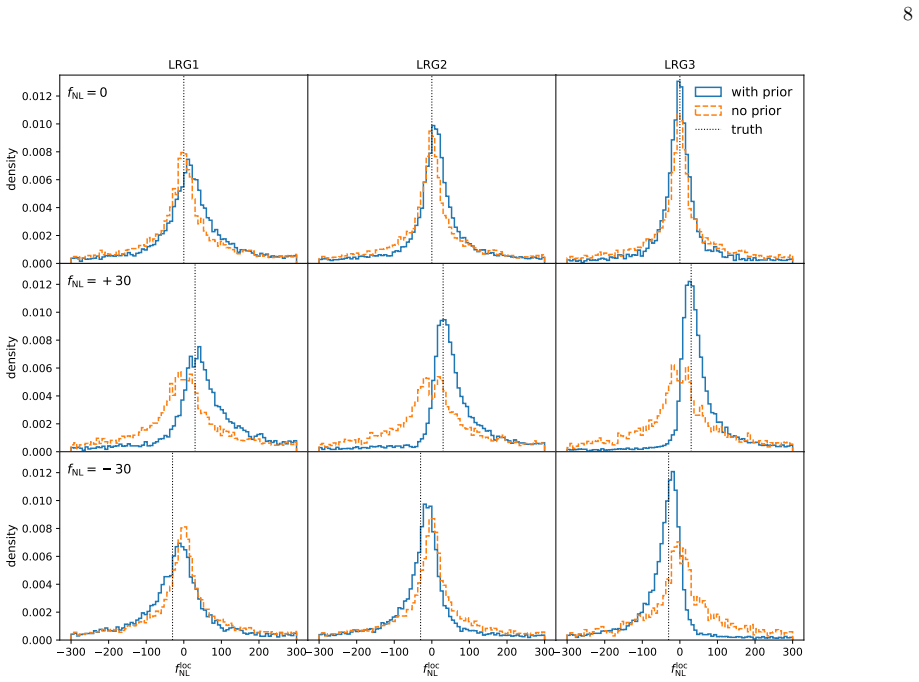
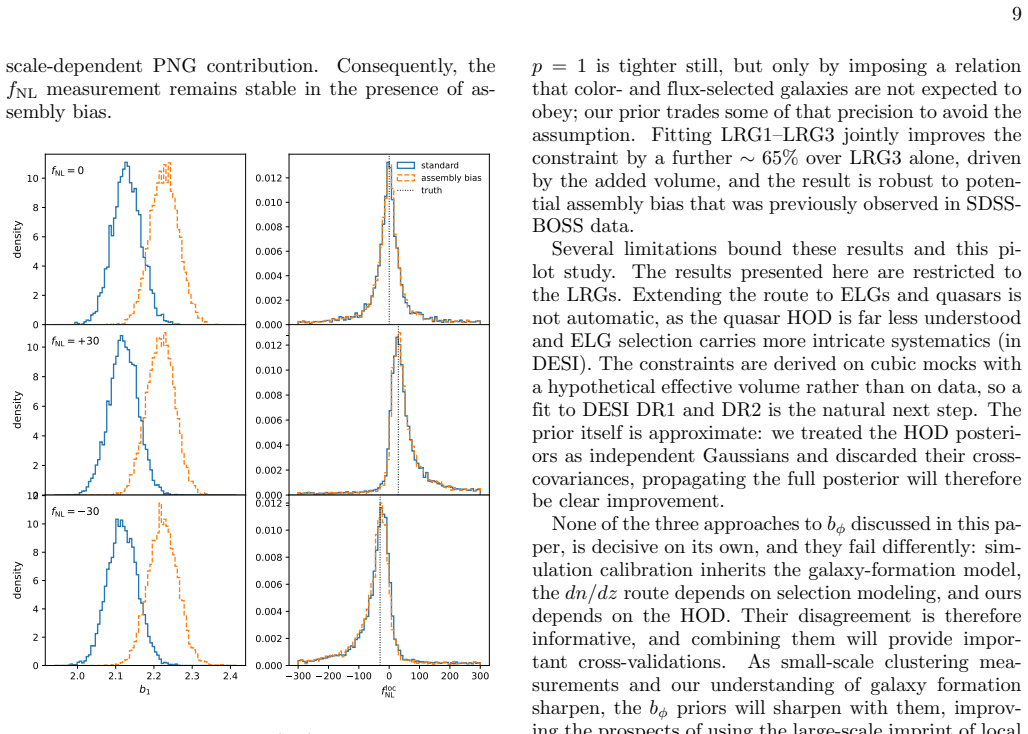
Sampling the posterior of a halo occupation distribution model fit to DESI EDR small-scale clustering generates mocks from which b_phi is measured and its prior is constructed; validation against additional mocks with different local PNG amplitudes shows that the method recovers unbiased f_NL even in the presence of assembly bias.
What carries the argument
Sampling HOD posteriors fitted to small-scale clustering to measure and prior-constrain b_phi.
If this is right
- The prior yields unbiased f_NL estimates from galaxy survey data.
- The recovery remains unbiased when assembly bias is present.
- The dominant uncertainty previously caused by unknown b_phi is reduced.
- The same workflow can be repeated with data from other surveys or tracers.
Where Pith is reading between the lines
- Small-scale clustering data can be repurposed to strengthen constraints on inflation parameters extracted from large-scale structure.
- The approach reduces reliance on assumptions that b_phi takes a single universal value across galaxy samples.
- Combining the resulting b_phi priors with multiple tracers could further tighten f_NL bounds in future analyses.
Load-bearing premise
The HOD posterior obtained from small-scale DESI EDR clustering fully captures the range of b_phi values realized by the actual galaxy population, including any effects of assembly bias.
What would settle it
A systematic offset between the recovered f_NL and the injected value in mocks whose assembly bias strength lies outside the variation spanned by the HOD posterior would falsify the claim.
Figures
read the original abstract
Local primordial non-Gaussianity (local PNG) induces a scale-dependent contribution to galaxy clustering proportional to $f_{\rm NL}\,b_\phi$, where $f_{\rm NL}$ is the local PNG amplitude and $b_\phi$ encodes the galaxy response to a long-wavelength primordial potential perturbation. Uncertainty in $b_\phi$ is the dominant obstacle to precise, robust constraints on $f_{\rm NL}$ from galaxy surveys. We translate small-scale clustering constraints on the galaxy--halo connection into priors on $b_\phi$: sampling the posterior of a halo occupation distribution (HOD) model fit to the DESI EDR, we generate mocks from which we measure $b_\phi$ and construct its prior. Validating against additional mocks with different local PNG amplitudes, we show that the method recovers unbiased $f_{\rm NL}$, even in the presence of assembly bias.
Editorial analysis
A structured set of objections, weighed in public.
Referee Report
Summary. The paper claims that priors on the PNG response parameter b_φ can be constructed by sampling the posterior of an HOD model fit to small-scale DESI EDR clustering; mocks drawn from this posterior are then used both to measure the b_φ distribution and to validate that the resulting f_NL constraints remain unbiased even when assembly bias is included in the HOD.
Significance. If the central claim is correct, the approach supplies a data-driven route to marginalize over b_φ uncertainty that has been the dominant systematic in local f_NL analyses; it thereby converts existing small-scale clustering constraints into a practical prior for large-scale PNG measurements and could be directly applicable to full DESI and other Stage-IV surveys.
major comments (1)
- [Validation section] Validation section (and abstract): the additional mocks used to demonstrate unbiased f_NL recovery are generated from the identical HOD posterior that supplies the b_φ prior. By construction, the b_φ values realized in these mocks lie inside the prior support; the test therefore cannot detect bias if the true galaxy population produces b_φ outside that support (e.g., from assembly-bias physics absent from the HOD model).
minor comments (1)
- [Abstract] The abstract states that mocks recover unbiased f_NL but does not report the recovered values, uncertainties, or number of realizations; adding these quantitative results would strengthen the validation claim.
Simulated Author's Rebuttal
Thank you for the referee's detailed review. We address the major comment on the validation section below.
read point-by-point responses
-
Referee: [Validation section] Validation section (and abstract): the additional mocks used to demonstrate unbiased f_NL recovery are generated from the identical HOD posterior that supplies the b_φ prior. By construction, the b_φ values realized in these mocks lie inside the prior support; the test therefore cannot detect bias if the true galaxy population produces b_φ outside that support (e.g., from assembly-bias physics absent from the HOD model).
Authors: We acknowledge that the validation procedure uses mocks generated from the same HOD posterior that defines the b_φ prior. Consequently, the test confirms unbiased f_NL recovery when the underlying galaxy population follows the HOD model constrained by the DESI EDR data, which incorporates assembly bias. It cannot, however, identify biases arising from b_φ values outside this support due to HOD model incompleteness. We will update the validation section to clarify this scope and emphasize that the prior is empirically derived from small-scale clustering observations. This approach still offers a practical way to incorporate b_φ uncertainty from data, and we note that extending the HOD model further would be a natural future direction. revision: yes
Circularity Check
No significant circularity; derivation remains self-contained via scale separation
full rationale
The paper constructs a b_phi prior by fitting an HOD model to small-scale DESI EDR clustering, sampling the posterior to generate mocks, and measuring b_phi from those mocks before applying the prior to large-scale f_NL constraints. Validation proceeds by generating additional mocks with injected f_NL values from the same HOD posterior and recovering the input f_NL. No equations or steps reduce the final f_NL constraint to the HOD fit by construction; the small-scale vs. large-scale separation and the fact that the prior is fixed before the f_NL analysis keep the chain independent. No self-citations, ansatzes, or renamings are invoked in a load-bearing way that collapses the result to its inputs.
Axiom & Free-Parameter Ledger
free parameters (1)
- HOD model parameters
axioms (1)
- domain assumption The halo occupation distribution model accurately describes the galaxy-halo connection properties relevant to b_phi on the scales used for the prior.
Reference graph
Works this paper leans on
-
[1]
Planck 2018 results. IX. Constraints on primordial non-Gaussianity
Y. Akramiet al.(Planck), Astron. Astrophys.641, A9 (2020), arXiv:1905.05697 [astro-ph.CO]
work page internal anchor Pith review Pith/arXiv arXiv 2020
- [2]
-
[3]
N. Dalal, O. Dore, D. Huterer, and A. Shirokov, Phys. Rev. D77, 123514 (2008), arXiv:0710.4560 [astro-ph]
work page internal anchor Pith review Pith/arXiv arXiv 2008
-
[4]
Data Release 1 of the Dark Energy Spectroscopic Instrument
DESI Collaboration, M. Abdul Karim, A. G. Adame, D. Aguado, J. Aguilar, S. Ahlen, S. Alam, G. Aldering, D. M. Alexander, R. Alfarsy, L. Allen, C. Allende Prieto, O. Alves, A. Anand, U. Andrade, E. Armengaud, S. A vila, A. A viles, H. Awan, S. Bailey, A. Baleato Lizancos, O. Ballester, A. Bault, J. Bautista, R. Bean, J. Behera, S. BenZvi, L. Beraldo e Silv...
work page internal anchor Pith review Pith/arXiv arXiv 2026
-
[5]
2025, Constraining primordial non-Gaussianity with DESI 2024 LRG and QSO samples, 2411.17623
E. Chaussidonet al., JCAP06, 029 (2025), arXiv:2411.17623 [astro-ph.CO]
-
[6]
A. J. Rosado-Marínet al., (2026), arXiv:2604.05213 [astro-ph.CO]
work page internal anchor Pith review Pith/arXiv arXiv 2026
-
[7]
Measuring local primordial non-Gaussianity from the clustering of DESI DR1 LRGs and QSOs
Z. Brownet al., (2026), 10.5281/zenodo.20751023, arXiv:2606.24651 [astro-ph.CO]
work page internal anchor Pith review Pith/arXiv arXiv doi:10.5281/zenodo.20751023 2026
-
[8]
Barreira, JCAP12, 031 (2020), arXiv:2009.06622 [astro-ph.CO]
A. Barreira, JCAP12, 031 (2020), arXiv:2009.06622 [astro-ph.CO]
-
[9]
Barreira, JCAP11, 013 (2022), arXiv:2205.05673 [astro-ph.CO]
A. Barreira, JCAP11, 013 (2022), arXiv:2205.05673 [astro-ph.CO]
-
[10]
T. Lazeyras, A. Barreira, F. Schmidt, and V. Desjacques, JCAP01, 023 (2023), arXiv:2209.07251 [astro-ph.CO]
-
[11]
A. Barreira, G. Cabass, F. Schmidt, A. Pillepich, and D. Nelson, JCAP12, 013 (2020), arXiv:2006.09368 [astro-ph.CO]
-
[12]
Barreira, JCAP01, 033 (2022), arXiv:2107.06887 [astro-ph.CO]
A. Barreira, JCAP01, 033 (2022), arXiv:2107.06887 [astro-ph.CO]
- [13]
-
[14]
B. Hadzhiyska and S. Ferraro, Phys. Rev. D111, 103521 (2025), arXiv:2501.14873 [astro-ph.CO]
-
[15]
Informative Priors on Primordial Non-Gaussianity Bias $b_{\phi}$ From Galaxy Formation
A. Moore, L. A. Perez, and E. Krause, (2026), arXiv:2604.21790 [astro-ph.CO]
work page internal anchor Pith review Pith/arXiv arXiv 2026
-
[16]
N. Dalal and W. J. Percival, (2025), arXiv:2503.21024 [astro-ph.CO]
- [17]
-
[18]
S. Yuanet al., Mon. Not. Roy. Astron. Soc.530, 947 (2024), arXiv:2306.06314 [astro-ph.CO]
-
[19]
J. M. Maldacena, JHEP05, 013 (2003), arXiv:astro-ph/0210603
work page internal anchor Pith review Pith/arXiv arXiv 2003
-
[20]
Planck 2018 results. VI. Cosmological parameters
N. Aghanimet al.(Planck), Astron. Astrophys.641, A6 (2020), [Erratum: Astron.Astrophys. 652, C4 (2021)], arXiv:1807.06209 [astro-ph.CO]
work page internal anchor Pith review Pith/arXiv arXiv 2020
-
[21]
The Atacama Cosmology Telescope: DR6 Power Spectra, Likelihoods and $\Lambda$CDM Parameters
T. Louiset al.(Atacama Cosmology Telescope), JCAP11, 062 (2025), arXiv:2503.14452 [astro-ph.CO]
work page internal anchor Pith review Pith/arXiv arXiv 2025
-
[22]
The DESI Experiment Part I: Science,Targeting, and Survey Design
A. Aghamousaet al.(DESI), (2016), arXiv:1611.00036 [astro-ph.IM]
work page internal anchor Pith review Pith/arXiv arXiv 2016
-
[23]
Cosmology with the SPHEREX All-Sky Spectral Survey
O. Doréet al.(SPHEREx), (2014), arXiv:1412.4872 [astro-ph.CO]
work page internal anchor Pith review Pith/arXiv arXiv 2014
-
[24]
C. Zhaoet al., (2024), arXiv:2411.07970 [astro-ph.CO]
work page internal anchor Pith review Pith/arXiv arXiv 2024
-
[25]
The spectroscopic stage-5 experiment,
R. Besuneret al.(Spec-S5), (2025), arXiv:2503.07923 [astro-ph.CO]
- [26]
- [27]
- [28]
-
[29]
B. Hadzhiyska, D. Eisenstein, S. Bose, L. H. Garrison, and N. Maksimova, Mon. Not. Roy. Astron. Soc.509, 501 (2021), arXiv:2110.11408 [astro-ph.CO]
-
[30]
B. Hadzhiyska, L. H. Garrison, D. J. Eisenstein, and S. Ferraro, Phys. Rev. D109, 103530 (2024), arXiv:2402.10881 [astro-ph.CO]
- [31]
-
[32]
Galaxy Evolution from Halo Occupation Distribution Modeling of DEEP2 and SDSS Galaxy Clustering
Z. Zheng, A. L. Coil, and I. Zehavi, Astrophys. J.667, 760 (2007), arXiv:astro-ph/0703457. 12
work page internal anchor Pith review Pith/arXiv arXiv 2007
- [33]
-
[34]
Fondiet al., JCAP06, 062 (2026), arXiv:2602.12357 [astro-ph.CO]
E. Fondiet al., JCAP06, 062 (2026), arXiv:2602.12357 [astro-ph.CO]
-
[35]
A. P. Hearin, A. R. Zentner, F. C. van den Bosch, D. Campbell, and E. Tollerud, Mon. Not. Roy. Astron. Soc.460, 2552 (2016), arXiv:1512.03050 [astro-ph.CO]
work page internal anchor Pith review Pith/arXiv arXiv 2016
-
[36]
H. A. Feldman, N. Kaiser, and J. A. Peacock, The Astrophysical Journal426, 23 (1994), arXiv:astro-ph/9304022
work page internal anchor Pith review Pith/arXiv arXiv 1994
-
[37]
N. Hand, Y. Li, Z. Slepian, and U. Seljak, Journal of Cosmology and Astroparticle Physics2017, 002 (2017), arXiv:1704.02357 [astro-ph]
work page internal anchor Pith review Pith/arXiv arXiv 2017
-
[38]
D. Wadekar and R. Scoccimarro, Phys. Rev. D102, 123517 (2020), arXiv:1910.02914 [astro-ph.CO]
-
[39]
Analytical covariance matrices of desi galaxy power spectrum multipoles,
O. Alves and DESI Collaboration, “Analytical covariance matrices of desi galaxy power spectrum multipoles,” (2026), (in prep.)
2026
-
[40]
A. G. Adame, J. Aguilar, S. Ahlen, S. Alam, D. M. Alexander, M. Alvarez, O. Alves, A. Anand, U. Andrade, E. Armengaud, S. A vila, A. A viles, H. Awan, S. Bailey, C. Baltay, A. Bault, J. Behera, S. BenZvi, F. Beutler, D. Bianchi, C. Blake, R. Blum, S. Brieden, A. Brodzeller, D. Brooks, Z. Brown, E. Buckley-Geer, E. Burtin, R. Calderon, R. Canning, A. Carne...
-
[41]
M. Karamanis, F. Beutler, and J. A. Peacock, arXiv preprint arXiv:2105.03468 (2021)
-
[42]
M. Karamanis and F. Beutler, arXiv preprint arXiv: 2002.06212 (2020)
- [43]
discussion (0)
Sign in with ORCID, Apple, or X to comment. Anyone can read and Pith papers without signing in.