REVIEW 3 major objections 6 minor 41 references
Ab Antiquo: Neural Proto-language Reconstruction
T0 review · 3 major / 6 minor · reviewed 2026-08-14 · deepseek-v4-flash
Pith's one-line read A character-level neural encoder-decoder trained on Romance cognates reconstructs unseen Latin proto-words, achieving 64.1% exact reconstruction and average edit distance 0.65 on the orthographic test set.
desk verdict A solid, honest empirical paper that sets a new benchmark for Romance proto-word reconstruction; the headline numbers are plausible but rest on a partially released dataset and no variance reporting. read the letter →
The pith
A machine-rendered reading of the paper's core claim, the machinery that carries it, and where it could break.
The reading
What carries the argument
The model is a character-level encoder-decoder with attention, built from GRU networks of 150 cells. The encoder processes the cognate set as a sequence of characters from all daughter languages, each character represented as a shared character embedding combined with a language-embedding vector, so that the same written letter can mean different sounds in different languages. The decoder generates the Latin proto-word character by character, using dot-product attention to pick out the most relevant cognate characters at each step, and an MLP with 200 hidden units produces the next character. The evaluation machinery is edit distance between the predicted and gold Latin form, reported as exact-match rate, average edit distance, and normalized edit distance.
What would settle it
Randomly sample test entries from the parts of the dataset that were not manually verified, have expert linguists check the cognate sets against etymological dictionaries and correct the IPA transcriptions by hand, then recompute the reported edit distances; if the corrections move the average orthographic edit distance from 0.65 by more than a small amount or push exact reconstruction below the earlier baseline, the central claim fails.
Extended reading notes
Core claim
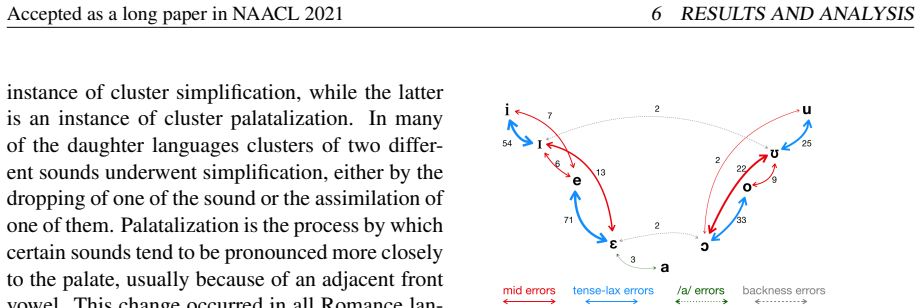
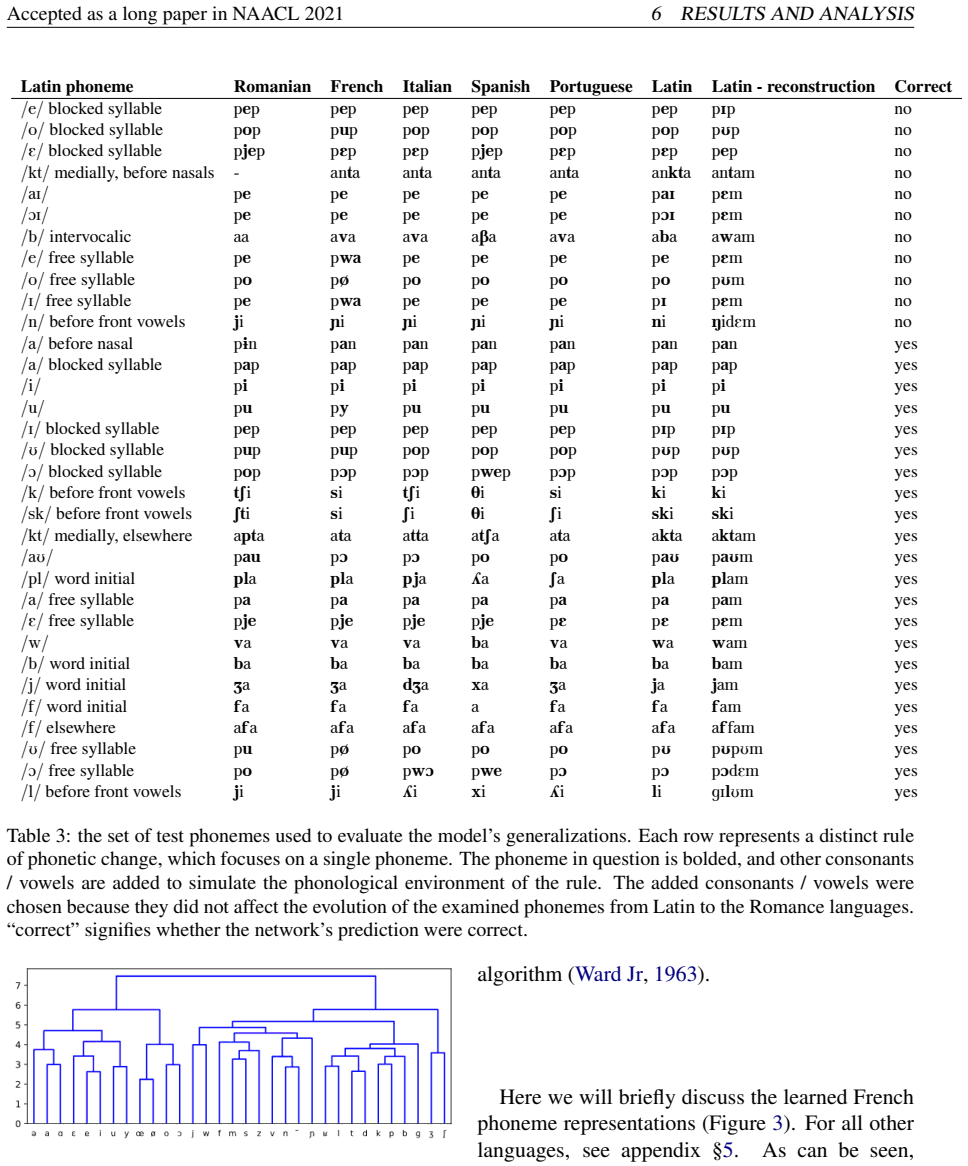
The central claim is that a supervised character-level encoder-decoder with attention can perform proto-word reconstruction well enough to beat earlier computational approaches, and that the model's internal representations and errors correspond to real historical phonology. Trained on sets of cognates tagged with their languages, the model reads the daughter forms and emits the Latin ancestor one character at a time. On the orthographic test set it reaches 64.1% exact reconstruction, 84.0% within one edit operation, with average edit distance 0.65 and normalized distance 0.064; the phonetic variant reaches 50.0% exact and normalized distance 0.100, with the gap largely explained by Latin tense-lax vowel contrasts that daughter languages neutralize. The paper further claims that roughly 80% of orthographic and 75% of phonetic errors fall into linguistically named categories, that the network correctly predicts 22 of 33 documented phonological-change rules on a synthetic test, and that its learned phoneme embeddings cluster into a phonologically meaningful hierarchy (vowels vs. consonants, voiced vs. voiceless pairs, allophones) without explicit supervision.
Load-bearing premise
The results stand on the dataset's correctness: the Wiktionary-derived cognate sets were manually checked only in part and the automatic IPA transcriptions were verified on only 200 words, so systematic errors in the unverified entries would distort every reported reconstruction score and every conclusion about learned sound changes.
Editorial extensions
If this is right
- For well-attested language families, large-scale reconstruction of proto-lexicons becomes a semi-automatic process: linguists supply or verify cognate sets, and the model proposes ancestor forms that can be checked.
- The systematic error categories make the model a diagnostic instrument: where reconstruction fails, the failure identifies sound changes that daughter languages have made opaque, indicating where extra evidence such as inscriptions or other branches is needed.
- The phonologically structured embeddings suggest that training on reconstruction tasks is a way to learn phoneme taxonomies without labeled data, which could transfer to under-resourced languages.
- The public 8,799-entry dataset gives the field a common benchmark, so future reconstruction methods can be compared on the same cognate sets and metrics.
Reading between the lines
- If the pattern generalizes, the same architecture could be tested on other attested proto-languages, such as Germanic or Slavic families, to see whether the 64% exact-reconstruction rate is typical or specific to the conservative orthography and close relatedness of Romance languages.
- Because the model's success depends on having access to the full cognate set, a natural next step is to couple it with automatic cognate detection and measure how reconstruction accuracy degrades as cognate sets become noisier or incomplete.
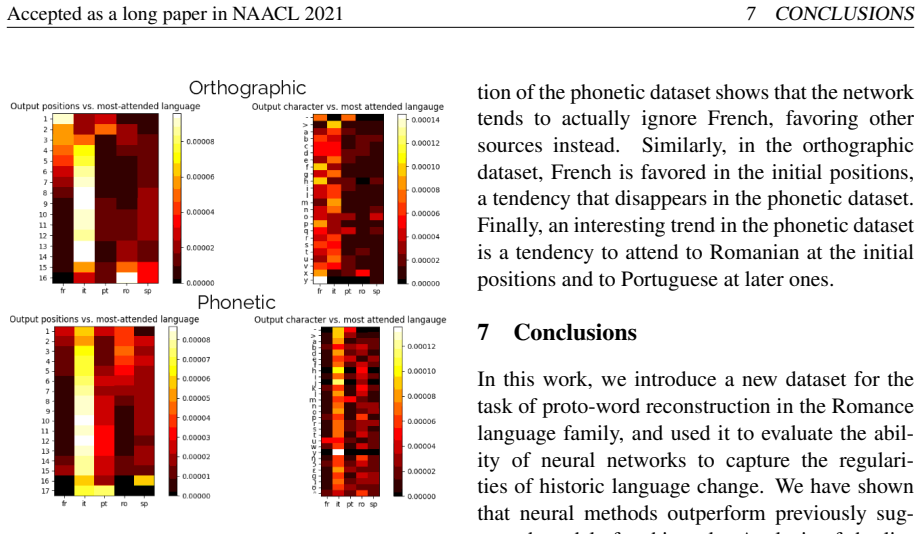
- The attention analysis suggests a concrete, testable extension: if a daughter language is most attended at a position, removing its cognate should hurt reconstruction at that position more than removing a low-attention language's cognate; this prediction could be checked with ablation experiments.
- If model errors reliably flag opaque changes, the same approach could be used to triage large dictionaries for human etymological review, making the comparative method faster without replacing the linguist.
Signed reviews
Editorial analysis
A structured set of objections, weighed in public.
Referee Report
Summary. The paper addresses automated proto-word reconstruction: given cognate forms in five Romance daughter languages, a character-level neural encoder-decoder predicts the Latin proto-word. The authors contribute a new dataset of 8,799 comparative entries, combining a cleaned version of the Ciobanu and Dinu (2014b) dataset with Wiktionary-derived additions, in both orthographic and eSpeak-transcribed IPA forms. On a held-out test set, the orthographic model achieves an average edit distance of 0.65, normalized edit distance of 0.064, and 64.1% exact reconstructions, which the authors compare favorably to the 1.07 average edit distance reported by Ciobanu and Dinu (2018). The paper also provides an error taxonomy, a synthetic test of 33 documented phonological-change rules, a hierarchical clustering of learned phoneme embeddings, and an attention analysis across languages.
Significance. If the results hold, this is a valuable contribution to computational historical linguistics. The new dataset is substantially larger than existing resources and the cleaning protocol demonstrably improves data quality (43 errors in a 300-entry sample of the original data versus 4 in the cleaned data). The synthetic rule evaluation, in which the model correctly handles 22 of 33 documented sound changes, and the learned-embedding analysis provide evidence that the model internalizes phonologically meaningful regularities rather than merely memorizing surface correspondences. The paper is also refreshingly explicit about the limits of the supervised setting relative to the historical linguist's task. However, the strength of these conclusions is tempered by evaluation-protocol issues: the headline comparison to prior work is cross-dataset, the test set is not fully reproducible from the public release, and the ground-truth labels rest on relatively small manual verification samples.
major comments (3)
- [Section 6, Table 1] The abstract and Section 6 claim that neural sequence models outperform conventional methods 'applied to this task so far,' but the only quantitative basis is a cross-dataset comparison to Ciobanu and Dinu (2018), who evaluated on a different, unreleased test set. No baseline is run on the new 1,055-entry test set, so the reader cannot tell whether the 0.65 edit distance reflects model quality or dataset ease. Footnote 7 mitigates the concern by reporting a smaller model on the original dataset (0.881 vs. 1.07), but that is still a comparison across implementations and hyperparameters. Add same-data baselines to Table 1, such as the CRF of Ciobanu and Dinu (2018) re-run on the new dataset or a simple alignment/majority baseline, to support the superiority claim on a common benchmark.
- [Section 4 and footnote 6] The test split of 1,055 entries is not fully reproducible: the release excludes entries that appeared in the original Ciobanu and Dinu (2014b) dataset, and the random split is not seeded or otherwise described. Moreover, all reported metrics come from a single training run, with no variance estimate. Because the headline numbers (0.65 average edit distance, 64.1% exact match) are the paper's central quantitative claim, the authors should report results over multiple random seeds (mean and standard deviation), state the seed used for the split, and either release the full test set (including cleaned original entries if legally possible) or release the model's test-set predictions so the exact numbers can be independently verified.
- [Appendix A.1] The quality of the ground-truth labels is established by manual checks of only 300 entries for error counting and 200 IPA transcriptions out of 8,799 entries and over 41,000 distinct words. The paper's own footnote 7 shows that preprocessing decisions of the kind in question change average edit distance by more than 0.2 units (0.881 vs. 0.612 on the original dataset), so label noise is not a negligible factor. A structured audit of a larger sample, stratified by source (Ciobanu-Dinu vs. Wiktionary) and by language, is needed to rule out systematic errors in the unverified majority, particularly for the Wiktionary additions and the eSpeak vowel-length and quality transcriptions.
minor comments (6)
- [Table 1] The table header contains typos: 'Ortographic' should be 'Orthographic' and 'datsaets' should be 'datasets'.
- [Section 6.1] In the paragraph on 'Other vowel changes,' 'This lef to reconstruction errors' should read 'This led to reconstruction errors'; also, 'A separated case is that of Greek words' should be 'A separate case.'
- [Section 6] In the discussion of vowel-length datasets, 'lenghts' should be 'lengths' (two occurrences).
- [Section 3] The running example uses 'lactem' as the Latin word for 'milk'; classical Latin is 'lac' (genitive 'lactis'). If the dataset normalizes to a later or analogical accusative form, this should be stated explicitly for readers unfamiliar with the normalization.
- [Section 5.1] Training details such as number of epochs, learning rate, optimizer, batch size, and early-stopping criterion are not reported; these details are needed for reproducibility.
- [Section 6.5 / Figure 4] The figure caption and text should define precisely how the counts are normalized ('with respect to time step, letter frequency and language frequency in the corpus') and state whether the reported values are percentages or ratio scores.
Circularity Check
No circularity found: the central reconstruction result is a supervised held-out evaluation, and the supporting analyses use externally sourced phonological rules and unsupervised representations.
full rationale
The paper's central claim is empirical: a character-level GRU encoder-decoder, trained on (cognate-set, Latin proto-form) pairs, predicts held-out Latin forms with an average edit distance of 0.65. The test split of 1,055 entries is disjoint from the training split, and the target labels are gold Latin forms from Ciobanu and Dinu (2014b) plus manually checked Wiktionary entries, not outputs of the model. The comparison to Ciobanu and Dinu (2018) is explicitly hedged in footnote 7, which reports re-runs on the original and cleaned datasets, so the improvement claim is not an imported conclusion. The error taxonomy in Table 2 is a post hoc analysis of model outputs rather than an input to training. The synthetic-rule evaluation in Section 6.3 uses 33 phonological rules drawn from external historical-linguistics references (Boyd-Bowman 1980; Alkire and Rosen 2010) and evaluates isolated syllables distinct from the training distribution. The phoneme-embedding analysis is an unsupervised clustering of the model's own learned representations, and the attention analysis inspects the model's behavior without imposing the conclusion. The main caveats—limited manual verification of Wiktionary and eSpeak labels, the non-public release of the original Ciobanu-Dinu entries, and the absence of seed-variance reporting—are data-quality and reproducibility concerns, not circularity. No equation in the paper reduces to its own input, and no load-bearing result is justified solely by a self-citation.
Assumptions & free parameters
free parameters (4)
- Encoder/decoder hidden size =
150
- Character embedding size =
100
- MLP hidden units =
200
- Train/eval/test split =
80/8/12%
assumptions (4)
- domain assumption Regularity of sound change
- domain assumption Accuracy of eSpeak IPA transcriptions
- domain assumption Correctness of cognate annotations and Latin lemmas
- standard math Representativeness of the random split
Cite this review
Pith. "Pith review of Ab Antiquo: Neural Proto-language Reconstruction." pith.science (2026). https://pith.science/paper/DSAUU4GS
@misc{pith2026190802477,
  author       = {Pith},
  title        = {Pith review of: Ab Antiquo: Neural Proto-language Reconstruction},
  year         = {2026},
  howpublished = {\url{https://pith.science/paper/DSAUU4GS}},
  note         = {Machine review of arXiv:1908.02477}
}
read the original abstract
Historical linguists have identified regularities in the process of historic sound change. The comparative method utilizes those regularities to reconstruct proto-words based on observed forms in daughter languages. Can this process be efficiently automated? We address the task of proto-word reconstruction, in which the model is exposed to cognates in contemporary daughter languages, and has to predict the proto word in the ancestor language. We provide a novel dataset for this task, encompassing over 8,000 comparative entries, and show that neural sequence models outperform conventional methods applied to this task so far. Error analysis reveals variability in the ability of neural model to capture different phonological changes, correlating with the complexity of the changes. Analysis of learned embeddings reveals the models learn phonologically meaningful generalizations, corresponding to well-attested phonological shifts documented by historical linguistics.
Figures

Figures from the paper (1 more)
Reference graph
Works this paper leans on
-
[1]
URL: " 'urlintro :=
ENTRY address author booktitle chapter edition editor howpublished institution journal key month note number organization pages publisher school series title type volume year eprint doi pubmed url lastchecked label extra.label sort.label short.list INTEGERS output.state before.all mid.sentence after.sentence after.block STRINGS urlintro eprinturl eprintpr...
-
[2]
write newline
" write newline "" before.all 'output.state := FUNCTION n.dashify 't := "" t empty not t #1 #1 substring "-" = t #1 #2 substring "--" = not "--" * t #2 global.max substring 't := t #1 #1 substring "-" = "-" * t #2 global.max substring 't := while if t #1 #1 substring * t #2 global.max substring 't := if while FUNCTION word.in bbl.in capitalize " " * FUNCT...
-
[3]
, " * write output.state after.block = add.period write newline
ENTRY address author booktitle chapter edition editor howpublished institution journal key month note number organization pages publisher school series title type volume year label extra.label sort.label short.list INTEGERS output.state before.all mid.sentence after.sentence after.block FUNCTION init.state.consts #0 'before.all := #1 'mid.sentence := #2 '...
-
[4]
write newline
" write newline "" before.all 'output.state := FUNCTION n.dashify 't := "" t empty not t #1 #1 substring "-" = t #1 #2 substring "--" = not "--" * t #2 global.max substring 't := t #1 #1 substring "-" = "-" * t #2 global.max substring 't := while if t #1 #1 substring * t #2 global.max substring 't := if while FUNCTION word.in bbl.in capitalize " " * FUNCT...
-
[5]
Ti Alkire and Carol Rosen. 2010. Romance languages: A historical introduction. Cambridge University Press
work page 2010
-
[6]
W Sidney Allen and William Sidney Allen. 1989. Vox latina. Cambridge University Press
work page 1989
-
[7]
Raimo Anttila. 1989. Historical and comparative linguistics, volume 6. John Benjamins Publishing
work page 1989
-
[8]
Dzmitry Bahdanau, Kyunghyun Cho, and Yoshua Bengio. 2015. http://arxiv.org/abs/1409.0473 Neural machine translation by jointly learning to align and translate . In 3rd International Conference on Learning Representations, ICLR 2015, San Diego, CA, USA, May 7-9, 2015, Conference Track Proceedings
arXiv 2015
Show all 41 references
-
[9]
Alexandre Bouchard-C \^o t \'e , Thomas L Griffiths, and Dan Klein. 2009. Improved reconstruction of protolanguage word forms. In Proceedings of human language technologies: The 2009 annual conference of the north american chapter of the association for computational linguisti...
2009
-
[10]
Alexandre Bouchard-C \^o t \'e , David Hall, Thomas L Griffiths, and Dan Klein. 2013. Automated reconstruction of ancient languages using probabilistic models of sound change. Proceedings of the National Academy of Sciences, 110(11):4224--4229
2013
-
[11]
Griffiths, and Dan Klein
Alexandre Bouchard - C \^ o t \' e , Percy Liang, Thomas L. Griffiths, and Dan Klein. 2007. http://www.aclweb.org/anthology/D07-1093 A probabilistic approach to diachronic phonology . In EMNLP-CoNLL 2007, Proceedings of the 2007 Joint Conference on Empirical Methods in Natural...
2007
-
[12]
Peter Boyd-Bowman. 1980. From Latin to Romance in sound charts. Georgetown University Press
1980
-
[13]
Kyunghyun Cho, Bart van Merrienboer, Dzmitry Bahdanau, and Yoshua Bengio. 2014. http://aclweb.org/anthology/W/W14/W14-4012.pdf On the properties of neural machine translation: Encoder-decoder approaches . In Proceedings of SSST@EMNLP 2014, Eighth Workshop on Syntax, Semantics ...
2014
-
[14]
Alina Maria Ciobanu and Liviu P Dinu. 2014 a . Automatic detection of cognates using orthographic alignment. In Proceedings of the 52nd Annual Meeting of the Association for Computational Linguistics (Volume 2: Short Papers), volume 2, pages 99--105
2014
-
[15]
Alina Maria Ciobanu and Liviu P Dinu. 2014 b . Building a dataset of multilingual cognates for the romanian lexicon. In Proceedings of the 9th International Conference on Language Resources and Evaluation, LREC, pages 1038--1043
2014
-
[16]
Alina Maria Ciobanu and Liviu P Dinu. 2018. Ab initio: Automatic latin proto-word reconstruction. In Proceedings of the 27th International Conference on Computational Linguistics, pages 1604--1614
2018
-
[17]
J Halvor Clegg and Willis C Fails. 2017. Manual de fon \'e tica y fonolog \' a espa \ n olas . Routledge
2017
-
[18]
Josette Rey Debove and Alain Rey. 2000. Le Nouveau Petit Robert: Dictionnaire alphabetique et analogique de la langue francaise. Dictionnaires Le Robert
2000
-
[19]
Friedrich Christian DIEZ and TC Donkin. 1864. An Etymological Dictionary of the Romance Languages; chiefly from the German of F. Diez. By TC Donkin. Williams and Norgate
-
[20]
Gerhard Ernst. 2003. Romanische Sprachgeschichte: Ein Internationales Handbuch Zur Geschichte Der Romanischen Sprachen Und Ihrer Erforschung/Manuel International Sur L'Histoire Et L'Etude Linguistique DES Langues Romanes. Mouton de Gruyter
2003
-
[21]
F \'e lix Gaffiot and Pierre Flobert. 1934. Dictionnaire latin-fran c ais . Hachette Paris
1934
-
[22]
Robert A Hall. 1944. Italian phonemes and orthography. Italica, 21(2):72--82
1944
-
[23]
Martin Harris and Nigel Vincent. 2003. The romance languages. Routledge
2003
-
[24]
G \"u nter Holtus, Michael Metzeltin, and Christian Schmitt. 1989. LRL, volume 3. M. Niemeyer
1989
-
[25]
Diana Inkpen, Oana Frunza, and Grzegorz Kondrak. 2005. Automatic identification of cognates and false friends in french and english. In Proceedings of the International Conference Recent Advances in Natural Language Processing, volume 9, pages 251--257
2005
-
[26]
Grzegorz Kondrak. 2001. Identifying cognates by phonetic and semantic similarity. In Proceedings of the second meeting of the North American Chapter of the Association for Computational Linguistics on Language technologies, pages 1--8. Association for Computational Linguistics
2001
-
[27]
Adam Ledgeway and Martin Maiden. 2016. The Oxford guide to the Romance languages, volume 1. Oxford University Press
2016
-
[28]
Lewis and Charles Short
Charlton T. Lewis and Charles Short. 1879. A latin dictionary. Perseus Digital Library
-
[29]
McCarthy, and David Yarowsky
Dylan Lewis, Winston Wu, Arya D. McCarthy, and David Yarowsky. 2020. https://doi.org/10.18653/v1/2020.coling-main.387 Neural transduction for multilingual lexical translation . In Proceedings of the 28th International Conference on Computational Linguistics, COLING 2020, Barce...
2020 doi
-
[30]
Johann-Mattis List, Philippe Lopez, and Eric Bapteste. 2016. Using sequence similarity networks to identify partial cognates in multilingual wordlists. In Proceedings of the 54th Annual Meeting of the Association for Computational Linguistics (Volume 2: Short Papers), volume 2...
2016
-
[31]
Mann and David Yarowsky
Gideon S. Mann and David Yarowsky. 2001. http://aclweb.org/anthology/N/N01/N01-1020.pdf Multipath translation lexicon induction via bridge languages . In Language Technologies 2001: The Second Meeting of the North American Chapter of the Association for Computational Linguisti...
2001
-
[32]
Maria Helena Mateus and Ernesto d'Andrade. 2000. The phonology of Portuguese. OUP Oxford
2000
-
[33]
Robert McColl Millar. 2013. Trask's historical linguistics. Routledge
2013
-
[34]
Andrea Mulloni and Viktor Pekar. 2006. Automatic detection of orthographics cues for cognate recognition. In LREC, pages 2387--2390
2006
-
[35]
Yuta Nishimura, Katsuhito Sudoh, Graham Neubig, and Satoshi Nakamura. 2020. https://doi.org/10.1109/TASLP.2019.2959224 Multi-source neural machine translation with missing data . IEEE ACM Trans. Audio Speech Lang. Process. , 28:569--580
2020
-
[36]
Fabian Pedregosa, Ga \"e l Varoquaux, Alexandre Gramfort, Vincent Michel, Bertrand Thirion, Olivier Grisel, Mathieu Blondel, Peter Prettenhofer, Ron Weiss, Vincent Dubourg, et al. 2011. Scikit-learn: Machine learning in python. Journal of machine learning research, 12(Oct):2825--2830
2011
-
[37]
Taraka Rama, Johann - Mattis List, Johannes Wahle, and Gerhard J \" a ger. 2018. https://aclanthology.info/papers/N18-2063/n18-2063 Are automatic methods for cognate detection good enough for phylogenetic reconstruction in historical linguistics? In Proceedings of the 2018 Con...
2018
-
[38]
Mika Sarlin. 2014. Romanian grammar. BoD-Books on Demand
2014
-
[39]
Joe H Ward Jr. 1963. Hierarchical grouping to optimize an objective function. Journal of the American statistical association, 58(301):236--244
1963
-
[40]
Winston Wu, Garrett Nicolai, and David Yarowsky. 2020. https://www.aclweb.org/anthology/2020.lrec-1.519/ Multilingual dictionary based construction of core vocabulary . In Proceedings of The 12th Language Resources and Evaluation Conference, LREC 2020, Marseille, France, May 1...
2020
-
[41]
Winston Wu and David Yarowsky. 2018. http://www.lrec-conf.org/proceedings/lrec2018/summaries/934.html Creating large-scale multilingual cognate tables . In Proceedings of the Eleventh International Conference on Language Resources and Evaluation, LREC 2018, Miyazaki, Japan, Ma...
2018
Reviewed August 14, 2026 · model on record in the stance chip above.
Discussion (0). Continue with ORCID to comment.