REVIEW 3 major objections 4 minor 23 references
Joint Precoding and Power Control in Small-Cell Networks With Proportional-Rate MISO-BC Backhaul
T0 review · 3 major / 4 minor · reviewed 2026-08-14 · deepseek-v4-flash
Pith's one-line read This paper claims that the non-convex joint precoding and power-control problem for small-cell networks with proportional-rate MISO broadcast backhauls can be solved optimally by first fixing rate ratios from the QoS constraints, then…
desk verdict The problem formulation is new and the decoupling idea is plausible, but the closed-form precoder (26) is arithmetically wrong, so the paper's optimality claim fails as written. read the letter →
The pith
A machine-rendered reading of the paper's core claim, the machinery that carries it, and where it could break.
The reading
What carries the argument
The load-bearing mechanism is a two-stage decoupling driven by Proposition 1 (all flow-conservation and QoS constraints active at the optimum). Once those constraints are active, the backhaul rates are fixed numbers $R_m^{\mathrm{REQ}}$, so the proportional-rate constraints become linear equations that fix the ratios $\phi_m^*$; the non-convex joint problem splits into a convex access-link power-control subproblem and a backhaul-precoding subproblem. The backhaul subproblem is solved by invoking the uplink–downlink duality of Gaussian MIMO broadcast channels: the rate of each dirty-paper-coded stream can be written as $\log|\Psi_{\pi_m}| - \log|\Theta_{\pi_m}|$ in the dual uplink, the optimal dual powers are given in closed form by (25), and the covariance injection (22) turns these into the closed-form downlink precoding vectors (26). The named identity doing the work is therefore the broadcast-channel / multiple-access-channel duality combined with the active-constraint reduction.
What would settle it
For a small network—say two base stations and one user each—enumerate or globally optimize the original problem over all feasible precoding covariances and access powers for fixed channels, and compare with the two-stage solution. If any optimum has a flow-conservation constraint strictly loose ($R_m^B > \sum_n R_{m,n}^A$ for some $m$), or if the two-stage solution's total power is higher than the global optimum, then Proposition 1 and the closed-form solution fail to solve the stated problem. Such a counterexample can be sought by random search over channel realizations.
Extended reading notes
Core claim
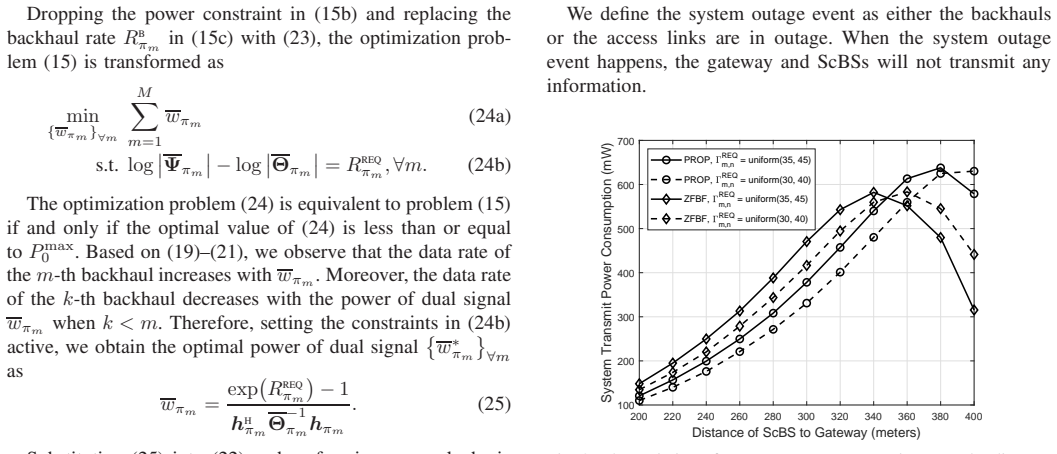
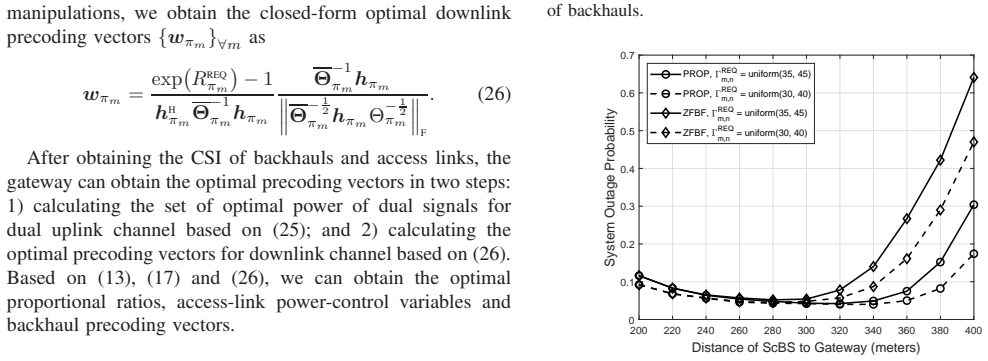
On its own terms, the paper establishes that the joint precoding and power-control (JPPc) problem—minimize $\sum_{m} \mathrm{Tr}(W_m) + \sum_{m,n} v_{m,n}$ subject to per-link rate and power constraints—can be solved optimally by decoupling it. Proposition 1 asserts that, apart from the proportional-rate constraints, at an optimum of the problem both the access QoS constraints and the flow-conservation constraints are active. The active flow constraints set the required backhaul rate of base station $m$ to $R_m^{\mathrm{REQ}} = \sum_n R_{m,n}^{\mathrm{REQ}}$, which fixes the proportional ratios $\phi_m^*$; the access subproblem then becomes a convex linear program in the powers $v_{m,n}$ with SINR equalities, and the backhaul subproblem, after the uplink–downlink duality transformation, has optimal dual powers and closed-form precoding vectors given by equations (25) and (26). The paper argues this solution is optimal for the original problem and demonstrates in simulation that, compared with a zero-forcing beamforming backhaul, it reduces system transmit power by about 20 percent and outage probability by 11–19 percentage points.
Load-bearing premise
The paper's decoupling stands on the assumption that at the optimum every backhaul link carries exactly the total rate its users require, never any extra; the proof of this for the backhaul constraints is only sketched by similar arguments, and it is not automatic under dirty-paper coding.
Editorial extensions
If this is right
- If the two-stage solution is correct, the proportional-rate fairness ratios are not free variables: they are dictated by the per-user QoS requirements, so fairness is enforced automatically by choosing QoS values.
- Access-link power control reduces to a linear feasibility and power-minimization problem solvable by any convex solver, with no need to iterate between backhaul and access optimization.
- Backhaul precoding vectors are obtained in closed form for a given encoding order, replacing iterative beamforming algorithms.
- Under the simulated settings the scheme lowers total transmit power by roughly 20 percent and system outage probability by 11–19 percentage points relative to a zero-forcing beamforming backhaul.
- The solution is only feasible when the optimal backhaul power does not exceed the gateway's maximum; beyond that threshold the system goes into outage with high probability.
Reading between the lines
- The closed-form backhaul precoders and fixed ratios suggest a natural online implementation: as long as the gateway can estimate channels and update the active rate equations, the beamformers can be recomputed sample-by-sample without running an iterative optimizer; this is a testable engineering claim the paper does not make.
- The same decoupling logic should extend to MIMO-BC backhauls with more than one receive antenna per base station, where the uplink–downlink duality still holds but the scalar dual-power formula becomes a matrix water-filling-type problem; whether the closed-form structure survives is an open extension.
- A direct test of Proposition 1's flow-conservation activeness—exhaustive search over small instances with, say, two base stations and one user per base station—would settle whether the two-stage solution is globally optimal or only an approximation; the paper's proof leaves this step by analogy.
Signed reviews
Editorial analysis
A structured set of objections, weighed in public.
Referee Report
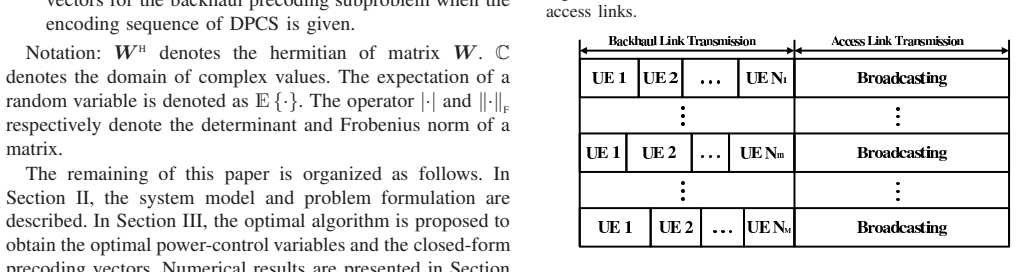
Summary. The manuscript considers a two-hop small-cell network in which an L-antenna gateway serves M single-antenna small-cell base stations over a dirty-paper-coded MISO broadcast backhaul, and each base station serves its users over interfering access links. It formulates problem (11) to minimize the total transmit power of the gateway and base stations subject to power budgets, per-user QoS constraints, proportional backhaul rates, and flow-conservation constraints. The paper claims that at the optimum all QoS and flow constraints are active, which fixes the backhaul rates and yields optimal proportional ratios; this decouples the problem into an access-link power-control subproblem (solved by convex programming) and a backhaul precoding subproblem for which closed-form precoders are proposed in equations (25) and (26). Simulation results compare the proposed scheme with zero-forcing beamforming and report lower transmit power and outage probability.
Significance. The high-level decoupling idea is appealing: if the active-constraint statement and the uplink-downlink transformation were valid, the paper would give a simple optimal solution to a meaningful non-convex resource-allocation problem, and the closed-form precoders would be practically valuable. The access subproblem (17) is indeed convex, and the paper does not fit any free parameters to data, so the analytic framework is potentially useful. However, the closed-form precoder formula is arithmetically wrong already for a single-user MISO channel, and the proof that all flow-conservation constraints are active is incomplete. Because the simulation results are generated by an algorithm that does not solve the stated backhaul subproblem, the central claims of optimality and of performance improvement are not established by this manuscript.
major comments (3)
- [Section III-C, Eq. (26)] The closed-form precoding vector is not correct, as can be seen in the simplest possible case. For M=1, Θ_{π_1}=σ²I and (25) gives the optimal dual power p=σ²(e^R−1)/‖h‖². Using the dimensionally consistent direction Θ^{-1}h/‖Θ^{-1/2}h‖ = h/(σ‖h‖), equation (26) yields w_1 = p h/(σ‖h‖), whose squared norm is σ²(e^R−1)²/‖h‖⁴, not p, and whose achieved rate is log(1+(e^R−1)²/‖h‖⁴), not R. The correct minimum-power precoder for this case is √p h/‖h‖. Thus (26) neither satisfies the rate constraint (15c) nor minimizes the power (15a), and the simulations in Section IV, which are based on (26), do not validate the claimed optimal algorithm.
- [Section III-C, Eq. (22)] The covariance transformation used to pass from dual uplink powers to downlink precoding vectors is not well defined as printed. In (22), u_{π_m} is a column vector, but the expression Θ_{π_m}^{-1/2} u_{π_m} Θ_{π_m} w_{π_m} u_{π_m}^H Θ_{π_m}^{-1/2} has incompatible dimensions for matrix multiplication, and the stated singular-value decomposition Θ_{π_m}^{-1/2} h_{π_m} Θ_{π_m}^{-1/2} = u_{π_m} λ_{π_m} treats the vector h_{π_m} as both a column and a row. This dimensional inconsistency propagates into (26) and must be repaired before the closed-form optimality claim can be assessed.
- [Appendix A, Proposition 1] The proof that constraints (11f) are active is acceptable, but the activeness of the flow-conservation constraints (11d) is dismissed with the sentence that 'similar arguments' can be used, and this step is not automatic. In a dirty-paper-coded backhaul, the rate of a given link depends on the covariances of other links through Ψ_{π_m} and Θ_{π_m}; lowering a transmit covariance W_m can increase the rates of users encoded later, and lowering access powers changes the interference seen by other access users. Since the entire decoupling into subproblems (14) and (15), and the fixed backhaul rates in (12), rely on all constraints (11d) being active at the optimum, this activeness claim is load-bearing and requires a rigorous proof rather than an analogy.
minor comments (4)
- [Section III-A, Eq. (13)] The expression for the optimal proportional ratio is mis-indexed: φ_m^* cannot depend on a free index n on the right-hand side. It should read φ_m^* = Σ_{n=1}^{N_m} R^{REQ}_{m,n} / Σ_{k=1}^M Σ_{n=1}^{N_k} R^{REQ}_{k,n}.
- [Equations (3) and (14c)] There are several notation inconsistencies: equation (3) contains a stray 's' in the capacity region definition, and the SINR notation in (14c) should be SINR^A_{m,n} to match the definition in (7).
- [Equation (26)] The Frobenius norm in (26) is applied to a rank-one object whose dimensions are unclear; the intended norm appears to be the Euclidean norm of a vector, and this should be stated explicitly.
- [Section IV] The units of the required SINR values drawn uniformly from (35,45) or (30,40) should be clarified; if these are in dB, they are extremely high, and the explanation of the non-monotonic power behavior in Figure 3 should state explicitly how outage events are averaged.
Circularity Check
No significant circularity: the derivation is self-contained and follows from stated assumptions plus standard external results.
full rationale
The derivation chain is self-contained. The proportional ratios in (13) follow from Proposition 1 and the substitution R_B^m = sum_n R_REQ_{m,n} into constraint (11c); this is a direct algebraic substitution of fixed QoS values, not a fitted parameter renamed as a prediction. The decoupling of (11) into the access subproblem (14) and the backhaul subproblem (15) is a separable reformulation once (11d) and (11f) are active, and the objective is exactly the sum of backhaul and access powers with no remaining coupling constraints. The backhaul precoding derivation relies on the MAC-BC duality from references [18] and [22], which are standard external information-theoretic results; the paper does not invoke its own prior work as the load-bearing justification. The closed-form dual power in (25) is obtained by monotonicity of rates in the dual powers, and equation (26) is presented as an algebraic consequence of substituting (25) into (22). Even if equation (26) contains a dimensional or arithmetic error, as a skeptical check suggests, that is a correctness defect, not circularity: the claimed result is not assumed as an input. The proof of Proposition 1 has a known gap (Appendix A only says 'similar arguments' for activeness of (11d)), but an omitted proof is not a circular reduction. No parameter is fitted to the output, and the simulation section compares the proposed scheme against an external zero-forcing beamforming benchmark, so the claimed performance gain is not manufactured by construction. The paper's self-citations are contextual and do not carry the central optimality claim.
Assumptions & free parameters
assumptions (7)
- standard math Uplink-downlink duality for Gaussian MISO BC/MAC channels
- standard math DPC capacity region formula for MISO broadcast channels
- domain assumption Channel state information is perfectly known at the gateway for all backhaul and access links
- domain assumption Backhaul and access links operate in orthogonal time slots and do not interfere
- ad hoc to paper At the optimum, all flow-conservation constraints (11d) are active
- domain assumption Access transmit powers are nonnegative
- domain assumption The target rates are feasible given the gateway and small-cell power limits
Cite this review
Pith. "Pith review of Joint Precoding and Power Control in Small-Cell Networks With Proportional-Rate MISO-BC Backhaul." pith.science (2026). https://pith.science/paper/DSJ2OXTE
@misc{pith2026190804885,
  author       = {Pith},
  title        = {Pith review of: Joint Precoding and Power Control in Small-Cell Networks With Proportional-Rate MISO-BC Backhaul},
  year         = {2026},
  howpublished = {\url{https://pith.science/paper/DSJ2OXTE}},
  note         = {Machine review of arXiv:1908.04885}
}
read the original abstract
In the small-cell networks with multiple-input-single-output broadcasting (MISO-BC) backhauls, the joint dirty-paper coding and power control are investigated for the \mbox{MISO-BC} backhauls and access links in order to minimize the system transmit power. Considering the proportional rates of MISO-BC backhauls and flow-conservation constraints, the formulated optimization problem is \mbox{non-convex}. Moreover, the formulated problem couples the precoding vectors with the power-control variables. In order to handle the \mbox{non-convex} optimization problem and decouple the backhaul and access links, the structure of the formulated problem is investigated such that the optimal precoding vectors and optimal power-control variables are independently obtained. Moreover, the optimal precoding vectors are obtained in closed-form expressions. Simulation results are used to show the performance improvement over the benchmark scheme.
Figures

Figures from the paper (1 more)
Reference graph
Works this paper leans on
-
[1]
Improving network capacity s caling law in ultra-dense small cell networks,
J. Liu, M. Sheng, and J. Li, “Improving network capacity s caling law in ultra-dense small cell networks,” IEEE Trans. Wireless Commun., vol. 17, no. 9, pp. 6218–6230, Sept. 2018
work page 2018
-
[2]
Wire less backhauling of 5G small cells: challenges and solution appr oaches,
U. Siddique, H. Tabassum, E. Hossain, and D. I. Kim, “Wire less backhauling of 5G small cells: challenges and solution appr oaches,” IEEE Wireless Commun. , vol. 22, no. 5, pp. 22–31, Oct. 2015
work page 2015
-
[3]
Fronthauling for 5G LTE-U ultra dense cloud small cell netw orks,
H. Zhang, Y . Dong, J. Cheng, M. J. Hossain, and V . C. M. Leun g, “Fronthauling for 5G LTE-U ultra dense cloud small cell netw orks,” IEEE Wireless Commun. , vol. 23, no. 6, pp. 48–53, Dec. 2016
work page 2016
-
[4]
Front haul-aware group sparse precoding and signal splitting in SWIPT C-RAN,
Y . Dong, M. J. Hossain, J. Cheng, and V . C. M. Leung, “Front haul-aware group sparse precoding and signal splitting in SWIPT C-RAN, ” in Proc. Globecom, Singapore, Dec. 2017, pp. 1–6
work page 2017
-
[5]
Cache- enabled physical layer security for video streaming in backhaul-li mited cellular networks,
L. Xiang, D. W. K. Ng, R. Schober, and V . W. S. Wong, “Cache- enabled physical layer security for video streaming in backhaul-li mited cellular networks,” IEEE Trans. Wireless Commun. , vol. 17, no. 2, pp. 736–751, Feb. 2018
work page 2018
-
[6]
J. Ma, S. Zhang, H. Li, N. Zhao, and V . C. M. Leung, “Interfe rence- alignment and soft-space-reuse based cooperative transmi ssion for multi- cell massive MIMO networks,” IEEE Trans. Wireless Commun. , vol. 17, no. 3, pp. 1907–1922, Mar. 2018
work page 1907
-
[7]
Secur e distributed on-device learning networks with Byzantine ad versaries,
Y . Dong, J. Cheng, M. J. Hossain, and V . C. M. Leung, “Secur e distributed on-device learning networks with Byzantine ad versaries,” IEEE Netw., pp. 1–8, to be published, 2019
work page 2019
-
[8]
M. Z. Hassan, M. J. Hossain, J. Cheng, and V . C. M. Leung, “J oint FSO fronthaul and millimeter-wave access link optimization in cloud small cell networks: A statistical-QoS aware approach,” IEEE Trans. Commun., to be published
Show all 23 references
-
[9]
Heterogeneous cellula r networks using wireless backhaul: Fast admission control and large s ystem anal- ysis,
J. Zhao, T. Q. S. Quek, and Z. Lei, “Heterogeneous cellula r networks using wireless backhaul: Fast admission control and large s ystem anal- ysis,” IEEE J. Sel. Areas in Commun. , vol. 33, no. 10, pp. 2128–2143, Oct. 2015
2015
-
[10]
Power optimizat ion with BLER constraint for wireless fronthauls in C-RAN,
T. X. Vu, T. V . Nguyen, and T. Q. S. Quek, “Power optimizat ion with BLER constraint for wireless fronthauls in C-RAN,” IEEE Commun. Lett., vol. 20, no. 3, pp. 602–605, Mar. 2016
2016
-
[11]
Mobile edge co mputing empowered energy efficient task offloading in 5G,
L. Y ang, H. Zhang, M. Li, J. Guo, and H. Ji, “Mobile edge co mputing empowered energy efficient task offloading in 5G,” IEEE Trans. V eh. Technol., vol. 67, no. 7, pp. 6398–6409, July 2018
2018
-
[12]
Downlink e nergy ef- ficiency of power allocation and wireless backhaul bandwidt h allocation in heterogeneous small cell networks,
H. Zhang, H. Liu, J. Cheng, and V . C. M. Leung, “Downlink e nergy ef- ficiency of power allocation and wireless backhaul bandwidt h allocation in heterogeneous small cell networks,” IEEE Trans. Commun. , vol. 66, no. 4, pp. 1705–1716, Apr. 2018
2018
-
[13]
Green full-duplex self-backhaul and energy harvesting small cel l networks with massive MIMO,
L. Chen, F. R. Y u, H. Ji, B. Rong, X. Li, and V . C. M. Leung, “ Green full-duplex self-backhaul and energy harvesting small cel l networks with massive MIMO,” IEEE J. Sel. Areas Commun. , vol. 34, no. 12, pp. 3709– 3724, Dec. 2016
2016
-
[14]
Caching UA V assisted secure transmission in hyper-dense n etworks based on interference alignment,
N. Zhao, F. Cheng, F. R. Y u, J. Tang, Y . Chen, G. Gui, and H. Sari, “Caching UA V assisted secure transmission in hyper-dense n etworks based on interference alignment,” IEEE Trans. Commun. , vol. 66, no. 5, pp. 2281–2294, May 2018
2018
-
[15]
Designing wireless b ackhaul het- erogeneous networks with small cell buffering,
T. M. Nguyen, W. Ajib, and C. Assi, “Designing wireless b ackhaul het- erogeneous networks with small cell buffering,” IEEE Trans. Commun. , vol. 66, no. 10, pp. 4596–4610, Oct. 2018
2018
-
[16]
Downlink optimization in clou d radio access networks with hybrid RF/FSO fronthaul,
A. Mostafa and L. Lampe, “Downlink optimization in clou d radio access networks with hybrid RF/FSO fronthaul,” in 2018 IEEE Globecom W orkshops (GC Wkshps), Dec. 2018, pp. 1–7
2018
-
[17]
Small cell cluster-based resource a llocation for wireless backhaul in two-tier heterogeneous networks w ith massive MIMO,
W. Hao and S. Y ang, “Small cell cluster-based resource a llocation for wireless backhaul in two-tier heterogeneous networks w ith massive MIMO,” IEEE Trans. V eh. Technol. , vol. 67, no. 1, pp. 509–523, Jan. 2018
2018
-
[18]
Optimal MIMO broadcasting for energy harvesting transmitter with non-ideal circuit power consu mption,
X. Wang, Z. Nan, and T. Chen, “Optimal MIMO broadcasting for energy harvesting transmitter with non-ideal circuit power consu mption,” IEEE Trans. Wireless Commun. , vol. 14, no. 5, pp. 2500–2512, May 2015
2015
-
[19]
Solution of the multiuser dow nlink beam- forming problem with individual SINR constraints,
M. Schubert and H. Boche, “Solution of the multiuser dow nlink beam- forming problem with individual SINR constraints,” IEEE Trans. V eh. Technol., vol. 53, no. 1, pp. 18–28, Jan. 2004
2004
-
[20]
Robu st energy efficient beamforming in MISOME-SWIPT systems with proport ional secrecy rate,
Y . Dong, M. J. Hossain, J. Cheng, and V . C. M. Leung, “Robu st energy efficient beamforming in MISOME-SWIPT systems with proport ional secrecy rate,” IEEE J. Sel. Areas Commun. , vol. 37, no. 1, pp. 202–215, Jan. 2019
2019
-
[21]
CVX: Matlab software for discip lined convex programming, version 2.1,
M. Grant and S. P . Boyd, “CVX: Matlab software for discip lined convex programming, version 2.1,” http://cvxr.com/cvx, Mar. 201 4
-
[22]
Duality, a chievable rates, and sum-rate capacity of gaussian MIMO broadcast channels,
S. Vishwanath, N. Jindal, and A. Goldsmith, “Duality, a chievable rates, and sum-rate capacity of gaussian MIMO broadcast channels, ” IEEE Trans. Inform. Theory , vol. 49, no. 10, pp. 2658–2668, Oct. 2003
2003
-
[23]
Study on channel model for frequencies from 0.5 t o 100 Ghz,
3GPP , “Study on channel model for frequencies from 0.5 t o 100 Ghz,” 3GPP TR 38.901 v14.3.0, Tech. Rep., Jan. 2018
2018
Reviewed August 14, 2026 · model on record in the stance chip above.
Discussion (0). Continue with ORCID to comment.