REVIEW 3 major objections 2 minor 102 references
The effect of grain boundaries on magnetic exchange interactions in iron
T0 review · 3 major / 2 minor · reviewed 2026-07-12 · grok-4.5
Pith's one-line read Grain boundaries reshape local magnetic exchange in iron but barely lower the Curie temperature at realistic densities.
desk verdict Useful applied claim on Fe GB magnetism, but we only have the abstract—the cached full text is the wrong paper—so the Tc result cannot be checked. read the letter →
The pith
A machine-rendered reading of the paper's core claim, the machinery that carries it, and where it could break.
The reading
What carries the argument
Heisenberg exchange parameters computed by density-functional theory plus the Liechtenstein–Katsnelson–Antropov–Gubanov Green’s-function method, then inserted into classical Monte Carlo simulations that map local exchange changes onto the finite-temperature Curie point.
What would settle it
Measure the Curie temperature of carefully prepared polycrystalline iron samples whose grain-boundary volume fraction and phosphorus segregation level are independently quantified and compare the observed shift with the Monte Carlo prediction for the same volume fraction.
Extended reading notes
Core claim
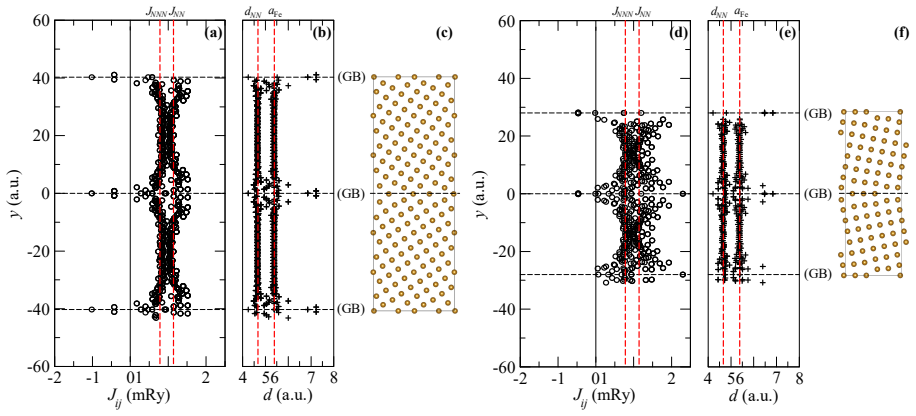
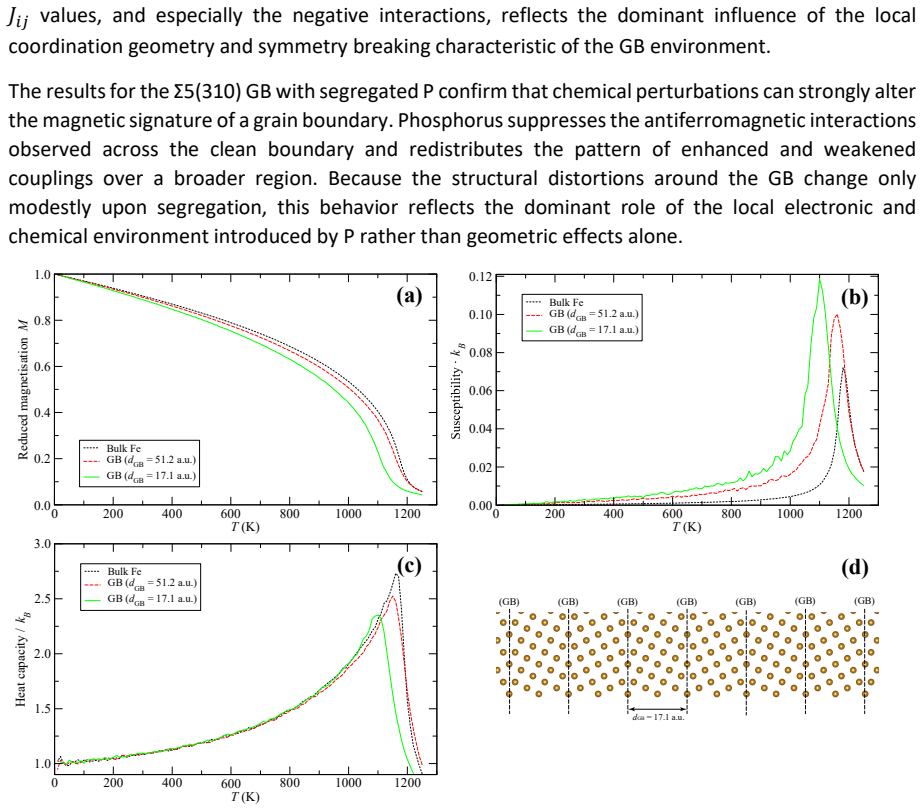
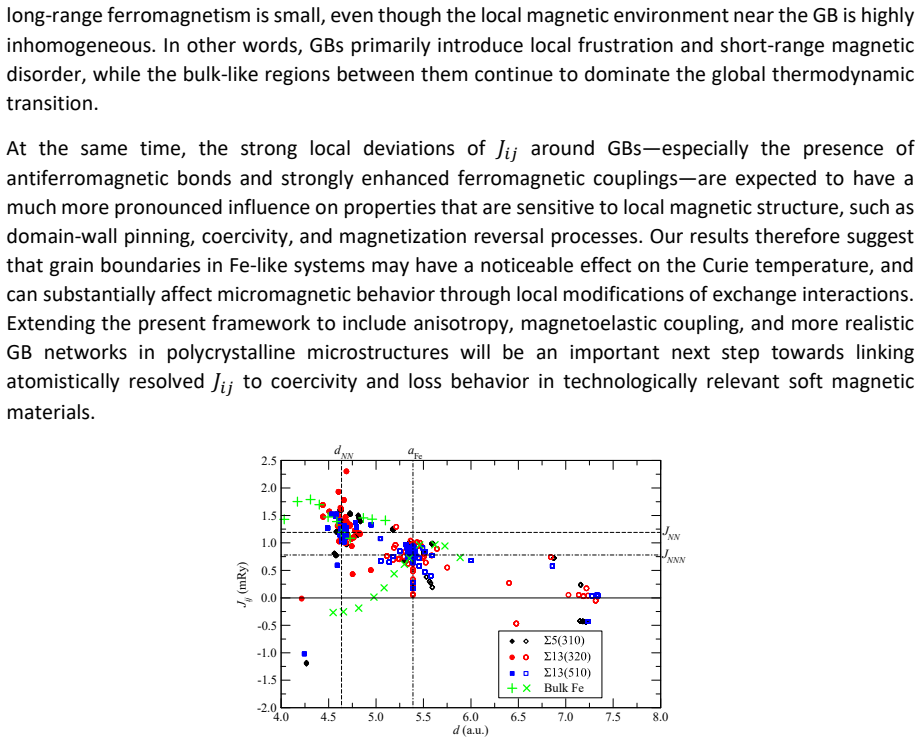
Clean symmetric-tilt grain boundaries in bcc iron produce strong local deviations from bulk Heisenberg exchange, including antiferromagnetic couplings across the boundary plane that are driven by altered coordination and symmetry breaking rather than by interatomic distance alone; phosphorus segregation suppresses those antiferromagnetic terms and redistributes the local exchange landscape, yet realistic grain-boundary densities still produce only a modest reduction in Curie temperature because bulk-like regions dominate the global magnetic transition.
Load-bearing premise
That exchange parameters taken from three model tilt boundaries and classical Monte Carlo are enough to predict the real Curie-temperature shift of polycrystalline iron containing phosphorus.
Editorial analysis
A structured set of objections, weighed in public.
Referee Report
Summary. The abstract claims that DFT combined with the Liechtenstein–Katsnelson–Antropov–Gubanov method yields Heisenberg exchange parameters for three clean symmetric tilt GBs in bcc Fe (Σ5(310), Σ13(510), Σ13(320)) that deviate strongly from bulk, including antiferromagnetic couplings across the boundary plane driven by coordination and symmetry breaking rather than distance alone. Phosphorus segregation (substitutional and interstitial) at Σ5(310) is said to suppress those AF couplings and redistribute the local exchange landscape. Classical Monte Carlo with these Jij then shows only a small Curie-temperature reduction at realistic GB densities, because bulk-like regions dominate the global transition; a large Tc drop appears only when the GB volume fraction is artificially inflated. The work positions this pipeline as a general atomistic-to-mesoscale framework for interfacial magnetism in Fe-based materials.
Significance. If the full calculations and Monte Carlo protocols hold, the result would be useful for magnetic materials design: it would separate strong local GB magnetic disruption from weak global Tc impact under realistic polycrystal densities, and would quantify how P segregation chemically retunes interfacial exchange. The DFT→LKAG→MC pipeline is standard and externally benchmarkable in principle. However, the supplied full manuscript text is an unrelated HCI paper on dance-motion simplification (arXiv:2604.10490), not the cond-mat.mtrl-sci study described by the title and abstract. No equations, supercells, Jij tables, bulk-Tc validation, MC protocols, or experimental comparisons for the Fe/GB work are available to assess. Significance therefore remains conditional on a correct manuscript.
major comments (3)
- The full manuscript text provided under this paper_id is not the grain-boundary magnetism study. It is an HCI paper on dance motion simplification (title, authors, methods, figures, and arXiv identifier all differ). None of the load-bearing claims in the abstract—AF Jij across the GB plane, distance-vs-coordination origin, substitutional/interstitial P effects, or the realistic-vs-artificial GB-volume-fraction Tc results—can be checked against methods, data, or figures. A technical review of the materials-science claims is not possible until the correct manuscript is supplied.
- Abstract-only: the central claim that realistic GB densities only weakly lower Tc rests on (i) quantitative reliability of DFT+LKAG Jij (including reported AF couplings) for clean and P-segregated GBs, (ii) classical Monte Carlo recovering bulk Tc and then the GB-perturbed transition, and (iii) a metallurgically grounded definition of “realistic” vs artificially inflated GB volume fraction. Without supercell constructions, bulk benchmarks, MC finite-size/protocol details, or experimental comparison, these steps cannot be validated or falsified.
- Abstract-only: the assertion that negative exchange is “not governed by interatomic distance alone, but arise primarily from altered local coordination and symmetry breaking” is a strong mechanistic claim. It requires explicit Jij-vs-distance comparisons, coordination analysis, and electronic-structure evidence (e.g., DOS, orbital projections) that are absent from the materials available for review.
minor comments (2)
- Once the correct manuscript is provided, the abstract’s three GB choices and the artificial volume-fraction scaling should be justified against typical polycrystalline Fe microstructures and compared to measured Tc or magnetization data where available.
- Clarify whether classical Heisenberg Monte Carlo (vs. quantum or beyond-Heisenberg corrections) is adequate near the GB where moments and exchange may be strongly reduced or non-collinear.
Circularity Check
No circularity found: abstract describes a standard DFT+LKAG→Jij→Monte Carlo pipeline whose Tc claim is a simulation output, not forced by construction or fit.
full rationale
Only the abstract of arXiv:2604.10489 is available for the claimed paper (the cached full text is an unrelated HCI dance-simplification manuscript, arXiv:2604.10490). From the abstract alone, the derivation chain is: (1) DFT + Liechtenstein–Katsnelson–Antropov–Gubanov Green’s-function extraction of Heisenberg Jij for three clean symmetric tilt GBs and for P-segregated Σ5(310); (2) classical Monte Carlo with those Jij to obtain finite-temperature ordering and Curie temperature; (3) comparison of realistic vs artificially inflated GB volume fractions. None of these steps is self-definitional: Jij are computed from electronic structure, not defined from Tc; Tc is an MC output, not a fitted input re-reported as prediction; the statement that bulk-like regions dominate the global transition is a result of the MC runs under different GB densities, not an identity. There is no uniqueness theorem, self-citation load-bearing premise, or renamed known empirical law in the abstract. Residual risk that bulk Tc was used as a free parameter to tune the MC Hamiltonian cannot be checked without the full methods, but that is a validation concern, not demonstrated circularity. Honest finding: score 0, no circular steps quotable from the available text.
Assumptions & free parameters
assumptions (3)
- domain assumption Magnetic interactions in bcc Fe near grain boundaries can be represented by a classical Heisenberg Hamiltonian with exchange parameters Jij from the LKAG Green's-function approach on DFT electronic structure.
- ad hoc to paper Three symmetric tilt GBs (Σ5(310), Σ13(510), Σ13(320)) plus artificial GB volume-fraction scaling are sufficient to infer realistic polycrystalline Fe magnetic behavior.
- domain assumption Monte Carlo sampling of the mapped Heisenberg model yields a meaningful Curie temperature comparable to experiment for bulk and GB-containing systems.
Cite this review
Pith. "Pith review of The effect of grain boundaries on magnetic exchange interactions in iron." pith.science (2026). https://pith.science/paper/DSMTBBDI
@misc{pith2026260410489,
  author       = {Pith},
  title        = {Pith review of: The effect of grain boundaries on magnetic exchange interactions in iron},
  year         = {2026},
  howpublished = {\url{https://pith.science/paper/DSMTBBDI}},
  note         = {Machine review of arXiv:2604.10489}
}
abstract
This work investigates how grain boundaries (GBs) modify magnetic exchange interactions in bcc iron, with particular focus on the effect of phosphorus segregation. Using density-functional theory combined with the Liechtenstein-Katsnelson-Antropov-Gubanov Green's-function approach, we calculate Heisenberg exchange parameters for three symmetric tilt GBs, $\Sigma5(310)$, $\Sigma13(510)$, and $\Sigma13(320)$, and use these parameters in Monte Carlo simulations to evaluate finite-temperature magnetic behavior. All clean GBs exhibit strong local deviations from bulk exchange interactions, including antiferromagnetic coupling across the boundary plane. These negative exchange interactions are not governed by interatomic distance alone, but arise primarily from the altered local coordination and symmetry breaking at the GB. Phosphorus segregation, modeled in both substitutional and interstitial configurations at the $\Sigma5(310)$ GB, suppresses the antiferromagnetic couplings and significantly redistributes the local exchange landscape through chemical and electronic effects. Monte Carlo results show that, despite pronounced local perturbations, realistic GB densities cause only a small reduction in the Curie temperature because bulk-like regions dominate the global magnetic transition. A substantial decrease in Curie temperature appears only when the GB volume fraction is artificially increased. The results demonstrate that GBs strongly influence local magnetic interactions while having a limited effect on global magnetic ordering, and they establish a general framework for linking atomistic interfacial structure and chemistry to mesoscale magnetic behavior in Fe-based materials.
Figures
Figures from the paper (4 more)
Reference graph
Works this paper leans on
-
[1]
Yeuhi Abe, C Karen Liu, and Zoran Popović. 2004. Momentum-based parameterization of dynamic character motion. In����������� �� ��� ���� ��� ��������������������� ��������� �� �������� ���������. 173–182
2004
-
[2]
Kfir Aberman, Peizhuo Li, Dani Lischinski, Olga Sorkine-Hornung, Daniel Cohen-Or, and Baoquan Chen. 2020. Skeleton-aware networks for deep motion retargeting.��� ������������ �� �������� �����39, 4 (2020), 62–1
2020
-
[3]
Sri Wulan Anggraeni, Yayan Alpian, Harmawati Harmawati, and Winda Anggraeni. 2024. Exploring Confidence in Boys’ Elementary Dance Education.������� �� ��������� ��� �������� ����������18, 1 (2024), 201–208
2024
-
[4]
Ben Baker, Tony Liu, Jordan Matelsky, Felipe Parodi, Brett Mensh, John W Krakauer, and Konrad Kording. 2024. Computational kinematics of dance: distinguishing hip hop genres.��������� �� �������� ��� ��11 (2024), 1295308. , Vol. 1, No. 1, Article . Publication date: April 2026. M��� ��S������M��� ��D����: Dance Motion Simplification to Support Novices’ Da...
2024
-
[5]
Gigi Berardi. 2004. Teaching Dance Skills: A Motor Learning and Development Approach.������� �� ����� �������� � �������8, 4 (2004), 125–125
2004
-
[6]
Julien Blanchet and Sixuan Han. 2023. Integrating a LLM into an Automatic Dance Practice Support System: Breathing Life Into The Virtual Coach. In������� ����������� �� ��� ���� ������ ��� ��������� �� ���� ��������� �������� ��� ����������. 1–2
2023
-
[7]
Julien Blanchet, Megan E Hillis, Yeongji Lee, Qijia Shao, Xia Zhou, David JM Kraemer, and Devin Balkcom. 2023. Learnthatdance: Augmenting tiktok dance challenge videos with an interactive practice support system powered by automatically generated lesson plans. In������� ����������� �� ��� ���� ������ ��� ��������� �� ���� ��������� �������� ��� ����������. 1–4
2023
-
[8]
Jules Brooks Blanchet, Megan E Hillis, Yeongji Lee, Qijia Shao, Xia Zhou, Devin Balkcom, and David JM Kraemer
Show all 102 references
-
[9]
In����������� �� ��� ���� ��� ���������� �� ����� ������� �� ��������� �������
Enhancing the Educational Potential of Online Movement Videos: System Development and Empirical Studies with TikTok Dance Challenges. In����������� �� ��� ���� ��� ���������� �� ����� ������� �� ��������� �������. ACM, 1–19
-
[10]
Ann E Blandford. 2013. Semi-structured qualitative studies. Interaction Design Foundation
2013
-
[11]
Armin Bruderlin and Lance Williams. 1995. Motion signal processing. In����������� �� ��� ���� ������ ���������� �� �������� �������� ��� ����������� ����������. 97–104
1995
-
[12]
Chan, Jia Huang, and Xin Di
Raymond C.K. Chan, Jia Huang, and Xin Di. 2009. Dexterous movement complexity and cerebellar activation: A meta-analysis.����� �������� �������59, 2 (2009), 316–323. doi:10.1016/j.brainresrev.2008.09.003
2009 doi
-
[13]
Michael Chang, Nicholas O’Dwyer, Roger Adams, Stephen Cobley, Kwee-Yum Lee, and Mark Halaki. 2020. Whole- body kinematics and coordination in a complex dance sequence: Differences across skill levels.����� �������� �������69 (2020), 102564
2020
-
[14]
Jingwen Chen, Yingwei Pan, Ting Yao, and Tao Mei. 2023. ControlStyle: Text-Driven Stylized Image Generation Using Diffusion Priors. In����������� �� ��� ���� ��� ������������� ���������� �� ����������(Ottawa ON, Canada) ��� ����. Association for Computing Machinery, New York, ...
2023 doi
-
[15]
Tianqi Chen and Carlos Guestrin. 2016. Xgboost: A scalable tree boosting system. In����������� �� ��� ���� ��� ������ ������������� ���������� �� ��������� ��������� ��� ���� ������. 785–794
2016
-
[16]
Diane Chi, Monica Costa, Liwei Zhao, and Norman Badler. 2000. The EMOTE model for effort and shape. In����������� �� ��� ���� ������ ���������� �� �������� �������� ��� ����������� ����������. 173–182
2000
-
[17]
Wonwoong Cho, Hareesh Ravi, Midhun Harikumar, Vinh Khuc, Krishna Kumar Singh, Jingwan Lu, David Inouye, and Ajinkya Kale. 2024. Enhanced Controllability of Diffusion Models via Feature Disentanglement and Realism-Enhanced Sampling Methods. In�������� ������ � ���� ����� ���� �...
2024 doi
-
[18]
Lucy Coates, Jian Shi, Lynn Rochester, Silvia Del Din, and Annette Pantall. 2020. Entropy of real-world gait in Parkinson’s disease determined from wearable sensors as a digital marker of altered ambulatory behavior.�������20, 9 (2020), 2631
2020
-
[19]
Cormen, Charles E
Thomas H. Cormen, Charles E. Leiserson, Ronald L. Rivest, and Clifford Stein. 2009.������������ �� ����������(3rd ed.). MIT Press, Cambridge, MA. See Chapter 33: Computational Geometry
2009
-
[20]
Wenxun Dai, Ling-Hao Chen, Jingbo Wang, Jinpeng Liu, Bo Dai, and Yansong Tang. 2024. Motionlcm: Real-time controllable motion generation via latent consistency model. In�������� ���������� �� �������� ������. Springer, 390–408
2024
-
[21]
Vincenzo D’Amato, Luca Oneto, Antonio Camurri, and Davide Anguita. 2021. Keep it simple: handcrafting Feature and tuning Random Forests and XGBoost to face the affective Movement Recognition Challenge 2021. In���� ��� ������������� ���������� �� �������� ��������� ��� ��������...
2021
-
[22]
Prafulla Dhariwal, Heewoo Jun, Christine Payne, Jong Wook Kim, Alec Radford, and Ilya Sutskever. 2020. Jukebox: A Generative Model for Music.����� �������� ����������������(2020)
2020
-
[23]
Océane Dubois, Agnès Roby-Brami, Ross Parry, Mahdi Khoramshahi, and Nathanaël Jarrassé. 2023. A guide to inter-joint coordination characterization for discrete movements: a comparative study.������� �� ���������������� ��� ��������������20, 1 (2023), 132
2023
-
[24]
Koki Endo, Shuhei Tsuchida, Tsukasa Fukusato, and Takeo Igarashi. 2024. Automatic Dance Video Segmentation for Understanding Choreography. In����������� �� ��� ��� ������������� ���������� �� �������� ��� ���������. 1–9
2024
-
[25]
Franz Faul, Edgar Erdfelder, Albert-Georg Lang, and Axel Buchner. 2007. G* Power 3: A flexible statistical power analysis program for the social, behavioral, and biomedical sciences.�������� �������� �������39, 2 (2007), 175–191
2007
-
[26]
Jane Forman and Laura Damschroder. 2007. Qualitative content analysis. In��������� ������� ��� ���������� � ������. Emerald Group Publishing Limited, 39–62
2007
-
[27]
Jerome H Friedman. 2001. Greedy function approximation: a gradient boosting machine.������ �� ����������(2001), 1189–1232. , Vol. 1, No. 1, Article . Publication date: April 2026. 36 Han et al
2001
-
[28]
2023.�������� ������������
Roman Garnett. 2023.�������� ������������. Cambridge University Press
2023
-
[29]
Michael Gleicher. 1997. Motion editing with spacetime constraints. In����������� �� ��� ���� ��������� �� ����������� �� ��������. 139–ff
1997
-
[30]
Mark A Guadagnoli and Timothy D Lee. 2004. Challenge point: a framework for conceptualizing the effects of various practice conditions in motor learning.������� �� ����� ��������36, 2 (2004), 212–224
2004
-
[31]
Hyunyoung Han, Kyungeun Jung, and Sang Ho Yoon. 2025. ChoreoCraft: In-situ Crafting of Choreography in Virtual Reality through Creativity Support Tool. In����������� �� ��� ���� ��� ���������� �� ����� ������� �� ��������� �������. 1–21
2025
-
[32]
Sandra G Hart and Lowell E Staveland. 1988. Development of NASA-TLX (Task Load Index): Results of empirical and theoretical research. In�������� �� ����������. Vol. 52. Elsevier, 139–183
1988
-
[33]
Saad Hassan, Caluã de Lacerda Pataca, Laleh Nourian, Garreth W Tigwell, Briana Davis, and Will Zhenya Silver Wag- man. 2024. Designing and Evaluating an Advanced Dance Video Comprehension Tool with In-situ Move Identification Capabilities. In����������� �� ��� ���� ��� �������...
2024
-
[34]
Kaiming He, Xiangyu Zhang, Shaoqing Ren, and Jian Sun. 2016. Deep residual learning for image recognition. In ����������� �� ��� ���� ���������� �� �������� ������ ��� ������� �����������. 770–778
2016
-
[35]
Teresa L Heiland, Robert Rovetti, and Jan Dunn. 2012. Effects of visual, auditory, and kinesthetic imagery interventions on dancers’ plié arabesques.������� �� ������� �������� �� ����� ��� �������� ��������7, 1 (2012)
2012
-
[36]
Martin Heusel, Hubert Ramsauer, Thomas Unterthiner, Bernhard Nessler, and Sepp Hochreiter. 2017. Gans trained by a two time-scale update rule converge to a local nash equilibrium.�������� �� ������ ����������� ���������� ������� 30 (2017)
2017
-
[37]
Jonathan Ho, Ajay Jain, and Pieter Abbeel. 2020. Denoising Diffusion Probabilistic Models.����� �������� ����������������(2020)
2020
-
[38]
Jonathan Ho and Tim Salimans. 2021. Classifier-Free Diffusion Guidance. In������� ���� �������� �� ���� ���������� ������ ��� ���������� ������������. https://openreview.net/forum?id=qw8AKxfYbI
2021
-
[39]
Daniel Holden, Jun Saito, and Taku Komura. 2016. A deep learning framework for character motion synthesis and editing.��� ������������ �� �������� �����35, 4 (2016), 1–11
2016
-
[40]
2015.������� �� �������� �� ����� ��������� �����������
Dayana Hristova. 2015.������� �� �������� �� ����� ��������� �����������. Master’s thesis. University of Vienna
2015
-
[41]
Eugene Hsu, Kari Pulli, and Jovan Popović. 2005. Style translation for human motion. In��� �������� ���� ������. 1082–1089
2005
-
[42]
Henry Hsu and Peter A Lachenbruch. 2014. Paired t test.����� ��������� ���������� ��������� ������(2014)
2014
-
[43]
Han-Ping Huang, Chang Francis Hsu, Yi-Chih Mao, Long Hsu, and Sien Chi. 2021. Gait stability measurement by using average entropy.�������23, 4 (2021), 412
2021
-
[44]
Deok-Kyeong Jang, Soomin Park, and Sung-Hee Lee. 2022. Motion puzzle: Arbitrary motion style transfer by body part.��� ������������ �� �������� �����41, 3 (2022), 1–16
2022
-
[45]
Biao Jiang, Xin Chen, Wen Liu, Jingyi Yu, Gang Yu, and Tao Chen. 2024. Motiongpt: Human motion as a foreign language.�������� �� ������ ����������� ���������� �������36 (2024)
2024
-
[46]
Hye-Young Jo, Laurenz Seidel, Michel Pahud, Mike Sinclair, and Andrea Bianchi. 2023. Flowar: How different augmented reality visualizations of online fitness videos support flow for at-home yoga exercises. In����������� �� ��� ���� ��� ���������� �� ����� ������� �� ��������� ...
2023
-
[47]
Korrawe Karunratanakul, Konpat Preechakul, Supasorn Suwajanakorn, and Siyu Tang. 2023. Guided motion diffusion for controllable human motion synthesis. In����������� �� ��� �������� ������������� ���������� �� �������� ������. 2151–2162
2023
-
[48]
Taewoo Kim, Sanga Yun, Junhyuk Park, and Sami Yli-Piipari. 2025. A Cluster Randomized Controlled Trial to Compare Online and In-Person Motor Skill Acquisition.������� �� �������� �� �������� ���������1, aop (2025), 1–15
2025
-
[49]
2015.����� �������� ��� ������� ��� ������ ���������� ��� ��������� ��� ���������� ��� ��������
Donna Krasnow and Mary Virginia Wilmerding. 2015.����� �������� ��� ������� ��� ������ ���������� ��� ��������� ��� ���������� ��� ��������. Human Kinetics
2015
-
[50]
Donna Krasnow and Virginia Wilmerding. 2024. Motor Learning for Dance Teachers and Performers. (2024)
2024
-
[51]
2003.��������� ��� ���� ����������� � �������������� ����� �� ���� ��������
Mike Kuniavsky. 2003.��������� ��� ���� ����������� � �������������� ����� �� ���� ��������. Elsevier
2003
-
[52]
Markus Laattala, Roosa Piitulainen, Nadia M Ady, Monica Tamariz, and Perttu Hämäläinen. 2024. Wave: Anticipatory movement visualization for vr dancing. In����������� �� ��� ���� ��� ���������� �� ����� ������� �� ��������� �������. 1–9
2024
-
[53]
2025.����� �������� ��� ������������ ���� ���������� �� �����������
Timothy D Lee and Richard A Schmidt. 2025.����� �������� ��� ������������ ���� ���������� �� �����������. Human Kinetics
2025
-
[54]
Ross, and Angjoo Kanazawa
Ruilong Li, Shan Yang, David A. Ross, and Angjoo Kanazawa. 2021. Learn to Dance with AIST++: Music Conditioned 3D Dance Generation. arXiv:2101.08779 [cs.CV]
2021 arXiv
-
[55]
Ronghui Li, Junfan Zhao, Yachao Zhang, Mingyang Su, Zeping Ren, Han Zhang, Yansong Tang, and Xiu Li. 2023. Finedance: A fine-grained choreography dataset for 3d full body dance generation. In����������� �� ��� �������� , Vol. 1, No. 1, Article . Publication date: April 2026. M...
2023
-
[56]
Olga V Limanskaya, Olena V Yefimova, Irina V Kriventsova, Krzysztof Wnorowski, and Abdelkrim Bensbaa. 2021. The coordination abilities development in female students based on dance exercises.�������� ��������� �� ��������25, 4 (2021), 249–256
2021
-
[57]
Nan Liu, Shuang Li, Yilun Du, Antonio Torralba, and Joshua B Tenenbaum. 2022. Compositional visual generation with composable diffusion models. In�������� ����������� ����� ���� �������� ����������� ��� ����� ������� ������� ������ ����� ������������ ���� ����. Springer, 423–439
2022
-
[58]
Matthew Loper, Naureen Mahmood, Javier Romero, Gerard Pons-Moll, and Michael J Black. 2023. SMPL: A skinned multi-person linear model. In������� �������� ������� ������� ��� ����������� ������ �. 851–866
2023
-
[59]
Lee Fay Low, Shane Carroll, Dafna Merom, Jess R Baker, N Kochan, Frances Moran, and Henry Brodaty. 2016. We think you can dance! A pilot randomised controlled trial of dance for nursing home residents with moderate to severe dementia.������������� ��������� �� ��������29 (2016), 42–44
2016
-
[60]
Zhenye Luo, Min Ren, Xuecai Hu, Yongzhen Huang, and Li Yao. 2024. Popdg: Popular 3d dance generation with popdanceset. In����������� �� ��� �������� ���������� �� �������� ������ ��� ������� �����������. 26984–26993
2024
-
[61]
Alexandros Malkogeorgos, Eleni Zaggelidou, Georgios Zaggelidis, and Galazoulas Christos. 2013. Physiological elements required by dancers.����� ������� ������22, 5-6 (2013), 343
2013
-
[62]
Desire L Massart, Leonard Kaufman, Peter J Rousseeuw, and Annick Leroy. 1986. Least median of squares: a robust method for outlier and model error detection in regression and calibration.��������� ������� ����187 (1986), 171–179
1986
-
[63]
Kevin D McCay, Edmond SL Ho, Claire Marcroft, and Nicholas D Embleton. 2019. Establishing pose based features using histograms for the detection of abnormal infant movements. In���� ���� ������ ������������� ���������� �� ��� ���� ����������� �� �������� ��� ������� ������� ��...
2019
-
[64]
Dafna Merom, Ding Ding, and Emmanuel Stamatakis. 2016. Dancing participation and cardiovascular disease mortality: a pooled analysis of 11 population-based British cohorts.�������� ������� �� ���������� ��������50, 6 (2016), 756–760
2016
-
[65]
Alexander Quinn Nichol and Prafulla Dhariwal. 2021. Improved Denoising Diffusion Probabilistic Models.. In ���� ������������ �� ������� �������� ��������� ���� ����, Marina Meila and Tong Zhang (Eds.). PMLR, 8162–8171. http://dblp.uni-trier.de/db/conf/icml/icml2021.html#NicholD21
2021
-
[66]
Byungjoo Noh, Changhong Youm, Eunkyoung Goh, Myeounggon Lee, Hwayoung Park, Hyojeong Jeon, and Oh Yoen Kim. 2021. XGBoost based machine learning approach to predict the risk of fall in older adults using gait outcomes. ��������� �������11, 1 (2021), 12183
2021
-
[67]
Pauline PL Poon and Wendy M Rodgers. 2000. Learning and remembering strategies of novice and advanced jazz dancers for skill level appropriate dance routines.�������� ��������� ��� �������� ��� �����71, 2 (2000), 135–144
2000
-
[68]
Unnikrishnan Radhakrishnan, Francesco Chinello, and Konstantinos Koumaditis. 2023. Investigating the effectiveness of immersive VR skill training and its link to physiological arousal.������� �������27, 2 (2023), 1091–1115
2023
-
[69]
Jean-Philippe Rivière, Sarah Fdili Alaoui, Baptiste Caramiaux, and Wendy E Mackay. 2019. Capturing movement decomposition to support learning and teaching in contemporary dance.����������� �� ��� ��� �� �������������� �����������3, CSCW (2019), 1–22
2019
-
[70]
Peter J Rousseeuw. 1991. Tutorial to robust statistics.������� �� ������������5, 1 (1991), 1–20
1991
-
[71]
Ziad Salam Patrous. 2018. Evaluating XGBoost for user classification by using behavioral features extracted from smartphone sensors
2018
-
[72]
Nahoko Sato, Hiroyuki Nunome, and Yasuo Ikegami. 2014. Key features of hip hop dance motions affect evaluation by judges.������� �� ������� ������������30, 3 (2014), 439–445
2014
-
[73]
Ronald W Schafer. 2011. What is a savitzky-golay filter?[lecture notes].���� ������ ���������� ��������28, 4 (2011), 111–117
2011
-
[74]
2020.�������� ��� ������������� ������� ����� ������� ������ �������� �� � ������� �����������
Simon Senecal. 2020.�������� ��� ������������� ������� ����� ������� ������ �������� �� � ������� �����������. Doctoral Thesis. University of Geneva, Geneva, Switzerland. doi:10.13097/archive-ouverte/unige:142477
2020 doi
-
[75]
S Shaphiro and MBJB Wilk. 1965. An analysis of variance test for normality.����������52, 3 (1965), 591–611
1965
-
[76]
Hannah Lena Siebers, Waleed Alrawashdeh, Marcel Betsch, Filippo Migliorini, Frank Hildebrand, and Jörg Eschweiler
-
[77]
Comparison of different symmetry indices for the quantification of dynamic joint angles.��� ������ �������� �������� ��� ��������������13, 1 (2021), 130
2021
-
[78]
Roger W Simmons. 2005. Sensory organization determinants of postural stability in trained ballet dancers.������������� ������� �� ������������115, 1 (2005), 87–97
2005
-
[79]
2019.����� ����������� ������
Pamela Anderson Sofras. 2019.����� ����������� ������. Human Kinetics
2019
-
[80]
Seyoon Tak and Hyeong-Seok Ko. 2005. A physically-based motion retargeting filter.��� ������������ �� �������� �����24, 1 (2005), 98–117. , Vol. 1, No. 1, Article . Publication date: April 2026. 38 Han et al
2005
-
[81]
Jonathan Tseng, Rodrigo Castellon, and Karen Liu. 2023. Edge: Editable dance generation from music. In����������� �� ��� �������� ���������� �� �������� ������ ��� ������� �����������. 448–458
2023
-
[82]
Shuhei Tsuchida, Satoru Fukayama, Masahiro Hamasaki, and Masataka Goto. 2019. AIST Dance Video Database: Multi-genre, Multi-dancer, and Multi-camera Database for Dance Information Processing. In����������� �� ��� ���� ������������� ������� ��� ����� ����������� ��������� �����...
2019
-
[83]
1978.���� �� �������� ��� ����������� �� ������ ������������� ���������
Lev S Vygotsky. 1978.���� �� �������� ��� ����������� �� ������ ������������� ���������. Vol. 86. Harvard university press
1978
-
[84]
Che Wei Wang, Pin Chun Lu, Yun Chen Cheng, and Mike Y Chen. 2025. MR. Drum: Designing Mixed Reality Interfaces to Support Structured Learning Micro-Progression in Drumming. In����������� �� ��� ���� ��� ���������� �� ����� ������� �� ��������� �������. 1–17
2025
-
[85]
Haofan Wang, Peng Xing, Renyuan Huang, Hao Ai, Qixun Wang, and Xu Bai. 2024. InstantStyle-Plus: Style Transfer with Content-Preserving in Text-to-Image Generation.����� �������� ����������������(2024)
2024
-
[86]
Yuan Wang, Di Huang, Yaqi Zhang, Wanli Ouyang, Jile Jiao, Xuetao Feng, Yan Zhou, Pengfei Wan, Shixiang Tang, and Dan Xu. 2024. Motiongpt-2: A general-purpose motion-language model for motion generation and understanding. ����� �������� ����������������(2024)
2024
-
[87]
Yi Wang, Liangchao Liu, Qi Chen, Yinru Chen, and Wing-Kai Lam. 2023. Pilot testing of a simplified dance intervention for cardiorespiratory fitness and blood lipids in obese older women.��������� �������51 (2023), 40–48
2023
-
[88]
Yufu Wang, Ziyun Wang, Lingjie Liu, and Kostas Daniilidis. 2024. TRAM: Global Trajectory and Motion of 3D Humans from in-the-wild Videos.����� �������� ����������������(2024)
2024
-
[89]
Edward C Warburton. 2024. TikTok challenge: dance education futures in the creator economy.���� ��������� ������ ������125, 4 (2024), 430–440
2024
-
[90]
Andrew Witkin and Zoran Popovic. 1995. Motion warping. In����������� �� ��� ���� ������ ���������� �� �������� �������� ��� ����������� ����������. 105–108
1995
-
[91]
Robert F Woolson. 2007. Wilcoxon signed-rank test.����� ������������ �� �������� ������(2007), 1–3
2007
-
[92]
Gabriele Wulf and Charles H Shea. 2002. Principles derived from the study of simple skills do not generalize to complex skill learning.����������� �������� � ������9, 2 (2002), 185–211
2002
-
[93]
Liu-Jie Xu, Jing Wu, Jing-Dong Zhu, and Ling Chen. 2025. Effects of AI-assisted dance skills teaching, evaluation and visual feedback on dance students’ learning performance, motivation and self-efficacy.������������� ������� �� �������������� �������195 (2025), 103410
2025
-
[94]
Yang Yang, Howard Leung, Lihua Yue, and Liqun Deng. 2010. Evaluating human motion complexity based on un-correlation and non-smoothness. In���������� ���������� �� ����������. Springer, 538–548
2010
-
[95]
Yang Yang, Howard Leung, Lihua Yue, and Liqun Deng. 2013. Generating a two-phase lesson for guiding beginners to learn basic dance movements.��������� � ���������61 (2013), 1–20
2013
-
[96]
Zixuan Ye, Huijuan Huang, Xintao Wang, Pengfei Wan, Di Zhang, and Wenhan Luo. 2025. Stylemaster: Stylize your video with artistic generation and translation. In����������� �� ��� �������� ������ ��� ������� ����������� ����������. 2630–2640
2025
-
[97]
Hengyuan Zhang, Zhe Li, Xingqun Qi, Mengze Li, Muyi Sun, Siye Wang, Man Zhang, and Sirui Han. 2025. DanceEditor: Towards Iterative Editable Music-driven Dance Generation with Open-Vocabulary Descriptions. In����������� �� ��� �������� ������������� ���������� �� �������� �����...
2025
-
[98]
Lvmin Zhang, Anyi Rao, and Maneesh Agrawala. 2023. Adding conditional control to text-to-image diffusion models. In����������� �� ��� �������� ������������� ���������� �� �������� ������. 3836–3847
2023
-
[99]
Mingyuan Zhang, Zhongang Cai, Liang Pan, Fangzhou Hong, Xinying Guo, Lei Yang, and Ziwei Liu. 2024. Motiondif- fuse: Text-driven human motion generation with diffusion model.���� ������������ �� ������� �������� ��� ������� ������������46, 6 (2024), 4115–4128
2024
-
[100]
Yiwen Zhao, Yang Wang, Liting Wen, Hengyuan Zhang, and Xingqun Qi. 2025. FreeDance: Towards Harmonic Free- Number Group Dance Generation via a Unified Framework. In����������� �� ��� �������� ������������� ���������� �� �������� ������. 10560–10569
2025
-
[101]
Yi Zhou, Connelly Barnes, Jingwan Lu, Jimei Yang, and Hao Li. 2019. On the continuity of rotation representations in neural networks. In����������� �� ��� �������� ���������� �� �������� ������ ��� ������� �����������. 5745–5753
2019
-
[102]
Donald W Zimmerman and Bruno D Zumbo. 1993. Relative power of the Wilcoxon test, the Friedman test, and repeated-measures ANOVA on ranks.��� ������� �� ������������ ���������62, 1 (1993), 75–86. , Vol. 1, No. 1, Article . Publication date: April 2026. M��� ��S������M��� ��D���...
1993
Reviewed July 12, 2026 · model on record in the stance chip above.
Discussion (0). Sign in to comment.