Searches for GeV-Scale ALPs at RHIC
Pith reviewed 2026-06-27 21:38 UTC · model grok-4.3
The pith
Ultra-peripheral Au+Au collisions at RHIC can probe axion-like particles with masses 2-5 GeV and couplings above 4 times 10 to the minus 4 per GeV.
A machine-rendered reading of the paper's core claim, the machinery that carries it, and where it could break.
Core claim
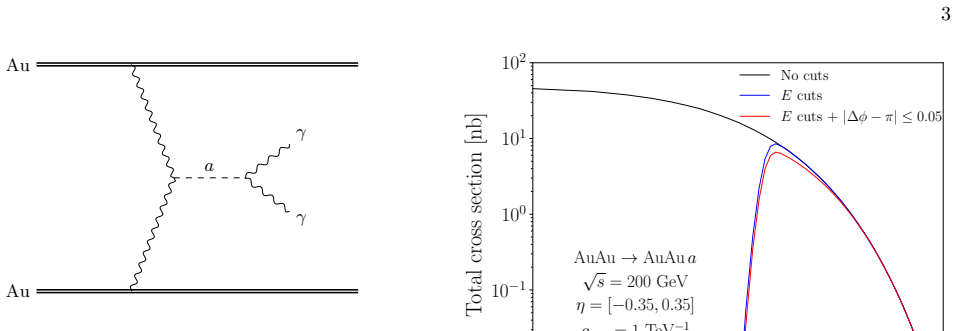
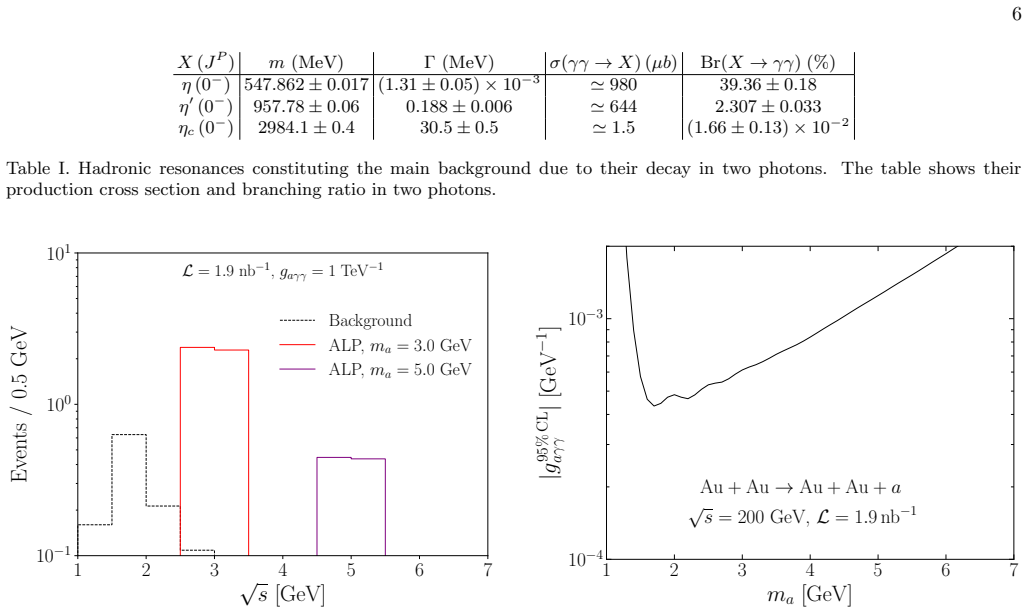
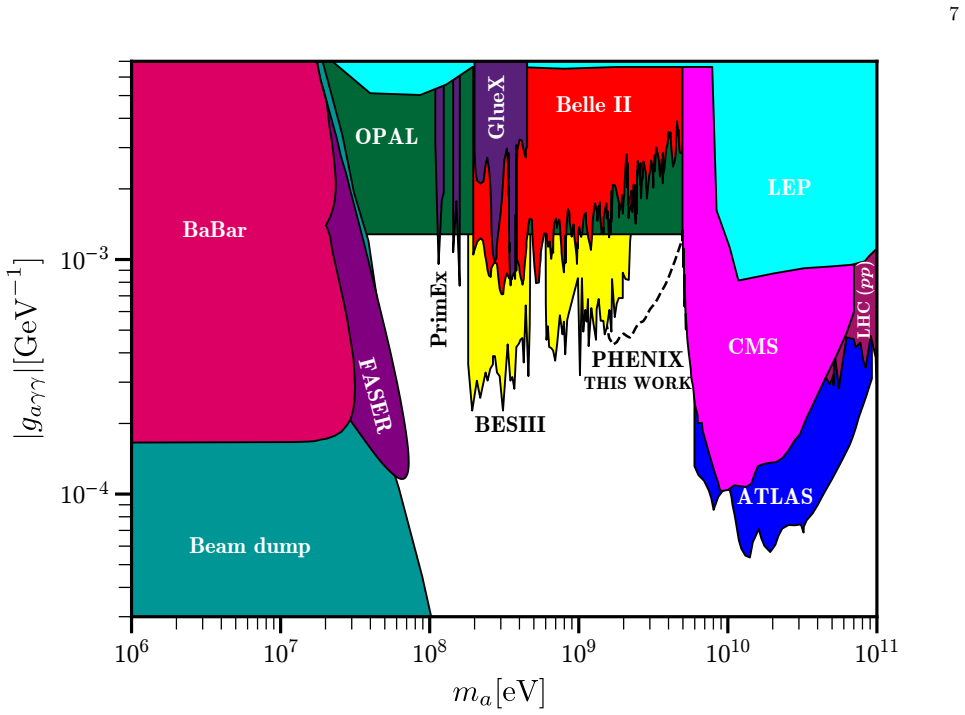
Ultra-peripheral Au+Au collision data collected at RHIC can be used to search for axion-like particles coupled to photons via the resonant process gamma gamma to a to gamma gamma. Exploiting the Z to the fourth enhancement of the two-photon luminosity and the low photon energy thresholds achievable at RHIC, simulations of signal and background processes yield estimated upper limits on the ALP-photon coupling assuming 1.9 inverse nanobarns of existing data. This produces sensitivity to ALP masses in the range 2 GeV to 5 GeV with couplings greater than or equal to 4 times 10 to the minus 4 per GeV, probing previously unexplored regions of parameter space.
What carries the argument
The resonant two-photon fusion process gamma gamma to a to gamma gamma, enhanced by the Z to the fourth power in the two-photon luminosity of ultra-peripheral heavy-ion collisions.
If this is right
- Upper limits on the ALP-photon coupling can be set in the 2-5 GeV mass window with existing luminosity.
- Larger integrated luminosity data sets would extend the reachable coupling strength.
- A dedicated analysis of ultra-peripheral collision data collected at RHIC is motivated.
- Other experiments recording ultra-peripheral collisions at RHIC could perform analogous searches.
Where Pith is reading between the lines
- The same photon-fusion technique could be applied at other heavy-ion colliders to cover overlapping or adjacent mass ranges.
- Absence of a signal would add new constraints to models that predict axion-like particles in the few-GeV window.
- Background modeling methods developed for this channel might transfer to related photon-photon processes at the same facility.
Load-bearing premise
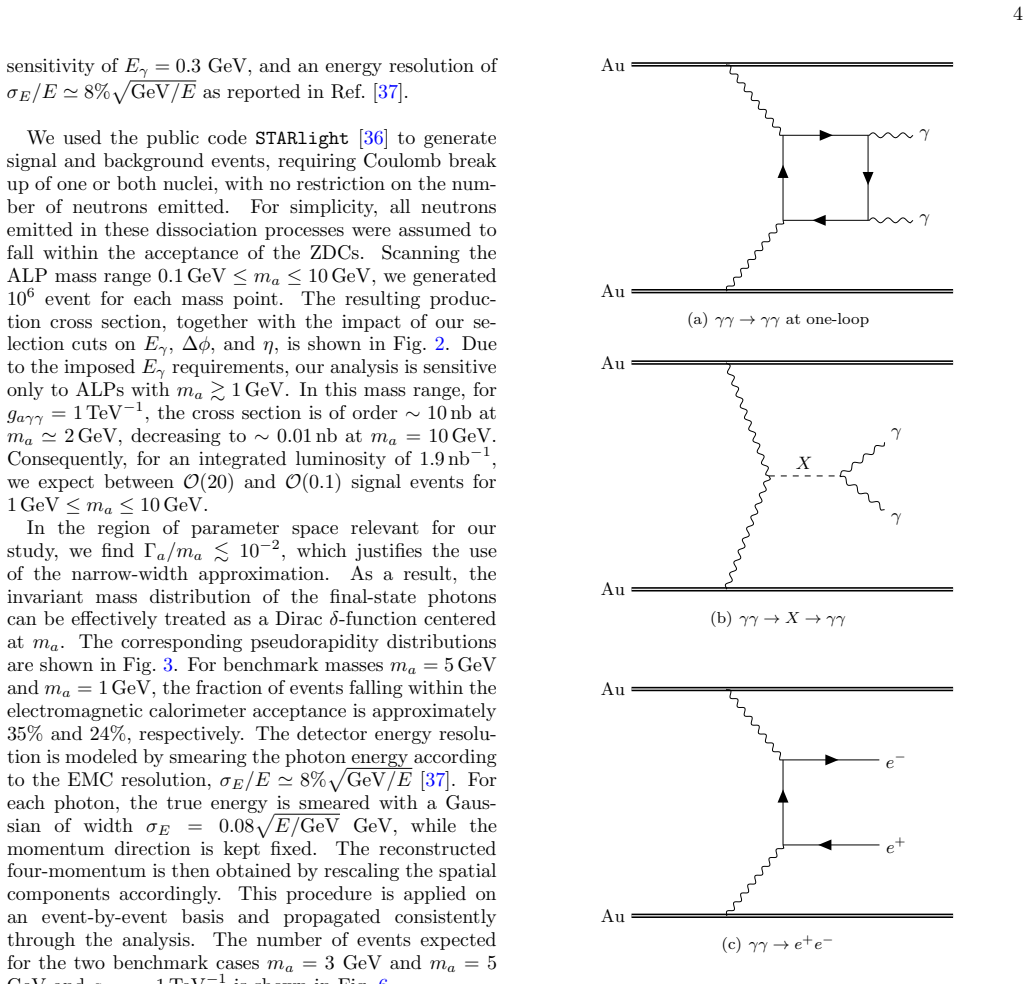
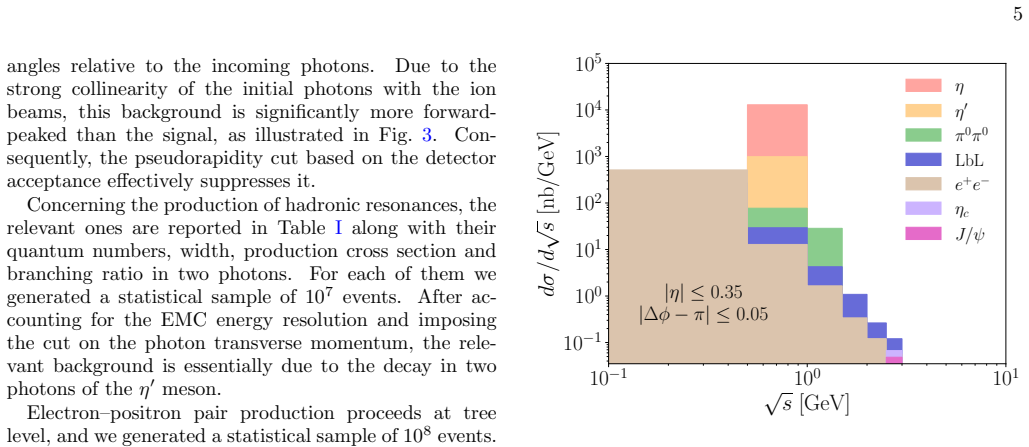
Backgrounds from light-by-light scattering, hadronic resonances, and misidentified electron-positron pairs can be modeled and subtracted sufficiently well in simulation to extract the quoted sensitivity limits.
What would settle it
An actual analysis of the 1.9 inverse nanobarn PHENIX ultra-peripheral data set that either observes no excess at the predicted level or finds that residual backgrounds prevent reaching the estimated coupling sensitivity.
Figures
read the original abstract
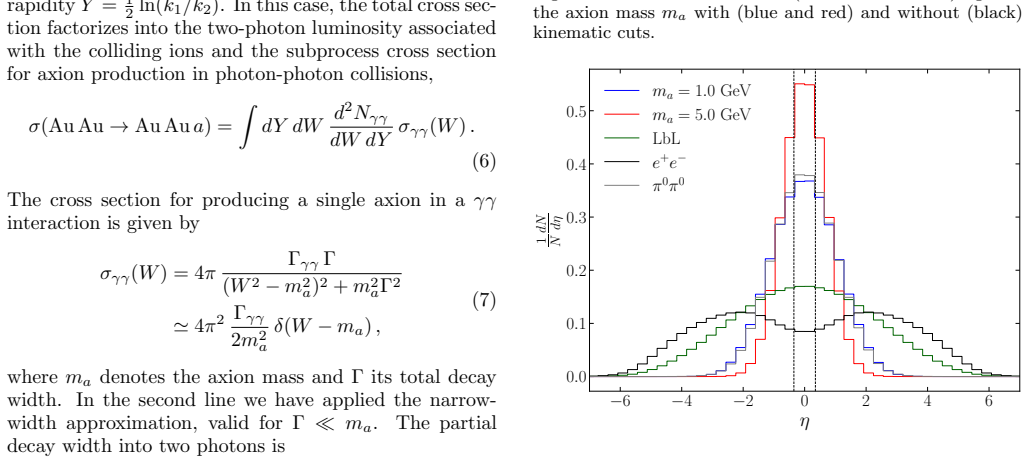
We point out that ultra-peripheral Au+Au collision data collected at the Relativistic Heavy Ion Collider, operational during 2000-2026, can be used to search for axion-like particles coupled to photons via the resonant process $\gamma\gamma \to a \to \gamma\gamma$. Exploiting the $Z^4$ enhancement of the two-photon luminosity in heavy-ion collisions and the low photon energy thresholds achievable at RHIC, we simulate signal and background processes, the latter dominated by light-by-light scattering, hadronic resonance production, and misidentified $e^+e^-$ pairs, and estimate upper limits on the ALP-photon coupling $g_{a\gamma\gamma}$ assuming $1.9~\text{nb}^{-1}$ of existing data collected by the PHENIX experiment. We find sensitivity to ALP masses in the range $2~\text{GeV} \lesssim m_a \lesssim 5~\text{GeV}$ with couplings $g_{a\gamma\gamma} \gtrsim 4\times 10^{-4}~\text{GeV}^{-1}$, probing previously unexplored regions of parameter space. Access to larger luminosity datasets could substantially extend the sensitivity of this search, motivating a dedicated analysis of ultra-peripheral collision data collected at RHIC by PHENIX as well as other experiments.
Editorial analysis
A structured set of objections, weighed in public.
Referee Report
Summary. The paper proposes using existing ultra-peripheral Au+Au data from RHIC (PHENIX, 1.9 nb^{-1}) to search for GeV-scale axion-like particles via the resonant process γγ → a → γγ. By simulating signal and backgrounds (dominated by light-by-light scattering, hadronic resonances, and misidentified e⁺e⁻ pairs), the authors estimate sensitivity to ALP masses 2 GeV ≲ m_a ≲ 5 GeV with couplings g_aγγ ≳ 4×10^{-4} GeV^{-1}, claiming this probes previously unexplored parameter space and motivating dedicated analyses of RHIC UPC data.
Significance. If the background modeling holds, the result would provide a new probe of ALP-photon couplings in an intermediate mass range using the Z^4-enhanced two-photon luminosity in heavy-ion collisions, leveraging existing low-threshold data at RHIC. The approach is a standard application of UPC physics but could fill a gap between lower-mass beam-dump and higher-mass collider searches if the projected limits are robust.
major comments (1)
- [Simulation and background modeling section] The central sensitivity claim (abstract and § on simulation results) rests on Monte Carlo modeling of backgrounds being accurate enough to extract the quoted limits on g_aγγ. No direct comparison of simulated rates or kinematic distributions to existing PHENIX/STAR UPC data in the low-p_T, forward-rapidity regime is shown, and systematic uncertainties on the background model are not quantified. This is load-bearing for the projected limits.
Simulated Author's Rebuttal
We thank the referee for their careful reading and constructive feedback on our manuscript. We address the single major comment below.
read point-by-point responses
-
Referee: [Simulation and background modeling section] The central sensitivity claim (abstract and § on simulation results) rests on Monte Carlo modeling of backgrounds being accurate enough to extract the quoted limits on g_aγγ. No direct comparison of simulated rates or kinematic distributions to existing PHENIX/STAR UPC data in the low-p_T, forward-rapidity regime is shown, and systematic uncertainties on the background model are not quantified. This is load-bearing for the projected limits.
Authors: We agree that the projected sensitivity depends on the fidelity of the background modeling and that explicit validation against data would strengthen the result. Our Monte Carlo employs standard generators (e.g., STARlight for the two-photon luminosity and resonance production) that have been used in published PHENIX and STAR UPC analyses. In the revised manuscript we will add a dedicated subsection comparing simulated p_T and rapidity distributions for light-by-light scattering and e⁺e⁻ pairs to existing low-p_T PHENIX and STAR measurements in the same kinematic regime, and we will provide a quantitative estimate of the dominant systematic uncertainties on the background rates (luminosity, efficiency, and modeling variations). These additions will make the load-bearing assumptions explicit while preserving the letter format. revision: yes
Circularity Check
No circularity: sensitivity from forward Monte Carlo simulation of signal and backgrounds
full rationale
The paper's central result is a projected sensitivity reach obtained by simulating the resonant ALP signal process γγ → a → γγ together with the dominant backgrounds (light-by-light scattering, hadronic resonances, misidentified e⁺e⁻ pairs) in ultra-peripheral Au+Au collisions, then applying the assumed 1.9 nb⁻¹ luminosity to extract coupling limits. No parameter is fitted to the target sensitivity, no equation reduces to its own input by construction, and no self-citation chain is invoked to justify the core claim. The derivation is therefore self-contained against external simulation benchmarks and does not exhibit any of the enumerated circularity patterns.
Axiom & Free-Parameter Ledger
Reference graph
Works this paper leans on
-
[1]
Preskill, M
J. Preskill, M. B. Wise, and F. Wilczek, Cosmology of the Invisible Axion, Phys. Lett. B120, 127 (1983)
1983
-
[2]
L. F. Abbott and P. Sikivie, A Cosmological Bound on the Invisible Axion, Phys. Lett. B120, 133 (1983)
1983
-
[3]
Dine and W
M. Dine and W. Fischler, The Not So Harmless Axion, Phys. Lett. B120, 137 (1983)
1983
-
[4]
V. A. Kuzmin, M. E. Shaposhnikov, and I. I. Tkachev, Strong CP violation, electroweak baryogenesis, and ax- ionic dark matter, Phys. Rev. D45, 466 (1992)
1992
-
[5]
Servant, Baryogenesis from StrongCPViolation and the QCD Axion, Phys
G. Servant, Baryogenesis from StrongCPViolation and the QCD Axion, Phys. Rev. Lett.113, 171803 (2014), arXiv:1407.0030 [hep-ph]
Pith/arXiv arXiv 2014
-
[6]
C. D. Froggatt and H. B. Nielsen, Hierarchy of Quark Masses, Cabibbo Angles and CP Violation, Nucl. Phys. B147, 277 (1979)
1979
-
[7]
Y. Ema, K. Hamaguchi, T. Moroi, and K. Nakayama, Flaxion: a minimal extension to solve puzzles in the stan- dard model, JHEP01, 096, arXiv:1612.05492 [hep-ph]
-
[8]
L. Calibbi, F. Goertz, D. Redigolo, R. Ziegler, and J. Zu- pan, Minimal axion model from flavor, Phys. Rev. D95, 095009 (2017), arXiv:1612.08040 [hep-ph]
Pith/arXiv arXiv 2017
-
[9]
P. Agrawal, M. Nee, and M. Reig, Axion couplings in grand unified theories, JHEP10, 141, arXiv:2206.07053 [hep-ph]. 8
-
[10]
A. de Giorgi and M. Ramos, Extra-dimensional ax- ion patterns, Phys. Rev. D111, 075006 (2025), arXiv:2412.00179 [hep-ph]
arXiv 2025
-
[11]
K. Choi, H. Kim, and S. Yun, Natural inflation with multiple sub-Planckian axions, Phys. Rev. D90, 023545 (2014), arXiv:1404.6209 [hep-th]
Pith/arXiv arXiv 2014
-
[12]
P. Svrcek and E. Witten, Axions In String Theory, JHEP 06, 051, arXiv:hep-th/0605206
-
[13]
A. Arvanitaki, S. Dimopoulos, S. Dubovsky, N. Kaloper, and J. March-Russell, String Axiverse, Phys. Rev. D81, 123530 (2010), arXiv:0905.4720 [hep-th]
Pith/arXiv arXiv 2010
-
[14]
M. Cicoli, M. Goodsell, and A. Ringwald, The type IIB string axiverse and its low-energy phenomenology, JHEP 10, 146, arXiv:1206.0819 [hep-th]
-
[15]
M. Demirtas, C. Long, L. McAllister, and M. Still- man, The Kreuzer-Skarke Axiverse, JHEP04, 138, arXiv:1808.01282 [hep-th]
-
[16]
J. Halverson, C. Long, B. Nelson, and G. Salinas, To- wards string theory expectations for photon couplings to axionlike particles, Phys. Rev. D100, 106010 (2019), arXiv:1909.05257 [hep-th]
arXiv 2019
-
[17]
M. Demirtas, N. Gendler, C. Long, L. McAllister, and J. Moritz, PQ axiverse, JHEP06, 092, arXiv:2112.04503 [hep-th]
-
[18]
M. B. Green and J. H. Schwarz, Anomaly Cancellation in Supersymmetric D=10 Gauge Theory and Superstring Theory, Phys. Lett. B149, 117 (1984)
1984
-
[19]
Witten, Some Properties of O(32) Superstrings, Phys
E. Witten, Some Properties of O(32) Superstrings, Phys. Lett. B149, 351 (1984)
1984
-
[20]
J. P. Conlon, The QCD axion and moduli stabilisation, JHEP05, 078, arXiv:hep-th/0602233
-
[21]
B. S. Acharya, K. Bobkov, and P. Kumar, An M Theory Solution to the Strong CP Problem and Constraints on the Axiverse, JHEP11, 105, arXiv:1004.5138 [hep-th]
-
[22]
Ringwald, Searching for axions and ALPs from string theory, J
A. Ringwald, Searching for axions and ALPs from string theory, J. Phys. Conf. Ser.485, 012013 (2014), arXiv:1209.2299 [hep-ph]
Pith/arXiv arXiv 2014
-
[23]
V. M. Mehta, M. Demirtas, C. Long, D. J. E. Marsh, L. McAllister, and M. J. Stott, Superradiance in string theory, JCAP07, 033, arXiv:2103.06812 [hep-th]
-
[24]
N. Gendler, D. J. E. Marsh, L. McAllister, and J. Moritz, Glimmers from the axiverse, JCAP09, 071, arXiv:2309.13145 [hep-th]
-
[25]
S. Knapen, T. Lin, H. K. Lou, and T. Melia, Search- ing for Axionlike Particles with Ultraperipheral Heavy- Ion Collisions, Phys. Rev. Lett.118, 171801 (2017), arXiv:1607.06083 [hep-ph]
Pith/arXiv arXiv 2017
-
[26]
G. Aadet al.(ATLAS), Measurement of light-by- light scattering and search for axion-like particles with 2.2 nb −1 of Pb+Pb data with the ATLAS detector, JHEP03, 243, [Erratum: JHEP 11, 050 (2021)], arXiv:2008.05355 [hep-ex]
arXiv 2021
-
[27]
A. Hayrapetyanet al.(CMS), Measurement of light- by-light scattering and the Breit-Wheeler process, and search for axion-like particles in ultraperipheral PbPb collisions at √sNN = 5.02 TeV, JHEP08, 006, arXiv:2412.15413 [nucl-ex]
-
[28]
d’Enterriaet al., Opportunities for new physics searches with heavy ions at colliders, J
D. d’Enterriaet al., Opportunities for new physics searches with heavy ions at colliders, J. Phys. G50, 050501 (2023), arXiv:2203.05939 [hep-ph]
arXiv 2023
-
[29]
Khatun (ALICE), UPC physics with ALICE in Run 3, Phys
A. Khatun (ALICE), UPC physics with ALICE in Run 3, Phys. Proc. UPC1, 22 (2024), arXiv:2405.19069 [hep- ex]
arXiv 2024
-
[30]
M. J. Dolan, T. Ferber, C. Hearty, F. Kahlhoefer, and K. Schmidt-Hoberg, Revised constraints and Belle II sensitivity for visible and invisible axion-like parti- cles, JHEP12, 094, [Erratum: JHEP 03, 190 (2021)], arXiv:1709.00009 [hep-ph]
Pith/arXiv arXiv 2021
- [31]
-
[32]
S. Afanasievet al.(PHENIX), Photoproduction ofJ/ψ and of high masse +e− in ultra-peripheral Au+Au colli- sions at √s= 200-GeV, Phys. Lett. B679, 321 (2009), arXiv:0903.2041 [nucl-ex]
Pith/arXiv arXiv 2009
-
[33]
A. Takahara and the PHENIX Collaboration, J/ψPho- toproduction in Ultra-Peripheral Au+Au Collisions Mea- sured by RHIC-PHENIX, inProceedings of the XX In- ternational Workshop on Deep-Inelastic Scattering and Related Subjects (DIS 2012)(2012) p. 114, dESY-PROC- 2012-02
2012
-
[34]
C. F. von Weizsacker, Radiation emitted in collisions of very fast electrons, Z. Phys.88, 612 (1934)
1934
-
[35]
E. J. Williams, Nature of the high-energy particles of pen- etrating radiation and status of ionization and radiation formulae, Phys. Rev.45, 729 (1934)
1934
-
[36]
S. R. Klein, J. Nystrand, J. Seger, Y. Gorbunov, and J. Butterworth, STARlight: A Monte Carlo simula- tion program for ultra-peripheral collisions of relativis- tic ions, Comput. Phys. Commun.212, 258 (2017), arXiv:1607.03838 [hep-ph]
Pith/arXiv arXiv 2017
-
[37]
Aphecetcheet al.(PHENIX), PHENIX calorimeter, Nucl
L. Aphecetcheet al.(PHENIX), PHENIX calorimeter, Nucl. Instrum. Meth. A499, 521 (2003)
2003
-
[38]
Z. Bern, A. De Freitas, L. J. Dixon, A. Ghinculov, and H. L. Wong, QCD and QED corrections to light by light scattering, JHEP11, 031, arXiv:hep-ph/0109079
-
[39]
G. J. Gounaris, P. I. Porfyriadis, and F. M. Renard, The γγ→γγprocess in the standard and SUSY models at high-energies, Eur. Phys. J. C9, 673 (1999), arXiv:hep- ph/9902230
arXiv 1999
-
[40]
Navaset al.(Particle Data Group), Review of particle physics, Phys
S. Navaset al.(Particle Data Group), Review of particle physics, Phys. Rev. D110, 030001 (2024)
2024
-
[41]
J. T. Mitchellet al.(PHENIX), Event reconstruction in the PHENIX central arm spectrometers, Nucl. Instrum. Meth. A482, 491 (2002), arXiv:nucl-ex/0201013
Pith/arXiv arXiv 2002
-
[42]
Aizawaet al.(PHENIX), PHENIX central arm parti- cle ID detectors, Nucl
M. Aizawaet al.(PHENIX), PHENIX central arm parti- cle ID detectors, Nucl. Instrum. Meth. A499, 508 (2003)
2003
-
[43]
M. Klusek-Gawenda and A. Szczurek,π +π− andπ 0π0 pair production in photon-photon and in ultraperipheral ultrarelativistic heavy ion collisions, Phys. Rev. C87, 054908 (2013), arXiv:1302.4204 [nucl-th]
Pith/arXiv arXiv 2013
-
[44]
Bergsmaet al.(CHARM), Search for Axion Like Parti- cle Production in 400-GeV Proton - Copper Interactions, Phys
F. Bergsmaet al.(CHARM), Search for Axion Like Parti- cle Production in 400-GeV Proton - Copper Interactions, Phys. Lett. B157, 458 (1985)
1985
-
[45]
E. M. Riordanet al., A Search for Short Lived Axions in an Electron Beam Dump Experiment, Phys. Rev. Lett. 59, 755 (1987)
1987
-
[46]
Blumleinet al., Limits on neutral light scalar and pseu- doscalar particles in a proton beam dump experiment, Z
J. Blumleinet al., Limits on neutral light scalar and pseu- doscalar particles in a proton beam dump experiment, Z. Phys. C51, 341 (1991)
1991
-
[47]
Banerjeeet al.(NA64), Search for Axionlike and Scalar Particles with the NA64 Experiment, Phys
D. Banerjeeet al.(NA64), Search for Axionlike and Scalar Particles with the NA64 Experiment, Phys. Rev. Lett.125, 081801 (2020), arXiv:2005.02710 [hep-ex]
arXiv 2020
-
[48]
R. Mammen Abrahamet al.(FASER), Shining light on the dark sector: search for axion-like particles and other new physics in photonic final states with FASER, JHEP 01, 199, arXiv:2410.10363 [hep-ex]. 9
-
[49]
Larinet al.(PrimEx), A New Measurement of theπ 0 Radiative Decay Width, Phys
I. Larinet al.(PrimEx), A New Measurement of theπ 0 Radiative Decay Width, Phys. Rev. Lett.106, 162303 (2011), arXiv:1009.1681 [nucl-ex]
Pith/arXiv arXiv 2011
- [50]
-
[51]
J. R. Pybuset al., Search for axion-like particles through nuclear Primakoff production using the GlueX detector, Phys. Lett. B855, 138790 (2024), arXiv:2308.06339 [hep- ex]
arXiv 2024
-
[52]
Ablikimet al.(BESIII), Search for an axion-like par- ticle in radiative J/ψdecays, Phys
M. Ablikimet al.(BESIII), Search for an axion-like par- ticle in radiative J/ψdecays, Phys. Lett. B838, 137698 (2023), arXiv:2211.12699 [hep-ex]
arXiv 2023
-
[53]
M. Ablikimet al.(BESIII), Search for diphoton decays of an axionlike particle in radiative J/ψdecays, Phys. Rev. D110, L031101 (2024), arXiv:2404.04640 [hep-ex]
arXiv 2024
-
[54]
F. Abudin´ enet al.(Belle-II), Search for Axion-Like Par- ticles produced ine +e− collisions at Belle II, Phys. Rev. Lett.125, 161806 (2020), arXiv:2007.13071 [hep-ex]
arXiv 2020
-
[55]
J. Jaeckel and M. Spannowsky, Probing MeV to 90 GeV axion-like particles with LEP and LHC, Phys. Lett. B 753, 482 (2016), arXiv:1509.00476 [hep-ph]
Pith/arXiv arXiv 2016
-
[56]
A. M. Sirunyanet al.(CMS), Evidence for light-by-light scattering and searches for axion-like particles in ultra- peripheral PbPb collisions at √sNN = 5.02 TeV, Phys. Lett. B797, 134826 (2019), arXiv:1810.04602 [hep-ex]
arXiv 2019
discussion (0)
Sign in with ORCID, Apple, or X to comment. Anyone can read and Pith papers without signing in.