DeLux: Cross-Modal Local Artifact Restoration in Video Using Neuromorphic Data
Pith reviewed 2026-06-29 01:35 UTC · model grok-4.3
The pith
Neuromorphic event streams guide targeted detection and inpainting to restore lighting artifacts in RGB video.
A machine-rendered reading of the paper's core claim, the machinery that carries it, and where it could break.
Core claim
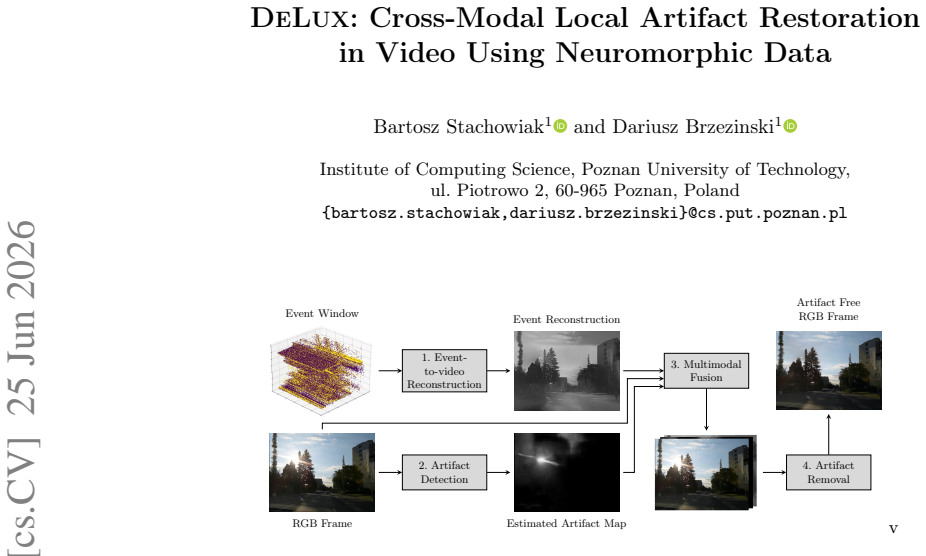
DeLux is a modular pipeline that uses neuromorphic event streams as a structural prior to guide the targeted detection and inpainting of lighting artifacts in RGB video, suppressing local degradations and restoring affected regions more effectively than existing RGB-only baselines or event-guided HDR models.
What carries the argument
Cross-modal restoration paradigm in which neuromorphic event streams supply a structural prior for selective artifact detection and inpainting.
If this is right
- Local artifacts that completely obscure image structure become recoverable without global frame alteration.
- Performance gains hold on both synthetic benchmarks and real automotive footage.
- The same modular design can be applied to additional artifact types once suitable event-RGB pairs are available.
- Public release of artifact generation tools and evaluation datasets enables direct comparison by other methods.
Where Pith is reading between the lines
- The approach may generalize to other sensor pairs where one modality preserves edges lost in the other.
- Real-time versions could be tested by measuring end-to-end latency on embedded automotive hardware.
- Combining the event prior with existing HDR pipelines might further reduce residual overexposure artifacts.
Load-bearing premise
Neuromorphic event streams supply a reliable and accurately aligned structural prior even for regions fully hidden by complex lighting artifacts.
What would settle it
A controlled test in which event data is deliberately misaligned with the RGB frames or fails to register edges inside artifact regions, after which the inpainting step produces visible structural errors or lower MS-SSIM scores than RGB-only baselines.
Figures


read the original abstract
Conventional RGB cameras suffer from lighting artifacts such as flare, glare, flicker, and overexposure, leading to irrecoverable information loss that necessitates computational restoration. However, existing approaches treat these problems in isolation, failing to recover structural details completely obscured by complex spatially discrete image degradations. In this paper, we propose a novel cross-modal restoration paradigm and present DeLux, a modular proof-of-concept pipeline that leverages neuromorphic event streams as a structural prior to guide the targeted detection and inpainting of lighting artifacts in RGB video. Validation on synthetic benchmarks and real-world automotive footage demonstrates that DeLux effectively suppresses local artifacts and restores affected regions. The proposed approach outperforms existing RGB-only baselines and event-guided HDR models, achieving an average MS-SSIM of over 0.99 across all artifact types and demonstrating up to an 88% reduction in artifact severity in real-world automotive footage. The synthetic artifact generation tools and curated real-world evaluation datasets are made publicly available to foster future research on cross-modal restoration.
Editorial analysis
A structured set of objections, weighed in public.
Referee Report
Summary. The manuscript introduces DeLux, a modular proof-of-concept pipeline for cross-modal local artifact restoration in RGB video. It uses neuromorphic event streams as a structural prior to guide targeted detection and inpainting of spatially discrete lighting artifacts (flare, glare, flicker, overexposure). Validation on synthetic benchmarks and real-world automotive footage claims that DeLux outperforms RGB-only baselines and event-guided HDR models, achieving average MS-SSIM > 0.99 across artifact types and up to 88% reduction in artifact severity. Synthetic artifact generation tools and curated real-world datasets are released publicly.
Significance. If the results hold under rigorous validation, the work would advance handling of irrecoverable local degradations in video by demonstrating a practical cross-modal approach. The public release of datasets and tools is a clear strength that supports reproducibility and future research. The modular design aids extensibility.
major comments (2)
- [Validation on synthetic benchmarks and real-world automotive footage (abstract and experimental sections)] The central performance claims (MS-SSIM > 0.99, 88% severity reduction) rest on the untested assumption that event streams supply usable scene structure inside completely obscured artifact masks. No ablation or controlled experiment is reported on cases of zero or near-zero events within masks (static/saturated regions), which would reduce the pipeline to standard RGB inpainting whose success is not independently shown. This is load-bearing for the cross-modal paradigm.
- [Cross-modal restoration paradigm description] Pixel-level alignment between event streams and RGB frames, plus encoding of structure under absent intensity changes, is assumed rather than validated under controlled sparsity or misalignment. The abstract and paradigm description treat this prior as given.
minor comments (2)
- Clarify the exact modular components and their interfaces in a diagram or pseudocode to aid reproducibility.
- The public dataset release is noted positively; ensure the paper includes explicit links and usage instructions.
Simulated Author's Rebuttal
We thank the referee for the constructive feedback and the recommendation for major revision. We address each major comment below and agree that targeted additions will strengthen the validation of the cross-modal claims.
read point-by-point responses
-
Referee: [Validation on synthetic benchmarks and real-world automotive footage (abstract and experimental sections)] The central performance claims (MS-SSIM > 0.99, 88% severity reduction) rest on the untested assumption that event streams supply usable scene structure inside completely obscured artifact masks. No ablation or controlled experiment is reported on cases of zero or near-zero events within masks (static/saturated regions), which would reduce the pipeline to standard RGB inpainting whose success is not independently shown. This is load-bearing for the cross-modal paradigm.
Authors: We agree that the manuscript does not report an explicit ablation isolating zero or near-zero event density inside artifact masks. The synthetic generation and real-world automotive data were constructed to include correlated events, but this does not directly test the reduction to RGB-only inpainting. In the revision we will add a controlled ablation that masks event input within artifact regions (including zero-event cases) and reports separate metrics against RGB-only baselines to clarify when the event prior contributes. revision: yes
-
Referee: [Cross-modal restoration paradigm description] Pixel-level alignment between event streams and RGB frames, plus encoding of structure under absent intensity changes, is assumed rather than validated under controlled sparsity or misalignment. The abstract and paradigm description treat this prior as given.
Authors: The current description relies on standard extrinsic calibration between the co-located RGB and event sensors. We acknowledge that controlled tests under varying event sparsity and small misalignment are not presented. The revised manuscript will expand the paradigm section with a short robustness study (or supplementary figure) that varies event density and introduces controlled spatial offsets to quantify sensitivity. revision: yes
Circularity Check
No circularity: empirical pipeline with no self-referential derivations
full rationale
The paper describes a modular cross-modal pipeline that uses event streams as a structural prior for artifact detection and inpainting. No equations, fitting procedures, or derivation steps are presented that reduce a claimed prediction or result to its own inputs by construction. Performance metrics (MS-SSIM >0.99, 88% severity reduction) are reported from validation on synthetic benchmarks and real-world footage rather than from any fitted parameter renamed as a prediction. No self-citation chains or uniqueness theorems are invoked as load-bearing premises. The central assumption about event data alignment and structure is treated as an empirical premise to be tested, not a definitional tautology.
Axiom & Free-Parameter Ledger
Reference graph
Works this paper leans on
-
[1]
Electronic Imaging35(5), 325–1–325–1 (2023)
Visual odometry and mapping under poor visibility conditions using a stereo in- frared thermal imaging system. Electronic Imaging35(5), 325–1–325–1 (2023)
2023
-
[2]
In: Proceedings of the 25th ACM SIGKDD International Conference on Knowledge Discovery and Data Min- ing (2019)
Akiba, T., Sano, S., Yanase, T., Ohta, T., Koyama, M.: Optuna: A next- generation hyperparameter optimization framework. In: Proceedings of the 25th ACM SIGKDD International Conference on Knowledge Discovery and Data Min- ing (2019)
2019
-
[3]
Blahnik, V., Voelker, B.: About the reduction of reflections for camera lenses: How t*-coating made glass invisible. Tech. rep., Carl Zeiss AG (March 2016),https:// lenspire.zeiss.com/photo/app/uploads/2022/02/technical-article-about- the-reduction-of-reflections-for-camera-lenses.pdf
2016
-
[4]
IEEE Transactions on Dependable and Secure Computing 20(4), 2731–2745 (2023)
Ceccarelli, A., Secci, F.: Rgb cameras failures and their effects in autonomous driving applications. IEEE Transactions on Dependable and Secure Computing 20(4), 2731–2745 (2023)
2023
-
[5]
IEEE Access11, 118812–118829 (2023) 16 B
Chiang, C.C., Yang, Y.Y., Liu, W.L., Lin, Y.C.: Improving automatic identification of medications in transparent packaging by glare removal and color correction. IEEE Access11, 118812–118829 (2023) 16 B. Stachowiak and D. Brzezinski
2023
-
[6]
In: Proc
Cordts, M., Omran, M., Ramos, S., Rehfeld, T., Enzweiler, M., Benenson, R., Franke, U., Roth, S., Schiele, B.: The cityscapes dataset for semantic urban scene understanding. In: Proc. of the IEEE Conference on Computer Vision and Pattern Recognition (CVPR) (2016)
2016
-
[7]
Dai, Y., Li, C., Zhou, S., Feng, R., Loy, C.C.: Flare7k: A phenomenological night- time flare removal dataset (2022)
2022
-
[8]
IEEE Transactions on Pattern Analysis and Machine Intelligence46(11), 7041–7055 (2024)
Dai, Y., Li, C., Zhou, S., Feng, R., Luo, Y., Loy, C.C.: Flare7k++: Mixing synthetic and real datasets for nighttime flare removal and beyond. IEEE Transactions on Pattern Analysis and Machine Intelligence46(11), 7041–7055 (2024)
2024
-
[9]
IEEE Transactions on Image Processing20(5), 1249–1261 (2011)
Deng, G.: A generalized unsharp masking algorithm. IEEE Transactions on Image Processing20(5), 1249–1261 (2011)
2011
-
[10]
In: Proceedings of the 1st Annual Conference on Robot Learning
Dosovitskiy, A., Ros, G., Codevilla, F., Lopez, A., Koltun, V.: CARLA: An open urban driving simulator. In: Proceedings of the 1st Annual Conference on Robot Learning. pp. 1–16 (2017)
2017
-
[11]
ACM Transactions on Graphics 36(6), 1–15 (Nov 2017)
Eilertsen,G.,Kronander,J.,Denes,G.,Mantiuk,R.K.,Unger,J.:Hdrimagerecon- struction from a single exposure using deep cnns. ACM Transactions on Graphics 36(6), 1–15 (Nov 2017)
2017
-
[12]
Atmo- sphere15(4) (2024)
Elvidge, C.D., Zhizhin, M., Pipkin, A., Anderson, S., Kowalik, W.S., Bazilian, M.: Exploring the hidden world of lighting flicker with a high-speed camera. Atmo- sphere15(4) (2024)
2024
-
[13]
In: 2019 IEEE/CVF Inter- national Conference on Computer Vision (ICCV)
Gehrig, D., Loquercio, A., Derpanis, K., Scaramuzza, D.: End-to-End Learning of Representations for Asynchronous Event-Based Data . In: 2019 IEEE/CVF Inter- national Conference on Computer Vision (ICCV). pp. 5632–5642. IEEE Computer Society, Los Alamitos, CA, USA (Nov 2019)
2019
-
[14]
IEEE Robotics and Automation LettersPP, 1–1 (03 2021)
Gehrig, M., Aarents, W., Gehrig, D., Scaramuzza, D.: Dsec: A stereo event camera dataset for driving scenarios. IEEE Robotics and Automation LettersPP, 1–1 (03 2021)
2021
-
[15]
Cam- bridge University Press, 2 edn
Hartley, R., Zisserman, A.: Multiple View Geometry in Computer Vision. Cam- bridge University Press, 2 edn. (2004)
2004
-
[16]
2016 IEEE Conference on Computer Vision and Pattern Recognition (CVPR) pp
He, K., Zhang, X., Ren, S., Sun, J.: Deep residual learning for image recognition. 2016 IEEE Conference on Computer Vision and Pattern Recognition (CVPR) pp. 770–778 (2015)
2016
-
[17]
The Annals of Mathe- matical Statistics35(1), 73 – 101 (1964)
Huber, P.J.: Robust Estimation of a Location Parameter. The Annals of Mathe- matical Statistics35(1), 73 – 101 (1964)
1964
-
[18]
In: 2018 International Symposium ELMAR
Jakubović, A., Velagić, J.: Image feature matching and object detection using brute-force matchers. In: 2018 International Symposium ELMAR. pp. 83–86 (2018)
2018
-
[19]
Jiang, Y., Chen, X., Pun, C.M., Wang, S., Feng, W.: Mfdnet: Multi-frequency de- flare network for efficient nighttime flare removal. ArXivabs/2406.18079(2024)
-
[20]
In: 2020 IEEE/CVF Conference on Computer Vision and Pattern Recognition (CVPR)
Jiang, Z., Zhang, Y., Zou, D., Ren, J., Lv, J., Liu, Y.: Learning event-based mo- tion deblurring. In: 2020 IEEE/CVF Conference on Computer Vision and Pattern Recognition (CVPR). pp. 3317–3326 (2020)
2020
-
[21]
Perceptual Losses for Real-Time Style Transfer and Super-Resolution
Johnson, J., Alahi, A., Fei-Fei, L.: Perceptual losses for real-time style transfer and super-resolution. ArXivabs/1603.08155(2016)
work page internal anchor Pith review Pith/arXiv arXiv 2016
-
[22]
ACM Trans
Kalantari, N.K., Ramamoorthi, R.: Deep high dynamic range imaging of dynamic scenes. ACM Trans. Graph.36(4) (Jul 2017)
2017
-
[23]
In: 2017 IEEE International Conference on Image Processing (ICIP)
Kanj, A., Talbot, H., Luparello, R.: Flicker removal and superpixel-based motion tracking for high speed videos. In: 2017 IEEE International Conference on Image Processing (ICIP). pp. 245–249 (09 2017)
2017
-
[24]
In: International Conference on Computer Vision Theory and Applications
Lamprinou, N., Psarakis, E.: Fast detection and removal of glare in gray scale laparoscopic images. In: International Conference on Computer Vision Theory and Applications. pp. 206–212 (01 2018) DeLux: Cross-Modal Local Artifact Restoration 17
2018
-
[25]
In: Proceedings of the IEEE/CVF Conference on Computer Vision and Pattern Recognition (CVPR) (June 2023)
Lei, C., Ren, X., Zhang, Z., Chen, Q.: Blind video deflickering by neural filtering with a flawed atlas. In: Proceedings of the IEEE/CVF Conference on Computer Vision and Pattern Recognition (CVPR) (June 2023)
2023
-
[26]
IEEE Transactions on Intelligent Transportation Systems24(5), 4716– 4737 (2023)
Li, Y., Moreau, J., Ibanez-Guzman, J.: Emergent visual sensors for autonomous vehicles. IEEE Transactions on Intelligent Transportation Systems24(5), 4716– 4737 (2023)
2023
-
[27]
Neuro- computing600, 128132 (2024)
Liet al., X.: Generalizing event-based hdr imaging to various exposures. Neuro- computing600, 128132 (2024)
2024
-
[28]
In: 2018 IEEE/CVF Conference on Computer Vision and Pattern Recognition
Liang, Z., Xu, J., Zhang, D., Cao, Z., Zhang, L.: A hybrid l1-l0 layer decomposition model for tone mapping. In: 2018 IEEE/CVF Conference on Computer Vision and Pattern Recognition. pp. 4758–4766 (2018)
2018
-
[29]
IEEE Transactions on Circuits and Sys- tems for Video TechnologyPP, 1–1 (08 2024)
Liu, X., Li, J., Shi, J., Fan, X., Tian, Y., Zhao, D.: Event-based monocular depth estimation with recurrent transformers. IEEE Transactions on Circuits and Sys- tems for Video TechnologyPP, 1–1 (08 2024)
2024
-
[30]
In: Proceedings of the IEEE/CVF Conference on Computer Vision and Pattern Recognition (CVPR) (2020)
Liu, Y.L., Lai, W.S., Chen, Y.S., Kao, Y.L., Yang, M.H., Chuang, Y.Y., Huang, J.B.: Single-image hdr reconstruction by learning to reverse the camera pipeline. In: Proceedings of the IEEE/CVF Conference on Computer Vision and Pattern Recognition (CVPR) (2020)
2020
-
[31]
In: 2020 IEEE/CVF Conference on Computer Vision and Pattern Recognition (CVPR) (2020)
Liu, Y.L., Lai, W.S., Chen, Y.S., Kao, Y.L., Yang, M.H., Chuang, Y.Y., Huang, J.B.: Single-image hdr reconstruction by learning to reverse the camera pipeline. In: 2020 IEEE/CVF Conference on Computer Vision and Pattern Recognition (CVPR) (2020)
2020
-
[32]
Interna- tional Journal of Computer Vision60(2), 91–110 (Nov 2004)
Lowe, D.G.: Distinctive image features from scale-invariant keypoints. Interna- tional Journal of Computer Vision60(2), 91–110 (Nov 2004)
2004
-
[33]
Computer Vision and Image Understand- ing218, 103403 (2022)
Lv, X., Zhang, S., Liu, Q., Xie, H., Zhong, B., Zhou, H.: Backlitnet: A dataset and network for backlit image enhancement. Computer Vision and Image Understand- ing218, 103403 (2022)
2022
-
[34]
Computer Graphics Forum37(2), 37–49 (2018)
Marnerides, D., Bashford-Rogers, T., Hatchett, J., Debattista, K.: Expandnet: A deep convolutional neural network for high dynamic range expansion from low dynamic range content. Computer Graphics Forum37(2), 37–49 (2018)
2018
-
[35]
Matta, G.R., Siddartha, R., Girish, R.S.V., Sharma, S., Mitra, K.: Gn- fr:generalizable neural radiance fields for flare removal. ArXivabs/2412.08200 (2024)
-
[36]
In: IEEE Conference on Computer Vision and Pattern Recognition Workshop (CVPRW), New Orleans, 2022 (2022)
Messikommer, N., Georgoulis, S., Gehrig, D., Tulyakov, S., Erbach, J., Bochic- chio, A., Li, Y., Scaramuzza, D.: Multi-bracket high dynamic range imaging with event cameras. In: IEEE Conference on Computer Vision and Pattern Recognition Workshop (CVPRW), New Orleans, 2022 (2022)
2022
-
[37]
IEEE Transactions on Pattern Analysis and Machine Intelligence44(10), 6890–6909 (2022)
Mostafavi, M., Nam, Y., Choi, J., Yoon, K.J.: E2sri: Learning to super-resolve intensity images from events. IEEE Transactions on Pattern Analysis and Machine Intelligence44(10), 6890–6909 (2022)
2022
-
[38]
Pattern Recognition157, 110816 (2025)
Niu, C., Li, K., Wang, D., Zhu, W., Xu, H., Dong, J.: Gr-gan: A unified adversarial framework for single image glare removal and denoising. Pattern Recognition157, 110816 (2025)
2025
-
[39]
Electronics11(10) (2022)
Qiao, J., Wang, X., Chen, J., Jian, M.: Low-light image enhancement with an anti- attention block-based generative adversarial network. Electronics11(10) (2022)
2022
-
[40]
In: 2019 IEEE/CVF Conference on Computer Vision and Pattern Recognition (CVPR)
Rebecq, H., Ranftl, R., Koltun, V., Scaramuzza, D.: Events-to-video: Bringing modern computer vision to event cameras. In: 2019 IEEE/CVF Conference on Computer Vision and Pattern Recognition (CVPR). pp. 3852–3861 (2019)
2019
-
[41]
IEEE Transactions on Pattern Analysis and Machine Intelligence43(6), 1964–1980 (2021) 18 B
Rebecq, H., Ranftl, R., Koltun, V., Scaramuzza, D.: High speed and high dynamic range video with an event camera. IEEE Transactions on Pattern Analysis and Machine Intelligence43(6), 1964–1980 (2021) 18 B. Stachowiak and D. Brzezinski
1964
-
[42]
Physica D: Nonlinear Phenomena60(1), 259–268 (1992)
Rudin, L.I., Osher, S., Fatemi, E.: Nonlinear total variation based noise removal algorithms. Physica D: Nonlinear Phenomena60(1), 259–268 (1992)
1992
-
[43]
In: Proceedings of the International Conference on Com- puter Vision Theory and Applications - Volume 1: VISAPP, (VISIGRAPP 2012)
Shihavuddin, A.S.M., Gracias, N., Garcia, R.: Online sunflicker removal using dy- namic texture prediction. In: Proceedings of the International Conference on Com- puter Vision Theory and Applications - Volume 1: VISAPP, (VISIGRAPP 2012). pp. 161–167. INSTICC, SciTePress (2012)
2012
-
[44]
Computer Optics45, 615–626 (07 2021)
Shoshin, A., Shvets, E.: Veiling glare removal: synthetic dataset generation, metrics and neural network architecture. Computer Optics45, 615–626 (07 2021)
2021
-
[45]
In: 2022 IEEE/CVF Conference on Computer Vision and Pattern Recognition (CVPR)
Song, C., Huang, Q., Bajaj, C.: E-cir: Event-enhanced continuous intensity recov- ery. In: 2022 IEEE/CVF Conference on Computer Vision and Pattern Recognition (CVPR). pp. 7793–7802 (2022)
2022
-
[46]
Stoffregen, T., Scheerlinck, C., Scaramuzza, D., Drummond, T., Barnes, N., Klee- man, L., Mahony, R.: Reducing the sim-to-real gap for event cameras (2020)
2020
-
[47]
In: 2019 IEEE/CVF Conference on Computer Vision and Pat- tern Recognition (CVPR)
Wang, L., Mostafavi, I.M., Ho, Y.S., Yoon, K.J.: Event-based high dynamic range image and very high frame rate video generation using conditional generative ad- versarial networks. In: 2019 IEEE/CVF Conference on Computer Vision and Pat- tern Recognition (CVPR). p. 10073–10082. IEEE (Jun 2019)
2019
-
[48]
In: The Thrity-Seventh Asilomar Conference on Signals, Systems and Computers, 2003
Wang, Z., Simoncelli, E., Bovik, A.: Multiscale structural similarity for image qual- ity assessment. In: The Thrity-Seventh Asilomar Conference on Signals, Systems and Computers, 2003. vol. 2, pp. 1398–1402 Vol.2 (2003)
2003
-
[49]
In: Proceedings of the IEEE/CVF Conference on Computer Vision and Pattern Recognition (CVPR)
Wang, Z., Cun, X., Bao, J., Zhou, W., Liu, J., Li, H.: Uformer: A general u-shaped transformer for image restoration. In: Proceedings of the IEEE/CVF Conference on Computer Vision and Pattern Recognition (CVPR). pp. 17683–17693 (June 2022)
2022
-
[50]
In: Computer Vision – ECCV 2018: 15th European Confer- ence, Munich, Germany, September 8-14, 2018, Proceedings, Part II
Wu, S., Xu, J., Tai, Y.W., Tang, C.K.: Deep high dynamic range imaging with large foreground motions. In: Computer Vision – ECCV 2018: 15th European Confer- ence, Munich, Germany, September 8-14, 2018, Proceedings, Part II. p. 120–135. Springer-Verlag, Berlin, Heidelberg (2018)
2018
-
[51]
In: Proceedings of the IEEE/CVF International Conference on Computer Vision
Wu, Y., He, Q., Xue, T., Garg, R., Chen, J., Veeraraghavan, A., Barron, J.T.: How to train neural networks for flare removal. In: Proceedings of the IEEE/CVF International Conference on Computer Vision. pp. 2239–2247 (2021)
2021
-
[52]
Applied Sciences13(17) (2023)
Xi, Y., Zhang, Z., Wang, W.: Low-light image enhancement method for electric power operation sites considering strong light suppression. Applied Sciences13(17) (2023)
2023
-
[53]
In: 2018 IEEE/CVF Conference on Computer Vision and Pattern Recognition
Yang, X., Xu, K., Song, Y., Zhang, Q., Wei, X., Lau, R.W.: Image correction via deep reciprocating hdr transformation. In: 2018 IEEE/CVF Conference on Computer Vision and Pattern Recognition. pp. 1798–1807 (2018)
2018
-
[54]
Applied Sciences12(20) (2022)
Yang, Z., Yang, X., Wu, L., Hu, J., Zou, B., Zhang, Y., Zhang, J.: Pre-inpainting convolutional skip triple attention segmentation network for agv lane detection in overexposure environment. Applied Sciences12(20) (2022)
2022
-
[55]
In: CVPR
Yanget al., Y.: Learning event guided high dynamic range video reconstruction. In: CVPR. pp. 13924–13934 (2023)
2023
-
[56]
In: ICCV
Yanget al., Y.: Event-guided hdr reconstruction with diffusion priors. In: ICCV. pp. 11787–11796 (2025)
2025
-
[57]
In: 2017 IEEE International Conference on Computer Vision (ICCV)
Zhang, J., Lalonde, J.F.: Learning high dynamic range from outdoor panoramas. In: 2017 IEEE International Conference on Computer Vision (ICCV). pp. 4529– 4538 (2017)
2017
-
[58]
IET Image Processing17(1), 193–203 (2023) DeLux: Cross-Modal Local Artifact Restoration 19
Zheng, Q., Zhao, Y., Zhang, X., Zhu, P., Ma, W.: A multi-view image fusion algorithm for industrial weld. IET Image Processing17(1), 193–203 (2023) DeLux: Cross-Modal Local Artifact Restoration 19
2023
-
[59]
Deep learning for event-based vision: A comprehensive survey and benchmarks,
Zheng, X., Liu, Y., Lu, Y., Hua, T., Pan, T., Zhang, W., Tao, D., Wang, L.: Deep learning for event-based vision: A comprehensive survey and benchmarks. arXiv.2302.08890 (2023)
-
[60]
In: 2019 IEEE/CVF Conference on Computer Vision and Pattern Recognition Workshops (CVPRW)
Zhu, A.Z., Yuan, L., Chaney, K., Daniilidis, K.: Live demonstration: Unsupervised event-based learning of optical flow, depth and egomotion. In: 2019 IEEE/CVF Conference on Computer Vision and Pattern Recognition Workshops (CVPRW). pp. 1694–1694 (2019)
2019
-
[61]
In: 2020 IEEE/CVF Conference on Computer Vision and Pattern Recognition (CVPR)
Zou, Z., Lei, S., Shi, T., Shi, Z., Ye, J.: Deep adversarial decomposition: A unified framework for separating superimposed images. In: 2020 IEEE/CVF Conference on Computer Vision and Pattern Recognition (CVPR). pp. 12803–12813 (2020) A Data Preparation Details This section outlines the preparation of the training data forDeLux, covering the steps taken f...
2020
-
[62]
Manual Intrinsic Parameter Estimation
-
[63]
Automatic Temporal Alignment
-
[64]
These parameters are necessary for projecting event data into the RGB image plane and are a prerequisite for accurate spatial alignment between the two modalities
Automatic Spatial Alignment Intrinsic Parameter Estimation.The internal camera parameters define the in- ternal geometry of the camera, including the focal length, the principal point, and the distortion of the lens [15]. These parameters are necessary for projecting event data into the RGB image plane and are a prerequisite for accurate spatial alignment...
discussion (0)
Sign in with ORCID, Apple, or X to comment. Anyone can read and Pith papers without signing in.