REVIEW 4 major objections 5 minor 57 references
Beyond Interactions: Node-Level Graph Generation for Knowledge-Free Augmentation in Recommender Systems
T0 review · 4 major / 5 minor · reviewed 2026-08-15 · deepseek-v4-flash
Pith's one-line read Diffusion-generated pseudo-items, injected into the user-item graph, can substantially improve recommender accuracy without any external knowledge.
desk verdict Novel node-level diffusion augmentation idea, but missing evaluation protocol and impossible metrics make the reported SOTA gains uninterpretable as submitted. read the letter →
The pith
A machine-rendered reading of the paper's core claim, the machinery that carries it, and where it could break.
The reading
What carries the argument
The load-bearing object is the injection-denoising pipeline built on a conditional Denoising Diffusion Probabilistic Model (DDPM) and a score-based latent diffusion model. In the injection stage, a VAE encoder with reparameterization maps position-aware LightGCN embeddings of all user/item nodes into a latent space; a DDPM conditioned on the node class generates new latent vectors; and the decoder splits each vector into a feature half and an adjacency half, yielding pseudo-item features $\hat{Z}_{\text{new}}$ and a predicted interaction map $\hat{X}_{\text{new}}$. Threshold $\tau$ and a count $K$ turn the map into a sparse augmentation $X_{\text{aug}}=[X \mid X']$. The denoising stage encodes $X_{\text{aug}}$ with a frozen preference-modeling VAE, diffuses the latent preference vectors with a finite-difference score estimate, and decodes the denoised vectors into optimized interactions $X_{\text{opt}}$ used for final training.
What would settle it
On each of the three datasets, fix a standard split (e.g., time-based or leave-one-out per user), tune $K$ and $\tau$ only on the validation users, and report test Recall@5/NDCG@5 against DiffRec and GiffCF under identical splits. If the relative gains disappear or reverse, or if the validation-optimal $K$ yields test performance no better than $K=0$, the central claim is not supported.
Extended reading notes
Core claim
NodeDiffRec's central claim is that knowledge-free augmentation should operate on nodes, not just edges. Existing diffusion recommenders remodel the user-item interaction matrix; NodeDiffRec instead learns a latent distribution over user and item nodes, samples new item nodes, decodes their features and interaction maps, and appends them to the bipartite graph. It then runs a second diffusion model that rebuilds clean preference distributions from the augmented, noisy matrix. The paper reports that this injection-denoising loop improves eight recommendation algorithms across three datasets, with relative gains over generative baselines as high as 98.6% in Recall@5 and 84.0% in NDCG@5.
Load-bearing premise
The load-bearing premise is that the reported Recall and NDCG numbers are computed on a held-out test split, with the injected-edge count $K$ and other hyperparameters selected on validation data; Section 4.1 does not describe such a split, so if metrics were computed on training interactions or $K$ was tuned on the test set, the performance claim collapses.
Editorial extensions
If this is right
- Recommendation augmentation can become fully self-contained: only the observed interaction matrix is needed, removing the dependency on knowledge graphs and LLMs that currently limits deployment.
- Node injection changes the cold-start picture: pseudo-items can provide structurally meaningful bridges for isolated entities, so cold users and items can receive more stable embeddings before any external profile is built.
- The two-stage design suggests that noisy generated structure can be repaired by a second generative model, which may apply to other graph-augmentation tasks beyond recommendation.
- Because gains are reported consistently across matrix factorization, neural, and graph-based algorithms, the method is best understood as a preprocessing mechanism rather than a new recommender architecture.
Reading between the lines
- An untested extension the paper only gestures at is user-side node injection: generating pseudo-users could densify sparse neighborhoods for cold items, and the same injection-denoising loop should apply symmetrically.
- The semantic-anchor intuition implies that injected items need not appear in the final top-K to help; their value is in reshaping the graph so real items become rankable. This is a concrete prediction that could be tested by ablating injected items from the final ranking.
- Because the injection VAE is trained on observed interactions, the method likely interpolates the observed distribution rather than correcting for its blind spots; evaluating under simulated missing-not-at-random data would show whether the gains persist when the dataset is biased.
Signed reviews
Editorial analysis
A structured set of objections, weighed in public.
Referee Report
Summary. The paper proposes NodeDiffRec, a knowledge-free augmentation framework for recommender systems. The method has two diffusion-based stages: first, a VAE-DDPM pipeline generates pseudo-item nodes and predicted user-item interactions, which are thresholded and injected into the original interaction matrix; second, a latent diffusion model with a frozen preference VAE denoises the augmented matrix to produce a cleaned interaction matrix for downstream recommendation training. The authors evaluate on ProgrammableWeb, Amazon Luxury Beauty, and MovieLens-100k using eight recommendation algorithms and compare against several generative baselines (MultiVAE, TVAE, VanillaGAN, CTGAN, DiffRec, GiffCF, SDRM variants). They report consistent improvements and claim SOTA augmentation performance, with maximum average relative improvements of 98.6% in Recall@5 and 84.0% in NDCG@5 over baselines.
Significance. If the reported results are valid, the framework would be a meaningful step for knowledge-free recommendation augmentation: it expands augmentation primitives from edge-level operations to node injection, combines structural and semantic signals, and includes a denoising stage to control injected noise. The paper is also commendable for evaluating across eight recommender models, providing ablations of the two main modules, and including per-user case studies. However, the empirical contribution is currently not interpretable because the evaluation protocol is not specified and several reported metric values are internally impossible. The central claim therefore does not yet stand.
major comments (4)
- [Section 4.1, Eq. (3), Table 1] The manuscript never specifies the train/validation/test split used to compute Recall and NDCG. Section 4.1 describes datasets and hyperparameter ranges but does not state which interactions are used to train LightGCN, to train the injection VAE, to build Xaug, or to evaluate the downstream recommenders. If the augmented matrix is evaluated on the same interactions that were used to generate and train it, the reported gains are not evidence of generalization. The claim in Section 4.2 that improvements are 'statistically significant' is also unsupported: no significance test is described, only standard deviations are reported. This is load-bearing for the paper's central empirical claim.
- [Table 1, NeuMF row on ALB; Appendix Table 13] Several reported metric patterns are impossible for standard cumulative Recall. In Table 1, NeuMF on Amazon Luxury Beauty has Recall@5 = 0.0417, Recall@10 = 0.0320, Recall@20 = 0.0234, and Recall@50 = 0.0154, which strictly decreases as the cutoff increases; NDCG shows the same decreasing pattern. For a single ranked list with a fixed ground-truth set, Recall@k is non-decreasing in k. Appendix Table 13 shows the same non-monotonicity for User 861 (Recall-bef 0.200 at @5, 0.300 at @10, 0.200 at @20, 0.333 at @50). These entries indicate that the metric computation is not standard Recall/NDCG, or that different ground truths are used at different cutoffs. This invalidates the interpretation of the headline numbers in Table 1 and the case study in Section 4.2.
- [Section 3.3, Eq. (18), Implementation in Section 4.1] The injection threshold is set to tau = 1.0, but Eq. (18) defines the predicted interaction scores as \hat{X}_new = \sigma(W_a z'_a + b_a), where \sigma is described as a sigmoid function. A sigmoid output is strictly less than 1, so thresholding at 1.0 would select no edges and Xaug would equal X, making the node-injection step vacuous. If the threshold is actually applied to pre-sigmoid logits or to a different scoring function, the text and equations must say so explicitly. As written, the proposed mechanism cannot produce the augmented matrix on which the reported improvements depend.
- [Section 4.1, Table 2, Appendix C] The comparison against generative baselines is not apples-to-apples as reported. For the baselines, the authors state that output matrices are min-max normalized and edges are selected with a fixed threshold of 0.5, while NodeDiffRec uses the (ambiguous) tau = 1.0 threshold. The number of generated interactions per baseline is not specified, and for NodeDiffRec only K (the number of injected high-confidence pairs) is said to be tuned at intervals of 500, without stating whether this tuning is performed on a validation split. The average relative improvement ratios in Table 2 therefore conflate model quality with thresholding and tuning choices, and the claimed SOTA advantage is not established.
minor comments (5)
- [Abstract vs. Section 4.2] The abstract reports maximum improvements of 98.6% in Recall@5 and 84.0% in NDCG@5, but Section 4.2 states a maximum 69.95% improvement in Recall and 57.14% in NDCG for Table 1; the relation between these figures (different baseline sets) should be clarified.
- [Appendix B, Table 3] For ML-100K the authors say they 'randomly drop partial interactions to render higher sparsity' but do not specify the drop ratio or the random seed; this makes the dataset preprocessing non-reproducible.
- [Notation: Eq. (3) vs. Section 3.3] The symbol K is used both for the number of LightGCN propagation layers in Eq. (3) and for the number of injected high-confidence interactions in Section 3.3; this overloaded notation is confusing.
- [Typographical issues] There are several typos: the author name 'In-Y oung Ko' has a stray space, Appendix C calls DiffRec the 'previous SOAT', and Section 4.2 says 'quantize' where 'quantify' is meant; these should be corrected.
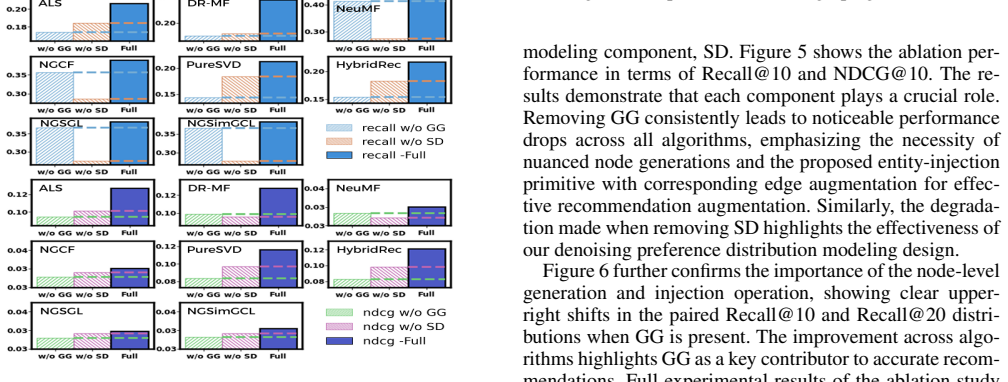
- [Figure 6 and Appendix D] Figure 6 is referenced as showing 'clear upper-right shifts', but the figure is not included in the provided text, and the corresponding paired distributions in Appendix Figure 9 are described only briefly; the authors should ensure the visual evidence is self-contained.
Circularity Check
No circularity: the augmentation pipeline is trained on the interaction data but no reported improvement is a fitted constant or a self-citation.
full rationale
I examined the derivation chain in Sections 3.2-3.4 and the empirical claims in Section 4. The injection VAE (Eqs. 4-17) is trained to reconstruct node embeddings and the user-item map X; the preference VAE/diffusion (Eqs. 19-22) is trained on the augmented matrix Xaug. In both cases the generated outputs are sampled from latent variables, not returned as the training targets themselves, so no 'prediction' reduces to a fitted input by construction. The paper contains no self-citations, no imported uniqueness theorem from the authors' prior work, and no ansatz smuggled in via citation; the components (LightGCN, DDPM, VAE) are external, standard methods. Hyperparameters including K and diffusion settings are tuned in terms of Recall@10 (Section 4.1), which can inflate correlated metrics and is a model-selection concern, but the headline improvements at Recall@5 and NDCG@5 are not equal to the tuning objective, so this is not a fitted-parameter-renamed-as-prediction. Significant correctness problems exist: Section 3.3 sets tau=1.0 on sigmoid scores, which would leave the injected interaction set empty, and no train/test split is specified, making the reported gains uninterpretable. These are reproducibility and validity issues, not circular reasoning. Hence the circularity score is 0.
Assumptions & free parameters
free parameters (5)
- N' =
2000
- tau =
1.0
- K =
tuned per algorithm
- diffusion epochs, lr, timesteps, VAE latent dim, VAE lr =
grid-searched
- lambda_feat, lambda_map =
unspecified
assumptions (4)
- domain assumption The user-item interaction matrix can be augmented with synthetic nodes and edges that follow the underlying preference distribution, and this improves downstream recommendation.
- domain assumption LightGCN pretraining on the original interaction matrix provides position-aware embeddings that are a valid initialization for generation.
- standard math A linear noise schedule and the DDPM reverse process accurately model the latent distribution of the VAE.
- standard math The finite-difference score approximation in Eq. 22 is a valid training objective.
invented entities (1)
-
Pseudo-item nodes
Cite this review
Pith. "Pith review of Beyond Interactions: Node-Level Graph Generation for Knowledge-Free Augmentation in Recommender Systems." pith.science (2026). https://pith.science/paper/DSZGOG7K
@misc{pith2026250720578,
  author       = {Pith},
  title        = {Pith review of: Beyond Interactions: Node-Level Graph Generation for Knowledge-Free Augmentation in Recommender Systems},
  year         = {2026},
  howpublished = {\url{https://pith.science/paper/DSZGOG7K}},
  note         = {Machine review of arXiv:2507.20578}
}
read the original abstract
Recent advances in recommender systems rely on external resources such as knowledge graphs or large language models to enhance recommendations, which limit applicability in real-world settings due to data dependency and computational overhead. Although knowledge-free models are able to bolster recommendations by direct edge operations as well, the absence of augmentation primitives drives them to fall short in bridging semantic and structural gaps as high-quality paradigm substitutes. Unlike existing diffusion-based works that remodel user-item interactions, this work proposes NodeDiffRec, a pioneering knowledge-free augmentation framework that enables fine-grained node-level graph generation for recommendations and expands the scope of restricted augmentation primitives via diffusion. By synthesizing pseudo-items and corresponding interactions that align with the underlying distribution for injection, and further refining user preferences through a denoising preference modeling process, NodeDiffRec dramatically enhances both semantic diversity and structural connectivity without external knowledge. Extensive experiments across diverse datasets and recommendation algorithms demonstrate the superiority of NodeDiffRec, achieving State-of-the-Art (SOTA) performance, with maximum average performance improvement 98.6% in Recall@5 and 84.0% in NDCG@5 over selected baselines.
Figures


Figures from the paper (6 more)




Reference graph
Works this paper leans on
-
[1]
Chicaiza, J.; and Valdiviezo-Diaz, P. 2021. A comprehensive survey of knowledge graph-based recommender systems: Technologies, development, and contributions. Information, 12(6): 232
work page 2021
-
[2]
Covington, P.; Adams, J.; and Sargin, E. 2016. Deep neural networks for youtube recommendations. In Proceedings of the 10th ACM conference on recommender systems, 191--198
work page 2016
-
[3]
Cremonesi, P.; Koren, Y.; and Turrin, R. 2010. Performance of recommender algorithms on top-n recommendation tasks. In Proceedings of the fourth ACM conference on Recommender systems, 39--46
work page 2010
-
[4]
De Cao, N.; and Kipf, T. 2018. MolGAN: An implicit generative model for small molecular graphs. arXiv preprint arXiv:1805.11973
arXiv 2018
-
[5]
Elahi, E.; Anwar, S.; Shah, B.; Halim, Z.; Ullah, A.; Rida, I.; and Waqas, M. 2024. Knowledge graph enhanced contextualized attention-based network for responsible user-specific recommendation. ACM Transactions on Intelligent Systems and Technology, 15(4): 1--24
work page 2024
-
[6]
Fan, W.; Ma, Y.; Li, Q.; He, Y.; Zhao, E.; Tang, J.; and Yin, D. 2019. Graph neural networks for social recommendation. In The world wide web conference, 417--426
2019
-
[7]
Gao, C.; Zheng, Y.; Li, N.; Li, Y.; Qin, Y.; Piao, J.; Quan, Y.; Chang, J.; Jin, D.; He, X.; et al. 2023. A survey of graph neural networks for recommender systems: Challenges, methods, and directions. ACM Transactions on Recommender Systems, 1(1): 1--51
2023
-
[8]
J.; Pouget-Abadie, J.; Mirza, M.; Xu, B.; Warde-Farley, D.; Ozair, S.; Courville, A.; and Bengio, Y
Goodfellow, I. J.; Pouget-Abadie, J.; Mirza, M.; Xu, B.; Warde-Farley, D.; Ozair, S.; Courville, A.; and Bengio, Y. 2014. Generative adversarial nets. Advances in neural information processing systems, 27
2014
Show all 57 references
-
[9]
Guo, Q.; Zhuang, F.; Qin, C.; Zhu, H.; Xie, X.; Xiong, H.; and He, Q. 2020. A survey on knowledge graph-based recommender systems. IEEE Transactions on Knowledge and Data Engineering, 34(8): 3549--3568
2020
-
[10]
Halko, N.; Martinsson, P.-G.; and Tropp, J. A. 2011. Finding structure with randomness: Probabilistic algorithms for constructing approximate matrix decompositions. SIAM review, 53(2): 217--288
2011
-
[11]
He, X.; Deng, K.; Wang, X.; Li, Y.; Zhang, Y.; and Wang, M. 2020. Lightgcn: Simplifying and powering graph convolution network for recommendation. In Proceedings of the 43rd International ACM SIGIR conference on research and development in Information Retrieval, 639--648
2020
-
[12]
He, X.; Liao, L.; Zhang, H.; Nie, L.; Hu, X.; and Chua, T.-S. 2017. Neural collaborative filtering. In Proceedings of the 26th international conference on world wide web, 173--182
2017
-
[13]
He, X.; Peng, Q.; Shao, M.; and Sun, Y. 2024. Diffusion Review-Based Recommendation. In International Conference on Knowledge Science, Engineering and Management, 255--269. Springer
2024
-
[14]
Hidasi, B.; Karatzoglou, A.; Baltrunas, L.; and Tikk, D. 2015. Session-based recommendations with recurrent neural networks. arXiv preprint arXiv:1511.06939
2015 arXiv
-
[15]
Ho, J.; Jain, A.; and Abbeel, P. 2020. Denoising diffusion probabilistic models. Advances in neural information processing systems, 33: 6840--6851
2020
-
[16]
Hu, Y.; Koren, Y.; and Volinsky, C. 2008. Collaborative filtering for implicit feedback datasets. In 2008 Eighth IEEE international conference on data mining, 263--272. Ieee
2008
-
[17]
Jiang, Y.; Yang, Y.; Xia, L.; and Huang, C. 2024. Diffkg: Knowledge graph diffusion model for recommendation. In Proceedings of the 17th ACM international conference on web search and data mining, 313--321
2024
-
[18]
Jin, W.; Barzilay, R.; and Jaakkola, T. 2018. Junction tree variational autoencoder for molecular graph generation. In International conference on machine learning, 2323--2332. PMLR
2018
-
[19]
Jo, J.; Lee, S.; and Hwang, S. J. 2022. Score-based generative modeling of graphs via the system of stochastic differential equations. In International conference on machine learning, 10362--10383. PMLR
2022
-
[20]
P.; Welling, M.; et al
Kingma, D. P.; Welling, M.; et al. 2013. Auto-encoding variational bayes
2013
-
[21]
Li, Y.; Liu, K.; Satapathy, R.; Wang, S.; and Cambria, E. 2024. Recent developments in recommender systems: A survey. IEEE Computational Intelligence Magazine, 19(2): 78--95
2024
-
[22]
G.; Hoffman, M
Liang, D.; Krishnan, R. G.; Hoffman, M. D.; and Jebara, T. 2018. Variational autoencoders for collaborative filtering. In Proceedings of the 2018 world wide web conference, 689--698
2018
-
[23]
Lilienthal, D.; Mello, P.; Eirinaki, M.; and Tiomkin, S. 2024. Multi-Resolution Diffusion for Privacy-Sensitive Recommender Systems. IEEE Access
2024
-
[24]
Lin, J.; Dai, X.; Xi, Y.; Liu, W.; Chen, B.; Zhang, H.; Liu, Y.; Wu, C.; Li, X.; Zhu, C.; et al. 2025. How can recommender systems benefit from large language models: A survey. ACM Transactions on Information Systems, 43(2): 1--47
2025
-
[25]
Liu, C.; Fan, W.; Liu, Y.; Li, J.; Li, H.; Liu, H.; Tang, J.; and Li, Q. 2023 a . Generative diffusion models on graphs: Methods and applications. arXiv preprint arXiv:2302.02591
2023 arXiv
-
[26]
Liu, Q.; Yan, F.; Zhao, X.; Du, Z.; Guo, H.; Tang, R.; and Tian, F. 2023 b . Diffusion augmentation for sequential recommendation. In Proceedings of the 32nd ACM International conference on information and knowledge management, 1576--1586
2023
-
[27]
Liu, S.; Sun, F.; Ge, Y.; Pei, C.; and Zhang, Y. 2021. Variation control and evaluation for generative slate recommendations. In Proceedings of the Web Conference 2021, 436--448
2021
-
[28]
Liu, Y.; Zhang, J.; Dang, Y.; Liang, Y.; Liu, Q.; Guo, G.; Zhao, J.; and Wang, X. 2025. Cora: Collaborative information perception by large language model’s weights for recommendation. In Proceedings of the AAAI Conference on Artificial Intelligence, volume 39, 12246--12254
2025
-
[29]
Luo, Y.; Yan, K.; and Ji, S. 2021. Graphdf: A discrete flow model for molecular graph generation. In International conference on machine learning, 7192--7203. PMLR
2021
-
[30]
Meng, F.; Meng, Z.; Jin, R.; Lin, R.; and Wu, B. 2025. DOGE: LLMs-Enhanced Hyper-Knowledge Graph Recommender for Multimodal Recommendation. In Proceedings of the AAAI Conference on Artificial Intelligence, volume 39, 12399--12407
2025
-
[31]
Niu, C.; Song, Y.; Song, J.; Zhao, S.; Grover, A.; and Ermon, S. 2020. Permutation invariant graph generation via score-based generative modeling. In International conference on artificial intelligence and statistics, 4474--4484. PMLR
2020
-
[32]
Qiu, Z.; Wu, X.; Gao, J.; and Fan, W. 2021. U-BERT: Pre-training user representations for improved recommendation. In Proceedings of the AAAI Conference on Artificial Intelligence, volume 35, 4320--4327
2021
-
[33]
Roy, D.; and Dutta, M. 2022. A systematic review and research perspective on recommender systems. Journal of Big Data, 9(1): 59
2022
-
[34]
B.; Konstan, J
Schafer, J. B.; Konstan, J. A.; and Riedl, J. 2001. E-commerce recommendation applications. Data mining and knowledge discovery, 5: 115--153
2001
-
[35]
K.; Sanner, S.; and Xie, L
Sedhain, S.; Menon, A. K.; Sanner, S.; and Xie, L. 2015. Autorec: Autoencoders meet collaborative filtering. In Proceedings of the 24th international conference on World Wide Web, 111--112
2015
-
[36]
Sohl-Dickstein, J.; Weiss, E.; Maheswaranathan, N.; and Ganguli, S. 2015. Deep unsupervised learning using nonequilibrium thermodynamics. In International conference on machine learning, 2256--2265. pmlr
2015
-
[37]
Sun, F.; Liu, J.; Wu, J.; Pei, C.; Lin, X.; Ou, W.; and Jiang, P. 2019. BERT4Rec: Sequential recommendation with bidirectional encoder representations from transformer. In Proceedings of the 28th ACM international conference on information and knowledge management, 1441--1450
2019
-
[38]
Sun, Y.; Yang, X.; Sun, Z.; Wang, Y.; Wang, B.; and Qu, X. 2025. LLM4RSR: Large Language Models as Data Correctors for Robust Sequential Recommendation. In Proceedings of the AAAI Conference on Artificial Intelligence, volume 39, 12604--12612
2025
-
[39]
Van den Oord, A.; Dieleman, S.; and Schrauwen, B. 2013. Deep content-based music recommendation. Advances in neural information processing systems, 26
2013
-
[40]
Van Den Oord, A.; Kalchbrenner, N.; and Kavukcuoglu, K. 2016. Pixel recurrent neural networks. In International conference on machine learning, 1747--1756. PMLR
2016
-
[41]
N.; Kaiser, .; and Polosukhin, I
Vaswani, A.; Shazeer, N.; Parmar, N.; Uszkoreit, J.; Jones, L.; Gomez, A. N.; Kaiser, .; and Polosukhin, I. 2017. Attention is all you need. Advances in neural information processing systems, 30
2017
-
[42]
Vignac, C.; Krawczuk, I.; Siraudin, A.; Wang, B.; Cevher, V.; and Frossard, P. 2022. Digress: Discrete denoising diffusion for graph generation. arXiv preprint arXiv:2209.14734
2022 arXiv
-
[43]
Walker, J.; Zhong, T.; Zhang, F.; Gao, Q.; and Zhou, F. 2022. Recommendation via collaborative diffusion generative model. In International Conference on Knowledge Science, Engineering and Management, 593--605. Springer
2022
-
[44]
Wang, J.; Yu, L.; Zhang, W.; Gong, Y.; Xu, Y.; Wang, B.; Zhang, P.; and Zhang, D. 2017. Irgan: A minimax game for unifying generative and discriminative information retrieval models. In Proceedings of the 40th International ACM SIGIR conference on Research and Development in I...
2017
-
[45]
Wang, W.; Xu, Y.; Feng, F.; Lin, X.; He, X.; and Chua, T.-S. 2023. Diffusion recommender model. In Proceedings of the 46th International ACM SIGIR Conference on Research and Development in Information Retrieval, 832--841
2023
-
[46]
Wang, X.; He, X.; Wang, M.; Feng, F.; and Chua, T.-S. 2019. Neural graph collaborative filtering. In Proceedings of the 42nd international ACM SIGIR conference on Research and development in Information Retrieval, 165--174
2019
-
[47]
Wu, J.; Wang, X.; Feng, F.; He, X.; Chen, L.; Lian, J.; and Xie, X. 2021. Self-supervised graph learning for recommendation. In Proceedings of the 44th international ACM SIGIR conference on research and development in information retrieval, 726--735
2021
-
[48]
Xi, Y.; Liu, W.; Lin, J.; Cai, X.; Zhu, H.; Zhu, J.; Chen, B.; Tang, R.; Zhang, W.; and Yu, Y. 2024. Towards open-world recommendation with knowledge augmentation from large language models. In Proceedings of the 18th ACM Conference on Recommender Systems, 12--22
2024
-
[49]
Xu, L.; Skoularidou, M.; Cuesta-Infante, A.; and Veeramachaneni, K. 2019. Modeling tabular data using conditional gan. Advances in neural information processing systems, 32
2019
-
[50]
Yang, S.; Ma, W.; Sun, P.; Ai, Q.; Liu, Y.; Cai, M.; and Zhang, M. 2024. Sequential recommendation with latent relations based on large language model. In Proceedings of the 47th International ACM SIGIR Conference on Research and Development in Information Retrieval, 335--344
2024
-
[51]
Yang, Y.; Huang, C.; Xia, L.; and Li, C. 2022. Knowledge graph contrastive learning for recommendation. In Proceedings of the 45th international ACM SIGIR conference on research and development in information retrieval, 1434--1443
2022
-
[52]
L.; and Leskovec, J
Ying, R.; He, R.; Chen, K.; Eksombatchai, P.; Hamilton, W. L.; and Leskovec, J. 2018. Graph convolutional neural networks for web-scale recommender systems. In Proceedings of the 24th ACM SIGKDD international conference on knowledge discovery & data mining, 974--983
2018
-
[53]
Yu, J.; Yin, H.; Xia, X.; Chen, T.; Cui, L.; and Nguyen, Q. V. H. 2022. Are graph augmentations necessary? simple graph contrastive learning for recommendation. In Proceedings of the 45th international ACM SIGIR conference on research and development in information retrieval, ...
2022
-
[54]
M.; Zhou, K.-Q.; Chen, X.; and Zhang, R.-M
Zhang, J.-C.; Zain, A. M.; Zhou, K.-Q.; Chen, X.; and Zhang, R.-M. 2024. A review of recommender systems based on knowledge graph embedding. Expert Systems with Applications, 123876
2024
-
[55]
Zhu, Y.; Wang, C.; Zhang, Q.; and Xiong, H. 2024. Graph signal diffusion model for collaborative filtering. In Proceedings of the 47th International ACM SIGIR Conference on Research and Development in Information Retrieval, 1380--1390
2024
-
[56]
, " * write output.state after.block = add.period write newline
ENTRY address archivePrefix author booktitle chapter edition editor eid eprint howpublished institution isbn journal key month note number organization pages publisher school series title type volume year label extra.label sort.label short.list INTEGERS output.state before.all...
-
[57]
write newline
" write newline "" before.all 'output.state := FUNCTION n.dashify 't := "" t empty not t #1 #1 substring "-" = t #1 #2 substring "--" = not "--" * t #2 global.max substring 't := t #1 #1 substring "-" = "-" * t #2 global.max substring 't := while if t #1 #1 substring * t #2 gl...
Reviewed August 15, 2026 · model on record in the stance chip above.
Discussion (0). Continue with ORCID to comment.