REVIEW 3 major objections 5 minor 69 references
Variable-Temperature Plasmonic High-Entropy Carbides
T0 review · 3 major / 5 minor · reviewed 2026-08-06 · deepseek-v4-flash
Pith's one-line read High-entropy transition-metal carbides sustain tunable plasmonic resonance from room temperature to above 1000 °C, returning to their initial optical state after repeated thermal cycles.
desk verdict Experimental confirmation of predicted room-temperature plasmonic HECs, with a solid high-temperature existence result but a thermal-cycling reversibility claim that currently rests on one composition and unverified sample stability. read the letter →
The pith
A machine-rendered reading of the paper's core claim, the machinery that carries it, and where it could break.
The reading
What carries the argument
The central object is the screened low-energy plasmon of a disordered rock-salt carbide, detected through the loss function \(-\operatorname{Im}[\hat{\epsilon}^{-1}]\): a peak appears where the real part of the complex dielectric function crosses zero, at the crossover energy \(E_0\), with the peak energy \(E_{\text{peak}}\) slightly above \(E_0\) because of dissipation. Compositional disorder on the transition-metal sublattice is what makes the resonance possible and tunable: the parent binary carbides are mostly not plasmonic, whereas mixing four or five metals creates a balance between dissipative d-electron interband transitions and the free-carrier response that sets the resonance energy. The simulations use the partial-occupancy (POCC) method, which represents the disordered solid solution as a Boltzmann-weighted ensemble of small ordered tiles, and temperature is included through the configurational temperature of that ensemble as well as lattice expansion. The same framework produces quadratic plasmon dispersion relations, which the paper uses as evidence that the measured EELS peaks are genuine collective excitations.
What would settle it
Measure the same polished high-entropy carbide sample by X-ray diffraction and electron microscopy before and after three room-temperature-to-1000 °C cycles; if new oxide, graphite, or decomposed phases appear, or the EELS peak does not return to its original energy and height, the reversibility is not intrinsic to the carbide.
Extended reading notes
Core claim
On the paper's own terms, the discovery is that plasmonic high-entropy carbides are real and robust: at least eleven rock-salt carbides containing four or five transition metals at equal molar ratio plus carbon show a low-energy screened plasmon resonance, appearing as a peak in the electron energy-loss spectrum at 1.6–2.3 eV at room temperature and persisting at 1000 °C with only a small red shift of 0.04–0.2 eV and a modest loss of intensity. The resonance energy is compositionally tunable, with group-4 metals shifting it to lower energies and group-6 metals shifting it higher and broadening it. For the lead composition, HfNbTaTiZrC5, the response is reversible over three complete room-temperature-to-1000 °C cycles, and TEM-EELS shows the plasmon survives at least to 1200 °C. The authors interpret the stability as a consequence of the rock-salt phase field: with carbon content inside the sub-stoichiometric solubility range, heating does not cause graphitic segregation or other irreversible structural change, so the optical changes are intrinsic electronic effects.
Load-bearing premise
The result assumes that the samples remain chemically and structurally unchanged during heating and cycling, so that the observed small red shift and intensity drop are intrinsic electronic effects rather than surface oxidation, carbon segregation, or other irreversible degradation.
Editorial extensions
If this is right
- A room-temperature optical measurement is sufficient to screen candidate high-temperature plasmonic ceramics, avoiding costly high-temperature characterization during the discovery phase.
- The resonance energies span the near-infrared to visible range roughly between 1 eV and 3 eV, a spectral window relevant for tailoring thermal emission and for telecommunication applications.
- Carbon composition can be chosen inside the sub-stoichiometric solubility range of the rock-salt phase, which the paper argues prevents graphitic segregation and gives complete reversibility over heating/cooling cycles.
- The successful synthesis of a previously unrealized composition, HfNbTaWZrC5, validates the disordered enthalpy-entropy descriptor used to select single-phase-forming high-entropy carbides.
- The integrated theoretical-experimental workflow can be extended to design new compositions with targeted resonance energies, since the optical properties are reproduced by first-principles calculations across all eleven samples.
Reading between the lines
- If the reversibility is intrinsic, these carbides could serve as frequency-selective thermal emitters whose emissivity changes with temperature, potentially improving thermophotovoltaic or radiative-cooling systems.
- A direct extension would be to nanostructure high-entropy carbides into nanoparticles or metasurfaces and measure localized surface plasmon resonance stability, since the paper only characterizes planar bulk samples.
- The reported composition rules—group-4 metals redshift, group-6 metals blueshift and broaden—suggest that a broader computational dataset could map resonance energy against metal fractions and accelerate discovery of custom alloys.
- Because the paper does not report post-cycle X-ray diffraction or composition analysis, future work should couple thermal cycling with in-situ structural characterization to separate intrinsic electronic reversibility from microstructural changes.
Signed reviews
Editorial analysis
A structured set of objections, weighed in public.
Referee Report
Summary. The manuscript reports room-temperature and high-temperature (1000 °C) plasmonic response in eleven equimolar high-entropy transition-metal carbides, characterized by spectroscopic ellipsometry, reflection EELS, and TEM-EELS, and interpreted with POCC-based DFT simulations. The authors find EELS loss peaks at 1–3 eV, a negative-to-positive crossover of the real dielectric function, approximate agreement with simulated spectra, a modest red shift and broadening at 1000 °C, and reversible behavior over three thermal cycles shown for one composition (2-HfNbTaTiZrC5). They conclude that HECs constitute a class of tunable, variable-temperature plasmonic ceramics.
Significance. If the claims hold, the work is significant: it validates a compositionally tunable refractory plasmonic platform for high-temperature thermal-management applications and extends the authors' earlier theoretical prediction to experiment. Strengths include the multi-technique experimental evidence (ellipsometry, REELS, TEM-EELS), the absence of fitted optical parameters in matching simulations, and the synthesis of a previously unrealized composition (3-HfNbTaWZrC5). The main limitation is that the thermal-cycling reversibility claim, which is central to the abstract, is directly demonstrated for only one composition.
major comments (3)
- [Table I and 'Plasmonic resonance at room temperature'] Table I reports E0, Epeak, FWHM, and hpeak without any uncertainty estimates, and Figure 1 shows no error bars or confidence bands. The claimed HT-induced changes (red shift of 0.04–0.2 eV and broadening of up to ~0.5 eV in FWHM) are comparable to the systematic differences already noted between ellipsometry and REELS, so without measurement uncertainties the reader cannot assess whether the HT shifts are significant. Please provide uncertainties for at least Epeak and FWHM for each composition.
- ['Plasmonic resonance at variable temperatures' and Figure 6] The general claim of 'considerable plasmonic thermal cycling stability' is supported only by Figure 6, which shows three heating/cooling cycles for 2-HfNbTaTiZrC5. No post-cycle XRD or compositional analysis is presented for any of the other ten compositions, and the final room-temperature spectra mentioned in the Methods are not quantitatively compared with the initial RT data. Because surface oxidation or graphitic segregation in a subset of the W- or V-containing compositions could alter the 1–3 eV dielectric response without being visible in bulk XRD (Supplementary Figure 1), the reversibility claim for 'many' HECs requires either post-cycle structural/compositional characterization or at least a quantitative initial-versus-final RT comparison across all 11 compositions.
- ['Plasmonic resonance at high temperature' and Figure 4b] The q-dependent dispersion used to confirm the plasmonic character is computed for only the most probable POCC tile, not for the full ensemble average defined in Eq. (1). Since the quadratic dispersion is presented as 'additional signatures of plasmonic excitations,' the authors should justify that the single-tile result is representative, for example by comparing two or more independent tiles for at least one composition or by estimating the tile-to-tile spread in Epeak(q).
minor comments (5)
- [Methods (Synthesis and dielectric-function modeling)] The text contains typographical artifacts: 'F AST' should be 'FAST' and 'V ASP' should be 'VASP' in the synthesis and dielectric-function modeling sections.
- [Figure 4a caption] The caption states that dots mark the peak positions, but the inset is too small to discern the dots clearly; please enlarge the inset or add arrows.
- [Figure 3 caption] The abbreviations 'eDOS' and 'IBT' are used in the caption without definition; please define them there or in the main text at first use.
- [Data availability] The data availability statement says the code 'will be publicly available upon the release of the next version of AFLOW'; please specify a version number, repository, or expected release date so the statement is actionable.
- [Section 'Plasmonic resonance at room temperature'] The pseudo-Voigt fitting procedure for extracting Epeak and FWHM should state the fitting range and whether the linear background was fitted simultaneously, as these choices affect the tabulated values.
Circularity Check
No significant circularity: the experimental claims rest on direct measurements, and the self-citations are prior predictions being tested rather than inputs that force the result.
full rationale
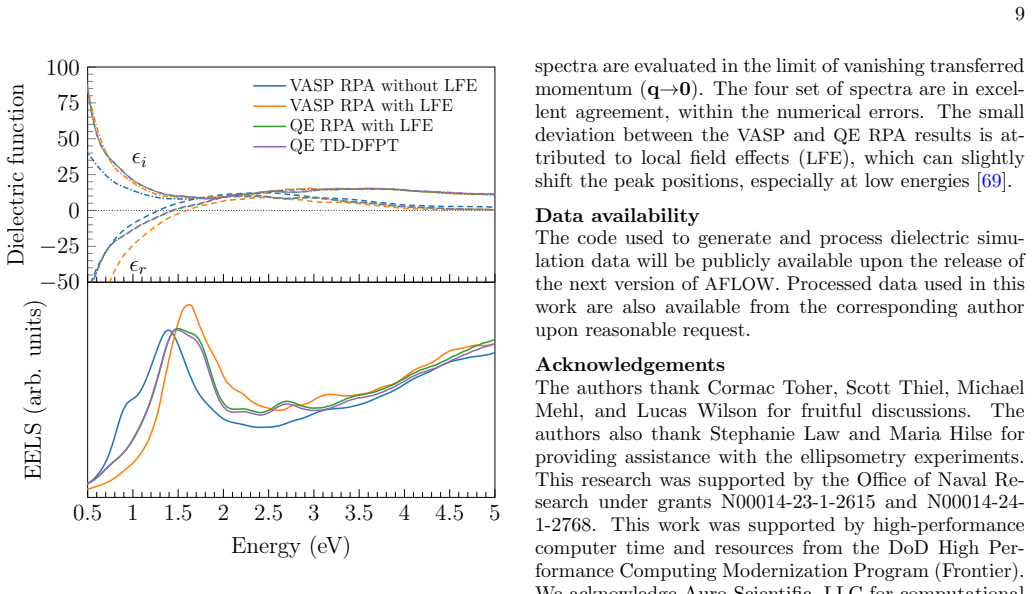
The central claims—plasmonic resonance in eleven HECs at room temperature and at 1000 °C, composition tunability, and cycling reversibility for at least the directly measured system—are established by independent ellipsometry, REELS, and TEM-EELS measurements. No optical parameter is fitted to the DFT/POCC simulations to force agreement; Table I and Figure 1 compare measured and simulated peak positions, widths, and heights as independent results, and Figure 7 benchmarks the simulation method internally against four ab-initio approximations. The self-citations (Refs. 25 and 36) supply the prior theoretical prediction of plasmonic HECs and the DEED descriptor used for sample selection, but these are being tested by the new experiments, not assumed as premises; the first synthesis of composition 3 is presented as an independent confirmation of DEED. The one genuine weakness is evidential rather than circular: the reversibility claim is directly demonstrated for system 2 and extrapolated to the other ten compositions by invoking rock-salt phase stability, with the paper itself conceding in the variable-temperature section that "HECs phase diagrams are not as well characterized as their binary and ternary carbide precursors, they are expected to follow the same high temperature trends [36]." No post-cycle XRD/XPS is shown, so the extrapolation is a limitation on scope, not a definitional reduction of the prediction to its inputs. No circular step can be quoted because no claimed result reduces by construction to a fitted parameter or to an unverified self-citation chain.
Assumptions & free parameters
assumptions (6)
- domain assumption PBE functional and RPA (without local field effects) accurately describe HEC optical response.
- domain assumption The POCC ensemble average over a finite set of ordered tiles represents the disordered solid solution.
- ad hoc to paper The most probable POCC tile is representative for q-dependent dispersion calculations.
- domain assumption HfO2 impurities do not affect the optical measurements in the near-IR/visible range.
- domain assumption Samples remain structurally and compositionally stable during heating and cycling (no graphitic segregation or significant oxidation).
- domain assumption An EELS peak with εr crossing zero and small εi at the same energy indicates a screened plasmon.
Cite this review
Pith. "Pith review of Variable-Temperature Plasmonic High-Entropy Carbides." pith.science (2026). https://pith.science/paper/DT2P6LM3
@misc{pith2026250703376,
  author       = {Pith},
  title        = {Pith review of: Variable-Temperature Plasmonic High-Entropy Carbides},
  year         = {2026},
  howpublished = {\url{https://pith.science/paper/DT2P6LM3}},
  note         = {Machine review of arXiv:2507.03376}
}
read the original abstract
Effective thermal management at variable and extreme temperatures face limitations for the development of novel energy and aerospace applications. Plasmonic approaches, shown to be capable of tailoring black-body emission, could be effective if materials with high-temperature and tunable plasmonic-resonance were available. Here, we report a synergy between experimental and theoretical results proving that many high-entropy transition-metal carbides, consisting of four or more metals at equal molar ratio, have plasmonic resonance at room, high (>1000C) and variable temperatures. We also found that these high-entropy carbides can be tuned and show considerable plasmonic thermal cycling stability. This paradigm-shift approach could prove quite advantageous as it facilitates the accelerated rational discovery and manufacturability of optically highly-optimized high-entropy carbides with ad-hoc properties.
Figures


Figures from the paper (4 more)


Reference graph
Works this paper leans on
-
[1]
Shabany, Heat Transfer: Thermal Management of Electronics (CRC Press, 2009)
Y. Shabany, Heat Transfer: Thermal Management of Electronics (CRC Press, 2009)
work page 2009
-
[2]
S. Jafari and T. Nikolaidis, Thermal Management Sys- tems for Civil Aircraft Engines: Review, Challenges and Exploring the Future , Applied Sciences 8, 2044 (2018), doi:10.3390/app8112044
-
[3]
M. T. Keif and R. H. Victora, Materials for Heat-Assisted Magnetic Recording, MRS Bull. 43, 87–92 (2018), doi: 10.1557/mrs.2018.2
-
[4]
C. Wu, B. N. III, J. John, A. Milder, B. Zollars, S. Savoy, and G. Shvets, Metamaterial-Based Integrated Plasmonic Absorber/Emitter for Solar Thermo-Photovoltaic Sys- tems, J. Opt. 14, 024005 (2012), doi:10.1088/2040- 8978/14/2/024005
doi:10.1088/2040- 2012
-
[5]
S. Pillai and M. A. Green, Plasmonics for Photovoltaic Applications, Sol. Energy Mater. Sol. Cells94, 1481–1486 10 (2010), doi:10.1016/j.solmat.2010.02.046
-
[6]
S. V. Boriskina, H. Ghasemi, and G. Chen, Plas- monic Materials for Energy: From Physics to Ap- plications, Mater. Today 16, 375–386 (2013), doi: 10.1016/j.mattod.2013.09.003
-
[7]
J. Cunha, T. Guo, G. D. Valle, A. N. Koya, R. P. Zac- caria, and A. Alabastri, Controlling Light, Heat, and Vi- brations in Plasmonics and Phononics , Adv. Opt. Mater. 8, 2001225 (2020), doi:10.1002/adom.202001225
-
[8]
D. Zhao, Z. Lin, W. Zhu, H. J. Lezec, T. Xu, A. Agrawal, C. Zhang, and K. Huang, Recent Advances in Ultraviolet Nanophotonics: From Plasmonics and Metamaterials to Metasurfaces, Nanophotonics 10, 2283–2308 (2021), doi: 10.1515/nanoph-2021-0083
Show all 69 references
-
[9]
Ahmadivand, B
A. Ahmadivand, B. Gerislioglu, R. Ahuja, and Y. K. Mishra, Terahertz Plasmonics: The Rise of Toroidal Metadevices Towards Immunobiosensings, Mater. Today 32, 108–130 (2020), doi:10.1016/j.mattod.2019.08.002
2020 doi
-
[10]
Jauffred, A
L. Jauffred, A. Samadi, H. Klingberg, P. M. Bendix, and L. B. Oddershede, Plasmonic Heating of Nanos- tructures, Chem. Rev. 119, 8087–8130 (2019), doi: 10.1021/acs.chemrev.8b00738
2019 doi
-
[11]
McSherry, M
S. McSherry, M. Webb, J. Kaufman, Z. Deng, A. Davood- abadi, T. Ma, E. Kioupakis, K. Esfarjani, J. T. Heron, and A. Lenert, Nanophotonic control of thermal emission under extreme temperatures in air, Nat. Nanotechnol. 17, 1104–1110 (2022), doi:10.1038/s41565-022-01205-1
2022 doi
-
[12]
A. B. Peters, D. Zhang, S. Chen, C. Ott, C. Oses, S. Cur- tarolo, I. McCue, T. Pollock, and S. E. Prameela, Ma- terials Design for Hypersonics , Nat. Commun. 15, 3328 (2024), doi:10.1038/s41467-024-46753-3
2024 doi
-
[13]
Esser, J
B. Esser, J. Barcena, M. Kuhn, A. Okan, L. Haynes, S. Gianella, A. Ortona, V. Liedtke, D. Francesconi, and H. Tanno, Innovative Thermal Management Concepts and Material Solutions for Future Space Vehicles , Jour- nal of Spacecraft and Rockets 53, 1051–1060 (2016), doi: 10.2514...
2016 doi
-
[14]
Y. Dong, E. Wang, Y. You, C. Yin, and Z. Wu, Ther- mal Protection System and Thermal Management for Combined-Cycle Engine: Review and Prospects , Energies 12, 240 (2019), doi:10.3390/en12020240
2019 doi
-
[15]
Lv, Y.-T
Y.-G. Lv, Y.-T. Wang, T. Meng, Q.-W. Wang, and W.-X. Chu, Review on thermal management tech- nologies for electronics in spacecraft environment , En- ergy Storage and Saving 3, 153–189 (2024), doi: 10.1016/j.enss.2024.03.001
2024 doi
-
[16]
J. C. Cuevas and F. J. Garc ´ ıa-Vidal, Radiative Heat Transfer, ACS Photonics 5, 3896–3915 (2018), doi: 10.1021/acsphotonics.8b01031
2018 doi
-
[17]
J. Yang, W. Du, Y. Su, Y. Fu, S. Gong, S. He, and Y. Ma, Observing of the super-Planckian near-field ther- mal radiation between graphene sheets, Nat. Commun. 9, 4033 (2018), doi:10.1038/s41467-018-06163-8
2018 doi
-
[18]
Y. Guo, C. L. Cortes, S. Molesky, and Z. Jacob, Broad- band super-Planckian thermal emission from hyperbolic metamaterials, Appl. Phys. Lett. 101, 131106 (2012), doi:10.1063/1.4754616
2012 doi
-
[19]
I. S. Nefedov and L. A. Melnikov, Super-Planckian far- zone thermal emission from asymmetric hyperbolic meta- materials, Appl. Phys. Lett. 105, 161902 (2014), doi: 10.1063/1.4899126
2014 doi
-
[20]
Y. Xiao, M. Sheldon, and M. A. Kats, Super-Planckian emission cannot really be ‘thermal’, Nature Photonics 16, 397–401 (2022), doi:10.1038/s41566-022-01005-y
2022 doi
-
[21]
J. A. Schuller, E. S. Barnard, W. Cai, Y. C. Jun, J. S. White, and M. L. Brongersma, Plasmonics for Extreme Light Concentration and Manipulation , Nat. Mater. 9, 193–204 (2010), doi:10.1038/nmat2630
2010 doi
-
[22]
M. S. Tame, K. R. McEnery, S ¸. K.¨Ozdemir, J. Lee, S. A. Maier, and M. S. Kim, Quantum Plasmonics, Nat. Phys. 9, 329–340 (2013), doi:10.1038/nphys2615
2013 doi
-
[23]
Berini and I
P. Berini and I. D. Leon, Surface Plasmon-Polariton Am- plifiers and Lasers , N. Photon. 6, 16–24 (2012), doi: 10.1038/nphoton.2011.285
2012 doi
-
[24]
Costantini, A
D. Costantini, A. Lefebvre, A.-L. Coutrot, I. Moldovan- Doyen, J.-P. Hugonin, S. Boutami, F. Marquier, H. Benisty, and J.-J. Greffet, Plasmonic Metasur- face for Directional and Frequency-Selective Thermal Emission, Phys. Rev. Applied 4, 014023 (2015), doi: 10.1103/PhysRevAppl...
2015 doi
-
[25]
Calzolari, C
A. Calzolari, C. Oses, C. Toher, M. Esters, X. Campi- longo, S. P. Stepanoff, D. E. Wolfe, and S. Curtarolo, Plasmonic high-entropy carbides , Nat. Commun. 13, 5993 (2022), doi:10.1038/s41467-022-33497-1
2022 doi
-
[26]
C. Oses, C. Toher, and S. Curtarolo, High-entropy ceramics, Nat. Rev. Mater. 5, 295–309 (2020), doi: 10.1038/s41578-019-0170-8
2020 doi
-
[27]
Toher, C
C. Toher, C. Oses, D. Hicks, and S. Curtarolo, Unavoid- able disorder and entropy in multi-component systems , npj Comput. Mater. 5, 69 (2019), doi:10.1038/s41524- 019-0206-z
2019 doi
-
[28]
Guler, A
U. Guler, A. Boltasseva, and V. M. Shalaev, Refrac- tory Plasmonics , Science 344, 263–264 (2014), doi: 10.1126/science.1252722
2014 doi
-
[29]
Cedillos-Barraza, D
O. Cedillos-Barraza, D. Manara, K. Boboridis, T. Watkins, S. Grasso, D. D. Jayaseelan, R. J. M. Konings, M. J. Reece, and W. E. Lee, Investigating the highest melting temperature materials: A laser melting study of the TaC-HfC system , Sci. Rep. 6, 37962 (2016), doi:10.1038/srep37962
2016 doi
-
[30]
Kumar, N
M. Kumar, N. Umezawa, S. Ishii, and T. Nagao, Examining the Performance of Refractory Conduc- tive Ceramics as Plasmonic Materials: A Theoreti- cal Approach , ACS Photonics 3, 43–50 (2016), doi: 10.1021/acsphotonics.5b00409
2016 doi
-
[31]
Catellani and A
A. Catellani and A. Calzolari, Plasmonic Properties of Refractory Titanium Nitride , Phys. Rev. B 95, 115145 (2017), doi:10.1103/PhysRevB.95.115145
2017 doi
-
[32]
Catellani, P
A. Catellani, P. D’Amico, and A. Calzolari, Tailoring the Plasmonic Properties of Metals: The Case of Substo- ichiometric Titanium Nitride , Phys. Rev. Materials 4, 015201 (2020), doi:10.1103/PhysRevMaterials.4.015201
2020 doi
-
[33]
S. T. Sundari, R. Ramaseshan, F. Jose, S. Dash, and A. K. Tyagi, Investigation of Temperature Dependent Di- electric Constant of a Sputtered TiN Thin Film by Spec- troscopic Ellipsometry , J. Appl. Phys. 115 (2014), doi: 10.1063/1.4862485
2014 doi
-
[34]
H. G. Reddy, U. Guler, Z. Kudyshev, A. V. Kildi- shev, V. M. Shalaev, and A. Boltasseva, Temperature- Dependent Optical Properties of Plasmonic Titanium Ni- tride Thin Films , ACS Photonics 4, 1413–1420 (2017), doi:10.1021/acsphotonics.7b00127
2017 doi
-
[35]
Krekeler, S
T. Krekeler, S. S. Rout, G. V. Krishnamurthy, M. St¨ ormer, M. Arya, A. Ganguly, D. S. Sutherland, S. I. Bozhevolnyi, M. Ritter, K. Pederson, A. Y. Petrov, M. Eich, and M. Chirumamilla, Unprecedented Ther- mal Stability of Plasmonic Titanium Nitride Films up 11 to 1400 ◦C, Adv...
2021 doi
-
[36]
Divilov, H
S. Divilov, H. Eckert, D. Hicks, C. Oses, C. Toher, R. Friedrich, M. Esters, M. J. Mehl, A. C. Zettel, Y. Led- erer, E. Zurek, J.-P. Maria, D. W. Brenner, X. Campi- longo, S. Filipovic, W. G. Fahrenholtz, C. J. Ryan, C. M. DeSalle, R. J. Crealese, D. E. Wolfe, A. Calzolari, an...
2024 doi
-
[37]
Sarker, T
P. Sarker, T. Harrington, C. Toher, C. Oses, M. Samiee, J.-P. Maria, D. W. Brenner, K. S. Vecchio, and S. Cur- tarolo, High-entropy high-hardness metal carbides dis- covered by entropy descriptors , Nat. Commun. 9, 4980 (2018), doi:10.1038/s41467-018-07160-7
2018 doi
-
[38]
T. J. Harrington, J. Gild, P. Sarker, C. Toher, C. M. Rost, O. F. Dippo, C. McElfresh, K. Kaufmann, E. Marin, L. Borowski, P. E. Hopkins, J. Luo, S. Cur- tarolo, D. W. Brenner, and K. S. Vecchio, Phase stability and mechanical properties of novel high entropy transi- tion meta...
2019 doi
-
[39]
D. E. Wolfe, P. E. Albert, C. J. Ryan, J. A. Reiss, S. P. Stepanoff, and P. Kolonin, Optimized processing of high density ternary hafnium-tantalum carbides via field as- sisted sintering technology for transition into hypersonic applications, J. Eur. Ceram. Soc. 42, 327–335 (2...
2022 doi
-
[40]
Fujiwara, Spectroscopic Ellipsometry: Principles and Applications (John Wiley & Sons, 2007), doi: 10.1002/9780470060193
H. Fujiwara, Spectroscopic Ellipsometry: Principles and Applications (John Wiley & Sons, 2007), doi: 10.1002/9780470060193
2007 doi
-
[41]
Z. L. Wang and J. M. Cowley, Reflection electron en- ergy loss spectroscopy (REELS): A technique for the study of surfaces , Surf. Sci. 193, 501–512 (1988), doi: 10.1016/0039-6028(88)90449-9
1988 doi
-
[42]
R. F. Egerton, Electron energy-loss spectroscopy in the electron microscope (Springer Science & Business Media, 2011), doi:10.1007/978-1-4419-9583-4
2011 doi
-
[43]
K. Yang, C. Oses, and S. Curtarolo, Modeling Off- Stoichiometry Materials with a High-Throughput Ab- Initio Approach , Chem. Mater. 28, 6484–6492 (2016), doi:10.1021/acs.chemmater.6b01449
2016 doi
-
[44]
Castle, T
E. Castle, T. Csan´ adi, S. Grasso, J. Dusza, and M. Reece, Processing and Properties of High-Entropy Ultra-High Temperature Carbides, Sci. Rep. 8, 8609 (2018), doi: 10.1038/s41598-018-26827-1
2018 doi
-
[45]
J. Zhou, J. Zhang, F. Zhang, B. Niu, L. Lei, and W. Wang, High-entropy Carbide: A Novel Class of Multicomponent Ceramics, Ceram. Int. 44, 22014–22018 (2018), doi:10.1016/j.ceramint.2018.08.100
2018 doi
-
[46]
X. Yan, L. Constantin, Y. Lu, J.-F. Silvain, M. Nastasi, and B. Cui, (Hf0.2Zr0.2Ta0.2Nb0.2Ti0.2)C high-entropy ceramics with low thermal conductivity , J. Am. Ceram. Soc. 101, 4486–4491 (2018), doi:10.1111/jace.15779
2018 doi
-
[47]
Chicardi, C
E. Chicardi, C. Garc ´ ıa-Garrido, and F. J. Gotor, Low temperature synthesis of an equiatomic (TiZrHfVNb)C 5 high entropy carbide by a mechanically-induced carbon diffusion route, Ceram. Int. 45, 21858–21863 (2019), doi: 10.1016/j.ceramint.2019.07.195
2019 doi
-
[48]
Chicardi, C
E. Chicardi, C. Garc ´ ıa-Garrido, J. Hern´ andez-Saz, and F. J. Gotor, Synthesis of all equiatomic five-transition metals High Entropy Carbides of the IVB (Ti, Zr, Hf ) and VB (V, Nb, Ta) groups by a low tempera- ture route , Ceram. Int. 46, 21421–21430 (2020), doi: 10.1016/j...
2020 doi
-
[49]
Pines, Elementary Excitations In Solids , Frontiers in Physics (Westview Press, 1999)
D. Pines, Elementary Excitations In Solids , Frontiers in Physics (Westview Press, 1999)
1999
-
[50]
L. H. Yang, K. T˝ ok´ esi, J. T´ oth, B. Da, H. M. Li, and Z. J. Ding, Optical Properties of Silicon and Germanium De- termined By High-Precision Analysis of Reflection Elec- tron Energy Loss Spectroscopy Spectra, Phys. Rev. B100, 245209 (2019), doi:10.1103/PhysRevB.100.245209
2019 doi
-
[51]
Costantini and J
J. Costantini and J. Ribis, Analysis of Plasmon Loss Peaks of Oxides and Semiconductors with the En- ergy Loss Function , Materials 16, 7610 (2023), doi: 10.3390/ma16247610
2023 doi
-
[52]
Y. Liu, R. F. Willis, K. V. Emtsev, and T. Seyller, Plasmon Dispersion and Damping in Electrically Iso- lated Two-Dimensional Charge Sheets , Phys. Rev. B 78, 201403 (2008), doi:10.1103/PhysRevB.78.201403
2008 doi
-
[53]
M. S. Dresselhaus, G. Dresselhaus, and A. Jorio, Group Theory: Application to the Physics of Condensed Matter (Springer, 2007)
2007
-
[54]
Wang and Y
F. Wang and Y. R. Shen, General Properties of Local Plasmons in Metal Nanostructures , Phys. Rev. Lett. 97, 206806 (2006), doi:10.1103/physrevlett.97.206806
2006 doi
-
[55]
Zollner, F
S. Zollner, F. Abadizaman, C. Emminger, and N. Sama- rasingha, Spectroscopic ellipsometry from 10 to 700 K , Adv. Opt.Tech. 11, 117–135 (2022), doi:doi:10.1515/aot- 2022-0016
2022 doi
-
[56]
Wang and Y
F. Wang and Y. R. Shen, Electron-phonon interactions from first principles, Rev. Mod. Phys. 89, 015003 (2017), doi:10.1103/revmodphys.89.015003
2017 doi
-
[57]
M. L. Cohen and S. G. Louie, Fundamentals of Con- densed Matter Physics (Cambridge University Press, 2016), doi:10.1017/CBO9781139031783
2016 doi
-
[58]
Baleva, T
M. Baleva, T. Georgiev, and G. Lashkarev, On the tem- perature dependence of the energy gap in PbSe and PbTe, J. Phys.: Condens. Matter 2, 2935–2940 (1990), doi: 10.1088/0953-8984/2/13/003
1990 doi
-
[59]
Kaveh and N
M. Kaveh and N. Wiser, Electron-electron scattering in conducting materials , Adv. Phys. 33, 257–372 (1984), doi:10.1080/00018738400101671
1984 doi
-
[60]
Tandon, S
B. Tandon, S. Ghosh, and D. J. Milliron, Dopant Selection Strategy for High-Quality Factor Localized Surface Plasmon Resonance from Doped Metal Oxide Nanocrystals, Chem. Mater. 31, 7752–7760 (2019), doi: 10.1021/acs.chemmater.9b02917
2019 doi
-
[61]
M. P. Wells, R. Bower, R. Kilmurray, B. Zou, A. P. Mi- hai, G. Gobalakrichenane, N. M. Alford, R. F. M. Oul- ton, L. F. Cohen, S. A. Maier, A. V. Zayats, and P. K. Petrov, Temperature stability of thin film refractory plas- monic materials , Optics Express 26, 15726 (2018), do...
2018 doi
-
[62]
T. B. Massalski, H. Okamoto, P. R. Subramanian, and L. Kacprzak, eds., Binary Alloy Phase Diagrams (ASM International, Materials Park, Ohio, USA, 1990)
1990
-
[63]
A. B. Djuriˇ si´ c and E. H. Li, Optical properties of graphite, J. Appl. Phys. 85, 7404–7410 (1999), doi: 10.1063/1.369370
1999 doi
-
[64]
S. Liu, S. Zhang, S. Liu, D. Li, Y. Li, and S. Wang, Phase stability, mechanical properties and melting points of high-entropy quaternary metal carbides from first- principles, J. Eur. Ceram. Soc. 41, 6267–6274 (2021), doi:10.1016/j.jeurceramsoc.2021.05.022
2021 doi
-
[65]
Gajdoˇ s, K
M. Gajdoˇ s, K. Hummer, G. Kresse, J. Furthm¨ uller, and F. Bechstedt, Linear optical properties in the projector- augmented wave methodology , Phys. Rev. B 73, 045112 12 (2006), doi:10.1103/PhysRevB.73.045112
2006 doi
-
[66]
Giannozzi, O
P. Giannozzi, O. Andreussi, T. Brumme, O. Bunau, M. Buongiorno Nardelli, M. Calandra, R. Car, C. Cavaz- zoni, D. Ceresoli, M. Cococcioni, N. Colonna, I. Carn- imeo, A. Dal Corso, S. de Gironcoli, P. Delugas, R. A. DiStasio Jr., A. Ferretti, A. Floris, G. Fratesi, G. Fugallo, R...
2017
-
[67]
J. P. Perdew, K. Burke, and M. Ernzerhof, Gen- eralized Gradient Approximation Made Simple , Phys. Rev. Lett. 77, 3865–3868 (1996), doi: 10.1103/PhysRevLett.77.3865
1996 doi
-
[68]
C. Oses, M. Esters, D. Hicks, S. Divilov, H. Eck- ert, R. Friedrich, M. J. Mehl, A. Smolyanyuk, X. Campilongo, A. van de Walle, J. Schroers, A. G. Kusne, I. Takeuchi, E. Zurek, M. Buongiorno Nardelli, M. Fornari, Y. Lederer, O. Levy, C. Toher, and S. Cur- tarolo, aflow++: A C+...
2023
-
[69]
Hanke and L
W. Hanke and L. J. Sham, Local-field and exci- tonic effects in the optical spectrum of a covalent crystal, Phys. Rev. B 12, 4501–4511 (1975), doi: 10.1103/physrevb.12.4501
1975 doi
Reviewed August 6, 2026 · model on record in the stance chip above.
Discussion (0). Continue with ORCID to comment.