REVIEW 3 major objections 6 minor 2 cited by
The Core-Cusp Problem Revisited: ULDM vs. CDM
T0 review · 3 major / 6 minor · reviewed 2026-08-14 · deepseek-v4-flash
Pith's one-line read With realistic scatter, ultralight dark matter can match cold dark matter's cusps, so current dwarf data cannot decide between the two models.
desk verdict A modest and honest cautionary paper whose specific 'ULDM can be less cuspy up to 10^12 Msun' claim leans on an uncalibrated scatter assumption, but whose broader 'these simplified models cannot meaningfully discriminate' conclusion survives that weak spot. read the letter →
The pith
A machine-rendered reading of the paper's core claim, the machinery that carries it, and where it could break.
The reading
What carries the argument
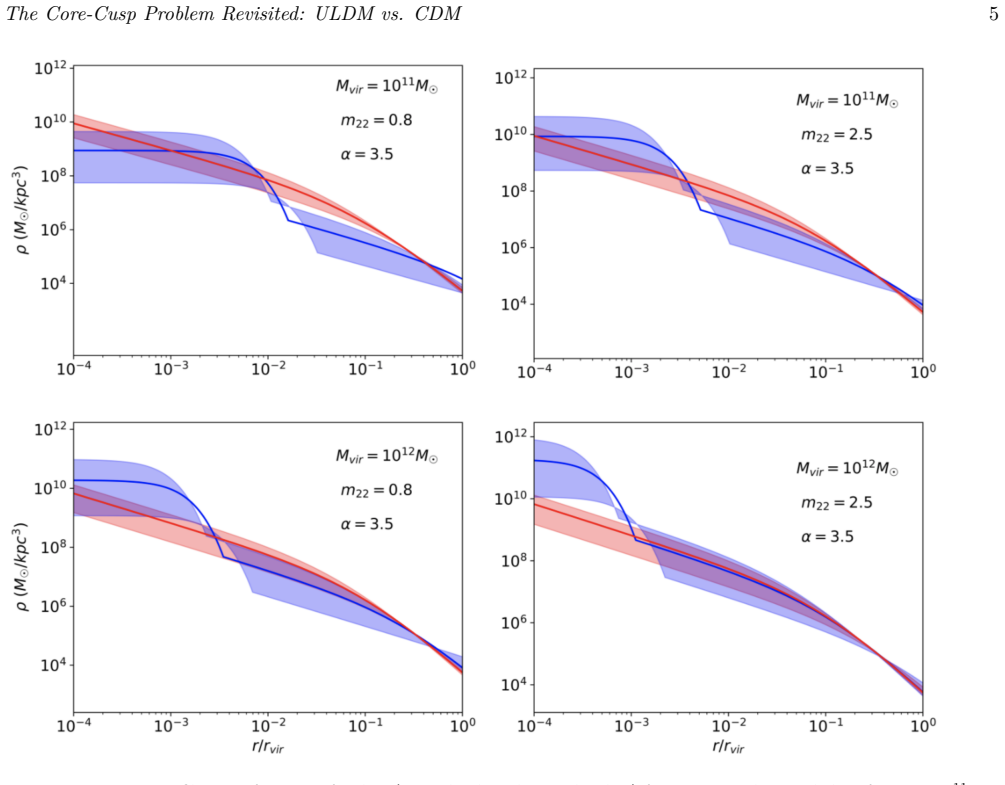
The key machinery is the piecewise semi-analytic ULDM halo profile: an inner solitonic core, the ground state of the Schrödinger–Poisson system, matched at a transition radius $r_\alpha = \alpha r_c$ to an outer NFW-like tail. The core's central density $\rho_c$ and radius $r_c$ are tied to the halo's virial mass by the core-halo mass relation, and the paper treats that relation as a statistical band by allowing a $\pm 50\%$ scatter in core mass $M_c$ (equivalently a range in the soliton scaling parameter $\gamma$ from $\gamma_p/4$ to $9\gamma_p/4$). This scatter, combined with the standard scatter in NFW concentration, generates the shaded profile bands into which observations are compared via converted circular-velocity curves.
What would settle it
A determination of the true scatter in the ULDM core-halo mass relation from higher-resolution simulations—showing, say, that core masses for a given virial mass vary by less than $\pm 20\%$—would shrink the band of feasible ULDM profiles, potentially restoring the earlier conclusion that ULDM worsens the core-cusp problem at high dwarf masses. Alternatively, a single well-measured dwarf rotation curve at $M_{\mathrm{vir}} \sim 10^{12}\,M_\odot$ that reaches inside the radii where ULDM and NFW predictions separate and cleanly excludes one model band would settle the direction of the discrepancy.
Extended reading notes
Core claim
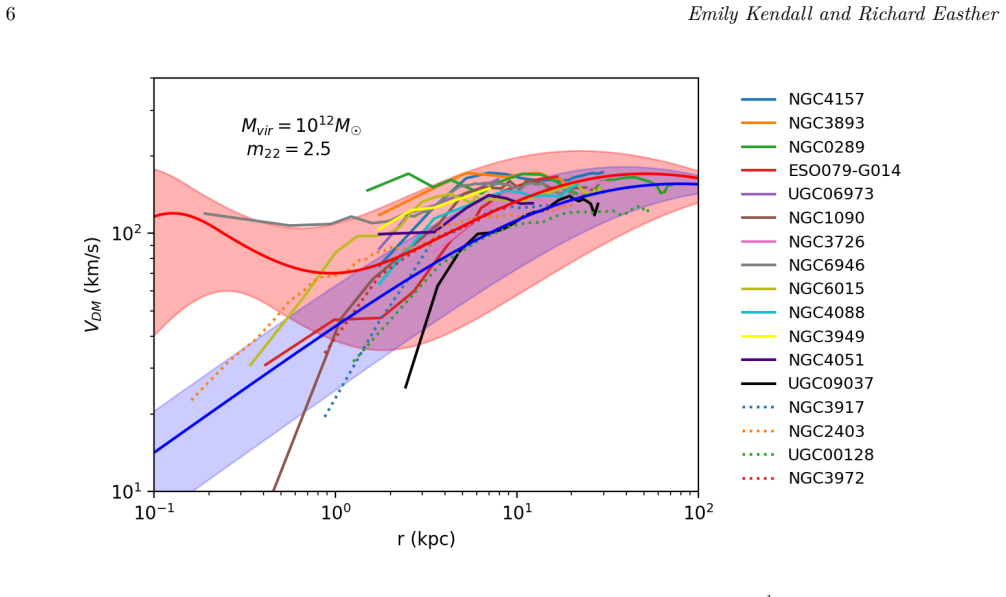
The central discovery is that the earlier conclusion that ULDM worsens the core-cusp problem for dwarf galaxies with virial masses above roughly $10^{11}\,M_\odot$ is not robust. Within the piecewise soliton-plus-NFW parameterization, the ULDM core-halo mass relation is not a single line but a band: allowing a $\pm 50\%$ scatter in the soliton core mass for a given virial mass produces ULDM profiles whose central densities can be lower than their NFW counterparts for halos up to $10^{12}\,M_\odot$. When these profiles are converted to rotation curves and compared to the observational database, neither the ULDM band nor the NFW concentration-scatter band provides a convincing fit across the full radial range. The paper therefore concludes that semi-analytic dark-matter-only comparisons, with limited data and without baryonic feedback, cannot meaningfully discriminate between ULDM and CDM, and that stronger claims about the core-cusp problem in either direction are premature.
Load-bearing premise
The argument that ULDM can avoid cuspy centers for halos up to $10^{12}\,M_\odot$ rests on the assumed $\pm 50\%$ scatter in the core-halo mass relation, a spread that the paper acknowledges cannot be fully justified from the limited simulations currently available.
Editorial extensions
If this is right
- Earlier claims that ULDM worsens the core-cusp problem for dwarf halos above about $10^{11}\,M_\odot$ are not robust once scatter in the core-halo mass relation is included.
- The rotation-curve data used here do not favor either ULDM or CDM; both models can fit subsets of galaxies with different parameter choices, so no model-selection conclusion is warranted from these data.
- Discriminating between ULDM and CDM on small scales will require rotation curves covering a much wider radial range, better constraints on the ULDM particle mass, and simulations that include baryonic feedback.
- The ULDM particle mass cannot be pinned down by current rotation-curve fits because the fits are degenerate with core-mass scatter and transition-radius choices.
Reading between the lines
- The paper's conclusion likely generalizes beyond ULDM: any dark-matter model with a cored central profile and a free core-size parameter will face the same degeneracy when fitted to a handful of inner rotation-curve points.
- A physically motivated scatter in the core-halo mass relation could be extracted from future ULDM cosmological simulations; the parameterization introduced here offers a direct template for that measurement.
- Because baryonic feedback can also produce flatter cores, the cleanest discriminator between ULDM and CDM may come from scaling relations, such as core mass versus halo mass, rather than from individual profile fits.
- The paper's caution implies that single-galaxy claims of detected ULDM soliton cores should be treated as provisional until the scatter distribution and baryonic influence are quantified.
Signed reviews
Editorial analysis
A structured set of objections, weighed in public.
Referee Report
Summary. The paper revisits the core-cusp problem as a discriminator between ultralight dark matter (ULDM) and standard cold dark matter. Using the piecewise semi-analytic ULDM halo model of Robles, Bullock, and Boylan-Kolchin, the authors allow for scatter in the Schive et al. core-halo mass relation, and compare the resulting density profiles and rotation-curve predictions with NFW halos for dwarf-to-LMC-mass halos (10^11 to 10^12 M_sun). They find that, for some choices of halo mass and ULDM particle mass, the allowed scatter yields ULDM profiles that are less cuspy than their NFW counterparts at observationally accessible radii, in contrast to the no-scatter case. Comparisons with SPARC rotation curves are presented as qualitative and inconclusive. The paper concludes that simplified semi-analytic DM-only models cannot meaningfully test the core-cusp problem and that robust conclusions will require better small-radius data, tighter particle-mass constraints, and simulations with baryonic feedback.
Significance. If taken as a cautionary statement, the paper has a worthwhile message: the ULDM core-halo relation, including its scatter, is not yet well enough characterized to make strong model-selection claims from DM-only semi-analytic profiles. The paper is transparent about its limitations, explicitly warns against over-interpreting the core-halo relation, and refrains from over-claiming a detection or exclusion. Its parameterization and the appendices on the core-halo scaling and SPARC errors are useful. The main caveat is that the central 'feasible profiles' result depends on an assumed, uncalibrated scatter range, and the comparison band for NFW is a different statistical containment interval; these issues need to be addressed before the main conclusion is fully persuasive.
major comments (3)
- [Section 2, Eqs. (11)-(12) and Figure 2] The central existence claim—that ULDM profiles less cuspy than NFW remain feasible up to Mvir = 10^12 M_sun—is built directly on the assumed ±50% scatter in the core mass Mc. The paper itself notes that the small sample in Schive et al. precludes a detailed statistical analysis and that universal application of the core-halo relation cannot be fully justified. Because the lower envelope of the blue band in Figure 2 is set by this assumed range, the claim is conditional on an uncalibrated quantile of the core-mass distribution. To make the conclusion robust, the authors should either calibrate the scatter from available simulations/observations or, at minimum, show a sensitivity study with smaller scatter values (e.g., ±25%, ±10%) and state explicitly at what scatter the 'less cuspy' crossover disappears for m22 = 2.5 and Mvir = 10^12 M_sun.
- [Figure 2 and Section 2] The blue ULDM band (±50% 'possible' scatter in Mc) and the red NFW band (±2σ concentration scatter) are not commensurate containment intervals. A ±50% range could correspond to a very different probability content than the nominal 2σ range, depending on the (unknown) distribution of core masses. As a result, the overlap or separation of the bands in Figure 2 is not a statistical statement about the relative plausibility of the two models. The figure and the surrounding text should either use the same containment level for both models, with an explicitly stated error distribution, or be labeled clearly as illustrative envelopes with different quantile meanings.
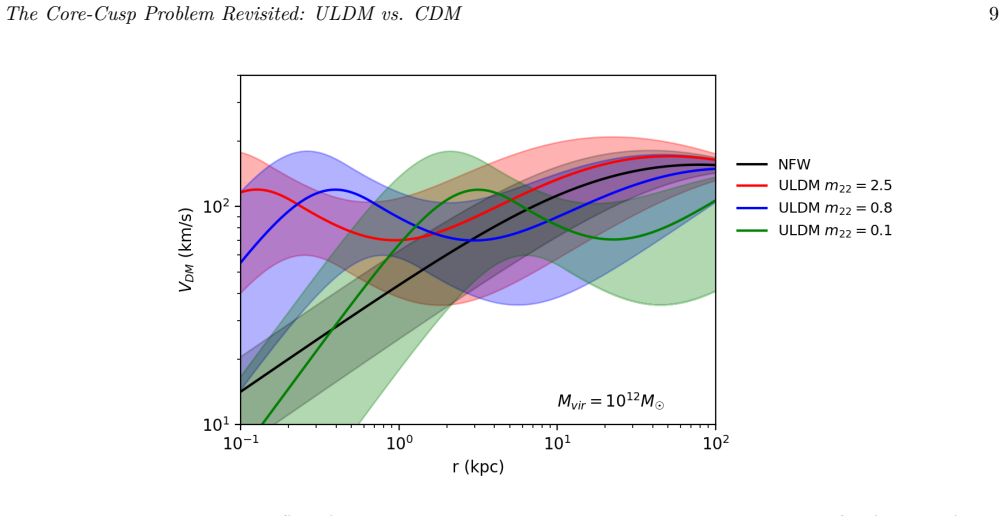
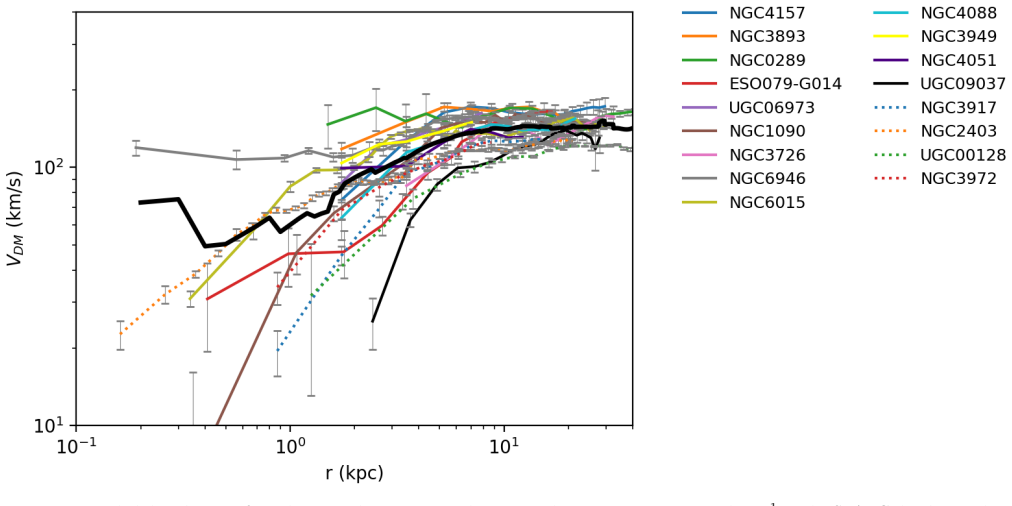
- [Section 3, Figures 3-4, and Section 4] The observational comparison is qualitative and uses inconsistent parameter choices across the two figures. In particular, Figure 4 adopts m22 = 0.1, which the authors themselves note is in tension with Lyman-alpha forest and other constraints, and the best-fitting curves in Figures 3 and 4 use different Mvir values. The conclusion that 'neither theoretical ULDM nor CDM model can reliably reproduce the data across a broad range' is therefore not demonstrated by the presented fits: the m22 = 0.1 fit lies outside the preferred 0.8-2.5 m22 window, and no quantitative model-selection statistic is applied, although BIC is discussed in Section 4. At minimum, the paper should state more carefully that this is an illustrative demonstration of non-uniqueness, not an empirical test, and should consider whether the qualitative conclusion survives if m22 is restricted to the preferred range.
minor comments (6)
- [Figures 3 and 4] The colors identifying ULDM and NFW are swapped relative to Figure 2: the captions for Figures 3 and 4 say the shaded blue region is NFW and the shaded red region is ULDM, whereas in Figure 2 blue is ULDM and red is NFW. Please make the color scheme consistent across all figures.
- [Section 4, first paragraph] The text contains a typographical error, 'UDLM' should read 'ULDM' in the sentence beginning 'the relative merits of the UDLM and NFW profiles'.
- [Appendix C] The sentence 'This spread of data may suggest that grouping galaxies based on asymptotic velocities alone is an insufficient method of characterisation' is repeated nearly verbatim in the same paragraph. Please remove the duplicate.
- [Appendix C] The phrase 'line-of-site velocities' should be 'line-of-sight velocities'.
- [References] Several references contain corrupted accented characters (e.g., [2] 'Pseudo-Goldsone-boson', [3] 'C. YÃĺche', [26] 'MacciÚ'). Please clean up the bibliography encoding.
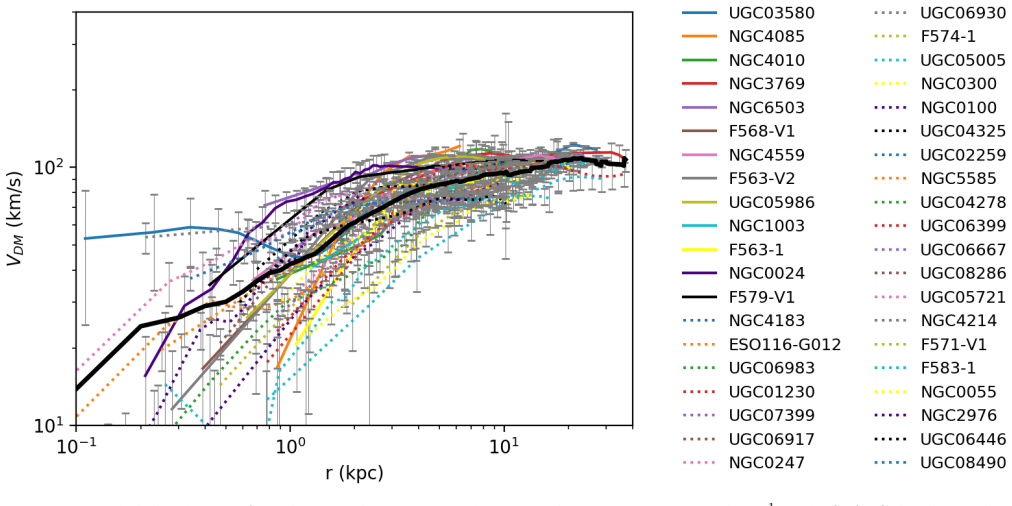
- [Section 3, Figures 3-4] Error bars are omitted from the main rotation-curve figures and deferred to Appendix C; a sentence near the figures indicating this deferral, with a brief statement of the typical error size, would help the reader judge the fits without flipping to the appendix.
Circularity Check
No circularity: the paper's inputs are external and its conclusions are conditional caveats, not fitted predictions.
full rationale
The paper's central quantitative inputs are the ULDM core-halo mass relation from Schive et al. [38] (Eqs. 11-12) and the NFW concentration scatter from Maccio et al. [26]. Neither is fit to the SPARC rotation curves used later in the paper. The ±50% scatter in the ULDM core mass is introduced explicitly as an exploratory assumption, with the paper stating that 'universal application of the core-halo mass relation cannot be fully justified' and that the small sample size in [38] precludes detailed statistical analysis. The shaded blue regions in Figures 2-4 are therefore parameter-space explorations built from that stated assumption, not predictions derived from a fit and then relabeled as findings. The abstract's 'feasible ULDM profiles' claim is explicitly conditional on the assumed scatter, and the main conclusion is that simplified DM-only semi-analytic models cannot meaningfully discriminate ULDM from CDM given limited data, unquantified systematics, and absent baryonic physics. This is a methodological caution, not a circular derivation. There is no load-bearing self-citation: the cited works for the ULDM profile [37] and core-halo relation [38] are external and independent of the present authors, and no uniqueness theorem from the authors' own prior work is invoked. The comparison to SPARC is deliberately informal, and the paper explicitly declines to perform model selection because of the large number of free parameters and systematic uncertainties. Thus, under the required standard of exhibiting a specific reduction or a fitted parameter renamed as a prediction, no circular step can be identified.
Assumptions & free parameters
free parameters (5)
- ULDM particle mass m22 =
0.8 and 2.5 (also 0.1 in one comparison)
- Core mass scatter range =
±50% of Schive et al. prediction
- Transition parameter alpha =
3.5
- Virial mass M_vir =
10^11 to 10^12 M_sun (5e11 for one bin)
- Stellar mass-to-light ratio Upsilon_star =
0.2 M_sun/L_sun at 3.6 micron
assumptions (5)
- domain assumption The ULDM halo density is the piecewise sum of a soliton core and an NFW tail matched at r_alpha = alpha r_c (Eq. 9).
- domain assumption The core-halo mass relation of Schive et al. [38] (Eqs. 11-12) applies to all halos in the studied mass range.
- domain assumption The SPARC rotation curves can be decomposed into disk, bulge, gas, and halo components with a constant stellar mass-to-light ratio (Eq. 14).
- standard math The virial theorem derivation of the core-halo scaling in Appendix A (Eqs. 16-18) is valid.
- domain assumption Observed tracer velocities trace the circular velocity of the halo with no pressure support or non-circular motions.
Cite this review
Pith. "Pith review of The Core-Cusp Problem Revisited: ULDM vs. CDM." pith.science (2026). https://pith.science/paper/DT372E7A
@misc{pith2026190802508,
  author       = {Pith},
  title        = {Pith review of: The Core-Cusp Problem Revisited: ULDM vs. CDM},
  year         = {2026},
  howpublished = {\url{https://pith.science/paper/DT372E7A}},
  note         = {Machine review of arXiv:1908.02508}
}
read the original abstract
The core-cusp problem is a widely cited motivation for the exploration of dark matter models beyond standard CDM. One such alternative is ULDM; extremely light scalar particles exhibiting wavelike properties on kiloparsec scales. Astrophysically realistic ULDM halos are expected to consist of inner solitonic cores embedded in NFW-like outer halos. The presence of the solitonic core suggests that ULDM may resolve the core-cusp discrepancy associated with pure NFW halos without recourse to baryonic physics. However, it has been demonstrated that the density of ULDM halos can exceed those of comparable NFW configurations at some radii and halo masses, apparently exacerbating the problem rather than solving it. This situation arises because, although solitonic cores are flat at their centres, they obey an inverse mass-radius scaling relationship. Meanwhile, the mass of the inner soliton increases with the total halo mass, and therefore the inner core becomes more peaked at large halo masses. We describe a parameterisation of the radial density profiles of ULDM halos that allows for environmental variability of the core-halo mass relation in order to investigate this issue in more detail. For halos up to 10^12 solar masses we find feasible ULDM profiles for which the central density is lower than their NFW counterparts at astrophysically accessible radii. However, comparisons to observed profiles do not strongly favour either option; both give reasonable fits to subsets of the data for some parameter choices. Consequently, we find that robust tests of the core-cusp problem in ULDM will require more comprehensive observational data and simulations that include baryonic feedback.
Figures

Figures from the paper (4 more)

Forward citations
Cited by 2 Pith papers
-
Supermassive Binaries in Ultralight Dark Matter Solitons
High-resolution simulations show that a symmetric SMBH binary decays faster in a ULDM soliton than semi-analytic estimates predict, due to soliton pinching, with implications for the final parsec problem and PTA gravi...
-
Bracketing the soliton-halo relation of ultralight dark matter
Numerical simulations and analytic equivalences show that the soliton-halo relation for ultralight dark matter is bracketed by the 1/2 relation as a lower bound and the 1/3 relation as an upper bound.
Reference graph
Works this paper leans on
-
[1]
P. A. R. Ade et al. Planck 2015 results. XIII. Cos- mological parameters. Astron. Astrophys., 594:A13,
work page 2015
-
[2]
L. Amendola and R. Barbieri. Dark matter from an ultra-light pseudo-Goldsone-boson. Phys. Lett., B642:192–196, 2006
work page 2006
-
[3]
E. Armengaud, N. Palanque-Delabrouille, C. YÃĺche, D. J. E. Marsh, and J. Baur. Constrain- ing the mass of light bosonic dark matter using SDSS Lyman-αforest. Mon. Not. Roy. Astron. Soc., 471(4):4606–4614, 2017
work page 2017
-
[4]
N. Bar, D. Blas, K. Blum, and S. Sibiryakov. Galac- tic rotation curves versus ultralight dark matter: Implications of the soliton-host halo relation.Phys. Rev., D98(8):083027, 2018
work page 2018
-
[5]
A. Benitez-Llambay, C. S. Frenk, A. D. Ludlow, and J. F. Navarro. Baryon-induced dark matter cores in the EAGLE simulations.arXiv e-prints, art. arXiv:1810.04186, Oct 2018
arXiv 2018
- [6]
-
[7]
M. Castellano, N. Menci, A. Grazian, A. Merle, N. G. Sanchez, A. Schneider, and M. Totzauer. Constraining Dark Matter models with extremely distant galaxies. InProceedings, Vulcano Workshop 2018: Frontier Objects in Astrophysics and Particle Physics: Vulcano Island, Sicily, Italy, May 20-26, 2018, pages 200–213, 2018
work page 2018
- [8]
Show all 48 references
-
[9]
Clough, T
K. Clough, T. Dietrich, and J. C. Niemeyer. Axion star collisions with black holes and neutron stars in full 3D numerical relativity.Phys. Rev., D98(8): 083020, 2018
2018
-
[10]
Mon. Not. Roy. Astron. Soc
G. Dashyan, J. Silk, G. A. Mamon, Y. Dubois, and T. Hartwig. AGN feedback in dwarf galaxies? "Mon. Not. Roy. Astron. Soc." , 473(4):5698–5703, Feb 2018
2018
-
[11]
Davoudiasl and P
H. Davoudiasl and P. B. Denton. Ultra Light Boson Dark Matter and Event Horizon Telescope Obser- vations of M87*. 2019
2019
-
[12]
de Bernardis et al
P. de Bernardis et al. A Flat universe from high res- olution maps of the cosmic microwave background radiation. Nature, 404:955–959, 2000
2000
-
[13]
A. A. Dutton, A. V. MacciÚ, T. Buck, K. L. Dixon, M. Blank, and A. Obreja. NIHAO XX: The impact of the star formation threshold on the cusp-core transformation of cold dark matter haloes. 2018
2018
-
[14]
Mon. Not. Roy. Astron. Soc
A. Genina, A. Benítez-Llambay, C. S. Frenk, S. Cole, A. Fattahi, J. F. Navarro, K. A. Oman, T. Sawala, and T. Theuns. The core-cusp problem: a matter of perspective."Mon. Not. Roy. Astron. Soc.", 474:1398–1411, Feb 2018
2018
-
[15]
N. W. Halverson et al. DASI first results: A Mea- surement of the cosmic microwave background an- gular power spectrum. Astrophys. J., 568:38–45,
-
[16]
Hanany et al
S. Hanany et al. MAXIMA-1: A Measurement of the cosmic microwave background anisotropy on angular scales of 10 arcminutes to 5 degrees. Astrophys. J., 545:L5, 2000
2000
-
[17]
Herrera, I
D. Herrera, I. Waga, and S. E. JorÃąs. Calculation of the critical overdensity in the spherical-collapse approximation. Phys. Rev., D95(6):064029, 2017
2017
-
[18]
Hu and S
W. Hu and S. Dodelson. Cosmic microwave back- ground anisotropies. Ann. Rev. Astron. Astrophys., 40:171–216, 2002
2002
-
[19]
L. Hui, J. P. Ostriker, S. Tremaine, and E. Witten. Ultralightscalarsascosmologicaldarkmatter. Phys. Rev., D95(4):043541, 2017
2017
-
[20]
A. T. Lee et al. A High spatial resolution analysis of the MAXIMA-1 cosmic microwave background anisotropy data. Astrophys. J., 561:L1–L6, 2001
2001
-
[21]
Lelli, S
F. Lelli, S. S. McGaugh, and J. M. Schombert. SPARC: Mass Models for 175 Disk Galaxies with Spitzer Photometry and Accurate Rotation Curves. Astron. J., 152:157, 2016
2016
-
[22]
A. R. Liddle. How many cosmological parameters? Mon. Not. Roy. Astron. Soc. , 351:L49–L53, 2004
2004
-
[23]
Implicationsofaprereionization 21-cm absorption signal for fuzzy dark matter.Phys
A.LidzandL.Hui. Implicationsofaprereionization 21-cm absorption signal for fuzzy dark matter.Phys. Rev., D98(2):023011, 2018
2018
-
[24]
Lin, H.-Y
S.-C. Lin, H.-Y. Schive, S.-K. Wong, and T. Chiueh. Self-consistent construction of virialized wave dark matter halos. Phys. Rev., D97(10):103523, 2018
2018
-
[25]
A. D. Ludlow, J. F. Navarro, R. E. Angulo, M. Boylan-Kolchin, V. Springel, C. Frenk, and S. D. M. White. The massâĂ“concentrationâĂ“red- shift relation of cold dark matter haloes.Mon. Not. Roy. Astron. Soc., 441(1):378–388, 2014
2014
-
[26]
A. V. Maccio’, A. A. Dutton, and F. C. v. d. Bosch. Concentration, Spin and Shape of Dark Matter Haloes as a Function of the Cosmological Model: WMAP1, WMAP3 and WMAP5 results.Mon. Not. Roy. Astron. Soc., 391:1940–1954, 2008
1940
-
[27]
Mocz and S
P. Mocz and S. Succi. Numerical solution of the nonlinear SchrÃűdinger equation using smoothed- particle hydrodynamics. Phys. Rev., E91(5):053304,
-
[28]
P. Mocz, M. Vogelsberger, V. H. Robles, J. Zavala, M. Boylan-Kolchin, A. Fialkov, and L. Hernquist. The Core-Cusp Problem Revisited: ULDM vs. CDM 11 Figure 6. Radial distributions for galaxies with maximum velocities in the range75≤v <125 kms−1 in the SPARC database. The avera...
2017
-
[29]
B. Moore. Evidence against dissipationless dark matter from observations of galaxy haloes.Nature, 370:629, 1994
1994
-
[30]
J. F. Navarro, C. S. Frenk, and S. D. M. White. The Structure of cold dark matter halos.Astrophys. J., 462:563–575, 1996
1996
-
[31]
Nebrin, R
O. Nebrin, R. Ghara, and G. Mellema. Fuzzy Dark Matter at Cosmic Dawn: New 21-cm Constraints. JCAP, 2019(04):051, 2020
2019
-
[32]
C. B. Netterfield et al. A measurement by Boomerang of multiple peaks in the angular power spectrum of the cosmic microwave background.As- trophys. J., 571:604–614, 2002
2002
-
[33]
Ni, M.-Y
Y. Ni, M.-Y. Wang, Y. Feng, and T. Di Matteo. Pre- dictions for the Abundance of High-redshift Galax- ies in a Fuzzy Dark Matter Universe. 2019
2019
-
[34]
Ragagnin, K
A. Ragagnin, K. Dolag, L. Moscardini, A. Biviano, and M. D’Onofrio. Dependency of halo concentra- tion on mass, redshift and fossilness in Magneticum hydrodynamic simulations. 2018
2018
-
[35]
J. I. Read, M. G. Walker, and P. Steger. The case for a cold dark matter cusp in Draco.Mon. Not. Roy. Astron. Soc., 481(1):860–877, 2018
2018
-
[36]
Richings, C
J. Richings, C. Frenk, A. Jenkins, and A. Robert- son. Subhalo destruction in the Apostle and Auriga simulations. arXiv e-prints, art. arXiv:1811.12437, Nov 2018
2018 arXiv
-
[37]
V. H. Robles, J. S. Bullock, and M. Boylan-Kolchin. Scalar Field Dark Matter: Helping or Hurting Small- Scale Problems in Cosmology? Mon. Not. Roy. Astron. Soc., 483(1):289–298, 2019
2019
-
[38]
Schive, M.-H
H.-Y. Schive, M.-H. Liao, T.-P. Woo, S.-K. Wong, T. Chiueh, T. Broadhurst, and W. Y. P. Hwang. Understanding the Core-Halo Relation of Quantum Wave Dark Matter from 3D Simulations.Phys. Rev. Lett., 113(26):261302, 2014
2014
-
[39]
Schumann
M. Schumann. Direct Detection of WIMP Dark Matter: Concepts and Status. 2019
2019
-
[40]
Schwabe, J
B. Schwabe, J. C. Niemeyer, and J. F. Engels. Sim- ulations of solitonic core mergers in ultralight ax- ion dark matter cosmologies.Phys. Rev., D94(4): 043513, 2016
2016
-
[41]
J. D. Simon et al. Testing the Nature of Dark Matter with Extremely Large Telescopes. 2019
2019
-
[42]
Sofue, M
Y. Sofue, M. Honma, and T. Omodaka. Unified Rotation Curve of the Galaxy – Decomposition into de Vaucouleurs Bulge, Disk, Dark Halo, and the 9-kpc Rotation Dip –.Publ. Astron. Soc. Jap. , 61: 227, 2009
2009
-
[43]
Springel et al
V. Springel et al. Simulating the joint evolution of quasars, galaxies and their large-scale distribution. Nature, 435:629–636, 2005
2005
-
[44]
D. Suto, T. Kitayama, K. Osato, S. Sasaki, and Y. Suto. Confrontation of Top-Hat Spherical Col- lapseagainstDarkHalosfromCosmologicalN-Body Simulations. Publ. Astron. Soc. Jap., 68(1):14, 2016
2016
-
[45]
Veltmaat, J
J. Veltmaat, J. C. Niemeyer, and B. Schwabe. For- mation and structure of ultralight bosonic dark matter halos. Phys. Rev., D98(4):043509, 2018
2018
-
[46]
L. L. Watkins, R. P. van der Marel, S. T. Sohn, and 12 Emily Kendall and Richard Easther Figure 7. Radial distributions for galaxies with maximum velocities in the range125≤v <175 kms−1 in the SPARC database. The average profile is shown in the bold black line. The limited numb...
2019
-
[47]
D. H. Weinberg, J. S. Bullock, F. Governato, R. Kuzio de Naray, and A. H. G. Peter. Cold dark matter: controversies on small scales.Proc. Nat. Acad. Sci., 112:12249–12255, 2015
2015
-
[48]
TheMassofahalo
M.J.White. TheMassofahalo. Astron. Astrophys., 367:27, 2001
2001
Reviewed August 14, 2026 · model on record in the stance chip above.
Discussion (0). Continue with ORCID to comment.