REVIEW 2 major objections 1 minor 3 cited by
Repetitive Penrose process for charged particles in Kerr-Newman black holes
T0 review · 2 major / 1 minor · reviewed 2026-07-01 · grok-4.3
Pith's one-line read Kerr-Newman black holes can reverse their electric charge sign through repetitive Penrose processes while remaining sub-extremal.
desk verdict Kerr-Newman allows charge sign reversal in repetitive Penrose process unlike RN, but the analytic solution under triple turning-point needs verification for continuity at Q=0. read the letter →
The pith
A machine-rendered reading of the paper's core claim, the machinery that carries it, and where it could break.
The reading
What carries the argument
The nonlinear iterative framework with the triple turning-point condition, governed by the two electromagnetic couplings that control ergoregion access and negative-energy depth.
What would settle it
A direct numerical integration of charged-particle geodesics in the Kerr-Newman metric that shows the triple turning-point condition cannot be maintained across multiple extractions without violating energy-momentum conservation.
Extended reading notes
Core claim
By imposing the triple turning-point condition, an analytic solution of the conservation equations is obtained that tracks the full nonlinear iterative sequence self-consistently. The Kerr-Newman black hole evolves through the neutral state and reverses the sign of its electric charge without violating the area theorem or cosmic censorship, in contrast to the extremal Reissner-Nordstrom case where a discharge barrier appears.
Load-bearing premise
The triple turning-point condition can be imposed to obtain an analytic solution of the conservation equations that remains self-consistent across the entire iterative extraction sequence.
Editorial extensions
If this is right
- The coupling ĤQĤq0 controls termination by determining whether incident particles can still reach the ergoregion.
- An attractive coupling ĤQĤq1<0 raises both energy return on investment and utilization efficiency.
- Above a critical charge the dimensionless spin increases transiently even as angular momentum is lost.
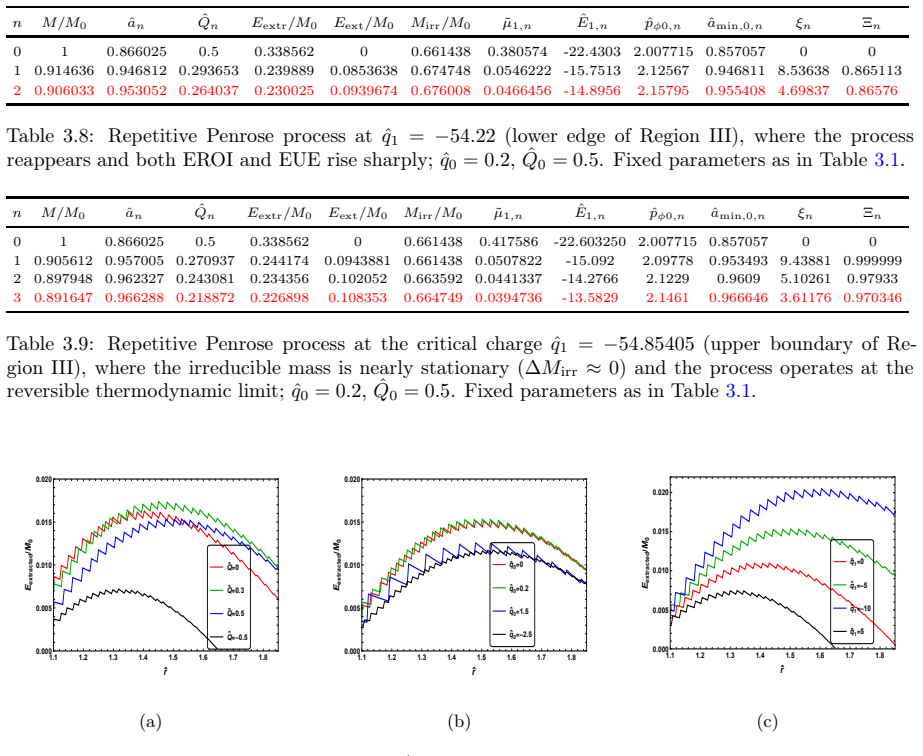
- Near the critical value Ĥq1-54.85405 the evolution reaches the reversible Christodoulou-Ruffini limit with efficiency approaching unity.
- Beyond that critical charge the irreducible mass begins to decrease, indicating breakdown of the test-particle approximation.
Reading between the lines
- Rotation appears to remove the charge-reversal barrier that exists in the non-rotating charged case, suggesting the barrier is tied to spherical symmetry rather than charge alone.
- The same iterative construction could be applied to other axisymmetric charged spacetimes to test whether sign reversal is generic when angular momentum is nonzero.
- Numerical-relativity runs that include back-reaction on the metric could check whether the analytic triple-turning-point sequence survives once the test-particle limit is relaxed.
Editorial analysis
A structured set of objections, weighed in public.
Referee Report
Summary. The manuscript develops a nonlinear iterative framework for the repetitive Penrose process of charged particles in an initially extremal Kerr-Newman black hole. By imposing a triple turning-point condition, an analytic solution to the conservation equations is obtained that permits self-consistent updates of the black-hole mass, angular momentum, charge, and irreducible mass after each extraction. Two electromagnetic couplings are identified: one controlling ergoregion access and process termination, the other governing negative-energy depth and efficiency. The central result is that the Kerr-Newman geometry, unlike the Reissner-Nordström case, permits the black hole to evolve through the neutral state (Q=0) and reverse the sign of its charge without violating the area theorem or cosmic censorship; a critical charge value ˆq_{1}≈−54.85405 is reported at which the energy utilization efficiency approaches unity while the hole remains sub-extremal.
Significance. If the analytic solution remains valid through the sign change of Q, the work would establish that the discharge barrier found in the RN repetitive Penrose process is not generic to charged black holes. The provision of an exact analytic solution under the triple-turning-point ansatz, together with the explicit four-region structure in captured-particle charge space and the identification of an attractive-interaction regime that transiently increases dimensionless spin, supplies concrete, falsifiable predictions. The nonlinear iterative construction itself is a technical strength that allows the full sequence to be tracked without step-by-step numerical root-finding.
major comments (2)
- [Abstract] Abstract and the paragraph introducing the analytic solution: the claim that the black hole can evolve through Q=0 and reverse charge sign rests on the triple-turning-point analytic solution remaining an exact solution of the conservation equations once both electromagnetic couplings vanish. At Q=0 the charge-dependent terms drop from the radial effective potential; it is not shown that the same functional form continues to satisfy the updated conservation laws continuously across the sign flip.
- [iterative framework] The iterative framework section (description of updates after each extraction): the self-consistency statement for the entire sequence requires explicit verification that the solution derived under the triple-turning-point condition for ˆQˆq_{1}<0 remains exact after the sign of Q (and therefore of the couplings) has flipped, especially near the reported critical value where efficiency approaches the reversible limit.
minor comments (1)
- The notation ˆQˆq_{0} and ˆQˆq_{1} is introduced without an explicit definition of the hat symbols or the normalization convention; a short paragraph or appendix equation defining these quantities would improve readability.
Simulated Author's Rebuttal
We thank the referee for the careful reading and constructive comments. The two major comments raise a single substantive issue concerning the continuity of the triple-turning-point analytic solution across Q=0. We address this point below and will revise the manuscript to supply the requested explicit verification.
read point-by-point responses
-
Referee: [Abstract] Abstract and the paragraph introducing the analytic solution: the claim that the black hole can evolve through Q=0 and reverse charge sign rests on the triple-turning-point analytic solution remaining an exact solution of the conservation equations once both electromagnetic couplings vanish. At Q=0 the charge-dependent terms drop from the radial effective potential; it is not shown that the same functional form continues to satisfy the updated conservation laws continuously across the sign flip.
Authors: We agree that the manuscript does not contain an explicit verification of continuity across Q=0. The conservation equations are continuous in Q; when Q=0 both couplings vanish identically and the radial effective potential reduces to the neutral Kerr case. Direct substitution of the analytic expressions into the conservation laws at Q=0 recovers the expected neutral-particle solution, and the same functional form remains a solution on either side of Q=0 by continuity of the equations. We will add a short subsection (or appendix) that performs this substitution explicitly, including at the reported critical value, to confirm that the solution remains exact through the sign change. revision: yes
-
Referee: [iterative framework] The iterative framework section (description of updates after each extraction): the self-consistency statement for the entire sequence requires explicit verification that the solution derived under the triple-turning-point condition for ˆQˆq_{1}<0 remains exact after the sign of Q (and therefore of the couplings) has flipped, especially near the reported critical value where efficiency approaches the reversible limit.
Authors: The same verification will be supplied in the iterative-framework section. Because the analytic solution is obtained by solving the conservation equations under the triple-turning-point ansatz, and those equations remain well-defined and continuous when the couplings change sign, the functional form carries through. The added subsection will demonstrate this explicitly near the critical charge, thereby supporting the self-consistency of the full sequence through the neutral state. revision: yes
Circularity Check
No significant circularity detected
full rationale
The derivation obtains an analytic solution to the conservation equations by explicitly imposing the triple turning-point condition as a modeling choice, then iterates the resulting expressions for mass, angular momentum, charge and irreducible mass. This imposition is stated upfront and is not defined in terms of the final claims about charge-sign reversal or area-theorem compliance. No self-citations are used to justify uniqueness or to forbid alternatives, no fitted parameters are relabeled as predictions, and no ansatz is imported via prior work. The four-region structure and the statement that the process continues through Q=0 are direct consequences of the updated conservation laws under the same imposed condition, rendering the chain self-contained against the paper's stated assumptions.
Assumptions & free parameters
free parameters (2)
- electromagnetic couplings ĤQĤq0 and ĤQĤq1
- critical charge value Ĥq1 ≈ -54.85405
assumptions (2)
- domain assumption The area theorem and cosmic censorship conjecture remain valid throughout the process.
- domain assumption The test-particle approximation holds until the irreducible mass begins to decrease.
Cite this review
Pith. "Pith review of Repetitive Penrose process for charged particles in Kerr-Newman black holes." pith.science (2026). https://pith.science/paper/DT4BXN76
@misc{pith2026260630969,
  author       = {Pith},
  title        = {Pith review of: Repetitive Penrose process for charged particles in Kerr-Newman black holes},
  year         = {2026},
  howpublished = {\url{https://pith.science/paper/DT4BXN76}},
  note         = {Machine review of arXiv:2606.30969}
}
abstract
We investigate the repetitive Penrose process for charged particles in an initially extremal Kerr--Newman black hole and develop a nonlinear iterative framework in which the black-hole mass, angular momentum, electric charge, and irreducible mass are updated after every extraction event. By imposing the triple turning-point condition, we obtain an analytic solution of the conservation equations, allowing the entire extraction sequence to be followed self-consistently. The dynamics are governed by two electromagnetic couplings. The coupling $\hat Q\hat q_0$ determines whether the incident particle can continue to access the ergoregion and therefore controls the termination of the repetitive process, whereas $\hat Q\hat q_1$ governs the depth of the negative-energy states and the extraction efficiency. An attractive interaction ($\hat Q\hat q_1<0$) significantly enhances both the energy return on investment and the energy utilization efficiency and, above a critical charge, produces a transient increase of the dimensionless spin despite the continuous loss of angular momentum. We identify a four-region structure in the captured-particle charge parameter space. Near the critical charge $\hat q_1\simeq-54.85405$, the evolution approaches the reversible Christodoulou--Ruffini limit with the energy utilization efficiency approaching unity while the black hole remains sub-extremal. Beyond this point the irreducible mass decreases, indicating the breakdown of the test-particle approximation. Unlike the repetitive Penrose process in the extremal Reissner--Nordstr\"om spacetime, the Kerr--Newman black hole can evolve through the neutral state and reverse the sign of its electric charge without violating the area theorem or cosmic censorship, demonstrating that the discharge barrier found in the Reissner--Nordstr\"om case is not a generic property of charged black holes.
Figures


Figures from the paper (3 more)


Forward citations
Cited by 3 Pith papers
-
Repetitive Penrose Process in Rotating 4D Einstein-Gauss-Bonnet Black Holes
Self-amplifying dimensionless Gauss–Bonnet coupling shrinks the ergosphere, cuts the number of Penrose decays, and reorganizes utilization efficiency into a four-region then three-region landscape versus Kerr.
-
Geometry-Induced Termination of the Repetitive Penrose Process in Rotating Simpson-Visser Black Holes
In rotating Simpson-Visser black holes, repeated Penrose extraction can terminate because the evolving mass/spin leaves the two-horizon regime before the spin limit is reached, an effect controlled by the regularizati...
-
Repetitive Penrose Process in Rastall Rotating Black Holes Immersed in Quintessence Dark Energy
In a quintessence-surrounded Rastall rotating black hole, the repetitive Penrose process stops at a spin threshold set by particle 0, and lower Rastall structure parameter values favor extraction at smaller decay radii.
Reference graph
Works this paper leans on
-
[1]
Gravitational collapse: The role of genera l relativity,
R. Penrose, “Gravitational collapse: The role of genera l relativity,” Riv. Nuovo Cimento 1, 252 (1969)
work page 1969
-
[2]
Extraction of rotational ene rgy from a black hole,
R. Penrose and R. M. Floyd, “Extraction of rotational ene rgy from a black hole,” Nature Phys. Sci. 229, 177 (1971)
work page 1971
-
[3]
J. M. Bardeen, W. H. Press, and S. A. Teukolsky, “Rotating black holes: Locally nonrotating frames, energy extraction, and scalar synchrotron radiation,” Ast rophys. J. 178, 347 (1972)
work page 1972
-
[4]
Energy limits on the Penrose process,
R. M. Wald, “Energy limits on the Penrose process,” Astro phys. J. 191, 231 (1974). 24 n M/M 0 ˆan ˆQn Eextr/M 0 Eext/M 0 Mirr/M 0 ˜µ 1,n ˆE1,n ˆpφ 0,n ˆamin, 0,n ξn Ξ n 0 1 0.866025 0.5 0.338562 0 0.661438 0.404551 -22.5423 2.007 715 0.857057 0 0 1 0.908805 0.95336 0.278994 0.242128 0.0911952 0.666677 0. 0520852 -15.3285 2.10798 0.95119 9.11952 0.945676 ...
work page 1974
-
[5]
On the energetics of Reissner–N ordström geometries,
G. Denardo and R. Ruffini, “On the energetics of Reissner–N ordström geometries,” Phys. Lett. B 45, 259 (1973)
work page 1973
-
[6]
On the energetics of black holes,
R. Ruffini, “On the energetics of black holes,” in Black Holes – Les Houches 1972 , ed. C. DeWitt and B. S. DeWitt (Gordon and Breach, New York, 1973)
work page 1972
-
[7]
Singl e versus the repetitive Penrose process in a Kerr black hole,
R. Ruffini, M. Prakapenia, H. Quevedo, and S. Zhang, “Singl e versus the repetitive Penrose process in a Kerr black hole,” Phys. Rev. Lett. 134, 081403 (2025), arXiv:2405.08229 [gr-qc]
-
[8]
R. Ruffini, C. L. Bianco, M. Prakapenia, H. Quevedo, J. A. Ru eda, and S. R. Zhang, “Role of the irreducible mass in repetitive Penrose energy extraction p rocesses in a Kerr black hole,” Phys. Rev. Res. 7, 013203 (2025), arXiv:2405.10459 [gr-qc]
Show all 15 references
-
[9]
Reversible and irreversible transf ormations in black-hole physics,
D. Christodoulou, “Reversible and irreversible transf ormations in black-hole physics,” Phys. Rev. Lett. 25, 1596 (1970)
1970
-
[10]
Reversible transforma tions of a charged black hole,
D. Christodoulou and R. Ruffini, “Reversible transforma tions of a charged black hole,” Phys. Rev. D 4, 3552 (1971)
1971
-
[11]
Gravitational radiation from collidin g black holes,
S. W. Hawking, “Gravitational radiation from collidin g black holes,” Phys. Rev. Lett. 26, 1344 (1971)
1971
-
[12]
Black holes and entropy,
J. D. Bekenstein, “Black holes and entropy,” Phys. Rev. D 7, 2333 (1973)
1973
-
[13]
Third law of repetitiv e electric Penrose processes,
L. Hu, R.-G. Cai, and S.-J. Wang, “Third law of repetitiv e electric Penrose processes,” Phys. Rev. D 113, L061501 (2026)
2026
-
[14]
Repetitive Penrose process in K err–de Sitter black holes,
K. Wang and X.-X. Zeng, “Repetitive Penrose process in K err–de Sitter black holes,” arXiv:2512.05491 [gr-qc] (2025)
2025
-
[15]
Repetitive Penrose process in a ccelerating Kerr black holes,
X.-X. Zeng and K. Wang, “Repetitive Penrose process in a ccelerating Kerr black holes,” arXiv:2601.01414 [gr-qc] (2026). 27
2026
Reviewed July 1, 2026 · model on record in the stance chip above.
Discussion (0). Continue with ORCID to comment.