Carbon Abundances in Metal-Poor Stars Reveal Distinct Galaxy and Star Formation Pathways in the Early Universe
Pith reviewed 2026-06-27 08:52 UTC · model grok-4.3
The pith
The metal-poor Milky Way halo assembled from many different dwarf galaxies, with carbon-enhanced stars supplied by ultra-faint systems and non-enhanced stars by intermediate-sized progenitors.
A machine-rendered reading of the paper's core claim, the machinery that carries it, and where it could break.
Core claim
The metal-poor Milky Way halo appears to have assembled from many different dwarf galaxies, with CEMP halo stars being contributed by early UFD-like systems and non-CEMP halo stars by intermediate-sized halos that later formed classical dwarfs.
What carries the argument
The low-metallicity Magnitude (M_V)--CEMP Fraction relation, which links observed carbon-enhancement fractions to galaxy mass and distinguishes supernova-dominated enrichment in ultra-faint dwarfs from in-situ formation in classical dwarfs.
If this is right
- High CEMP fractions in ultra-faint dwarfs indicate their chemical enrichment was dominated by faint supernovae whose energy input did not quench further star formation.
- Low CEMP fractions in classical dwarfs imply those galaxies formed predominantly in situ rather than through accretion of smaller CEMP-rich systems.
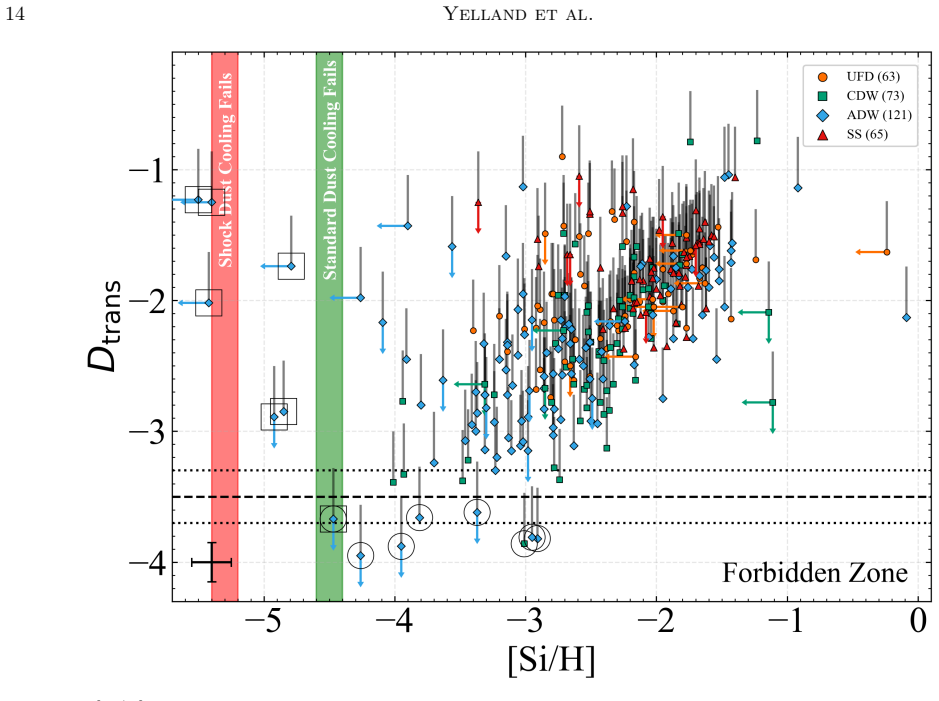
- Stars lying near the forbidden zone in [C/H] space indicate that dust-induced cooling operated alongside fine-structure line cooling during the earliest low-mass star formation.
- The Milky Way halo therefore contains a mixture of stellar populations inherited from both the smallest and the intermediate-sized early galaxies.
Where Pith is reading between the lines
- The same carbon-based distinction could be applied to stars in the halos of other large galaxies to test whether their assembly histories followed similar mass-dependent pathways.
- Future observations of disrupted streams or fully disrupted dwarfs could reveal whether the CEMP fraction changes with the degree of tidal processing.
- The presence of forbidden-zone stars only in UFD-like environments suggests targeted searches in surviving ultra-faint dwarfs for additional dust-cooled candidates.
Load-bearing premise
The observed differences in CEMP fractions between surviving ultra-faint dwarfs and classical dwarfs directly reflect distinct supernova enrichment histories and formation modes rather than selection biases or differential survival effects.
What would settle it
A new homogeneous survey that finds comparable CEMP fractions in classical dwarfs and ultra-faint dwarfs at [Fe/H] less than -2.5, after matching selection criteria, would falsify the claim of distinct pathways.
Figures
read the original abstract
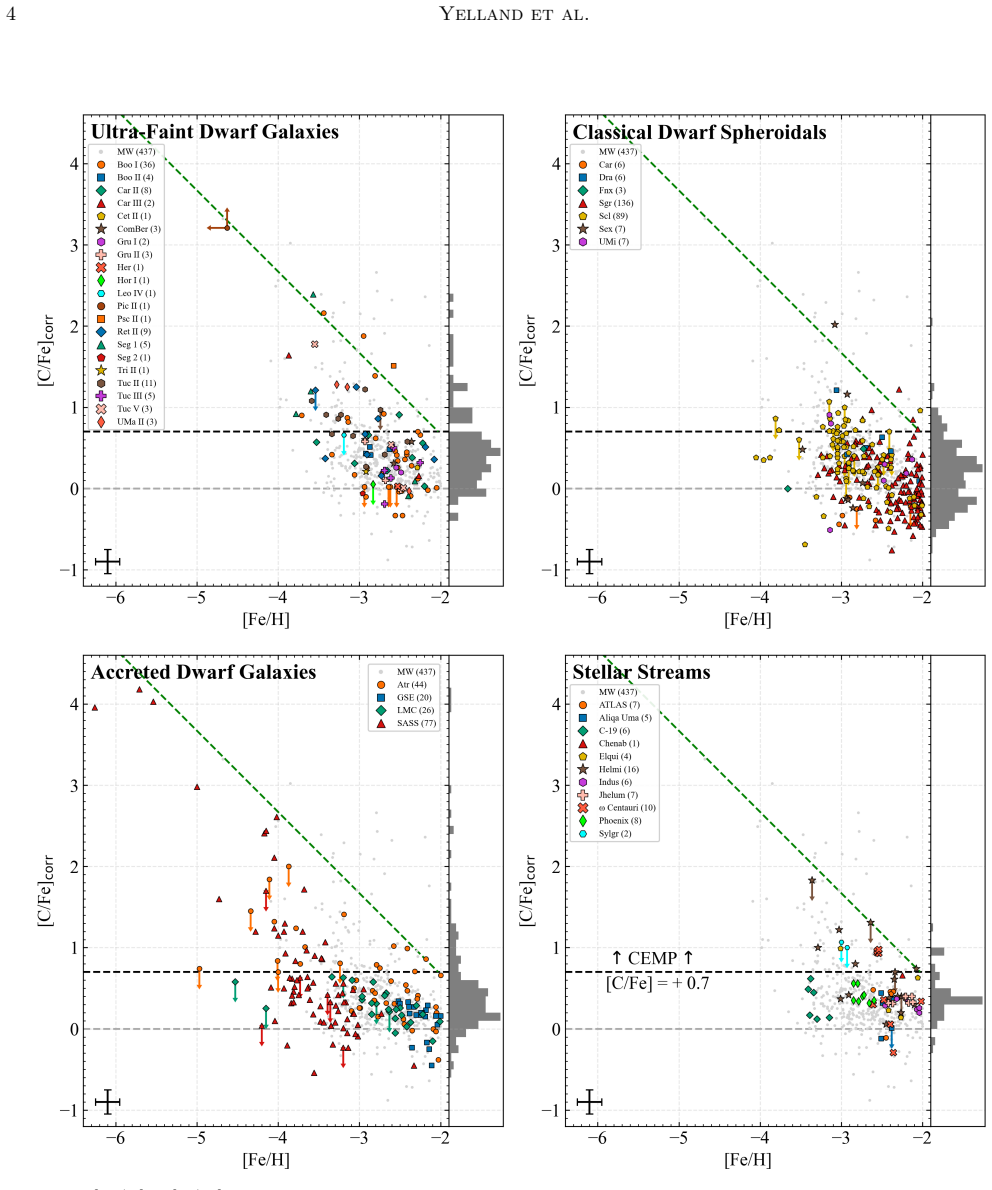
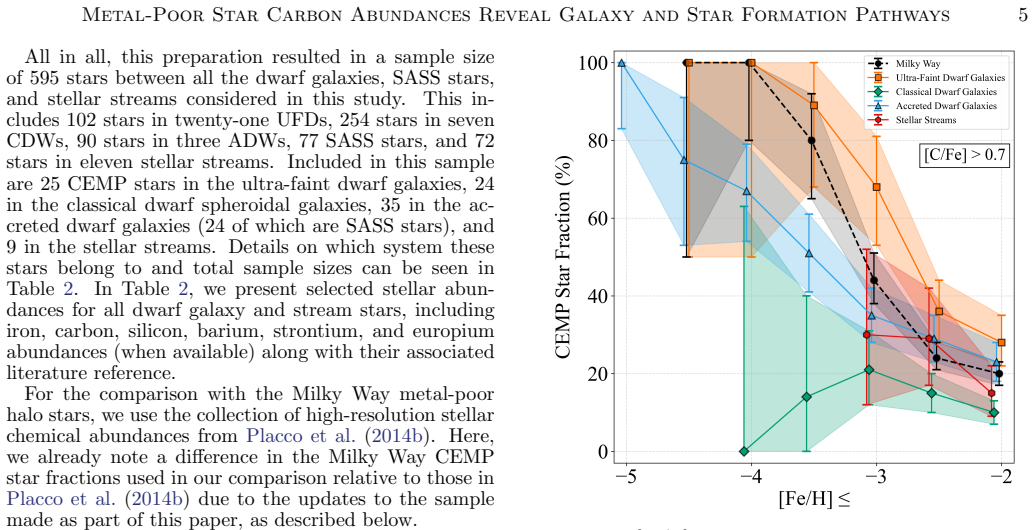
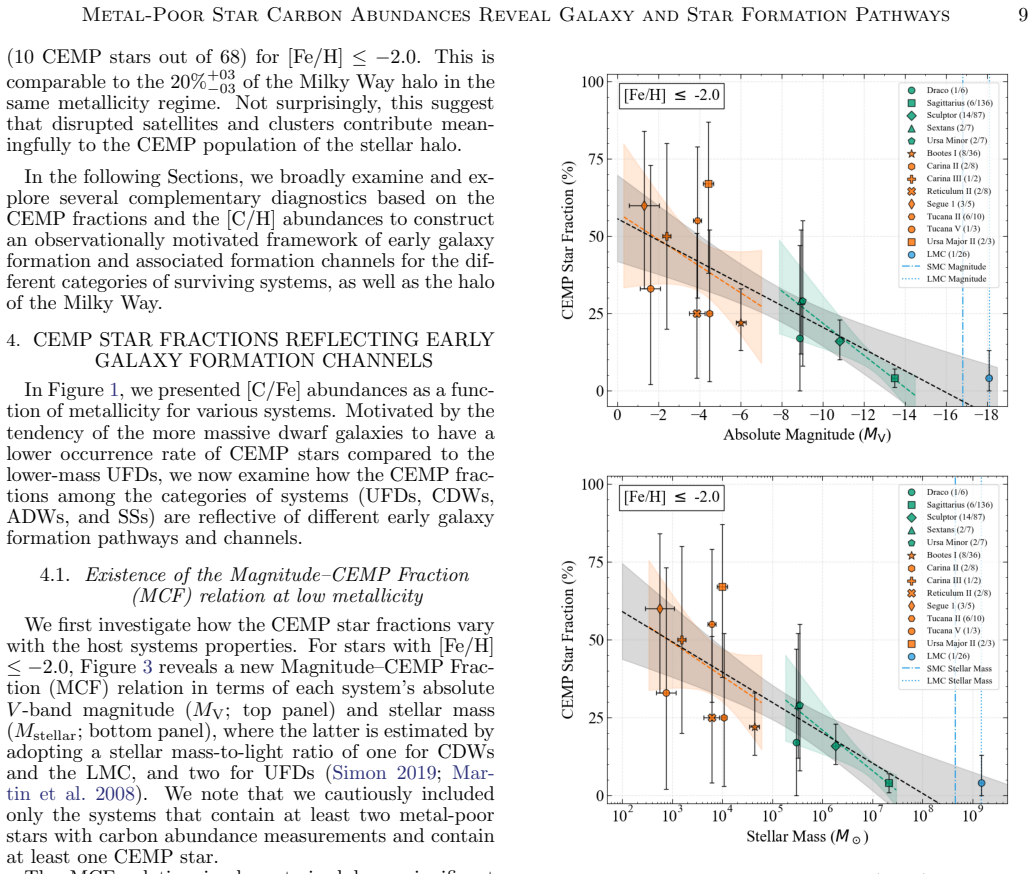
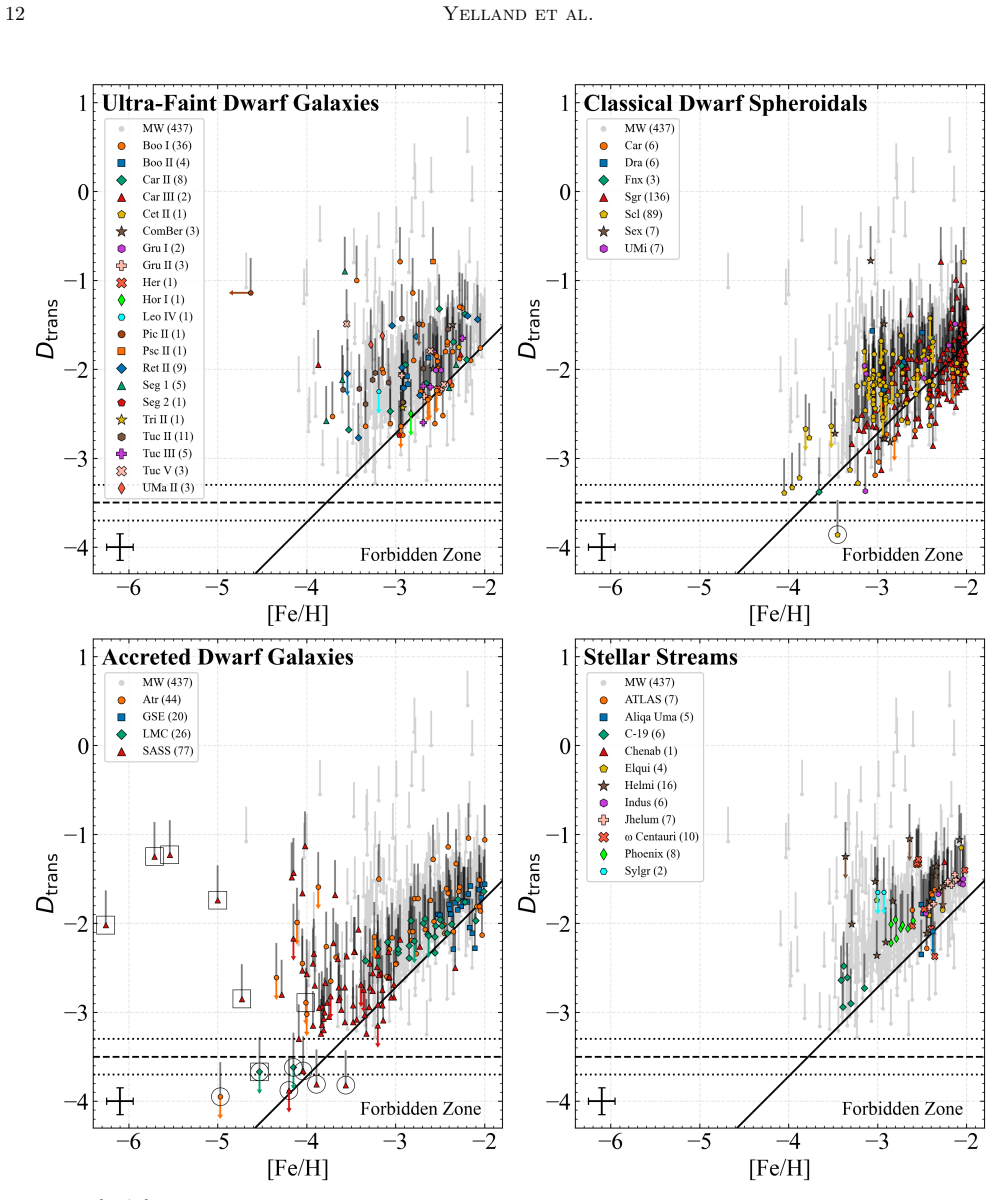
Carbon-enhanced metal-poor (CEMP; with $\rm{[Fe/H]} \le -2.0$ and $\rm{[C/Fe]} \ge 0.7$) stars preserve information about early chemical enrichment, low-mass star formation, and the hierarchical assembly of galaxies. In this study, we have compiled an extensive literature sample of 1032 stellar carbon abundances spanning the metal-poor Milky Way halo (437 stars), 21 ultra-faint dwarf galaxies (UFDs; 102 stars), seven classical dwarf spheroidal galaxies (254 stars), three accreted dwarf galaxies (90 stars), the Small Accreted Stellar Systems (SASS; 77 stars), and eleven stellar streams (72 stars). We establish the fractions of CEMP stars for each of these systems and categories. Generally, the low-mass UFDs possess the high fractions at low metallicities, whereas the more massive classical dwarf galaxies have relatively few CEMP stars. This behavior reveals a new low-metallicity Magnitude ($M_{\rm V}$)--CEMP Fraction relation across the dwarf satellite galaxy population. The high CEMP fractions in surviving UFDs suggest their enrichment was dominated by faint supernovae, as higher energy input would likely have quenched star production. The low CEMP fractions in classical dwarfs imply predominantly in situ formation rather than assembly from smaller systems. Using $\rm{[C/H]}$ abundances, we also probe early low-mass star formation. Eight stars lie within or near the theoretical ''forbidden zone'', indicating that dust-induced cooling, alongside fine-structure line cooling, contributed to early star formation. These rare dust-cooled stars may have formed in UFD-like systems that did not survive. Overall, the metal-poor Milky Way halo appears to have assembled from many different dwarf galaxies, with CEMP halo stars being contributed by early UFD-like systems and non-CEMP halo stars by intermediate-sized halos that later formed classical dwarfs.
Editorial analysis
A structured set of objections, weighed in public.
Referee Report
Summary. The manuscript compiles a literature sample of 1032 carbon abundance measurements for metal-poor stars ([Fe/H] ≤ -2) across the Milky Way halo (437 stars), 21 UFDs (102 stars), seven classical dSphs (254 stars), three accreted dwarfs (90 stars), SASS (77 stars), and eleven streams (72 stars). It reports systematically higher CEMP fractions ([C/Fe] ≥ 0.7) in UFDs than in classical dwarfs, identifies a new M_V–CEMP fraction relation, interprets the pattern as evidence that UFDs experienced faint-supernova-dominated enrichment while classical dwarfs formed largely in situ, and concludes that the metal-poor halo assembled from a heterogeneous mix of UFD-like and intermediate-mass progenitors, with eight stars near the theoretical forbidden zone implying dust cooling in early low-mass systems.
Significance. If the reported CEMP fractions prove robust against selection effects, the magnitude–CEMP relation and the inferred differential contributions to the halo would supply a new, observationally grounded constraint on the mass-dependent enrichment and assembly channels that built the Milky Way’s metal-poor component. The identification of stars near the forbidden zone would additionally highlight a possible dust-cooling pathway in the lowest-mass early systems.
major comments (3)
- [Abstract] Abstract (and the sample description): the central claim that CEMP fractions directly trace distinct supernova enrichment and in-situ versus accreted modes rests on the assumption that the compiled fractions are free of heterogeneous literature selection and targeting biases. No selection function, completeness correction, or quantification of differential spectroscopic follow-up priorities across the 21 UFDs, 7 classical dSphs, and halo samples is provided, even though more luminous systems have higher surface densities that can suppress CEMP detection rates at fixed [Fe/H] < -2.
- [Abstract] Abstract (and the statistical analysis section): no description is given of the statistical methods used to compute CEMP fractions, propagate uncertainties, or assess the significance of the reported M_V–CEMP fraction relation. Without these, it is impossible to determine whether the claimed differences between UFDs and classical dwarfs exceed what would be expected from Poisson sampling or from the heterogeneous literature compilation.
- [Abstract] Abstract (interpretation paragraph): the inference that low CEMP fractions in classical dwarfs imply predominantly in-situ formation rather than assembly from smaller systems is load-bearing for the halo-assembly conclusion, yet the manuscript does not test or quantify differential survival effects that could make the surviving UFD sample unrepresentative of the progenitor population that contributed to the halo.
minor comments (1)
- [Abstract] The abstract uses the notation rm{[Fe/H]} and rm{[C/Fe]} without defining the exact solar reference scale or the precise [C/Fe] threshold adopted for the CEMP classification in the compiled sample.
Simulated Author's Rebuttal
We thank the referee for their constructive and detailed comments. We address each major comment below and indicate revisions made to the manuscript.
read point-by-point responses
-
Referee: [Abstract] Abstract (and the sample description): the central claim that CEMP fractions directly trace distinct supernova enrichment and in-situ versus accreted modes rests on the assumption that the compiled fractions are free of heterogeneous literature selection and targeting biases. No selection function, completeness correction, or quantification of differential spectroscopic follow-up priorities across the 21 UFDs, 7 classical dSphs, and halo samples is provided, even though more luminous systems have higher surface densities that can suppress CEMP detection rates at fixed [Fe/H] < -2.
Authors: We agree that heterogeneous selection effects represent a significant caveat for any literature compilation. Complete selection functions and completeness corrections are unavailable for the full set of contributing surveys. However, the reported M_V–CEMP fraction trend runs opposite to the direction expected from surface-density suppression in brighter systems, and subsets of UFDs observed with different instruments yield consistent high CEMP fractions. In the revised manuscript we have added an explicit paragraph in the sample section acknowledging these limitations and noting that the observed trend provides a lower limit on the true difference. revision: partial
-
Referee: [Abstract] Abstract (and the statistical analysis section): no description is given of the statistical methods used to compute CEMP fractions, propagate uncertainties, or assess the significance of the reported M_V–CEMP fraction relation. Without these, it is impossible to determine whether the claimed differences between UFDs and classical dwarfs exceed what would be expected from Poisson sampling or from the heterogeneous literature compilation.
Authors: We thank the referee for highlighting this omission. CEMP fractions were computed as the binomial proportion of stars with [C/Fe] ≥ 0.7 among those with [Fe/H] ≤ −2; uncertainties follow the standard binomial (or Poisson for small N) formula. The M_V–CEMP relation was assessed with the Spearman rank correlation test. The revised manuscript now contains a dedicated “Statistical Methods” subsection that fully describes these procedures, reports the resulting p-value, and discusses the impact of sample heterogeneity. revision: yes
-
Referee: [Abstract] Abstract (interpretation paragraph): the inference that low CEMP fractions in classical dwarfs imply predominantly in-situ formation rather than assembly from smaller systems is load-bearing for the halo-assembly conclusion, yet the manuscript does not test or quantify differential survival effects that could make the surviving UFD sample unrepresentative of the progenitor population that contributed to the halo.
Authors: The interpretation rests on the large observed contrast in CEMP fractions between surviving UFDs and classical dwarfs. We acknowledge that differential survival of early progenitors could alter the representativeness of the UFD sample. A quantitative assessment of such effects requires cosmological simulations with detailed chemical tagging that lie outside the scope of this observational compilation. The revised discussion now explicitly flags this limitation while retaining the interpretation as the most direct reading of the extant data on surviving systems. revision: partial
- Quantitative modeling or simulation-based test of differential survival effects that could render the surviving UFD population unrepresentative of halo progenitors
Circularity Check
No circularity: claims rest on direct literature compilation and counting
full rationale
The paper compiles 1032 literature carbon abundances, computes CEMP fractions per system category, reports an observed M_V--CEMP fraction trend, and offers an interpretive narrative about assembly pathways. No equations, fitted parameters, or derivations appear in the provided text. All load-bearing steps are empirical counts and comparisons of external data; none reduce by construction to the paper's own inputs, self-citations, or ansatzes. This matches the default expectation of a self-contained observational study.
Axiom & Free-Parameter Ledger
axioms (2)
- domain assumption CEMP classification uses the standard thresholds [Fe/H] ≤ -2.0 and [C/Fe] ≥ 0.7
- domain assumption Differences in observed CEMP fractions between galaxy types reflect intrinsic enrichment pathways rather than selection or survival biases
Reference graph
Works this paper leans on
-
[1]
Abohalima, A., & Frebel, A. 2018, Astrophys. J. Suppl. Ser., 238, 36, 10.3847/1538-4365/aadfe9
-
[2]
S., Allende Prieto, C., Gonz \'a lez Hern \'a ndez, J
Aguado, D. S., Allende Prieto, C., Gonz \'a lez Hern \'a ndez, J. I., Rebolo, R., & Caffau, E. 2017, Astron. Astrophys., 604, A9, 10.1051/0004-6361/201731320
-
[3]
S., Molaro, P., Caffau, E., et al
Aguado, D. S., Molaro, P., Caffau, E., et al. 2022, Astron. Astrophys., 668, A86, 10.1051/0004-6361/202244627
-
[4]
Akerman, C. J., Carigi, L., Nissen, P. E., Pettini, M., & Asplund, M. 2004, Astron. Astrophys., 414, 931, 10.1051/0004-6361:20034188
-
[5]
D., Santos Figueiredo, A., Fienberg, C
Andales, H. D., Santos Figueiredo, A., Fienberg, C. G., Mardini, M. K., & Frebel, A. 2024, Mon. Not. R. Astron. Soc., 530, 4712, 10.1093/mnras/stae670
-
[6]
Aoki, W., Beers, T. C., Christlieb, N., et al. 2007 a , Astrophys. J., 655, 492, 10.1086/509817
-
[7]
Aoki, W., Bisterzo, S., Gallino, R., et al. 2006, Astrophys. J., 650, L127, 10.1086/508878
-
[8]
Aoki, W., Ryan, S. G., Norris, J. E., et al. 2002, Astrophys. J., 580, 1149, 10.1086/343885
-
[9]
Aoki, W., Honda, S., Beers, T. C., et al. 2005, Astrophys. J., 632, 611, 10.1086/432862
-
[10]
---. 2007 b , Astrophys. J., 660, 747, 10.1086/512601
-
[11]
Aoki, W., Beers, T. C., Sivarani, T., et al. 2008, Astrophys. J., 678, 1351, 10.1086/533517
-
[12]
Aoki, W., Beers, T. C., Lee, Y. S., et al. 2013, Astron. J., 145, 13, 10.1088/0004-6256/145/1/13
-
[13]
Arentsen, A., Placco, V. M., Lee, Y. S., et al. 2022, Mon. Not. R. Astron. Soc., 515, 4082, 10.1093/mnras/stac2062
-
[14]
Asplund, M., Grevesse, N., Sauval, A. J., & Scott, P. 2009, Annu. Rev. Astron. Astrophys., 47, 481, 10.1146/annurev.astro.46.060407.145222
-
[15]
Astropy Collaboration , Robitaille , T. P., Tollerud , E. J., et al. 2013, , 558, A33, 10.1051/0004-6361/201322068
-
[16]
, archivePrefix = "arXiv", eprint =
Astropy Collaboration , Price-Whelan , A. M., Sip o cz , B. M., et al. 2018, , 156, 123, 10.3847/1538-3881/aabc4f
-
[17]
Astropy Collaboration , Price-Whelan , A. M., Lim , P. L., et al. 2022, , 935, 167, 10.3847/1538-4357/ac7c74
work page internal anchor Pith review doi:10.3847/1538-4357/ac7c74 2022
-
[18]
Barklem, P. S., Christlieb, N., Beers, T. C., et al. 2005, Astron. Astrophys., 439, 129, 10.1051/0004-6361:20052967
-
[19]
Beers, T. C., Placco, V. M., Carollo, D., et al. 2017, Astrophys. J., 835, 81, 10.3847/1538-4357/835/1/81
-
[20]
Bekki, K., & Freeman, K. C. 2003, Mon. Not. R. Astron. Soc., 346, L11, 10.1046/j.1365-2966.2003.07275.x
-
[21]
Belokurov, V., Erkal, D., Evans, N. W., Koposov, S. E., & Deason, A. J. 2018, Mon. Not. R. Astron. Soc., 478, 611, 10.1093/mnras/sty982
-
[22]
Besla, G., Kallivayalil, N., Hernquist, L., et al. 2007, Astrophys. J., 668, 949, 10.1086/521385
-
[23]
Bonifacio, P., Spite, M., Cayrel, R., et al. 2009, Astron. Astrophys., 501, 519, 10.1051/0004-6361/200810610
-
[24]
Brauer, K., Emerick, A., Mead, J., et al. 2025, Astrophys. J., 980, 41, 10.3847/1538-4357/ada4a1
-
[25]
Bromm, V. 2013, Rep. Prog. Phys., 76, 112901, 10.1088/0034-4885/76/11/112901
-
[26]
2003, Nature, 425, 812, 10.1038/nature02071
Bromm, V., & Loeb, A. 2003, Nature, 425, 812, 10.1038/nature02071
-
[27]
2011, Nature, 477, 67, 10.1038/nature10377
Caffau, E., Bonifacio, P., Fran c ois, P., et al. 2011, Nature, 477, 67, 10.1038/nature10377
-
[28]
Carollo, D., Beers, T. C., Bovy, J., et al. 2012, Astrophys. J., 744, 195, 10.1088/0004-637X/744/2/195
-
[29]
Casey, A. R., & Schlaufman, K. C. 2017, Astrophys. J., 850, 179, 10.3847/1538-4357/aa9079
-
[30]
Cayrel, R., Depagne, E., Spite, M., et al. 2004, Astron. Astrophys., 416, 1117, 10.1051/0004-6361:20034074
-
[31]
Chiaki, G., Nozawa, T., & Yoshida, N. 2013 a , Astrophys. J., 765, L3, 10.1088/2041-8205/765/1/L3
-
[32]
Chiaki, G., Yoshida, N., & Kitayama, T. 2013 b , Astrophys. J., 762, 50, 10.1088/0004-637X/762/1/50
-
[33]
Chiti, A., Frebel, A., Ji, A. P., et al. 2018 a , Astrophys. J., 857, 74, 10.3847/1538-4357/aab4fc
-
[34]
Chiti, A., Simon, J. D., Frebel, A., et al. 2018 b , Astrophys. J., 856, 142, 10.3847/1538-4357/aab663
-
[35]
Chiti, A., Frebel, A., Ji, A. P., et al. 2023, Astron. J., 165, 55, 10.3847/1538-3881/aca416
-
[36]
Chiti, A., Mardini, M., Limberg, G., et al. 2024, Nat. Astron., 8, 637, 10.1038/s41550-024-02223-w
-
[37]
Chiti, A., Placco, V. M., Pace, A. B., et al. 2025, A Second-Generation Star in a Relic Dwarf Galaxy, arXiv, 10.48550/arXiv.2508.04053
-
[38]
---. 2026, Nat. Astron., 10.1038/s41550-026-02802-z
-
[39]
Choplin, A., Hirschi, R., Meynet, G., et al. 2018, Astron. Astrophys., 618, A133, 10.1051/0004-6361/201833283
-
[40]
G., Christlieb, N., McWilliam, A., et al
Cohen, J. G., Christlieb, N., McWilliam, A., et al. 2008, Astrophys. J., 672, 320, 10.1086/523638
-
[41]
G., Christlieb, N., Thompson, I., et al
Cohen, J. G., Christlieb, N., Thompson, I., et al. 2013, Astrophys. J., 778, 56, 10.1088/0004-637X/778/1/56
-
[42]
G., Hsieh, S., Metchev, S., Djorgovski, S
Cohen, J. G., Hsieh, S., Metchev, S., Djorgovski, S. G., & Malkan, M. 2007 a , Astron. J., 133, 99, 10.1086/509127
-
[43]
G., McWilliam, A., Christlieb, N., et al
Cohen, J. G., McWilliam, A., Christlieb, N., et al. 2007 b , Astrophys. J., 659, L161, 10.1086/518031
-
[44]
Cohen, J. G., Thompson, I. B., Sumi, T., et al. 2009, Astrophys. J., 699, 66, 10.1088/0004-637X/699/1/66
-
[45]
Cohen, J. G., Gould, A., Thompson, I. B., et al. 2010, Astrophys. J., 711, L48, 10.1088/2041-8205/711/1/L48
-
[46]
Cooke, R. J., & Madau, P. 2014, Astrophys. J., 791, 116, 10.1088/0004-637X/791/2/116
-
[47]
Ezzeddine, R., Frebel, A., Roederer, I. U., et al. 2019, Astrophys. J., 876, 97, 10.3847/1538-4357/ab14e7
-
[48]
Ezzeddine, R., Rasmussen, K., Frebel, A., et al. 2020, Astrophys. J., 898, 150, 10.3847/1538-4357/ab9d1a
-
[49]
Farouqi, K., Frebel, A., & Thielemann, F.-K. 2025, Eur. Phys. J. A, 61, 207, 10.1140/epja/s10050-025-01668-5
-
[50]
Fran c ois, P., Monaco, L., Bonifacio, P., et al. 2016, Astron. Astrophys., 588, A7, 10.1051/0004-6361/201527181
-
[51]
Fran c ois, P., Depagne, E., Hill, V., et al. 2007, Astron. Astrophys., 476, 935, 10.1051/0004-6361:20077706
-
[52]
Fran c ois, P., Caffau, E., Bonifacio, P., et al. 2018, Astron. Astrophys., 620, A187, 10.1051/0004-6361/201834375
-
[53]
2016, Searching for the Oldest Stars
Frebel, A. 2016, Searching for the Oldest Stars . Ancient Relics from the Early Universe (Princeton University Press). https://ui.adsabs.harvard.edu/abs/2016sosa.book.....F
2016
-
[54]
Frebel, A., & Bromm, V. 2012, Astrophys. J., 759, 115, 10.1088/0004-637X/759/2/115
-
[55]
Frebel, A., Chiti, A., Ji, A. P., Jacobson, H. R., & Placco, V. M. 2015, Astrophys. J., 810, L27, 10.1088/2041-8205/810/2/L27
-
[56]
Frebel, A., Collet, R., Eriksson, K., Christlieb, N., & Aoki, W. 2008, Astrophys. J., 684, 588, 10.1086/590327
-
[57]
Frebel, A., Johnson, J. L., & Bromm, V. 2007 a , Mon. Not. R. Astron. Soc., 380, L40, 10.1111/j.1745-3933.2007.00344.x
-
[58]
Frebel, A., Kirby, E. N., & Simon, J. D. 2010 a , Nature, 464, 72, 10.1038/nature08772
-
[59]
Frebel, A., & Norris, J. E. 2013, in Planets, Stars and Stellar Systems . Volume 5: Galactic Structure and Stellar Populations , Vol. 5 (Springer), 55, 10.1007/978-94-007-5612-0_3
-
[60]
---. 2015, Annu. Rev. Astron. Astrophys., 53, 631, 10.1146/annurev-astro-082214-122423
-
[61]
Frebel, A., Norris, J. E., Aoki, W., et al. 2007 b , Astrophys. J., 658, 534, 10.1086/511517
-
[62]
Frebel, A., Norris, J. E., Gilmore, G., & Wyse, R. F. G. 2016, Astrophys. J., 826, 110, 10.3847/0004-637X/826/2/110
-
[63]
Frebel, A., Simon, J. D., Geha, M., & Willman, B. 2010 b , Astrophys. J., 708, 560, 10.1088/0004-637X/708/1/560
-
[64]
Frebel, A., Simon, J. D., & Kirby, E. N. 2014, Astrophys. J., 786, 74, 10.1088/0004-637X/786/1/74
-
[65]
Frebel, A., Christlieb, N., Norris, J. E., et al. 2006, Astrophys. J., 652, 1585, 10.1086/508506
-
[66]
Fulbright, Jon . P., Rich, R. M., & Castro, S. 2004, Astrophys. J., 612, 447, 10.1086/421712
-
[67]
Gilmore, G., Norris, J. E., Monaco, L., et al. 2013, Astrophys. J., 763, 61, 10.1088/0004-637X/763/1/61
-
[68]
Gull, M., Frebel, A., Hinojosa, K., et al. 2021, Astrophys. J., 912, 52, 10.3847/1538-4357/abea1a
-
[69]
J., El-Souri , M., Monaco, L., et al
Hansen, C. J., El-Souri , M., Monaco, L., et al. 2018 a , Astrophys. J., 855, 83, 10.3847/1538-4357/aa978f
-
[70]
Hansen, T., Hansen, C. J., Christlieb, N., et al. 2014, Astrophys. J., 787, 162, 10.1088/0004-637X/787/2/162
-
[71]
---. 2015, Astrophys. J., 807, 173, 10.1088/0004-637X/807/2/173
-
[72]
Hansen, T. T., Simon, J. D., Li, T. S., et al. 2024, Astrophys. J., 968, 21, 10.3847/1538-4357/ad3a52
-
[73]
Hansen, T. T., Simon, J. D., Marshall, J. L., et al. 2017, Astrophys. J., 838, 44, 10.3847/1538-4357/aa634a
-
[74]
Hansen, T. T., Holmbeck, E. M., Beers, T. C., et al. 2018 b , Astrophys. J., 858, 92, 10.3847/1538-4357/aabacc
-
[75]
Hansen, T. T., Marshall, J. L., Simon, J. D., et al. 2020, Astrophys. J., 897, 183, 10.3847/1538-4357/ab9643
-
[76]
Haywood, M., Di Matteo, P., Lehnert, M. D., et al. 2018, Astrophys. J., 863, 113, 10.3847/1538-4357/aad235
-
[77]
Heger, A., & Woosley, S. E. 2010, Astrophys. J., 724, 341, 10.1088/0004-637X/724/1/341
-
[78]
Helmi, A., Babusiaux, C., Koppelman, H. H., et al. 2018, Nature, 563, 85, 10.1038/s41586-018-0625-x
-
[79]
Helmi, A., White, S. D. M., de Zeeuw , P. T., & Zhao, H. 1999, Nature, 402, 53, 10.1038/46980
-
[80]
Hill, V., Sk \'u lad \'o ttir, \'A ., Tolstoy, E., et al. 2019, Astron. Astrophys., 626, A15, 10.1051/0004-6361/201833950
discussion (0)
Sign in with ORCID, Apple, or X to comment. Anyone can read and Pith papers without signing in.