REVIEW 3 major objections 5 minor 27 references
Critical size limits for collinear and spin spiral magnetism in CoCr$_2$O$_4$
T0 review · 3 major / 5 minor · reviewed 2026-08-14 · deepseek-v4-flash
Pith's one-line read CoCr2O4 nanoparticles lose their spin-spiral magnetic order below a coherent size of 4.4 nm, and collinear ferrimagnetism below 3.3 nm.
desk verdict Solid neutron data on size-driven collapse of spiral order in CoCr2O4; the precise critical sizes are model-dependent extrapolations rather than direct measurements. read the letter →
The pith
A machine-rendered reading of the paper's core claim, the machinery that carries it, and where it could break.
The reading
What carries the argument
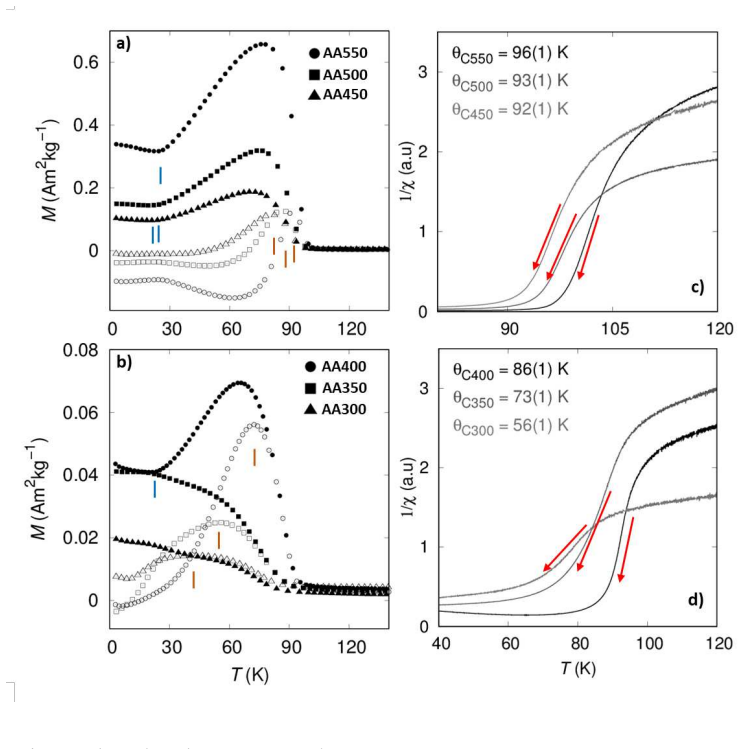
The central carrier is the $1/d$ scaling law $T(d)=T_{\mathrm{bulk}}(1-C/d)$ (from Ref. 24), applied to the Curie temperature, the blocking temperature, and the spin-spiral transition temperature; because all parameters except the shape factor are fixed, the curvature of each phase boundary is controlled by particle shape, and the zero of $T(d)$ defines the critical size. The experimental lever is polarized neutron diffraction with XYZ polarization analysis, which separates the magnetic scattering cross section from nuclear and spin-incoherent contributions, so that the fundamental (111) reflection tracks collinear ferrimagnetic order and the satellite reflections track the conical spin spiral. The spin-spiral propagation vector $\tau$, extracted with the conical spiral model of Refs. 22 and 23, gives the spiral period $\omega_{\mathrm{spiral}}=2\pi/\sqrt{2\tau^2}$, whose size dependence is the paper's direct observation of spiral compression.
What would settle it
Measure the transition temperatures of monodisperse CoCr2O4 particles with diameters from 2.5 to 4.0 nm whose surfaces are clean rather than oleic-acid terminated: if polarized neutron diffraction still detects spiral satellites below 4.4 nm or fundamental magnetic reflections below 3.3 nm, the critical sizes are an artifact of the $1/d$ extrapolation rather than an intrinsic size limit.
Extended reading notes
Core claim
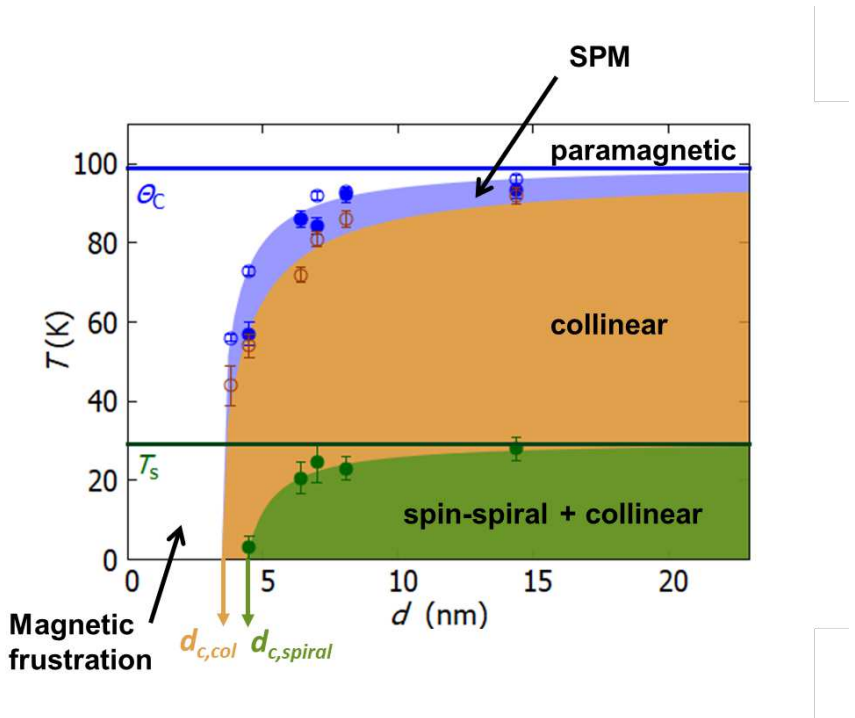
The paper establishes that the magnetic phase boundaries of nanocrystalline CoCr2O4 follow the size scaling $T(d)=T_{\mathrm{bulk}}(1-C/d)$ with all parameters fixed except the shape factor, and that extrapolating each transition to zero temperature yields the critical coherent domain sizes: $d_{c,\mathrm{spiral}}=4.4(1)$ nm, $d_{c,\mathrm{col}}=3.3(1)$ nm, $d_{c,\mathrm{spm}}=3.2(5)$ nm. It further shows, through polarized neutron diffraction, that the incommensurate spin-spiral propagation vector $\tau$ increases from $6.32(1)\times10^{-2}$ to $7.2(1)\times10^{-2}$ Å$^{-1}$ as the particle size decreases, so the spiral period shrinks and at 7-6.4 nm almost exactly one period is squeezed into the particle. The ferrimagnetic phase remains present down to 4.5 nm with the spiral absent at 3.6 nm, and at 2.7 nm (from the authors' earlier work) the system enters a frustrated cluster-glass state. Finally, higher-harmonic permittivity measurements on the AA500 sample show a ferroelectric transition near the spin-spiral transition temperature, directly confirming multiferroic behavior in the nanoparticle phase.
Load-bearing premise
The load-bearing premise is that the magnetic transition temperatures follow $T(d)=T_{\mathrm{bulk}}(1-C/d)$ over the entire 3.6-14 nm range with only the shape factor varying, so that setting $T(d_c)=0$ gives physical particle sizes; if the true size dependence is not $1/d$, for example because surface disorder, the oleic-acid shell, or deviations from spherical shape change the scaling, the quoted critical sizes are artifacts of the extrapolation.
Editorial extensions
If this is right
- Any CoCr2O4 nanoparticle with coherent size below $d_{c,\mathrm{spiral}} = 4.4$ nm cannot host the conical spin spiral, so it also cannot show the spin-spiral-driven electric polarization.
- The ferrimagnetic collinear phase is confined to particles larger than $3.3$ nm; below that, magnetic frustration and cluster-glass behavior take over, as already observed at 2.7 nm.
- The minimum particle size that can contain one full spin-spiral period is about $6.4$ nm; for particles between roughly 4.4 and 6.4 nm the spiral must be compressed or truncated.
- The size-temperature phase diagram provides a direct target for growth: to retain multiferroic CoCr2O4 at the nanoscale, the coherent crystalline domain must exceed 4.4 nm, and the organic surfactant should be minimized to allow the ferroelectric signal to be measured.
- The continuous size dependence of $\tau$ means the spiral pitch is tunable by particle size, which may be used to adjust the magnetoelectric response in nanostructured devices.
Reading between the lines
- Implicitly, the 4.4 nm spiral threshold acts as a practical lower bound for nanoscale magnetoelectric devices built from CoCr2O4, a consequence the paper states only in its concluding outlook.
- Because the scaling law leaves only the shape factor free, the same measurement protocol on shape-controlled particles (rods, plates, cubes) would predict different critical sizes; this is a testable extension the paper does not carry out.
- The observed compression of the spiral period implies that the effective magnetic exchange lengths are renormalized by the particle surface; measuring the helix pitch at fixed size but different surface terminations could separate intrinsic size effects from surface-disorder effects.
- Ferroelectric polarization measurements, which the paper found possible only when the organic fraction is low, could serve as a complementary probe of the spiral transition in nanoparticles, since the magnetization minimum becomes unreadable below 6.4 nm.
Signed reviews
Editorial analysis
A structured set of objections, weighed in public.
Referee Report
Summary. The manuscript combines polarized neutron diffraction with XYZ polarization analysis and macroscopic magnetization measurements on CoCr2O4 nanoparticles with coherent domain sizes between 3.6 and 14.0 nm. From the temperature dependence of the fundamental magnetic reflection and the spin-spiral satellites it constructs a size-temperature magnetic phase diagram and fits the transition temperatures of the collinear, spin-spiral, and blocking transitions to the 1/d law of Eq. (1). The central quantitative claims are the critical sizes d_c,spiral = 4.4(1) nm, d_c,col = 3.3(1) nm, and d_c,spm = 3.2(5) nm, together with a continuous shortening of the spin-spiral period with decreasing particle size and the first observation of ferroelectric polarization in the spin-spiral phase of nanocrystalline CoCr2O4.
Significance. The direct observation of spin-spiral satellite reflections by polarized neutron diffraction is a clear strength: the data show that the noncollinear phase is present at d_XRD = 4.5 nm and absent at 3.6 nm, giving an experiment-based bracket for d_c,spiral. The correlation length analysis in Fig. 4 is a useful check that the magnetic and structural coherence lengths coincide, and the polarization measurement on AA500 provides evidence for multiferroic behavior in nanoparticles. If the critical sizes are robust, the paper would establish a practical lower bound for spin-spiral multiferroicity in CoCr2O4 and would be of interest to the nanoparticle magnetism community. The main reservation is that the numerical values of d_c are obtained by extrapolating a phenomenological scaling law rather than read from a direct phase boundary, so their accuracy depends on model assumptions that are not fully tested.
major comments (3)
- [Eq. (1) and Fig. 5] The three critical sizes are zeros of Eq. (1), T(d) = T_bulk(1 - C/d), but the manuscript does not test whether the 1/d form describes the measured size window or justify extrapolating it to T(d)=0. The neutron data themselves only bracket d_c,spiral between 4.5 and 3.6 nm and d_c,col between 3.6 and 2.7 nm. Because the shape factor is fitted to the same phase boundaries, the quoted d_c values are model outputs, not direct measurements. I request a residual plot for the fits, a statement of the fitted shape factor(s), and a sensitivity analysis against alternative forms such as T(d) = T_bulk[1 - (C/d)^n] or a dead-layer model. The 0.1 nm uncertainties should be expanded to include this model uncertainty, which can shift d_c by more than 0.1 nm.
- [Eq. (1), T_b fit] Applying Eq. (1) to the blocking temperature T_b is conceptually problematic: for single-domain nanoparticles T_b reflects the anisotropy energy barrier KV and is not a thermodynamic transition temperature with a finite bulk limit. Using T_b,bulk = 94 K, taken from the onset of ferrimagnetic order in polycrystalline CoCr2O4, conflates two different quantities and directly affects d_c,spm = 3.2(5) nm. The authors should either justify this use with a model for T_b(d) or relegate d_c,spm to an empirical fit with an explicit statement that it is not a true critical size.
- [Fig. 4 and p. 6] The claim that the spin-spiral period approaches the particle size in the range 7 to 6.4 nm and that exactly one period is compressed slightly to fit into the NP is stated descriptively. Given that the propagation vector tau is determined only at T_s for each sample and the correlation length xi_spiral is similar to d_XRD, the relation between omega_spiral and particle size would benefit from a quantitative test, for example comparing omega_spiral with 2*pi/(sqrt(2)*tau^2) and xi_spiral as a function of d. This is important because Fig. 4 supports the minimum spin spiral period squeezed into the NP statement in the abstract.
minor comments (5)
- [Title] The title contains a typo: magnetis m should read magnetism.
- [Eq. (1)] The displayed formula for C is difficult to parse: 6*mu*(6*M)^(1/3)/(rho*pi*N_A)^(1/3)*Z^(2/3)*pi*k^2 lacks parentheses and clear exponents; please rewrite it with all symbols defined, including the shape factor mu and the lattice-parameter ratio k.
- [Sec. 4, Fig. 4] The propagation vector is denoted tau tau_0; please define tau_0 explicitly, presumably as the bulk value, and use it consistently in the text and in Fig. 4.
- [Ferroelectric results, Fig. S9] The ferroelectric transition at about 28 K for AA500 is described as being in good agreement with T_s = 23(3) K, yet the difference is about 5 K, larger than the quoted uncertainty; a brief comment on this discrepancy would prevent confusion.
- [Abstract and Fig. 5] The abstract states critical coherent domain sizes, but the values d_c are obtained from fits that use the PXRD coherent domain sizes; the distinction between structural particle size from TEM and coherent domain size from PXRD should be restated in the relevant figure captions and in the discussion of d_c.
Circularity Check
The central critical sizes are fit zeros: Eq. (1) gives d_c = C, so the quoted d_c values are the fitted shape-factor parameter renamed as a result.
-
fitted input called prediction
[Equation (1) and following paragraph; Fig. 5]
"All parameters in equation (1) were fixed, except the shape factor, which determines the curvature of the phase boundaries. ... We obtain critical particle sizes (T(dc)=0) for the formation of the spin spiral magnetic structure dc,spiral = 4.4(1) nm, for the collinear magnetic order dc,col = 3.3(1) nm and for SPM behavior dc,spm = 3.2(5) nm."
Equation (1) is T(d)=T_bulk(1-C/d), with C fixed by the fitted shape factor. Setting T(d_c)=0 gives d_c=C algebraically, so each quoted critical size is simply the fitted parameter C (a one-to-one rescaling of the fitted shape factor) for that transition. The values are not independently measured or out-of-sample predictions: they are zeros of the same fitted curve that was matched to the transition temperatures used to construct the phase diagram. The neutron data only bracket d_c,spiral between 3.6 and 4.5 nm; the precise 4.4(1) nm value and its uncertainty are least-squares fit outputs under the assumed 1/d model. Presenting these fit zeros as 'established critical coherent domain sizes' is a fitted parameter renamed as a result.
full rationale
The paper's main quantitative result, the set of critical particle sizes, reduces by construction to the fitted parameter in Eq. (1): because T(d_c)=0 forces d_c=C, and C is determined by the shape factor fitted to the measured transition temperatures, the quoted d_c values are re-parametrizations of that fit rather than independent empirical determinations. This is the central claim, so the circularity score is substantial. The qualitative phase diagram is nevertheless well supported by direct observation: the 4.5 nm sample shows spin-spiral satellites while the 3.6 nm sample does not, and the measured propagation-vector evolution, correlation lengths, and polarization onset are independent data. No load-bearing self-citation chain is present: Ref. 13 supports the cluster-glass behavior at 2.7 nm but is not needed for the fitted critical sizes, and Eq. (1) is imported from an external source. The main caveat beyond circularity is model risk: the 1/d form is assumed and extrapolated to T=0, so the 0.1 nm uncertainties do not include possible deviations from the assumed scaling; that is a correctness concern rather than an additional circular step.
Assumptions & free parameters
free parameters (1)
- shape factor mu in Eq. (1) =
not reported in the preprint text
assumptions (4)
- domain assumption The 1/d finite-size scaling law (Eq. 1, from Ref. [24]) describes all three transition temperatures in this size range.
- domain assumption Coherent domain size d_XRD from PXRD is the relevant length scale for magnetic ordering in the nanoparticles.
- domain assumption The magnetic structure is described by a conical spin spiral with a single propagation vector tau, as in bulk CoCr2O4 (Refs. 22,23).
- domain assumption Higher-harmonic permittivity measurements are a sufficient indicator of a ferroelectric transition in nanoparticles.
Cite this review
Pith. "Pith review of Critical size limits for collinear and spin spiral magnetism in CoCr$_2$O$_4$." pith.science (2026). https://pith.science/paper/DT7LYKBJ
@misc{pith2026190810582,
  author       = {Pith},
  title        = {Pith review of: Critical size limits for collinear and spin spiral magnetism in CoCr$_2$O$_4$},
  year         = {2026},
  howpublished = {\url{https://pith.science/paper/DT7LYKBJ}},
  note         = {Machine review of arXiv:1908.10582}
}
abstract
The multiferroic behavior of CoCr$_2$O$_4$ results from the appearance of conical spin-spiral magnetic ordering, which induces electric polarization. The magnetic ground state has a complex size dependent behavior, which collapses when reaching a critical particle size. Here, the magnetic phase stability of CoCr$_2$O$_4$ in the size range of 3.6 - 14.0 nm is presented in detail using the combination of neutron diffraction with XYZ polarization analysis and macroscopic magnetization measurements. We establish critical coherent domain sizes for the formation of the spin spiral and ferrimagnetic structure and reveal the evolution of the incommensurate spin spiral vector with particle size. We further confirm the presence of ferroelectric polarization in the spin spiral phase for nanocrystalline CoCr$_2$O$_4$.
Figures


Figures from the paper (2 more)

Reference graph
Works this paper leans on
-
[1]
author M. Fiebig , author T. Lottermoser , author D. Meier , and author M. Trassin , journal Nature Reviews Materials volume 1 , pages 16046 ( year 2016 )
work page 2016
-
[2]
author T. Kimura , author S. Ishihara , author H. Shintani , author T. Arima , author K. T. Takahashi , author K. Ishizaka , and author Y. Tokura , journal Phys. Rev. B volume 68 , pages 060403 ( year 2003 )
work page 2003
-
[3]
author T. Goto , author T. Kimura , author G. Lawes , author A. P. Ramirez , and author Y. Tokura , journal Phys. Rev. Lett. volume 92 , pages 257201 ( year 2004 )
work page 2004
-
[4]
author E. Bousquet and author A. Cano , journal Journal of Physics: Condensed Matter volume 28 , pages 123001 ( year 2016 )
work page 2016
-
[5]
author D. Higashiyama , author S. Miyasaka , author N. Kida , author T. Arima , and author Y. Tokura , journal Phys. Rev. B volume 70 , pages 174405 ( year 2004 )
work page 2004
-
[6]
author M. Mostovoy , journal Phys. Rev. Lett. volume 96 , pages 067601 ( year 2006 )
work page 2006
-
[7]
author S. W. Cheong and author M. Mostovoy , journal Nat Mater. volume 6 , pages 13 ( year 2007 )
work page 2007
-
[8]
author Y. Yamasaki , author S. Miyasaka , author Y. Kaneko , author J.-P. He , author T. Arima , and author Y. Tokura , journal Phys. Rev. Lett. volume 96 , pages 207204 ( year 2006 )
work page 2006
Show all 27 references
-
[9]
Kim , author Y
author I. Kim , author Y. Seok Oh , author Y. Liu , author S. Chun , author J.-S. Lee , author K.-T. Ko , author J.-H. Park , author J.-H. Chung , and author K. H. Kim , journal Appl. Phys. Lett. volume 94 , pages 042505 ( year 2009 )
2009
-
[10]
author L. J. Chang , author D. J. Huang , author W.-H. Li , author S.-W. Cheong , author W. Ratcliff , and author J. W. Lynn , journal Journal of Physics: Condensed Matter volume 21 , pages 456008 ( year 2009 )
2009
-
[11]
Z \'a kutn \'a , author A
author D. Z \'a kutn \'a , author A. Repko , author I. Matulkov \'a , author D. Ni z n ansk \'y , author A. Ardu , author C. Cannas , author A. Mantlikov \'a , and author J. Vejpravov \'a , journal Journal of Nanoparticle Research volume 16 , pages 2251 ( year 2014 )
2014
-
[12]
Z \'a kutn \'a , author I
author D. Z \'a kutn \'a , author I. Matulkov \'a , author E. Kentzinger , author R. Medlin , author Y. Su , author K. Nemkovski , author S. Disch , author J. Vejpravov \'a , and author D. Ni z n ansk \'y , journal RSC Adv. volume 6 , pages 107659 ( year 2016 )
2016
-
[13]
Z\'akutn\'a , author J
author D. Z\'akutn\'a , author J. Vl c c ek , author P. Fitl , author K. Nemkovski , author D. Honecker , author D. Ni z z n n ansk\'y , and author S. Disch , journal Phys. Rev. B volume 98 , pages 064407 ( year 2018 )
2018
-
[14]
Rath and author P
author C. Rath and author P. Mohanty , journal Journal of Superconductivity and Novel Magnetism volume 24 , pages 629 ( year 2011 )
2011
-
[15]
author D. P. Dutta , author J. Manjanna , and author A. K. Tyagi , journal Journal of Applied Physics volume 106 , pages 043915 ( year 2009 )
2009
-
[16]
Kumar , author P
author L. Kumar , author P. Mohanty , author T. Shripathi , and author C. Rath , journal Nanoscience and Nanotechnology Letters volume 1 , pages 193 ( year 2009 )
2009
-
[17]
Tian , author C
author Z. Tian , author C. Zhu , author J. Wang , author Z. Xia , author Y. Liu , and author S. Yuan , journal J. Magn. Magn. Mater. volume 377 , pages 176 ( year 2015 )
2015
-
[18]
author J. K. Galivarapu , author D. Kumar , author A. Banerjee , and author C. Rath , journal IEEE Transactions on Magnetics volume 52 , pages 1 ( year 2016 a )
2016
-
[19]
author J. K. Galivarapu , author D. Kumar , author A. Banerjee , author V. Sathe , author G. Aquilanti , and author C. Rath , journal RSC Adv. volume 6 , pages 63809 ( year 2016 b )
2016
-
[20]
Kumar , author J
author D. Kumar , author J. K. Galivarapu , author A. Banerjee , author K. S. Nemkovski , author Y. Su , and author C. Rath , journal Nanotechnology volume 27 , pages 175702 ( year 2016 )
2016
-
[21]
note See Supplemental Material at [URL will be inserted by publisher] for experimental details, macroscopic magnetization measurements, results of the Le Bail analysis of PXRD data, a complete set of neutron diffractograms including temperature dependence of integral intensity...
-
[22]
author J. M. Hastings and author L. M. Corliss , journal Physical Review volume 126 , pages 556 ( year 1962 )
1962
-
[23]
author D. H. Lyons , author T. A. Kaplan , author K. Dwight , and author N. Menyuk , journal Physical Review volume 126 , pages 540 ( year 1962 )
1962
-
[24]
Xie , author M
author D. Xie , author M. Wang , and author L. Cao , journal physica status solidi (b) volume 242 , pages R76 ( year 2005 )
2005
-
[25]
Lawes , author B
author G. Lawes , author B. Melot , author K. Page , author C. Ederer , author M. A. Hayward , author T. Proffen , and author R. Seshadri , journal Phys. Rev. B volume 74 , pages 024413 ( year 2006 )
2006
-
[26]
Niermann , author C
author D. Niermann , author C. Grams , author M. Schalenbach , author P. Becker , author L. Bohat\'y , author J. Stein , author M. Braden , and author J. Hemberger , journal Phys. Rev. B volume 87 , pages 134412 ( year 2014 )
2014
-
[27]
Grams , author S
author C. Grams , author S. Kopatz , author D. Br\" u ning , author S. Biesenkamp , author P. Becker , author L. Bohat\'y , author T. Lorenz , and author J. Hemberger , journal Sci. Rep. volume 9 , pages 4391 ( year 2019 )
2019
Reviewed August 14, 2026 · model on record in the stance chip above.
Discussion (0). Continue with ORCID to comment.