REVIEW 3 major objections 6 minor 233 references
Personalized virtual reality, the paper argues, is not a patchwork of domain-specific tricks but one shared five-stage closed-loop process — sense, process, decide, update, re-sense — that runs through every application area it reviewed.
Reviewed by Pith at T0; open to challenge. T0 means a machine referee read the full paper against a public rubric. the ladder, T0–T4 →
A systematic review synthesizes 132 VR personalization studies into a five-stage closed-loop pipeline and identifies trends toward multimodal sensing, AI-based adaptation, and unresolved evaluation and privacy challenges.
T0 review reviewed 2026-08-04 challenge →
load-bearing objection A useful and well-organized review with a credible unifying framework, but un-auditable corpus reporting and PRISMA inconsistencies need fixing before it can serve as a reliable census of the field. the 3 major comments →
From Adaptation to Intelligence: A Systematic Review of Data, Strategies, and Impact in Personalized VR
The pith
A machine-rendered reading of the paper's core claim, the machinery that carries it, and where it could break.
The reading
Core claim
The paper's central claim is that personalization in VR is one general five-stage closed-loop process, not a collection of unrelated methods. In every reviewed system, user information — physiological, behavioral, or demographic — is captured through continuous sensing, cleaned and structured, interpreted by rule-based or machine-learned logic, used to update the virtual environment, and then re-measured so the loop can repeat. The authors argue this structure appears across rehabilitation, mental health, accessibility, education, training, gaming, and navigation, and they chart the field's trajectory: multimodal sensor fusion, a move toward hybrid reactive/proactive systems, and AI-driven a
What carries the argument
The central organizing object is the five-stage adaptive pipeline: input collection, data processing, adaptive logic, system update, and feedback loop. This named framework carries the argument by providing a single lens through which the review categorizes sensing modalities, adaptation mechanisms (rule-based versus machine learning), and adaptive objectives (difficulty adjustment, display adaptation, environment manipulation, feedback personalization). The framework is what lets the authors claim that results from one domain can inform another and that the field's trends are coherent rather than scattered.
Load-bearing premise
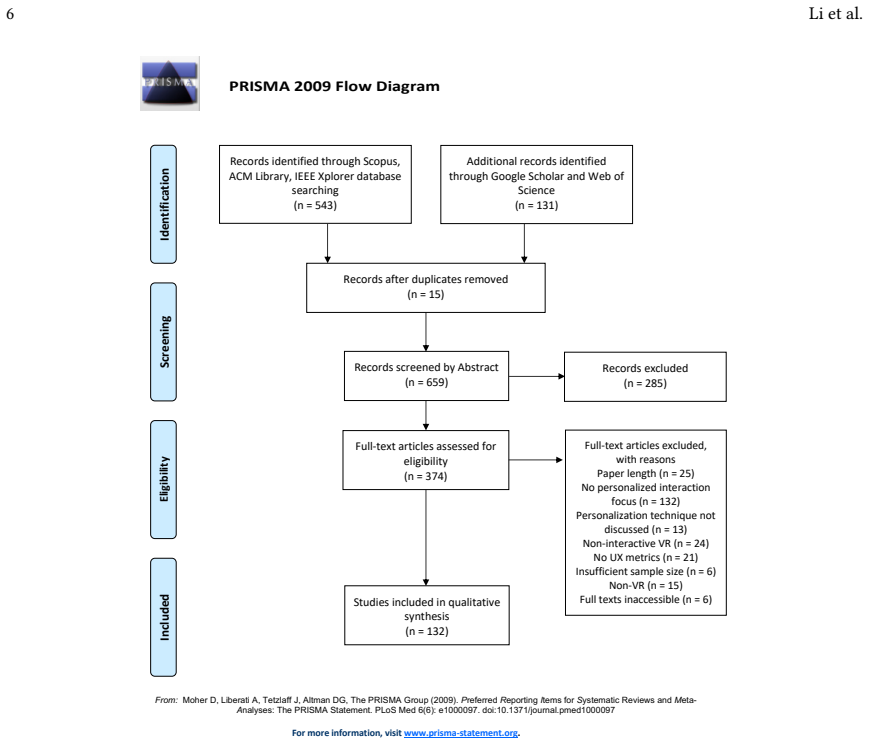
The load-bearing premise is that the 132 papers reviewed form a representative, correctly screened sample of adaptive-VR research from 2014 to 2025; if the screening arithmetic or date filters were applied inconsistently — the flow diagram lists only 15 records after duplicates removed while 659 records were screened, and some cited studies predate 2014 — then the five-stage framework and trend claims may describe a skewed slice of the literature rather than the field as a wh
What would settle it
A reader could examine the paper's own flow diagram and reference list: if the 659 screened records cannot be reconciled with the reported counts at each exclusion stage, or if a meaningful number of the 132 included studies fall outside the stated 2014–2025 window, then the corpus is not what it claims to be, and the generality of the five-stage framework would rest on an unrepresentative sample.
If this is right
- If the five-stage framework is correct, personalization techniques developed in one application domain should transfer to another that runs the same loop — for example, dynamic difficulty adjustment from games could be applied to rehabilitation exercises.
- The identified shift toward hybrid reactive/proactive systems implies future VR systems will be expected to anticipate user state, not merely react to it, which requires more accurate user-state prediction models.
- The growing adoption of AI, including LLM-driven NPCs and generative content, points toward scalable personalization where virtual environments and conversations adapt on the fly rather than being hand-authored.
- Standardized evaluation protocols and benchmark datasets are prerequisites for comparing personalization strategies across studies, since the current diversity of measures and the absence of shared datasets limit comparability.
- The challenges the review identifies — real-time processing, sensor noise, privacy, and scalability — are the concrete barriers that must be addressed before personalized VR leaves the laboratory.
Where Pith is reading between the lines
- A testable extension of the review's claim is that adaptive VR systems could be built as interchangeable modules: swapping the sensing stage (say, EEG for eye tracking) while keeping the same adaptive logic should preserve system effectiveness. The paper does not test this modularity claim directly.
- The review's observation that most systems are reactive suggests a concrete comparative study: running proactive versus reactive versions of the same adaptive task, measuring engagement, performance, and sense of control. The paper identifies the gap but does not run such comparisons.
- If evaluation comparability is the bottleneck the authors say it is, then their analysis implies the field's next step is a domain-specific benchmark dataset for VR personalization, analogous to image-recognition benchmarks. The review calls for such datasets but does not build one.
- A re-audit of the paper's own screening data is warranted before its trend claims are used to guide research agendas: the flow diagram reports 'records after duplicates removed (n = 15)' while 659 records were screened, and the reference list includes studies from 2012 and 2013 that fall outside the stated 2014–2025 inclusion window.
Editorial analysis
A structured set of objections, weighed in public.
Referee Report
Summary. This systematic review examines 132+ studies on personalized/adaptive VR interaction, focusing on how user data (physiological, behavioral, contextual) is used to drive adaptation mechanisms. The authors propose a five-stage closed-loop framework (input collection, data processing, adaptation logic, system update, feedback loop) and identify trends toward multimodal sensing, hybrid reactive/proactive adaptation, and increasing use of AI, while also cataloging challenges in real-time processing, signal accuracy, and privacy. The review is organized around three research questions addressing technological implementation, UX evaluation, and implementation challenges.
Significance. If the corpus is representative and correctly screened, the review offers a useful synthesis of a fragmented literature, and the five-stage framework provides a clear organizing structure for future work. The explicit focus on combining sensing and adaptation—rather than treating them separately—addresses a genuine gap. The paper is also commendable for its broad coverage of domains (rehabilitation, mental health, accessibility, education, gaming), its detailed tables of questionnaires and ML techniques, and its balanced discussion of challenges. However, the value of the framework and the trend claims rests on the auditability of the reviewed corpus, and that auditability is currently compromised by internal inconsistencies in the PRISMA flow diagram and by included studies that violate the stated date window.
major comments (3)
- [§3.2.1 / Fig. 1] The PRISMA flow diagram is internally inconsistent. Records identified are 543 + 131 = 674; the diagram states 'Records after duplicates removed (n = 15)' but then 'Records screened by Abstract (n = 659)'. Since 659 = 674 − 15, the label after duplicates removed should be 659, not 15. The text also says 'over 132 studies' while the diagram reports exactly 132. These discrepancies make the screening process unverifiable and must be corrected and reconciled in a revised flow diagram.
- [§3.2.1 / §4.4.1 / Table 2] The inclusion criteria state that only studies published from 2014 to 2025 are eligible, yet the review includes studies outside this window. Ref. [104] (Lahiri et al., 2012) is listed in Table 2 as a study using the SUS, and Ref. [143] (Park et al., 2013) is cited in §4.4.1 as an example of gait training. No inclusion list or screening log is supplied. This inconsistency directly undermines the representativeness of the corpus on which the five-stage framework and the trend claims (multimodal sensing, hybrid reactive/proactive, AI adoption) rest. The authors must either exclude out-of-window studies or revise the stated date window, and should provide the full list of included studies with screening decisions as an appendix.
- [§5.1.1 / Fig. 3] The paper asserts several 'emerging trends' (e.g., increasing integration of multimodal physiological data, transition to hybrid reactive/proactive adaptation, adoption of AI) but does not present a temporal or coded quantitative analysis supporting these claims. Fig. 3 gives percentages but no per-year breakdown or coding rubric for how studies were categorized. Since the corpus is not auditable (see previous comments), these trend claims are not verifiable. The authors should either provide the underlying coded data (e.g., counts by year and category) or explicitly temper these claims to reflect qualitative observation rather than systematic trend analysis.
minor comments (6)
- [§1.1 / Fig. 1] The text says 'over 132 studies' in §4, while Fig. 1 reports exactly 132 included. Please make the number consistent (e.g., '132 studies').
- [§4.2.1] GEQ is cited as [81, 174]; the correct references for the Game Experience Questionnaire should be [81, 152] (as in Table 2).
- [Table 2] AttrakDiff-Short is cited as [167] in Table 2, but the text in §4.2.1 cites it as [73]. Please align these citations.
- [§3.2.1] The stated window 'last 10 years (from 2014 to 2025)' actually spans up to 12 years depending on the cutoff month. Please specify the exact search date range (e.g., January 2014–October 2025).
- [§5.1.1] Typo: 'biosignals such as EEG, GSE, EDA, and HR' should be 'GSR' instead of 'GSE'.
- [Throughout] Several typos and inconsistencies should be cleaned: 'scability' (§6), 'conputationally' (Table 4), 'dependecies' (Table 4), 'explic programm' (Table 4), 'embodiement' (Table 4), 'Cladue-3' (§5.1.3), 'Augest' (Refs [140,164]).
Circularity Check
No significant circularity; the five-stage framework is an analytic synthesis, and the PRISMA/date issues are correctness risks rather than circular steps.
full rationale
This is a qualitative systematic review, not a derivation. The central deliverable is the five-stage pipeline (input collection, data processing, adaptive logic, system update, feedback loop) used to organize the reviewed systems. That pipeline is introduced as 'typically involving' (Sec. 4.3) and then used as an analytic lens (Sec. 5.1, Fig. 5); it is an abstraction imported from the adaptive-systems literature (e.g., [9]) and applied to the corpus, not a quantity fitted to the corpus, so no prediction reduces by construction to its inputs. The trend claims (multimodal sensing, hybrid reactive/proactive, AI uptake) are empirical summaries of the included 132 papers; their reliability depends on corpus representativeness, which is a correctness/validity concern, not circularity. The flow-diagram label 'Records after duplicates removed (n = 15)' is evidently a labeling error: 543+131-15 = 659 reconciles with the screened count, and the cited 2012/2013 papers (Refs. [104], [143]) outside the stated 2014-2025 window raise screening-consistency questions; these affect the strength of the empirical claims but do not create a self-referential derivation. Several self-citations ([203], [205]-[207], [229]) occur as illustrative examples in tables and discussion; none is load-bearing for the framework or main trends. No circular step is exhibited.
Axiom & Free-Parameter Ledger
axioms (4)
- domain assumption The published literature captured by the stated query and databases is representative of personalized VR research.
- ad hoc to paper Each included study was faithfully categorized into the five pipeline stages and application domains.
- domain assumption PRISMA is the appropriate reporting standard and the reported counts are accurate.
- domain assumption Self-reported UX instruments (SSQ, PQ, SUS, NASA-TLX, etc.) and biosignals are commensurable enough to support cross-study synthesis.
invented entities (1)
-
Five-stage pipeline (input collection, data processing, adaptive logic, system update, feedback loop)
no independent evidence
Cite this review
Pith. "Pith review of From Adaptation to Intelligence: A Systematic Review of Data, Strategies, and Impact in Personalized VR." pith.science (2026). https://pith.science/paper/DTBRAHHB
@misc{pith2026251013123,
  author       = {Pith},
  title        = {Pith review of: From Adaptation to Intelligence: A Systematic Review of Data, Strategies, and Impact in Personalized VR},
  year         = {2026},
  howpublished = {\url{https://pith.science/paper/DTBRAHHB}},
  note         = {Machine review of arXiv:2510.13123}
}
read the original abstract
As virtual reality (VR) systems advance, they are increasingly expected to adapt intelligently to individual users' states, abilities, and preferences. While prior research has examined user-state sensing and adaptive interaction design in VR, existing reviews typically address these aspects in isolation. In this paper, we examine the growing body of research on personalization in VR, with a particular focus on how user data collected during immersion is used to drive adaptive strategies that tailor the experience and enhance engagement, performance, or other specific goals. We synthesize findings from studies that employ adaptive techniques across diverse application domains and summarize a five-stage conceptual framework that unifies adaptive mechanisms across domains. Our analysis reveals emerging trends, including the integration of multimodal sensors, the transition from purely reactive to hybrid adaptation systems, and the adoption of artificial intelligence approaches. Finally, we identify key challenges related to data, modeling, and evaluation, and outline future research directions toward more effective and user-centered VR systems.
Figures


Reference graph
Works this paper leans on
-
[1]
César Iván Aguilar Reyes, David Wozniak, Angel Ham, and Maryam Zahabi. 2023. Design and evaluation of an adaptive virtual reality training system.Virtual Reality27, 3 (2023), 2509–2528
2023
-
[2]
Nahdatul Akma Ahmad, Azaliza Zainal, Muhammad Fairuz Abd Rauf, Tengku Shahrom, Tengku Shahdan, Fadia Razali, Noor Hidayah Azmi, MH MOhd-Yussof, and Zirawani Baharum. 2020. Development of virtual reality game for the rehabilitation of upper limb control in the elderly patients Manuscript submitted to ACM Adapting to the User: A Systematic Review of Persona...
2020
-
[3]
Rawan Alghofaili, Yasuhito Sawahata, Haikun Huang, Hsueh-Cheng Wang, Takaaki Shiratori, and Lap-Fai Yu. 2019. Lost in style: Gaze-driven adaptive aid for vr navigation. InProceedings of the 2019 CHI conference on human factors in computing systems. Association for Computing Machinery, New York, NY, USA, 1–12
2019
-
[4]
Aliza Aliza, Irene Zaugg, Elif Celik, Wolfgang Stuerzlinger, Francisco Raul Ortega, Anil Ufuk Batmaz, and Mine Sarac. 2024. Eye-hand coordination training: A systematic comparison of 2d, vr, and ar display technologies and task instructions. In2024 IEEE Conference Virtual Reality and 3D User Interfaces (VR). IEEE, 200–210
2024
-
[5]
Ferran Argelaguet. 2014. Adaptive navigation for virtual environments. In2014 IEEE symposium on 3D user interfaces (3DUI). IEEE, 123–126
2014
-
[6]
Justin Asbee, Kimberly Kelly, Timothy McMahan, and Thomas D Parsons. 2023. Machine learning classification analysis for an adaptive virtual reality Stroop task.Virtual Reality27, 2 (2023), 1391–1407
2023
-
[7]
Trevor Ashby, Braden K Webb, Gregory Knapp, Jackson Searle, and Nancy Fulda. 2023. Personalized quest and dialogue generation in role-playing games: A knowledge graph-and language model-based approach. InProceedings of the 2023 CHI Conference on Human Factors in Computing Systems. 1–20
2023
-
[8]
Md Aashikur Rahman Azim, Zihao Su, and Seongkook Heo. 2025. Your Hands Can Tell: Detecting Redirected Hand Movements in Virtual Reality. InProceedings of the 2025 CHI Conference on Human Factors in Computing Systems. Association for Computing Machinery, New York, NY, USA, 1–14
2025
-
[9]
Christopher Baker and Stephen H Fairclough. 2022. Adaptive virtual reality. InCurrent research in neuroadaptive technology. Elsevier, 159–176
2022
-
[10]
Esubalew Bekele, Joshua Wade, Dayi Bian, Jing Fan, Amy Swanson, Zachary Warren, and Nilanjan Sarkar. 2016. Multimodal adaptive social interaction in virtual environment (MASI-VR) for children with Autism spectrum disorders (ASD). In2016 IEEE virtual reality (VR). IEEE, 121–130
2016
-
[11]
Brett Benda, Benjamin Rheault, Yanna Lin, and Eric D Ragan. 2024. Examining Effects of Technique Awareness on the Detection of Remapped Hands in Virtual Reality.IEEE Transactions on Visualization and Computer Graphics30, 5 (2024), 2651–2661
2024
-
[12]
Mohamed S Benlamine, Aude Dufresne, Miriam H Beauchamp, and Claude Frasson. 2021. BARGAIN: behavioral affective rule-based games adaptation interface–towards emotionally intelligent games: application on a virtual reality environment for socio-moral development.User Modeling and User-Adapted Interaction31 (2021), 287–321
2021
-
[13]
Kamilla Bergsnev and Ana Luisa Sánchez Laws. 2022. Personalizing virtual reality for the research and treatment of fear-related disorders: A mini review.Frontiers in Virtual Reality3 (2022), 834004
2022
-
[14]
Simon Besga, Nancy Rodriguez, Arnaud Sallaberry, Thomas Papastergiou, and Pascal Poncelet. 2025. Task-blind adaptive virtual reality: Is it possible to help users without knowing their assignments?Virtual Reality29, 1 (2025), 35
2025
-
[15]
Dinesh Bhugra, Alex Till, and Norman Sartorius. 2013. What is mental health? 3–4 pages
2013
-
[16]
Dayi Bian, Joshua Wade, Amy Swanson, Amy Weitlauf, Zachary Warren, and Nilanjan Sarkar. 2019. Design of a physiology-based adaptive virtual reality driving platform for individuals with ASD.ACM Transactions on Accessible Computing (TACCESS)12, 1 (2019), 1–24
2019
-
[17]
Frank Biocca. 1997. The cyborg’s dilemma: Progressive embodiment in virtual environments.Journal of computer-mediated communication3, 2 (1997), JCMC324
1997
-
[18]
Loën Boban, Lucas Strauss, Hugo Decroix, Bruno Herbelin, and Ronan Boulic. 2023. Unintentional synchronization with self-avatar for upper-and lower-body movements.Frontiers in Virtual Reality4 (2023), 1073549
2023
-
[19]
Efe Bozkir, David Geisler, and Enkelejda Kasneci. 2019. Person independent, privacy preserving, and real time assessment of cognitive load using eye tracking in a virtual reality setup. In2019 IEEE conference on virtual reality and 3D user interfaces (VR). IEEE, 1834–1837
2019
-
[20]
Margaret M Bradley and Peter J Lang. 1994. Measuring emotion: the self-assessment manikin and the semantic differential.Journal of behavior therapy and experimental psychiatry25, 1 (1994), 49–59
1994
-
[21]
Susanna Brambilla, Giuseppe Boccignone, Alberto Nunzio Borghese, Daniele Croci, and Laura Anna Ripamonti. 2023. Tuning Stressful Experience in Virtual Reality Games. InProceedings of the 15th Biannual Conference of the Italian SIGCHI Chapter. Association for Computing Machinery, New York, NY, USA, 1–8
2023
-
[22]
John Brooke et al. 1996. SUS-A quick and dirty usability scale.Usability evaluation in industry189, 194 (1996), 4–7
1996
-
[23]
Oscar I Caldas, Mauricio Mauledoux, Oscar F Aviles, and Carlos Rodriguez-Guerrero. 2024. Breaking presence in immersive virtual reality toward behavioral and emotional engagement.Computer Methods and Programs in Biomedicine248 (2024), 108124
2024
-
[24]
James Calvert and Rhodora Abadia. 2020. Impact of immersing university and high school students in educational linear narratives using virtual reality technology.Computers & Education159 (2020), 104005
2020
-
[25]
Julian Felipe Villada Castillo, Maria Fernanda Montoya Vega, John Edison Muñoz Cardona, David Lopez, Leonardo Quiñones, Oscar Alberto Henao Gallo, and Jose Fernando Lopez. 2024. Design of virtual reality exergames for upper limb stroke rehabilitation following iterative design methods: usability study.JMIR Serious Games12, 1 (2024), e48900
2024
-
[26]
Philippe Chan, Tom Van Gerven, Jean-Luc Dubois, and Kristel Bernaerts. 2023. Study of motivation and engagement for chemical laboratory safety training with VR serious game.Safety Science167 (2023), 106278
2023
-
[27]
David Checa and Andres Bustillo. 2020. A review of immersive virtual reality serious games to enhance learning and training.Multimedia tools and applications79, 9 (2020), 5501–5527
2020
-
[28]
Shu-Yu Chen, Yu-Kun Lai, Shihong Xia, Paul L Rosin, and Lin Gao. 2022. 3D face reconstruction and gaze tracking in the HMD for virtual interaction.IEEE Transactions on Multimedia25 (2022), 3166–3179. Manuscript submitted to ACM 28 Li et al
2022
-
[29]
Yi Fei Cheng, Christoph Gebhardt, and Christian Holz. 2023. Interactionadapt: Interaction-driven workspace adaptation for situated virtual reality environments. InProceedings of the 36th Annual ACM Symposium on User Interface Software and Technology. Association for Computing Machinery, New York, NY, USA, 1–14
2023
-
[30]
Vuthea Chheang, Shayla Sharmin, Rommy Márquez-Hernández, Megha Patel, Danush Rajasekaran, Gavin Caulfield, Behdokht Kiafar, Jicheng Li, Pinar Kullu, and Roghayeh Leila Barmaki. 2024. Towards anatomy education with generative AI-based virtual assistants in immersive virtual reality environments. In2024 IEEE international conference on artificial intelligen...
2024
-
[31]
Francesco Chiossi, Changkun Ou, Carolina Gerhardt, Felix Putze, and Sven Mayer. 2025. Designing and evaluating an adaptive virtual reality system using eeg frequencies to balance internal and external attention states.International Journal of Human-Computer Studies196 (2025), 103433
2025
-
[32]
Francesco Chiossi, Changkun Ou, and Sven Mayer. 2024. Optimizing visual complexity for physiologically-adaptive vr systems: Evaluating a multimodal dataset using eda, ecg and eeg features. InProceedings of the 2024 International Conference on Advanced Visual Interfaces. Association for Computing Machinery, New York, NY, USA, 1–9
2024
-
[33]
Francesco Chiossi, Yagiz Turgut, Robin Welsch, and Sven Mayer. 2023. Adapting visual complexity based on electrodermal activity improves working memory performance in virtual reality.Proceedings of the ACM on Human-Computer Interaction7, MHCI (2023), 1–26
2023
-
[34]
Jin Woo Choi, Haram Kwon, Jaehoon Choi, Netiwit Kaongoen, Chaeeun Hwang, Minuk Kim, Byung Hyung Kim, and Sungho Jo. 2023. Neural applications using immersive virtual reality: a review on EEG studies.IEEE Transactions on Neural Systems and Rehabilitation Engineering31 (2023), 1645–1658
2023
-
[35]
Théo Combe, Jean-Rémy Chardonnet, Frédéric Merienne, and Jivka Ovtcharova. 2023. CAVE and HMD: distance perception comparative study. Virtual Reality27, 3 (2023), 2003–2013
2023
-
[36]
Carolina Cruz-Neira, Daniel J Sandin, Thomas A DeFanti, Robert V Kenyon, and John C Hart. 1992. The CAVE: Audio visual experience automatic virtual environment.Commun. ACM35, 6 (1992), 64–73
1992
-
[37]
Adyasha Dash and Uttama Lahiri. 2019. Design of virtual reality-enabled surface electromyogram-triggered grip exercise platform.IEEE Transactions on Neural Systems and Rehabilitation Engineering28, 2 (2019), 444–452
2019
-
[38]
Jaybie A De Guzman, Kanchana Thilakarathna, and Aruna Seneviratne. 2019. Security and privacy approaches in mixed reality: A literature survey. ACM Computing Surveys (CSUR)52, 6 (2019), 1–37
2019
-
[39]
Edirlei Soares de Lima, Bruno MC Silva, and Gabriel Teixeira Galam. 2022. Adaptive virtual reality horror games based on machine learning and player modeling.Entertainment Computing43 (2022), 100515
2022
-
[40]
Thomas A DeFanti, Daniel Acevedo, Richard A Ainsworth, Maxine D Brown, Steven Cutchin, Gregory Dawe, Kai-Uwe Doerr, Andrew Johnson, Chris Knox, Robert Kooima, et al. 2011. The future of the CAVE.Central European Journal of Engineering1, 1 (2011), 16–37
2011
-
[41]
Jia Deng, Wei Dong, Richard Socher, Li-Jia Li, Kai Li, and Li Fei-Fei. 2009. Imagenet: A large-scale hierarchical image database. In2009 IEEE conference on computer vision and pattern recognition. Ieee, 248–255
2009
-
[42]
Arindam Dey, Alex Chatburn, and Mark Billinghurst. 2019. Exploration of an EEG-based cognitively adaptive training system in virtual reality. In 2019 ieee conference on virtual reality and 3d user interfaces (vr). IEEE, 220–226
2019
-
[43]
Zhi-Chao Dong, Wenming Wu, Zenghao Xu, Qi Sun, Guanjie Yuan, Ligang Liu, and Xiao-Ming Fu. 2021. Tailored reality: Perception-aware scene restructuring for adaptive vr navigation.ACM Transactions on Graphics (TOG)40, 5 (2021), 1–15
2021
-
[44]
Qiuxin Du, Zhen Song, Haiyan Jiang, Xiaoying Wei, Dongdong Weng, and Mingming Fan. 2024. LightSword: A customized virtual reality exergame for long-term cognitive inhibition training in older adults. InProceedings of the 2024 CHI Conference on Human Factors in Computing Systems. Association for Computing Machinery, New York, NY, USA, 1–17
2024
-
[45]
Ilana Dubovi. 2022. Cognitive and emotional engagement while learning with VR: The perspective of multimodal methodology.Computers & Education183 (2022), 104495
2022
-
[46]
John Dudley, Lulu Yin, Vanja Garaj, and Per Ola Kristensson. 2023. Inclusive Immersion: a review of efforts to improve accessibility in virtual reality, augmented reality and the metaverse.Virtual Reality27, 4 (2023), 2989–3020
2023
-
[47]
Marie Eckert, Emanuël AP Habets, and Olli S Rummukainen. 2021. Cognitive load estimation based on pupillometry in virtual reality with uncontrolled scene lighting. In2021 13th international conference on quality of multimedia experience (qomex). IEEE, 73–76
2021
-
[48]
Martin Feick, Kora Persephone Regitz, Lukas Gehrke, André Zenner, Anthony Tang, Tobias Patrick Jungbluth, Maurice Rekrut, and Antonio Krüger
-
[49]
Carlos Flavián, Sergio Ibáñez-Sánchez, and Carlos Orús. 2021. Impacts of technological embodiment through virtual reality on potential guests’ emotions and engagement.Journal of Hospitality Marketing & Management30, 1 (2021), 1–20
2021
-
[50]
Mikhail Fominykh, Ekaterina Prasolova-Førland, Tore C Stiles, Anne Berit Krogh, and Mattias Linde. 2018. Conceptual framework for therapeutic training with biofeedback in virtual reality: First evaluation of a relaxation simulator.Journal of Interactive Learning Research29, 1 (2018), 51–75
2018
-
[51]
Rachel L Franz, Jinghan Yu, and Jacob O Wobbrock. 2023. Comparing locomotion techniques in virtual reality for people with upper-body motor impairments. InProceedings of the 25th international ACM SIGACCESS conference on computers and accessibility. 1–15
2023
-
[52]
Hong Gao, Yiyang Xie, and Enkelejda Kasneci. 2025. PerVRML: ChatGPT-Driven Personalized VR Environments for Machine Learning Education. International Journal of Human–Computer Interaction0, 0 (2025), 1–15
2025
-
[53]
Maria-Jose Garcia-Bonete, Maja Jensen, and Gergely Katona. 2019. A practical guide to developing virtual and augmented reality exercises for teaching structural biology.Biochemistry and Molecular Biology Education47, 1 (2019), 16–24. Manuscript submitted to ACM Adapting to the User: A Systematic Review of Personalized Interaction in VR 29
2019
-
[54]
Gheorghita Ghinea and Oluwakemi A Ademoye. 2011. Olfaction-enhanced multimedia: perspectives and challenges.Multimedia Tools and Applications55, 3 (2011), 601–626
2011
-
[55]
Alberto Giaretta. 2024. Security and privacy in virtual reality: a literature survey.Virtual Reality29, 1 (2024), 10
2024
-
[56]
Irene Gironacci. 2022. XR management training simulator supported by content-based scenario recommendation. In2022 IEEE International Conference on Artificial Intelligence and Virtual Reality (AIVR). IEEE, 104–108
2022
-
[57]
Guilherme Gonçalves, Hugo Coelho, Pedro Monteiro, Miguel Melo, and Maximino Bessa. 2022. Systematic review of comparative studies of the impact of realism in immersive virtual experiences.Comput. Surveys55, 6 (2022), 1–36
2022
-
[58]
Mar Gonzalez-Franco and Tabitha C Peck. 2018. Avatar embodiment. towards a standardized questionnaire.Frontiers in Robotics and AI5 (2018), 74
2018
-
[59]
Sabine Graf, Kinshuk, and Tzu-Chien Liu. 2009. Supporting teachers in identifying students’ learning styles in learning management systems: An automatic student modelling approach.Journal of Educational Technology & Society12, 4 (2009), 3–14
2009
-
[60]
1968.Diagnostic criteria for grading the severity of acute motion sickness
Ashton Graybiel, Charles D Wood, Earl F Miller II, et al. 1968.Diagnostic criteria for grading the severity of acute motion sickness. Vol. 1030. Naval Aerospace Medical Institute, Naval Aerospace Medical Center
1968
-
[61]
Jesse W Grootjen, Philipp Thalhammer, and Thomas Kosch. 2024. Your eyes on speed: Using pupil dilation to adaptively select speed-reading parameters in virtual reality.Proceedings of the ACM on Human-Computer Interaction8, MHCI (2024), 1–17
2024
-
[62]
Shihui Guo, Wenyi Jiang, Xing Gao, Meili Wang, and Minghong Liao. 2018. Optimizing neural network as locomotion controller with motion data. IEEE Access6 (2018), 26949–26957
2018
-
[63]
Martin Guy, Jean-Marie Normand, Camille Jeunet-Kelway, and Guillaume Moreau. 2023. The sense of embodiment in virtual reality and its assessment methods.Frontiers in Virtual Reality4 (2023), 1141683
2023
-
[64]
Azadeh Hadadi, Jean-Rémy Chardonnet, Christophe Guillet, and Jivka Ovtcharova. 2024. Machine Learning Application for Real-Time Simulator. InProceedings of the 2024 9th International Conference on Machine Learning Technologies. Association for Computing Machinery, New York, NY, USA, 1–5
2024
-
[65]
Azadeh Hadadi, Christophe Guillet, Jean-Rémy Chardonnet, Mikhail Langovoy, Yuyang Wang, and Jivka Ovtcharova. 2022. Prediction of cybersickness in virtual environments using topological data analysis and machine learning.Frontiers in Virtual Reality3 (2022), 973236
2022
-
[66]
Christos Hadjipanayi and Despina Michael-Grigoriou. 2022. Arousing a wide range of emotions within educational virtual reality simulation about major depressive disorder affects knowledge retention.Virtual Reality26, 1 (2022), 343–359
2022
-
[67]
Andreas Halbig and Marc Erich Latoschik. 2021. A systematic review of physiological measurements, factors, methods, and applications in virtual reality.Frontiers in virtual reality2 (2021), 694567
2021
-
[68]
Asim Hameed and Andrew Perkis. 2024. Authenticity and presence: Defining perceived quality in VR experiences.Frontiers in Psychology15 (2024), 1291650
2024
-
[69]
Jining Han, Qiyu Zheng, and Yunan Ding. 2021. Lost in virtual reality? Cognitive load in high immersive VR environments.Journal of Advances in Information Technology12, 4 (2021), 302–310
2021
-
[70]
Wei Han, Hui Chen, and Soujanya Poria. 2021. Improving Multimodal Fusion with Hierarchical Mutual Information Maximization for Multimodal Sentiment Analysis. InProceedings of the 2021 Conference on Empirical Methods in Natural Language Processing. 9180–9192
2021
-
[71]
Daniel Harley, Alexander Verni, Mackenzie Willis, Ashley Ng, Lucas Bozzo, and Ali Mazalek. 2018. Sensory vr: Smelling, touching, and eating virtual reality. InProceedings of the twelfth international conference on tangible, embedded, and embodied interaction. 386–397
2018
-
[72]
Sandra G Hart. 2006. NASA-task load index (NASA-TLX); 20 years later. InProceedings of the human factors and ergonomics society annual meeting, Vol. 50. Sage publications Sage CA: Los Angeles, CA, 904–908
2006
-
[73]
Marc Hassenzahl, Michael Burmester, and Franz Koller. 2003. AttrakDiff: Ein Fragebogen zur Messung wahrgenommener hedonischer und pragmatischer Qualität. InMensch & computer 2003: interaktion in bewegung. Springer, 187–196
2003
-
[74]
Samar Helou, Nour Khalil, Melissa Daou, and Elie El Helou. 2023. Virtual reality for healthcare: a scoping review of commercially available applications for head-mounted displays.Digital health9 (2023), 20552076231178619
2023
-
[75]
Andreas Hinderks. 2017. Design and evaluation of a short version of the user experience questionnaire (UEQ-S).International Journal of Interactive Multimedia and Artificial Intelligence(2017)
2017
-
[76]
Valentin Holzwarth, Johannes Schneider, Joshua Handali, Joy Gisler, Christian Hirt, Andreas Kunz, and Jan vom Brocke. 2021. Towards estimating affective states in Virtual Reality based on behavioral data.Virtual reality(2021), 1–14
2021
-
[77]
Jasmin Hopf, Melina Scholl, Barbara Neuhofer, and Roman Egger. 2019. Exploring the impact of multisensory VR on travel recommendation: A presence perspective. InInformation and Communication Technologies in Tourism 2020: Proceedings of the International Conference in Surrey, United Kingdom, January 08–10, 2020. Springer, 169–180
2019
-
[78]
Matt C Howard. 2019. Virtual reality interventions for personal development: A meta-analysis of hardware and software.Human–Computer Interaction34, 3 (2019), 205–239
2019
-
[79]
Sergi Bermudez i Badia, Luis Velez Quintero, Monica S Cameirao, Alice Chirico, Stefano Triberti, Pietro Cipresso, and Andrea Gaggioli. 2018. Toward emotionally adaptive virtual reality for mental health applications.IEEE journal of biomedical and health informatics23, 5 (2018), 1877–1887
2018
-
[80]
Manuel López Ibáñez, Maximiliano Miranda, Nahum Alvarez, and Federico Peinado. 2021. Using gestural emotions recognised through a neural network as input for an adaptive music system in virtual reality.Entertainment Computing38 (2021), 100404
2021
This paper was first reviewed by deepseek-v4-flash on August 4, 2026.
discussion (0)
Sign in with ORCID, Apple, or X to comment. Anyone can read and Pith papers without signing in.