REVIEW 3 major objections 5 minor 69 references
Entanglement certification and quantification in spatial-bin photonic qutrits
T0 review · 3 major / 5 minor · reviewed 2026-08-14 · deepseek-v4-flash
Pith's one-line read For pure bipartite qutrits, the Pearson correlation coefficient in the generalized $\sigma_x$ basis equals the negativity; the paper uses this identity to quantify a spatial-bin photon pair at $N=0.85$ and $EOF=1.23$.
desk verdict The theory relation is interesting, but the experimental values don't hold because the measured matrix violates the pure-state symmetry the method relies on. read the letter →
The pith
A machine-rendered reading of the paper's core claim, the machinery that carries it, and where it could break.
The reading
What carries the argument
The load-bearing object is the mutually unbiased pair of qutrit bases used for the measurements. The generalized $\sigma_x$ basis $\{|b_0\rangle,|b_1\rangle,|b_2\rangle\}$ is built from discrete Fourier combinations of the computational basis, $|b_j\rangle=(|0\rangle+\omega^j|1\rangle+\omega^{2j}|2\rangle)/\sqrt{3}$ with $\omega=e^{2\pi i/3}$, while the computational basis serves as the $\sigma_z$-like basis. When Alice and Bob both measure the observable whose eigenstates are the $|b_j\rangle$'s, the Pearson correlation coefficient collapses to the negativity $N$, and this identity is what converts a few coincidence counts into a quantitative entanglement value. The companion formulas for mutual predictability and mutual information extend the same data to a second, independent entanglement measure.
What would settle it
Perform a full tomographic reconstruction of the two-qutrit state at the same source settings, compute its negativity and entanglement of formation directly from the density matrix, and compare with $0.848\pm0.027$ and $1.233\pm0.012$; disagreement beyond statistical error would show the pure-state formulas are not valid for this state.
Extended reading notes
Core claim
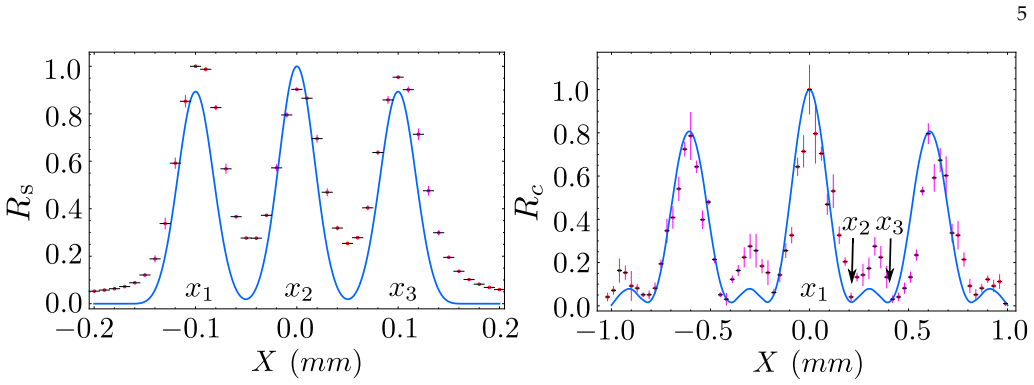
The paper's claim is that entanglement in pure bipartite qutrit states is not only certifiable but directly readable from a few correlation measurements. For any state written in Schmidt form, the Pearson correlation coefficient for the generalized $\sigma_x$ observable on both sides is exactly the negativity: $|C_{A_1B_1}|=N$, with $N=c_0c_1+c_0c_2+c_1c_2$. Measuring $\sigma_x$ on one side and its complex conjugate on the other gives mutual predictability $C=\frac{1}{3}(1+2N)$, and measuring in the computational basis gives mutual information $I_{AB}=-\sum_i c_i^2\log_2 c_i^2$, which is exactly the entanglement of formation. The experiment records these correlations for pump-beam-modulated spontaneous parametric down-conversion, certifies entanglement through focal-plane interference, and reports three consistent values ($N=0.848\pm0.027$ from PCC, $N=0.849\pm0.020$ from MP, $EOF=1.233\pm0.012$), demonstrating the first experimental non-equivalence of the two measures across dimensions.
Load-bearing premise
The entire quantitative bridge assumes the prepared pair is a pure bipartite qutrit state; if the actual state is noticeably mixed, the measured correlation coefficients no longer equal negativity and entanglement of formation, and the reported numbers inherit an unquantified error.
Editorial extensions
If this is right
- Pure qutrit entanglement can be quantified from a small set of coincidence measurements, avoiding the full tomographic reconstruction that scales poorly with dimension.
- The generalized $\sigma_x$ correlation measurement, the conjugate-basis predictability measurement, and the computational-basis mutual-information measurement each give a certified entanglement value, with the two negativity routes agreeing within error.
- Negativity and entanglement of formation are not equivalent reporters of qutrit entanglement: they place the prepared state at roughly 15% and 24% deviation from maximal entanglement, so claims about the quality of a high-dimensional state should specify which measure is being used.
- The mutual-information/EOF identity is derived for any pure qudit dimension, so the same correlation-measurement approach can be carried to higher-dimensional spatial-bin systems without a new theoretical derivation for EOF.
Reading between the lines
- A direct tomographic reconstruction of the same source, compared with the correlation-derived numbers, would settle how much residual mixedness biases the pure-state formulas; the paper does not itself run that test.
- The identity $|C_{A_1B_1}|=N$ suggests a generic recipe: any platform with access to a Fourier-type basis, whether time-bin, orbital angular momentum, or frequency, could use the same Pearson-correlation measurement as an entanglement meter for pure qudits.
- The observed non-equivalence between negativity and EOF implies that resource-theoretic claims for high-dimensional protocols should be measure-specific; a state that looks closer to maximal under one measure may look farther under the other.
- Tuning the slit parameters to vary the Schmidt coefficients would allow a direct experimental scan of the predicted non-monotonic relationship between $N$ and EOF, connecting the demonstration to the theoretical analysis in the appendix.
Signed reviews
Editorial analysis
A structured set of objections, weighed in public.
Referee Report
Summary. The manuscript claims three advances: analytical relations between statistical correlation measures and entanglement measures for pure bipartite qutrits, their experimental use to quantify entanglement in spatially correlated photonic qutrits, and the first experimental demonstration of non-equivalence between entanglement measures in higher dimensions. The central theoretical relations are Eq. (8), |C_A1B1| = N, where the Pearson correlation coefficient in a generalized sigma-x basis equals negativity; Eq. (11), relating mutual predictability to negativity; and Eqs. (14)-(15), identifying mutual information in the computational basis with entanglement of formation for pure states. The experiment uses a triple-slit modulated SPDC source, measures correlation matrices in image and focal planes, and reports N = 0.848 +/- 0.027 from PCC, N = 0.849 +/- 0.020 from MP, and EOF = 1.23 +/- 0.01. From these values the paper infers ~15% and ~24% deviations from the maximally entangled state and claims a non-equivalence of entanglement measures.
Significance. If the theoretical and experimental claims were fully established, the paper would be a useful contribution: it gives compact, analytic pure-state relations connecting directly measurable correlation statistics to negativity and entanglement of formation, and it applies them to a scalable spatial-bin qutrit source. The theoretical derivations for pure states are sound, and the Appendix material on monotonicity and non-equivalence is a strength. The paper is also careful to present representative correlation matrices and to report uncertainties from repeated measurements. However, the experimental conclusions rest on a pure-state assumption that is not directly verified and appears to be contradicted by the measured matrices; the EOF extraction is particularly problematic. The significance of the experimental demonstration is therefore conditional on a reanalysis or additional state characterization.
major comments (3)
- [Experimental scheme, Table I (right)] The measured focal-plane correlation matrix does not satisfy the symmetry required by Eq. (8) for a pure Schmidt state. For such a state, the generalized sigma-x joint probabilities depend only on (j+k) mod 3, so the equalities P11 = P23 = P32, P12 = P21 = P33, and P13 = P31 = P22 must hold. In the representative matrix these are violated by much more than Poisson counting uncertainties: for example, P11 = 0.344, P23 = 0.260, and P32 = 0.302, a spread of 0.084; likewise P12 = 0.017, P21 = 0.008, and P33 = 0.017. This is direct evidence that either the state is mixed or the effective measurement basis deviates from the ideal generalized sigma-x basis. In either case, identifying the measured PCC with the negativity through Eq. (8) is not justified as presented. The authors should provide a quantitative purity estimate, a calibration of the implemented measurement operators, or an error analysis showing that the symmetry violations are within the expected tolerance.
- [Relating Mutual Information with Entanglement of Formation; Experimental scheme] The reported EOF value of 1.23 is not supported by the measured data as presented. Equation (14) equates mutual information with EOF only when the joint probabilities in the computational basis are exactly diagonal, p(ab) = c_i^2 delta_{ab}. The image-plane matrix in Table I (left) is not diagonal: off-diagonal entries such as 0.024, 0.014, 0.006, and 0.002 are nonzero and comparable to a few percent of the diagonal entries. Computing the classical mutual information from the full noisy joint distribution gives a number that is not an entanglement measure. Indeed, evaluating EOF from the diagonal entries alone gives approximately 1.56, whereas the reported 1.23 is close to the mutual information of the full image-plane matrix. The text is also ambiguous about whether the MI was computed from the image-plane or focal-plane data, because x1, x2, x3 and y1, y2, y3 were previously defined for the sigma-x basis. The authors need to specify the exact input matrix, justify why the non-diagonal terms can be ignored or corrected, and either provide a valid EOF estimate or withdraw the EOF-based non-equivalence claim.
- [Experimental scheme; Consistency check of purity] The pure-state assumption is not adequately supported. The consistency between N from PCC and N from MP is presented as a purity check, but both quantities are extracted from the same focal-plane correlation matrix (the MP uses three entries of the same matrix that enters the PCC computation), so the agreement does not independently certify purity. The 94% visibility of the coincidence interference is a coherence indicator but not a direct estimate of the qutrit-state purity; it does not rule out the mixedness or measurement-basis errors implied by the symmetry violations in Table I. A direct purity estimate, such as a partial or full quantum state tomography or a fidelity bound, is needed before Eqs. (8) and (14) can be applied to the experimental data.
minor comments (5)
- [Eq. (8) and eigenvalue assignment] The derivation of Eq. (8) does not specify the numerical eigenvalues of the observables; later the text says eigenvalues 0, 1, and -1 are assigned. Please state explicitly that Eq. (8) holds for this particular eigenvalue assignment, since a different assignment (e.g., a different affine choice) would change the relation between PCC and negativity.
- [Mutual Predictability definitions] Appendix A derives the mutual predictability for sigma-x on both sides as 1/3, while the main text uses sigma-x on one side and its complex conjugate on the other to obtain Eq. (11). This distinction is easy to miss and should be highlighted in the main text to avoid confusion, especially because the experimental MP sum uses the off-diagonal x2-y3 and x3-y2 elements.
- [Table I] The correlation matrices in Table I are given without element-wise uncertainties or the normalization convention (e.g., whether rows, columns, or the total are normalized to unity). Providing these details would help the reader assess whether the symmetry violations in the focal-plane matrix are statistically significant.
- [Non-equivalence discussion] The comparison of percentage deviations, Q_E and Q_N, depends on the different scales and normalizations of the two measures (log2(3) versus 1). The authors should discuss whether the quoted non-equivalence is a statement about the chosen normalization or about the more substantive non-monotonicity illustrated in Appendix C.
- [Appendix C, Eq. (43)] There are typographical issues in the derivative formulas, such as the notation 'w.r.tc0' and the placement of logarithms, which should be cleaned up for readability.
Circularity Check
No circular derivation chain: the PCC-negativity, MP-negativity, and MI-EOF relations are analytically derived identities, and the experimental values are inputs to those identities rather than fitted targets.
full rationale
The central theoretical relations are derived from the Schmidt decomposition of a pure bipartite qutrit state and standard definitions. Equation (8) follows by direct evaluation of the Pearson coefficient with eigenvalues (0,1,-1) against the negativity of the Schmidt state; Eq. (11) is obtained by summing the joint probabilities in the generalized sigma-x and conjugate bases and using N = sum_{i<j} c_i c_j; Eqs. (14)-(15) identify the Shannon entropy of the squared Schmidt coefficients with both the mutual information in the computational basis and the entanglement of formation. None of these steps fits a parameter to the target value; the measured PCC, MP, and MI are inserted into already-derived formulas, so the reported N and EOF are not equal to the inputs by construction. The paper explicitly acknowledges the pure-state assumption and uses the agreement between N from PCC and MP as a consistency check, which is a stated limitation of the experimental analysis rather than a circular argument. The self-citations (refs. 37, 52, 54) provide background, an accompanying mixed-state study, and a two-qubit comparison; the load-bearing mathematical steps are shown in the appendices or are standard (the generalized sigma-x basis is also cited to Scarani et al. and Spengler et al.), so the self-citations are not load-bearing. Potential experimental concerns, such as the purity of the generated state or the use of the sigma-x correlation matrix for the MI-EOF evaluation, are correctness risks and do not amount to circularity.
Assumptions & free parameters
assumptions (4)
- domain assumption The experimentally generated state is a pure bipartite qutrit state.
- domain assumption The focal-plane detector positions map exactly to the generalized sigma-x eigenstates of Eqs (4)-(6).
- standard math Standard definitions of negativity and entanglement of formation for pure bipartite states.
- standard math The generalized sigma-x basis is mutually unbiased with the computational basis.
Cite this review
Pith. "Pith review of Entanglement certification and quantification in spatial-bin photonic qutrits." pith.science (2026). https://pith.science/paper/DTC57XHJ
@misc{pith2026190901367,
  author       = {Pith},
  title        = {Pith review of: Entanglement certification and quantification in spatial-bin photonic qutrits},
  year         = {2026},
  howpublished = {\url{https://pith.science/paper/DTC57XHJ}},
  note         = {Machine review of arXiv:1909.01367}
}
read the original abstract
Higher dimensional quantum systems are an important avenue for new explorations in quantum computing as well as quantum communications. One of the ubiquitous resources in quantum technologies is entanglement. However, so far, entanglement has been certified in higher dimensional systems through suitable bounds on known entanglement measures. In this work, we have, for the first time, quantified the amount of entanglement in bi-partite pure qutrit states by analytically relating statistical correlation measures and known measures of entanglement, and have determined the amount of entanglement in our experimentally generated spatially correlated bi-partite qutrit system. We obtain the value of Negativity in our bi-partite qutrit to be 0.85 +/- 0.03 and the Entanglement of Formation(EOF) to be 1.23 +/- 0.01. In terms of quantifying the deviation from the maximally entangled state, the Negativity value demonstrates ~15 % deviation while the EOF value demonstrates ~24 % deviation. This serves as the first experimental evidence of such non-equivalence of entanglement measures for higher dimensional systems.
Figures


Reference graph
Works this paper leans on
-
[1]
E. Schrodinger, Mathematical Proceedings of the Cam- bridge Philosophical Society 31, 555 (1935), ISSN 1469- 8064, URL http://journals.cambridge.org/article_ S0305004100013554
work page 1935
-
[2]
J. S. Bell, Physics 1, 195 (1964)
1964
-
[3]
C. H. Bennett and S. J. Wiesner, Phys. Rev. Lett. 69, 2881 (1992), URL https://link.aps.org/doi/10.1103/ PhysRevLett.69.2881
1992
-
[4]
D. Deutsch, Proc. Roy. Soc. A 400, 97 (1985), ISSN 0080- 4630, URL http://rspa.royalsocietypublishing.org/ content/400/1818/97
work page 1985
-
[5]
C. H. Bennett, G. Brassard, C. Cr ´epeau, R. Jozsa, A. Peres, and W. K. Wootters, Phys. Rev. Lett. 70, 1895 (1993), URL https://link.aps.org/doi/10.1103/ PhysRevLett.70.1895
1993
-
[6]
Jozsa and N
R. Jozsa and N. Linden, Proc. Roy. Soc. A 459, 2011 (2003), ISSN 1364-5021, URL http://rspa. royalsocietypublishing.org/content/459/2036/ 2011
2003
-
[7]
A. K. Ekert, Phys. Rev. Lett. 67, 661 (1991), URL https: //link.aps.org/doi/10.1103/PhysRevLett.67.661
-
[8]
A. Ac ´ın, N. Brunner, N. Gisin, S. Massar, S. Pironio, and V . Scarani, Phys. Rev. Lett. 98, 230501 (2007), URL https://link.aps.org/doi/10.1103/PhysRevLett.98. 230501
Show all 69 references
-
[9]
Brukner, M
C. Brukner, M. ˙Zukowski, J.-W. Pan, and A. Zeilinger, Phys. Rev. Lett. 92, 127901 (2004), URL https://link. aps.org/doi/10.1103/PhysRevLett.92.127901
2004 doi
-
[10]
Buhrman, R
H. Buhrman, R. Cleve, S. Massar, and R. de Wolf, Rev. Mod. Phys. 82, 665 (2010), URL https://link.aps.org/ doi/10.1103/RevModPhys.82.665
2010 doi
-
[11]
Pironio, A
S. Pironio, A. Acin, S. Massar, A. B. de la Giroday, D. N. Matsukevich, P . Maunz, S. Olmschenk, D. Hayes, L. Luo, T. A. Manning, et al., Nat Phys 464, 1021 (2010)
2010
-
[12]
Nieto-Silleras, S
O. Nieto-Silleras, S. Pironio, and J. Silman, New Journal of Physics 16, 013035 (2014), URL http://stacks.iop.org/ 1367-2630/16/i=1/a=013035
2014
-
[13]
C. H. Bennett, P . W. Shor, J. A. Smolin, and A. V . Thapliyal, Phys. Rev. Lett. 83, 3081 (1999), URL https://link.aps. org/doi/10.1103/PhysRevLett.83.3081
1999 doi
-
[14]
Wang, F.-G
C. Wang, F.-G. Deng, Y.-S. Li, X.-S. Liu, and G. L. Long, Phys. Rev. A 71, 044305 (2005), URL https://link.aps. org/doi/10.1103/PhysRevA.71.044305
2005 doi
-
[15]
Bechmann-Pasquinucci and W
H. Bechmann-Pasquinucci and W. Tittel, Phys. Rev. A 61, 062308 (2000), URL https://link.aps.org/doi/10. 1103/PhysRevA.61.062308
2000
-
[16]
N. J. Cerf, M. Bourennane, A. Karlsson, and N. Gisin, Phys. Rev. Lett. 88, 127902 (2002), URL https://link. aps.org/doi/10.1103/PhysRevLett.88.127902
2002 doi
-
[17]
D. Bruß, M. Christandl, A. Ekert, B.-G. Englert, D. Kas- zlikowski, and C. Macchiavello, Phys. Rev. Lett. 91, 097901 (2003), URL https://link.aps.org/doi/10. 1103/PhysRevLett.91.097901
2003
-
[18]
Sheridan and V
L. Sheridan and V . Scarani, Phys. Rev. A82, 030301 (2010), URL https://link.aps.org/doi/10.1103/PhysRevA. 82.030301
2010 doi
-
[19]
V ´ertesi, S
T. V ´ertesi, S. Pironio, and N. Brunner, Phys. Rev. Lett. 104, 060401 (2010), URL https://link.aps.org/doi/10. 1103/PhysRevLett.104.060401
2010
-
[20]
L. M. Ioannou, Quantum Information and Computation 7, 335 (2007)
2007
-
[21]
Tonolini, S
F. Tonolini, S. Chan, M. Agnew, A. Lindsay, and J. Leach, Sci. Rep 4, 6542 (2014)
2014
-
[22]
Giovannini, J
D. Giovannini, J. Romero, J. Leach, A. Dudley, A. Forbes, and M. J. Padgett, Phys. Rev. Lett.110, 143601 (2013), URL https://link.aps.org/doi/10.1103/PhysRevLett. 110.143601
2013 doi
-
[23]
G. A. Howland, S. H. Knarr, J. Schneeloch, D. J. Lum, and J. C. Howell, Phys. Rev. X 6, 021018 (2016), URL https: //link.aps.org/doi/10.1103/PhysRevX.6.021018
2016 doi
-
[24]
M. H. Paul Erker, Mario Krenn, Quantum 1, 22 (2017), URL https://doi.org/10.22331/q-2017-07-28-22
2017 doi
-
[25]
Shahandeh, J
F. Shahandeh, J. Sperling, and W. Vogel, Phys. Rev. A 88, 062323 (2013), URL https://link.aps.org/doi/10. 1103/PhysRevA.88.062323
2013
-
[26]
Shahandeh, J
F. Shahandeh, J. Sperling, and W. Vogel, Phys. Rev. Lett. 113, 260502 (2014), URL https://link.aps.org/doi/10. 1103/PhysRevLett.113.260502
2014
-
[27]
Shahandeh, M
F. Shahandeh, M. J. W. Hall, and T. C. Ralph, Phys. Rev. Lett. 118, 150505 (2017), URL https://link.aps.org/ doi/10.1103/PhysRevLett.118.150505
2017 doi
-
[28]
ˇSupi´c, P
I. ˇSupi´c, P . Skrzypczyk, and D. Cavalcanti, Phys. Rev. A 95, 042340 (2017), URL https://link.aps.org/doi/10. 1103/PhysRevA.95.042340. 7
2017
-
[29]
Tiranov, S
A. Tiranov, S. Designolle, E. Z. Cruzeiro, J. Lavoie, N. Brunner, M. Afzelius, M. Huber, and N. Gisin, Phys. Rev. A 96, 040303 (2017), URL https://link.aps.org/ doi/10.1103/PhysRevA.96.040303
2017 doi
-
[30]
Martin, T
A. Martin, T. Guerreiro, A. Tiranov, S. Designolle, F. Fr ¨owis, N. Brunner, M. Huber, and N. Gisin, Phys. Rev. Lett. 118, 110501 (2017), URL https://link.aps. org/doi/10.1103/PhysRevLett.118.110501
2017 doi
-
[31]
Bavaresco, H
J. Bavaresco, H. V . Natalia, C. Klckl, M. Pivoluska, N. Friis, M. Malik, and M. Huber (????), 1709.07344
-
[32]
Schneeloch and G
J. Schneeloch and G. A. Howland, Phys. Rev. A 97, 042338 (2018), URL https://link.aps.org/doi/10. 1103/PhysRevA.97.042338
2018
-
[33]
S. M. Roy, Phys. Rev. Lett. 94, 010402 (2005), URL https://link.aps.org/doi/10.1103/PhysRevLett.94. 010402
2005 doi
-
[34]
Datta, P
C. Datta, P . Agrawal, and S. K. Choudhary, Phys. Rev. A 95, 042323 (2017), URL https://link.aps.org/doi/10. 1103/PhysRevA.95.042323
2017
-
[35]
Huang, L
Z. Huang, L. Maccone, A. Karim, C. Macchiavello, R. J. Chapman, and A. Peruzzo, Sci. Rep 6, 27637 (2016)
2016
-
[36]
Maccone, D
L. Maccone, D. Bruß, and C. Macchiavello, Phys. Rev. Lett. 114, 130401 (2015), URL https://link.aps.org/doi/10. 1103/PhysRevLett.114.130401
2015
-
[37]
Jebarathinam, D
C. Jebarathinam, D. Home, and U. Sinha, Accompanying paper (2019)
2019
-
[38]
B. C. Hiesmayr, M. J. A. de Dood, and W. L ¨offler, Phys. Rev. Lett. 116, 073601 (2016), URL https://link.aps. org/doi/10.1103/PhysRevLett.116.073601
2016 doi
-
[39]
Palacios, R
S. Palacios, R. de J. Le ´on-Montiel, M. Hendrych, A. Valencia, and J. P . Torres, Opt. Express 19, 14108 (2011), URL http://www.opticsexpress.org/abstract. cfm?URI=oe-19-15-14108
2011
-
[40]
Fickler, G
R. Fickler, G. Campbell, B. Buchler, P . K. Lam, and A. Zeilinger, Proceedings of the National Academy of Sciences 113, 13642 (2016), ISSN 0027-8424, https://www.pnas.org/content/113/48/13642.full.pdf, URL https://www.pnas.org/content/113/48/13642
2016
-
[41]
W. H. Peeters, E. J. K. Verstegen, and M. P . van Exter, Phys. Rev. A 76, 042302 (2007), URL https://link.aps.org/ doi/10.1103/PhysRevA.76.042302
2007 doi
-
[42]
S. P . Walborn, A. N. de Oliveira, R. S. Thebaldi, and C. H. Monken, Phys. Rev. A 69, 023811 (2004), URL https:// link.aps.org/doi/10.1103/PhysRevA.69.023811
2004 doi
-
[43]
Taguchi, T
G. Taguchi, T. Dougakiuchi, N. Yoshimoto, K. Kasai, M. Iinuma, H. F. Hofmann, and Y. Kadoya, Phys. Rev. A 78, 012307 (2008), URL https://link.aps.org/doi/10. 1103/PhysRevA.78.012307
2008
-
[44]
W. H. Peeters, J. J. Renema, and M. P . van Exter, Phys. Rev. A 79, 043817 (2009), URL https://link.aps.org/ doi/10.1103/PhysRevA.79.043817
2009 doi
-
[45]
Taguchi, T
G. Taguchi, T. Dougakiuchi, M. Iinuma, H. F. Hofmann, and Y. Kadoya, Phys. Rev. A 80, 062102 (2009), URL https://link.aps.org/doi/10.1103/PhysRevA.80. 062102
2009 doi
-
[46]
Neves, G
L. Neves, G. Lima, J. G. Aguirre G ´omez, C. H. Monken, C. Saavedra, and S. P ´adua, Phys. Rev. Lett. 94, 100501 (2005), URL https://link.aps.org/doi/10. 1103/PhysRevLett.94.100501
2005
-
[47]
C. H. Monken, P . H. S. Ribeiro, and S. P ´adua, Phys. Rev. A 57, 3123 (1998), URL https://link.aps.org/doi/10. 1103/PhysRevA.57.3123
1998
-
[48]
Neves, S
L. Neves, S. P ´adua, and C. Saavedra, Phys. Rev. A 69, 042305 (2004), URL https://link.aps.org/doi/10. 1103/PhysRevA.69.042305
2004
-
[49]
M. A. M. Versteegh, M. E. Reimer, A. A. van den Berg, G. Juska, V . Dimastrodonato, A. Gocalinska, E. Pelucchi, and V . Zwiller, Phys. Rev. A92, 033802 (2015), URLhttps: //link.aps.org/doi/10.1103/PhysRevA.92.033802
2015 doi
-
[50]
Marcikic, H
I. Marcikic, H. de Riedmatten, W. Tittel, H. Zbinden, M. Legr ´e, and N. Gisin, Phys. Rev. Lett. 93, 180502 (2004), URL https://link.aps.org/doi/10.1103/ PhysRevLett.93.180502
2004
-
[51]
R. T. Thew, S. Tanzilli, W. Tittel, H. Zbinden, and N. Gisin, Phys. Rev. A 66, 062304 (2002), URL https://link.aps. org/doi/10.1103/PhysRevA.66.062304
2002 doi
-
[52]
Ghosh, T
D. Ghosh, T. Jennewein, P . Kolenderski, and U. Sinha, OSA Continuum 1, 996 (2018), URL http://www.osapublishing.org/osac/abstract. cfm?URI=osac-1-3-996
2018
-
[53]
Kolenderski, U
P . Kolenderski, U. Sinha, L. Youning, T. Zhao, M. Volpini, A. Cabello, R. Laflamme, and T. Jennewein, Phys. Rev. A 86, 012321 (2012), URL https://link.aps.org/doi/10. 1103/PhysRevA.86.012321
2012
-
[54]
Singh, I
A. Singh, I. Ahamed, D. Home, and U. Sinha, arXiv e- prints arXiv:1907.09268 (2019), 1907.09268
2019 arXiv
-
[55]
Miranowicz and A
A. Miranowicz and A. Grudka, Phys. Rev. A 70, 032326 (2004), URL https://link.aps.org/doi/10. 1103/PhysRevA.70.032326
2004
-
[56]
Chattopadhyay and D
I. Chattopadhyay and D. Sarkar, Quantum Information Processing 7, 243 (2008), ISSN 1573-1332, URL https: //doi.org/10.1007/s11128-008-0085-6
2008 doi
-
[57]
Erol, AIP Conference Proceedings1653, 020037 (2015)
V . Erol, AIP Conference Proceedings1653, 020037 (2015)
2015
-
[58]
Bellomo, G
B. Bellomo, G. L. Giorgi, G. M. Palma, and R. Zambrini, Phys. Rev. A 95, 043807 (2017), URL https://link.aps. org/doi/10.1103/PhysRevA.95.043807
2017 doi
-
[59]
Boccaletti, J
S. Boccaletti, J. Kurths, G. Osipov, D. Valladares, and C. Zhou, Physics Reports 366, 1 (2002), ISSN 0370-1573
2002
-
[60]
Scarani, N
V . Scarani, N. Gisin, N. Brunner, L. Masanes, S. Pino, and A. Ac´ın, Phys. Rev. A 74, 042339 (2006), URL https:// link.aps.org/doi/10.1103/PhysRevA.74.042339
2006 doi
-
[61]
Spengler, M
C. Spengler, M. Huber, S. Brierley, T. Adaktylos, and B. C. Hiesmayr, Phys. Rev. A 86, 022311 (2012), URL https:// link.aps.org/doi/10.1103/PhysRevA.86.022311
2012 doi
-
[62]
Eltschka, G
C. Eltschka, G. T ´oth, and J. Siewert, Phys. Rev. A 91, 032327 (2015), URL https://link.aps.org/doi/10. 1103/PhysRevA.91.032327
2015
-
[63]
Zhang, A
L. Zhang, A. K. Pati, and J. Wu, Phys. Rev. A 92, 022316 (2015), URL https://link.aps.org/doi/10. 1103/PhysRevA.92.022316
2015
-
[64]
Sj ¨oqvist, A
E. Sj ¨oqvist, A. K. Pati, A. Ekert, J. S. Anandan, M. Er- icsson, D. K. L. Oi, and V . Vedral, Phys. Rev. Lett. 85, 2845 (2000), URL https://link.aps.org/doi/10.1103/ PhysRevLett.85.2845. Appendices A. Mutual Predictability when generalized σx observable is measured on both s...
2000
-
[65]
(43) Similarly, rate of change ofE w.r.tc1 dE dc1 = (2/ln(2))c1log 2(1− (c2 0 + c2 1))/c2
-
[66]
(44) Rate of change ofN w.r.tc0 dN dc0 = c1 + (1− c0c1− c2 1− 2c2 0)/ √ 1− (c2 0 + c2
-
[67]
(45) Similarly, rate of change ofN w.r.tc1 dN dc1 = c0 + (1− c0c1− c2 0− 2c2 1)/ √ 1− (c2 0 + c2
-
[68]
(43),(44),(45),(46) it can be seen that for a given c0 (c1),E andN grow with c0 (c1), reach a certain value and then start decreasing w.r.t c0 ( c1)
(46) Observations: • From Eqs. (43),(44),(45),(46) it can be seen that for a given c0 (c1),E andN grow with c0 (c1), reach a certain value and then start decreasing w.r.t c0 ( c1). All the above four Eqs.(43),(44),(45),(46) vanish when c0 = c1 = 1/ √ 3 • As in the case of two ...
-
[69]
For example, consider a pair of two qutrit pure states with Schmidt coefficients c0 = 0.4 , c1 = 0.9 & c0 = 0.5 , c1 = 0.1
This explains the presence of non-monotonic nature between these two param- eters. For example, consider a pair of two qutrit pure states with Schmidt coefficients c0 = 0.4 , c1 = 0.9 & c0 = 0.5 , c1 = 0.1. Former state has, E1 = 0.8879 & N1 = 0.5661 whereas the latter state ha...
2010
Reviewed August 14, 2026 · model on record in the stance chip above.
Discussion (0). Continue with ORCID to comment.