REVIEW 3 minor 19 references
Low cost, easily manufactured, highly flexible strain and touch sensitive fiber for robotics applications
T0 review · 0 major / 3 minor · reviewed 2026-06-27 · grok-4.3
Pith's one-line read A conductive fiber made from cheap thread and tubing functions as both strain and touch sensor for robots.
desk verdict Simple COTS fiber sensor for strain and touch with robot demos; practical recipe but thin on repeatability data. read the letter →
The pith
A machine-rendered reading of the paper's core claim, the machinery that carries it, and where it could break.
The reading
What carries the argument
The conductive fiber formed by threading conductive thread through silicone tubing, which changes resistance under mechanical stretch for strain sensing and supports capacitance changes for touch sensing when knitted.
What would settle it
Repeated trials in which the fiber's resistance fails to change predictably with applied strain or its capacitive signal fails to trigger the described robot arm actions would show the sensors do not perform as claimed.
Extended reading notes
Core claim
The authors create a conductive fiber by inserting conductive thread into silicone tubing with a loop-style needle threader and show that its resistance varies with strain while its capacitance supports touch and proximity detection, enabling five robotic applications plus knitting and repair without specialized equipment.
Load-bearing premise
The assembly process using conductive thread, silicone tubing, and a basic needle threader produces sensors whose electrical behavior remains consistent and functional across the shown robotic uses.
Editorial extensions
If this is right
- Robotic assistive fingers can use the fiber to trigger grasps based on detected strain.
- Pneumatically actuated straps and flexible solids can have their poses estimated from the fiber's resistance changes.
- Commercial robot arms can respond to touch commands and follow nearby hand motion via the fiber's capacitive mode.
- Knitted versions of the fiber maintain flexibility while serving as touch sensors.
- Cut fibers can be repaired to restore sensing function.
Reading between the lines
- The low material and time cost could allow faster iteration when adding sensing to new soft robot designs.
- Embedding multiple fibers in larger fabric structures might create distributed sensing surfaces on robots or wearables.
- The same fiber could be tested in non-robotic settings such as medical monitoring bands where flexibility and low cost matter.
Editorial analysis
A structured set of objections, weighed in public.
Referee Report
Summary. The manuscript presents a low-cost conductive fiber sensor fabricated from commercial off-the-shelf conductive thread ($0.07/ft) and silicone tubing ($0.94/ft) using a simple needle threader, with a 20 cm length manufacturable in 2 minutes. It experimentally characterizes the fiber for use as a resistive strain sensor and as a capacitive touch/near-field sensor, demonstrating applications including grasp triggering in a pneumatic assistive finger, pose sensing in a pneumatic robotic strap and flexible solid, touch-triggered motion on a commercial robot arm, and hand-following via near-field sensing with knitted capacitive versions. The work also addresses manufacturing scalability trade-offs and a repair method for cut fibers.
Significance. If the experimental results and manufacturing consistency hold, the work is significant for lowering barriers to sensor integration in soft robotics and assistive devices through its emphasis on inexpensive COTS materials, minimal tooling, and rapid fabrication. The multi-application demonstrations illustrate practical versatility without specialized equipment, and the knitting demonstration for capacitive sensing underscores the fiber's flexibility. The experimental focus with proof-of-concept robotic integrations, rather than high-precision metrology, aligns well with the accessibility goals and provides a reproducible starting point for the community.
minor comments (3)
- The abstract and introduction would benefit from a brief quantitative comparison (e.g., cost, fabrication time, or performance metrics) against one or two representative existing fiber sensors to strengthen the 'low cost' and 'easily manufactured' claims.
- In the application sections, clarify whether the resistive or capacitive readings required per-device calibration or if the reported behaviors were obtained with a single set of parameters across demonstrations.
- The scalability discussion would be improved by including a simple table or list contrasting the current manual process with the proposed improvements in terms of time, cost, and consistency.
Simulated Author's Rebuttal
We thank the referee for the positive summary, significance assessment, and recommendation of minor revision. No major comments were listed in the report.
Circularity Check
No significant circularity; purely experimental work
full rationale
The paper is an experimental report on fabricating and characterizing a conductive fiber from COTS materials, with direct physical demonstrations in robotic applications. No mathematical derivations, predictions, fitted parameters, or uniqueness theorems appear; all claims rest on manufacturing descriptions and measured behaviors rather than any chain that reduces to self-defined inputs or self-citations. The work is therefore self-contained against external benchmarks.
Assumptions & free parameters
Cite this review
Pith. "Pith review of Low cost, easily manufactured, highly flexible strain and touch sensitive fiber for robotics applications." pith.science (2026). https://pith.science/paper/DTSDN52V
@misc{pith2026260613352,
  author       = {Pith},
  title        = {Pith review of: Low cost, easily manufactured, highly flexible strain and touch sensitive fiber for robotics applications},
  year         = {2026},
  howpublished = {\url{https://pith.science/paper/DTSDN52V}},
  note         = {Machine review of arXiv:2606.13352}
}
abstract
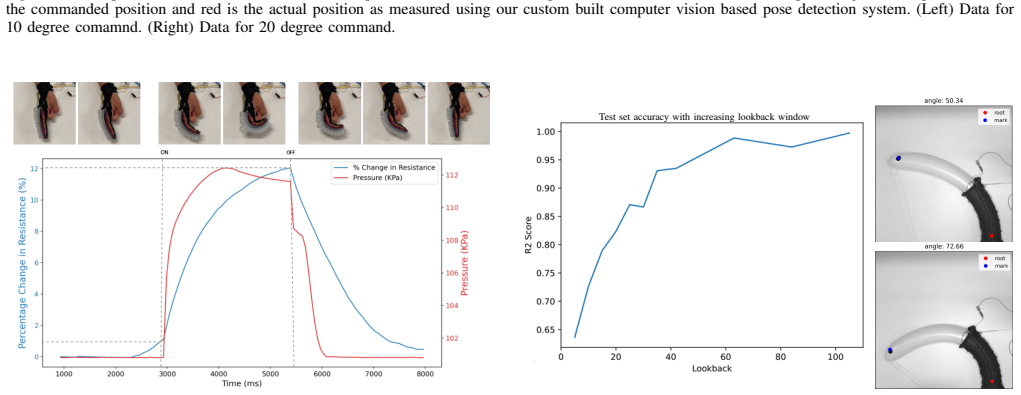
Existing stretch and touch sensors for robots are generally expensive with respect to at least one of material costs, required manufacturing equipment, or manufacturing time. We present and experimentally characterize a conductive fiber made using only inexpensive commercial off-the-shelf parts (conductive thread at $0.07/ft, silicone tubing at $0.94/ft) and tools (loop-style needle threader at $2), which can be manufactured quickly (20 cm length in 2 minutes.) We demonstrate its use as a resistive strain sensor with three applications: Triggering a grasp in a pneumatically actuated assistive finger, sensing the pose of a pneumatically actuated robotic strap, and estimating the pose of a flexible solid. We also demonstrate that it can be used as a capacitive sensor with two applications: First, as a touch sensor which triggers a commercial robot arm to move, and second, as a near-field sensor enabling the robot arm to follow a moving hand. The capacitive sensors are knitted, showcasing the high flexibility of the fiber. We discuss methods for improving manufacturing scalability and their cost trade-offs. Finally, we demonstrate a method for repairing a cut fiber.
Figures


Figures from the paper (7 more)




Reference graph
Works this paper leans on
-
[1]
Fabrication of a soft robotic gripper with integrated strain sensing elements using multi-material additive manufacturing,
A. Georgopoulou, B. Vanderborght, and F. Clemens, “Fabrication of a soft robotic gripper with integrated strain sensing elements using multi-material additive manufacturing,”Frontiers in Robotics and AI, vol. 8, p. 615991, 2021
2021
-
[2]
Advances in wearable strain sensors based on eletrospun fibers,
Z. Gao, X. Xiao, A. Di Carlo, J. Yin, Y . Wang, L. Huang, J. Tang, and J. Chen, “Advances in wearable strain sensors based on eletrospun fibers,”Advanced Functional Materials, Volume 33, Issue 18, 2023
2023
-
[3]
B. Xu, L. Zhong, G. Zhang, X. Liang, D. Virtue, R. Madan, and T. Bhattacharjee, “Cushsense: Soft, stretchable, and comfort- able tactile-sensing skin for physical human-robot interaction,”arXiv preprint arXiv:2405.03155, 2024
-
[4]
Multidimensional capacitive sensing for robot-assisted dressing and bathing,
Z. Erickson, H. M. Clever, V . Gangaram, G. Turk, C. K. Liu, and C. C. Kemp, “Multidimensional capacitive sensing for robot-assisted dressing and bathing,” in2019 IEEE 16th International Conference on Rehabilitation Robotics (ICORR), pp. 224–231, IEEE, 2019
2019
-
[5]
Wearable and stretchable strain sensors: Materials, sensing mechanisms, and applications,
H. Souri, H. Banerjee, A. Jusufi, N. Radacsi, A. A. Stokes, I. Park, M. Sitti, and M. Amjadi, “Wearable and stretchable strain sensors: Materials, sensing mechanisms, and applications,”Advanced Science Reviews, 2020
2020
-
[6]
Soft tactile sensing skins for robotics,
P. Roberts, M. Zadan, and C. Majidi, “Soft tactile sensing skins for robotics,”Current Robotics Reports, vol. 2, no. 3, pp. 343–354, 2021
2021
-
[7]
Robotsweater: Scalable, generalizable, and customizable machine-knitted tactile skins for robots,
Z. Si, T. C. Yu, K. Morozov, J. McCann, and W. Yuan, “Robotsweater: Scalable, generalizable, and customizable machine-knitted tactile skins for robots,”arXiv preprint arXiv:2303.02858, 2023
-
[8]
Wearable and stretchable strain sensors: materials, sensing mechanisms, and applications,
H. Souri, H. Banerjee, A. Jusufi, N. Radacsi, A. A. Stokes, I. Park, M. Sitti, and M. Amjadi, “Wearable and stretchable strain sensors: materials, sensing mechanisms, and applications,”Advanced Intelli- gent Systems, vol. 2, no. 8, p. 2000039, 2020
2020
Show all 19 references
-
[9]
Computational design of ulta-robust strain sensors for soft robot perception and autonomy,
H. Yang, S. Ding, J. Wang, S. Sun, R. Swaminathan, S. Wen, L. Ng, X. Pan, and G. W. Ho, “Computational design of ulta-robust strain sensors for soft robot perception and autonomy,”Nature Communica- tions 15, Article number: 1636, 2024
2024
-
[10]
Flexible strain sensors fabricated using carbon-based nanomaterials: A review,
T. Yan, Z. Wang, and Z.-J. Pan, “Flexible strain sensors fabricated using carbon-based nanomaterials: A review,”Current Opinion in Solid State and Materials Science, vol. 22, no. 6, pp. 213–228, 2018
2018
-
[11]
Controlling the fold: proprioceptive feedback in a soft origami robot,
N. Hanson, I. A. Mensah, S. F. Roberts, J. Healey, C. Wu, and K. L. Dorsey, “Controlling the fold: proprioceptive feedback in a soft origami robot,”Frontiers in Robotics and AI, vol. 11, p. 1396082, 2024
2024
-
[12]
Co- designing accessible computer and smartphone input using physical computing,
R. Cossovich, M. Chang, Z. Fu, A. Girouard, and S. Hodges, “Co- designing accessible computer and smartphone input using physical computing,”IEEE Pervasive Computing, 2024
2024
-
[13]
Clinical and maker perspectives on the design of assistive technology with rapid prototyping technologies,
M. Hofmann, J. Burke, J. Pearlman, G. Fiedler, A. Hess, J. Schull, S. E. Hudson, and J. Mankoff, “Clinical and maker perspectives on the design of assistive technology with rapid prototyping technologies,” in Proceedings of the 18th international ACM SIGACCESS conference on co...
2016
-
[14]
Hand spinning e-textile yarns: Understanding the craft practices of hand spinners and work- shop explorations with e-textile fibers and materials,
L. Jones, A. Awad, M. Koelle, and S. Nabil, “Hand spinning e-textile yarns: Understanding the craft practices of hand spinners and work- shop explorations with e-textile fibers and materials,” inProceedings of the 2024 ACM Designing Interactive Systems Conference, pp. 1–19, 2024
2024
-
[15]
Hierarchical architecture of active knits,
J. Abel, J. Luntz, and D. Brei, “Hierarchical architecture of active knits,”Smart materials and Structures, vol. 22, no. 12, p. 125001, 2013
2013
-
[16]
Towards a soft pneumatic glove for hand rehabilitation,
P. Polygerinos, S. Lyne, Z. Wang, L. F. Nicolini, B. Mosadegh, G. M. Whitesides, and C. J. Walsh, “Towards a soft pneumatic glove for hand rehabilitation,” in2013 IEEE/RSJ International Conference on Intelligent Robots and Systems, pp. 1512–1517, IEEE, 2013
2013
-
[17]
A high-strength, highly-flexible robotic strap for harnessing, lifting, and transferring humans,
K. Barhydt and H. H. Asada, “A high-strength, highly-flexible robotic strap for harnessing, lifting, and transferring humans,”IEEE Robotics and Automation Letters, vol. 8, no. 4, pp. 2110–2117, 2023
2023
-
[18]
Digital fabrication of soft actuated objects by machine knitting,
L. Albaugh, S. Hudson, and L. Yao, “Digital fabrication of soft actuated objects by machine knitting,” inProceedings of the 2019 CHI Conference on Human Factors in Computing Systems, pp. 1–13, 2019
2019
-
[19]
A soft strain sensor based on ionic and metal liquids,
J.-B. Chossat, Y .-L. Park, R. J. Wood, and V . Duchaine, “A soft strain sensor based on ionic and metal liquids,”Ieee sensors journal, vol. 13, no. 9, pp. 3405–3414, 2013
2013
Reviewed June 27, 2026 · model on record in the stance chip above.
Discussion (0). Sign in to comment.