REVIEW 3 major objections 5 minor 6 references
Beyond the Channel Capacity of BPSK Input
T0 review · 3 major / 5 minor · reviewed 2026-08-14 · deepseek-v4-flash
Pith's one-line read The paper claims that a four-symbol constellation formed by rotating BPSK, called double mapping modulation, reaches an achievable bit rate beyond the channel capacity of BPSK input.
desk verdict The paper's 'beyond BPSK capacity' claim collapses because the transmitted constellation is just QPSK and Eq. (5)'s additive mutual information decomposition is invalid; what remains is a modest, plausible BER gain from a relabeled QPSK with successive decoding. read the letter →
The pith
A machine-rendered reading of the paper's core claim, the machinery that carries it, and where it could break.
The reading
What carries the argument
The load-bearing object is DMM, defined by mapping each bit of the second stream to a rotation $\beta \in \{0, \pi/2\}$ of a BPSK point, so each transmitted symbol carries two bits: one in the sign of $x_1$ and one in the rotation. The Hamming-to-Euclidean mapping produces four points and lets the receiver separate the two streams in two stages: decode the rotation bit, de-rotate the stored signal, then decode the BPSK bit. The specific mechanism claimed to create the gain is Eq. (5), the additive decomposition of total mutual information into the two per-stream mutual informations. Since mutual information is a nonlinear function of signal-to-noise ratio, the decomposition turns the capacity question into a sum of two per-stream mutual informations, and the receiver's de-rotation step is what makes that additive form available.
What would settle it
Take the four-symbol DMM constellation at the SNRs of Fig. 2 and compute the true mutual information $I(V_1,V_2;Y)$ by numerical entropy estimation; then compare it with the sum in Eq. (5) and with the single-BPSK mutual-information curve. If the true value is no larger than BPSK's curve at any SNR, the claimed $-0.516$ dB surplus is not achievable; if the sum exceeds the true value, the decomposition itself is the reason for the apparent gain.
Extended reading notes
Core claim
The central claim is that double mapping modulation (DMM) raises the achievable bit rate of a BPSK-based system above the channel capacity of BPSK input. The first stream is mapped to ordinary BPSK symbols $x_1$; the second stream chooses a rotation angle $\beta = 0$ or $\beta = \pi/2$ applied to $x_1$, yielding the four-symbol constellation $s_1,\dots,s_4$ in the complex plane. At the receiver the rotation bit is decoded first, the stored signal is de-rotated to recover $x_1$, and then the BPSK bit is decoded. The paper replaces the single mutual information with the additive form $\tilde{I}_t = \tilde{I}_{x_1}(E_{x_1}/\sigma_N^2) + \tilde{I}_{x_2}(E_{x_2}/\sigma_N^2)$, and because both streams use the same symbol energy, the sum is claimed to be larger than the single-stream BPSK mutual information at the same SNR. Simulations of the two-stage receiver with LDPC codes show a BER gain over plain BPSK, and the paper's extension subtracts this gain from the 0.0045 dB coding gap, obtaining $G = 0.0045\,\mathrm{dB} - 0.52\,\mathrm{dB} = -0.516\,\mathrm{dB}$, which it reads as going beyond BPSK capacity.
Load-bearing premise
The whole argument depends on Eq. (5): the total mutual information of the two-stream signal is exactly the sum of the individual mutual informations computed at the same noise level, with no extra term for how much the first stream's bits depend on knowing the second stream's rotation.
Editorial extensions
If this is right
- With error-free recovery of the rotation bit, the first stream retains exactly BPSK's BER, so the second stream's information is a pure addition to the achievable rate.
- If the additive split in Eq. (5) holds, the design problem for a binary-input system becomes choosing two codes, one for each layer, with the total rate being the sum of their rates rather than the single-constellation capacity.
- The reported gain would close and cross the 0.0045 dB gap between LDPC-coded BPSK and the BPSK input channel capacity, placing the operating point in a region normally forbidden for BPSK.
- At the target spectral efficiency of 0.5 bit/s/Hz, the same LDPC code that serves the first stream can be kept, while the added rotation stream uses a lower-rate repeated code, giving a small positive energy-per-bit advantage over plain BPSK.
Reading between the lines
- The same construction could be layered: more than one rotation angle per BPSK point would add more streams, but each extra layer would inherit the estimation errors of the layers decoded before it.
- The paper uses one strong code on the first stream and a weaker repeated code on the rotation stream; a natural design search would optimize the rate split between the two layers, since spending too much rate on the rotation stream erodes the claimed net gain.
- If Eq. (5) is replaced by the exact chain rule, any gap between the two formulas would show whether the gain is a property of the constellation or a property of the additive decomposition; this is a direct numerical check the paper does not perform.
Signed reviews
Editorial analysis
A structured set of objections, weighed in public.
Referee Report
Summary. The paper proposes a 'double mapping modulation' (DMM) scheme in which two independent binary streams are combined into one complex symbol: the first stream determines the sign of x1 and the second selects a rotation angle β ∈ {0, π/2}. The receiver successively estimates the rotation to recover the second stream and then de-rotates to recover the first. The authors claim that the achievable bit rate is the sum of the two individual mutual informations (Eq. (5)), and they report a simulated gain of 0.052 dB (later 0.52 dB) over BPSK with LDPC codes. They then subtract this gain from the 0.0045 dB gap of a rate-1/2 LDPC code to BPSK capacity, obtaining a negative gap and concluding that the scheme operates beyond the BPSK channel capacity.
Significance. If the paper's central claim were correct, it would contradict the standard capacity formula for a fixed input alphabet, because the transmitted set {s1, s2, s3, s4} is exactly a QPSK constellation. The paper is clearly written and the simulation setup is described in enough detail to be reproducible in its essentials, but the information-theoretic argument rests on an incorrect additive decomposition of mutual information. The correct treatment shows that the DMM is QPSK with two bits per symbol; the observation that QPSK can exceed BPSK capacity at the same symbol energy is well known and does not require the proposed construction. The paper's quantitative extension is also invalid because it subtracts a simulated coding gain from a Shannon gap. The manuscript's central contribution is therefore not established.
major comments (3)
- [Section II, Eq. (5)] Equation (5) asserts that the overall mutual information is the sum of two separate mutual informations, I_x1(E_s/σ_N^2) + I_x2(E_s/σ_N^2). This is not the mutual information of the actual channel in Eq. (10), y = x1 e^{jβ} + n, which is a single observation corrupted by one noise term. The correct decomposition is the chain rule I(V1,V2;Y) = I(V2;Y) + I(V1;Y|V2), and the second term is not equal to the BPSK mutual information unless V2 is known perfectly. The signal set in Table I and Fig. 1 is the standard QPSK constellation, whose capacity is the relevant upper bound. Thus Eq. (5) double-counts the received signal and overestimates the achievable rate; the central premise of the paper is false.
- [Section III, paragraph beginning 'An extension is made'] The calculation G = 0.0045 dB − 0.52 dB = −0.516 dB is not a valid information-theoretic result. The 0.0045 dB quantity in [1] is the gap of a particular rate-1/2 LDPC code to the BPSK capacity at a particular operating point, and the simulated gain of the proposed scheme is a finite-length, finite-SNR coding gain. Subtracting these two numbers does not produce a bound on the gap to capacity. Furthermore, because the DMM alphabet is QPSK, the correct capacity to compare against is C_QPSK, so the conclusion that the scheme achieves a rate beyond BPSK capacity is an immediate consequence of using a two-bit-per-symbol constellation and does not follow from the proposed separation.
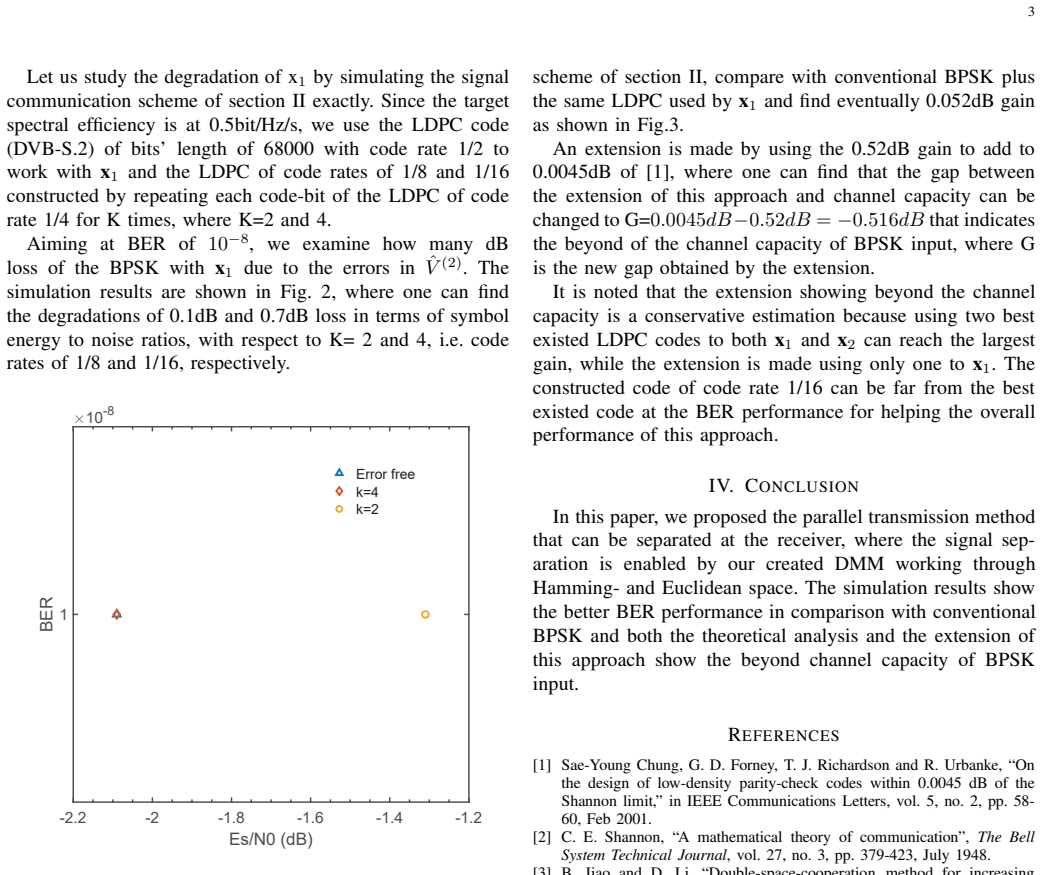
- [Section III, Fig. 3 and the following sentence] The manuscript reports a gain of '0.052dB' and then, in the next sentence, '0.52dB' for the same simulation. This order-of-magnitude inconsistency is not resolved, and the BER curves in Fig. 3 are shown without error bars or any statistical confidence measure. Since the extension in the following paragraph uses the 0.52 dB value, the numerical basis of the beyond-capacity claim is unreliable. The authors should clarify the correct value and provide confidence intervals or repeated trials.
minor comments (5)
- [Abstract] The first sentence uses 'The paper proposed' and 'the ABR's summation'; these should be 'This paper proposes' and 'the summation of the ABRs' for grammatical correctness and clarity.
- [Section III] The text uses 'infinitive length' and 'arbitrary small'; these should be 'infinite length' and 'arbitrarily small'.
- [Section III] 'Shannon theorem' should be 'Shannon's channel coding theorem' or 'the Shannon coding theorem'.
- [Table I] Table I is difficult to read; a standard table with columns for v(2), β, and the resulting symbol points would be much clearer.
- [Section III] The statement about the 'target spectral efficiency is at 0.5bit/Hz/s' is unclear because the DMM symbol carries two code bits; the overall spectral efficiency depends on the two code rates and should be explicitly computed.
Circularity Check
The beyond-capacity result is forced by the additive decomposition in Eq. (5) and by subtracting a simulated coding gain from a published capacity gap.
-
self definitional
[Section I, Eq. (5), and Section III, first paragraph]
"As such, instead of (2), the ABR of the system with these separated signals will be calculated using ˜I_t = ˜I_x1(E_x1/σ_N^2) + ˜I_x2(E_x2/σ_N^2) ... Then, the ABR contribution from x2 increases the overall ABR of the proposed method to a level beyond the channel capacity of conventional BPSK."
Eq. (5) defines the overall ABR as the sum of two unconditional BPSK mutual informations evaluated at the same full SNR. The actual channel, however, is one observation y = Γ_β x1 + n; the exact relation is the chain rule I(V1,V2;Y)=I(V2;Y)+I(V1;Y|V2), with the second term conditioned on V2 and not equal to the BPSK term used in the sum. Because the paper then concludes that the positive x2 term pushes the total beyond BPSK capacity, that conclusion is already contained in the defining additive decomposition: no independent calculation on the actual channel is performed. The 'beyond-capacity' result is therefore equivalent to the assumed input of Eq. (5).
-
fitted input called prediction
[Section III, paragraphs after Fig. 3]
"Then, we select the constructed LDPC of code rate 1/16 to x2 and the LDPC of code rate 1/2 to x1 to simulate the scheme of section II, compare with conventional BPSK plus the same LDPC used by x1 and find eventually 0.052dB gain as shown in Fig.3. An extension is made by using the 0.52dB gain to add to 0.0045dB of [1], where one can find that the gap between the extension of this approach and channel capacity can be changed to G=0.0045dB−0.52dB=−0.516dB that indicates the beyond of the channel capacity of BPSK input."
The 0.052 dB (elsewhere 0.52 dB) number is a simulated BER gain of one finite-length LDPC construction relative to another at BER 10^-8; it is not an information-theoretic capacity parameter. The 'extension' subtracts this simulated gain from the published 0.0045 dB capacity gap and declares G=-0.516 dB, i.e., beyond capacity. This makes the predicted beyond-capacity statistic the same as the fitted simulation gain, just algebraically rearranged. Without an argument that a finite-length coding gain adds linearly to a Shannon gap, the 'theoretical' extension is the simulation input renamed as a prediction, not a first-principles result.
full rationale
The paper's central claim that DMM exceeds BPSK capacity is not an independent information-theoretic result. The load-bearing step is Eq. (5), where the overall ABR is defined as I_x1(Es/N0)+I_x2(Es/N0) after imagining separate observations y1=x1+n and y2=x2+n. But the actual channel is a single observation y = Γ_β x1 + n, whose exact mutual information is governed by the chain rule I(V1,V2;Y)=I(V2;Y)+I(V1;Y|V2); the conditional term is not the unconditional BPSK mutual information at full SNR. With Eq. (5) accepted, 'beyond BPSK capacity' is immediate because a positive second term is added to a BPSK term, so the conclusion is contained in the defining equation rather than derived from the channel. The Section III 'extension' is similarly self-fed: a simulated finite-length LDPC gain (stated first as 0.052 dB, then as 0.52 dB) is subtracted from the Chung et al. 0.0045 dB capacity gap to obtain G=-0.516 dB. That operation treats the simulation's BER number as a capacity-gap reduction, so the 'theoretical beyond' is the fitted simulation gain renamed as a prediction. The non-circular parts—actual BER simulations against a particular BPSK LDPC code—show only a finite-length coding comparison and do not establish capacity. The self-citation [3] is not load-bearing. Overall the claimed derivation reduces to its own defining decomposition plus arithmetic on a simulated number.
Assumptions & free parameters
free parameters (2)
- Rate of the second-stream LDPC code =
1/16 (with 1/8 tested)
- Simulated coding gain used in the capacity extension =
0.52 dB (also written 0.052 dB in the text)
assumptions (3)
- ad hoc to paper The total mutual information of the separated signals is the sum of two individual mutual informations at the same SNR (Eq. 5).
- standard math Shannon's theorem guarantees a code making V2 error probability arbitrarily small, so the rotation angle beta can be treated as error-free.
- ad hoc to paper A simulated BER gain in dB can be subtracted from the 0.0045 dB gap to capacity to obtain the new gap.
Cite this review
Pith. "Pith review of Beyond the Channel Capacity of BPSK Input." pith.science (2026). https://pith.science/paper/DTTYAI64
@misc{pith2026190808836,
  author       = {Pith},
  title        = {Pith review of: Beyond the Channel Capacity of BPSK Input},
  year         = {2026},
  howpublished = {\url{https://pith.science/paper/DTTYAI64}},
  note         = {Machine review of arXiv:1908.08836}
}
read the original abstract
The paper proposed a method that organizes a parallel transmission of two signals to be separated from each other at receiver through Hamming- to Euclidean space, where the conventional problem of achievable bit rate (ABR) is converted to that of the ABR's summation with respect to the two separated signals. Actually, the mutual information is separated accordingly into two. Since the mutual information is non-linear function of signal power in general, the separation brings a chance for achieving higher ABR. The proposed work proceeds along the above thinking and achieves higher bit-error-rate (BER) performance in comparison with BPSK as shown in the simulations. Moreover, one can find theoretically beyond of channel capacity of BPSK input.
Figures


Reference graph
Works this paper leans on
-
[1]
Sae-Young Chung, G. D. Forney, T. J. Richardson and R. Urbanke, ``On the design of low-density parity-check codes within 0.0045 dB of the Shannon limit," in IEEE Communications Letters, vol. 5, no. 2, pp. 58-60, Feb 2001
work page 2001
-
[2]
C. E. Shannon, ``A mathematical theory of communication'', The Bell System Technical Journal, vol. 27, no. 3, pp. 379-423, July 1948
work page 1948
-
[3]
B. Jiao and D. Li, ``Double-space-cooperation method for increasing channel capacity'', China Communications, vol. 12, no. 12, pp. 76-83, Dec. 2015
work page 2015
-
[4]
D. P. Palomar and S. Verdú, ``Representation of Mutual Information Via Input Estimates'', IEEE Trans. Inform. Theory, vol. 53, no. 2, pp.453-470, 2007
work page 2007
-
[5]
Short Term Link Performance Modeling for ML Receivers with Mutual Information per Bit Metrics,
K. Sayana, J. Zhuang and K. Stewart, "Short Term Link Performance Modeling for ML Receivers with Mutual Information per Bit Metrics," IEEE GLOBECOM 2008 - 2008 IEEE Global Telecommunications Conference, New Orleans, LO, 2008, pp. 1-6
work page 2008
-
[6]
11em plus .33em minus .07em 4000 4000 100 4000 4000 500 `\.=1000 = #1 \@IEEEnotcompsoconly \@IEEEcompsoconly #1 * [1] 0pt [0pt][0pt] #1 * [1] 0pt [0pt][0pt] #1 * \| ** #1 \@IEEEauthorblockNstyle \@IEEEcompsocnotconfonly \@IEEEauthorblockAstyle \@IEEEcompsocnotconfonly \@IEEEcompsocconfonly \@IEEEauthordefaulttextstyle \@IEEEcompsocnotconfonly \@IEEEauthor...
Reviewed August 14, 2026 · model on record in the stance chip above.
Discussion (0). Continue with ORCID to comment.