REVIEW 4 major objections 5 minor 38 references
Candidate Captured Interstellar Objects in the Solar System
T0 review · 4 major / 5 minor · reviewed 2026-08-15 · deepseek-v4-flash
Pith's one-line read The paper argues that roughly ten interstellar planetesimals are now gravitationally bound to the solar system, most captured by Jupiter's gravitational braking, and that 25 observed objects are candidate members of that population.
desk verdict Qualitatively interesting and worth refereeing, but the '~10 bound ISOs' headline is not yet supported: the abstract and full text disagree by a factor of ~220, the survival-law prefactor is mis-normalized, and the heavy-tailed Weibull reaches beyond what the 1.9 Myr integrations can justify. read the letter →
The pith
A machine-rendered reading of the paper's core claim, the machinery that carries it, and where it could break.
The reading
What carries the argument
The load-bearing object is the gravitational slingshot at Jupiter, characterized by a two-body deflection angle $\delta=2\tan^{-1}(GM_J/(b v^2))$ that determines whether an incoming ISO leaves the encounter with negative heliocentric energy. The organizing variable for the resulting population is the Tisserand parameter with respect to Jupiter, $T_J\approx a_J/a + 2\sqrt{(a/a_J)(1-e^2)}\cos i$, whose $T_J=3$ boundary marks the transition from planet-dominated to Sun-dominated dynamics; captured ISOs pile up along it. The conversion from capture events to a present-day census is carried by a Weibull survival fit $P(t)\propto\exp(-(t/t_0)^k)$ with $t_0=1.9\times10^5\,\mathrm{yr}$ and $k=0.46$, applied to N-body integrations that include the other giant planets, radiation pressure, Poynting-Robertson drag, Yarkovsky drift, general-relativistic precession, and outgassing.
What would settle it
Re-run the post-capture N-body integrations for at least 100 million years instead of 1.9 million years; if the ejection rate no longer follows the heavy-tailed Weibull law with $k\approx0.46$ and nearly all captured objects are ejected within a few million years, the predicted $\sim10$ bound ISOs would collapse. Observational check: a complete survey of the 25% highest-density contour near $T_J=3$ should find roughly two bound ISOs; finding zero after full sky coverage would falsify the model.
Extended reading notes
Core claim
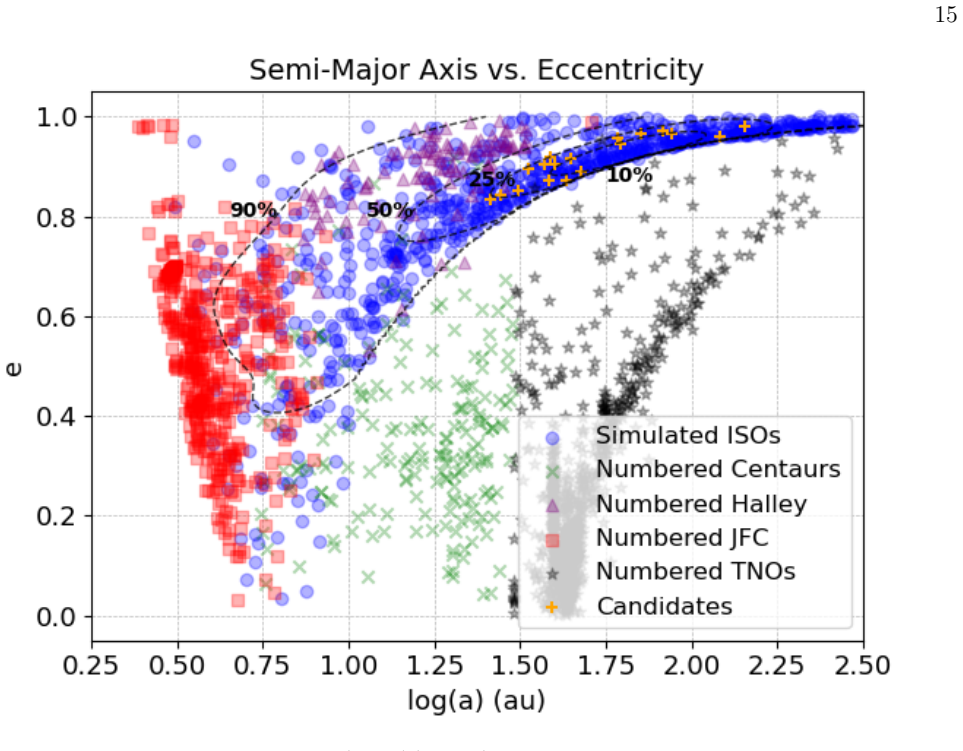
On the paper's own terms, the discovery is that gravitational braking by Jupiter is a small but steady capture channel for interstellar planetesimals: the simulations produce one bound ISO roughly every $4.85\times10^4$ years, and a Weibull survival law with $t_0=1.9\times10^5$ years and $k=0.46$ describes how long those captures stay bound before ejection. Integrating this capture-and-survival balance over 4.5 billion years yields about eight bound ISOs from Jupiter and two from Saturn, with the Hills mechanism contributing fewer than about three, for a total near ten. The captured population clusters at $T_J\approx3$ with semimajor axes beyond Jupiter's, eccentricities mostly $0.9$--$1$, and inclinations biased prograde at capture but reshaped toward high values by long-term survival. Comparing that phase-space region with the catalog of known solar system objects yields 18 single-ISO candidates and 7 binary-capture candidates, of which the paper expects roughly three and one, respectively, to be genuinely interstellar.
Load-bearing premise
The load-bearing premise is that the solar system's capture conditions—the interstellar flux and the giant planets' orbits—have stayed roughly constant over 4.5 billion years, so that a survival curve measured from 1.9 million years of post-capture integration can be extrapolated to the present day.
Editorial extensions
If this is right
- If the central estimate holds, the solar system currently hosts a handful of bound extrasolar planetesimals, making them repeatable targets for orbit refinement and physical characterization rather than one-pass interlopers.
- Bound ISOs should be searched for near $T_J=3$: high eccentricity, semimajor axes larger than Jupiter's, and inclinations biased to high values, a region of orbital space that known solar system populations populate only sparsely.
- The model predicts that roughly three of the 18 flagged single-ISO candidates and one of the 7 binary candidates are genuinely interstellar; the strongest single candidate, 2024 XS15, sits in the 10% highest-density contour.
- The prograde capture bias combined with high-inclination survival offers a dynamical explanation for part of the small prograde excess among Halley-type comets without invoking a large interstellar component.
- Future wide-field surveys that cover the predicted phase-space region should find additional members, and the count would directly test the assumed interstellar number density because the bound population scales linearly with it.
Reading between the lines
- A testable extension the paper does not pursue: because the predicted bound population scales linearly with the assumed interstellar number density, counting bound ISOs in a complete survey would measure $n_\mathrm{iso}$ independently of single-pass interloper detections.
- The same capture physics should operate around massive planets in other planetary systems, so a $T_J\approx3$ pileup of captured bodies might be imprinted on the orbital distribution of debris or ejected planetesimals around stars with close-in giants.
- Orbital position alone cannot certify interstellar origin; if the 25 candidates display the volatile or isotopic anomalies seen in known interstellar interlopers, the dynamical assignments would be strengthened, while native Kuiper-belt-like compositions would argue that most are solar system objects.
Signed reviews
Editorial analysis
A structured set of objections, weighed in public.
Referee Report
Summary. The paper combines a semi-analytic capture model with N-body simulations (REBOUND/REBOUNDx) to estimate the steady-state population of interstellar objects temporarily bound to the solar system. For single ISOs, 5e7 test particles are launched at Jupiter's Hill sphere; 1393 are captured, yielding a quoted rate of 1 bound ISO every 48,500 years. Post-capture survival is fit with a Weibull law and integrated over 4.5 Gyr to predict about 8 Jupiter-captured ISOs today, plus 2 from Saturn, concentrated near the Jupiter Tisserand boundary (TJ = 3) at high eccentricity and high inclination. For binary ISOs, the Hills mechanism is modeled with equal-mass circular binaries; the f = 1/50 case yields an estimated 3 currently bound objects. The predicted phase-space regions are compared with JPL small-body data, giving 18 single-ISO candidates and 7 ISBO candidates, with the caveat that only a few are expected to be genuinely interstellar.
Significance. If the quantitative estimate were fully supported, this would be a valuable prediction: a small, dynamically distinctive population of bound interstellar planetesimals, with candidate lists that can be followed up by surveys. The paper has real strengths: an independent semi-analytic capture check (1011 vs 1393), explicit inclusion of non-gravitational effects and the four giant planets, a public GitHub repository, and a candidate-selection procedure that does not tune the dynamical model to the observed candidates. The qualitative phase-space prediction (TJ < 3, high eccentricity, high inclination) is likely robust to the issues below. However, the headline number of ~10 currently bound objects is not reproducible from the text as written because of an abstract/full-text discrepancy, a normalization inconsistency in Eq. (15), an unvalidated survival-law extrapolation, and a missing derivation of the Monte Carlo rate factor. These issues are fixable with corrected derivations and either longer integrations or a more cautious statement of the prediction.
major comments (4)
- [Abstract and §5.1] The abstract reports a mean capture interval of about 220 years, whereas §5.1 states that 1393 captures out of 5e7 simulated particles correspond to 1 bound ISO every 48,500 years. These numbers differ by more than two orders of magnitude, and the 48,500-year value is the one used for all population estimates; the abstract's interval is therefore not supported by the paper. Please correct the abstract and also state explicitly whether the '~10 currently bound ISOs' is the sum of the eight Jupiter-capture objects, the two Saturn objects, and the up-to-three ISBO objects, since these contributions are never summed in the text.
- [§5.1, Eq. (15)] The prefactor 2.79e-5 in Eq. (15) is 1393 / 5e7, the fraction of simulated particles that are captured; it is not the per-year capture rate quoted in §5.1 (about 2.06e-5 yr^-1). The sentence 'This is the capture rate multiplied by the rate of ejection' is therefore dimensionally inconsistent, and integrating the stated P_iso(t) over 4.5 Gyr gives a population roughly 35% larger than integration with the quoted per-year rate. Please replace the prefactor with the physical rate, or explain exactly what quantity Eq. (15) is meant to represent, and recompute the inferred current populations (the values 8 and 9 in §5.1).
- [§5.1, Eq. (15) and Fig. 5] The steady-state population estimate relies on a Weibull survival law fit to 1.9 Myr of post-capture integration. At the end of the simulated interval (t = 1.9e6 yr, about 10 t0), the survival fraction is exp[-(10)^0.46] about 0.056, so 78 of the 1393 captured particles are still bound; the fitted tail beyond 1.9 Myr contributes roughly one-third of the 4.5 Gyr integral. This tail is not validated by data, and the simulation duration is short relative to the orbital periods of the long-lived objects (periods up to about 2e5 yr, semi-major axes up to 3500 au, as reported in §5.1.1). Please extend the integrations for surviving particles, provide a sensitivity analysis to the Weibull tail (for example, versus a power-law tail), and report how much of the predicted ~10 comes from extrapolation beyond the simulated time.
- [§4.1, Eqs. (10)-(11)] The conversion from 1393 captured particles to a physical per-year rate is not shown explicitly. In Eq. (11), the geometric factor is written as 4 pi^2 r_max^2 n_iso times a Monte Carlo average over sampled velocities and directions. If the velocity directions are sampled uniformly over the inward hemisphere, the unbiased estimator for the flux integral in Eq. (10) requires an additional factor of 2 pi from the uniform hemisphere measure, because the cos(theta) factor is part of the integrand; as written, the rate would be low by a factor of two unless the sampling is cosine-weighted. Please provide the explicit unbiased estimator, including all factors of 2 pi and the sampling measure, or otherwise demonstrate that 1393 / 5e7 corresponds to 2.06e-5 yr^-1. This is load-bearing because the 48,500-year interval is a direct input to the final population estimate.
minor comments (5)
- [Table 1] Please use standard scientific notation (10^6, 3e6, etc.) in Table 1; as typeset, '106' and '3·106' are ambiguous and likely to be misread.
- [Table 3] The name '96P/Macholz' in Table 3 is spelled '96P/Machholz' in the text and in the cited literature; please make the spelling consistent.
- [§5.1.2] The sentence 'Many of these objects have not been studied well and represent excellent candidates for future surveys' would be more informative if accompanied by a quantitative statement of how many of the 18 candidates have measured physical properties (colors, activity, or albedo) and by a machine-readable table in the GitHub repository.
- [§5.2] The scaling discussion for the ISBO capture rate (C proportional to f^4 for high f) is terse; a short derivation connecting Eq. (12) to the collision and encounter probability would help the reader verify the claimed scaling.
- [§3 and §4.2] The maximal-dot-product assumption in Eq. (8) and the equal-mass circular-binary assumption are stated clearly, but the paper would benefit from a brief quantitative estimate of how much these assumptions could bias the ISBO capture rate in either direction, beyond the qualitative over- and underestimate discussion in §5.2.
Circularity Check
No circular derivation: capture rates come from independent N-body and semi-analytic calculations, the survival law is fit to simulation output rather than to the candidate list, and the candidate search is a downstream application of the model.
full rationale
The paper's central derivation chain is: (i) initial conditions are sampled from an assumed isotropic flux and a log-normal velocity distribution (Section 4.1); (ii) the capture probability is estimated both by Monte Carlo N-body integration (1393 captured out of 50 million) and by a semi-analytic gravitational-slingshot integral (1011 predicted), providing two independent routes to the capture rate; (iii) post-capture survival is fit to a Weibull distribution from 1.9 Myr of N-body ejection statistics (Equation 15, Figure 5) and then integrated to 4.5 Gyr to estimate roughly eight currently bound single ISOs; and (iv) the simulated orbital-element density contours are used only as a search filter over the JPL catalog to nominate candidates. At no point are the 18 ISO candidates or 7 ISBO candidates fed back into the capture-rate or survival-law fits, so the candidate lists are not tuning the model. The author-overlap citations (Sekhar et al. 2017 and Moore et al. 2020, both coauthored by G. Li) are peripheral: they support the discussion of 96P/Machholz's inclination oscillation and of ISBO ejection by stellar flybys, and they do not supply the capture mechanism, the survival law, or the predicted population size. There are real quantitative concerns, such as the normalization mismatch in Equation 15 (the prefactor 2.79e-5 is the per-particle capture probability 1393/50e6 rather than the stated per-year capture rate 1/48500) and the abstract/full-text inconsistency between 220-year and 48,500-year capture intervals, but these are internal-consistency and extrapolation issues, not circular reductions. The derivation is therefore self-contained with respect to its inputs; concerns about the unvalidated Weibull tail are correctness risks rather than circularity.
Assumptions & free parameters
free parameters (8)
- ISO number density n_iso =
0.1 au^-3
- Velocity distribution log-normal parameters mu, sigma =
mu=0.624, sigma=3.715
- ISBO number density fraction =
0.1 * n_iso
- Binary separation distribution log-normal parameters =
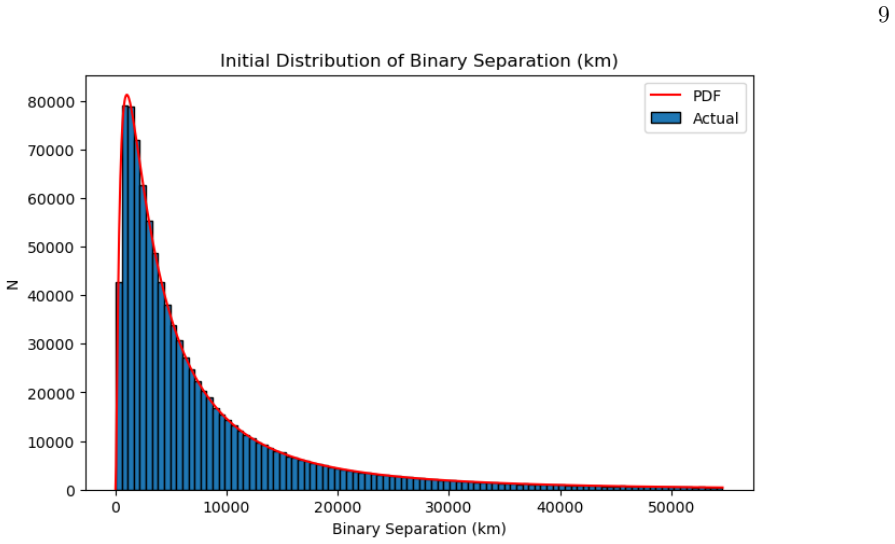
mu=1.23, sigma=8.44
- Binary mass density rho =
3 g/m^3
- f = binary separation / component radius =
varied 1/5 to 1/200; favored 1/50
- Particle diameter =
1 km
- Higher-order physical parameters (beta, albedo, A1-A3) =
see Appendix A
assumptions (5)
- domain assumption During Jupiter encounter, the Sun's gravity can be neglected for capture dynamics (Section 2, Eqs. 1-4).
- domain assumption Incoming interstellar objects have an isotropic velocity distribution at the Hill sphere (Section 4.1).
- domain assumption Capture and ejection rates are statistically independent over long timescales (Section 5.1, before Eq. 15).
- domain assumption Solar system capture and ejection conditions have been constant over 4.5 Gyr (Section 5.1).
- ad hoc to paper ISBOs are equal-mass binaries on circular orbits, and the energy change at tidal disruption is evaluated with maximal dot product (Section 3, Eq. 8).
Cite this review
Pith. "Pith review of Candidate Captured Interstellar Objects in the Solar System." pith.science (2026). https://pith.science/paper/DUR6KK5W
@misc{pith2026250905905,
  author       = {Pith},
  title        = {Pith review of: Candidate Captured Interstellar Objects in the Solar System},
  year         = {2026},
  howpublished = {\url{https://pith.science/paper/DUR6KK5W}},
  note         = {Machine review of arXiv:2509.05905}
}
read the original abstract
Interstellar objects (ISOs) provide direct probes of planetesimal formation and ejection in other planetary systems. While most ISOs that pass through the Solar System escape it after a single passage, a small fraction can become temporarily bound through gravitational interactions. We develop a self-consistent semi-analytic framework that couples analytic modeling of the interstellar object flux near Jupiter with N-body simulations of capture and long-term dynamical evolution, allowing us to predict the steady-state phase-space distribution of bound interstellar objects. Using an analytic model to construct initial conditions and N-body integrations to simulate capture and ejection, we compute capture rates and orbital distributions consistent with previous analytical estimates, finding a mean capture interval of approximately 220 years. We show that post-capture survival strongly reshapes the observable population: although capture initially favors prograde orbits, long-term stability is dominated by highly inclined objects that encounter planets less frequently and thus are less likely to be ejected. The resulting steady-state population is therefore concentrated at high inclinations, providing a potential dynamical discriminant for identifying candidates. However, most captured objects occupy semimajor axes comparable to the inner Oort cloud, making them difficult to distinguish from native long-period comets. The predicted phase-space distribution contains 122 known Solar System objects within the highest-density region of our model.
Figures


Figures from the paper (9 more)




Reference graph
Works this paper leans on
-
[1]
Burns, J. A., Lamy, P. L., & Soter, S. 1979, Icarus, 40, 1, doi: 10.1016/0019-1035(79)90050-2
-
[2]
Cordiner, M. A., Roth, N. X., Kelley, M. S. P., et al. 2025, arXiv e-prints, arXiv:2508.18209, doi: 10.48550/arXiv.2508.18209
-
[3]
Dehnen, W., Hands, T. O., & Sch¨ onrich, R. 2021, Monthly Notices of the Royal Astronomical Society, 512, 4078–4085, doi: 10.1093/mnras/stab3666
-
[4]
Do, A., Tucker, M. A., & Tonry, J. 2018, The Astrophysical Journal Letters, 855, L10, doi: 10.3847/2041-8213/aaae67
-
[5]
Eisner, N. L., Knight, M. M., Snodgrass, C., et al. 2019, AJ, 157, 186, doi: 10.3847/1538-3881/ab0f42
-
[6]
Eubanks, T. M., Hein, A. M., Lingam, M., et al. 2021, https://arxiv.org/abs/2103.03289
arXiv 2021
- [7]
-
[8]
Hands, T. O., & Dehnen, W. 2020, MNRAS, 493, L59, doi: 10.1093/mnrasl/slz186
Show all 38 references
-
[9]
M., Eubanks, M., Hibberd, A., et al
Hein, A. M., Eubanks, M., Hibberd, A., et al. 2022, Bulletin of the AAS, 53, doi: 10.3847/25c2cfeb.7273f358 24
2022 doi
-
[10]
Hills, J. G. 1988, Nature, 331, 687, doi: 10.1038/331687a0
1988 doi
- [11]
-
[12]
Jewitt, D., & Seligman, D. Z. 2023, ARA&A, 61, 197, doi: 10.1146/annurev-astro-071221-054221
2023 doi
-
[13]
J., & Bromley, B
Kenyon, S. J., & Bromley, B. C. 2004, Nature, 432, 598, doi: 10.1038/nature03136
2004 doi
-
[14]
2019, Astronomy & Astrophysics, 630, A4, doi: 10.1051/0004-6361/201935229
Kramer, T., & L¨ auter, M. 2019, Astronomy & Astrophysics, 630, A4, doi: 10.1051/0004-6361/201935229
2019 doi
-
[15]
2021, Planet
Moore, K., Courville, S., Ferguson, S., et al. 2021, Planet. Space Sci., 197, 105137, doi: 10.1016/j.pss.2020.105137
2021
-
[16]
Moore, N. W. H., Li, G., & Adams, F. C. 2020, The Astrophysical Journal, 901, 92, doi: 10.3847/1538-4357/abb08f
2020 doi
-
[17]
2023, Monthly Notices of the Royal Astronomical Society, 525, 908–921, doi: 10.1093/mnras/stad2317
Mukherjee, D., Siraj, A., Trac, H., & Loeb, A. 2023, Monthly Notices of the Royal Astronomical Society, 525, 908–921, doi: 10.1093/mnras/stad2317
2023 doi
-
[18]
J., Adams, F
Napier, K. J., Adams, F. C., & Batygin, K. 2021a, PSJ, 2, 53, doi: 10.3847/PSJ/abe76e/53
-
[19]
J., Adams, F
Napier, K. J., Adams, F. C., & Batygin, K. 2021b, PSJ, 2, 217, doi: 10.3847/PSJ/ac29bb
-
[20]
Nobili, A., & Roxburgh, I. W. 1986, in IAU
1986
- [21]
-
[22]
H., & Kavelaars, J
Parker, A. H., & Kavelaars, J. J. 2010, ApJL, 722, L204, doi: 10.1088/2041-8205/722/2/L204
2010 doi
-
[23]
2024, Nature Astronomy, 8, 1380–1386, doi: 10.1038/s41550-024-02349-x
Pfalzner, S., Govind, A., & Portegies Zwart, S. 2024, Nature Astronomy, 8, 1380–1386, doi: 10.1038/s41550-024-02349-x
2024 doi
-
[24]
2012, Astronomy & Astrophysics, 537, A128, doi: 10.1051/0004-6361/201118085
Rein, H., & Liu, S.-F. 2012, Astronomy & Astrophysics, 537, A128, doi: 10.1051/0004-6361/201118085
2012 doi
-
[25]
Schleicher, D. G. 2008, AJ, 136, 2204, doi: 10.1088/0004-6256/136/5/2204
2008 doi
-
[26]
2017, Monthly Notices of the Royal Astronomical Society, 468, 1405–1414, doi: 10.1093/mnras/stx548
Vaubaillon, J., & Li, G. 2017, Monthly Notices of the Royal Astronomical Society, 468, 1405–1414, doi: 10.1093/mnras/stx548
2017 doi
-
[27]
J., et al
Sekhar, A., Vaubaillon, J., Asher, D. J., et al. 2023, in LPI Contributions, Vol. 2851,
2023
-
[28]
2018, AJ, 155, 217, doi: 10.3847/1538-3881/aabd37
Seligman, D., & Laughlin, G. 2018, AJ, 155, 217, doi: 10.3847/1538-3881/aabd37
2018 doi
-
[29]
Z., & Moro-Mart´ ın, A
Seligman, D. Z., & Moro-Mart´ ın, A. 2022, Contemporary Physics, 63, 200, doi: 10.1080/00107514.2023.2203976
2022
- [30]
-
[31]
Sersante, B., Penoyre, Z., & Rossi, E. M. 2025, https://arxiv.org/abs/2505.08499
2025 arXiv
-
[32]
2019, ApJL, 872, L10, doi: 10.3847/2041-8213/ab042a
Siraj, A., & Loeb, A. 2019, ApJL, 872, L10, doi: 10.3847/2041-8213/ab042a
2019 doi
-
[33]
2022, Astrobiology, 22, 1459–1470, doi: 10.1089/ast.2021.0189
Siraj, A., & Loeb, A. 2022, Astrobiology, 22, 1459–1470, doi: 10.1089/ast.2021.0189
2022
-
[34]
A., Protopapa, S., Freeman, M., et al
Stern, S. A., Protopapa, S., Freeman, M., et al. 2024, Planet. Space Sci., 241, 105850, doi: 10.1016/j.pss.2024.105850
2024
-
[35]
Tamayo, D., Rein, H., Shi, P., & Hernandez, D. M. 2019, Monthly Notices of the Royal Astronomical Society, 491, 2885–2901, doi: 10.1093/mnras/stz2870
2019 doi
-
[36]
2019, MNRAS, 485, 708, doi: 10.1093/mnras/stz421
Veras, D., Higuchi, A., & Ida, S. 2019, MNRAS, 485, 708, doi: 10.1093/mnras/stz421
2019 doi
-
[37]
H., & Brasser, R
Wang, J. H., & Brasser, R. 2014, A&A, 563, A122, doi: 10.1051/0004-6361/201322508
2014 doi
-
[38]
2020, The Astronomical Journal, 159, 143, doi: 10.3847/1538-3881/ab700d
Wiegert, P., Brown, P., Pokorn´ y, P., et al. 2020, The Astronomical Journal, 159, 143, doi: 10.3847/1538-3881/ab700d
2020 doi
Reviewed August 15, 2026 · model on record in the stance chip above.
Discussion (0). Continue with ORCID to comment.