REVIEW 3 major objections 5 minor 37 references
Connecting Large Language Models with Blockchain: Advancing the Evolution of Smart Contracts from Automation to Intelligence
T0 review · 3 major / 5 minor · reviewed 2026-08-11 · deepseek-v4-flash
Pith's one-line read This paper claims that blockchain smart contracts can safely use large language models by routing questions through a decentralized oracle network and aggregating the LLM text answers with a method the authors call SenteTruth, and it…
desk verdict SenteTruth is a plausible tamper-resilient oracle aggregation method for LLM text, but the headline accuracy claim measures unaltered-data selection, not factual correctness. read the letter →
The pith
A machine-rendered reading of the paper's core claim, the machinery that carries it, and where it could break.
The reading
What carries the argument
The load-bearing mechanism is SenteTruth, a two-stage aggregation algorithm for text answers: an SBERT sentence encoder plus cosine similarity gives a semantic relatedness score for every answer, and a truth-discovery loop repeatedly multiplies relatedness by node credibility to select the winner and then updates credibility. The iterative weighting is what carries the argument: a single similarity error by SBERT is corrected by the accumulated credibility of nodes that have historically agreed with the majority, which is why the paper reports high accuracy even when malicious nodes are 40 percent of the network. The C-LLM framework around it supplies the commit-reveal data exchange that prevents nodes from copying each other's answers before aggregation. In mathematical terms the aggregation objective is $\bar D = \arg\max_i C_i \varphi(v_i)$ with credibility update $C_i \leftarrow \left(\frac{\sum_{i} C_i}{\sum_{i} C_i \varphi(v_i)}\right) C_i \varphi(v_i)$.
What would settle it
Build a dataset where 60 percent of nodes give correct but semantically varied answers to an open question and 40 percent collude on a single plausible but wrong answer; SenteTruth would pick the colluding answer because it maximizes semantic relatedness. Observing that outcome would show the central claim holds for tamper resistance but fails for factual answer quality.
Extended reading notes
Core claim
The paper's central discovery is that truth-discovery weighting, previously limited to numerical data, can be carried over to free-form LLM text if semantic relatedness replaces numeric distance. SenteTruth maps each node's answer $D_i$ to an embedding $v_i = \text{SBERT}(D_i)$, computes each answer's relatedness $\varphi(v_i)$ as the sum of cosine similarities to all other answers, and selects the aggregate $\bar D = \arg\max_i C_i \varphi(v_i)$ using each node's learned credibility $C_i$. Credibility is then updated so nodes whose answers resemble the aggregate gain weight and those that deviate lose weight. The paper reports that this scheme achieves near-perfect accuracy under three text-specific attacks—random responses, model substitution, and prompt-engineered incorrect answers—and that at 40 percent malicious nodes the average accuracy gain over the best baseline is 17.74 percent. The authors define accuracy as the proportion of unaltered data in the final aggregated result, so the gain is specifically tamper resilience rather than factual correctness.
Load-bearing premise
The method assumes that the 'truth' is whatever answer is semantically closest to the majority of nodes, so if honest nodes give diverse answers or share the same misconception, the aggregated answer can still be wrong.
Editorial extensions
If this is right
- Smart-contract applications can request open-ended reasoning from LLMs through an oracle contract and receive a single consensus answer, with gas costs on the order of a few hundred thousand per request.
- An oracle network with fewer than half malicious nodes can tolerate random responses, cheaper-model substitution, and prompt-injected incorrect answers, keeping data accuracy near 1.0 across the BASE, MIX, and PRO datasets.
- Because SenteTruth treats node credibility as a learned quantity, honest nodes accumulate weight over time while persistently deviating nodes are suppressed, so the system improves as it operates.
- The paper explicitly argues that replacing SBERT with a stronger text encoder should further improve SenteTruth's aggregation accuracy.
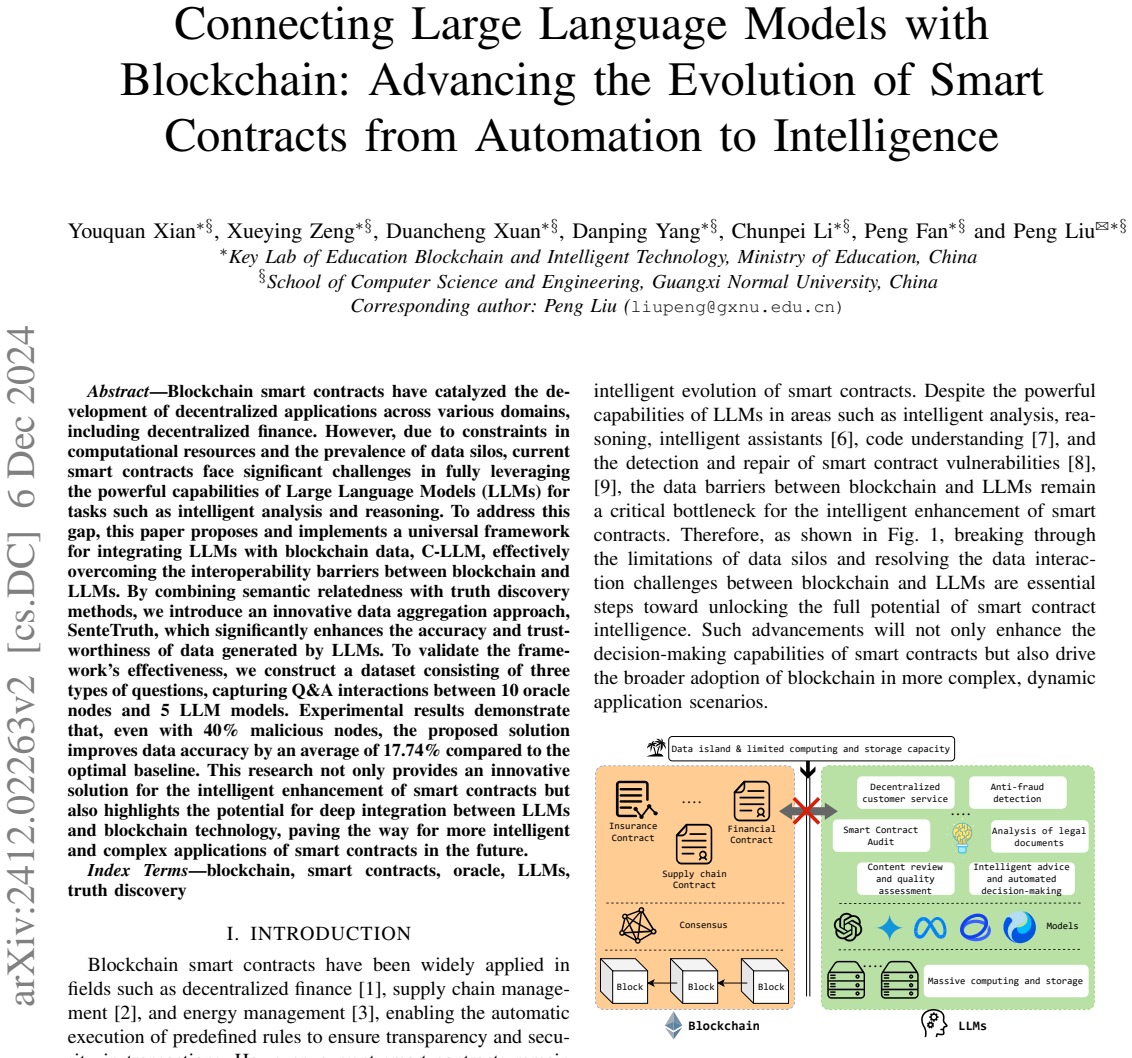
- The framework makes blockchain contracts capable of handling ambiguity and dynamic scenarios, moving from pure automation toward contract intelligence.
Reading between the lines
- The paper's accuracy metric counts whether the final selected answer was an unaltered node response, not whether it is factually correct; the 17.74 percent improvement therefore demonstrates tamper resistance, and a reader should not infer that the selected answer is more truthful than the honest nodes' answers.
- If malicious nodes collude and emit semantically similar wrong answers while honest nodes produce correct but diverse phrasings, SenteTruth's majority-similarity assumption would favor the attackers; the paper only assumes fewer than half malicious nodes and no collusion.
- A natural test is to run SenteTruth on open-ended questions with a fact-checked gold standard, comparing selected answers against the gold standard rather than against the set of unaltered responses; this would separate tamper resistance from answer quality.
Editorial analysis
A structured set of objections, weighed in public.
Referee Report
Summary. The paper proposes C-LLM, a framework for routing smart-contract oracle requests to LLM APIs and returning an aggregated answer, and SenteTruth, a method that combines SBERT sentence embeddings with a truth-discovery-style credibility update to select the most central answer from a set of node responses. The system is implemented on a local Ethereum/Ganache testbed with Solidity contracts and evaluated on a custom dataset built from 10 oracle nodes querying 5 LLMs under three attacks (random response, model substitution, incorrect response). The headline result is a 17.74% average accuracy improvement over the best baseline at 40% malicious nodes.
Significance. The practical scenario is plausible and the artifact is valuable: the authors provide code and data, deploy on a real local blockchain, include gas measurements, and cover five commercial/open LLMs. If the reported robustness were about factual answer quality, this would be a solid contribution to LLM oracle aggregation. As written, the evaluation metric is tamper-resilience (selecting an unaltered node response), not factual correctness, so the central quantitative claim needs reframing or a new evaluation. SenteTruth is a simple combination of two existing ideas; its novelty lies mainly in the application, the selection rule, and the open artifact.
major comments (3)
- [Section IV-B, RQ2; Section III-C] The paper defines Accuracy as "the proportion of unaltered data in the final aggregated result" and defines truth as data that is "free from tampering, even if the response is not entirely accurate in content." Under this metric, Tables I-III and Fig. 7, together with the 17.74% claim in the abstract, measure whether the final answer is an unchanged honest-node response, not whether it is factually correct. A unanimous hallucination would score 1.0, and a correct answer that is paraphrased relative to the majority wording could score 0.0. Because the abstract and conclusion claim improved "accuracy and trustworthiness of data generated by LLMs," this is a load-bearing mismatch. Please either add a ground-truth-based factual accuracy evaluation with human or verified labels, or change the claims throughout to "tamper-resilience" or "data-integrity selection accuracy."
- [Section III-C, Eq. (2) and Eq. (4)] Equation (2) defines phi(v_i) as a sum of cosine similarities over all j != i; with 10 nodes and identical answers this value is about 9, not less than 1. The sentence "Since phi(v_i) < 1" immediately after Eq. (4) is therefore false. The credibility update in Eq. (4) is a normalized multiplicative update only if phi is an average similarity or is otherwise bounded; as written, the stated reason for the update and its stability are not established. Please clarify the definition (e.g., use average similarity) and provide a convergence or stability argument for the iterative update.
- [Section III-C, Eq. (3)] Equation (3) selects one node's answer D_i that maximizes C_i * phi(v_i); the algorithm does not synthesize or aggregate text. The text says the goal is to "synthesize an aggregated result" and repeatedly calls SenteTruth an aggregation method, but the output is always one of the received responses. This means the method cannot fix a factual error shared by the majority of honest nodes; it only selects the most centrally credible answer among the received responses. The claims should be stated as robust selection rather than aggregation, or a true text-synthesis/aggregation step should be added.
minor comments (5)
- [Figures 2, 5, and 6] The captions and axis labels of Figures 2, 5, and 6 contain "/uni..." placeholder tokens, making the visual results unreadable in the submitted PDF; these figures need to be regenerated with proper text.
- [Section III-C, Eq. (4)] Equation (4) uses i both for the node being updated and as the summation index; please use a separate index (e.g., k) in the numerator and denominator to avoid ambiguity.
- [Section III-C, Section IV-E] The paper gives no stopping criterion for the credibility update. Figure 8 shows 20 epochs, but the algorithmic description does not state how many iterations are used in general or how convergence is detected.
- [Table III and Table VII] The "TF-IDF Similarity + TD" baseline reports a 0.0 accuracy for Llama under model substitution, meaning that adding truth discovery always selects a malicious response on that condition. Given that truth discovery should not normally make a method worse than chance, the authors should explain or investigate this pathological value.
- [References] Reference [20] is a blog URL with no year or archival identifier; please replace it with a citable and preferably archival source.
Circularity Check
The headline 17.74% accuracy result is partially self-definitional: the paper defines 'truth' as majority-consensus, tamper-free data and 'accuracy' as unaltered data, so the central metric measures consensus and tamper-resistance rather than factual correctness of LLM outputs.
-
self definitional
[Section III-C (SenteTruth, truth definition) and Section IV-B (RQ2, accuracy definition); the selection rule is Eq. (3).]
"Here, the truth refers to the data that reflects the majority consensus of the nodes and is free from tampering, even if the response is not entirely accurate in content. ... This question will evaluate the effectiveness of the proposed method in ensuring data Accuracy, with data Accuracy defined as the proportion of unaltered data in the final aggregated result."
SenteTruth's selection rule is a majority-consensus selector: ∅D ← argmax_i C_i·φ(v_i), where φ(v_i) is the sum of cosine similarities of node i's answer to all other answers. The paper then defines 'truth' as majority-consensus, tamper-free data, and 'accuracy' as the proportion of unaltered data in the final aggregated result. With 40% malicious nodes and honest nodes in the majority, the unaltered honest answers are by construction the consensus cluster, so any aggregation rule that selects the majority-like answer will score well on this metric. The reported 17.74% improvement therefore measures robustness against minority tampering, not factual correctness or trustworthiness of LLM-generated content.
full rationale
The only substantive circularity concern is the co-definition of the evaluation metric with the algorithm's objective. The definitions in Section III-C and Section IV-B make explicit that 'truth' and 'accuracy' are consensus and tamper-resistance notions, not ground-truth factual correctness. SenteTruth selects by weighted semantic similarity to the majority, and 'accuracy' labels exactly that kind of selection as correct, so the central quantitative claim is partly built into the metric. This is partial, not total, circularity: the experimental comparison against TF-IDF, SBERT, and majority-voting baselines is an empirical result, and the method's robustness to random responses, incorrect responses, and model substitution is an independently meaningful property. The self-citations in the related work are descriptive and not load-bearing for the central claim. Because the abstract claims the method 'significantly enhances the accuracy and trustworthiness of data generated by LLMs,' while the metric cannot distinguish a unanimous hallucination from a correct answer, the headline claim overstates what is shown; a score of 5 reflects this partial circularity.
Assumptions & free parameters
free parameters (1)
- truth discovery iteration count (epochs) =
unspecified
assumptions (5)
- domain assumption Honest node responses are semantically similar to each other in SBERT embedding space.
- domain assumption The truth is the majority consensus of the nodes, even if factually incorrect.
- domain assumption Malicious nodes are fewer than half and do not collude.
- domain assumption Cosine similarity in SBERT embedding space is a valid measure of semantic relatedness for the answers.
- ad hoc to paper The credibility update formula (Eq. 4) converges to useful weights without oscillation.
Cite this review
Pith. "Pith review of Connecting Large Language Models with Blockchain: Advancing the Evolution of Smart Contracts from Automation to Intelligence." pith.science (2026). https://pith.science/paper/DUZ7SXP7
@misc{pith2026241202263,
  author       = {Pith},
  title        = {Pith review of: Connecting Large Language Models with Blockchain: Advancing the Evolution of Smart Contracts from Automation to Intelligence},
  year         = {2026},
  howpublished = {\url{https://pith.science/paper/DUZ7SXP7}},
  note         = {Machine review of arXiv:2412.02263}
}
read the original abstract
Blockchain smart contracts have catalyzed the development of decentralized applications across various domains, including decentralized finance. However, due to constraints in computational resources and the prevalence of data silos, current smart contracts face significant challenges in fully leveraging the powerful capabilities of Large Language Models (LLMs) for tasks such as intelligent analysis and reasoning. To address this gap, this paper proposes and implements a universal framework for integrating LLMs with blockchain data, {\sysname}, effectively overcoming the interoperability barriers between blockchain and LLMs. By combining semantic relatedness with truth discovery methods, we introduce an innovative data aggregation approach, {\funcname}, which significantly enhances the accuracy and trustworthiness of data generated by LLMs. To validate the framework's effectiveness, we construct a dataset consisting of three types of questions, capturing Q\&A interactions between 10 oracle nodes and 5 LLM models. Experimental results demonstrate that, even with 40\% malicious nodes, the proposed solution improves data accuracy by an average of 17.74\% compared to the optimal baseline. This research not only provides an innovative solution for the intelligent enhancement of smart contracts but also highlights the potential for deep integration between LLMs and blockchain technology, paving the way for more intelligent and complex applications of smart contracts in the future.
Figures


Figures from the paper (5 more)


Reference graph
Works this paper leans on
-
[1]
Defi: Decentralized finance-an introduction and overview,
P. Schueffel, “Defi: Decentralized finance-an introduction and overview,” Journal of Innovation Management , vol. 9, no. 3, pp. I–XI, 2021. I
work page 2021
-
[2]
P. Dutta, T.-M. Choi, S. Somani, and R. Butala, “Blockchain technology in supply chain operations: Applications, challenges and research oppor- tunities,” Transportation research part e: Logistics and transportation review, vol. 142, p. 102067, 2020. I
work page 2020
-
[3]
Q. Wang and M. Su, “Integrating blockchain technology into the energy sector—from theory of blockchain to research and application of energy blockchain,” Computer Science Review , vol. 37, p. 100275, 2020. I
work page 2020
-
[4]
Interoperability in blockchain: A survey,
K. Ren, N.-M. Ho, D. Loghin, T.-T. Nguyen, B. C. Ooi, Q.-T. Ta, and F. Zhu, “Interoperability in blockchain: A survey,”IEEE Transactions on Knowledge and Data Engineering , vol. 35, no. 12, pp. 12 750–12 769,
-
[5]
A survey on blockchain interoperability: Past, present, and future trends,
R. Belchior, A. Vasconcelos, S. Guerreiro, and M. Correia, “A survey on blockchain interoperability: Past, present, and future trends,” Acm Computing Surveys (CSUR) , vol. 54, no. 8, pp. 1–41, 2021. I
work page 2021
-
[6]
Toolqa: A dataset for llm question answering with external tools,
Y . Zhuang, Y . Yu, K. Wang, H. Sun, and C. Zhang, “Toolqa: A dataset for llm question answering with external tools,” Advances in Neural Information Processing Systems , vol. 36, pp. 50 117–50 143, 2023. I
work page 2023
-
[7]
Using an llm to help with code understanding,
D. Nam, A. Macvean, V . Hellendoorn, B. Vasilescu, and B. Myers, “Using an llm to help with code understanding,” in Proceedings of the IEEE/ACM 46th International Conference on Software Engineering , 2024, pp. 1–13. I
work page 2024
-
[8]
W. Ma, D. Wu, Y . Sun, T. Wang, S. Liu, J. Zhang, Y . Xue, and Y . Liu, “Combining fine-tuning and llm-based agents for intuitive smart contract auditing with justifications,” arXiv preprint arXiv:2403.16073 , 2024. I
arXiv 2024
Show all 37 references
-
[9]
Fellmvp: An ensemble llm framework for classifying smart contract vulnerabilities,
Y . Luo, W. Xu, K. Andersson, M. S. Hossain, and D. Xu, “Fellmvp: An ensemble llm framework for classifying smart contract vulnerabilities,” in 2024 IEEE International Conference on Blockchain (Blockchain) . IEEE, 2024, pp. 89–96. I
2024
-
[10]
Smartllm: A new oracle system for smart contracts calling large language models,
Z. Xu, J. Wang, C. Zha, X. Li, and H. Yin, “Smartllm: A new oracle system for smart contracts calling large language models,” in 2023 IEEE 22nd International Conference on Trust, Security and Privacy in Computing and Communications (TrustCom) . IEEE, 2023, pp. 2668–
2023
-
[11]
Augur: a decentralized oracle and prediction market platform,
J. Peterson, J. Krug, M. Zoltu, A. K. Williams, and S. Alexander, “Augur: a decentralized oracle and prediction market platform,” arXiv preprint arXiv:1501.01042, 2015. I, II
2015 arXiv
-
[12]
Astraea: A decentralized blockchain oracle,
R. Berryhill and A. Veneris, “Astraea: A decentralized blockchain oracle,” IEEE Blockchain Technical Briefs , 2019. I, II
2019
-
[13]
Deepthought: A reputation and voting-based blockchain oracle,
M. D. Gennaro, L. Italiano, G. Meroni, and G. Quattrocchi, “Deepthought: A reputation and voting-based blockchain oracle,” in Service-Oriented Computing: 20th International Conference, ICSOC 2022, Seville, Spain, November 29–December 2, 2022, Proceedings . Springer, 2022, pp. ...
2022
-
[14]
Town crier: An authenticated data feed for smart contracts,
F. Zhang, E. Cecchetti, K. Croman, A. Juels, and E. Shi, “Town crier: An authenticated data feed for smart contracts,” in Proceedings of the 2016 aCM sIGSAC conference on computer and communications security , 2016, pp. 270–282. I, II
2016
-
[15]
Extending on-chain trust to off-chain–trustworthy blockchain data collection using trusted execution environment (tee),
C. Liu, H. Guo, M. Xu, S. Wang, D. Yu, J. Yu, and X. Cheng, “Extending on-chain trust to off-chain–trustworthy blockchain data collection using trusted execution environment (tee),” IEEE Transactions on Computers, vol. 71, no. 12, pp. 3268–3280, 2022. I, II
2022
-
[16]
A distributed oracle using intel sgx for blockchain-based iot applications,
S. Woo, J. Song, and S. Park, “A distributed oracle using intel sgx for blockchain-based iot applications,” Sensors, vol. 20, no. 9, p. 2725,
-
[17]
A distributed efficient blockchain oracle scheme for internet of things,
Y . Xian, L. Zhou, J. Jiang, B. Wang, H. Huo, and P. Liu, “A distributed efficient blockchain oracle scheme for internet of things,” IEICE Trans- actions on Communications , vol. E107-B, no. 9, pp. 573–582, 2024. I
2024
-
[18]
A trust- worthy and consistent blockchain oracle scheme for industrial internet of things,
P. Liu, Y . Xian, C. Yao, P. Wang, L.-e. Wang, and X. Li, “A trust- worthy and consistent blockchain oracle scheme for industrial internet of things,” IEEE Transactions on Network and Service Management , vol. 21, no. 5, pp. 5135–5148, 2024. I, II
2024
-
[19]
A decentralized oracle service network to boost blockchain usability with real world data and computation power,
D. Network, “A decentralized oracle service network to boost blockchain usability with real world data and computation power,” https://dos. network, 2019. I, II, III
2019
-
[20]
How to make your completions outputs consistent with the new seed parameter,
S. Anadkat, “How to make your completions outputs consistent with the new seed parameter,” https://cookbook.openai.com/examples/ reproducible outputs with the seed parameter, 2023. I
2023
-
[21]
Daon: A decentralized autonomous oracle network to provide secure data for smart contracts,
J. Dong, C. Song, Y . Sun, and T. Zhang, “Daon: A decentralized autonomous oracle network to provide secure data for smart contracts,” IEEE Transactions on Information Forensics and Security , 2023. I, II, III-B, IV-A
2023
-
[22]
Chainlink 2.0: Next steps in the evolution of decentralized oracle networks,
L. Breidenbach, C. Cachin, B. Chan, A. Coventry, S. Ellis, A. Juels, F. Koushanfar, A. Miller, B. Magauran, D. Moroz et al., “Chainlink 2.0: Next steps in the evolution of decentralized oracle networks,” Chainlink Labs, vol. 1, pp. 1–136, 2021. I, III, 5 , IV-A
2021
-
[23]
Schellingcoin: A minimal-trust univer- sal data feed,
V . Buterin, “Schellingcoin: A minimal-trust univer- sal data feed,” https://blog.ethereum.org/2014/03/28/ schellingcoin-a-minimal-trust-universal-data-feed, 2014. I, II
2014
-
[24]
Oracul system,
R. Brodetski, “Oracul system,” https://gist.github.com/RomanBrodetski,
-
[25]
Compound protocol,
C. Protocol, “Compound protocol,” https://compound.inance/docs, 2021. I, II
2021
-
[26]
A decentralized truth dis- covery approach to the blockchain oracle problem,
Y . Xiao, N. Zhang, W. Lou, and Y . T. Hou, “A decentralized truth dis- covery approach to the blockchain oracle problem,” in IEEE INFOCOM 2023-IEEE Conference on Computer Communications. IEEE, 2023, pp. 1–10. I, II
2023
-
[27]
Safeguarding the truth of high- value price oracle task: A dynamically adjusted truth discovery method,
Y . Xian, P. Liu, D. Li, and X. Zeng, “Safeguarding the truth of high- value price oracle task: A dynamically adjusted truth discovery method,” arXiv preprint arXiv:2402.02543 , 2024. I, II
2024 arXiv
-
[28]
A decentralized oracle architecture for a blockchain-based iot global market,
L. Gigli, I. Zyrianoff, F. Montori, C. Aguzzi, L. Roffia, and M. Di Felice, “A decentralized oracle architecture for a blockchain-based iot global market,” IEEE Communications Magazine , vol. 61, no. 8, pp. 86–92,
-
[29]
A novel architecture combining oracle with decentralized learning for iiot,
Y . Lin, Z. Gao, W. Shi, Q. Wang, H. Li, M. Wang, Y . Yang, and L. Rui, “A novel architecture combining oracle with decentralized learning for iiot,” IEEE Internet of Things Journal , vol. 10, no. 5, pp. 3774–3785,
-
[30]
Deco: Lib- erating web data using decentralized oracles for tls,
F. Zhang, D. Maram, H. Malvai, S. Goldfeder, and A. Juels, “Deco: Lib- erating web data using decentralized oracles for tls,” in Proceedings of the 2020 ACM SIGSAC Conference on Computer and Communications Security, 2020, pp. 1919–1938. II
2020
-
[31]
Proxying is enough: Security of proxying in tls oracles and aead context unforgeability,
Z. Luo, Y . Jia, Y . Shen, and A. Kate, “Proxying is enough: Security of proxying in tls oracles and aead context unforgeability,” Cryptology ePrint Archive, 2024. II
2024
-
[32]
Instant resonance: Dual strategy enhances the data consensus suc- cess rate of blockchain threshold signature oracles,
Y . Xian, X. Zeng, C. Li, D. Li, P. Wang, P. Liu, and X. Li, “Instant resonance: Dual strategy enhances the data consensus suc- cess rate of blockchain threshold signature oracles,” arXiv preprint arXiv:2411.02945, 2024. II
2024 arXiv
-
[33]
A survey on truth discovery,
Y . Li, J. Gao, C. Meng, Q. Li, L. Su, B. Zhao, W. Fan, and J. Han, “A survey on truth discovery,” ACM Sigkdd Explorations Newsletter , vol. 17, no. 2, pp. 1–16, 2016. II, III-C
2016
-
[34]
Towards analyzing and mitigating sycophancy in large vision-language models,
Y . Zhao, R. Zhang, J. Xiao, C. Ke, R. Hou, Y . Hao, Q. Guo, and Y . Chen, “Towards analyzing and mitigating sycophancy in large vision-language models,” arXiv preprint arXiv:2408.11261 , 2024. 3
2024
-
[35]
Sentence-bert: Sentence embeddings using siamese bert- networks,
N. Reimers, “Sentence-bert: Sentence embeddings using siamese bert- networks,” arXiv preprint arXiv:1908.10084 , 2019. III-C, IV-A
1908 arXiv
-
[36]
Text mining: use of tf-idf to examine the relevance of words to documents,
S. Qaiser and R. Ali, “Text mining: use of tf-idf to examine the relevance of words to documents,” International Journal of Computer Applications, vol. 181, no. 1, pp. 25–29, 2018. IV-A
2018
-
[37]
C-eval: A multi-level multi- discipline chinese evaluation suite for foundation models,
Y . Huang, Y . Bai, Z. Zhu, J. Zhang, J. Zhang, T. Su, J. Liu, C. Lv, Y . Zhang, J. Lei, Y . Fu, M. Sun, and J. He, “C-eval: A multi-level multi- discipline chinese evaluation suite for foundation models,” in Advances in Neural Information Processing Systems , 2023. 3
2023
Reviewed August 11, 2026 · model on record in the stance chip above.
Discussion (0). Continue with ORCID to comment.