REVIEW 4 major objections 6 minor 100 references
Toward Robust Neural Reconstruction from Sparse Point Sets
T0 review · 4 major / 6 minor · reviewed 2026-08-11 · deepseek-v4-flash
Pith's one-line read Training on worst-case query distributions makes sparse 3D reconstruction robust.
desk verdict A sensible application of known DRO machinery to neural SDF fitting, but the headline empirical gains are clouded by an epoch-selection protocol that may favor the proposed method. read the letter →
The pith
A machine-rendered reading of the paper's core claim, the machinery that carries it, and where it could break.
The reading
What carries the argument
The load-bearing object is the adversarially chosen query distribution $Q'$ in a Wasserstein ball around the empirical query distribution $Q$. The identity that carries the argument is the dual reformulation of the Sinkhorn DRO problem: for a fixed dual variable $\lambda>0$, the robust loss becomes $\lambda\rho\,\mathbb{E}_{q\sim Q}[\log \mathbb{E}_{q'\sim Q_{q,\rho}}[\exp(L(\theta,q')/(\lambda\rho))]]$, where $Q_{q,\rho}$ is a Gaussian centered at $q$ under the quadratic transport cost $c(q',q)=\frac{1}{2}\|q'-q\|^2$. This soft-max over nearby queried points spreads the SDF error across the shape instead of letting it concentrate in low-density or noisy areas.
What would settle it
Train SDRO on the same sparse noisy benchmark while actively updating $\lambda$ using the dual update from Eq. (6); if the actively optimized version fails to match the fixed-$\lambda$ version, the paper's attribution of its gains to DRO is unsupported. A second check would replace the soft-max over $Q_{q,\rho}$ with plain Gaussian noise of the same width: if reconstruction quality is unchanged, the worst-case distribution is not the operative ingredient.
Extended reading notes
Core claim
The central discovery is that the robustness problem in sparse-point-cloud SDF learning can be cast as a choice of query distribution: instead of sampling queries normally around each input point and minimizing the average pull loss, one minimizes the loss over the worst-case distribution of queries inside a Wasserstein ball around that empirical distribution. The paper shows that this DRO problem admits a practical dual formulation, and that substituting the Sinkhorn distance for the Wasserstein distance gives a smoothed worst-case distribution that is efficient to sample and backpropagate. On ShapeNet the entropic variant (SDRO) reaches a Chamfer distance of 0.63, compared with 0.76 for NAP and SparseOcc, and it also leads on the 3D Scene dataset; the authors attribute the gains to a better spatial distribution of SDF errors, which concentrate in sparse and noisy regions under the baseline.
Load-bearing premise
The training objective is the exact worst-case DRO loss only if the dual variable $\lambda$ is optimized; with $\lambda$ fixed at 20, the implemented loss is a fixed soft-max regularizer, so the formal robustness guarantees of DRO do not carry over to the algorithm that actually produces the reported results.
Editorial extensions
If this is right
- If the central claim is right, a single sparse noisy scan suffices for faithful implicit reconstruction without labelled shape priors or hand-tuned smoothness weights.
- The entropic SDRO variant reaches its best result in under six minutes on reported hardware, so the robustness gain does not come with a large training-time penalty.
- The same unsupervised loss transfers across synthetic objects, real articulated humans, LiDAR road scenes, and multi-view stereo point clouds.
- Because the method is unsupervised and architecture-agnostic, it can be dropped into existing Neural-Pull-style pipelines to upgrade their sparse-input robustness.
Reading between the lines
- The role of the DRO framing could be isolated by comparing SDRO against plain additive Gaussian noise on queries with the same variance: if the gains persist without the soft-max, the effect is smoothing, not worst-case hedging.
- Because the paper fixes $\lambda=20$ rather than optimizing it, the implemented method is formally a fixed soft-max regularizer; an exact or adaptive dual update might either increase robustness or reveal that the fixed choice is essential.
- The same adversarial-query principle applies to other implicit-field losses, such as occupancy functions or radiance fields, wherever spatial queries are sampled during training.
Editorial analysis
A structured set of objections, weighed in public.
Referee Report
Summary. The paper proposes a distributionally robust optimization (DRO) framework for unsupervised neural SDF reconstruction from sparse, noisy point clouds. Two variants are presented: WDRO, based on a Wasserstein uncertainty ball, and SDRO, based on a Sinkhorn distance with entropic regularization, both building on the Neural Pull baseline. The central claim is that these DRO losses improve reconstruction fidelity relative to recent baselines (NP, NAP, SparseOcc, NTPS) across object, articulated shape, and scene datasets, with qualitative and quantitative evaluations in Tables 1–4 and additional ablations in the appendix.
Significance. If the reported gains are reproducible, the paper makes a useful contribution by adapting tractable DRO dual formulations to SDF learning, particularly for robustness to sparse noisy inputs. The ablation studies (noise, density, hyperparameters) and training-time analysis are thoughtful and the paper is generally clearly written. However, the central empirical claim rests on an evaluation protocol that selects checkpoints by Chamfer distance to the training input, and on several baseline numbers cited from other papers; without variance estimates or controlled re-runs, the magnitude and even the direction of the improvement remain uncertain. The DRO derivation itself is standard and taken from prior work, and the paper honestly notes that its SDRO loss fixes the dual variable, which limits the formal DRO interpretation. Overall the idea is promising, but the current evidence is not strong enough to fully support the abstract's state-of-the-art claim.
major comments (4)
- [Section 4.3] The evaluation protocol selects 'the optimal evaluation epoch for each method based on Chamfer distance between the reconstructed and input point clouds.' Since the input cloud is also the training signal, this criterion selects checkpoints that reproduce the noisy input, not necessarily the true surface. For methods with different training curves, this can change the reported margins. Moreover, Section 4.6 states that NAP and SparseOcc results in Table 3 'are cited from their respective publications,' so those numbers were not necessarily produced under the same epoch-selection rule. The paper should state explicitly which baselines were re-run under this protocol, report the selected epochs, and provide multiple-seed standard deviations for at least the main tables. Without this, the headline margins (e.g., Table 1 CD1 0.63 vs. 0.76) cannot be distinguished from checkpoint-selection artifacts or run-to-run noise.
- [Section 3.2 (Eq. 11), Section 4.3] The manuscript derives the SDRO loss from the dual of a Sinkhorn DRO problem, but the dual formulation in Eq. (9) requires optimizing the dual variable lambda. The paper fixes lambda = 20 to avoid instability. With lambda fixed, Eq. (11) is no longer the exact dual of the worst-case expected loss over a Sinkhorn ball; it is a soft-max regularized loss. The paper acknowledges this by citing [85], but it should be stated in the main text that the implemented method is a heuristic approximation and that the theoretical DRO robustness guarantees do not directly apply to the fixed-lambda objective. The claimed connection to distributionally robust optimization is therefore substantially weakened.
- [Section 4.5 vs. Table 2] The text states that on Faust, 'across all metrics, our distributionally robust training procedures demonstrate superior performance.' This is directly contradicted by Table 2: NAP achieves better CD1 (0.220 vs. 0.251 for SDRO), better CD2 (0.001 vs. 0.002), better NC (0.956 vs. 0.955), and better FS (0.981 vs. 0.979). The subsequent sentence 'Notably, NAP outperforms our approach in this setting' is consistent with the table, but the preceding claim must be corrected. This overstatement affects the paper's central claim of consistent state-of-the-art improvement.
- [Section 4.4 vs. Table 1] The text claims that 'Our approach, based on Wasserstein Robust DRO (WDRO), outperforms existing methods in terms of reconstruction accuracy, as measured by CD1 and CD2.' In Table 1, WDRO has CD1 = 0.77, which is worse than NAP and SparseOcc (both 0.76), and its NC and FS are equal to or slightly worse than those baselines. Only CD2 improves (0.015 vs. 0.020). The claim should be revised to reflect that WDRO is comparable or slightly better on CD2 only, with the larger improvement coming from SDRO.
minor comments (6)
- [Eq. (12)] The symbol L is used both for the base query-pulling loss (Eq. 2) and for the combined loss on the left-hand side of Eq. (12). This is confusing; the combined loss should be denoted with a different symbol, e.g., \mathcal{L}.
- [Section 3.1] There is a duplicated word: 'pulling query points to their their nearest input point cloud sample.'
- [Section 2] The word 'aleviate' should be 'alleviate.'
- [Section 4.4] The text contains a typo: 'SparaseOcc' should be 'SparseOcc.'
- [Section 4.3] The paper should state explicitly which numbers in Tables 1 and 2 were produced by the authors' own runs under the optimal-epoch protocol and which were cited from the original publications; this is currently only specified for Table 3.
- [Eq. (12)] The reference [46] (Liebel and Körner) is used for the loss weighting scheme, but the canonical reference for this uncertainty-based weighting is Kendall et al. (CVPR 2018). The authors should cite the original source.
Circularity Check
No significant circularity: the DRO derivation follows external duality theory and the empirical claims are benchmarked against external baselines; self-citations to the authors' prior methods are comparative, not load-bearing.
full rationale
The paper's methodological chain is not circular. The Wasserstein DRO primal in Eq. (5) is reformulated into the dual in Eq. (6) using the duality result of Blanchet and Murthy [11], and the Sinkhorn DRO dual in Eqs. (9)-(11) is adopted from Wang, Gao, and Xie [85]; these are external mathematical results, not restatements of the paper's own conclusion. The central claim that SDRO improves SDF reconstruction is supported by quantitative comparisons on external benchmarks (ShapeNet, Faust, 3D Scene, SRB) against external baselines (NP, NTPS, SPSR, POCO, CONet, etc.), so it is not true by construction. The authors' prior works NAP [64] and SparseOcc [67] appear as comparison baselines and as motivation, but the derivation does not depend on those papers' conclusions; the cited relationship between DRO and adversarial training in [83] is also external. The fixed-lambda implementation (Eq. 11 with lambda=20) and the optimal-epoch selection protocol described in Sec. 4.3 are legitimate concerns about evaluation fairness and theoretical fidelity, but they are not definitional reductions: no equation is defined in terms of the outcome it is used to establish, and no fitted parameter is renamed as a prediction. The self-citations to the authors' own prior baselines are minor and not load-bearing for the paper's central derivation, so the appropriate circularity score is low.
Assumptions & free parameters
free parameters (3)
- SDRO dual variable lambda =
20
- Entropic regularization rho (SDRO) =
rho_avg (average local std)
- Wasserstein ball radius epsilon (WDRO) =
1e-4
assumptions (4)
- standard math The dual reformulation of Wasserstein DRO (Eq. 6) requires an upper semi-continuous loss and a non-negative lower semi-continuous cost with c(z,z')=0 iff z=z'.
- domain assumption The Sinkhorn DRO dual objective (Eq. 9) is exact only when the dual variable lambda is optimized; the paper fixes lambda=20.
- domain assumption The empirical query distribution Q is a mixture of Gaussians around input points with sigma_p from K nearest neighbors.
- domain assumption The nearest point p in the NP loss is the closest input sample to q and is treated as a ground-truth surface point.
Cite this review
Pith. "Pith review of Toward Robust Neural Reconstruction from Sparse Point Sets." pith.science (2026). https://pith.science/paper/DVDHWXXS
@misc{pith2026241216361,
  author       = {Pith},
  title        = {Pith review of: Toward Robust Neural Reconstruction from Sparse Point Sets},
  year         = {2026},
  howpublished = {\url{https://pith.science/paper/DVDHWXXS}},
  note         = {Machine review of arXiv:2412.16361}
}
read the original abstract
We consider the challenging problem of learning Signed Distance Functions (SDF) from sparse and noisy 3D point clouds. In contrast to recent methods that depend on smoothness priors, our method, rooted in a distributionally robust optimization (DRO) framework, incorporates a regularization term that leverages samples from the uncertainty regions of the model to improve the learned SDFs. Thanks to tractable dual formulations, we show that this framework enables a stable and efficient optimization of SDFs in the absence of ground truth supervision. Using a variety of synthetic and real data evaluations from different modalities, we show that our DRO based learning framework can improve SDF learning with respect to baselines and the state-of-the-art methods.
Figures


Figures from the paper (7 more)


Reference graph
Works this paper leans on
-
[85]
Sinkhorn distributionally robust optimization
Jie Wang, Rui Gao, and Yao Xie. Sinkhorn distributionally robust optimization. arXiv preprint arXiv:2109.11926, 2021. 2, 4, 5, 12, 13
arXiv 2021
-
[1]
Neural point-based graphics
Kara-Ali Aliev, Artem Sevastopolsky, Maria Kolos, Dmitry Ulyanov, and Victor Lempitsky. Neural point-based graphics. In Computer Vision–ECCV 2020: 16th European Conference, Glasgow, UK, August 23–28, 2020, Proceedings, Part XXII 16, 2020. 2
2020
-
[2]
The power crust, unions of balls, and the medial axis transform
Nina Amenta, Sunghee Choi, and Ravi Krishna Kolluri. The power crust, unions of balls, and the medial axis transform. CG, 2001. 2
2001
-
[3]
Sal: Sign agnostic learn- ing of shapes from raw data
Matan Atzmon and Yaron Lipman. Sal: Sign agnostic learn- ing of shapes from raw data. In CVPR, 2020. 3
2020
-
[4]
Sald: Sign agnostic learn- ing with derivatives
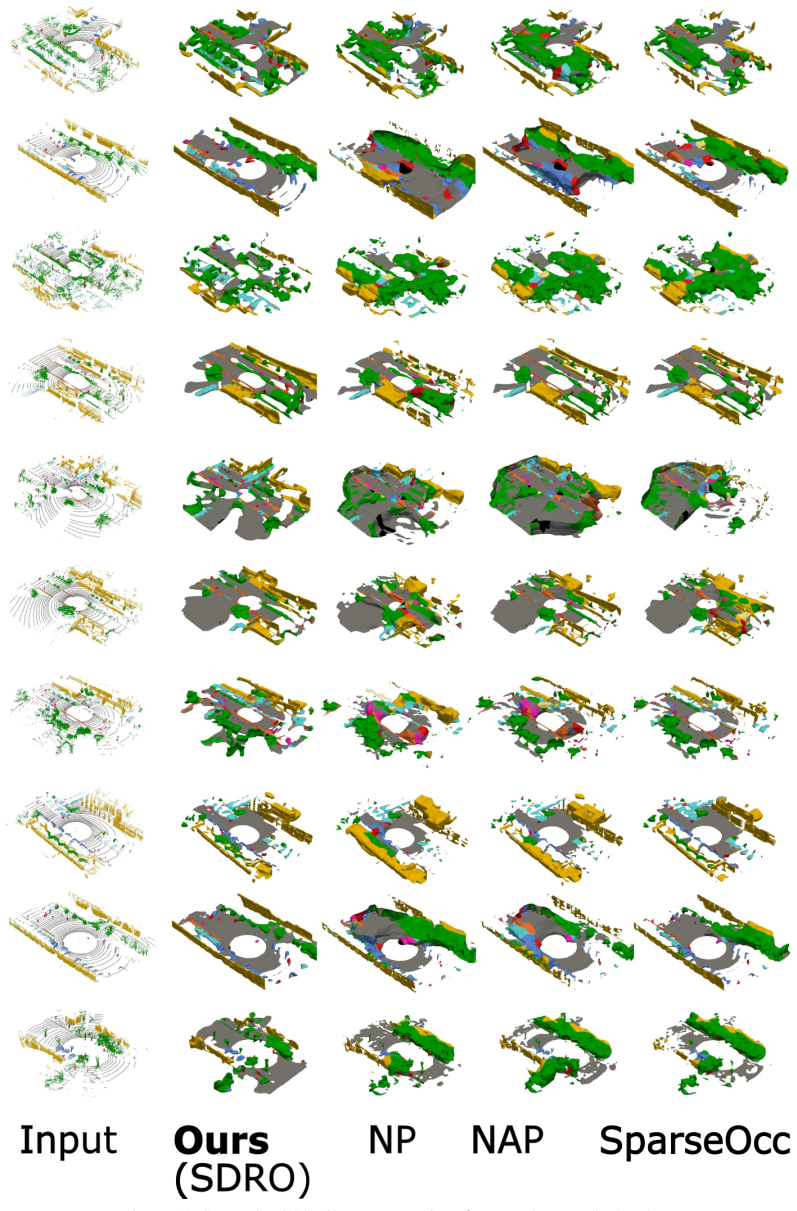
Matan Atzmon and Yaron Lipman. Sald: Sign agnostic learn- ing with derivatives. In ICML, 2020. 3
2020
-
[5]
Regu- larization for wasserstein distributionally robust optimization
Waïss Azizian, Franck Iutzeler, and Jérôme Malick. Regu- larization for wasserstein distributionally robust optimization. ESAIM: Control, Optimisation and Calculus of Variations , 29:33, 2023. 2, 4, 12
2023
-
[6]
Digs: Divergence guided shape implicit neu- ral representation for unoriented point clouds
Yizhak Ben-Shabat, Chamin Hewa Koneputugodage, and Stephen Gould. Digs: Divergence guided shape implicit neu- ral representation for unoriented point clouds. In Proceedings of the IEEE/CVF Conference on Computer Vision and Pattern Recognition, pages 19323–19332, 2022. 2, 5, 12, 13
2022
-
[7]
Robust solutions of optimization problems affected by uncertain probabilities
Aharon Ben-Tal, Dick Den Hertog, Anja De Waegenaere, Bertrand Melenberg, and Gijs Rennen. Robust solutions of optimization problems affected by uncertain probabilities. Management Science, 59(2):341–357, 2013. 2, 12
2013
Show all 100 references
-
[8]
The ball-pivoting algorithm for surface reconstruction
Fausto Bernardini, Joshua Mittleman, Holly Rushmeier, Clau- dio Silva, and Gabriel Taubin. The ball-pivoting algorithm for surface reconstruction. TVCG, 1999. 2
1999
-
[9]
Data- driven robust optimization
Dimitris Bertsimas, Vishal Gupta, and Nathan Kallus. Data- driven robust optimization. Mathematical Programming, 167: 235–292, 2018. 12
2018
-
[10]
Semi-supervised learning based on distributionally robust optimization, 2020
Jose Blanchet and Yang Kang. Semi-supervised learning based on distributionally robust optimization, 2020. 2
2020
-
[11]
Quantifying distribu- tional model risk via optimal transport
Jose Blanchet and Karthyek Murthy. Quantifying distribu- tional model risk via optimal transport. Mathematics of Oper- ations Research, 44(2):565–600, 2019. 2, 4, 12
2019
-
[12]
Federica Bogo, Javier Romero, Matthew Loper, and Michael J. Black. FAUST: Dataset and evaluation for 3D mesh registra- tion. In CVPR, 2014. 5, 6
2014
-
[13]
Poco: Point con- volution for surface reconstruction
Alexandre Boulch and Renaud Marlet. Poco: Point con- volution for surface reconstruction. In Proceedings of the IEEE/CVF Conference on Computer Vision and Pattern Recognition, pages 6302–6314, 2022. 2, 5, 6, 13
2022
-
[14]
Needrop: Self-supervised shape represen- tation from sparse point clouds using needle dropping
Alexandre Boulch, Pierre-Alain Langlois, Gilles Puy, and Renaud Marlet. Needrop: Self-supervised shape represen- tation from sparse point clouds using needle dropping. In 2021 International Conference on 3D Vision (3DV) , pages 940–950. IEEE, 2021. 3, 5, 7
2021
-
[15]
A unified wasserstein distributional robust- ness framework for adversarial training
Tuan Anh Bui, Trung Le, Quan Tran, He Zhao, and Dinh Phung. A unified wasserstein distributional robust- ness framework for adversarial training. arXiv preprint arXiv:2202.13437, 2022. 2, 4, 12
2022 arXiv
-
[16]
Reconstruction and representation of 3d objects with radial basis functions
Jonathan C Carr, Richard K Beatson, Jon B Cherrie, Tim J Mitchell, W Richard Fright, Bruce C McCallum, and Tim R Evans. Reconstruction and representation of 3d objects with radial basis functions. In SIGGRAPH, 2001. 2
2001
-
[17]
Frédéric Cazals and Joachim Giesen.Effective Computational Geometry for Curves and Surfaces. 2006. 2
2006
-
[18]
Efficient geometry-aware 3d generative adversarial networks
Eric R Chan, Connor Z Lin, Matthew A Chan, Koki Nagano, Boxiao Pan, Shalini De Mello, Orazio Gallo, Leonidas J Guibas, Jonathan Tremblay, Sameh Khamis, et al. Efficient geometry-aware 3d generative adversarial networks. In Pro- ceedings of the IEEE/CVF Conference on Computer V...
2022
-
[19]
Shapenet: An information- rich 3d model repository
Angel X Chang, Thomas Funkhouser, Leonidas Guibas, Pat Hanrahan, Qixing Huang, Zimo Li, Silvio Savarese, Manolis Savva, Shuran Song, Hao Su, et al. Shapenet: An information- rich 3d model repository. arXiv preprint arXiv:1512.03012,
-
[20]
Latent partition implicit with surface codes for 3d representation
Chao Chen, Yu-Shen Liu, and Zhizhong Han. Latent partition implicit with surface codes for 3d representation. InEuropean Conference on Computer Vision (ECCV), 2022. 3
2022
-
[21]
Unsupervised inference of signed distance functions from single sparse point clouds without learning priors
Chao Chen, Zhizhong Han, and Yu-Shen Liu. Unsupervised inference of signed distance functions from single sparse point clouds without learning priors. In Proceedings of the IEEE/CVF Conference on Computer Vision and Pattern Recognition (CVPR), 2023. 1, 2, 3, 5, 6, 7, 12, 13
2023
-
[22]
Gridpull: To- wards scalability in learning implicit representations from 3d point clouds
Chao Chen, Yu-Shen Liu, and Zhizhong Han. Gridpull: To- wards scalability in learning implicit representations from 3d point clouds. In Proceedings of the ieee/cvf international conference on computer vision, pages 18322–18334, 2023. 5, 6
2023
-
[23]
Implicit feature net- works for texture completion from partial 3d data
Julian Chibane and Gerard Pons-Moll. Implicit feature net- works for texture completion from partial 3d data. In Eu- ropean Conference on Computer Vision , pages 717–725. Springer, 2020. 2
2020
-
[24]
Sinkhorn distances: Lightspeed computation of optimal transport
Marco Cuturi. Sinkhorn distances: Lightspeed computation of optimal transport. Advances in neural information processing systems, 26, 2013. 2, 4
2013
-
[25]
A point set generation network for 3d object reconstruction from a single image
Haoqiang Fan, Hao Su, and Leonidas J Guibas. A point set generation network for 3d object reconstruction from a single image. In CVPR, 2017. 2
2017
-
[26]
Distributionally robust stochas- tic optimization with wasserstein distance
Rui Gao and Anton Kleywegt. Distributionally robust stochas- tic optimization with wasserstein distance. Mathematics of Operations Research, 48(2):603–655, 2023. 4
2023
-
[27]
Distributionally robust optimiza- tion and its tractable approximations
Joel Goh and Melvyn Sim. Distributionally robust optimiza- tion and its tractable approximations. Operations research, 58(4-part-1):902–917, 2010. 12
2010
-
[28]
Implicit geometric regularization for learning shapes
Amos Gropp, Lior Yariv, Niv Haim, Matan Atzmon, and Yaron Lipman. Implicit geometric regularization for learning shapes. In ICML, 2020. 2
2020
-
[29]
Algebraic point set surfaces
Gaël Guennebaud and Markus Gross. Algebraic point set surfaces. In ACM siggraph 2007 papers, pages 23–es. 2007. 1, 2
2007
-
[30]
Iterative poisson surface reconstruction (ipsr) for unoriented points
Fei Hou, Chiyu Wang, Wencheng Wang, Hong Qin, Chen Qian, and Ying He. Iterative poisson surface reconstruction (ipsr) for unoriented points. arXiv preprint arXiv:2209.09510,
-
[31]
Neusurf: On-surface priors for neural surface reconstruction from sparse input views
Han Huang, Yulun Wu, Junsheng Zhou, Ge Gao, Ming Gu, and Yushen Liu. Neusurf: On-surface priors for neural surface reconstruction from sparse input views. In AAAI, 2024. 3
2024
-
[32]
Neural kernel surface recon- struction
Jiahui Huang, Zan Gojcic, Matan Atzmon, Or Litany, Sanja Fidler, and Francis Williams. Neural kernel surface recon- struction. In Proceedings of the IEEE/CVF Conference on Computer Vision and Pattern Recognition (CVPR) , pages 4369–4379, 2023. 5, 6
2023
-
[33]
Neural kernel surface recon- struction
Jiahui Huang, Zan Gojcic, Matan Atzmon, Or Litany, Sanja Fidler, and Francis Williams. Neural kernel surface recon- struction. In Proceedings of the IEEE/CVF Conference on Computer Vision and Pattern Recognition, pages 4369–4379,
-
[34]
Barron, Pieter Abbeel, and Ben Poole
Ajay Jain, Ben Mildenhall, Jonathan T. Barron, Pieter Abbeel, and Ben Poole. Zero-shot text-guided object generation with dream fields. 2022. 2
2022
-
[35]
Neural mesh-based graphics
Shubhendu Jena, Franck Multon, and Adnane Boukhayma. Neural mesh-based graphics. In European Conference on Computer Vision, 2022. 2
2022
-
[36]
Geotransfer: Generalizable few-shot multi-view reconstruc- tion via transfer learning
Shubhendu Jena, Franck Multon, and Adnane Boukhayma. Geotransfer: Generalizable few-shot multi-view reconstruc- tion via transfer learning. In European Conference on Com- puter Vision, 2024. 2
2024
-
[37]
Local implicit grid representations for 3d scenes
Chiyu Jiang, Avneesh Sud, Ameesh Makadia, Jingwei Huang, Matthias Nießner, Thomas Funkhouser, et al. Local implicit grid representations for 3d scenes. In CVPR, 2020. 5
2020
-
[38]
Neu- ral 3d mesh renderer
Hiroharu Kato, Yoshitaka Ushiku, and Tatsuya Harada. Neu- ral 3d mesh renderer. In CVPR, 2018. 2
2018
-
[39]
Screened poisson surface reconstruction
Michael Kazhdan and Hugues Hoppe. Screened poisson surface reconstruction. TOG, 2013. 1, 2, 6, 7, 12
2013
-
[40]
3d gaussian splatting for real-time radiance field rendering
Bernhard Kerbl, Georgios Kopanas, Thomas Leimkühler, and George Drettakis. 3d gaussian splatting for real-time radiance field rendering. ACM Transactions on Graphics, 2023. 2
2023
-
[41]
Tanks and temples: Benchmarking large-scale scene reconstruction
Arno Knapitsch, Jaesik Park, Qian-Yi Zhou, and Vladlen Koltun. Tanks and temples: Benchmarking large-scale scene reconstruction. ACM Transactions on Graphics (ToG), 36(4): 1–13, 2017. 5, 7, 8
2017
-
[42]
Provably good moving least squares
Ravikrishna Kolluri. Provably good moving least squares. TALG, 2008. 2
2008
-
[43]
Octree guided unoriented surface reconstruc- tion
Chamin Hewa Koneputugodage, Yizhak Ben-Shabat, and Stephen Gould. Octree guided unoriented surface reconstruc- tion. In Proceedings of the IEEE/CVF Conference on Com- puter Vision and Pattern Recognition, pages 16717–16726,
-
[44]
Learn- ing generalizable light field networks from few images
Qian Li, Franck Multon, and Adnane Boukhayma. Learn- ing generalizable light field networks from few images. In ICASSP 2023-2023 IEEE International Conference on Acous- tics, Speech and Signal Processing (ICASSP) , pages 1–5. IEEE, 2023. 2
2023
-
[45]
Regulariz- ing neural radiance fields from sparse rgb-d inputs
Qian Li, Franck Multon, and Adnane Boukhayma. Regulariz- ing neural radiance fields from sparse rgb-d inputs. In 2023 IEEE International Conference on Image Processing (ICIP), pages 2320–2324. IEEE, 2023. 2
2023
-
[46]
Auxiliary tasks in multi-task learning
Lukas Liebel and Marco Körner. Auxiliary tasks in multi-task learning. arXiv preprint arXiv:1805.06334, 2018. 5
2018 arXiv
-
[47]
Sur- face reconstruction from point clouds without normals by parametrizing the gauss formula
Siyou Lin, Dong Xiao, Zuoqiang Shi, and Bin Wang. Sur- face reconstruction from point clouds without normals by parametrizing the gauss formula. ACM Transactions on Graphics, 42(2):1–19, 2022. 2
2022
-
[48]
Dynamic plane convolutional occupancy networks
Stefan Lionar, Daniil Emtsev, Dusan Svilarkovic, and Songyou Peng. Dynamic plane convolutional occupancy networks. In Proceedings of the IEEE/CVF Winter Confer- ence on Applications of Computer Vision, pages 1829–1838,
-
[49]
Phase transitions, distance functions, and implicit neural representations
Yaron Lipman. Phase transitions, distance functions, and implicit neural representations. In ICML, 2021. 3
2021
-
[50]
Learning smooth neural functions via lipschitz regularization
Hsueh-Ti Derek Liu, Francis Williams, Alec Jacobson, Sanja Fidler, and Or Litany. Learning smooth neural functions via lipschitz regularization. arXiv preprint arXiv:2202.08345,
-
[51]
Meshing point clouds with predicted intrinsic-extrinsic ratio guidance
Minghua Liu, Xiaoshuai Zhang, and Hao Su. Meshing point clouds with predicted intrinsic-extrinsic ratio guidance. In ECCV, 2020. 2
2020
-
[52]
Deep implicit moving least-squares functions for 3d reconstruction
Shi-Lin Liu, Hao-Xiang Guo, Hao Pan, Peng-Shuai Wang, Xin Tong, and Yang Liu. Deep implicit moving least-squares functions for 3d reconstruction. In CVPR, 2021. 2
2021
-
[53]
Marching cubes: A high resolution 3d surface construction algorithm
William E Lorensen and Harvey E Cline. Marching cubes: A high resolution 3d surface construction algorithm. In SIG- GRAPH, 1987. 3
1987
-
[54]
Neural-pull: Learning signed distance functions from point clouds by learning to pull space onto surfaces
Baorui Ma, Zhizhong Han, Yu-Shen Liu, and Matthias Zwicker. Neural-pull: Learning signed distance functions from point clouds by learning to pull space onto surfaces. In ICML, 2021. 1, 2, 3, 5, 6, 7, 8, 12
2021
-
[55]
Reconstruct- ing surfaces for sparse point clouds with on-surface priors
Baorui Ma, Yu-Shen Liu, and Zhizhong Han. Reconstruct- ing surfaces for sparse point clouds with on-surface priors. In Proceedings of the IEEE/CVF Conference on Computer Vision and Pattern Recognition, pages 6315–6325, 2022. 3, 5, 6
2022
-
[56]
Surface reconstruction from point clouds by learning predictive context priors
Baorui Ma, Yu-Shen Liu, Matthias Zwicker, and Zhizhong Han. Surface reconstruction from point clouds by learning predictive context priors. In Proceedings of the IEEE/CVF Conference on Computer Vision and Pattern Recognition , pages 6326–6337, 2022. 3
2022
-
[57]
Moving level-of-detail surfaces
Corentin Mercier, Thibault Lescoat, Pierre Roussillon, Tamy Boubekeur, and Jean-Marc Thiery. Moving level-of-detail surfaces. ACM Transactions on Graphics (TOG), 41(4):1–10,
-
[58]
Occupancy networks: Learning 3d reconstruction in function space
Lars Mescheder, Michael Oechsle, Michael Niemeyer, Se- bastian Nowozin, and Andreas Geiger. Occupancy networks: Learning 3d reconstruction in function space. In Proceedings of the IEEE/CVF conference on computer vision and pattern recognition, pages 4460–4470, 2019. 2, 15
2019
-
[59]
Nerf: Representing scenes as neural radiance fields for view synthe- sis
Ben Mildenhall, Pratul P Srinivasan, Matthew Tancik, Jonathan T Barron, Ravi Ramamoorthi, and Ren Ng. Nerf: Representing scenes as neural radiance fields for view synthe- sis. In ECCV, 2020. 2
2020
-
[60]
Distributional smoothing with virtual adversarial training
Takeru Miyato, Shin-ichi Maeda, Masanori Koyama, Ken Nakae, and Shin Ishii. Distributional smoothing with virtual adversarial training. arXiv preprint arXiv:1507.00677, 2015. 2, 12
2015 arXiv
-
[61]
Data-driven distributionally robust optimization using the wasserstein met- ric: performance guarantees and tractable reformulations
Peyman Mohajerin Esfahani and Daniel Kuhn. Data-driven distributionally robust optimization using the wasserstein met- ric: performance guarantees and tractable reformulations. Mathematical Programming, 171(1-2):115–166, 2018. 2, 12
2018
-
[62]
Stochastic gra- dient methods for distributionally robust optimization with f-divergences
Hongseok Namkoong and John C Duchi. Stochastic gra- dient methods for distributionally robust optimization with f-divergences. In NIPS, pages 2208–2216, 2016. 2, 12
2016
-
[63]
Few’zero level set’- shot learning of shape signed distance functions in feature space
Amine Ouasfi and Adnane Boukhayma. Few’zero level set’- shot learning of shape signed distance functions in feature space. In ECCV, 2022. 2
2022
-
[64]
Few-shot unsuper- vised implicit neural shape representation learning with spa- tial adversaries
Amine Ouasfi and Adnane Boukhayma. Few-shot unsuper- vised implicit neural shape representation learning with spa- tial adversaries. arXiv preprint arXiv:2408.15114, 2024. 1, 2, 3, 5, 6, 7, 8, 12
2024 arXiv
-
[65]
Mixing-denoising generalizable occupancy networks
Amine Ouasfi and Adnane Boukhayma. Mixing-denoising generalizable occupancy networks. 3DV, 2024. 2
2024
-
[66]
Robustifying general- izable implicit shape networks with a tunable non-parametric model
Amine Ouasfi and Adnane Boukhayma. Robustifying general- izable implicit shape networks with a tunable non-parametric model. Advances in Neural Information Processing Systems, 36, 2024. 1, 2
2024
-
[67]
Unsupervised occu- pancy learning from sparse point cloud
Amine Ouasfi and Adnane Boukhayma. Unsupervised occu- pancy learning from sparse point cloud. In Proceedings of the IEEE/CVF Conference on Computer Vision and Pattern Recognition, pages 21729–21739, 2024. 2, 3, 5, 6, 7, 8, 12
2024
-
[68]
Semanticposs: A point cloud dataset with large quantity of dynamic instances
Yancheng Pan, Biao Gao, Jilin Mei, Sibo Geng, Chengkun Li, and Huijing Zhao. Semanticposs: A point cloud dataset with large quantity of dynamic instances. In 2020 IEEE Intelligent Vehicles Symposium (IV), pages 687–693, 2020. 5, 7, 14
2020
-
[69]
Deepsdf: Learning continuous signed distance functions for shape representation
Jeong Joon Park, Peter Florence, Julian Straub, Richard New- combe, and Steven Lovegrove. Deepsdf: Learning continuous signed distance functions for shape representation. In CVPR,
-
[70]
A linear time histogram metric for improved sift matching
Ofir Pele and Michael Werman. A linear time histogram metric for improved sift matching. In European Conference on Computer Vision, pages 495–508, 2008. 2
2008
-
[71]
Convolutional occupancy net- works
Songyou Peng, Michael Niemeyer, Lars Mescheder, Marc Pollefeys, and Andreas Geiger. Convolutional occupancy net- works. In European Conference on Computer Vision, pages 523–540. Springer, 2020. 2, 5, 6, 15
2020
-
[72]
Shape as points: A differentiable poisson solver
Songyou Peng, Chiyu Jiang, Yiyi Liao, Michael Niemeyer, Marc Pollefeys, and Andreas Geiger. Shape as points: A differentiable poisson solver. Advances in Neural Information Processing Systems, 34:13032–13044, 2021. 2, 3, 5, 7
2021
-
[73]
Distribution- ally robust optimization: A review
Hamed Rahimian and Sanjay Mehrotra. Distribution- ally robust optimization: A review. arXiv preprint arXiv:1908.05659, 2019. 1
1908 arXiv
-
[74]
Differentiable surface triangulation
Marie-Julie Rakotosaona, Noam Aigerman, Niloy Mitra, Maks Ovsjanikov, and Paul Guerrero. Differentiable surface triangulation. In SIGGRAPH Asia, 2021. 2
2021
-
[75]
The earth mover’s distance as a metric for image retrieval
Yossi Rubner, Carlo Tomasi, and Leonidas J Guibas. The earth mover’s distance as a metric for image retrieval. Inter- national Journal of Computer Vision , 40(2):99–121, 2000. 2
2000
-
[76]
A min-max solution of an inventory problem
Herbert E Scarf, KJ Arrow, and S Karlin. A min-max solution of an inventory problem. Rand Corporation Santa Monica,
-
[77]
Kernel methods for implicit surface modeling
Bernhard Schölkopf, Joachim Giesen, and Simon Spalinger. Kernel methods for implicit surface modeling. In NeurIPS,
-
[78]
Distributionally robust logistic regres- sion
Soroosh Shafieezadeh Abadeh, Peyman M Mohajerin Esfa- hani, and Daniel Kuhn. Distributionally robust logistic regres- sion. Advances in neural information processing systems, 28,
-
[79]
Certifying some distributional robustness with princi- pled adversarial training
Aman Sinha, Hongseok Namkoong, Riccardo V olpi, and John Duchi. Certifying some distributional robustness with princi- pled adversarial training. arXiv preprint arXiv:1710.10571,
-
[80]
Implicit neural representa- tions with periodic activation functions
Vincent Sitzmann, Julien Martel, Alexander Bergman, David Lindell, and Gordon Wetzstein. Implicit neural representa- tions with periodic activation functions. In NeurIPS, 2020. 3
2020
-
[81]
Earth mover’s distances on discrete surfaces
Justin Solomon, Raif Rustamov, Leonidas Guibas, and Adrian Butscher. Earth mover’s distances on discrete surfaces. ACM Transactions on Graphics, 33(4):67, 2014. 2
2014
-
[82]
Convolutional wasserstein distances: Ef- ficient optimal transportation on geometric domains
Justin Solomon, Fernando De Goes, Gabriel Peyré, Marco Cuturi, Adrian Butscher, Andy Nguyen, Taegyu Du, and Leonidas Guibas. Convolutional wasserstein distances: Ef- ficient optimal transportation on geometric domains. ACM Transactions on Graphics, 34(4):66, 2015. 2
2015
-
[83]
Distributionally robust deep learning as a generalization of adversarial training
Matthew Staib and Stefanie Jegelka. Distributionally robust deep learning as a generalization of adversarial training. In NIPS workshop on Machine Learning and Computer Security, page 4, 2017. 2
2017
-
[84]
Generalizing to unseen domains via adversarial data augmentation
Riccardo V olpi, Hongseok Namkoong, Ozan Sener, John C Duchi, Vittorio Murino, and Silvio Savarese. Generalizing to unseen domains via adversarial data augmentation. Advances in neural information processing systems, 31, 2018. 1
2018
-
[86]
Vggsfm: Visual geometry grounded deep structure from motion
Jianyuan Wang, Nikita Karaev, Christian Rupprecht, and David Novotny. Vggsfm: Visual geometry grounded deep structure from motion. In Proceedings of the IEEE/CVF Con- ference on Computer Vision and Pattern Recognition, pages 21686–21697, 2024. 5, 7
2024
-
[87]
Pixel2mesh: Generating 3d mesh models from single rgb images
Nanyang Wang, Yinda Zhang, Zhuwen Li, Yanwei Fu, Wei Liu, and Yu-Gang Jiang. Pixel2mesh: Generating 3d mesh models from single rgb images. In ECCV, 2018. 2
2018
-
[88]
Neus: Learning neural implicit surfaces by volume rendering for multi-view reconstruction
Peng Wang, Lingjie Liu, Yuan Liu, Christian Theobalt, Taku Komura, and Wenping Wang. Neus: Learning neural implicit surfaces by volume rendering for multi-view reconstruction. arXiv preprint arXiv:2106.10689, 2021. 2
2021 arXiv
-
[89]
Deep geometric prior for surface reconstruction
Francis Williams, Teseo Schneider, Claudio Silva, Denis Zorin, Joan Bruna, and Daniele Panozzo. Deep geometric prior for surface reconstruction. In CVPR, 2019. 12, 13
2019
-
[90]
Neural splines: Fitting 3d surfaces with infinitely-wide neural networks
Francis Williams, Matthew Trager, Joan Bruna, and Denis Zorin. Neural splines: Fitting 3d surfaces with infinitely-wide neural networks. In CVPR, 2021. 2, 3, 5, 7
2021
-
[91]
Neural fields as learnable kernels for 3d reconstruction
Francis Williams, Zan Gojcic, Sameh Khamis, Denis Zorin, Joan Bruna, Sanja Fidler, and Or Litany. Neural fields as learnable kernels for 3d reconstruction. In CVPR, 2022. 2
2022
-
[92]
Blendedmvs: A large- scale dataset for generalized multi-view stereo networks
Yao Yao, Zixin Luo, Shiwei Li, Jingyang Zhang, Yufan Ren, Lei Zhou, Tian Fang, and Long Quan. Blendedmvs: A large- scale dataset for generalized multi-view stereo networks. In Proceedings of the IEEE/CVF conference on computer vision and pattern recognition, pages 1790–1799, 2...
2020
-
[93]
V ol- ume rendering of neural implicit surfaces.Advances in Neural Information Processing Systems, 34:4805–4815, 2021
Lior Yariv, Jiatao Gu, Yoni Kasten, and Yaron Lipman. V ol- ume rendering of neural implicit surfaces.Advances in Neural Information Processing Systems, 34:4805–4815, 2021. 2
2021
-
[94]
Spar- secraft: Few-shot neural reconstruction through stereopsis guided geometric linearization
Mae Younes, Amine Ouasfi, and Adnane Boukhayma. Spar- secraft: Few-shot neural reconstruction through stereopsis guided geometric linearization. In European Conference on Computer Vision. 3
-
[95]
Dense scene reconstruc- tion with points of interest
Qian-Yi Zhou and Vladlen Koltun. Dense scene reconstruc- tion with points of interest. ACM Transactions on Graphics (ToG), 32(4):1–8, 2013. 5, 7
2013
-
[96]
The DRO framework operates by defining an uncertainty set U, typically modeled as a ball of radiusϵ around an empirical distribution ˆQn , such that U = {Q : d(Q, ˆQn) ≤ ϵ}
Background on Distributionally Robust Op- timization Distributionally Robust Optimization (DRO) was initially introduced by [76] and has since become a significant frame- work for addressing uncertainty in decision-making [9, 27] . The DRO framework operates by defining an unc...
-
[97]
Varying the point cloud density In order to assess the performance of our method under vari- ous point cloud densities we perform an ablative analysis on the SRB benchmark [89]
Additional Ablative Analysis 9.1. Varying the point cloud density In order to assess the performance of our method under vari- ous point cloud densities we perform an ablative analysis on the SRB benchmark [89]. We present quantitative results for Sparse Dense SPSR [39] 2.27 1...
-
[98]
Training algorithm for WDRO We provide in Algorithm 2 the detailed training procedure for WDRO
-
[99]
Additional Qualitative Results We provide additional qualitative comparisons using Seman- ticPOSS road scene LiDAR data. Fig. 11 highlights the superiority of our method in this challenging scenario com- pared to NAP and SparseOcc. This is particularly evident in highly noisy ...
-
[100]
Let S and ˆS denote the ground truth and predicted meshes, respectively
Evaluation Metrics Building on the definitions provided in [ 13] and [ 89], we present the formal definitions of the metrics used for evalua- tion in the main submission. Let S and ˆS denote the ground truth and predicted meshes, respectively. Following [21], all metrics are a...
Reviewed August 11, 2026 · model on record in the stance chip above.
Discussion (0). Continue with ORCID to comment.