Hard-constrained Physics-informed Neural Networks for Interface Problems
Pith reviewed 2026-05-21 09:18 UTC · model grok-4.3
The pith
Hard-constrained PINNs embed interface continuity and flux balance directly into the neural network solution, decoupling enforcement from PDE minimization and removing loss-weight tuning.
A machine-rendered reading of the paper's core claim, the machinery that carries it, and where it could break.
Core claim
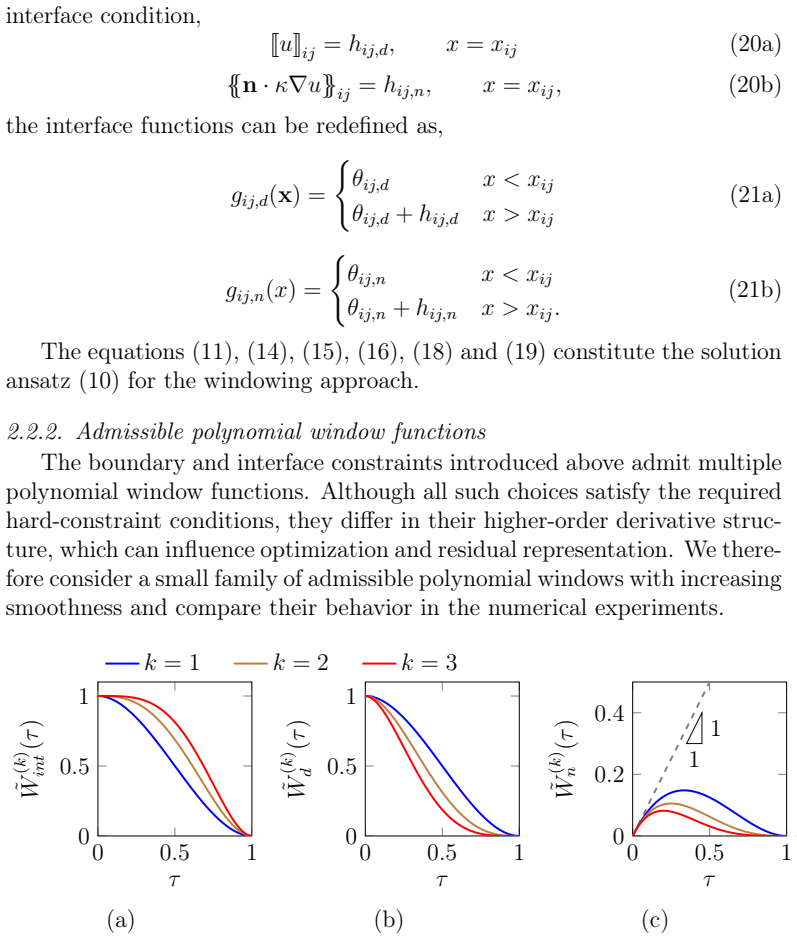
The paper introduces two hard-constrained PINN formulations for interface problems. The windowing approach constructs the trial space from compactly supported windowed subnetworks so that interface continuity and flux balance are satisfied by design. The buffer approach augments unrestricted subnetworks with auxiliary buffer functions that enforce boundary and interface constraints at discrete points through a lightweight correction. Both decouple interface enforcement from PDE residual minimization and yield higher interface fidelity on elliptic benchmarks without loss-weight tuning.
What carries the argument
Ansatz-based hard-constrained formulations (windowing with compactly supported subnetworks and buffer with discrete auxiliary corrections) that embed interface continuity and flux conditions into the solution representation by construction.
If this is right
- In one dimension the windowing method reaches errors as low as O(10^{-9}) on simple structured cases.
- The buffer method maintains roughly O(10^{-5}) accuracy across varied source terms and interface configurations.
- In two dimensions the buffer formulation remains robust while windowing becomes sensitive to overlap and corner effects.
- Both formulations remove the need to tune loss weights that soft-constrained PINNs require.
Where Pith is reading between the lines
- The same hard-constraint construction could be adapted to time-dependent or nonlinear interface problems by updating the window or buffer functions dynamically.
- The discrete buffer correction may extend more readily to irregular or high-dimensional geometries than the continuous windowing construction.
- Combining the buffer method with existing adaptive sampling techniques in PINNs could further reduce training cost on complex interfaces.
Load-bearing premise
The interface geometry and location must be known exactly in advance so that the window functions or buffer correction points can be defined without adding new approximation error.
What would settle it
Train both the windowing and buffer hard-constrained PINNs on the same one- and two-dimensional elliptic interface benchmark problems used in the paper and check whether the measured interface error norms are lower than those obtained from standard soft-constrained PINNs when no loss-weight tuning is performed.
Figures


read the original abstract
Physics-informed neural networks (PINNs) have emerged as a flexible framework for solving partial differential equations, but their performance on interface problems remains challenging because continuity and flux conditions are typically imposed through soft penalty terms. The standard soft-constraint formulation leads to imperfect interface enforcement and degraded accuracy near interfaces. We introduce two ansatz-based hard-constrained PINN formulations for interface problems that embed the interface physics into the solution representation and thereby decouple interface enforcement from PDE residual minimization. The first, termed the windowing approach, constructs the trial space from compactly supported windowed subnetworks so that interface continuity and flux balance are satisfied by design. The second, called the buffer approach, augments unrestricted subnetworks with auxiliary buffer functions that enforce boundary and interface constraints at discrete points through a lightweight correction. We study these formulations on one- and two-dimensional elliptic interface benchmarks and compare them with soft-constrained baselines. In one-dimensional problems, hard constraints consistently improve interface fidelity and remove the need for loss-weight tuning; the windowing approach attains very high accuracy (as low as $O(10^{-9})$) on simple structured cases, whereas the buffer approach remains accurate ($\sim O(10^{-5})$) across a wider range of source terms and interface configurations. In two dimensions, the buffer formulation is shown to be more robust because it enforces constraints through a discrete buffer correction, as the windowing construction becomes more sensitive to overlap and corner effects and over-constrains the problem. This positions the buffer method as a straightforward and geometrically flexible approach to complex interface problems.
Editorial analysis
A structured set of objections, weighed in public.
Referee Report
Summary. The paper introduces two ansatz-based hard-constrained PINN formulations for elliptic interface problems. The windowing approach constructs the trial space from compactly supported windowed subnetworks so that interface continuity and flux balance hold by design. The buffer approach augments subnetworks with auxiliary buffer functions that enforce constraints at discrete points via a lightweight correction. Both are tested on 1D and 2D benchmarks against soft-constrained baselines, with windowing reaching O(10^{-9}) accuracy on simple 1D cases and buffer proving more robust in 2D due to reduced sensitivity to geometry details.
Significance. If the central claims hold, the work offers a practical route to enforce interface conditions exactly in PINNs without loss-weight tuning, which could improve accuracy and reliability for interface problems arising in fluid dynamics, materials science, and electromagnetics. The explicit comparison of two distinct hard-constraint mechanisms and the identification of buffer robustness in 2D provide concrete guidance for practitioners.
major comments (2)
- [Abstract and §4 (Numerical Experiments)] Abstract and results presentation: reported accuracies (O(10^{-9}) in 1D windowing, O(10^{-5}) in 2D buffer) are given without network architectures, training-point counts, optimizer details, or error bars across multiple runs. This information is load-bearing for assessing whether the observed gains over soft baselines are reproducible and insensitive to hyperparameter choices.
- [Windowing approach description] Windowing formulation: the claim that continuity and flux balance are satisfied exactly by construction presupposes that the interface geometry is known precisely enough to define the compactly supported windows without discretization error. For curved or non-grid-aligned interfaces, any approximation in window support or overlap introduces a coupling between constraint enforcement and the underlying discretization, undermining the asserted decoupling from PDE residual minimization. The noted 2D sensitivity to overlap and corners already signals this fragility.
minor comments (3)
- [Method sections] Provide explicit formulas for the window functions and buffer corrections in the main text (rather than relegating all details to an appendix) to improve readability.
- [Numerical results] Add a short discussion or table comparing the computational overhead (training time, number of parameters) of the hard-constrained formulations versus the soft baseline.
- [Buffer approach] Clarify the precise definition of the discrete buffer correction points and how they are chosen when the interface is not aligned with the collocation grid.
Simulated Author's Rebuttal
We thank the referee for the thorough review and valuable comments on our manuscript. We provide point-by-point responses to the major comments and outline the revisions we plan to implement.
read point-by-point responses
-
Referee: [Abstract and §4 (Numerical Experiments)] Abstract and results presentation: reported accuracies (O(10^{-9}) in 1D windowing, O(10^{-5}) in 2D buffer) are given without network architectures, training-point counts, optimizer details, or error bars across multiple runs. This information is load-bearing for assessing whether the observed gains over soft baselines are reproducible and insensitive to hyperparameter choices.
Authors: We agree with the referee that providing these implementation details is crucial for assessing reproducibility. In the revised manuscript, we will expand Section 4 to include the specific network architectures (depth and width of subnetworks), the number and distribution of training points in each subdomain, the choice of optimizer (e.g., Adam with learning rate schedule), and quantitative error statistics including means and standard deviations from at least five independent training runs with different initializations. revision: yes
-
Referee: [Windowing approach description] Windowing formulation: the claim that continuity and flux balance are satisfied exactly by construction presupposes that the interface geometry is known precisely enough to define the compactly supported windows without discretization error. For curved or non-grid-aligned interfaces, any approximation in window support or overlap introduces a coupling between constraint enforcement and the underlying discretization, undermining the asserted decoupling from PDE residual minimization. The noted 2D sensitivity to overlap and corners already signals this fragility.
Authors: The referee raises an important point regarding the practical realization of the windowing approach. Our theoretical construction assumes exact knowledge of the interface to define the compactly supported window functions, ensuring that the interface conditions are satisfied exactly in the continuous sense. In the discrete training, collocation points are sampled accordingly. However, for interfaces that are curved or not aligned with any underlying grid, defining the window supports exactly may indeed require numerical approximations, potentially introducing a weak coupling. This is consistent with the sensitivity to overlap parameters and corner effects that we already report in the 2D experiments, which motivated our recommendation of the buffer approach for more complex geometries. We will revise the description of the windowing method to clarify this assumption and add a brief discussion of its implications for general interface problems. revision: partial
Circularity Check
Ansatz-based hard-constrained formulations embed constraints by construction with no reduction to fitted inputs or self-referential predictions.
full rationale
The paper proposes two new formulations (windowing and buffer) that are explicitly constructed as ansatzes to satisfy interface continuity and flux balance in the trial space. These choices are presented as design decisions rather than derived predictions, and the central claims rest on empirical comparisons to soft-constrained baselines on elliptic benchmarks rather than on any self-citation chain or parameter fit that is then renamed as a result. The assumption of known interface geometry is stated up front and does not create a circular loop in the reported derivation or validation steps. This is a standard low-level ansatz construction with independent content in the numerical experiments.
Axiom & Free-Parameter Ledger
axioms (2)
- domain assumption Interface location and geometry are known exactly a priori.
- standard math Neural networks can represent the sub-problems on each side of the interface with sufficient accuracy.
Lean theorems connected to this paper
-
IndisputableMonolith/Cost/FunctionalEquation.leanwashburn_uniqueness_aczel unclear?
unclearRelation between the paper passage and the cited Recognition theorem.
The windowing approach constructs the trial space from compactly supported windowed subnetworks so that interface continuity and flux balance are satisfied by design... polynomial window functions... ˜Wint(τ)=1−3τ²+2τ³
-
IndisputableMonolith/Foundation/AlphaCoordinateFixation.leanalpha_pin_under_high_calibration unclear?
unclearRelation between the paper passage and the cited Recognition theorem.
buffer approach... augments unrestricted subnetworks with auxiliary buffer functions that enforce boundary and interface constraints at discrete points through a lightweight correction
What do these tags mean?
- matches
- The paper's claim is directly supported by a theorem in the formal canon.
- supports
- The theorem supports part of the paper's argument, but the paper may add assumptions or extra steps.
- extends
- The paper goes beyond the formal theorem; the theorem is a base layer rather than the whole result.
- uses
- The paper appears to rely on the theorem as machinery.
- contradicts
- The paper's claim conflicts with a theorem or certificate in the canon.
- unclear
- Pith found a possible connection, but the passage is too broad, indirect, or ambiguous to say the theorem truly supports the claim.
Reference graph
Works this paper leans on
-
[1]
G. E. Karniadakis, I. G. Kevrekidis, L. Lu, P. Perdikaris, S. Wang, L. Yang, Physics-informed machine learning, Nature Reviews Physics 3 (6) (2021) 422–440
work page 2021
-
[2]
I. E. Lagaris, A. Likas, D. I. Fotiadis, Artificial neural networks for solving ordinary and partial differential equations, IEEE Transactions on Neural Networks 9 (5) (1998) 987–1000
work page 1998
- [3]
- [4]
-
[5]
A. D. Jagtap, G. E. Karniadakis, Extended physics-informed neural net- works (xpinns): A generalized space-time domain decomposition based deep learning framework for nonlinear partial differential equations, Communications in Computational Physics 28 (5) (2020)
work page 2020
-
[6]
A. D. Jagtap, E. Kharazmi, G. E. Karniadakis, Conservative physics- informed neural networks on discrete domains for conservation laws: Applications to forward and inverse problems, Computer Methods in Applied Mechanics and Engineering 365 (2020) 113028
work page 2020
-
[7]
S. Li, M. Penwarden, Y. Xu, C. Tillinghast, A. Narayan, M. Kirby, S. Zhe, Meta learning of interface conditions for multi-domain physics- informed neural networks, in: Proceedings of the 40th International Conference on Machine Learning, Vol. 202 of Proceedings of Machine Learning Research, PMLR, 2023, pp. 19855–19881
work page 2023
-
[8]
S.Cuomo, V.S.DiCola, F.Giampaolo, G.Rozza, M.Raissi, F.Piccialli, Scientific machine learning through physics–informed neural networks: Where we are and what’s next, Journal of Scientific Computing 92 (3) (2022) 88. 50
work page 2022
-
[9]
L. Lu, R. Pestourie, W. Yao, Z. Wang, F. Verdugo, S. G. Johnson, Physics-informed neural networks with hard constraints for inverse de- sign, SIAMJournalon ScientificComputing43(6)(2021)B1105–B1132
work page 2021
-
[10]
N. Sukumar, A. Srivastava, Exact imposition of boundary conditions with distance functions in physics-informed deep neural networks, Com- puter Methods in Applied Mechanics and Engineering 389 (2022) 114333
work page 2022
-
[11]
J. Wang, Y. Mo, B. Izzuddin, C.-W. Kim, Exact dirichlet boundary physics-informed neural network epinn for solid mechanics, Computer Methods in Applied Mechanics and Engineering 414 (2023) 116184
work page 2023
-
[12]
S. Liu, H. Zhongkai, C. Ying, H. Su, J. Zhu, Z. Cheng, A unified hard- constraint framework for solving geometrically complex pdes, Advances in Neural Information Processing Systems 35 (2022) 20287–20299
work page 2022
- [13]
-
[14]
H. Yu, S. Zhang, A natural deep ritz method for essential boundary value problems, Journal of Computational Physics (2025) 114133
work page 2025
-
[15]
N. Sukumar, R. Roy, A wachspress-based transfinite formulation for exactly enforcing dirichlet boundary conditions on convex polyg- onal domains in physics-informed neural networks, arXiv preprint arXiv:2601.01756 (2026)
work page internal anchor Pith review arXiv 2026
- [16]
-
[17]
A. K. Sarma, S. Roy, C. Annavarapu, P. Roy, S. Jagannathan, Inter- face pinns (i-pinns): A physics-informed neural networks framework for interface problems, Computer Methods in Applied Mechanics and En- gineering 429 (2024) 117135
work page 2024
- [18]
- [19]
-
[20]
S. Roy, D. R. Sarkar, C. Annavarapu, P. Roy, B. Lecampion, D. M. Valiveti, Adaptive interface-pinns (adai-pinns) for transient diffusion: Applications to forward and inverse problems in heterogeneous media, Finite Elements in Analysis and Design 244 (2025) 104305
work page 2025
-
[21]
D. R. Sarkar, C. Annavarapu, P. Roy, Adaptive interface-pinns (adai- pinns) for inverse problems: Determining material properties for het- erogeneous systems, Finite Elements in Analysis and Design 249 (2025) 104373
work page 2025
-
[22]
P. Roy, S. T. Castonguay, Exact enforcement of temporal continuity in sequential physics-informed neural networks, Computer Methods in Applied Mechanics and Engineering 430 (2024) 117197
work page 2024
-
[23]
B. Moseley, A. Markham, T. Nissen-Meyer, Finite basis physics- informed neural networks (fbpinns): a scalable domain decomposition approach for solving differential equations, Advances in Computational Mathematics 49 (4) (2023) 62
work page 2023
-
[24]
R. Anderson, J. Andrej, A. Barker, J. Bramwell, J.-S. Camier, J. Cer- veny, V. Dobrev, Y. Dudouit, A. Fisher, T. Kolev, W. Pazner, M. Stow- ell, V. Tomov, I.Akkerman, J. Dahm, D.Medina, S.Zampini, MFEM: A modular finite element methods library, Computers & Mathematics with Applications 81 (2021) 42–74.doi:10.1016/j.camwa.2020.06.009
-
[25]
N. Vyas, D. Morwani, R. Zhao, M. Kwun, I. Shapira, D. Brandfonbrener, L. Janson, S. Kakade, Soap: Improving and stabilizing shampoo using adam, arXiv preprint arXiv:2409.11321 (2024)
work page internal anchor Pith review Pith/arXiv arXiv 2024
-
[26]
M. Dauge, Elliptic boundary value problems on corner domains: smoothness and asymptotics of solutions, Springer, 2006
work page 2006
- [27]
-
[28]
E. Lee, Least-squares enhanced physics-informed learning for singular and ill-posed partial differential equations, Computers & Mathematics with Applications 206 (2026) 301–315
work page 2026
-
[29]
S. Zeng, Y. Liang, Q. Zhang, Adaptive deep neural networks for solving cornersingularproblems, EngineeringAnalysiswithBoundaryElements 159 (2024) 68–80
work page 2024
-
[30]
N. Rahaman, A. Baratin, D. Arpit, F. Draxler, M. Lin, F. Hamprecht, Y. Bengio, A. Courville, On the spectral bias of neural networks, in: International conference on machine learning, PMLR, 2019, pp. 5301– 5310. 53
work page 2019
discussion (0)
Sign in with ORCID, Apple, or X to comment. Anyone can read and Pith papers without signing in.