REVIEW 1 cited by
Genuine Multipartite Entanglement in Quantum Optimization
T0 review · reviewed 2026-08-12 · deepseek-v4-flash
Pith's one-line read In slow Trotterized annealing on MaxCut, genuine multipartite entanglement rises to a barrier near the minimum gap and falls again, and the chance of finding the optimum is bounded by one minus the final entanglement.
desk verdict The analytical GGM bound is solid and the barrier observation is worth reporting, but the paper should scan the symmetry-breaking offset before claiming the barrier is generic. read the letter →
The pith
A machine-rendered reading of the paper's core claim, the machinery that carries it, and where it could break.
The reading
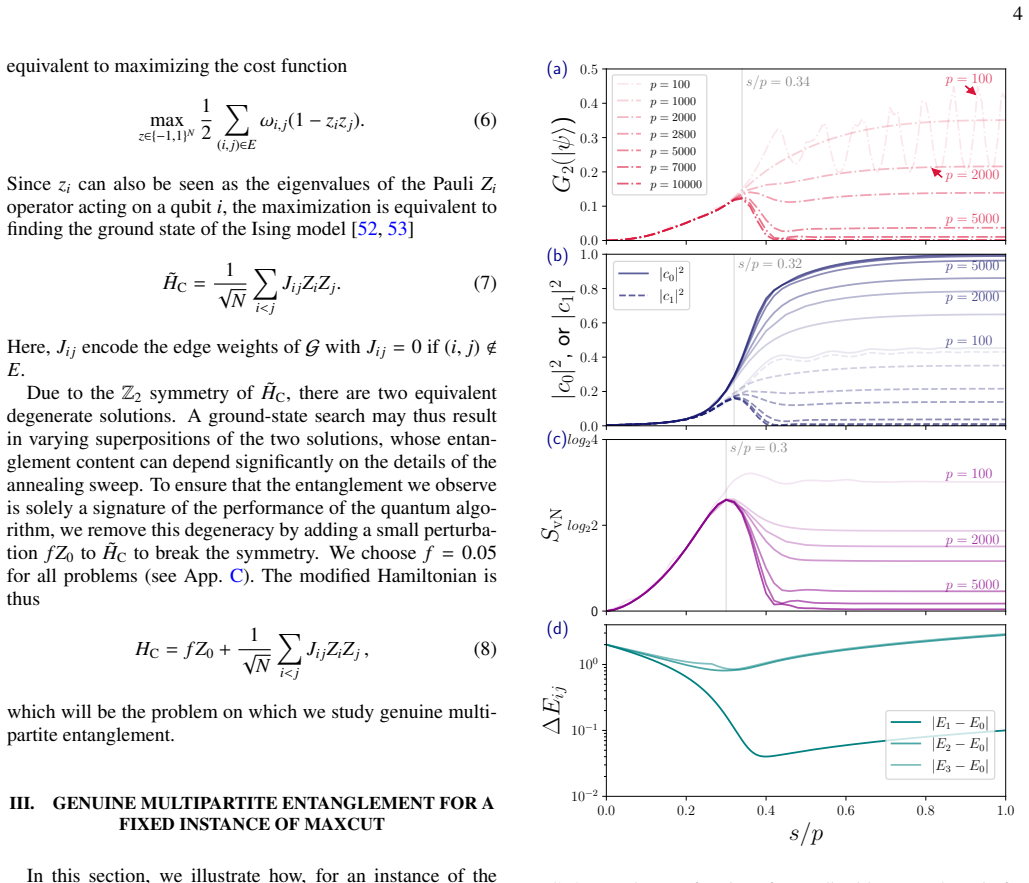
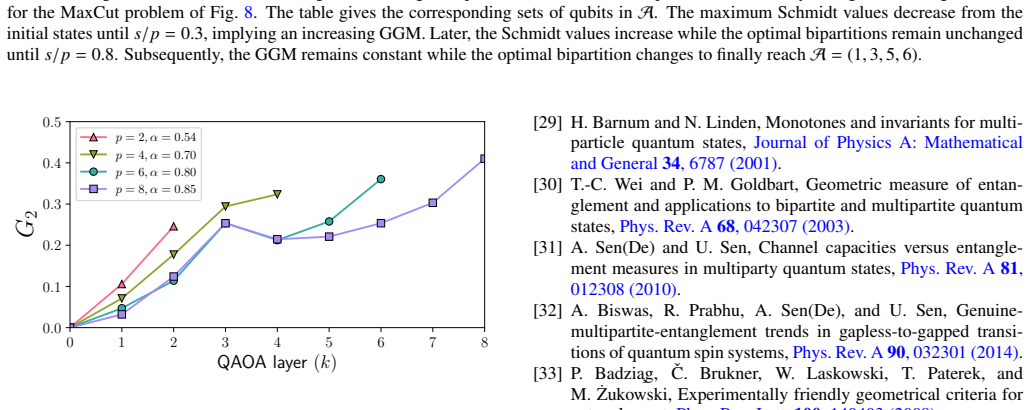
For MaxCut problems on eight qubits, the authors simulate Trotterized quantum annealing. In slow sweeps, the GGM rises as the system crosses the point where the two lowest energy levels come close together, then falls again as the algorithm approaches the product-state answer. They call this rise and fall a multipartite entanglement barrier. In fast, unsuccessful sweeps, the entanglement stays high at the end. The quantum approximate optimization algorithm behaves differently: with each added layer it builds up GGM without a barrier.
The paper also proves a simple bound: the probability of measuring the optimal answer is no larger than one minus the final GGM. In addition, overlaps with the initial product state and the exact solution product state bound the GGM throughout the sweep. Because those overlaps are easier to measure than full entanglement, the bound could serve as an experimental proxy for multipartite entanglement in optimization hardware.
Extended reading notes
Core claim
The central analytical result is Eq. (14): G2(|ψ(s)⟩) ≤ min{1−|c0(s)|², 1−|d+(s)|², 1/2}, giving the corollary that the final success probability |c0|² is bounded above by 1 − G2_final. If correct, the final multipartite entanglement directly caps the chance of outputting the optimal product-state solution, and the rise and fall of GGM, the multipartite entanglement barrier, tracks whether a slow anneal succeeds.
Load-bearing premise
The numerical claim of a multipartite entanglement barrier rests on the modeling assumption that the arbitrary symmetry-breaking offset f=0.05 in Eq. (8) is small enough to preserve the physical MaxCut annealing while making the solution unique. As App. C shows, the barrier mechanism is a near-GHZ superposition of the Z2-paired computational basis states |e0⟩ and |e1⟩; if the pairing or the level structure changes with f, the barrier could be an artifact of the perturbation rather than a generic feature of quantum optimization.
Signed reviews
Editorial analysis
A structured set of objections, weighed in public.
Assumptions & free parameters
free parameters (2)
- Symmetry-breaking offset f =
0.05
- Trotter time step Δt =
0.19 (Fig. 2); 0.2 (Figs. 5 and 6)
assumptions (4)
- standard math GGM equals 1 minus the squared maximum Schmidt coefficient over all bipartitions (Eq. (2)).
- domain assumption Eigenstates |e_i> of the cost Hamiltonian are product states.
- standard math The first-order Trotter-Suzuki decomposition (Eq. (4)) accurately represents the annealing sweep.
- ad hoc to paper The f=0.05 perturbation preserves the physical annealing dynamics while lifting degeneracy.
Cite this review
Pith. "Pith review of Genuine Multipartite Entanglement in Quantum Optimization." pith.science (2026). https://pith.science/paper/DVYIR7SP
@misc{pith2026241108119,
  author       = {Pith},
  title        = {Pith review of: Genuine Multipartite Entanglement in Quantum Optimization},
  year         = {2026},
  howpublished = {\url{https://pith.science/paper/DVYIR7SP}},
  note         = {Machine review of arXiv:2411.08119}
}
read the original abstract
The ability to generate bipartite entanglement in quantum computing technologies is widely regarded as pivotal. However, the role of genuinely multipartite entanglement is much less understood than bipartite entanglement, particularly in the context of solving complicated optimization problems using quantum devices. It is thus crucial from both the algorithmic and hardware standpoints to understand whether multipartite entanglement contributes to achieving a good solution. Here, we tackle this challenge by analyzing genuine multipartite entanglement -- quantified by the generalized geometric measure -- generated in Trotterized quantum annealing and the quantum approximate optimization algorithm. Using numerical benchmarks, we analyze its occurrence in the annealing schedule in detail. We observe a multipartite-entanglement barrier, and we explore how it correlates to the algorithm's success. We also prove how multipartite entanglement provides an upper bound to the overlap of the instantaneous state with an exact solution. Vice versa, the overlaps to the initial and final product states, which can be easily measured experimentally, offer upper bounds for the multipartite entanglement during the entire schedule. Our results help to shed light on how complex quantum correlations come to bear as a resource in quantum optimization.
Figures


Figures from the paper (7 more)


Forward citations
Cited by 1 Pith paper
-
Boosting quantum annealing performance through direct polynomial unconstrained binary optimization
For 3-SAT problems, direct PUBO encoding shows larger minimum energy gaps than a standard QUBO reduction, hinting at an exponential speedup for some problem families.
Reference graph
Works this paper leans on
-
[1]
Final GGM and success probability As a corollary to the Sec. III D, the success probability, i.e., the probability corresponding to the ground-state of the cost Hamiltonian, |c0|2, is bounded above by 1 − Gfinal 2 . In Fig. 7(a), we see that with an increasing number of layers (slower sweep), the success probability saturates the bound. In contrast, with ...
-
[2]
Disentanglement and success probability As a complementary analysis, we also study how the amount of dis-entanglement, i.e., the reduction of GGM af- ter its peak, ∆G = Gmax 2 − Gfinal 2 , is related to the success probability. To this end, we calculate the conditional proba- bility (Pcond[Pc,ϵ ]) of obtaining a success probability greater than some Pc, g...
-
[3]
R. Jozsa, Quantum effects in algorithms, in NASA International Conference on Quantum Computing and Quantum Communi- cations (Springer, 1998) pp. 103–112
work page 1998
-
[4]
R. Jozsa and N. Linden, On the role of entanglement in quantum-computational speed-up, Proceedings of the Royal Society of London. Series A: Mathematical, Physical and Engi- neering Sciences 459, 2011 (2003)
work page 2003
-
[5]
S. Ding and Z. Jin, Review on the study of entanglement in quantum computation speedup, Chinese Science Bulletin 52, 2161 (2007)
work page 2007
-
[6]
N. Linden and S. Popescu, Good dynamics versus bad kinemat- ics: Is entanglement needed for quantum computation?, Phys. Rev. Lett. 87, 047901 (2001)
work page 2001
- [7]
-
[8]
H. M. Bauza and D. A. Lidar, Scaling advantage in approxi- mate optimization with quantum annealing, arXiv:2401.07184 (2024)
arXiv 2024
Show all 78 references
-
[9]
Hauke, H
P. Hauke, H. G. Katzgraber, W. Lechner, H. Nishimori, and W. D. Oliver, Perspectives of quantum annealing: methods and implementations, Reports on Progress in Physics 83, 054401 (2020)
2020
-
[10]
Rajak, S
A. Rajak, S. Suzuki, A. Dutta, and B. K. Chakrabarti, Quan- tum annealing: An overview, Philosophical Transactions of the Royal Society A 381, 20210417 (2023)
2023
-
[11]
Farhi, J
E. Farhi, J. Goldstone, and S. Gutmann, A quantum approxi- mate optimization algorithm, arXiv:1411.4028 (2014)
2014 arXiv
-
[12]
Cerezo, A
M. Cerezo, A. Arrasmith, R. Babbush, S. C. Benjamin, S. Endo, K. Fujii, J. R. McClean, K. Mitarai, X. Yuan, L. Cincio, et al., Variational quantum algorithms, Nature Reviews Physics3, 625 (2021)
2021
-
[13]
Hauke, L
P. Hauke, L. Bonnes, M. Heyl, and W. Lechner, Probing entan- glement in adiabatic quantum optimization with trapped ions, Frontiers in Physics 3, 21 (2015)
2015
-
[14]
Or ´us and J
R. Or ´us and J. I. Latorre, Universality of entanglement and quantum-computation complexity, Phys. Rev. A 69, 052308 (2004)
2004
-
[15]
A. K. Pati and S. L. Braunstein, Role of entanglement in quan- tum computation, Journal of the Indian Institute of Science 89, 295 (2009)
2009
-
[16]
Dupont, N
M. Dupont, N. Didier, M. J. Hodson, J. E. Moore, and M. J. Reagor, Calibrating the classical hardness of the quantum ap- proximate optimization algorithm, PRX Quantum 3, 040339 (2022)
2022
-
[17]
Dupont, N
M. Dupont, N. Didier, M. J. Hodson, J. E. Moore, and M. J. Reagor, Entanglement perspective on the quantum approximate optimization algorithm, Phys. Rev. A 106, 022423 (2022)
2022
-
[18]
S. S. Roy, S. N. Santalla, J. Rodr ´ıguez-Laguna, and G. Sierra, Entanglement as geometry and flow, Phys. Rev. B 101, 195134 (2020)
2020
-
[19]
S. S. Roy, S. N. Santalla, G. Sierra, and J. Rodr ´ıguez-Laguna, Link representation of the entanglement entropies for all bipar- titions, Journal of Physics A: Mathematical and Theoretical 54, 305301 (2021)
2021
-
[20]
De Chiara and A
G. De Chiara and A. Sanpera, Genuine quantum correlations in quantum many-body systems: a review of recent progress, Reports on Progress in Physics 81, 074002 (2018)
2018
-
[21]
Binder and A
K. Binder and A. P. Young, Spin glasses: Experimental facts, 12 0.0 0.2 0.4 0.6 0.8 1.0 s/p 0.80 0.85 0.90 0.95 1.00 ∏2 max 1st 2nd 3rd 4th 𝒔/𝒑=𝟎𝟎.𝟏𝟎.𝟐𝟎.𝟑𝟎.𝟒𝟎.𝟓𝟎.𝟔𝟎.𝟕𝟎.𝟖𝟎.𝟗𝟏all(4)(3)(2)(2)(2)(2)(2)(2)(3)(1, 3, 5, 6)---(5)(2)(3)(3)(3)(3)(3)(3)(4)(0, 2, 4, 7)---(3)(6)(6)(4)(4)(4...
1986
-
[22]
Tanaka, R
S. Tanaka, R. Tamura, and B. K. Chakrabarti, Quantum spin glasses, annealing and computation, Cambridge University Press (2017)
2017
-
[23]
Hillery, V
M. Hillery, V . Buˇzek, and A. Berthiaume, Quantum secret shar- ing, Phys. Rev. A 59, 1829 (1999)
1999
-
[24]
Chen, S.-Y
P.-X. Chen, S.-Y . Zhu, and G.-C. Guo, General form of genuine multipartite entanglement quantum channels for teleportation, Phys. Rev. A 74, 032324 (2006)
2006
-
[25]
Epping, H
M. Epping, H. Kampermann, C. macchiavello, and D. Bruß, Multi-partite entanglement can speed up quantum key distribu- tion in networks, New Journal of Physics 19, 093012 (2017)
2017
-
[26]
T ´oth, Multipartite entanglement and high-precision metrol- ogy, Phys
G. T ´oth, Multipartite entanglement and high-precision metrol- ogy, Phys. Rev. A85, 022322 (2012)
2012
-
[27]
H. J. Briegel, D. E. Browne, W. D ¨ur, R. Raussendorf, and M. Van den Nest, Measurement-based quantum computation, Nature Physics 5, 19–26 (2009)
2009
-
[28]
Bruß and C
D. Bruß and C. Macchiavello, Multipartite entanglement in quantum algorithms, Phys. Rev. A 83, 052313 (2011)
2011
-
[29]
G. C. Santra, F. Jendrzejewski, P. Hauke, and D. J. Egger, Squeezing and quantum approximate optimization, Phys. Rev. A 109, 012413 (2024)
2024
-
[30]
Shimony, Degree of entanglement, Annals of the New York Academy of Sciences 755, 675 (1995)
A. Shimony, Degree of entanglement, Annals of the New York Academy of Sciences 755, 675 (1995)
1995
-
[31]
Barnum and N
H. Barnum and N. Linden, Monotones and invariants for multi- particle quantum states, Journal of Physics A: Mathematical and General 34, 6787 (2001)
2001
-
[32]
Wei and P
T.-C. Wei and P. M. Goldbart, Geometric measure of entan- glement and applications to bipartite and multipartite quantum states, Phys. Rev. A 68, 042307 (2003)
2003
-
[33]
Sen(De) and U
A. Sen(De) and U. Sen, Channel capacities versus entangle- ment measures in multiparty quantum states, Phys. Rev. A 81, 012308 (2010)
2010
-
[34]
Biswas, R
A. Biswas, R. Prabhu, A. Sen(De), and U. Sen, Genuine- multipartite-entanglement trends in gapless-to-gapped transi- tions of quantum spin systems, Phys. Rev. A90, 032301 (2014)
2014
-
[35]
Badzia ¸ g, ˇC
P. Badzia ¸ g, ˇC. Brukner, W. Laskowski, T. Paterek, and M. ˙Zukowski, Experimentally friendly geometrical criteria for entanglement, Phys. Rev. Lett. 100, 140403 (2008)
2008
-
[36]
D. A. Meyer, Sophisticated quantum search without entangle- ment, Phys. Rev. Lett. 85, 2014 (2000)
2000
-
[37]
Biham, G
E. Biham, G. Brassard, D. Kenigsberg, and T. Mor, Quantum computing without entanglement, Theoretical Computer Sci- ence 320, 15 (2004)
2004
-
[38]
Kenigsberg, T
D. Kenigsberg, T. Mor, and G. Ratsaby, Quantum advantage without entanglement., Quantum Inf. Comput. 6, 606 (2006)
2006
-
[39]
Van den Nest, Universal quantum computation with little entanglement, Phys
M. Van den Nest, Universal quantum computation with little entanglement, Phys. Rev. Lett. 110, 060504 (2013)
2013
-
[40]
Sreedhar, P
R. Sreedhar, P. Vikstål, M. Svensson, A. Ask, G. Johansson, and L. Garc´ıa- ´Alvarez, The quantum approximate optimization algorithm performance with low entanglement and high circuit depth, arXiv:2207.03404 (2022)
2022 arXiv
-
[41]
Naseri, T
M. Naseri, T. V . Kondra, S. Goswami, M. Fellous-Asiani, and A. Streltsov, Entanglement and coherence in the bernstein- vazirani algorithm, Phys. Rev. A 106, 062429 (2022)
2022
-
[42]
Chitambar and G
E. Chitambar and G. Gour, Quantum resource theories, Rev. Mod. Phys. 91, 025001 (2019)
2019
-
[43]
Lanting, A
T. Lanting, A. J. Przybysz, A. Y . Smirnov, F. M. Spedalieri, M. H. Amin, A. J. Berkley, R. Harris, F. Altomare, S. Boixo, P. Bunyk, N. Dickson, C. Enderud, J. P. Hilton, E. Hoskin- son, M. W. Johnson, E. Ladizinsky, N. Ladizinsky, R. Neufeld, T. Oh, I. Perminov, C. Rich, M. C...
2014
-
[44]
D´ıez-Valle, D
P. D´ıez-Valle, D. Porras, and J. J. Garc´ıa-Ripoll, Quantum vari- ational optimization: The role of entanglement and problem hardness, Phys. Rev. A 104, 062426 (2021)
2021
-
[45]
Y . Chen, L. Zhu, N. J. Mayhall, E. Barnes, and S. E. Economou, How much entanglement do quantum optimization algorithms 13 require?, in Quantum 2.0 Conference and Exhibition (Optica Publishing Group, 2022) p. QM4A.2
2022
-
[46]
Bengtsson and K
I. Bengtsson and K. ˙Zyczkowski, Geometry of quantum states: an introduction to quantum entanglement (Cambridge univer- sity press, 2017)
2017
-
[47]
Bures, An extension of Kakutani’s theorem on infinite prod- uct measures to the tensor product of semifinite w∗ -algebras, Trans
D. Bures, An extension of Kakutani’s theorem on infinite prod- uct measures to the tensor product of semifinite w∗ -algebras, Trans. Amer. Math. Soc. 135, 199 (1969)
1969
-
[48]
In the absence of simplifications such as symmetries, we need to calculate over the following number of bipartitions— N 1 + ··· + N N−1 2 = 2N−1− 1 for odd N and N 1 +··· + N N 2−1 + N N 2 = 2N−1− 1 + 1 2 N N 2 for even N
-
[49]
Consider an arbi- trary bipartitionA :B where|A| = m and|B| = N− m
We can understand this intuitively as follows. Consider an arbi- trary bipartitionA :B where|A| = m and|B| = N− m. For this bipartition, there can be at most dm non-zero Schmidt co- efficients, denoted as {λ1 A:B,λ 2 A:B,...,λ k=dm A:B}. To maximize the GGM, we need to arrange...
-
[50]
T. Das, S. S. Roy, S. Bagchi, A. Misra, A. Sen, U. Sen, et al., Generalized geometric measure of entanglement for multiparty mixed states, Physical Review A 94, 022336 (2016)
2016
-
[51]
K. G. H. V ollbrecht and R. F. Werner, Entanglement measures under symmetry, Phys. Rev. A64, 062307 (2001)
2001
-
[52]
Rossi, D
M. Rossi, D. Bruß, and C. Macchiavello, Scale invariance of entanglement dynamics in grover’s quantum search algorithm, Phys. Rev. A 87, 022331 (2013)
2013
-
[53]
M. H. S. Amin, Consistency of the adiabatic theorem, Phys. Rev. Lett. 102, 220401 (2009)
2009
-
[54]
Lucas, Ising formulations of many NP problems, Front
A. Lucas, Ising formulations of many NP problems, Front. Phys. 2, 5 (2014)
2014
-
[55]
Albash and D
T. Albash and D. A. Lidar, Adiabatic quantum computation, Rev. Mod. Phys. 90, 015002 (2018)
2018
-
[56]
Soriani, P
A. Soriani, P. Naz ´e, M. V . S. Bonanc ¸a, B. Gardas, and S. Deffner, Three phases of quantum annealing: Fast, slow, and very slow, Phys. Rev. A105, 042423 (2022)
2022
-
[57]
Miessen, D
A. Miessen, D. J. Egger, I. Tavernelli, and G. Mazzola, Benchmarking digital quantum simulations and optimization above hundreds of qubits using quantum critical dynamics, arXiv:2404.08053 (2024)
2024 arXiv
-
[58]
Ivakhnenko, S
V . Ivakhnenko, S. N. Shevchenko, and F. Nori, Nonadiabatic landau–zener–st¨uckelberg–majorana transitions, dynamics, and interference, Physics Reports 995, 1 (2023)
2023
-
[59]
Hauke, M
P. Hauke, M. Heyl, L. Tagliacozzo, and P. Zoller, Measur- ing multipartite entanglement through dynamic susceptibilities, Nat. Phys. 12, 778 (2016)
2016
-
[60]
A. C. Nakhl, T. Quella, and M. Usman, Calibrating the role of entanglement in variational quantum circuits, Phys. Rev. A109, 032413 (2024)
2024
-
[61]
Teramoto, R
K. Teramoto, R. Raymond, and H. Imai, The role of entangle- ment in quantum-relaxation based optimization algorithms, in 2023 IEEE International Conference on Quantum Computing and Engineering (QCE), V ol. 1 (IEEE, 2023) pp. 543–553
2023
-
[62]
Buerschaper, A
O. Buerschaper, A. Garc´ıa-Saez, R. Or´us, and T.-C. Wei, Topo- logical minimally entangled states via geometric measure, Jour- nal of Statistical Mechanics: Theory and Experiment 2014, P11009 (2014)
2014
-
[63]
Hart and J
M. Hart and J. McAllister, Quantum circuit cutting minimis- ing loss of qubit entanglement, in Proceedings of the 21st ACM International Conference on Computing Frontiers (2024) pp. 207–214
2024
-
[64]
Weidenfeller, L
J. Weidenfeller, L. C. Valor, J. Gacon, C. Tornow, L. Bello, S. Woerner, and D. J. Egger, Scaling of the quantum approx- imate optimization algorithm on superconducting qubit based hardware, Quantum 6, 870 (2022)
2022
-
[65]
Bittel and M
L. Bittel and M. Kliesch, Training variational quantum algo- rithms is np-hard, Phys. Rev. Lett. 127, 120502 (2021)
2021
-
[66]
Streif and M
M. Streif and M. Leib, Training the quantum approximate op- timization algorithm without access to a quantum processing unit, Quantum Science and Technology 5, 034008 (2020)
2020
-
[67]
Gu ´ery-Odelin, A
D. Gu ´ery-Odelin, A. Ruschhaupt, A. Kiely, E. Torrontegui, S. Mart ´ınez-Garaot, and J. G. Muga, Shortcuts to adiabatic- ity: Concepts, methods, and applications, Rev. Mod. Phys. 91, 045001 (2019)
2019
-
[68]
Broder and E
A. Broder and E. Shamir, On the second eigenvalue of random regular graphs, in 28th Annual Symposium on F oundations of Computer Science (sfcs 1987) (IEEE, 1987) pp. 286–294
1987
-
[69]
Boixo, V
S. Boixo, V . N. Smelyanskiy, A. Shabani, S. V . Isakov, M. Dykman, V . S. Denchev, M. H. Amin, A. Y . Smirnov, M. Mohseni, and H. Neven, Computational multiqubit tun- nelling in programmable quantum annealers, Nature commu- nications 7, 10327 (2016)
2016
-
[70]
Altshuler, H
B. Altshuler, H. Krovi, and J. Roland, Anderson localization makes adiabatic quantum optimization fail, Proceedings of the National Academy of Sciences 107, 12446 (2010)
2010
-
[71]
Veitch, S
V . Veitch, S. A. H. Mousavian, D. Gottesman, and J. Emerson, The resource theory of stabilizer quantum computation, New Journal of Physics 16, 013009 (2014)
2014
-
[72]
A. Bera, T. Das, D. Sadhukhan, S. Singha Roy, A. Sen(De), and U. Sen, Quantum discord and its allies: a review of recent progress, Reports on Progress in Physics 81, 024001 (2017)
2017
-
[73]
Streltsov, G
A. Streltsov, G. Adesso, and M. B. Plenio, Colloquium: Quan- tum coherence as a resource, Rev. Mod. Phys. 89, 041003 (2017)
2017
-
[74]
Knill and R
E. Knill and R. Laflamme, Power of one bit of quantum infor- mation, Phys. Rev. Lett. 81, 5672 (1998)
1998
-
[75]
Aharonov, A
D. Aharonov, A. Kitaev, and N. Nisan, Quantum circuits with mixed states, in Proceedings of the thirtieth annual ACM sym- posium on Theory of computing (1998) pp. 20–30
1998
-
[76]
Datta and G
A. Datta and G. Vidal, Role of entanglement and correlations in mixed-state quantum computation, Phys. Rev. A 75, 042310 (2007)
2007
-
[77]
Schulte-Herbr ¨uggen, R
T. Schulte-Herbr ¨uggen, R. Marx, A. Fahmy, L. Kau ffman, S. Lomonaco, N. Khaneja, and S. J. Glaser, Control aspects of quantum computing using pure and mixed states, Philosophical Transactions of the Royal Society A: Mathematical, Physical and Engineering Sciences 370, 4651 (2012)
2012
-
[78]
G. C. Santra, S. Singha Roy, D. J. Egger, and P. Hauke, Dataset for ”genuine multipartite entanglement in quantum optimiza- tion”, 10.5281/zenodo.14851898 (2025)
2025 doi
Reviewed August 12, 2026 · model on record in the stance chip above.
Discussion (0). Continue with ORCID to comment.