REVIEW 3 major objections 5 minor 35 references
Multi-MLLM Knowledge Distillation for Out-of-Context News Detection
T0 review · 3 major / 5 minor · reviewed 2026-08-07 · deepseek-v4-flash
Pith's one-line read A 7B multimodal model detects out-of-context news at state-of-the-art accuracy using under 10% labeled data.
desk verdict A sensible and clearly described distillation recipe for out-of-context news detection, but the SOTA claim rests on a test-set-dependent teacher choice and single-run numbers; worth refereeing, not ready as stated. read the letter →
The pith
A machine-rendered reading of the paper's core claim, the machinery that carries it, and where it could break.
The reading
What carries the argument
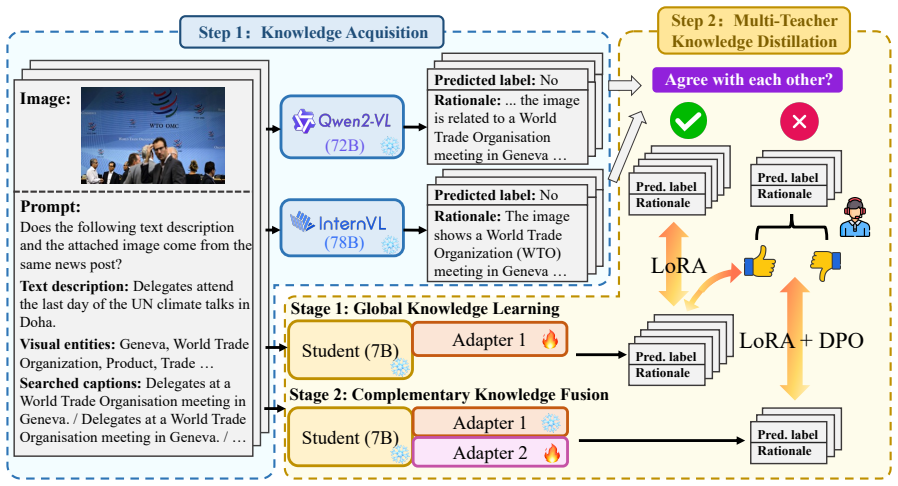
The load-bearing mechanism is two-stage multi-teacher distillation with LoRA adapters and DPO. In Stage 1 a LoRA adapter is trained on all 71,072 training samples to reproduce teacher-generated label-plus-rationale texts, giving the student the teachers' global detection logic. In Stage 2, on the 6,122 items (8.61%) where the two teacher MLLMs give conflicting labels, a second LoRA adapter is trained with the standard language-modeling loss plus a DPO term that rewards the correct teacher's rationale and penalizes the incorrect one. The prompt given to teachers also carries web-retrieved evidence—visual entities and searched captions—which the paper shows lifts zero-shot teacher accuracy from 82.85% to 91.11% in pilot experiments; that evidence context is part of what gets distilled.
What would settle it
Take a random sample of the teacher-agreed training items, have human annotators label them, and compare teacher labels against human labels; if teacher accuracy on agreed items is not well above chance or is far below the 91.11% pilot accuracy, then Stage 1's unverified supervision is the weak link. A stronger test: train the same student only on the 6,122 conflicting items with human labels and compare to MMKD; if the two perform similarly, the unlabeled Stage 1 data adds nothing.
Extended reading notes
Core claim
The central claim is that teacher disagreement marks the hard cases worth labeling, and that training a student on all teacher outputs first, then specifically on those disagreements with preference learning, fuses the two teachers' knowledge better than either teacher alone. The paper's own framing: a small open MLLM can outperform prior fine-tuned detectors and match a 72B/78B teacher's accuracy at 10x smaller scale, using 8.61% labeled data, because Stage 1 installs broad rationale-following behavior and Stage 2 sharpens discrimination where teachers conflict. The targeted output in Stage 1 is the agreed teacher's label-plus-rationale, or the correct teacher's output when teachers disagree; in Stage 2, DPO treats the correct teacher output as preferred and the incorrect one as rejected, so the student learns the boundary between plausible and wrong reasoning.
Load-bearing premise
Stage 1 treats the teachers' generated labels and rationales as correct training text for all 71,072 samples, with no human check on the 91.39% where teachers agree; if teacher errors there are systematic, the student is trained to reproduce them and the claimed label efficiency is illusory.
Editorial extensions
If this is right
- Detecting out-of-context news no longer requires label-rich fine-tuning of large models; a 7B student with 1.2M trainable parameters can outperform larger baselines.
- Annotation budgets can be targeted automatically: human labels are needed only where teacher MLLMs conflict, cutting labeled data to 8.61% in this benchmark.
- Deployment is cheaper and safer: the final student runs without proprietary API calls, so detection can happen on local infrastructure.
- Because knowledge is stored in separate LoRA adapters per stage, new teacher knowledge can be added or removed without retraining the base model.
- The framework's effectiveness depends on teacher quality and diversity; any improvement in teachers' zero-shot out-of-context reasoning should transfer directly to the student.
Reading between the lines
- Beyond the paper: the agreement-as-confidence heuristic is testable elsewhere—if two teachers share systematic blind spots from similar training data, their agreement could mask errors, so agreement rate may not be a reliable difficulty signal in other datasets.
- Beyond the paper: the same conflict-driven DPO stage could turn teacher disagreement into a preference dataset for other multimodal classification tasks, without extra prompt engineering.
- Beyond the paper: because the evidence prompt's searched captions contributed the largest zero-shot gain, retrieval augmentation rather than model scale may be the dominant factor in teacher quality; a dedicated ablation that removes visual entities alone would isolate this.
- Beyond the paper: the paper reports label accuracy but not whether the student's rationales become more factually faithful after DPO; measuring rationale correctness would show whether preference learning improves reasoning or only classification.
Editorial analysis
A structured set of objections, weighed in public.
Referee Report
Summary. The paper proposes MMKD, a multi-teacher knowledge distillation framework for out-of-context news detection. Two large teacher MLLMs (Qwen2-VL-72B and InternVL-2.5-78B) are prompted to generate predicted labels and rationales, which are then distilled into a 7B student MLLM (LLaVA-Vicuna) through two stages: Stage 1 applies LoRA fine-tuning on all training data, and Stage 2 applies LoRA fine-tuning together with DPO on the subset of examples where the two teachers disagree. Only the disagreeing examples receive human ground-truth labels, which the authors report as 8.61% of the training data. Experiments on NewsCLIPpings Merged-Balanced report 90.04% accuracy, outperforming the previous state of the art (Sniffer) by 1.87% while using only 1.2M learnable parameters.
Significance. If the reported results hold, the paper offers a practical recipe for low-resource multimodal misinformation detection: distilling knowledge from large open-weight MLLMs into a smaller student with minimal human annotation and no proprietary API calls. The paper's strengths include a clear two-stage distillation design with ablations for each component, sensitivity analysis for key hyperparameters, and case studies illustrating qualitative improvements. The central claim of state-of-the-art performance with less than 10% labeled data is plausible but rests on an evaluation choice that needs to be made more rigorous; the manuscript also lacks multiple-seed or error-bar reporting. The contribution is relevant to the multimodal misinformation and knowledge distillation communities, and the label-efficiency idea is worth pursuing, but the headline comparison needs to be secured.
major comments (3)
- [Section 5.2, Implementation Details] The teacher-selection rule for agreed cases is chosen using the test set: 'When both teachers’ predictions agree, we use Qwen2’s output as knowledge because it outperforms InternVL on the test set.' Since roughly 91% of Stage-1 training targets come from agreed cases, this is a test-set-informed selection on the same test set used to claim state-of-the-art performance. The reported margin over Sniffer is only 1.87% accuracy, so a validation-based teacher choice (or a report of results under both teacher choices) is needed to establish that the improvement is not an artifact of selection on the evaluation metric. Please fix the teacher-selection rule before evaluation, e.g., by using the validation split, and report the resulting numbers.
- [Table 1 and Section 6.1] All reported results appear to come from single runs, and no error bars, confidence intervals, or multiple seeds are provided. The headline claim of outperforming Sniffer by 1.87% in accuracy and the ablation differences in Table 2 (e.g., w/o DPO vs. MMKD differ by 0.13%) could be within run-to-run variance for a 7B model fine-tuned with LoRA. Reporting at least three seeds with mean and standard deviation, or otherwise providing variance estimates, is necessary to support the state-of-the-art claim.
- [Section 4.2, Stage 1: Global Knowledge Learning] Stage 1 treats teacher-generated rationales and labels as ground-truth text for all 71,072 training samples without human verification, and the authors acknowledge that 'the teacher’s reasoning and predicted labels may sometimes be incorrect.' The paper does not quantify teacher accuracy or agreement rates beyond the 8.61% disagreement figure, nor does it analyze whether systematic teacher errors on agreed cases are propagated to the student. If teacher errors are frequent, the claimed label efficiency (8.61% labeled data) would not translate to reliable performance. Please report per-teacher accuracy on the validation or test set, the agreement rate, and ideally an analysis of how often both teachers are wrong on agreed cases.
minor comments (5)
- [Table 1 vs. Table 2] The MMKD F1 score is reported as 89.86 in Table 1 but as 89.96 in Table 2; the accuracy, precision, and recall values are identical. This inconsistency should be corrected and checked across all tables.
- [Abstract and Section 5.2] The phrase 'using less than 10% labeled data' is accurate but could be clearer: Stage 1 uses no human labels, and Stage 2 uses human labels only for the 6,122 disagreeing examples. Please state this explicitly in the abstract or experimental setup to avoid ambiguity about what 'labeled data' means.
- [Section 5.2, Implementation Details] The line 'We use LLaV A-v1.6-Vicuna-7B as the student model' contains an apparent typo ('LLaV A' should be 'LLaVA'). Please also specify the exact model checkpoint and any prompt template used for the student.
- [Section 4.2, Stage 2 and Section 5.2] The process for obtaining the ground-truth labels for hard cases is not described: who annotated the 6,122 disagreeing examples, whether the annotators were experts, and what annotation cost was involved. Please clarify this to substantiate the annotation-efficiency claim.
- [Appendix A.1, Table 3] The pilot experiment table shows that adding searched images as text degrades Qwen2-VL-72B performance to 65.31 accuracy, which is a notable drop. The text mentions this briefly, but a one-sentence explanation of why this occurs would help readers understand the prompt-design decision.
Circularity Check
No significant circularity: MMKD's gains come from distilling external teacher outputs, and the only test-set-informed choice is a leakage risk rather than a circular reduction.
full rationale
MMKD's derivation chain is not circular. Stage 1 trains a LoRA adapter on teacher-generated labels and rationales, and Stage 2 adds LoRA+DPO on the 8.61% of examples where teachers conflict, using human labels to pick the correct teacher output. The student's test predictions are compared against NewsCLIPpings ground-truth labels, not against the teacher outputs it was trained on, so the central SOTA claim is an empirical transfer result rather than a construction from the training targets. The only step that uses the test set is the choice of Qwen2 over InternVL for the agreed cases ('it outperforms InternVL on the test set') and the pilot prompt selection; this is a selection-on-evaluation-metric leak that could inflate the comparison with baselines, but it does not make the model's output logically equivalent to its input. The single self-citation (SoftLogic, Ma et al. 2024) is a baseline and is not load-bearing. Overall, no circular step meets the quoted-evidence bar.
Assumptions & free parameters
free parameters (8)
- Teacher model used for agreed-case knowledge =
Qwen2-VL-72B
- LoRA rank r =
128
- LoRA alpha =
256
- Stage 2 DPO weight alpha =
0.5
- Stage 2 LoRA weight gamma =
0.3
- DPO sensitivity beta =
0.1
- Learning rates =
2e-5 (Stage 1), 5e-7 (Stage 2)
- Training epochs =
3 (Stage 1), 1 (Stage 2)
assumptions (4)
- domain assumption Teacher-generated labels and rationales are reliable enough to serve as training targets when the two teachers agree.
- domain assumption News items on which the two teachers disagree are the most valuable examples to label.
- domain assumption The correct teacher output provides a preferred answer and the incorrect teacher output a rejected answer for DPO.
- standard math LoRA and DPO update rules (Eqs. 2-6) are standard and stable at the chosen hyperparameters.
Cite this review
Pith. "Pith review of Multi-MLLM Knowledge Distillation for Out-of-Context News Detection." pith.science (2026). https://pith.science/paper/DW62TKSN
@misc{pith2026250522517,
  author       = {Pith},
  title        = {Pith review of: Multi-MLLM Knowledge Distillation for Out-of-Context News Detection},
  year         = {2026},
  howpublished = {\url{https://pith.science/paper/DW62TKSN}},
  note         = {Machine review of arXiv:2505.22517}
}
read the original abstract
Multimodal out-of-context news is a type of misinformation in which the image is used outside of its original context. Many existing works have leveraged multimodal large language models (MLLMs) for detecting out-of-context news. However, observing the limited zero-shot performance of smaller MLLMs, they generally require label-rich fine-tuning and/or expensive API calls to GPT models to improve the performance, which is impractical in low-resource scenarios. In contrast, we aim to improve the performance of small MLLMs in a more label-efficient and cost-effective manner. To this end, we first prompt multiple teacher MLLMs to generate both label predictions and corresponding rationales, which collectively serve as the teachers' knowledge. We then introduce a two-stage knowledge distillation framework to transfer this knowledge to a student MLLM. In Stage 1, we apply LoRA fine-tuning to the student model using all training data. In Stage 2, we further fine-tune the student model using both LoRA fine-tuning and DPO on the data points where teachers' predictions conflict. This two-stage strategy reduces annotation costs and helps the student model uncover subtle patterns in more challenging cases. Experimental results demonstrate that our approach achieves state-of-the-art performance using less than 10% labeled data.
Figures


Figures from the paper (2 more)

Reference graph
Works this paper leans on
-
[1]
Sahar Abdelnabi, Rakibul Hasan, and Mario Fritz. 2022. Open-domain, content-based, multi-modal fact-checking of out-of-context images via online resources. In Proceedings of the IEEE/CVF Conference on Computer Vision and Pattern Recognition, pages 14940--14949
work page 2022
-
[2]
Yoshua Bengio, J \'e r \^o me Louradour, Ronan Collobert, and Jason Weston. 2009. Curriculum learning. In Proceedings of the 26th annual international conference on machine learning, pages 41--48
2009
-
[3]
Giscard Biamby, Grace Luo, Trevor Darrell, and Anna Rohrbach. 2022. T witter- COMM s: Detecting climate, COVID , and military multimodal misinformation. In Proceedings of the 2022 Conference of the North American Chapter of the Association for Computational Linguistics: Human Language Technologies, pages 1530--1549, Seattle, United States. Association for...
work page 2022
-
[4]
Li Chenglin, Qianglong Chen, Liangyue Li, Caiyu Wang, Feng Tao, Yicheng Li, Zulong Chen, and Yin Zhang. 2024. Mixed distillation helps smaller language models reason better. In Findings of the Association for Computational Linguistics: EMNLP 2024, pages 1673--1690
work page 2024
-
[5]
Wenliang Dai, Junnan Li, Dongxu Li, Anthony Meng Huat Tiong, Junqi Zhao, Weisheng Wang, Boyang Li, Pascale N Fung, and Steven Hoi. 2024. Instructblip: Towards general-purpose vision-language models with instruction tuning. Advances in Neural Information Processing Systems, 36
2024
-
[6]
Lisa Fazio. 2020. Out-of-context photos are a powerful low-tech form of misinformation. https://theconversation.com/out-of-context-photos-are-a-powerful-low-tech-form-of-misinformation-129959/
work page 2020
-
[7]
Google-Vision-API. Detect web entities and pages. https://cloud.google.com/vision/docs/detecting-web
-
[8]
Dan Hendrycks, Collin Burns, Steven Basart, Andy Zou, Mantas Mazeika, Dawn Song, and Jacob Steinhardt. 2020. Measuring massive multitask language understanding. arXiv preprint arXiv:2009.03300
arXiv 2020
Show all 35 references
-
[9]
Edward J Hu, Yelong Shen, Phillip Wallis, Zeyuan Allen-Zhu, Yuanzhi Li, Shean Wang, Lu Wang, Weizhu Chen, and 1 others. 2022. Lora: Low-rank adaptation of large language models. ICLR, 1(2):3
2022
-
[10]
Aaron Hurst, Adam Lerer, Adam P Goucher, Adam Perelman, Aditya Ramesh, Aidan Clark, AJ Ostrow, Akila Welihinda, Alan Hayes, Alec Radford, and 1 others. 2024. Gpt-4o system card. arXiv preprint arXiv:2410.21276
2024 arXiv
-
[11]
Kumud Lakara, Juil Sock, Christian Rupprecht, Philip Torr, John Collomosse, and Christian Schroeder de Witt. 2024. Mad-sherlock: Multi-agent debates for out-of-context misinformation detection. arXiv preprint arXiv:2410.20140
2024
-
[12]
Liunian Harold Li, Jack Hessel, Youngjae Yu, Xiang Ren, Kai-Wei Chang, and Yejin Choi. 2023. Symbolic chain-of-thought distillation: Small models can also" think" step-by-step. arXiv preprint arXiv:2306.14050
2023 arXiv
-
[13]
Liunian Harold Li, Mark Yatskar, Da Yin, Cho-Jui Hsieh, and Kai-Wei Chang. 2019. Visualbert: A simple and performant baseline for vision and language. arXiv preprint arXiv:1908.03557
2019 arXiv
-
[14]
Fuxiao Liu, Yinghan Wang, Tianlu Wang, and Vicente Ordonez. 2021. Visual news: Benchmark and challenges in news image captioning. In Proceedings of the 2021 Conference on Empirical Methods in Natural Language Processing, pages 6761--6771
2021
-
[15]
Jiaheng Liu, Chenchen Zhang, Jinyang Guo, Yuanxing Zhang, Haoran Que, Ken Deng, Jie Liu, Ge Zhang, Yanan Wu, Congnan Liu, and 1 others. 2024 a . Ddk: Distilling domain knowledge for efficient large language models. Advances in Neural Information Processing Systems, 37:98297--98319
2024
-
[16]
Xuannan Liu, Peipei Li, Huaibo Huang, Zekun Li, Xing Cui, Jiahao Liang, Lixiong Qin, Weihong Deng, and Zhaofeng He. 2024 b . Fka-owl: Advancing multimodal fake news detection through knowledge-augmented lvlms. In Proceedings of the 32nd ACM International Conference on Multimed...
2024
-
[17]
Grace Luo, Trevor Darrell, and Anna Rohrbach. 2021. N ews CLIP pings: A utomatic G eneration of O ut-of- C ontext M ultimodal M edia. In Proceedings of the 2021 Conference on Empirical Methods in Natural Language Processing, pages 6801--6817, Online and Punta Cana, Dominican R...
2021
-
[18]
Huanhuan Ma, Jinghao Zhang, Qiang Liu, Shu Wu, and Liang Wang. 2024. Interpretable multimodal out-of-context detection with soft logic regularization. In ICASSP 2024-2024 IEEE International Conference on Acoustics, Speech and Signal Processing (ICASSP), pages 4740--4744. IEEE
2024
-
[19]
Lucie Charlotte Magister, Jonathan Mallinson, Jakub Adamek, Eric Malmi, and Aliaksei Severyn. 2023. Teaching small language models to reason. In Proceedings of the 61st Annual Meeting of the Association for Computational Linguistics (Volume 2: Short Papers), pages 1773--1781, ...
2023
-
[20]
Stefanos-Iordanis Papadopoulos, Christos Koutlis, Symeon Papadopoulos, and Panagiotis Petrantonakis. 2023. Synthetic misinformers: Generating and combating multimodal misinformation. In Proceedings of the 2nd ACM International Workshop on Multimedia AI against Disinformation, ...
2023
-
[21]
Peng Qi, Zehong Yan, Wynne Hsu, and Mong Li Lee. 2024. Sniffer: Multimodal large language model for explainable out-of-context misinformation detection. arXiv preprint arXiv:2403.03170
2024 arXiv
-
[22]
Alec Radford, Jong Wook Kim, Chris Hallacy, Aditya Ramesh, Gabriel Goh, Sandhini Agarwal, Girish Sastry, Amanda Askell, Pamela Mishkin, Jack Clark, and 1 others. 2021. Learning transferable visual models from natural language supervision. In International conference on machine...
2021
-
[23]
Rafael Rafailov, Archit Sharma, Eric Mitchell, Christopher D Manning, Stefano Ermon, and Chelsea Finn. 2023. Direct preference optimization: Your language model is secretly a reward model. Advances in Neural Information Processing Systems, 36:53728--53741
2023
-
[24]
Fatma Shalabi, Hichem Felouat, Huy H Nguyen, and Isao Echizen. 2024. Leveraging chat-based large vision language models for multimodal out-of-context detection. In International Conference on Advanced Information Networking and Applications, pages 86--98. Springer
2024
-
[25]
Fatma Shalabi, Huy H Nguyen, Hichem Felouat, Ching-Chun Chang, and Isao Echizen. 2023. Image-text out-of-context detection using synthetic multimodal misinformation. In 2023 Asia Pacific Signal and Information Processing Association Annual Summit and Conference (APSIPA ASC), p...
2023
-
[26]
Kumar Shridhar, Alessandro Stolfo, and Mrinmaya Sachan. 2023. Distilling reasoning capabilities into smaller language models. In Findings of the Association for Computational Linguistics: ACL 2023, pages 7059--7073, Toronto, Canada. Association for Computational Linguistics
2023
-
[27]
Yin Wu, Zhengxuan Zhang, Fuling Wang, Yuyu Luo, Hui Xiong, and Nan Tang. 2025. Exclaim: An explainable cross-modal agentic system for misinformation detection with hierarchical retrieval. arXiv preprint arXiv:2504.06269
2025 arXiv
-
[28]
Zhuofeng Wu, Richard He Bai, Aonan Zhang, Jiatao Gu, V.G.Vinod Vydiswaran, Navdeep Jaitly, and Yizhe Zhang. 2024. Divide-or-conquer? which part should you distill your LLM ? In Findings of the Association for Computational Linguistics: EMNLP 2024, pages 2572--2585, Miami, Flor...
2024
-
[29]
Xiaohan Xu, Ming Li, Chongyang Tao, Tao Shen, Reynold Cheng, Jinyang Li, Can Xu, Dacheng Tao, and Tianyi Zhou. 2024. A survey on knowledge distillation of large language models. arXiv preprint arXiv:2402.13116
2024 arXiv
-
[30]
Xin Yuan, Jie Guo, Weidong Qiu, Zheng Huang, and Shujun Li. 2023. Support or refute: Analyzing the stance of evidence to detect out-of-context mis- and disinformation. In Proceedings of the 2023 Conference on Empirical Methods in Natural Language Processing, pages 4268--4280, ...
2023
-
[31]
Yudi Zhang, Lu Wang, Meng Fang, Yali Du, Chenghua Huang, Jun Wang, Qingwei Lin, Mykola Pechenizkiy, Dongmei Zhang, Saravan Rajmohan, and 1 others. 2025. Distill not only data but also rewards: Can smaller language models surpass larger ones? arXiv preprint arXiv:2502.19557
2025 arXiv
-
[32]
Jiachen Zhao, Zonghai Yao, Zhichao Yang, and Hong Yu. 2024. Large language models are in-context teachers for knowledge reasoning. In Findings of the Association for Computational Linguistics: EMNLP 2024, pages 16470--16486, Miami, Florida, USA. Association for Computational L...
2024
-
[33]
Deyao Zhu, Jun Chen, Xiaoqian Shen, Xiang Li, and Mohamed Elhoseiny. 2023. Minigpt-4: Enhancing vision-language understanding with advanced large language models. arXiv preprint arXiv:2304.10592
2023 arXiv
-
[34]
online" 'onlinestring :=
ENTRY address archivePrefix author booktitle chapter edition editor eid eprint eprinttype howpublished institution journal key month note number organization pages publisher school series title type volume year doi pubmed url lastchecked label extra.label sort.label short.list...
-
[35]
write newline
" write newline "" before.all 'output.state := FUNCTION n.dashify 't := "" t empty not t #1 #1 substring "-" = t #1 #2 substring "--" = not "--" * t #2 global.max substring 't := t #1 #1 substring "-" = "-" * t #2 global.max substring 't := while if t #1 #1 substring * t #2 gl...
Reviewed August 7, 2026 · model on record in the stance chip above.
Discussion (0). Sign in to comment.