The Curious Case of PHL 1811: Heavy Obscuration Versus Intrinsic X-ray Weakness
Pith reviewed 2026-06-27 15:32 UTC · model grok-4.3
The pith
PHL 1811 reaches a normal X-ray state during the 2024 flare, showing its prior weakness arises from obscuration by a clumpy wind.
A machine-rendered reading of the paper's core claim, the machinery that carries it, and where it could break.
Core claim
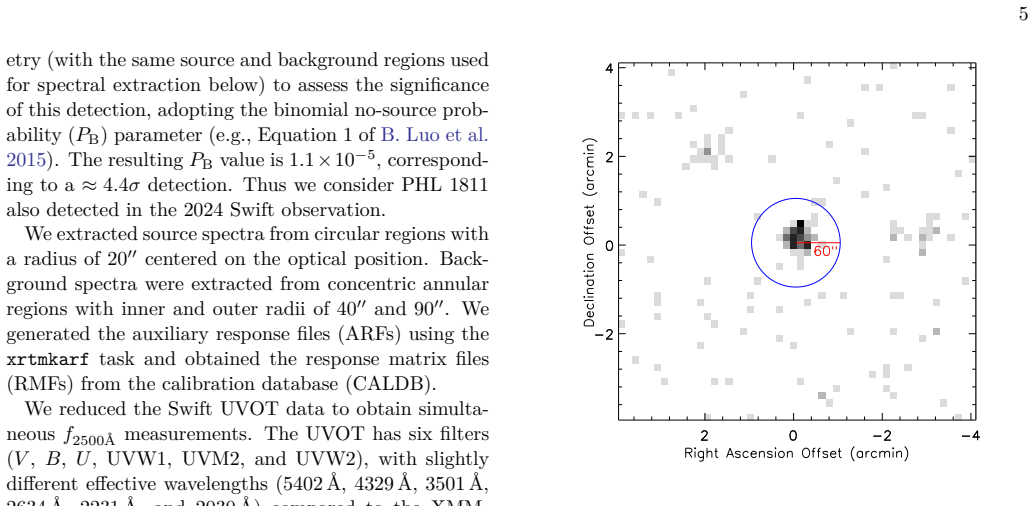
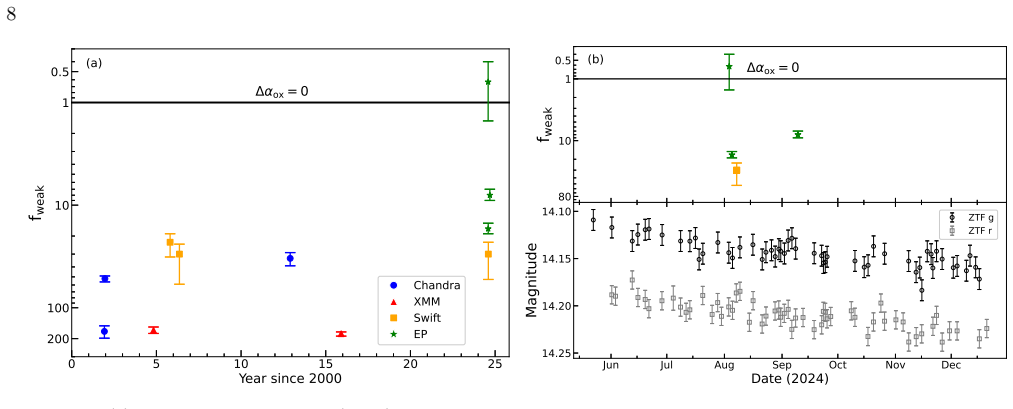
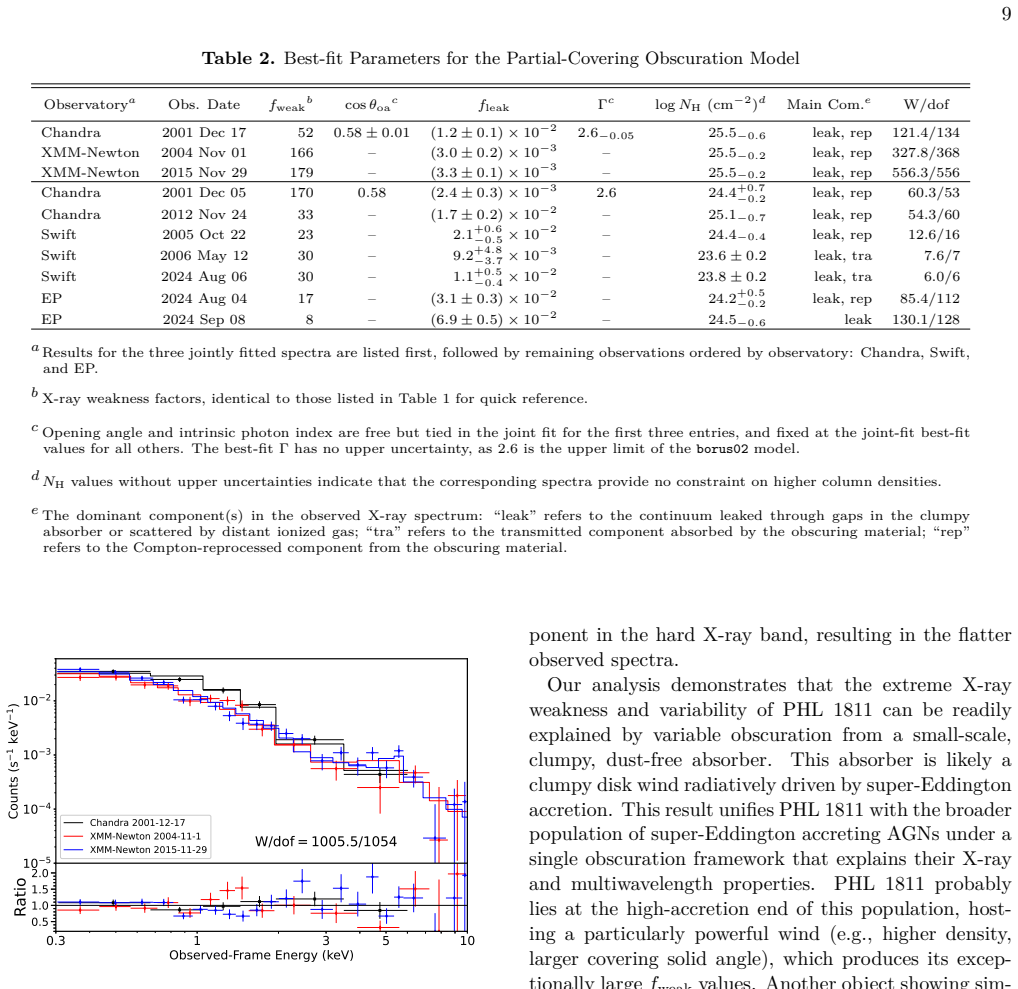
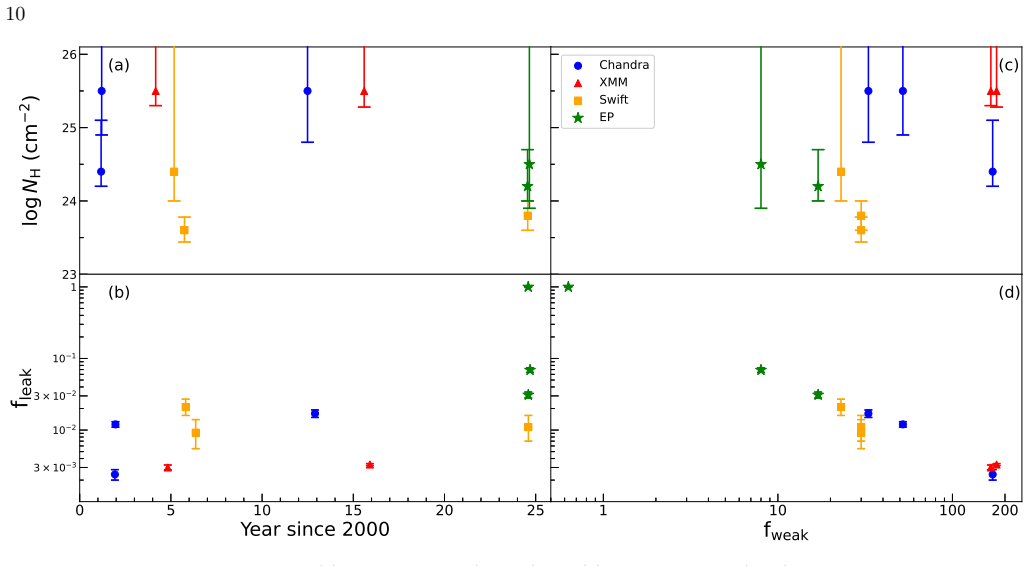
PHL 1811 exhibits X-ray weakness factors of approximately 23-179 in all epochs before 2024. The 2024 Einstein Probe flare marks the first detection of an X-ray nominal state with weakness factor approximately 0.63. The spectra are reproduced by a partial-covering obscuration model in which the steep observed shapes arise from a small leaked or scattered fraction of the intrinsic continuum, while variability is produced by changes in leakage fraction and column density of a clumpy dust-free absorber.
What carries the argument
Partial-covering obscuration model applied to multi-epoch spectra, in which variability arises from changes in the leakage fraction and column density of a clumpy dust-free absorber.
If this is right
- X-ray variability in PHL 1811 is produced by changes in the covering fraction and column density of the wind.
- PHL 1811 joins the population of super-Eddington accreting AGNs under a single obscuration framework.
- Objects previously classified as intrinsically X-ray weak may instead be explained by variable partial covering.
Where Pith is reading between the lines
- Repeated X-ray monitoring of other X-ray weak quasars could reveal similar hidden nominal states during flares.
- High-resolution spectroscopy during a future nominal state could directly measure the wind column and ionization.
- The fraction of truly intrinsically weak quasars may be lower than current estimates once obscuration is accounted for in similar sources.
Load-bearing premise
X-ray state transitions without corresponding optical or infrared variability indicate changes in a clumpy dust-free absorber rather than intrinsic changes in the X-ray emission mechanism.
What would settle it
Detection of optical or infrared variability that tracks future X-ray state changes would indicate intrinsic emission changes instead of obscuration.
Figures
read the original abstract
We present a systematic X-ray analysis of the narrow-line Type 1 quasar PHL 1811, which has long been regarded as the prototype of intrinsically X-ray weak quasars. A critical breakthrough came with the first detection of a bright X-ray flare from this source by the Einstein Probe (EP) in 2024. We utilize archival X-ray observations spanning 2001-2024, including the post-flare EP and Swift data. We confirm that PHL 1811 shows X-ray weakness factors $f_{\rm weak} \approx 23$-179 across all epochs before 2024. The 2024 EP flare marks the first detection of an X-ray nominal state with $f_{\rm weak} \approx 0.63$, followed by a rapid flux decline. We identify three key observational signatures that strongly support heavy obscuration: (1) a significant hard X-ray excess above $\approx5$ keV in the 2015 XMM-Newton spectrum; (2) relatively flat spectral shapes in two Swift observations; and (3) transitions between X-ray nominal and multiple X-ray weak states without corresponding optical/infrared variability, consistent with expectations from obscuration by a clumpy dust-free absorber. Fitting with a partial-covering obscuration model reproduces all multi-epoch spectra well. The observed steep spectra are dominated by a small leaked/scattered fraction of the intrinsic continuum, and variability is driven by changes in the leakage fraction and column density. Our results strongly favor the scenario where PHL 1811 is obscured by a radiatively driven accretion-disk wind from super-Eddington accretion, unifying PHL 1811 with the broader population of super-Eddington accreting AGNs under a single obscuration framework.
Editorial analysis
A structured set of objections, weighed in public.
Referee Report
Summary. The manuscript presents a multi-epoch X-ray study of the quasar PHL 1811 using archival data from 2001-2024 and new Einstein Probe observations of a 2024 flare. It reports X-ray weakness factors of 23-179 pre-flare and 0.63 during the flare, identifies three signatures (hard excess in 2015 XMM-Newton data, flat Swift spectra, state transitions without optical/IR variability) supporting obscuration over intrinsic weakness, shows that partial-covering models fit the spectra, and concludes that the source is obscured by a radiatively driven accretion disk wind associated with super-Eddington accretion, thereby unifying it with other super-Eddington AGNs.
Significance. Should the obscuration interpretation hold, the result would strengthen the case for clumpy, dust-free absorbers explaining X-ray weak states in narrow-line Type 1 quasars. The new EP flare detection adds temporal leverage on variability mechanisms. However, the unification under a super-Eddington wind framework is not derived from the data presented.
major comments (2)
- [Abstract] Abstract: The conclusion that PHL 1811 is obscured by a radiatively driven accretion-disk wind from super-Eddington accretion (unifying it with the broader super-Eddington AGN population) is load-bearing for the strongest claim, yet the manuscript contains no black hole mass, bolometric luminosity, or Eddington-ratio estimate derived from the X-ray data or supporting observations.
- [Abstract] Abstract: The statement that the partial-covering obscuration model 'reproduces all multi-epoch spectra well' lacks any accompanying fit statistics (e.g., χ^{2}/dof), best-fit parameter values with uncertainties for column density and leakage fraction, or references to specific spectral fitting results, tables, or figures. This prevents quantitative evaluation of the model support for the heavy-obscuration scenario.
Simulated Author's Rebuttal
We thank the referee for the constructive comments. We address each major point below.
read point-by-point responses
-
Referee: [Abstract] Abstract: The conclusion that PHL 1811 is obscured by a radiatively driven accretion-disk wind from super-Eddington accretion (unifying it with the broader super-Eddington AGN population) is load-bearing for the strongest claim, yet the manuscript contains no black hole mass, bolometric luminosity, or Eddington-ratio estimate derived from the X-ray data or supporting observations.
Authors: We agree that the present manuscript does not contain new black-hole mass or Eddington-ratio calculations derived from the X-ray data. The super-Eddington interpretation is motivated by the observed radiatively driven wind signatures and by the source's established properties in the literature; the unification with other super-Eddington AGNs follows from the shared obscuration mechanism rather than a fresh Eddington-ratio derivation here. In the revised manuscript we will add explicit citations to published optical/UV-based Eddington-ratio estimates for PHL 1811 to anchor this part of the discussion. revision: yes
-
Referee: [Abstract] Abstract: The statement that the partial-covering obscuration model 'reproduces all multi-epoch spectra well' lacks any accompanying fit statistics (e.g., χ^{2}/dof), best-fit parameter values with uncertainties for column density and leakage fraction, or references to specific spectral fitting results, tables, or figures. This prevents quantitative evaluation of the model support for the heavy-obscuration scenario.
Authors: The spectral-fitting results, including χ²/dof values, best-fit column densities, leakage fractions with uncertainties, and references to the relevant tables and figures, are already presented in Section 3, Table 2, and Figures 3–5 of the manuscript. We will revise the abstract to include a concise reference to these quantitative results so that the claim can be evaluated directly from the abstract. revision: yes
Circularity Check
No significant circularity; core claims rest on new EP flare data and standard partial-covering fits
full rationale
The paper's derivation chain begins with multi-epoch X-ray spectra (2001-2024), the 2024 EP flare detection, and fits to a partial-covering obscuration model. These reproduce the observed hard excess, flat spectra, and state transitions without optical/IR variability. No step equates a fitted parameter or prediction to its input by construction, nor does any load-bearing premise reduce to a self-citation chain. The interpretive unification with super-Eddington AGNs is presented as a favored scenario consistent with the obscuration framework but is not derived via equations or fits within the presented analysis; the X-ray results remain independently supported by the new observations.
Axiom & Free-Parameter Ledger
free parameters (2)
- absorber column density
- covering fraction / leakage fraction
axioms (1)
- domain assumption X-ray luminosity can be predicted from optical/UV luminosity using established correlations for normal quasars.
Reference graph
Works this paper leans on
-
[1]
Arnaud, K. A. 1996, in ASP Conf. Ser., Vol. 101, Astronomical Data Analysis Software and Systems V, ed. G. H. Jacoby & J. Barnes, 17 Baloković, M., Brightman, M., Harrison, F. A., et al. 2018, ApJ, 854, 42, doi: 10.3847/1538-4357/aaa7eb
-
[2]
Boroson, T. A., & Green, R. F. 1992, ApJS, 80, 109, doi: 10.1086/191661
-
[3]
Cardelli, J. A., Clayton, G. C., & Mathis, J. S. 1989, ApJ, 345, 245, doi: 10.1086/167900
-
[4]
arXiv , author =:2407.03422 , journal =
Chen, Y., Luo, B., Brandt, W. N., et al. 2024, ApJ, 972, 191, doi: 10.3847/1538-4357/ad5f89
-
[5]
Observational characteristics of accretion onto black holes
Done, C. 2010, arXiv e-prints, arXiv:1008.2287, doi: 10.48550/arXiv.1008.2287
work page internal anchor Pith review Pith/arXiv arXiv doi:10.48550/arxiv.1008.2287 2010
-
[6]
Fabian, A. C., Alston, W. N., Cackett, E. M., et al. 2017, Astronomische Nachrichten, 338, 269, doi: 10.1002/asna.201713341
-
[7]
2014, SSRv, 183, 121, doi: 10.1007/s11214-014-0071-5
Gilfanov, M., & Merloni, A. 2014, SSRv, 183, 121, doi: 10.1007/s11214-014-0071-5
-
[8]
Grupe, D., Komossa, S., & Gallo, L. C. 2007, ApJL, 668, L111, doi: 10.1086/523042 HI4PI Collaboration, Ben Bekhti, N., Flöer, L., et al. 2016, A&A, 594, A116, doi: 10.1051/0004-6361/201629178
-
[9]
Strong X-ray Variability of I Zwicky 1: Obscuration from Clumpy Accretion-Disk Winds
Huang, J., Luo, B., Brandt, W. N., Ho, L. C., & Ni, Q. 2026, ApJ, in press (arXiv:2605.22918), doi: 10.48550/arXiv.2605.22918
work page internal anchor Pith review Pith/arXiv arXiv doi:10.48550/arxiv.2605.22918 2026
-
[10]
Huang, J., Luo, B., Brandt, W. N., et al. 2025, ApJ, 979, 107, doi: 10.3847/1538-4357/ad9baf
-
[11]
Huang, J., Luo, B., Brandt, W. N., et al. 2023, ApJ, 950, 18, doi: 10.3847/1538-4357/accd64
-
[12]
doi:10.1093/pasj/psaf050 , eprint =
Inayoshi, K., Kimura, S. S., & Noda, H. 2025, PASJ, 77, 811, doi: 10.1093/pasj/psaf050
-
[13]
Komossa, S., Grupe, D., Gallo, L. C., et al. 2020, A&A, 643, L7, doi: 10.1051/0004-6361/202039098
-
[14]
2022, A&A, 657, A57, doi: 10.1051/0004-6361/202141829
Laurenti, M., Piconcelli, E., Zappacosta, L., et al. 2022, A&A, 657, A57, doi: 10.1051/0004-6361/202141829
-
[15]
Leighly, K. M., Halpern, J. P., Jenkins, E. B., & Casebeer, D. 2007a, ApJS, 173, 1, doi: 10.1086/519768
-
[16]
Leighly, K. M., Halpern, J. P., Jenkins, E. B., et al. 2007b, ApJ, 663, 103, doi: 10.1086/518017
-
[17]
L., Wang, W
Li, A., Wang, Y. L., Wang, W. X., et al. 2024, The Astronomer’s Telegram, 16763, 1 12
2024
-
[18]
Liu, H., Luo, B., Brandt, W. N., et al. 2022, ApJ, 930, 53, doi: 10.3847/1538-4357/ac6265
-
[19]
Liu, H., Luo, B., Brandt, W. N., et al. 2019, ApJ, 878, 79, doi: 10.3847/1538-4357/ab1d5b
-
[20]
Liu, H., Luo, B., Brandt, W. N., et al. 2021, ApJ, 910, 103, doi: 10.3847/1538-4357/abe37f
-
[21]
Luo, B., Brandt, W. N., Hall, P. B., et al. 2015, ApJ, 805, 122, doi: 10.1088/0004-637X/805/2/122
-
[22]
2017, A&A, 602, A79, doi: 10.1051/0004-6361/201630079
Lusso, E., & Risaliti, G. 2017, A&A, 602, A79, doi: 10.1051/0004-6361/201630079
-
[23]
MacLeod, C. L., Ivezić, Ž., Kochanek, C. S., et al. 2010, ApJ, 721, 1014, doi: 10.1088/0004-637X/721/2/1014
-
[24]
Mainzer, A., Bauer, J., Cutri, R. M., et al. 2014, ApJ, 792, 30, doi: 10.1088/0004-637X/792/1/30
-
[25]
doi:10.1093/mnras/staf359 , eprint =
Maiolino, R., Risaliti, G., Signorini, M., et al. 2025, MNRAS, 538, 1921, doi: 10.1093/mnras/staf359
-
[26]
The Zwicky Transient Facility: Data Processing, Products, and Archive
Masci, F. J., Laher, R. R., Rusholme, B., et al. 2019, PASP, 131, 018003, doi: 10.1088/1538-3873/aae8ac
work page internal anchor Pith review doi:10.1088/1538-3873/aae8ac 2019
-
[27]
Fender, R. P. 2006, Nature, 444, 730, doi: 10.1038/nature05389
-
[28]
Miniutti, G., Brandt, W. N., Schneider, D. P., et al. 2012, MNRAS, 425, 1718, doi: 10.1111/j.1365-2966.2012.21648.x
-
[29]
2019, A&A, 632, A109, doi: 10.1051/0004-6361/201936911
Nardini, E., Lusso, E., Risaliti, G., et al. 2019, A&A, 632, A109, doi: 10.1051/0004-6361/201936911
-
[30]
Ni, Q., Brandt, W. N., Luo, B., et al. 2018, MNRAS, 480, 5184, doi: 10.1093/mnras/sty1989
-
[31]
Ni, Q., Brandt, W. N., Yi, W., et al. 2020, ApJL, 889, L37, doi: 10.3847/2041-8213/ab6d78 O’Donnell, J. E. 1994, ApJ, 422, 158, doi: 10.1086/173713 Planck Collaboration, Aghanim, N., Akrami, Y., et al. 2020, A&A, 641, A6, doi: 10.1051/0004-6361/201833910
-
[32]
Pu, X., Luo, B., Brandt, W. N., et al. 2020, ApJ, 900, 141, doi: 10.3847/1538-4357/abacc5
-
[33]
Maps of Dust IR Emission for Use in Estimation of Reddening and CMBR Foregrounds
Schlegel, D. J., Finkbeiner, D. P., & Davis, M. 1998, ApJ, 500, 525, doi: 10.1086/305772
work page internal anchor Pith review doi:10.1086/305772 1998
-
[34]
Shen, Y., & Ho, L. C. 2014, Nature, 513, 210, doi: 10.1038/nature13712
-
[35]
Steffen, A. T., Strateva, I., Brandt, W. N., et al. 2006, AJ, 131, 2826, doi: 10.1086/503627
-
[36]
2000, ApJL, 536, L5, doi: 10.1086/312717
Dultzin-Hacyan, D. 2000, ApJL, 536, L5, doi: 10.1086/312717
-
[37]
Timlin, III, J. D., Brandt, W. N., Zhu, S., et al. 2020, MNRAS, 498, 4033, doi: 10.1093/mnras/staa2661
-
[38]
2023, A&A, 677, A111, doi: 10.1051/0004-6361/202346024
Trefoloni, B., Lusso, E., Nardini, E., et al. 2023, A&A, 677, A111, doi: 10.1051/0004-6361/202346024
-
[39]
Tripathi, S., McGrath, K. M., Gallo, L. C., et al. 2020, MNRAS, 499, 1266, doi: 10.1093/mnras/staa2817
-
[40]
Wang, C., Luo, B., Brandt, W. N., et al. 2022, ApJ, 936, 95, doi: 10.3847/1538-4357/ac886e
-
[41]
Wang, S., Brandt, W. N., Luo, B., et al. 2024, ApJ, 974, 2, doi: 10.3847/1538-4357/ad7589
-
[42]
X-ray variability of SDSS J000532.84+200717.4: from a normal state to an X-weak state
Xiaohui, Y., Yanli, A., Liming, D., et al. 2026, arXiv e-prints, arXiv:2604.00476, doi: 10.48550/arXiv.2604.00476
work page internal anchor Pith review Pith/arXiv arXiv doi:10.48550/arxiv.2604.00476 2026
-
[43]
Yang, G., Brandt, W. N., Luo, B., et al. 2016, ApJ, 831, 145, doi: 10.3847/0004-637X/831/2/145
-
[44]
Handbook of X-ray and Gamma-ray Astrophysics , year = 2022, editor =
Yuan, W., Zhang, C., Chen, Y., & Ling, Z. 2022, in Handbook of X-ray and Gamma-ray Astrophysics, ed. C. Bambi & A. Sangangelo, 86, doi: 10.1007/978-981-16-4544-0_151-1
discussion (0)
Sign in with ORCID, Apple, or X to comment. Anyone can read and Pith papers without signing in.