REVIEW 1 major objections 5 minor 107 references
Optimal Training-Time Scaling in Gradual Adaptation
T0 review · 1 major / 5 minor · reviewed 2026-08-08 · deepseek-v4-flash
Pith's one-line read A gradual adaptation path divided into N tasks is best traversed by training each task for a time proportional to 1/N, because progress vanishes if the total budget is too small or too large.
desk verdict A sound and clean theory result for whole-path common-solution progress, but the abstract's unqualified Θ(N^{-1}) claim is misleading because the same model makes infinite per-task training optimal for final-task loss. read the letter →
The pith
A machine-rendered reading of the paper's core claim, the machinery that carries it, and where it could break.
The reading
What carries the argument
The central object is the effective training time $\tau = N s_N$ together with the continuum evolution $\dot{x}_\tau = -\tau H(t) x_\tau$; its progress identity $P_\tau = 2\tau \int x_\tau^\top H x_\tau\,dt$ turns the whole-path progress into an accumulated cost that can be compared across all discretizations. The argument combines exact exponential updates $v_j = e^{-s_N H(t_j)}v_{j-1}$, a Taylor expansion of these updates against the continuum ODE with uniform $O(N^{-1})$ approximation, and Kato transport $U(t)$, defined by $\dot U = [\dot P, P]U$, which rotates the moving zero-loss spaces into a fixed frame so the large-$N s_N$ regime can be expanded into the operators $G_s$ and $G_H$. Two tail expansions, $P_\tau = 2\tau\langle v_0, A_H v_0\rangle + O(\tau^2)$ and $P_\tau = 2\tau^{-1}\langle v_0, G_H v_0\rangle + o(\tau^{-1})$, deliver the $\Theta(\tau)$ and $\Theta(\tau^{-1})$ bounds.
What would settle it
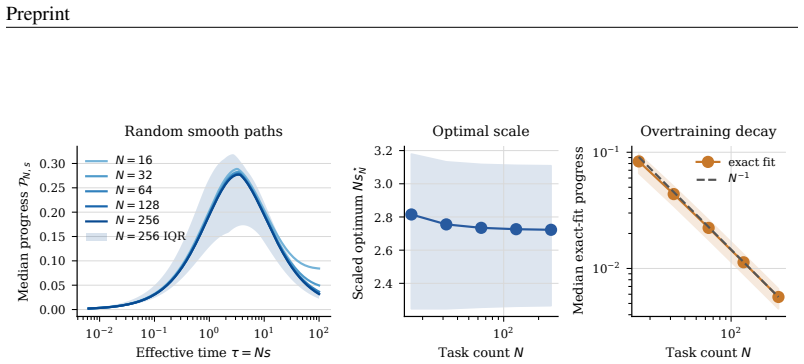
On a smooth rank-one rotating regression path with known matrices, compute the exact progress $P_{N,s}(v_0)$ on a fine grid of $s$ for $N=16,32,\ldots,256$ and locate the maximizer $N s_N^*$; Theorem 2 predicts it stays in a fixed bounded interval with all accumulation points maximizing the limiting curve, so observing $N s_N^* \to 0$ or $N s_N^* \to \infty$ would refute the scaling law.
Extended reading notes
Core claim
Under a $C^3$, constant-rank path of Hessians $H(t)$ with a common zero-loss parameter $w^*$, the learning progress $P_{N,s_N}(v_0) = \|v_0\|^2 - \|v_N\|^2$ (distance squared to the common solution set, after removing the component invisible to all tasks) has a sharp continuum limit. If $N s_N \to \tau \in [0,\infty)$, the endpoint converges to the solution of $\dot{x}_\tau(t) = -\tau H(t) x_\tau(t)$, and the progress converges to $P_\tau(v_0)$, which satisfies the exact identity $P_\tau(v_0) = 2\tau \int_0^1 x_\tau(t)^\top H(t) x_\tau(t)\,dt$. The limiting curve rises linearly for small $\tau$ and decays as $\tau^{-1}$ for large $\tau$, so its maximum lies at a finite positive $\tau$. The paper therefore proves that for every sufficiently large $N$, all optimizers of per-task training time are finite and satisfy $s_N^*(v_0)=\Theta(N^{-1})$, equivalently $N s_N^* = \Theta(1)$, meaning the total effective training budget stays constant as the path is refined. An explicit corollary is that training every task to convergence belongs to the vanishing-progress regime.
Load-bearing premise
The $N^{-1}$ law depends on measuring progress as whole-path squared-distance reduction to a common zero-loss solution; the paper's own figures show it need not transfer to target-endpoint loss, because final-task loss can keep improving after whole-path progress starts to decline, and the proof also assumes this shared solution and a smooth constant-rank Hessian path.
Editorial extensions
If this is right
- When a fixed task path is divided into more steps, each task should be trained proportionally less; the optimal total budget $N s_N^*$ stays at the same finite scale rather than growing with $N$.
- Training each intermediate task to convergence is not harmless: it is the overtraining regime and its progress falls like $N^{-1}$, tending to zero as the discretization is refined.
- Task resolution and per-task optimization time cannot be chosen independently: keeping $s_N$ fixed while increasing $N$ sends the total effective time to infinity and moves the system to the wrong regime.
- At any fixed nonzero per-task time, finite fitting gives a strictly larger first-order progress coefficient than exact fitting, and this ordering survives any strictly increasing transformation of squared distance.
- Rotated MNIST and temporal Yearbook experiments show fitted exponents whose confidence intervals contain the predicted inverse scaling, supporting the qualitative rule of less per-task training under finer discretization.
Reading between the lines
- An implication the paper leaves implicit: in practical test-time or continual adaptation, the update budget should be set by the rate of distribution change rather than by a fixed number of steps per task, since the total effective training time along the path is what determines progress.
- A testable extension is to measure the same scaling under an endpoint-weighted objective; the paper's own right-hand panels in Figures 3 and 4 show final-task loss still improving after whole-path mean loss rises, so a different optimum should appear.
- A neighbouring problem it suggests: for a path with non-uniform task spacing, the analogous law would likely become a local update density proportional to the local rate of change of the Hessian, an extension the paper does not address.
Editorial analysis
A structured set of objections, weighed in public.
Referee Report
Summary. The paper studies how per-task training time should scale when a fixed gradual-adaptation path is sampled into N tasks. It considers a smooth path of overparameterized linear regression tasks t∈[0,1] that share a zero-loss parameter w*, with Hessians H(t) of constant rank, and trains each of the N tasks for time s under gradient flow, so each update is the matrix exponential e^{-sH(t_j)}. Defining learning progress P_{N,s}(v0) as the reduction in squared distance to the common solution set K=∩_t ker H(t) (Eq. (6)), the paper proves (Theorem 1) that when Ns_N→τ the discrete updates converge uniformly to the continuum ODE ẋ=-τH(t)x, with O(N^{-1}) rates on compact τ ranges. Theorem 2 characterizes the limiting progress as Θ(τ) for τ→0 and Θ(τ^{-1}) for τ→∞, and concludes that positive limiting progress occurs exactly when Ns_N=Θ(1), giving s_N^*(v0)=Θ(N^{-1}). Proposition 3 compares fixed finite per-task training with exact fitting at first order, and the paper reports experiments on rotating rank-one regression, rotated MNIST, and Yearbook as qualitative consistency checks.
Significance. The mathematical core is nontrivial and, for the measure it analyzes, appears sound and self-contained: the paper gives an exact telescoping decomposition (Proposition 2), a dense-task limit with explicit uniform rates (Lemma 1), Kato-transport expansions for the large-τ tail (Lemma 2), finite-time first-order expansions with a strict coefficient comparison (Lemma 3), and an explicit anisotropic counterexample showing that the finite-vs-exact comparison can reverse under a different distance (Section A.4). The experiments are honestly labeled as qualitative checks, with fixed seeds, bootstrap intervals, and explicit caveats about departures from the theorem's assumptions. The main qualification is scope: the optimal N^{-1} scaling law concerns the whole-path common-kernel distance measure, not final-task loss, and the abstract and introduction currently state the result without this qualification.
major comments (1)
- [Section 2.2 (Eq. (6)), Section 3.2 (Theorem 2), Abstract] The scaling law s_N^* = Θ(N^{-1}) is established only for the progress measure P_{N,s}(v0) = ||v0||^2 - ||Φ_{N,s}v0||^2, i.e., the reduction of squared distance to the common solution set K = ∩_t V(t). This is not the usual gradual-adaptation objective of good final-task performance. Under the same assumptions, the final-task population loss L_1(w_N) = ½ v_N^T H(1) v_N from Eq. (1) is exactly zero at s = ∞, because Φ_{N,∞}v0 = P(t_N)⋯P(t_1)v0 lies in V(1) = ker H(1). Hence for target-endpoint loss, s = ∞ is an optimizer for every N, not Θ(N^{-1}); the N^{-1} rule is contradicted by the same model when the objective is final-task loss rather than whole-path common-kernel distance. The paper's own Figure 3 (right) and Figure 4 (right) demonstrate the operative distinction: final-angle and target-year losses keep improving after whole-path mean loss has turned upward. The abstract's unqualified statement that optimal per-task training times scale as s_N^* = Θ(N^{-1}) is therefore misleading. The claims must either be explicitly restricted to the whole-path common-kernel distance objective, or the target-endpoint objective must be analyzed separately.
minor comments (5)
- [Section 1] In the sentence 'coupling its resolution N to the local training times N', the second 'N' should be 's_N'; as printed, the sentence is self-referential and confusing.
- [Table 2] The Yearbook interpolated optima are non-monotone between N=16 (4.23) and N=32 (5.01). The text says the optimum 'falls overall' but should explicitly acknowledge this non-monotonicity, since it weakens the visual support for a monotone N^{-1} trend.
- [Section B.3 and B.4] The experiments use mean cross-entropy over the path as the empirical objective, whereas Proposition 1 relates the theoretical progress measure to the worst-case path loss sup_t L_t(w), not the average. Since the experiments are qualitative consistency checks this is acceptable, but the mismatch should be stated where the proxy is introduced.
- [Proposition 1, Eq. (7)] The upper bound uses L from Eq. (3) but L is not redefined in Proposition 1; readers must infer it from the spectral bound. A one-line reminder would improve readability.
- [Contributions, Section 1] In the second bullet, 'prove its Θ(τ) growth' should read 'prove its Θ(τ) growth' or 'prove the Θ(τ) growth'; the sentence as printed has an awkward missing subject.
Circularity Check
No significant circularity: the N^{-1} law is derived from the ODE and Kato-transport analysis; the sole self-citation is not load-bearing.
full rationale
The paper's central derivation is self-contained. Theorem 1's dense-task limit is proved by Taylor expansion of the matrix exponentials and contraction estimates, giving the uniform O_T(N^{-1}) rates in Eqs. (13)-(14) and the identity in Eq. (15). Theorem 2's small- and large-budget tails are proved from the limiting ODE and the Kato-transport block decomposition in Lemmas 2-4, with the large-τ decay following from the spectral-gap estimate and the explicit operator G_H in Eq. (32). The optimal scaling s_N^* = Θ(N^{-1}) then follows from the two tail bounds and compactness of the limiting maximizer set, not from any fitted constant or from the definition of P_N,s. The progress measure P_N,s(v0)=||v0||^2-||Φ_{N,s}v0||^2 is explicitly introduced in Eq. (6), and the optimal time in Eq. (9) is a maximizer of that named objective; choosing a different objective such as final-task loss is a scope limitation that the paper itself acknowledges ('continued training can improve the target task while worsening full-path performance'), but this is objective-dependence, not circularity. The only overlapping-author citation is Xu and Ma 2026, which appears in a related-work sentence ('while recent work studies continual models under SGD and task distributions (Evron et al., 2026; Xu & Ma, 2026)') and is not used in any proof, definition, or assumption. The experiments fit empirical exponents and report confidence intervals containing 1, while the text explicitly calls these qualitative consistency checks rather than exact verifications, so the empirical claims are not fitted parameters renamed as predictions. No equation in the paper reduces by construction to its own input, and no load-bearing result is imported solely from the authors' prior work.
Assumptions & free parameters
assumptions (6)
- domain assumption All tasks share a zero-loss parameter w* with y = x^T w* almost surely.
- domain assumption The Hessian path H(t) is C^3 with constant rank and nonzero eigenvalues in [mu, L].
- domain assumption The initial error lies in V(0) intersect K-perp after fitting the first task.
- standard math Kato's adiabatic transport theorem and the generator identities for continuously varying projections.
- domain assumption Learning progress is squared-distance reduction to the common solution set, equivalent to whole-path mean loss.
- domain assumption Gradient-flow time approximates finite-step SGD in the experiments.
Cite this review
Pith. "Pith review of Optimal Training-Time Scaling in Gradual Adaptation." pith.science (2026). https://pith.science/paper/DWHJBIUS
@misc{pith2026260804927,
  author       = {Pith},
  title        = {Pith review of: Optimal Training-Time Scaling in Gradual Adaptation},
  year         = {2026},
  howpublished = {\url{https://pith.science/paper/DWHJBIUS}},
  note         = {Machine review of arXiv:2608.04927}
}
abstract
In gradual adaptation, how should the training time on each task change as the number of intermediate tasks increases? We study this question for overparameterized linear regression tasks that change smoothly and share a zero-loss solution. With $N$ tasks and training time $s_N$ on each, the final learning progress converges to a continuum curve when $Ns_N\to\tau$. The limiting progress is $\Theta(\tau)$ for small $\tau$ and $\Theta(\tau^{-1})$ for large $\tau$, so both very short and very long training produce little progress. It follows that optimal per-task training times scale as $s_N^\star=\Theta(N^{-1})$, equivalently $Ns_N^\star=\Theta(1)$. Experiments on gradually rotated MNIST and a natural Yearbook time shift are consistent with less per-task training as the path is divided more finely.
Figures


Figures from the paper (2 more)

Reference graph
Works this paper leans on
-
[1]
Neural Networks , volume=
Continual Lifelong Learning with Neural Networks: A Review , author=. Neural Networks , volume=. 2019 , doi=
2019
-
[2]
IEEE Transactions on Pattern Analysis and Machine Intelligence , volume=
A Continual Learning Survey: Defying Forgetting in Classification Tasks , author=. IEEE Transactions on Pattern Analysis and Machine Intelligence , volume=. 2022 , doi=
2022
-
[3]
Proceedings of the 37th International Conference on Machine Learning , series=
Understanding Self-Training for Gradual Domain Adaptation , author=. Proceedings of the 37th International Conference on Machine Learning , series=. 2020 , publisher=
2020
-
[4]
Advances in Neural Information Processing Systems , volume=
Gradual Domain Adaptation without Indexed Intermediate Domains , author=. Advances in Neural Information Processing Systems , volume=. 2021 , url=
2021
-
[5]
Proceedings of the 39th International Conference on Machine Learning , series=
Understanding Gradual Domain Adaptation: Improved Analysis, Optimal Path and Beyond , author=. Proceedings of the 39th International Conference on Machine Learning , series=. 2022 , publisher=
2022
-
[6]
Proceedings of the IEEE/CVF Conference on Computer Vision and Pattern Recognition , pages=
Continual Test-Time Domain Adaptation , author=. Proceedings of the IEEE/CVF Conference on Computer Vision and Pattern Recognition , pages=. 2022 , url=
2022
-
[7]
Proceedings of the IEEE/CVF Conference on Computer Vision and Pattern Recognition , pages=
Robust Mean Teacher for Continual and Gradual Test-Time Adaptation , author=. Proceedings of the IEEE/CVF Conference on Computer Vision and Pattern Recognition , pages=. 2023 , url=
2023
-
[8]
Proceedings of the IEEE/CVF Conference on Computer Vision and Pattern Recognition , pages=
Robust Test-Time Adaptation in Dynamic Scenarios , author=. Proceedings of the IEEE/CVF Conference on Computer Vision and Pattern Recognition , pages=. 2023 , url=
2023
Show all 107 references
-
[9]
IEEE Robotics and Automation Letters , volume=
Test-Time Adaptation in the Dynamic World with Compound Domain Knowledge Management , author=. IEEE Robotics and Automation Letters , volume=. 2023 , url=
2023
-
[10]
2025 , publisher=
Zhang, Yunbei and Mehra, Akshay and Niu, Shuaicheng and Hamm, Jihun , booktitle=. 2025 , publisher=
2025
-
[11]
The Eleventh International Conference on Learning Representations , year=
Dynamic Update-to-Data Ratio: Minimizing World Model Overfitting , author=. The Eleventh International Conference on Learning Representations , year=
-
[12]
Proceedings of the 34th International Conference on Machine Learning , series=
Automated Curriculum Learning for Neural Networks , author=. Proceedings of the 34th International Conference on Machine Learning , series=. 2017 , publisher=
2017
-
[13]
Proceedings of the 39th International Conference on Machine Learning , series=
Curriculum Reinforcement Learning via Constrained Optimal Transport , author=. Proceedings of the 39th International Conference on Machine Learning , series=. 2022 , publisher=
2022
-
[14]
Advances in Neural Information Processing Systems , volume=
Curriculum Reinforcement Learning using Optimal Transport via Gradual Domain Adaptation , author=. Advances in Neural Information Processing Systems , volume=. 2022 , url=
2022
-
[15]
The Thirteenth International Conference on Learning Representations , year=
Optimal Protocols for Continual Learning via Statistical Physics and Control Theory , author=. The Thirteenth International Conference on Learning Representations , year=
-
[16]
Constructive Approximation , volume=
On Early Stopping in Gradient Descent Learning , author=. Constructive Approximation , volume=. 2007 , doi=
2007
-
[17]
Journal of Machine Learning Research , volume=
Early Stopping and Non-parametric Regression: An Optimal Data-dependent Stopping Rule , author=. Journal of Machine Learning Research , volume=. 2014 , url=
2014
-
[18]
Proceedings of the 22nd International Conference on Artificial Intelligence and Statistics , series=
A Continuous-Time View of Early Stopping for Least Squares Regression , author=. Proceedings of the 22nd International Conference on Artificial Intelligence and Statistics , series=. 2019 , publisher=
2019
-
[19]
Proceedings of the 33rd International Conference on Machine Learning , series=
Train Faster, Generalize Better: Stability of Stochastic Gradient Descent , author=. Proceedings of the 33rd International Conference on Machine Learning , series=. 2016 , publisher=
2016
-
[20]
Advances in Neural Information Processing Systems , volume=
Understanding the Role of Training Regimes in Continual Learning , author=. Advances in Neural Information Processing Systems , volume=
-
[21]
Proceedings of the 41st International Conference on Machine Learning , series=
A Statistical Theory of Regularization-Based Continual Learning , author=. Proceedings of the 41st International Conference on Machine Learning , series=. 2024 , publisher=
2024
-
[22]
Advances in Neural Information Processing Systems , volume=
Optimal Rates in Continual Linear Regression via Increasing Regularization , author=. Advances in Neural Information Processing Systems , volume=. 2025 , url=
2025
-
[23]
Proceedings of the 2nd Conference on Lifelong Learning Agents , series=
Challenging Common Assumptions about Catastrophic Forgetting and Knowledge Accumulation , author=. Proceedings of the 2nd Conference on Lifelong Learning Agents , series=. 2023 , publisher=
2023
-
[24]
Proceedings of the 42nd International Conference on Machine Learning , series=
The Importance of Being Lazy: Scaling Limits of Continual Learning , author=. Proceedings of the 42nd International Conference on Machine Learning , series=. 2025 , publisher=
2025
-
[25]
Proceedings of the 35th Conference on Learning Theory , series=
How Catastrophic Can Catastrophic Forgetting Be in Linear Regression? , author=. Proceedings of the 35th Conference on Learning Theory , series=. 2022 , publisher=
2022
-
[26]
Advances in Neural Information Processing Systems , volume=
Nearly Optimal Bounds for Cyclic Forgetting , author=. Advances in Neural Information Processing Systems , volume=. 2023 , url=
2023
-
[27]
From Continual Learning to
Evron, Itay and Levinstein, Ran and Schliserman, Matan and Sherman, Uri and Koren, Tomer and Soudry, Daniel and Srebro, Nathan , booktitle=. From Continual Learning to. 2026 , publisher=
2026
-
[28]
Journal of the Physical Society of Japan , volume=
On the Adiabatic Theorem of Quantum Mechanics , author=. Journal of the Physical Society of Japan , volume=. 1950 , doi=
1950
-
[29]
Facchi, Paolo and Pascazio, Saverio , journal=. Quantum. 2008 , doi=
2008
-
[30]
Communications in Mathematical Physics , volume=
Adiabatic Theorems for Generators of Contracting Evolutions , author=. Communications in Mathematical Physics , volume=. 2012 , doi=
2012
-
[32]
Journal of Dynamics and Games , volume=
Asymptotic Behavior of Compositions of Under-Relaxed Nonexpansive Operators , author=. Journal of Dynamics and Games , volume=. 2014 , doi=
2014
-
[33]
Proceedings of the 26th International Conference on Machine Learning , pages=
Curriculum Learning , author=. Proceedings of the 26th International Conference on Machine Learning , pages=. 2009 , doi=
2009
-
[34]
Advances in Neural Information Processing Systems , volume=
Self-Paced Learning for Latent Variable Models , author=. Advances in Neural Information Processing Systems , volume=
-
[35]
Proceedings of the 35th International Conference on Machine Learning , series=
Curriculum Learning by Transfer Learning: Theory and Experiments with Deep Networks , author=. Proceedings of the 35th International Conference on Machine Learning , series=. 2018 , publisher=
2018
-
[36]
Proceedings of the 36th International Conference on Machine Learning , series=
On the Power of Curriculum Learning in Training Deep Networks , author=. Proceedings of the 36th International Conference on Machine Learning , series=. 2019 , publisher=
2019
-
[37]
Proceedings of the 37th International Conference on Machine Learning , series=
Test-Time Training with Self-Supervision for Generalization under Distribution Shifts , author=. Proceedings of the 37th International Conference on Machine Learning , series=. 2020 , publisher=
2020
-
[38]
2021 , url=
Wang, Dequan and Shelhamer, Evan and Liu, Shaoteng and Olshausen, Bruno and Darrell, Trevor , booktitle=. 2021 , url=
2021
-
[39]
Proceedings of the 39th International Conference on Machine Learning , series=
Efficient Test-Time Model Adaptation without Forgetting , author=. Proceedings of the 39th International Conference on Machine Learning , series=. 2022 , publisher=
2022
-
[40]
Zhang, Marvin and Levine, Sergey and Finn, Chelsea , booktitle=
-
[41]
International Conference on Learning Representations , year=
Towards Stable Test-Time Adaptation in Dynamic Wild World , author=. International Conference on Learning Representations , year=
-
[42]
Machine Learning , volume=
A Theory of Learning from Different Domains , author=. Machine Learning , volume=. 2010 , doi=
2010
-
[43]
Journal of Machine Learning Research , volume=
Domain-Adversarial Training of Neural Networks , author=. Journal of Machine Learning Research , volume=
-
[44]
and Darrell, Trevor , booktitle=
Hoffman, Judy and Tzeng, Eric and Park, Taesung and Zhu, Jun-Yan and Isola, Phillip and Saenko, Kate and Efros, Alexei A. and Darrell, Trevor , booktitle=. 2018 , publisher=
2018
-
[45]
Proceedings of the IEEE Conference on Computer Vision and Pattern Recognition , pages=
Maximum Classifier Discrepancy for Unsupervised Domain Adaptation , author=. Proceedings of the IEEE Conference on Computer Vision and Pattern Recognition , pages=
-
[46]
Proceedings of the National Academy of Sciences , volume=
Overcoming Catastrophic Forgetting in Neural Networks , author=. Proceedings of the National Academy of Sciences , volume=. 2017 , doi=
2017
-
[47]
Proceedings of the 34th International Conference on Machine Learning , series=
Continual Learning Through Synaptic Intelligence , author=. Proceedings of the 34th International Conference on Machine Learning , series=. 2017 , publisher=
2017
-
[48]
Advances in Neural Information Processing Systems , volume=
Gradient Episodic Memory for Continual Learning , author=. Advances in Neural Information Processing Systems , volume=
-
[49]
Efficient Lifelong Learning with
Chaudhry, Arslan and Ranzato, Marc'Aurelio and Rohrbach, Marcus and Elhoseiny, Mohamed , booktitle=. Efficient Lifelong Learning with. 2019 , url=
2019
-
[50]
Proceedings of the 23rd International Conference on Artificial Intelligence and Statistics , series=
Orthogonal Gradient Descent for Continual Learning , author=. Proceedings of the 23rd International Conference on Artificial Intelligence and Statistics , series=. 2020 , publisher=
2020
-
[51]
Advances in Neural Information Processing Systems , volume=
Online Structured Laplace Approximations for Overcoming Catastrophic Forgetting , author=. Advances in Neural Information Processing Systems , volume=
-
[52]
Proceedings of the 25th International Conference on Artificial Intelligence and Statistics , series=
Unifying Importance Based Regularisation Methods for Continual Learning , author=. Proceedings of the 25th International Conference on Artificial Intelligence and Statistics , series=. 2022 , publisher=
2022
-
[53]
Nature Machine Intelligence , volume=
Three Types of Incremental Learning , author=. Nature Machine Intelligence , volume=. 2022 , doi=
2022
-
[54]
IEEE Transactions on Computational Imaging , volume=
A Century of Portraits: A Visual Historical Record of American High School Yearbooks , author=. IEEE Transactions on Computational Imaging , volume=. 2017 , doi=
2017
-
[55]
Advances in Neural Information Processing Systems Datasets and Benchmarks Track , year=
Wild-Time: A Benchmark of in-the-Wild Distribution Shift over Time , author=. Advances in Neural Information Processing Systems Datasets and Benchmarks Track , year=
-
[56]
Zico Kolter, and Ryan J
Alnur Ali, J. Zico Kolter, and Ryan J. Tibshirani. A continuous-time view of early stopping for least squares regression. In Proceedings of the 22nd International Conference on Artificial Intelligence and Statistics, volume 89 of Proceedings of Machine Learning Research, pp.\ ...
2019
-
[57]
J. E. Avron, M. Fraas, G. M. Graf, and P. Grech. Adiabatic theorems for generators of contracting evolutions. Communications in Mathematical Physics, 314: 0 163--191, 2012. doi:10.1007/s00220-012-1504-1
2012 doi
-
[58]
A theory of learning from different domains
Shai Ben-David, John Blitzer, Koby Crammer, Alex Kulesza, Fernando Pereira, and Jennifer Wortman Vaughan. A theory of learning from different domains. Machine Learning, 79: 0 151--175, 2010. doi:10.1007/s10994-009-5152-4
2010 doi
-
[59]
Curriculum learning
Yoshua Bengio, J \'e r \^o me Louradour, Ronan Collobert, and Jason Weston. Curriculum learning. In Proceedings of the 26th International Conference on Machine Learning, pp.\ 41--48, 2009. doi:10.1145/1553374.1553380
2009
-
[60]
Unifying importance based regularisation methods for continual learning
Frederik Benzing. Unifying importance based regularisation methods for continual learning. In Proceedings of the 25th International Conference on Artificial Intelligence and Statistics, volume 151 of Proceedings of Machine Learning Research, pp.\ 2372--2396. PMLR, 2022
2022
-
[61]
Efficient lifelong learning with A-GEM
Arslan Chaudhry, Marc'Aurelio Ranzato, Marcus Rohrbach, and Mohamed Elhoseiny. Efficient lifelong learning with A-GEM . In International Conference on Learning Representations, 2019. URL https://openreview.net/forum?id=Hkf2_sC5FX
2019
-
[62]
Gradual domain adaptation without indexed intermediate domains
Hong-You Chen and Wei-Lun Chao. Gradual domain adaptation without indexed intermediate domains. In Advances in Neural Information Processing Systems, volume 34, 2021. URL https://proceedings.neurips.cc/paper/2021/hash/45017f6511f91be700fda3d118034994-Abstract.html
2021
-
[63]
A continual learning survey: Defying forgetting in classification tasks
Matthias De Lange, Rahaf Aljundi, Marc Masana, Sarah Parisot, Xu Jia, Ale s Leonardis, Gregory Slabaugh, and Tinne Tuytelaars. A continual learning survey: Defying forgetting in classification tasks. IEEE Transactions on Pattern Analysis and Machine Intelligence, 44 0 (7): 0 3...
2022
-
[64]
Marsden, and Bin Yang
Mario D \"o bler, Robert A. Marsden, and Bin Yang. Robust mean teacher for continual and gradual test-time adaptation. In Proceedings of the IEEE/CVF Conference on Computer Vision and Pattern Recognition, pp.\ 7704--7714, 2023. URL https://openaccess.thecvf.com/content/CVPR202...
2023
-
[65]
Dynamic update-to-data ratio: Minimizing world model overfitting
Nicolai Dorka, Tim Welschehold, and Wolfram Burgard. Dynamic update-to-data ratio: Minimizing world model overfitting. In The Eleventh International Conference on Learning Representations, 2023. URL https://openreview.net/forum?id=BJv0jo4hqEZ
2023
-
[66]
Ward, Nathan Srebro, and Daniel Soudry
Itay Evron, Edward Moroshko, Rachel A. Ward, Nathan Srebro, and Daniel Soudry. How catastrophic can catastrophic forgetting be in linear regression? In Proceedings of the 35th Conference on Learning Theory, volume 178 of Proceedings of Machine Learning Research, pp.\ 4028--407...
2022
-
[67]
From continual learning to SGD and back: Better rates for continual linear models
Itay Evron, Ran Levinstein, Matan Schliserman, Uri Sherman, Tomer Koren, Daniel Soudry, and Nathan Srebro. From continual learning to SGD and back: Better rates for continual linear models. In Proceedings of the 37th International Conference on Algorithmic Learning Theory, vol...
2026
-
[68]
Orthogonal gradient descent for continual learning
Mehrdad Farajtabar, Navid Azizan, Alex Mott, and Ang Li. Orthogonal gradient descent for continual learning. In Proceedings of the 23rd International Conference on Artificial Intelligence and Statistics, volume 108 of Proceedings of Machine Learning Research, pp.\ 3762--3773. ...
2020
-
[69]
Domain-adversarial training of neural networks
Yaroslav Ganin, Evgeniya Ustinova, Hana Ajakan, Pascal Germain, Hugo Larochelle, Fran c ois Laviolette, Mario Marchand, and Victor Lempitsky. Domain-adversarial training of neural networks. Journal of Machine Learning Research, 17 0 (59): 0 1--35, 2016
2016
-
[70]
a henb \
Shiry Ginosar, Kate Rakelly, Sarah M. Sachs, Brian Yin, Crystal Lee, Philipp Kr \"a henb \"u hl, and Alexei A. Efros. A century of portraits: A visual historical record of american high school yearbooks. IEEE Transactions on Computational Imaging, 3 0 (3): 0 421--431, 2017. do...
2017
-
[71]
The importance of being lazy: Scaling limits of continual learning
Jacopo Graldi, Alessandro Breccia, Giulia Lanzillotta, Thomas Hofmann, and Lorenzo Noci. The importance of being lazy: Scaling limits of continual learning. In Proceedings of the 42nd International Conference on Machine Learning, volume 267 of Proceedings of Machine Learning R...
2025
-
[72]
Bellemare, Jacob Menick, R \'e mi Munos, and Koray Kavukcuoglu
Alex Graves, Marc G. Bellemare, Jacob Menick, R \'e mi Munos, and Koray Kavukcuoglu. Automated curriculum learning for neural networks. In Proceedings of the 34th International Conference on Machine Learning, volume 70 of Proceedings of Machine Learning Research, pp.\ 1311--13...
2017
-
[73]
On the power of curriculum learning in training deep networks
Guy Hacohen and Daphna Weinshall. On the power of curriculum learning in training deep networks. In Proceedings of the 36th International Conference on Machine Learning, volume 97 of Proceedings of Machine Learning Research, pp.\ 2535--2544. PMLR, 2019
2019
-
[74]
Train faster, generalize better: Stability of stochastic gradient descent
Moritz Hardt, Ben Recht, and Yoram Singer. Train faster, generalize better: Stability of stochastic gradient descent. In Proceedings of the 33rd International Conference on Machine Learning, volume 48 of Proceedings of Machine Learning Research, pp.\ 1225--1234. PMLR, 2016. UR...
2016
-
[75]
Efros, and Trevor Darrell
Judy Hoffman, Eric Tzeng, Taesung Park, Jun-Yan Zhu, Phillip Isola, Kate Saenko, Alexei A. Efros, and Trevor Darrell. CyCADA : Cycle-consistent adversarial domain adaptation. In Proceedings of the 35th International Conference on Machine Learning, volume 80 of Proceedings of M...
1989
-
[76]
Curriculum reinforcement learning using optimal transport via gradual domain adaptation
Peide Huang, Mengdi Xu, Jiacheng Zhu, Laixi Shi, Fei Fang, and Ding Zhao. Curriculum reinforcement learning using optimal transport via gradual domain adaptation. In Advances in Neural Information Processing Systems, volume 35, 2022. URL https://proceedings.neurips.cc/paper_fi...
2022
-
[77]
On the adiabatic theorem of quantum mechanics
Tosio Kato. On the adiabatic theorem of quantum mechanics. Journal of the Physical Society of Japan, 5 0 (6): 0 435--439, 1950. doi:10.1143/JPSJ.5.435
1950 doi
-
[78]
Rusu, Kieran Milan, John Quan, Tiago Ramalho, Agnieszka Grabska-Barwinska, Demis Hassabis, Claudia Clopath, Dharshan Kumaran, and Raia Hadsell
James Kirkpatrick, Razvan Pascanu, Neil Rabinowitz, Joel Veness, Guillaume Desjardins, Andrei A. Rusu, Kieran Milan, John Quan, Tiago Ramalho, Agnieszka Grabska-Barwinska, Demis Hassabis, Claudia Clopath, Dharshan Kumaran, and Raia Hadsell. Overcoming catastrophic forgetting i...
2017 doi
-
[79]
Curriculum reinforcement learning via constrained optimal transport
Pascal Klink, Haoyi Yang, Carlo D'Eramo, Jan Peters, and Joni Pajarinen. Curriculum reinforcement learning via constrained optimal transport. In Proceedings of the 39th International Conference on Machine Learning, volume 162 of Proceedings of Machine Learning Research, pp.\ 1...
2022
-
[80]
Understanding self-training for gradual domain adaptation
Ananya Kumar, Tengyu Ma, and Percy Liang. Understanding self-training for gradual domain adaptation. In Proceedings of the 37th International Conference on Machine Learning, volume 119 of Proceedings of Machine Learning Research, pp.\ 5468--5479. PMLR, 2020. URL https://procee...
2020
-
[81]
Pawan Kumar, Benjamin Packer, and Daphne Koller
M. Pawan Kumar, Benjamin Packer, and Daphne Koller. Self-paced learning for latent variable models. In Advances in Neural Information Processing Systems, volume 23, 2010
2010
-
[82]
Challenging common assumptions about catastrophic forgetting and knowledge accumulation
Timoth \'e e Lesort, Oleksiy Ostapenko, Pau Rodr \'i guez, Diganta Misra, Md Rifat Arefin, Laurent Charlin, and Irina Rish. Challenging common assumptions about catastrophic forgetting and knowledge accumulation. In Proceedings of the 2nd Conference on Lifelong Learning Agents...
2023
-
[83]
Optimal rates in continual linear regression via increasing regularization
Ran Levinstein, Amit Attia, Matan Schliserman, Uri Sherman, Daniel Soudry, Tomer Koren, and Itay Evron. Optimal rates in continual linear regression via increasing regularization. In Advances in Neural Information Processing Systems, volume 38, 2025. URL https://proceedings.ne...
2025
-
[84]
Gradient episodic memory for continual learning
David Lopez-Paz and Marc'Aurelio Ranzato. Gradient episodic memory for continual learning. In Advances in Neural Information Processing Systems, volume 30, 2017
2017
-
[85]
Understanding the role of training regimes in continual learning
Seyed Iman Mirzadeh, Mehrdad Farajtabar, Razvan Pascanu, and Hassan Ghasemzadeh. Understanding the role of training regimes in continual learning. In Advances in Neural Information Processing Systems, volume 33, pp.\ 7308--7320, 2020
2020
-
[86]
Optimal protocols for continual learning via statistical physics and control theory
Francesco Mori, Stefano Sarao Mannelli, and Francesca Mignacco. Optimal protocols for continual learning via statistical physics and control theory. In The Thirteenth International Conference on Learning Representations, 2025
2025
-
[87]
Efficient test-time model adaptation without forgetting
Shuaicheng Niu, Jiaxiang Wu, Yifan Zhang, Yaofo Chen, Shijian Zheng, Peilin Zhao, and Mingkui Tan. Efficient test-time model adaptation without forgetting. In Proceedings of the 39th International Conference on Machine Learning, volume 162 of Proceedings of Machine Learning Re...
2022
-
[88]
Towards stable test-time adaptation in dynamic wild world
Shuaicheng Niu, Jiaxiang Wu, Yifan Zhang, Zhiquan Wen, Yaofo Chen, Peilin Zhao, and Mingkui Tan. Towards stable test-time adaptation in dynamic wild world. In International Conference on Learning Representations, 2023. URL https://openreview.net/forum?id=g2YraF75Tj
2023
-
[89]
Parisi, Ronald Kemker, Jose L
German I. Parisi, Ronald Kemker, Jose L. Part, Christopher Kanan, and Stefan Wermter. Continual lifelong learning with neural networks: A review. Neural Networks, 113: 0 54--71, 2019. doi:10.1016/j.neunet.2019.01.012
2019 doi
-
[90]
Wainwright, and Bin Yu
Garvesh Raskutti, Martin J. Wainwright, and Bin Yu. Early stopping and non-parametric regression: An optimal data-dependent stopping rule. Journal of Machine Learning Research, 15 0 (11): 0 335--366, 2014. URL https://jmlr.org/papers/v15/raskutti14a.html
2014
-
[91]
Online structured laplace approximations for overcoming catastrophic forgetting
Hippolyt Ritter, Aleksandar Botev, and David Barber. Online structured laplace approximations for overcoming catastrophic forgetting. In Advances in Neural Information Processing Systems, volume 31, 2018
2018
-
[92]
Maximum classifier discrepancy for unsupervised domain adaptation
Kuniaki Saito, Kohei Watanabe, Yoshitaka Ushiku, and Tatsuya Harada. Maximum classifier discrepancy for unsupervised domain adaptation. In Proceedings of the IEEE Conference on Computer Vision and Pattern Recognition, pp.\ 3723--3732, 2018
2018
-
[93]
Test-time adaptation in the dynamic world with compound domain knowledge management
Junha Song, Kwanyong Park, InKyu Shin, Sanghyun Woo, Chaoning Zhang, and In So Kweon. Test-time adaptation in the dynamic world with compound domain knowledge management. IEEE Robotics and Automation Letters, 8 0 (11): 0 7583--7590, 2023. URL https://arxiv.org/abs/2212.08356
2023 arXiv
-
[94]
Efros, and Moritz Hardt
Yu Sun, Xiaolong Wang, Zhuang Liu, John Miller, Alexei A. Efros, and Moritz Hardt. Test-time training with self-supervision for generalization under distribution shifts. In Proceedings of the 37th International Conference on Machine Learning, volume 119 of Proceedings of Machi...
2020
-
[95]
Ward, Mark Kong, and Halyun Jeong
William Swartworth, Deanna Needell, Rachel A. Ward, Mark Kong, and Halyun Jeong. Nearly optimal bounds for cyclic forgetting. In Advances in Neural Information Processing Systems, volume 36, 2023. URL https://proceedings.neurips.cc/paper_files/paper/2023/hash/d72ae75abaa70a3b1...
2023
-
[96]
van de Ven, Tinne Tuytelaars, and Andreas S
Gido M. van de Ven, Tinne Tuytelaars, and Andreas S. Tolias. Three types of incremental learning. Nature Machine Intelligence, 4: 0 1185--1197, 2022. doi:10.1038/s42256-022-00568-3
2022 doi
-
[97]
Tent : Fully test-time adaptation by entropy minimization
Dequan Wang, Evan Shelhamer, Shaoteng Liu, Bruno Olshausen, and Trevor Darrell. Tent : Fully test-time adaptation by entropy minimization. In International Conference on Learning Representations, 2021. URL https://openreview.net/forum?id=uXl3bZLkr3c
2021
-
[98]
Understanding gradual domain adaptation: Improved analysis, optimal path and beyond
Haoxiang Wang, Bo Li, and Han Zhao. Understanding gradual domain adaptation: Improved analysis, optimal path and beyond. In Proceedings of the 39th International Conference on Machine Learning, volume 162 of Proceedings of Machine Learning Research, pp.\ 22784--22801. PMLR, 20...
2022
-
[99]
Continual test-time domain adaptation
Qin Wang, Olga Fink, Luc Van Gool, and Dengxin Dai. Continual test-time domain adaptation. In Proceedings of the IEEE/CVF Conference on Computer Vision and Pattern Recognition, pp.\ 7201--7211, 2022 b . URL https://openaccess.thecvf.com/content/CVPR2022/html/Wang_Continual_Tes...
2022
-
[100]
Curriculum learning by transfer learning: Theory and experiments with deep networks
Daphna Weinshall, Gad Cohen, and Dan Amir. Curriculum learning by transfer learning: Theory and experiments with deep networks. In Proceedings of the 35th International Conference on Machine Learning, volume 80 of Proceedings of Machine Learning Research, pp.\ 5238--5246. PMLR, 2018
2018
-
[101]
From order to distribution: A spectral characterization of forgetting in continual learning
Zonghuan Xu and Xingjun Ma. From order to distribution: A spectral characterization of forgetting in continual learning. arXiv preprint arXiv:2604.13460, 2026
2026 arXiv
-
[102]
Wild-time: A benchmark of in-the-wild distribution shift over time
Huaxiu Yao, Caroline Choi, Bochuan Cao, Yoonho Lee, Pang Wei Koh, and Chelsea Finn. Wild-time: A benchmark of in-the-wild distribution shift over time. In Advances in Neural Information Processing Systems Datasets and Benchmarks Track, 2022
2022
-
[103]
On early stopping in gradient descent learning
Yuan Yao, Lorenzo Rosasco, and Andrea Caponnetto. On early stopping in gradient descent learning. Constructive Approximation, 26 0 (2): 0 289--315, 2007. doi:10.1007/s00365-006-0663-2
2007 doi
-
[104]
Robust test-time adaptation in dynamic scenarios
Longhui Yuan, Binhui Xie, and Shuang Li. Robust test-time adaptation in dynamic scenarios. In Proceedings of the IEEE/CVF Conference on Computer Vision and Pattern Recognition, pp.\ 15922--15932, 2023. URL https://openaccess.thecvf.com/content/CVPR2023/html/Yuan_Robust_Test-Ti...
2023
-
[105]
Continual learning through synaptic intelligence
Friedemann Zenke, Ben Poole, and Surya Ganguli. Continual learning through synaptic intelligence. In Proceedings of the 34th International Conference on Machine Learning, volume 70 of Proceedings of Machine Learning Research, pp.\ 3987--3995. PMLR, 2017
2017
-
[106]
MEMO : Test time robustness via adaptation and augmentation
Marvin Zhang, Sergey Levine, and Chelsea Finn. MEMO : Test time robustness via adaptation and augmentation. In Advances in Neural Information Processing Systems, volume 35, 2022
2022
-
[107]
DPC ore: Dynamic prompt coreset for continual test-time adaptation
Yunbei Zhang, Akshay Mehra, Shuaicheng Niu, and Jihun Hamm. DPC ore: Dynamic prompt coreset for continual test-time adaptation. In Proceedings of the 42nd International Conference on Machine Learning, volume 267 of Proceedings of Machine Learning Research, pp.\ 75757--75778. P...
2025
-
[108]
A statistical theory of regularization-based continual learning
Xuyang Zhao, Huiyuan Wang, Weiran Huang, and Wei Lin. A statistical theory of regularization-based continual learning. In Proceedings of the 41st International Conference on Machine Learning, volume 235 of Proceedings of Machine Learning Research, pp.\ 61021--61039. PMLR, 2024...
2024
Reviewed August 8, 2026 · model on record in the stance chip above.
Discussion (0). Continue with ORCID to comment.