Gauge-Equivariant Graph Networks via Self-Interference Cancellation
Pith reviewed 2026-05-21 17:44 UTC · model grok-4.3
The pith
A projection-based mechanism cancels self-interference to reduce oversmoothing in gauge-equivariant graph networks.
A machine-rendered reading of the paper's core claim, the machinery that carries it, and where it could break.
Core claim
The paper claims that the absence of interference handling in gauge-based GNNs is a primary driver of oversmoothing, and introduces GESC to explicitly model and cancel self-interference from redundant low-frequency components using a projection mechanism, leading to consistent outperformance on diverse graph benchmarks.
What carries the argument
A rank-1 projection applied after a U(1) phase connection that suppresses self-parallel components in the message passing process.
If this is right
- Absence of interference handling drives oversmoothing in gauge-based GNNs.
- GESC outperforms recent state-of-the-art models across diverse graph benchmarks.
- The approach provides a unified interference-aware view of message passing.
- Replacing additive aggregation with projection suppresses self-parallel components effectively.
Where Pith is reading between the lines
- This could inspire interference-aware designs in non-gauge GNNs to address oversmoothing.
- Connections to phase inconsistency in signals might link to other heterophily solutions.
- Scalability tests on larger graphs would show if the projection remains efficient.
Load-bearing premise
Self-interference from redundant low-frequency components is the dominant cause of oversmoothing in prior gauge-equivariant GNNs.
What would settle it
Running the same benchmarks with and without the rank-1 projection and sign-aware gate to check if performance gains disappear and oversmoothing metrics increase when interference handling is removed.
Figures




read the original abstract
Graph Neural Networks (GNNs) excel on homophilous graphs but often fail under heterophily due to self-reinforcing and phase-inconsistent signals. We propose a \textbf{G}auge-\textbf{E}quivariant Graph Network with \textbf{S}elf-Interference \textbf{C}ancellation (GESC), which replaces additive aggregation with a projection-based interference mechanism. Unlike prior magnetic or gauge-equivariant GNNs that rely on additive message mixing, GESC explicitly models self-interference arising from redundant low-frequency components. We show that the absence of interference handling in existing gauge-based GNNs is a primary driver of oversmoothing under gauge transport. We introduce a $\mathrm{U}(1)$ phase connection followed by a rank-1 projection that suppresses self-parallel components before attention, and a sign-aware gate that regulates negatively aligned neighbors. Across diverse graph benchmarks, GESC consistently outperforms recent state-of-the-art models while offering a unified, interference-aware view of message passing. Our code is available at https://github.com/ChoiYoonHyuk/GESC.
Editorial analysis
A structured set of objections, weighed in public.
Referee Report
Summary. The manuscript introduces Gauge-Equivariant Graph Network with Self-Interference Cancellation (GESC). It replaces additive aggregation in gauge-equivariant GNNs with a projection-based mechanism consisting of a U(1) phase connection, a rank-1 projection that suppresses self-parallel low-frequency components before attention, and a sign-aware gate for negatively aligned neighbors. The central claim is that the absence of interference handling in prior gauge-based models is a primary driver of oversmoothing under gauge transport; the paper reports consistent outperformance over recent state-of-the-art models on diverse graph benchmarks and releases code.
Significance. If the attribution of gains specifically to self-interference cancellation holds, the work supplies a concrete mechanism for mitigating oversmoothing in heterophilous and gauge-transport settings and unifies message passing under an interference-aware lens. The public code release supports reproducibility.
major comments (2)
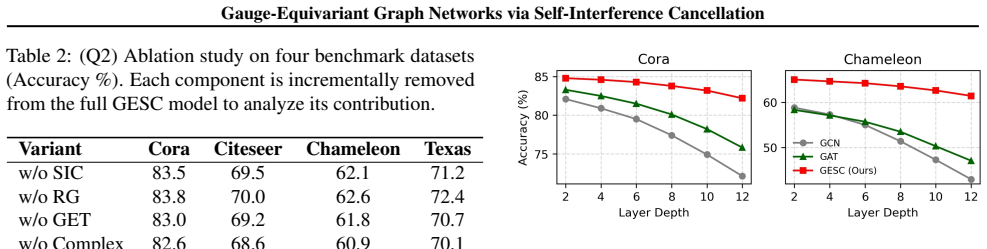
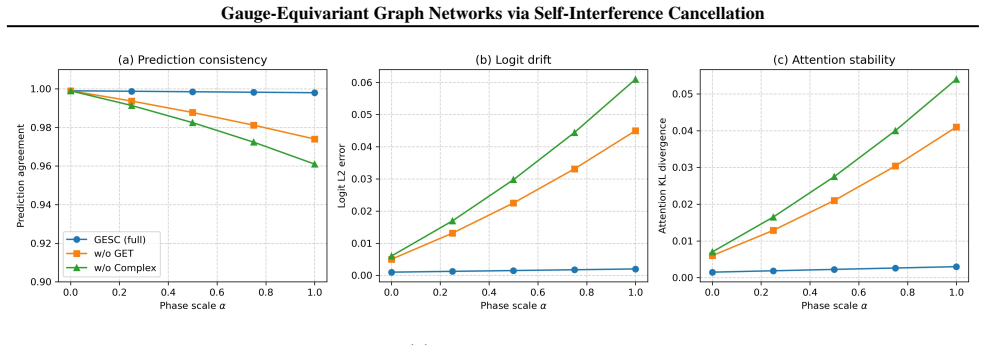
- [Experimental results / ablation studies] The central claim that redundant low-frequency self-interference (rather than attention dilution, normalization, or the sign-aware gate) is the dominant oversmoothing driver requires isolation. The reported gains compare the full GESC model against external baselines, but no ablation is described that holds the U(1) phase connection and sign-aware gate fixed while removing only the rank-1 projection. This is load-bearing for the claim in the abstract that 'the absence of interference handling ... is a primary driver of oversmoothing under gauge transport.'
- [Method section (projection formula)] The exact definition and derivation of the rank-1 projection operator (including how it is applied after the U(1) phase connection and before attention) must be stated with explicit equations. Without this, it is not possible to verify that the projection indeed cancels self-parallel components by construction rather than through additional learned parameters.
minor comments (2)
- [Notation and preliminaries] Notation for the sign-aware gate threshold or scaling factor should be introduced once and used consistently; the abstract refers to it only descriptively.
- [Figures] Figure captions should explicitly state which baselines are gauge-equivariant versus non-equivariant to aid comparison with the interference-cancellation narrative.
Simulated Author's Rebuttal
We thank the referee for the constructive and detailed comments. We address each major point below and will revise the manuscript accordingly to strengthen the presentation and empirical support for our claims.
read point-by-point responses
-
Referee: [Experimental results / ablation studies] The central claim that redundant low-frequency self-interference (rather than attention dilution, normalization, or the sign-aware gate) is the dominant oversmoothing driver requires isolation. The reported gains compare the full GESC model against external baselines, but no ablation is described that holds the U(1) phase connection and sign-aware gate fixed while removing only the rank-1 projection. This is load-bearing for the claim in the abstract that 'the absence of interference handling ... is a primary driver of oversmoothing under gauge transport.'
Authors: We agree that an internal ablation isolating the rank-1 projection is necessary to substantiate the central claim. In the revised manuscript we will add an ablation that fixes the U(1) phase connection and sign-aware gate while comparing performance with and without the rank-1 projection. This will directly test whether the projection, rather than the other components, is responsible for mitigating self-interference and oversmoothing. revision: yes
-
Referee: [Method section (projection formula)] The exact definition and derivation of the rank-1 projection operator (including how it is applied after the U(1) phase connection and before attention) must be stated with explicit equations. Without this, it is not possible to verify that the projection indeed cancels self-parallel components by construction rather than through additional learned parameters.
Authors: We acknowledge that the current exposition would benefit from greater mathematical precision. In the revised manuscript we will add explicit equations in the Method section defining the rank-1 projection operator, deriving its action on the phase-adjusted features, and showing its application immediately after the U(1) phase connection and before the attention step. The derivation will demonstrate that the operator projects out the self-parallel component by construction. revision: yes
Circularity Check
No circularity: empirical claims and independent architectural components
full rationale
The paper defines GESC via explicit new components (U(1) phase connection, rank-1 projection for self-interference suppression, sign-aware gate) and reports benchmark outperformance as empirical outcomes. The statement that absence of interference handling drives oversmoothing is framed as an observation from prior models lacking the mechanism, not as a quantity derived by construction from the paper's own fitted parameters or equations. No self-definitional loops, fitted-input predictions, or load-bearing self-citations appear; the derivation chain remains self-contained against external benchmarks and code release.
Axiom & Free-Parameter Ledger
free parameters (1)
- sign-aware gate threshold or scaling factor
axioms (1)
- domain assumption U(1) phase connection can be attached to existing gauge-equivariant message passing without breaking equivariance
Lean theorems connected to this paper
-
IndisputableMonolith/Cost/FunctionalEquation.leanwashburn_uniqueness_aczel unclear?
unclearRelation between the paper passage and the cited Recognition theorem.
We introduce a U(1) phase connection followed by a rank-1 projection that suppresses self-parallel components before attention, and a sign-aware gate that regulates negatively aligned neighbors.
-
IndisputableMonolith/Foundation/AbsoluteFloorClosure.leanabsolute_floor_iff_bare_distinguishability unclear?
unclearRelation between the paper passage and the cited Recognition theorem.
Proposition 5.1 (Effect of SIC on message decomposition) ... (I−η_sic Π_ε(h_i)) h̃ = (1−η_sic λ) h̃_∥ + h̃_⊥
-
IndisputableMonolith/Foundation/AlexanderDuality.leanalexander_duality_circle_linking unclear?
unclearRelation between the paper passage and the cited Recognition theorem.
Theorem 5.5 (Gauge equivariance) ... local U(1) gauge transformation
What do these tags mean?
- matches
- The paper's claim is directly supported by a theorem in the formal canon.
- supports
- The theorem supports part of the paper's argument, but the paper may add assumptions or extra steps.
- extends
- The paper goes beyond the formal theorem; the theorem is a base layer rather than the whole result.
- uses
- The paper appears to rely on the theorem as machinery.
- contradicts
- The paper's claim conflicts with a theorem or certificate in the canon.
- unclear
- Pith found a possible connection, but the passage is too broad, indirect, or ambiguous to say the theorem truly supports the claim.
Reference graph
Works this paper leans on
-
[1]
52 yields X j∈N(i) α(m) ji bm(m) j→i 2 ≤ ∥W (m)∥2 ·max j∈N(i) ∥h(t) j ∥2,(62) which proves the claim
By the triangle inequality and convexity (a weighted average is bounded by the maximum term), one can introduce: X j∈N(i) α(m) ji bm(m) j→i 2 ≤ X j∈N(i) α(m) ji ∥bm(m) j→i∥2 ≤max j∈N(i) ∥bm(m) j→i∥2 ≤max j∈N(i) ∥˜h(m) j→i∥2.(61) Combining with Eq. 52 yields X j∈N(i) α(m) ji bm(m) j→i 2 ≤ ∥W (m)∥2 ·max j∈N(i) ∥h(t) j ∥2,(62) which proves the claim. B.3. Ga...
work page 2017
-
[2]
introduces magnetic Laplacians for directional structure, and GCNII (Chen et al., 2020) incorporates identity mapping to counter over-smoothing. • Adaptive and structure-enhanced models:ACM-GCN (Luan et al., 2022) uses channel mixing, GloGNN (Li et al., 2022a) adds global nodes to enhance long-range propagation, Auto-HeG (Zheng et al., 2023) automates het...
work page 2020
discussion (0)
Sign in with ORCID, Apple, or X to comment. Anyone can read and Pith papers without signing in.