REVIEW 2 major objections 4 minor 50 references
Converting Faraday rotation into magnetization in europium chalcogenides
T0 review · 2 major / 4 minor · reviewed 2026-08-14 · deepseek-v4-flash
Pith's one-line read Faraday rotation in europium chalcogenides is proportional to magnetization, independent of magnetic phase, temperature, and field, with a constant fixed by photon energy and band gap.
desk verdict A convincing demonstration that Faraday rotation tracks magnetization in EuSe, but the universal scaling law is tested in a regime where its own derivation breaks down. read the letter →
The pith
A machine-rendered reading of the paper's core claim, the machinery that carries it, and where it could break.
The reading
What carries the argument
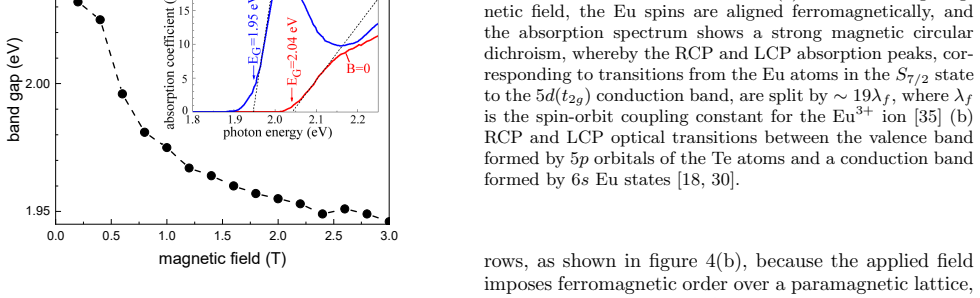
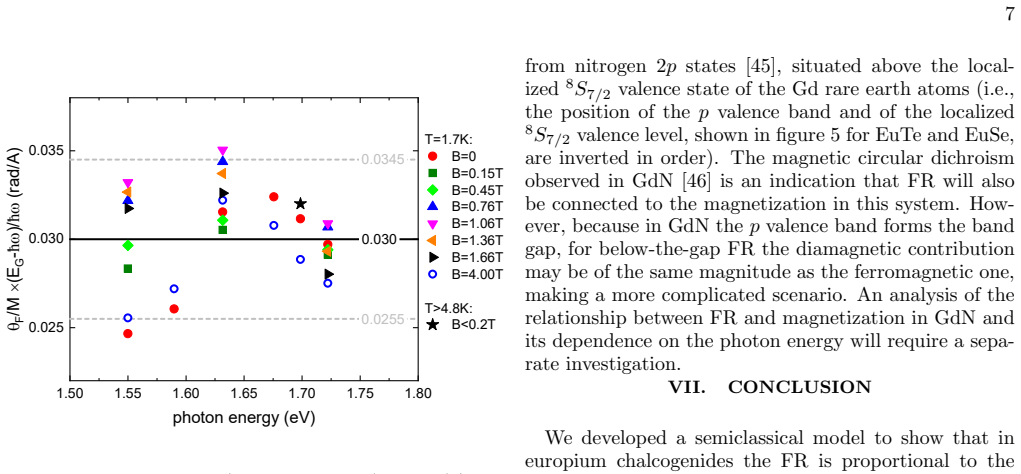
The mechanism is a semiclassical symmetry argument: the spin $S$ of each Eu atom, pictured as a circulating current, is projected onto the light propagation direction, so the circular polarizabilities scale as $\cos\theta$ in exactly the same way as the magnetization does. That yields equation (9), $\theta_F^{\mathrm{mag}} = (\pi/\lambda)(N/\varepsilon_0)(M/M_{\mathrm{SAT}})(\alpha_-^{\parallel}-\alpha_+^{\parallel})/(2n_0)$. The second ingredient is the EuX electronic structure: at high fields the absorption edge splits into two narrow right- and left-circularly polarized lines separated by about $19\lambda_f$, where $\lambda_f$ is the Eu $3+$ spin-orbit constant, giving $\alpha_-^{\parallel}\approx \frac12\mu_{df}^2/(E_G-\hbar\omega)$ and $\alpha_+^{\parallel}\approx \frac12\mu_{df}^2/(E_G+19\lambda_f-\hbar\omega)$. Assuming the splitting is small compared with $E_G-\hbar\omega$ yields the working formula $\theta_F/M \times (E_G-\hbar\omega)/\hbar\omega = \mathrm{const}$, equation (17), which is the object tested and calibrated in Figure 6.
What would settle it
Measure $\theta_F$ and $M$ in EuSe at photon energies within about $180\,\mathrm{meV}$ of the band gap, or in magnetic fields where the gap shifts steeply, and check whether $(\theta_F/M)(E_G-\hbar\omega)/\hbar\omega$ stays flat; a systematic deviation as $E_G-\hbar\omega$ approaches $19\lambda_f$ would show that the small-splitting approximation is load-bearing. Alternatively, fit the same data to the full two-denominator expression $\theta_F/M \propto [1/(E_G-\hbar\omega)-1/(E_G+19\lambda_f-\hbar\omega)]$ and see whether that dispersion describes the data better than equation (17).
Extended reading notes
Core claim
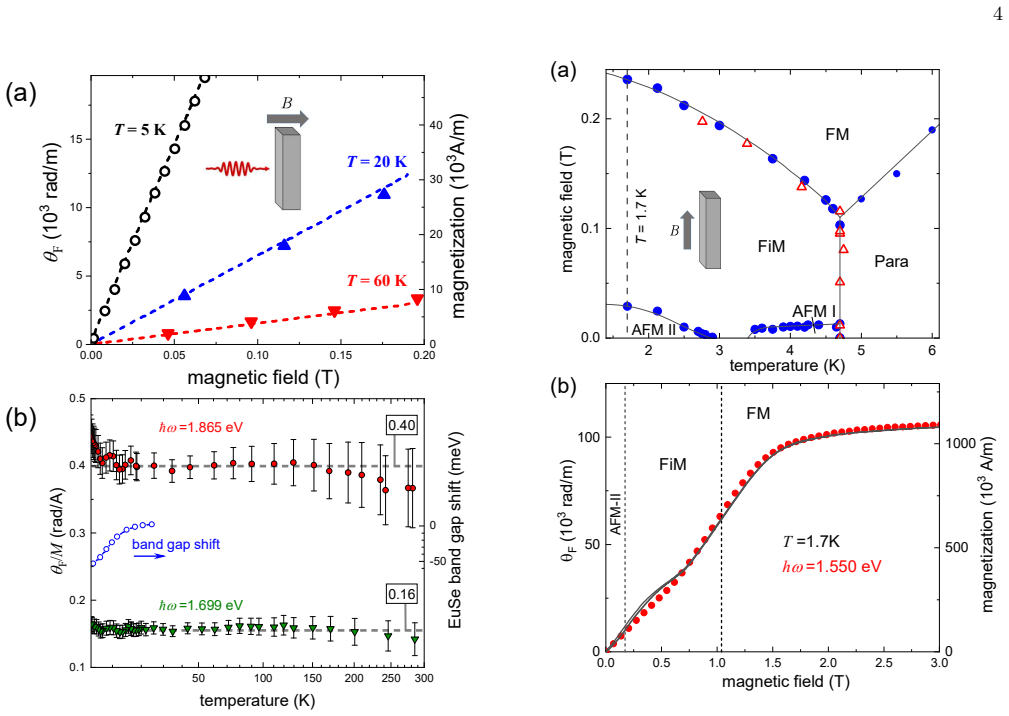
The central claim is that the magnetization-dependent part of the Faraday rotation in EuX is $\theta_F^{\mathrm{mag}} = (\pi/\lambda)(N/\varepsilon_0)(M/M_{\mathrm{SAT}})(\alpha_-^{\parallel}-\alpha_+^{\parallel})/(2n_0)$, so the rotation angle is exactly proportional to $M$. Combining this with the EuX band-edge structure, in which the magnetic contribution to the circular polarizability is carried by two dichroic absorption lines split by the spin-orbit energy $19\lambda_f$, leads to the practical scaling law that $\theta_F/M \times (E_G-\hbar\omega)/\hbar\omega$ is constant. The measured ratio stays constant within experimental error, about 15 percent, across the paramagnetic, antiferromagnetic, ferrimagnetic, and ferromagnetic phases of EuSe, although small band-gap shifts with temperature and field slightly alter the constant. The paper concludes that this formula can substitute for a full quantum-mechanical calculation in converting Faraday rotation into magnetization for any member of the EuX family.
Load-bearing premise
The derivation of the conversion formula assumes that the magnetic contribution to the circular polarizability comes entirely from two narrow absorption lines split by the spin-orbit energy, and that this splitting is much smaller than the distance from the photon energy to the band gap; where that second condition fails, the stated scaling law is not guaranteed by the model.
Editorial extensions
If this is right
- Within the EuX family, one calibration of $\theta_F/M$ at a single reference condition fixes the conversion constant, so Faraday rotation can be used to read out magnetization without simultaneous SQUID measurements.
- Time-resolved Faraday rotation in EuX can be interpreted quantitatively as magnetization dynamics, not just as a qualitative spin signal, because the proportionality is phase-independent.
- The diamagnetic, field-proportional Faraday contribution in EuX is suppressed by a factor of order $g\mu_B B/(19\lambda_f)$, typically a few percent even at several tesla, so the magnetization term dominates.
- For other intrinsic magnetic semiconductors whose top valence band comes from localized magnetic orbitals, the same scaling law should hold; if the top valence band is diamagnetic, as in GdN, the response is a superposition of a magnetization part and a field part.
Reading between the lines
- A direct extension would be to apply equation (17) to EuO, EuS, and EuTe; if the claim is universal within EuX, scaled data from those compounds should collapse onto the same curve once band-gap shifts are accounted for.
- Near resonance, where $E_G-\hbar\omega$ is comparable to $19\lambda_f$, the small-splitting approximation used to derive equation (17) fails; the apparent collapse in Figure 6 could then reflect compensation from band-gap shifts rather than the model's stated dispersion.
- If the proportionality survives on ultrafast timescales, Faraday-rotation magnetometry could track demagnetization and spin-reorientation dynamics in these materials with nanoradian sensitivity, replacing magnetometry in pulsed-field or pump-probe geometries.
- The model suggests a route to all-optical magnetometry in other concentrated magnetic semiconductors such as EuO or GdN, but predicts that a diamagnetic valence band will add a field-linear background that must be subtracted.
Signed reviews
Editorial analysis
A structured set of objections, weighed in public.
Referee Report
Summary. The paper proposes a simple semiclassical model for europium chalcogenides (EuX) in which the Faraday rotation (FR) angle per unit length is proportional to the magnetization M, with a proportionality coefficient set by the electronic polarizability and thus independent of magnetic phase, temperature, and applied field. The model is tested on EuSe via FR and SQUID magnetization measurements from 1.7 to 300 K and 0 to 7 T, covering paramagnetic, antiferromagnetic, ferrimagnetic, and ferromagnetic phases. In Section VI the authors combine the semiclassical model with a two-line dichroic absorption model to derive Eq. (14), which they rewrite as the scaling law Eq. (17): theta_F/M times (E_G - hbar omega)/hbar omega is a constant. This law is presented as a practical tool for converting FR into magnetization in any EuX material.
Significance. The central proportionality between Faraday rotation and magnetization is supported by an unusually complete dataset and by a transparent symmetry argument that is not circular. Direct overlays of theta_F(B) and M(B) across all EuSe magnetic phases (Fig. 3b) are convincing, and the paper makes a falsifiable prediction, Eq. (17), that could be useful for magneto-optical magnetometry in EuX and possibly other intrinsic magnetic semiconductors. The didactic value of the semiclassical derivation is real. However, the paper's headline quantitative claim, the energy/wavelength scaling law, has a derivation gap that must be resolved before the practical conversion formula can be accepted as derived from the model.
major comments (2)
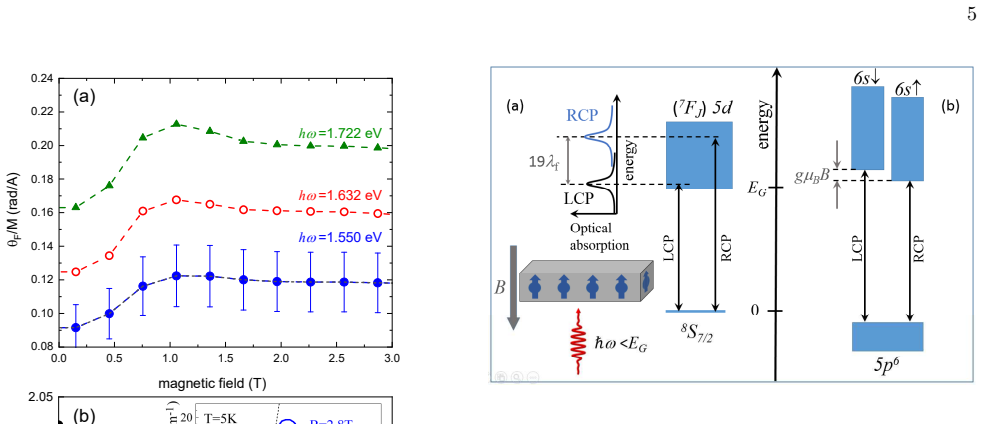
- [VI, Eq. (14), Fig. 6] The passage from Eq. (13) to Eq. (14) uses the small-splitting approximation 19lambda_f << E_G - hbar omega, but Fig. 6 tests Eq. (17) in a regime where this approximation is violated. Retaining the full denominators of Eq. (13) gives alpha^- - alpha^+ proportional to 1/[(E_G - hbar omega)(E_G + 19lambda_f - hbar omega)], so Eq. (14) should contain a denominator E_G + O(19lambda_f) - hbar omega rather than E_G - hbar omega. For example, at hbar omega = 1.80 eV and B = 4 T, Fig. 4(b) gives E_G about 1.95 eV, so E_G - hbar omega is about 0.15 eV, comparable to 19lambda_f = 0.18 eV. The correction factor (E_G - hbar omega)/(E_G + 19lambda_f/2 - hbar omega) varies by roughly 40% across the plotted range of Fig. 6, which is larger than the stated 15% experimental uncertainty. Thus the data collapse in Fig. 6 cannot be taken as validation of Eq. (17) as derived. The authors should either restrict Eq. (17) to the regime where the approximation is valid, or re-derive the scaling using the full denominator and retest Fig. 6 with the corrected expression.
- [VI, Eqs. (3), (14), (17)] The step from Eq. (14) to Eq. (17) implicitly assumes that the prefactor (n0^2 - 1)/(2n0) is a constant independent of photon energy. However, Eq. (14) is obtained by using Eq. (3) to eliminate the dipole matrix element in favor of n0^2 - 1, which in the model is proportional to the magnetic-band polarizability and therefore to 1/(E_G - hbar omega). If n0 is instead taken to be the measured refractive index of the crystal, its dispersion in the 1.50-1.80 eV range is not negligible, and this dispersion must be included when testing Eq. (17). The manuscript should state unambiguously which quantity n0 denotes and justify the omission of its photon-energy dependence; without this, the derivation of the central scaling law is incomplete.
minor comments (4)
- [II] The definition of n0 as "the refractive index that the material would have, if no other valence band was present except the one under scrutiny" is confusing because Eq. (4) uses n0 as the average refractive index of the actual material. Please clarify the notation.
- [Fig. 6] The caption of Fig. 6 lists many magnetic-field values for T = 1.7 K but does not identify which symbol corresponds to which field. A legend or explicit marker map would make the figure easier to interpret.
- [Eq. (17)] E_G in Eq. (17) is temperature- and field-dependent, as shown in Fig. 4(b); the text should state explicitly that the E_G values used in Fig. 6 are the measured band gaps at each (B,T) condition.
- [Abstract] The abstract's phrase "irrespective of ... applied magnetic field" is too strong in view of Fig. 4(a), where theta_F/M varies with B in the ordered phases even when the 15% uncertainty is considered; the variation is attributed to band-gap narrowing, but this qualification should appear in the abstract or introduction.
Circularity Check
No circularity: the semiclassical relation between Faraday rotation and magnetization rests on an explicit symmetry ansatz, and Eq. (17) is tested against independent EuSe data; the near-resonance small-splitting issue is a validity concern, not a circular step.
full rationale
The central relation θ_F ∝ M is obtained from the symmetry ansatz P^± = N α^±_∥ E0 cosθ and the magnetization definition M = N μ* cosθ. Although both share the cosθ factor, they are not mutually defined: α^±_∥ and μ* are independent material constants, and the model would fail if α^±(θ) had a different angular dependence or an additional perpendicular contribution. The angular dependence is therefore an assumption, not a restatement of the target result. Section V tests the resulting constant ratio θ_F/M against independently measured magnetization and Faraday rotation in EuSe across paramagnetic, AFM-I/II, ferrimagnetic, and ferromagnetic phases, so the proportionality claim has external content. Eq. (17) is an algebraic rearrangement of Eq. (14), but the collapse in Fig. 6 is a genuine prediction tested on new data; only the overall constant is fitted, and a single overall scale does not make the scaling law circular. The step from Eq. (13) to Eq. (14) uses an explicitly stated small-splitting condition 19λ_f ≪ E_G−ℏω; its near-resonance violation is a validity/correctness concern, not a circularity. Self-citations (Refs. 19 and 35) supply a standard perturbation formula and experimental MCD parameters, but they are not the sole justification of the central claim, which is independently derived and empirically validated.
Assumptions & free parameters
free parameters (1)
- overall proportionality constant in eq. (17) =
0.03 rad/A
assumptions (3)
- domain assumption The top valence band of EuX is formed by half-filled 4f orbitals of Eu, preserving the atomic S=7/2 spin in the solid.
- domain assumption The circular polarizability difference is dominated by two narrow 4f-5d(t2g) transitions split by 19lambda_f, and the diamagnetic 5p-6s contribution is negligible by the estimate of eq. (16).
- ad hoc to paper The small-splitting approximation 19lambda_f << E_G - hbar_omega holds for the data analyzed.
Cite this review
Pith. "Pith review of Converting Faraday rotation into magnetization in europium chalcogenides." pith.science (2026). https://pith.science/paper/DWKV3XYY
@misc{pith2026190804444,
  author       = {Pith},
  title        = {Pith review of: Converting Faraday rotation into magnetization in europium chalcogenides},
  year         = {2026},
  howpublished = {\url{https://pith.science/paper/DWKV3XYY}},
  note         = {Machine review of arXiv:1908.04444}
}
read the original abstract
We present a simple semiclassical model to sustain that in europium chalcogenides (EuX), Faraday rotation (FR) in the transparency gap is proportional to the magnetization of the sample, irrespective of the material's magnetic phase, temperature, or applied magnetic field. The model is validated by FR and magnetization measurements in EuSe in the temperature interval 1.7-300K, covering all EuSe magnetic phases (paramagnetic, antiferromagnetic type I or type II, ferrimagnetic and ferromagnetic). Furthermore, by combining the semiclassical model with the explicit electronic energy structure of EuX, the proportionality coefficient between magnetization and FR is shown to be dependent only on the wavelength and the band gap. Due to its simplicity, the model has didactic value, moreover, it provides a working tool for converting FR into magnetization in EuX. Possible extension of the model to other intrinsic magnetic semiconductors is discussed.
Figures


Figures from the paper (3 more)
Reference graph
Works this paper leans on
-
[1]
S. A. Crooker, D. D. Awschalom, and N. Samarth, IEEE J. Sel. Top. Quantum Electron 1, 1082 (1995)
work page 1995
-
[2]
Y. K. Kato, R. C. Myers, A. C. Gossard, and D. D. Awschalom, Science 306, 1910 (2004)
2004
-
[3]
S. A. Crooker, Coherent Spin Dynamics of Carriers and Magnetic Ions in Diluted Magnetic Semiconductors , edited by J. Kossut and J. A. Gaj, Springer Series in Ma- terials Science, Vol. 144 (Springer-Verlag, Berlin, 2010) p. 305
work page 2010
-
[4]
M. Atat¨ ure, J. Dreiser, A. Badolato, and A. Imamoglu, Nature Physics 3, 101 (2007)
work page 2007
-
[5]
D. D. Awschalom and J. M. Kikkawa, Physics Today 52, 33 (1999)
work page 1999
-
[6]
A. Greilich, D. R. Yakovlev, A. Shabaev, A. L. Efros, I. A. Yugova, R. Oulton, V. Stavarache, D. Reuter, A. Wieck, and M. Bayer, Science 313, 341 (2006)
work page 2006
-
[7]
A. B. Henriques, R. C. Cordeiro, P. M. Koenraad, F. W. M. Otten, and M. Bayer, Phys. Rev. B 91, 081303(R) (2015)
work page 2015
-
[8]
Kirilyuk, A
A. Kirilyuk, A. V. Kimel, and T. Rasing, Rev. Mod. Phys. 82, 2731 (2010)
2010
Show all 50 references
-
[9]
A. B. Henriques, X. Gratens, P. A. Usachev, V. A. Chitta, and G. Springholz, Phys. Rev. Lett. 120, 217203 (2018)
2018
-
[10]
Madelung, Introduction to Solid State Theory (Springer-Verlag, Berlin, 1978) p
O. Madelung, Introduction to Solid State Theory (Springer-Verlag, Berlin, 1978) p. 299. 8
1978
-
[11]
Semiconductors and semimetals,
H. Piller, “Semiconductors and semimetals,” (Elsevier, Amsterdam, 1972) Chap. Faraday rotation, pp. 103–179
1972
-
[12]
Magneto-optics,
K. Shinagawa, “Magneto-optics,” (Springer, Berlin,
-
[13]
Miura, Physics of Semiconductors in High Magnetic Fields (Oxford University Press, Oxford, 2008) p
N. Miura, Physics of Semiconductors in High Magnetic Fields (Oxford University Press, Oxford, 2008) p. 265
2008
-
[14]
J. A. Gaj and J. Kossut, Basic Consequences of sp-d and d-d Interactions in DMS , edited by J. Kossut and J. A. Gaj, Springer Series in Materials Science, Vol. 144 (Springer-Verlag, Berlin, 2010) p. 1
2010
-
[15]
Becquerel, Comptes Rendus 125, 679 (1897)
H. Becquerel, Comptes Rendus 125, 679 (1897)
-
[16]
Sommerfeld, Optics (Academic Press, New York,
A. Sommerfeld, Optics (Academic Press, New York,
-
[17]
Krenn, W
H. Krenn, W. Herbst, H. Pascher, Y. Ueta, G. Springholz, and G. Bauer, Phys. Rev. B 60, 8117 (1999)
1999
-
[18]
Mauger and C
A. Mauger and C. Godart, Phys. Rep. 141, 51 (1986)
1986
-
[19]
A. B. Henriques and P. A. Usachev, Phys. Rev. B 96, 195210 (2017)
2017
-
[20]
Y. R. Shen, Phys. Rev. 133, A511 (1964)
1964
-
[21]
Y. R. Shen and N. Bloembergen, Phys. Rev. 133, A515 (1964)
1964
-
[22]
D. U. Bartholomew, J. K. Furdyna, and A. K. Ramdas, Phys. Rev. B 34, 6943 (1986)
1986
-
[23]
J. C. Maxwell, A Treatise on Electricity and Magnetism , Vol. 2 (Clarendon Press, Oxford, 1873) Chap. XXI
-
[24]
Kittel, Introduction to solid state physics , seventh ed
C. Kittel, Introduction to solid state physics , seventh ed. (John Wiley & Sons, New York, 1996) p. 389, formula (22)
1996
-
[25]
R. P. Feynman, R. B. Leighton, and M. L. Sands, The Feynman Lectures on Physics , Vol. 2 (Addison-Wesley, 1963-1965) Chap. 11, p. 11-2, formula (11-8)
1963
-
[26]
R. W. Boyd, Nonlinear Optics (Academic Press, 2003)
2003
-
[27]
Blundell, Magnetism in condensed matter (Oxford University Press, Oxford, 2001)
S. Blundell, Magnetism in condensed matter (Oxford University Press, Oxford, 2001)
2001
-
[28]
P. J. L. Herv´ e and L. K. J. Vandamme, J. Appl. Phys. 77, 5476 (1977)
1977
-
[29]
Talghader and J
J. Talghader and J. S. Smith, Appl. Phys. Lett. 66, 335 (1995)
1995
-
[30]
Wachter, C R C Critical Reviews in Solid State Sci- ences 3, 189 (1972)
P. Wachter, C R C Critical Reviews in Solid State Sci- ences 3, 189 (1972)
1972
-
[31]
Blundell, Magnetism in condensed matter (Oxford University Press, Oxford, 2001) Appendix D, p
S. Blundell, Magnetism in condensed matter (Oxford University Press, Oxford, 2001) Appendix D, p. 214
2001
-
[32]
A. B. Henriques, G. D. Galgano, B. L. Diaz, P. H. O. Rappl, and E. Abramof, J. Phys.: Condens. Matter 19, 406234 (2007)
2007
-
[33]
B. Diaz, E. Granado, E. Abramof, P. H. O. Rappl, V. A. Chitta, and A. B. Henriques, Phys. Rev. B 78, 134423 (2008)
2008
-
[34]
R. T. Lechner, G. Springholz, T. U. Sch¨ ulli, J. Stangl, T. Schwarzl, and G. Bauer, Phys. Rev. Lett. 94, 157201 (2005)
2005
-
[35]
A. B. Henriques, A. Wierts, M. A. Manfrini, G. Springholz, P. H. O. Rappl, E. Abramof, and A. Y. Ueta, Phys. Rev. B 72, 155337 (2005)
2005
-
[36]
Vidyasagar, O
R. Vidyasagar, O. A. Santos, J. Holanda, R. O. Cunha, F. L. A. Machado, P. R. T. Ribeiro, A. R. Rodrigues, J. B. S. Mendes, A. Azevedo, and S. M. Rezende, Appl. Phys. Lett. 109, 122402 (2016)
2016
-
[37]
The band gap was determined by extrapolating the linear region in the absorption curve to the abscissa, as shown in the inset of figure 4(b). Other authors have estimated the band gap through the photon energy at which the optical transmittance falls to 1% of the transparency r...
-
[38]
19, where χ is the susceptibility
In arriving at (11), we substitutedα± =εoχ±/N in equa- tion (9) of Ref. 19, where χ is the susceptibility
-
[39]
L. K. Hanamoto, A. B. Henriques, N. F. Oliveira, P. Rappl, E. Abramof, and Y. Ueta, J. Phys.: Condens. Matter 16, 5597 (2004)
2004
-
[40]
A. B. Henriques, M. A. Manfrini, P. H. O. Rappl, and E. Abramof, Phys. Rev. B 77, 035204 (2008)
2008
-
[41]
Kaminski, M
B. Kaminski, M. Lafrentz, R. V. Pisarev, D. R. Yakovlev, V. V. Pavlov, V. A. Lukoshkin, A. B. Henriques, G. Springholz, G. Bauer, E. Abramof, P. H. O. Rappl, and M. Bayer, Phys. Rev. Lett. 103, 057203 (2009)
2009
-
[42]
A. B. Henriques, P. H. O. Rappl, and E. Abramof, Phys. Rev. B 80, 245206 (2009)
2009
-
[43]
A. B. Henriques, G. D. Galgano, and E. Abramof, J. Phys.: Condens. Matter 20, 255209 (2008)
2008
-
[44]
A. B. Henriques, A. R. Naupa, P. A. Usachev, V. V. Pavlov, P. H. O. Rappl, and E. Abramof, Phys. Rev. B 95, 045205 (2017)
2017
-
[45]
Natali, B
F. Natali, B. J. Ruck, H. J. Trodahl, D. L. Binh, S. Vezian, B. Damilano, Y. Cordier, F. Semond, and C. Meyer, Phys. Rev. B 87, 035202 (2013)
2013
-
[46]
Yoshitomi, R
H. Yoshitomi, R. Vidyasagar, S. Kitayama, T. Kita, H. Ohta, S. Okubo, Y. Fukuoka, and T. Sakurai, Appl. Phys. Lett. 101, 122402 (2012)
2012
-
[47]
Heiss, R
W. Heiss, R. Kirchschlager, G. Springholz, Z. Chen, M. Debnath, and Y. Oka, Phys. Rev. B 70, 035209 (2004)
2004
-
[48]
J. Tauc, R. Grigorovici, and A. Vancu, Phys. Stat. Sol. 15, 627 (1966)
1966
-
[49]
Mauger and D
A. Mauger and D. L. Mills, Phys. Rev. B 31, 8024 (1985)
1985
-
[2000]
Faraday and Kerr Effects in Ferromagnets, pp
Chap. Faraday and Kerr Effects in Ferromagnets, pp. 137–177
Reviewed August 14, 2026 · model on record in the stance chip above.
Discussion (0). Continue with ORCID to comment.