REVIEW 4 major objections 7 minor 93 references
Impact of photon addition and subtraction on nonclassical and phase properties of a displaced Fock state
T0 review · 4 major / 7 minor · reviewed 2026-08-14 · deepseek-v4-flash
Pith's one-line read Photon addition strengthens nonclassicality across a family of engineered light states.
desk verdict A competent extension of the authors' earlier PASDFS work with new higher-order witnesses and phase analysis, but missing coefficient definitions and unstated numerical truncation make the plotted claims non-reproducible as written. read the letter →
The pith
A machine-rendered reading of the paper's core claim, the machinery that carries it, and where it could break.
The reading
What carries the argument
The load-bearing object is the photon-added-then-subtracted displaced Fock state $$|\psi(k,q,n,\$\alpha$)\rangle = \mathcal{N}\,\hat{a}^q\,\hat{a}^{\dagger k}\,\hat{D}(\$\alpha$)|n\rangle,$$ with normalization $\mathcal{N}$, together with the moment formula $$\langle \hat{a}^{\dagger t}\hat{a}^j\rangle = \mathcal{N}^2 \sum_{m=0}^\infty C_m^*\, C_{m-j+t}\, \frac{\sqrt{(m+k-q)!\,(m+k-q-j+t)!}}{(m+k-q-j)!}.$$ All the nonclassicality witnesses are constructed from such moments, so this formula is the central engine of the paper: once it is fixed, each criterion is just a different combination of moments. The phase distribution and the $Q$ function are built from the same expansion coefficients $C_m$, so a single analytic expression drives all the reported results.
What would settle it
Take one of the plotted witnesses, say the antibunching parameter $d(1)$ or Agarwal-Tara's $A_3$, for a state with large $\alpha$ (for example $\alpha = 4$) and recompute it while increasing the truncation cutoff until the value stops changing. If the sign of the witness flips between a low cutoff and the converged value, the reported nonclassicality regions for large displacement are an artifact of truncation rather than a property of the state.
Extended reading notes
Core claim
On its own terms, the paper establishes a parameter-by-parameter map of how photon addition, photon subtraction, displacement, and the initial Fock level shape nonclassicality and phase properties. Using moments of the bosonic operators, it evaluates six criteria: Klyshko's, Agarwal-Tara's, Vogel's, antibunching, Hong-Mandel squeezing, and sub-Poissonian statistics, together with the phase distribution, phase fluctuation parameter $U$, and the $Q$ function. The consistent pattern is that photon addition deepens the nonclassicality witnesses in most regimes; photon subtraction is the operation that induces squeezing and is the most effective at altering phase properties; and the Fock parameter behaves oppositely to addition and subtraction, helping at small displacement and hurting at large. A further claim is that the higher-order versions of the criteria are more sensitive, catching nonclassicality that the lower-order versions miss, with the exception that higher-order sub-Poissonian statistics is never negative for even orders.
Load-bearing premise
The numerical claims assume that truncating the infinite sums in Eqs. (3) and (19) at a finite photon number gives converged values, but the paper does not report the truncation order or a convergence check, and for large displacement $\alpha$ the neglected high-photon terms can be substantial.
Editorial extensions
If this is right
- The same witness hierarchy can certify single-photon sources: when lower-order antibunching or sub-Poissonian statistics gives no signal, a higher-order criterion still records nonclassicality, and the reported depth grows with the order.
- Photon subtraction is the operation to reach for when squeezing is the target, and adding several photons lets squeezing survive at large displacement amplitudes, trading away the squeezing seen at small amplitudes.
- Because the state reduces to coherent, Fock, photon-added coherent, photon-subtracted coherent, and displaced Fock states, the reported trends carry over to those known states as limiting cases.
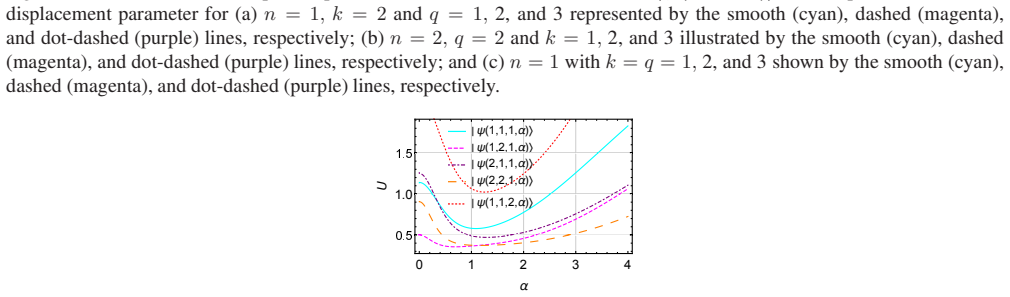
- The phase-distribution plots indicate that subtraction changes phase properties more than addition, while the Fock parameter shifts the phase behaviour in the opposite direction, so the three operations are not interchangeable knobs.
- The phase fluctuation parameter $U$ detects antibunching in the same cases where Vogel's criterion does, giving an independent, phase-based route to the same nonclassicality signal.
Reading between the lines
- The odd-order-only higher-order sub-Poissonian pattern suggests a combinatorial constraint in the Stirling-number expansion of the witness: if that constraint holds for all orders, then even-order sub-Poissonian statistics can never certify nonclassicality for any state in this family, not just for the plotted cases.
- A practical state-engineering protocol could exploit the reported trade-off by choosing $k$, $q$, and $n$ according to the target displacement: more subtraction for bright fields, more Fock level for dim fields, with photon addition as the baseline improvement.
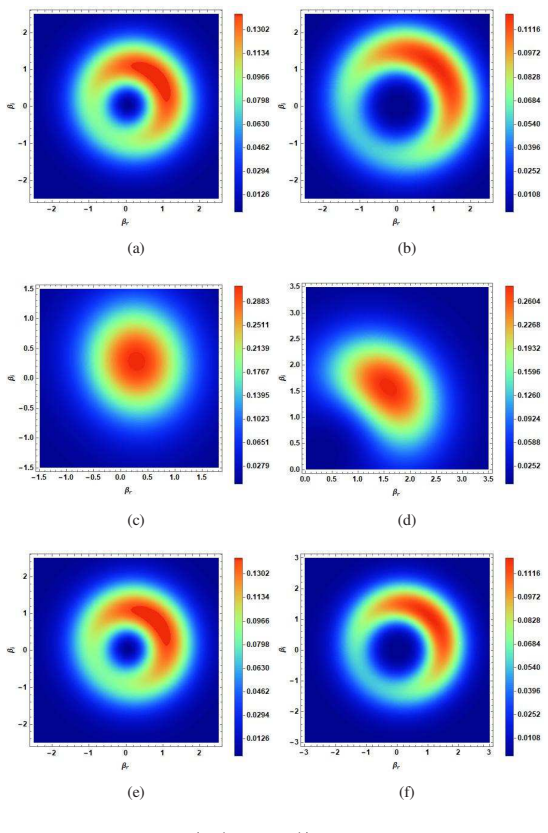
- Because the $Q$ function shows zeros and non-Gaussian deformation at specific parameters, a heterodyne measurement of $Q$ could serve as a direct experimental test of the predicted parameter regions without full tomography.
- The claim that higher-order criteria catch what lower-order criteria miss suggests a noise-robust detection strategy: in the presence of losses that wash out low-order moments, the higher-order witnesses may still give a nonclassicality signal.
Signed reviews
Editorial analysis
A structured set of objections, weighed in public.
Referee Report
Summary. The paper studies the family of photon-added-then-subtracted displaced Fock states |ψ(k,q,n,α)⟩ = N a^q a†^k D(α)|n⟩. Analytic formulas are given for the moments ⟨a†^t a^j⟩, the phase distribution, and the Q function; these are used to evaluate a battery of nonclassicality witnesses—lower- and higher-order antibunching, higher-order sub-Poissonian photon statistics, Hong–Mandel-type squeezing, Klyshko's, Agarwal–Tara's, and Vogel's criteria—whose dependence on α is plotted for various (k,q,n). Phase properties (phase distribution and Carruthers–Nieto fluctuation parameter U) and the Q function are also studied. The main conclusions are that photon addition generally deepens nonclassicality; photon subtraction extends nonclassicality to larger displacement α at the cost of the small-α depth; higher-order criteria can detect nonclassicality where lower-order ones fail, with an exception noted for HOSPS; HOSPS appears only in odd orders; and subtraction modifies phase properties more strongly than addition.
Significance. If the numerical results are reproducible, this is a useful systematic survey of a broad and experimentally relevant state family that unifies coherent, Fock, displaced Fock, PACS, and photon-subtracted states in various limits. The computations are parameter-free (no fitting), and the comparative phenomenology—especially the complementarity between photon addition at small α and photon subtraction at large α, and the added reach of higher-order criteria—is a plausible guide for continuous-variable state engineering. The analytic framework is standard and the criteria are applied in the conventional way. The principal weaknesses are completeness and reproducibility: the central coefficient C_m(α,n,k,q) is never defined, the summation limits are omitted, and the truncation of the infinite sums used for all figures is undocumented. These gaps currently prevent verification of the paper's headline claims.
major comments (4)
- [§2, Eqs. (2)–(3)] The coefficient C_m(α,n,k,q) in the expansion (2) is never defined, and the summation ranges in Eqs. (2), (3), (14), and (19) are not specified. For k < q the Fock index m+k−q is negative for m < q−k, and the factorials appearing in Eq. (3) are undefined unless the sum is restricted so that both m+k−q−j and m−j+t are non-negative. As printed, the central moment formula (3) is ill-defined for states such as |ψ(1,2,1,α)⟩ used in Fig. 1, and the plotted results are not reproducible as written. Please define C_m(α,n,k,q) explicitly (e.g., as the displaced-Fock coefficient C_m(α,n) times the factorial factors arising from a^q a†^k) and state the allowed summation limits for each moment order.
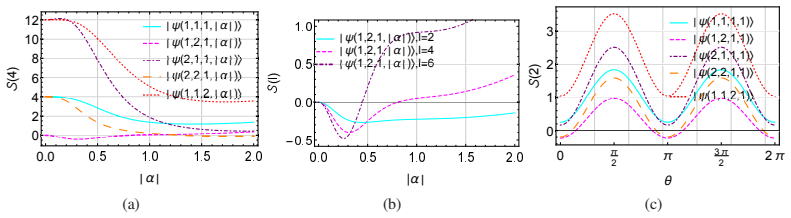
- [§3, Figs. 1–4, 6, 7] The infinite sums in Eq. (3) (and in Eq. (19) for the Q function) are truncated for numerical evaluation, but the truncation order and any convergence criterion are not reported. This is quantitatively consequential: a displaced Fock state has its photon-number distribution peaked near m ≈ |α|² with width O(|α|), and the higher-order witnesses weight the tail by powers m^l. Since α ranges up to about 4–5 in Figs. 1 and 2, an insufficient cutoff could shift zero crossings or change the sign of witnesses such as d(l−1), D_h(l−1), and S(l). Because the headline claims of Section 3 are read from the signs and depths of these curves, please report the cutoff used, add a convergence check showing that the qualitative conclusions are unchanged when the cutoff is doubled, and state the number of terms retained for each figure.
- [§3.2 and Abstract] The abstract and Conclusions state that higher-order sub-Poissonian photon statistics 'is only observed for the odd orders.' This is presented as a general statement but is supported only by the representative curves of Fig. 1(d) for selected parameter values. If a theorem guarantees non-negativity of the HOSPS witness for even orders, please provide a citation or a short proof; otherwise, restrict the claim to the parameter ranges actually studied and describe it as a numerical observation.
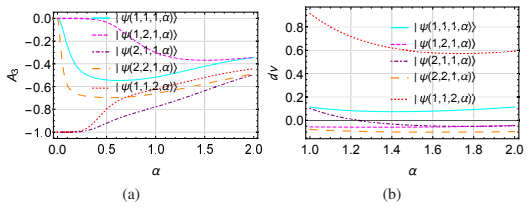
- [§3.5, Eq. (9)] Equation (9) as printed, A3 = det m(3)/det μ(3) − det m(3) < 0, is not the standard Agarwal–Tara witness: the two terms have incompatible scalings, and for a coherent state both determinants vanish, leaving the ratio indeterminate rather than giving the boundary value A3 = 0. The usual definition is A3 = det m(3) − det μ(3) < 0; please correct Eq. (9) accordingly and confirm that Fig. 4(a) was generated with the corrected expression.
minor comments (7)
- [Throughout] There are several typographical errors, including 'a nd' in the title, 'nonclasscial' in the Conclusions, and 'Here, We will establish' in Section 5; the manuscript needs a careful proofread.
- [Figs. 1 and 2 captions] The figure captions are garbled and incomplete: the Fig. 1 caption mixes the antibunching panels (a)–(b) with the HOSPS panels (c)–(d), and the Fig. 2 caption does not clearly identify all three panels. Please rewrite the captions to identify each panel and the plotted quantity with its formula number.
- [§3.4] The sentence 'The Klyshko's nonclassicality witness is positive for some photon numbers only if k+n>q' presumably should read 'negative' rather than 'positive'; please clarify the intended condition and state it precisely.
- [§3.3, Eq. (7)] The upper limit 'r/2' of the second sum in Eq. (7) should be written as floor(r/2), with an explicit statement that the sum over i runs over integers, to remove ambiguity for odd r.
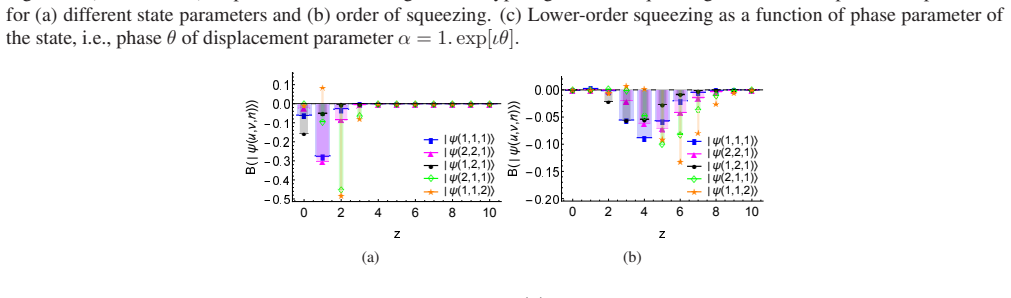
- [§4.2] The three parameter combinations for which the phase-fluctuation parameter U dips below its coherent-state value are not identified; please list them explicitly rather than referring to Fig. 6 without a specification.
- [§5] The claim that non-Gaussianity is established via the Q function is qualitative: a Gaussian state always has a positive Q function, so please state the specific criterion used (e.g., presence of zeros, or departure from a fitted Gaussian) and acknowledge the qualitative nature of the non-Gaussianity statement.
- [Abstract vs. §3.2] The abstract's statement that 'higher-order nonclassicality criteria are found to detect nonclassicality even in the cases when corresponding lower-order criteria failed to do so' should be qualified, since §3.2 reports the opposite behavior for HOSPS (higher-order HOSPS fails where lower-order succeeds for certain α).
Circularity Check
No circularity: the paper evaluates standard nonclassicality witnesses on an explicitly defined state; no fitted parameter is disguised as a prediction.
full rationale
The paper's derivation chain is self-contained at the level claimed. It defines the photon-added-then-subtracted displaced Fock state in Eq. (2), computes expectation values of bosonic operator moments in Eq. (3) directly from that state, and then evaluates established, external nonclassicality criteria (antibunching, sub-Poissonian statistics, squeezing, Klyshko, Agarwal-Tara, Vogel, phase distribution, and Q function). There are no fitted parameters, no data subsets used to predict closely related quantities, and no result that is assumed in the inputs. The comparative claims about photon addition, photon subtraction, Fock parameter, and displacement parameter are obtained by evaluating the same criteria for different parameter values, not by construction from the definitions. Self-citations appear, such as the use of higher-order sub-Poissonian and squeezing criteria from [35, 36], but these supply standard formulas and context; the numerical witnesses plotted in Figs. 1-7 are computed from the present state definitions, so the citations are not load-bearing reductions. The lack of an explicit closed form for C_m(α,n,k,q) and the unreported truncation of the infinite sums in Eqs. (3) and (19) are reproducibility concerns, not circularity. The paper therefore does not exhibit a circular derivation or a fitted-input-called-prediction structure.
Assumptions & free parameters
assumptions (4)
- domain assumption The state |psi(k,q,n,alpha)> is defined by applying a^q a^dag^k to a displaced Fock state, with photon addition before subtraction.
- standard math Negativity of the Glauber-Sudarshan P function is the operational definition of nonclassicality.
- domain assumption Moments-based criteria (antibunching, HOSPS, squeezing, Klyshko, Agarwal-Tara, Vogel) are valid witnesses of nonclassicality.
- ad hoc to paper Numerical evaluations truncate the infinite sums in Eq. (3) and Eq. (19) at a finite photon number with assumed convergence.
Cite this review
Pith. "Pith review of Impact of photon addition and subtraction on nonclassical and phase properties of a displaced Fock state." pith.science (2026). https://pith.science/paper/DX3MW5IU
@misc{pith2026190804086,
  author       = {Pith},
  title        = {Pith review of: Impact of photon addition and subtraction on nonclassical and phase properties of a displaced Fock state},
  year         = {2026},
  howpublished = {\url{https://pith.science/paper/DX3MW5IU}},
  note         = {Machine review of arXiv:1908.04086}
}
abstract
Various nonclassical and quantum phase properties of photon added then subtracted displaced Fock state have been examined systematically and rigorously. Higher-order moments of the relevant bosonic operators are computed to test the nonclassicality of the state of interest, which reduces to various quantum states (having applications in quantum optics, metrology and information processing) in different limits ranging from the coherent (classical) state to the Fock (most nonclassical) states. The nonclassical features are discussed using Klyshko's, Vogel's, and Agarwal-Tara's criteria as well as the criteria of lower- and higher-order antibunching, sub-Poissonian photon statistics and squeezing. In addition, phase distribution function and quantum phase fluctuation have been studied. These properties are examined for various combinations of number of photon addition and/or subtraction and Fock parameter. The examination has revealed that photon addition generally improves nonclassicality, and this advantage enhances for the large (small) values of displacement parameter using photon subtraction (Fock parameter). The higher-order sub-Poissonian photon statistics is only observed for the odd orders. In general, higher-order nonclassicality criteria are found to detect nonclassicality even in the cases when corresponding lower-order criteria failed to do so. Photon subtraction is observed to induce squeezing, but only large number of photon addition can be used to probe squeezing for large values of displacement parameter. Further, photon subtraction is found to alter the phase properties more than photon addition, while Fock parameter has an opposite effect of the photon addition/subtraction. Finally, nonclassicality and non-Gaussianity is also established using $Q$ function.
Figures

Figures from the paper (4 more)
Reference graph
Works this paper leans on
-
[35]
P . Malpani, N. Alam, K. Thapliyal, A. Pathak, V . Narayanan, and S. Banerjee, Annalen der Physik 531, 1800318 (2019)
work page 2019
-
[1]
Douce, D
T. Douce, D. Markham, E. Kashefi, E. Diamanti, T. Coudreau , P . Milman, P . V an Loock, and G. Ferrini, Physical Review Letters 118, 070503 (2017)
2017
-
[2]
R. J. Glauber, Physical Review 131, 2766 (1963)
1963
-
[3]
Sudarshan, Physical Review Letters 10, 277 (1963)
E. Sudarshan, Physical Review Letters 10, 277 (1963)
1963
-
[4]
Quantum computation and qua ntum information,
M. A. Nielsen and I. Chuang, “Quantum computation and qua ntum information,” (2002)
2002
-
[5]
Pathak and A
A. Pathak and A. Ghatak, Journal of Electromagnetic Wave s and Applications 32, 229 (2018)
2018
-
[6]
Lanzagorta, Synthesis Lectures on Quantum Computing 3, 1 (2011)
M. Lanzagorta, Synthesis Lectures on Quantum Computing 3, 1 (2011)
2011
-
[7]
Liao, W .-Q
S.-K. Liao, W .-Q. Cai, J. Handsteiner, B. Liu, J. Yin, L. Z hang, D. Rauch, M. Fink, J.-G. Ren, W .-Y . Liu,et al., Physical Review Letters 120, 030501 (2018)
2018
Show all 93 references
-
[8]
Sharma and S
V . Sharma and S. Banerjee, Quantum Information Processi ng 18, 67 (2019)
2019
-
[9]
J. Aasi, J. Abadie, B. P . Abbott, R. Abbott, T. D. Abbott, M . R. Abernathy, C. Adams, T. Adams, P . Addesso, R. X. Adhikari, et al., Nature Photonics 7, 613 (2013)
2013
-
[10]
Grote, K
H. Grote, K. Danzmann, K. L. Dooley, R. Schnabel, J. Slut sky, and H. V ahlbruch, Physical Review Letters 110, 181101 (2013)
2013
- [11]
-
[12]
Naikoo, K
J. Naikoo, K. Thapliyal, S. Banerjee, and A. Pathak, Phy sical Review A 99, 023820 (2019)
2019
-
[13]
Banerjee, R
S. Banerjee, R. Srikanth, C. Chandrashekar, and P . Rung ta, Physical Review A 78, 052316 (2008)
2008
-
[14]
B. R. Rao, R. Srikanth, C. Chandrashekar, and S. Banerje e, Physical Review A 83, 064302 (2011)
2011
-
[15]
Srikanth, S
R. Srikanth, S. Banerjee, and C. Chandrashekar, Physic al Review A 81, 062123 (2010)
2010
-
[16]
Naikoo, K
J. Naikoo, K. Thapliyal, A. Pathak, and S. Banerjee, Phy sical Review A 97, 063840 (2018)
2018
-
[17]
N. Alam, K. Thapliyal, A. Pathak, B. Sen, A. V erma, and S. Mandal, The European Physical Journal D 73, 139 (2019)
2019
-
[18]
Thapliyal, A
K. Thapliyal, A. Pathak, B. Sen, and J. Pe ˇrina, Physical Review A 90, 013808 (2014)
2014
-
[19]
Thapliyal, A
K. Thapliyal, A. Pathak, B. Sen, and J. Pe ˇrina, Physics Letters A 378, 3431 (2014)
2014
-
[20]
Thapliyal, A
K. Thapliyal, A. Pathak, B. Sen, and J. Pe ˇrina, Optics Communications 444, 111 (2019)
2019
-
[21]
Thapliyal and J
K. Thapliyal and J. Pe ˇrina, Physics Letters A 383, 2011 (2019)
2019
-
[22]
S. K. Giri, K. Thapliyal, B. Sen, and A. Pathak, Physica A : Statistical Mechanics and its Applications 466, 140 (2017)
2017
-
[23]
Pathak and A
A. Pathak and A. Banerjee (Society of Photo-Optical Ins trumentation Engineers (SPIE), 2016). 10
2016
-
[24]
Cooper, E
M. Cooper, E. Slade, M. Karpi ´nski, and B. J. Smith, New Journal of Physics 17, 033041 (2015)
2015
-
[25]
Dakna, L
M. Dakna, L. Knöll, and D.-G. Welsch, The European Physi cal Journal D-Atomic, Molecular, Optical and Plasma Physics 3, 295 (1998)
1998
-
[26]
Makhlin, G
Y . Makhlin, G. Schön, and A. Shnirman, Reviews of Modern Physics 73, 357 (2001)
2001
-
[27]
V erstraete, M
F. V erstraete, M. M. Wolf, and J. I. Cirac, Nature Physic s 5, 633 (2009)
2009
-
[28]
Miranowicz, W
A. Miranowicz, W . Leonski, and N. Imoto, Advances in Che mical Physics 119, 155 (2001)
2001
-
[29]
Escher, A
B. Escher, A. Avelar, T. da Rocha Filho, and B. Baseia, Ph ysical Review A 70, 025801 (2004)
2004
-
[30]
C. C. Gerry and A. Benmoussa, Physics Letters A 303, 30 (2002)
2002
-
[31]
Malpani, K
P . Malpani, K. Thapliyal, N. Alam, A. Pathak, V . Narayanan, and S. Banerjee, arXiv preprint arXiv:1907.03257 (2019 )
1907 arXiv
-
[32]
Meher and S
N. Meher and S. Sivakumar, Quantum Information Process ing 17, 233 (2018)
2018
-
[33]
G. S. Agarwal, Quantum Optics (Cambridge University Press, Cambridge, 2013)
2013
-
[34]
De Oliveira, M
F. De Oliveira, M. Kim, P . L. Knight, and V . Buek, Physica l Review A 41, 2645 (1990)
1990
-
[36]
Thapliyal, N
K. Thapliyal, N. L. Samantray, J. Banerji, and A. Pathak , Physics Letters A 381, 3178 (2017)
2017
-
[37]
Zavatta, S
A. Zavatta, S. Viciani, and M. Bellini, Science 306, 660 (2004)
2004
-
[38]
N. Alam, K. Mandal, and A. Pathak, International Journa l of Theoretical Physics 57, 3443 (2018)
2018
-
[39]
N. Alam, A. V erma, and A. Pathak, Physics Letters A 382, 1842 (2018)
2018
-
[40]
Pathak and M
A. Pathak and M. E. Garcia, Applied Physics B 84, 479 (2006)
2006
-
[41]
Pathak and A
A. Pathak and A. V erma, Indian Journal of Physics 84, 1005 (2010)
2010
-
[42]
V erma, N
A. V erma, N. K. Sharma, and A. Pathak, Physics Letters A 372, 5542 (2008)
2008
-
[43]
Hamar, V
M. Hamar, V . Michálek, and A. Pathak, Measurement Scien ce Review 14, 227 (2014)
2014
-
[44]
Pe ˇrina Jr, V
J. Pe ˇrina Jr, V . Michálek, and O. Haderka, Physical Review A 96, 033852 (2017)
2017
-
[45]
Malpani, K
P . Malpani, K. Thapliyal, N. Alam, A. Pathak, V . Narayanan, and S. Banerjee, arXiv preprint arXiv:1904.01603 (2019 )
1904 arXiv
-
[46]
Susskind and J
L. Susskind and J. Glogower, Physics Physique Fizika 1, 49 (1964)
1964
-
[47]
Pegg, Physical Review A 39, 1665 (1989)
D. Pegg, Physical Review A 39, 1665 (1989)
1989
-
[48]
Barnett, Journal of Physics A: Mathematical and Gene ral 19, 3849 (1986)
S. Barnett, Journal of Physics A: Mathematical and Gene ral 19, 3849 (1986)
1986
-
[49]
C. H. Bennett, G. Brassard, C. Crépeau, R. Jozsa, A. Pere s, and W . K. Wootters, Physical Review Letters 70, 1895 (1993)
1993
-
[50]
C. H. Bennett, G. Brassard, and N. D. Mermin, Physical Re view Letters 68, 557 (1992)
1992
-
[51]
L. F. Borelli, L. d. S. Aguiar, J. A. Roversi, and A. Vidie lla-Barranco, Quantum Information Processing 15, 893 (2016)
2016
-
[52]
Srikara, K
S. Srikara, K. Thapliyal, and A. Pathak, arXiv preprint arXiv:1906.07768 (2019)
2019 arXiv
-
[53]
D. N. Klyshko, Physics Letters A 213, 7 (1996)
1996
-
[54]
G. S. Agarwal and K. Tara, Physical Review A 46, 485 (1992)
1992
-
[55]
E. V . Shchukin and W . V ogel, Physical Review A72, 043808 (2005)
2005
-
[56]
Hillery, Physical Review A 36, 3796 (1987)
M. Hillery, Physical Review A 36, 3796 (1987). 11
1987
-
[57]
C. K. Hong and L. Mandel, Physical Review A 32, 974 (1985)
1985
-
[58]
C. K. Hong and L. Mandel, Physical Review Letters 54, 323 (1985)
1985
-
[59]
Zou and L
X. Zou and L. Mandel, Physical Review A 41, 475 (1990)
1990
-
[60]
G. S. Agarwal and R. P . Singh, Physics Letters A 217, 215 (1996)
1996
-
[61]
M. Beck, D. T. Smithey, and M. G. Raymer, Physical Review A 48, R890 (1993)
1993
-
[62]
Carruthers and M
P . Carruthers and M. M. Nieto, Reviews of Modern Physics 40, 411 (1968)
1968
-
[63]
Peˇrinová, A
V . Peˇrinová, A. Lukš, and J. Pe ˇrina, Phase in Optics (World Scientific, 1998)
1998
-
[64]
C. H. Bennett and G. Brassard, in International Conference on Computer System and Signal Pro cessing, IEEE, 1984 (1984) pp. 175–179
1984
-
[65]
Bennett, Charles H, Physical Review Letters 68, 3121 (1992)
1992
-
[66]
P . V . P . Pinheiro and R. V . Ramos, Quantum Information Processing 12, 537 (2013)
2013
-
[67]
D. Wang, M. Li, F. Zhu, Z.-Q. Yin, W . Chen, Z.-F. Han, G.-C . Guo, and Q. Wang, Physical Review A 90, 062315 (2014)
2014
-
[68]
Grosshans and P
F. Grosshans and P . Grangier, Physical Review Letters 88, 057902 (2002)
2002
-
[69]
Hirano, T
T. Hirano, T. Ichikawa, T. Matsubara, M. Ono, Y . Oguri, R . Namiki, K. Kasai, R. Matsumoto, and T. Tsurumaru, Quantum Science and Technology 2, 024010 (2017)
2017
-
[70]
Huang, P
D. Huang, P . Huang, D. Lin, and G. Zeng, Scientific Report s 6, 19201 (2016)
2016
-
[71]
H.-X. Ma, P . Huang, D.-Y . Bai, S.-Y . Wang, W .-S. Bao, andG.-H. Zeng, Physical Review A 97, 042329 (2018)
2018
-
[72]
K. P . Seshadreesan, J. P . Olson, K. R. Motes, P . P . Rohde, and J. P . Dowling, Physical Review A 91, 022334 (2015)
2015
-
[73]
Parigi, A
V . Parigi, A. Zavatta, M. Kim, and M. Bellini, Science 317, 1890 (2007)
2007
-
[74]
E. P . Wigner, Physical Review 40, 749 (1932)
1932
-
[75]
Kenfack and K
A. Kenfack and K. ˙Zyczkowski, Journal of Optics B: Quantum and Semiclassical Optics 6, 396 (2004)
2004
-
[76]
Husimi, Proceedings of the Physico-Mathematical So ciety of Japan
K. Husimi, Proceedings of the Physico-Mathematical So ciety of Japan. 3rd Series 22, 264 (1940)
1940
-
[77]
Lütkenhaus and S
N. Lütkenhaus and S. M. Barnett, Physical Review A 51, 3340 (1995)
1995
-
[78]
Miranowicz, M
A. Miranowicz, M. Bartkowiak, X. Wang, Y .-x. Liu, and F. Nori, Physical Review A 82, 013824 (2010)
2010
-
[79]
Richter and W
T. Richter and W . V ogel, Physical Review Letters 89, 283601 (2002)
2002
-
[80]
Avenhaus, K
M. Avenhaus, K. Laiho, M. V . Chekhova, and C. Silberhorn , Physical Review Letters 104, 063602 (2010)
2010
-
[81]
Allevi, S
A. Allevi, S. Olivares, and M. Bondani, Physical Review A 85, 063835 (2012)
2012
-
[82]
Loudon and P
R. Loudon and P . L. Knight, Journal of Modern Optics 34, 709 (1987)
1987
-
[83]
Banerjee and R
S. Banerjee and R. Srikanth, Physical Review A 76, 062109 (2007)
2007
-
[84]
Banerjee, J
S. Banerjee, J. Ghosh, and R. Ghosh, Physical Review A 75, 062106 (2007)
2007
-
[85]
Giovannetti, S
V . Giovannetti, S. Lloyd, and L. Maccone, Nature photon ics 5, 222 (2011)
2011
-
[86]
G. S. Agarwal, S. Chaturvedi, K. Tara, and V . Srinivasan , Physical Review A 45, 4904 (1992)
1992
-
[87]
P . A. M. Dirac, Proceedings of the Royal Society of Londo n Series A 114, 243 (1927)
1927
-
[88]
W . H. Louisell, Physics Letters 7 (1963)
1963
-
[89]
Gupta and A
P . Gupta and A. Pathak, Physics Letters A 365, 393 (2007). 12
2007
-
[90]
Pathak and S
A. Pathak and S. Mandal, Physics Letters A 272, 346 (2000)
2000
-
[91]
Thapliyal, S
K. Thapliyal, S. Banerjee, A. Pathak, S. Omkar, and V . Ra vishankar, Annals of Physics 362, 261 (2015)
2015
-
[92]
J. S. Ivan, M. S. Kumar, and R. Simon, Quantum Informatio n Processing 11, 853 (2012)
2012
-
[93]
J. Lee, J. Park, and H. Nha, NPJ Quantum Information 5, 1 (2019). 13
2019
Reviewed August 14, 2026 · model on record in the stance chip above.
Discussion (0). Continue with ORCID to comment.