Recursive behavior in a diatomic FPUT lattice
Pith reviewed 2026-06-25 21:47 UTC · model grok-4.3
The pith
In the diatomic FPUT lattice an optical-acoustical-acoustical resonant triad of Fourier modes produces recurrent energy exchange between dispersion branches.
A machine-rendered reading of the paper's core claim, the machinery that carries it, and where it could break.
Core claim
The central claim is that an optical-acoustical-acoustical resonant interaction between three Fourier modes exists in the diatomic FPUT lattice with cubic anharmonicity, and that this interaction produces observable recurrent behavior in the energy distribution among the modes.
What carries the argument
The optical-acoustical-acoustical resonant triad, which couples one mode from the optical branch to two modes from the acoustical branch through the cubic nonlinearity and the diatomic dispersion relation, enabling periodic energy exchange.
If this is right
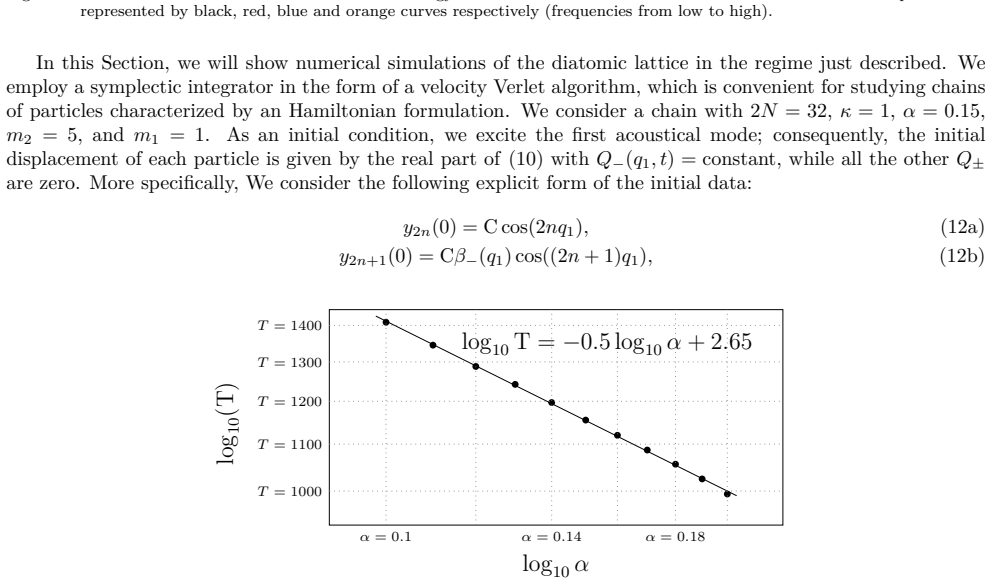
- The classic FPUT recurrence period in the diatomic lattice scales with nonlinear strength in the same manner as in the monatomic case.
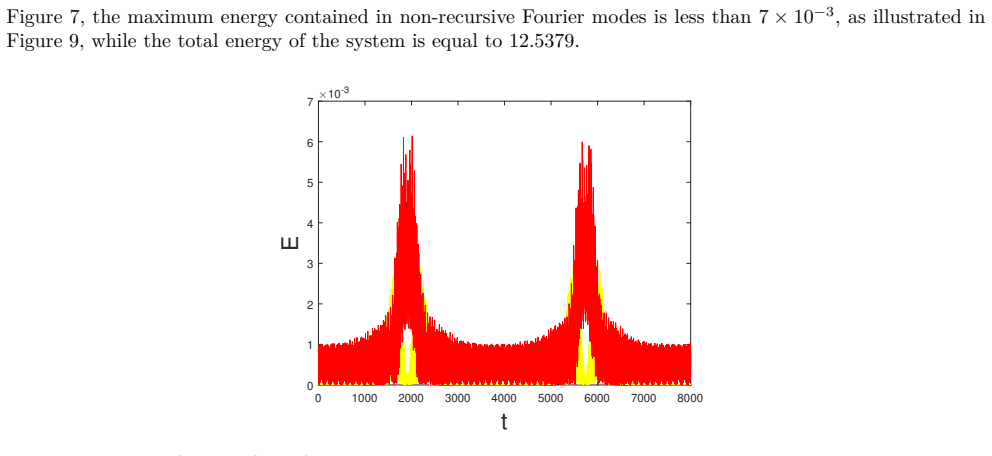
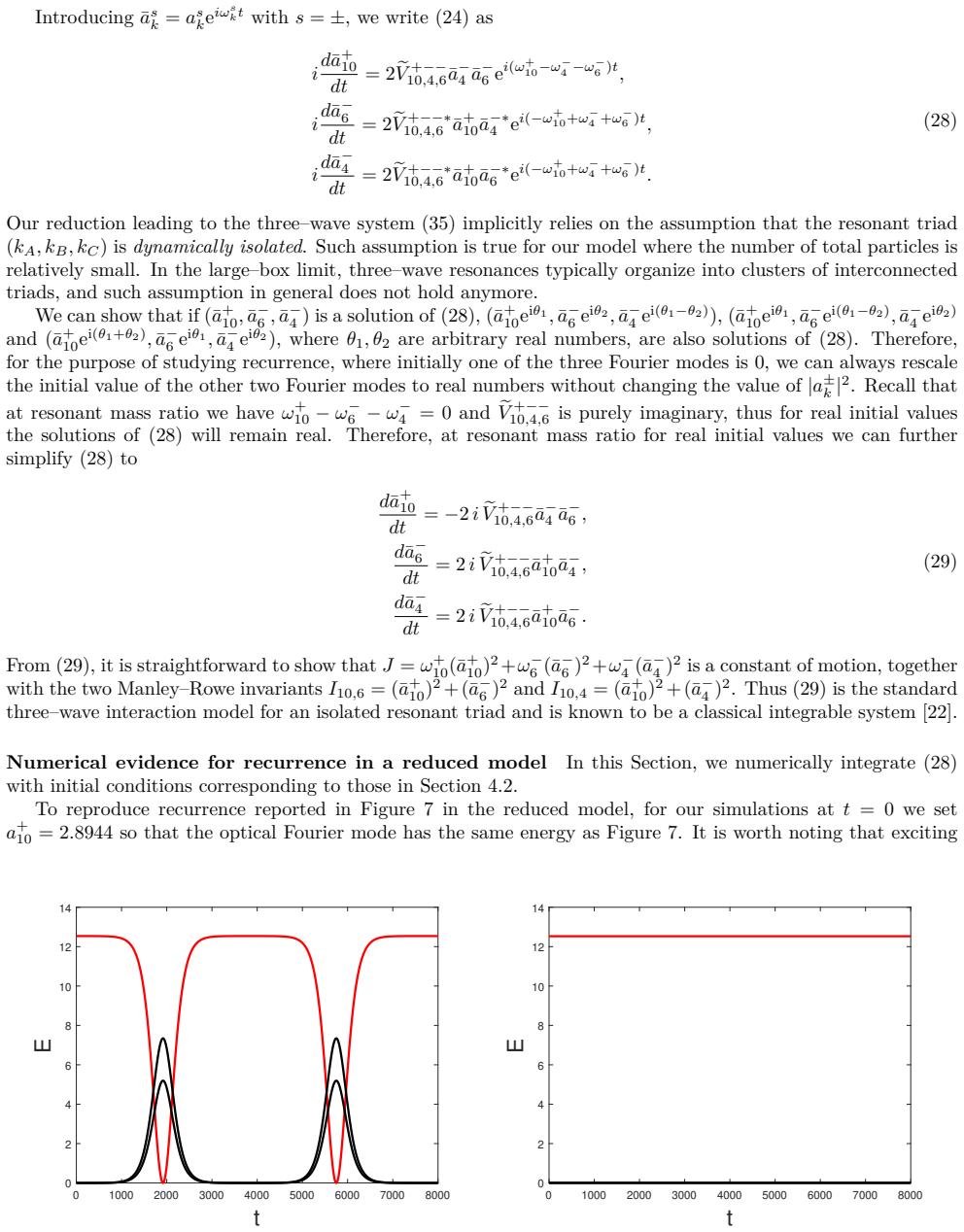
- A reduced Fourier-space model containing only the resonant triad reproduces the observed recurrent energy distribution.
- The same recurrent behavior appears in the diatomic Toda lattice and the diatomic granular chain.
- In the long-wavelength limit the discrete system reduces to an integrable set of three coupled partial differential equations.
Where Pith is reading between the lines
- The existence of a second recurrence mechanism suggests that diatomic lattices can sustain long-term periodic energy transfers between branches that monatomic lattices cannot support.
- The integrability of the continuum limit raises the possibility that the discrete recurrence is protected by an underlying conserved quantity that survives discretization.
- Because the recurrence survives in both the Toda and granular cases, it may appear in any one-dimensional diatomic chain whose dispersion relation admits the same optical-acoustical-acoustical resonance.
Load-bearing premise
The resonant condition identified for the three modes is sufficient to produce clean, observable recurrence in the full lattice without being overwhelmed by interactions with other modes.
What would settle it
A numerical integration of the three-mode truncation in which the energy fails to return periodically to its initial distribution after the expected recurrence time would falsify the claim that the resonant interaction produces recurrence.
Figures






read the original abstract
We study the diatomic FPUT lattice with cubic anharmonic potential, and analyze the recurrent behaviour of its solutions. We find that two distinct types of recurrence occur. One type is the classic FPUT recurrence; for such recurrence, we find that the relation between recurrence period and nonlinear strength is similar to that in the monatomic case. The other type, which cannot exist in the monatomic lattice, is the recurrence due to the interactions between modes in the two branches of the dispersion relation. Indeed, we prove the existence of the optical-acoustical-acoustical resonant interaction between three Fourier modes for which a recurrent behavior in the distribution of the energy is observed. In addition, we develop a reduced Fourier-space dynamical model that reproduces the same recurrent behavior. We assess the robustness of our results through numerical simulations of the diatomic Toda lattice and the diatomic granular chain; in both cases, the same recursive behavior is observed. Finally, in the continuous limit, we derive from the diatomic model a system of three coupled PDEs which are known to be integrable.
Editorial analysis
A structured set of objections, weighed in public.
Referee Report
Summary. The manuscript studies recurrent energy distributions in the diatomic FPUT lattice with cubic anharmonicity. It distinguishes classical FPUT recurrence from a second type arising from optical-acoustical-acoustical resonant triads unique to the two-branch dispersion relation. The authors prove existence of a resonant triad satisfying both wavenumber and frequency conditions, construct a reduced three-mode Fourier model that reproduces the recurrence, verify the behavior persists under Toda and granular potentials, and derive a system of three integrable PDEs in the continuum limit.
Significance. If the resonant triad remains isolated from other couplings on the observed timescale, the work supplies a concrete mechanism for recurrence that cannot occur in monatomic lattices and links it to an integrable continuum system. The reduced-model construction and cross-potential numerical checks are concrete strengths that would make the result useful for further studies of multi-branch resonances.
major comments (2)
- [Resonant-triad identification and reduced-model sections] The claim that the optical-acoustical-acoustical triad produces observable recurrence rests on the reduced three-mode model reproducing the full-lattice behavior. However, the manuscript provides no explicit calculation (in the section identifying the resonant condition or in the reduced-model derivation) showing that other possible triads or quartets involving the chosen modes remain sufficiently detuned under the diatomic dispersion relation to prevent appreciable energy leakage on the recurrence timescale.
- [Numerical results on recurrence periods] The abstract states that the relation between recurrence period and nonlinear strength for the classical type is similar to the monatomic case, yet no quantitative comparison (e.g., scaling exponents or tabulated periods versus nonlinearity parameter) is supplied to support this similarity or to contrast it with the new recurrence type.
minor comments (2)
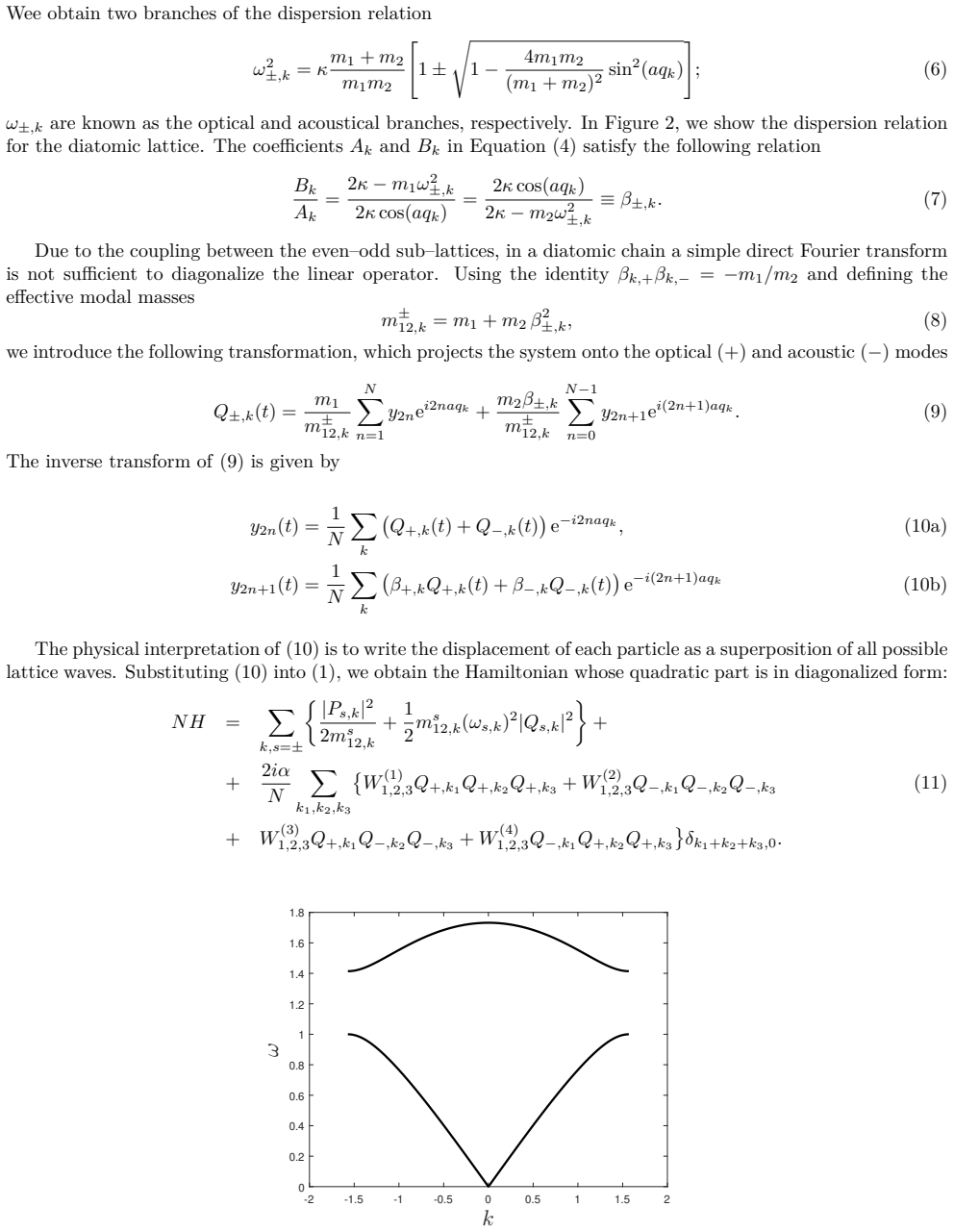
- [Dispersion relation] Notation for the two dispersion branches (optical vs. acoustical) should be introduced once with explicit formulas for ω_o(k) and ω_a(k) before the resonance condition is stated.
- [Continuum limit] The continuous-limit derivation of the three coupled PDEs would benefit from a brief statement of the scaling assumptions used to obtain the integrable system.
Simulated Author's Rebuttal
We thank the referee for the careful reading and constructive comments. We address the two major comments below.
read point-by-point responses
-
Referee: [Resonant-triad identification and reduced-model sections] The claim that the optical-acoustical-acoustical triad produces observable recurrence rests on the reduced three-mode model reproducing the full-lattice behavior. However, the manuscript provides no explicit calculation (in the section identifying the resonant condition or in the reduced-model derivation) showing that other possible triads or quartets involving the chosen modes remain sufficiently detuned under the diatomic dispersion relation to prevent appreciable energy leakage on the recurrence timescale.
Authors: We agree that an explicit calculation of detunings for competing triads and quartets would strengthen the argument that the selected optical-acoustical-acoustical interaction remains isolated on the observed timescale. In the revised manuscript we will add this calculation, evaluating the frequency mismatches for other combinations involving the chosen wavenumbers under the diatomic dispersion relation and confirming that the detunings are large enough to suppress appreciable energy leakage. revision: yes
-
Referee: [Numerical results on recurrence periods] The abstract states that the relation between recurrence period and nonlinear strength for the classical type is similar to the monatomic case, yet no quantitative comparison (e.g., scaling exponents or tabulated periods versus nonlinearity parameter) is supplied to support this similarity or to contrast it with the new recurrence type.
Authors: We acknowledge that the manuscript asserts similarity to the monatomic case without supplying quantitative data. In the revision we will include a direct comparison, for example by reporting the scaling of recurrence period with nonlinearity parameter (or a table of periods for several values) for both the classical and the new recurrence, thereby supporting the claim and highlighting the contrast. revision: yes
Circularity Check
Derivation chain is self-contained with no circular reductions
full rationale
The paper identifies resonant wave-number and frequency conditions for an optical-acoustical-acoustical triad under the diatomic dispersion relation, proves existence by explicit solution of those conditions, truncates to a three-mode Fourier model whose equations are derived directly from the original lattice Hamiltonian, and verifies that both the full lattice and the reduced model exhibit the same recurrence. The continuous-limit reduction to three coupled PDEs is obtained by standard long-wave expansion and is stated to match known integrable systems. None of these steps reduces a claimed prediction to a fitted input, renames a known result, or relies on a load-bearing self-citation; the recurrence follows from the resonant truncation and is cross-checked by direct simulation of the original system.
Axiom & Free-Parameter Ledger
axioms (1)
- standard math Fourier modes on a periodic diatomic lattice satisfy standard dispersion relations with acoustic and optical branches
Reference graph
Works this paper leans on
-
[1]
Fermi, J
E. Fermi, J. Pasta, and S. Ulam. Los Alamos Report LA-1940. E. Fermi, Collected Papers , 2:977–988, 1955
1940
-
[2]
N. J. Zabusky and M. D. Kruskal. Interaction of ”solitons” in a collisionless plasma and the recurrence of initial states. Phys. Rev. Lett. , 15:240–243, 1965
1965
-
[3]
M. Toda. Theory of Nonlinear Lattices . Springer-Verlag, 1989
1989
-
[4]
Friesecke and J
G. Friesecke and J. A. D. Wattis. Existence theorem for solitary waves on lattices. Commun. Math. Phys. , 161(2):391–418, 1994
1994
-
[5]
Friesecke and R
G. Friesecke and R. L. Pego. Solitary waves on FPU lattices: I. Qualitative properties, renormalization and continuum limit. Nonlinearity, 12(6):1601–1627, 1999
1999
-
[6]
S. Chen, Y. Zhang, J. Wang, and H. Zhao. Diffusion of heat, energy, momentum, and mass in one-dimensional systems. Phys. Rev. E , 87:032153, 2013
2013
-
[7]
S. Lepri. Thermal transport in low dimensions: from statistical physics to nanoscale heat transfer , volume
-
[8]
S. D. Pace, K. A. Reiss, and D. K. Campbell. The β Fermi-Pasta-Ulam-Tsingou recurrence problem. Chaos: An Interdisciplinary Journal of Nonlinear Science , 29(11):113107, 2019
2019
-
[9]
Z. Li, M. A. Porter, and B. Choubey. Recurrence recovery in heterogeneous Fermi–Pasta–Ulam–Tsingou systems. Chaos: An Interdisciplinary Journal of Nonlinear Science , 33(9):093108, 2023
2023
-
[10]
Benettin, H
G. Benettin, H. Christodoulidi, and A. Ponno. The Fermi-Pasta-Ulam problem and its underlying integrable dynamics. J. Stat. Phys. , 152:195–212, 2013
2013
-
[11]
Nazarenko
S. Nazarenko. Wave turbulence, volume 825. Springer Science & Business Media, 2011
2011
-
[12]
V. E. Zakharov, V. S. L’vov, and G. Falkovich. Kolmogorov spectra of turbulence I: Wave turbulence. Springer Science & Business Media, 2012
2012
-
[13]
Onorato, L
M. Onorato, L. Vozella, D. Proment, and Y. V. Lvov. Route to thermalization in the α-Fermi-Pasta-Ulam system. Proceedings of the National Academy of Sciences , 112(14):4208–4213, 2015. 17
2015
-
[14]
Y. V. Lvov and M. Onorato. Double scaling in the relaxation time in the β-Fermi-Pasta-Ulam-Tsingou model. Phys. Rev. Lett. , 120(14):144301, 2018
2018
-
[15]
Pistone, M
L. Pistone, M. Onorato, and S. Chibbaro. Thermalization in the discrete nonlinear Klein-Gordon chain in the wave-turbulence framework. Europhys. Lett., 121(4):44003, 2018
2018
-
[16]
W. Fu, Y. Zhang, and H. Zhao. Universal law of thermalization for one-dimensional perturbed Toda lattices. New J. Phys. , 21(4):043009, 2019
2019
-
[17]
Multi-wave resonances in the diatomic α-fput system
A Pezzi, G Deng, Y Lvov, M Lorenzo, and M Onorato. Multi-wave resonances in the diatomic α-fput system. Chaos, Solitons & Fractals , 192:116005, 2025
2025
-
[18]
A. M. Maiocchi. Freezing of the optical-branch energy in a diatomic FPU chain. Commun. Math. Phys. , 372:91–117, 2019
2019
-
[19]
Galgani, A
L. Galgani, A. Giorgilli, A. Martinoli, and S. Vanzini. On the problem of energy equipartition for large systems of the Fermi-Pasta-Ulam type: analytical and numerical estimates. Physica D , 59:334–348, 1992
1992
-
[20]
Bambusi and A
D. Bambusi and A. Giorgilli. Exponential stability of states close to resonance in infinite-dimensional Hamil- tonian systems. J. Stat. Phys. , 71:569–606, 1993
1993
- [21]
-
[22]
Resonance clustering in wave turbulent regimes: Integrable dynamics
Miguel D Bustamante and Elena Kartashova. Resonance clustering in wave turbulent regimes: Integrable dynamics. Communications in Computational Physics , 10(5):1211–1240, 2011
2011
-
[23]
V. F. Nesterenko. Dynamics of Heterogeneous Materials . Springer-Verlag, Heidelberg, Germany, 2001
2001
-
[24]
Resonant interaction of wave packets in nonlinear media
VE Zakharov and SV Manakov. Resonant interaction of wave packets in nonlinear media. Technical report, Inst. of Nuclear Physics, Novosibirsk, USSR, 1973
1973
-
[25]
The theory of resonance interaction of wave packets in nonlinear media
VE Zakharov and SV Manakov. The theory of resonance interaction of wave packets in nonlinear media. Zh. Eksp. Teor. Fiz , 69(5):1654–1673, 1975
1975
-
[26]
Applications of the inverse scattering transform ii: the three-wave resonant interaction
DJ Kaup. Applications of the inverse scattering transform ii: the three-wave resonant interaction. The Rocky Mountain Journal of Mathematics , pages 283–308, 1978. 18 A Calculation of the coefficients The coefficients of the transformed Hamiltonian (11) are W (1) 1,2,3 = [A+++ 1,2,3 + A+++ 2,1,3 + A+++ 3,2,1 ]/3, (36a) W (2) 1,2,3 = [A−−− 1,2,3 + A−−− 2,1,3...
1978
discussion (0)
Sign in with ORCID, Apple, or X to comment. Anyone can read and Pith papers without signing in.