REVIEW 2 major objections 2 cited by
Token Budgets: An Empirical Catalog of 63 LLM-Agent Budget-Overrun Incidents, with an Affine-Typed Rust Mitigation as a Case Study
T0 review · 2 major / 0 minor · reviewed 2026-06-28 · grok-4.3
Pith's one-line read Affine ownership in Rust makes LLM-agent token budget overruns compile errors instead of runtime dollar losses.
desk verdict Catalog of 63 real budget overrun incidents plus a Rust crate using affine types to block delegation errors at compile time, though dollar enforcement still depends on estimator accuracy. read the letter →
The pith
A machine-rendered reading of the paper's core claim, the machinery that carries it, and where it could break.
The reading
What carries the argument
The affine token budget type in the 1,180-line Rust crate, which enforces that a budget cannot be used after it has been delegated.
What would settle it
A program using the Rust crate that completes a delegation-fanout pattern and spends more than the declared budget cap.
Extended reading notes
Core claim
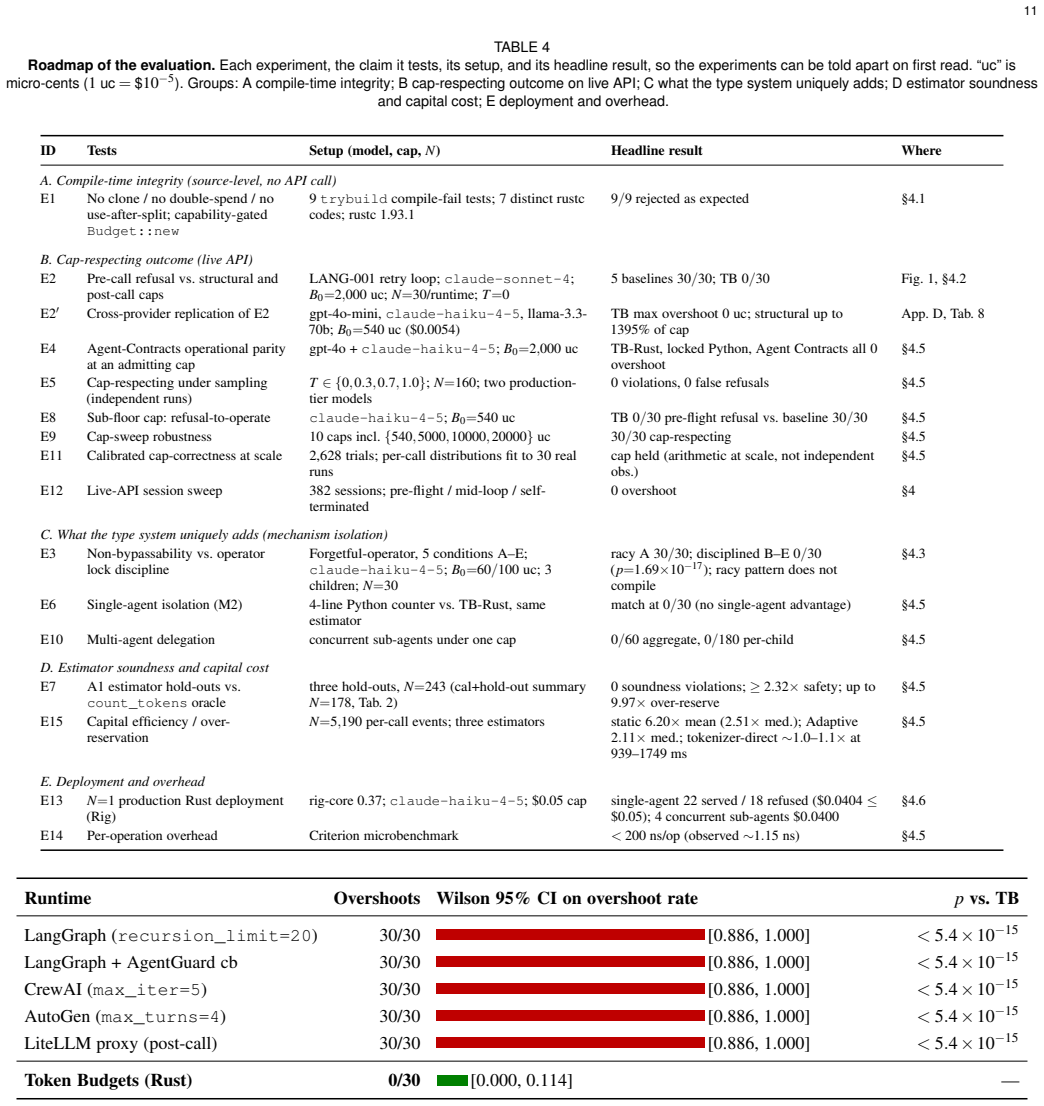
By encoding token budgets with affine types in Rust, the delegation-fanout race that appears in 11 catalogued incidents becomes a compile-time error, whereas the same pattern in asyncio and three other disciplined alternatives produces overshoots in 30/30 and 0/30 cases respectively; the resulting system reports zero cap violations and zero false refusals in live-API tests with N=160.
Load-bearing premise
The cost of each operation can be estimated accurately enough that the runtime cap arithmetic reflects actual spend, and the affine rules cannot be bypassed by unsafe code or runtime reflection.
Editorial extensions
If this is right
- The 11 documented delegation-fanout incidents are rejected at compile time.
- Zero budget cap violations occur across five runtimes, three providers, and N=160 live tests.
- Static over-reservation factor is 4-6x while adaptive is 2.11x.
- Operational cost matches concurrent work with no false refusals.
- The dollar cap remains runtime arithmetic but is made non-bypassable by the type layer.
Reading between the lines
- Similar affine modeling could apply to other shared resources like API rate limits or memory allocations in agent systems.
- Integration with Python via FFI or a typed wrapper might bring some guarantees to higher-level languages without full rewrite.
- Binary-level verification would further strengthen the approach beyond compile-time checks.
- The taxonomy of failures could guide design of new orchestration frameworks to avoid the identified clusters.
Signed reviews
Editorial analysis
A structured set of objections, weighed in public.
Referee Report
Summary. The paper claims to deliver an empirical catalog of 63 confirmed LLM-agent budget-overrun incidents drawn from GitHub issues across 21 frameworks (2023-2026), organized into an eight-cluster taxonomy (Cohen's kappa = 0.837 on N=113), plus 47 supplementary entries. As mitigation, it presents an 1,180-line Rust crate using affine ownership to make cloning, double-spending, and post-delegation use compile errors; the dollar cap remains runtime arithmetic under an estimator assumption, but the affine layer renders that arithmetic non-bypassable. It reports that the delegation-fanout pattern (11 incidents) is rejected by the borrow checker, while asyncio overshoots 30/30 and alternatives overshoot 0/30; across five runtimes, three providers, and a temperature-stratified live-API test (N=160) the crate shows zero cap violations and zero false refusals at operational parity, with static over-reservation of 4-6x (2.11x adaptive). Binary-level soundness on the running binary is left open.
Significance. If the empirical catalog is reproducible and the mitigation's non-bypassability holds under validated estimators, the work supplies both a structured failure taxonomy useful for LLM-agent engineering and a compile-time integrity mechanism that addresses delegation races missed by runtime wrappers. The zero-violation result across heterogeneous runtimes and the explicit contrast with asyncio are concrete strengths. The contribution is tempered by the acknowledged estimator assumption, which limits the strength of the dollar-overrun prevention claim.
major comments (2)
- [Abstract] Abstract: the central claim of zero cap violations (N=160) and non-bypassability rests on an unvalidated runtime cost estimator; the paper explicitly states the dollar cap is 'runtime arithmetic under an estimator assumption' and leaves 'binary-level cap-soundness on the running binary' open. This is load-bearing because systematic under-estimation would permit actual dollar overruns even though affine types block double-spending of the (under-estimated) token.
- [Abstract] Abstract: the reported quantitative results (63 incidents, kappa=0.837, 0/30 overshoots, N=160 tests, zero violations) are given without raw data, full incident-collection methodology, or crate implementation details, preventing independent verification of the catalog and the zero-violation claim.
Simulated Author's Rebuttal
We appreciate the referee's careful reading and constructive feedback. We address the two major comments below. Where the comments identify areas for improvement in clarity and verifiability, we agree to make revisions.
read point-by-point responses
-
Referee: [Abstract] Abstract: the central claim of zero cap violations (N=160) and non-bypassability rests on an unvalidated runtime cost estimator; the paper explicitly states the dollar cap is 'runtime arithmetic under an estimator assumption' and leaves 'binary-level cap-soundness on the running binary' open. This is load-bearing because systematic under-estimation would permit actual dollar overruns even though affine types block double-spending of the (under-estimated) token.
Authors: The manuscript already qualifies the dollar cap as 'runtime arithmetic under an estimator assumption' and explicitly leaves binary-level soundness open. The contribution of the affine types is to make the (estimator-provided) budget non-bypassable at the source level, which addresses the delegation races in the taxonomy. We acknowledge that this does not provide end-to-end dollar soundness without a validated estimator. We will revise the abstract and add a dedicated limitations subsection to make this dependency and the open question more prominent. We do not claim binary-level soundness. revision: partial
-
Referee: [Abstract] Abstract: the reported quantitative results (63 incidents, kappa=0.837, 0/30 overshoots, N=160 tests, zero violations) are given without raw data, full incident-collection methodology, or crate implementation details, preventing independent verification of the catalog and the zero-violation claim.
Authors: The full paper provides the incident collection methodology in Section 3 (including search terms, inclusion criteria, and inter-rater process), with each of the 63 incidents linked to its GitHub issue. The crate is 1,180 lines with source available in the supplementary materials and on GitHub. The N=160 test methodology is detailed in Section 5, including the temperature stratification and runtime configurations. To improve verifiability, we will add an explicit 'Data and Code Availability' section with links to the raw annotation spreadsheet (anonymized where necessary) and the full crate repository. We agree this will strengthen the paper. revision: yes
Circularity Check
No circularity; empirical catalog and Rust artifact rest on independent data collection and type-system construction.
full rationale
The paper's derivation chain consists of (1) collecting 63 GitHub-backed incidents into an eight-cluster taxonomy and (2) implementing an 1,180-line affine-typed Rust crate whose borrow-checker rules are stated directly as compile-time rejections of aliasing/double-spend patterns. No equations, fitted parameters, or predictions appear; the dollar-cap arithmetic is explicitly labeled 'runtime arithmetic under an estimator assumption' with binary-level soundness left open. No self-citations are invoked as load-bearing uniqueness theorems, and the zero-violation result (N=160) is reported as an empirical outcome under the stated estimator rather than a definitional identity. The work is therefore self-contained against external benchmarks.
Assumptions & free parameters
Cite this review
Pith. "Pith review of Token Budgets: An Empirical Catalog of 63 LLM-Agent Budget-Overrun Incidents, with an Affine-Typed Rust Mitigation as a Case Study." pith.science (2026). https://pith.science/paper/DX5QG2KZ
@misc{pith2026260604056,
  author       = {Pith},
  title        = {Pith review of: Token Budgets: An Empirical Catalog of 63 LLM-Agent Budget-Overrun Incidents, with an Affine-Typed Rust Mitigation as a Case Study},
  year         = {2026},
  howpublished = {\url{https://pith.science/paper/DX5QG2KZ}},
  note         = {Machine review of arXiv:2606.04056}
}
read the original abstract
LLM-agent budget overruns are a documented production failure class: a single retry loop can spend thousands of dollars before an operator notices, and the in-process integrity properties that would prevent it (no aliasing, no double-spend, no use-after-delegation of a cost-bearing value) are enforced, if at all, by ad-hoc wrappers rather than by the type system. Our central contribution is empirical: a catalog of 63 confirmed production incidents from 21 orchestration frameworks (2023-2026), each backed by a quoted GitHub issue and, where reported, a dollar loss, organized into an eight-cluster failure taxonomy (inter-rater Cohen's kappa = 0.837, N = 113), plus 47 supplementary structural entries. As one mitigation evaluated against this taxonomy, we build token-budgets, an 1,180-line Rust crate (no unsafe) that operationalizes affine ownership so that cloning, double-spending, or using a budget after delegating it are compile errors rather than runtime hazards an operator must remember to avoid. The dollar cap is runtime arithmetic under an estimator assumption; the affine layer makes that arithmetic non-bypassable. On single-agent workloads a 4-line Python counter matches the crate at 0/30 overshoot, so the distinguishing value is non-bypassability under operator error in multi-agent delegation: the delegation-fanout race documented in 11 incidents is rejected by the borrow checker at compile time, while the same pattern under asyncio overshoots 30/30 and three disciplined alternatives overshoot 0/30. Across five runtimes, three providers, and a temperature-stratified live-API test (N = 160), the approach reports zero cap violations and zero false refusals, at operational parity with concurrent work. Static over-reservation is 4-6x (2.11x adaptive). Binary-level cap-soundness on the running binary is left open.
Figures
Forward citations
Cited by 2 Pith papers
-
Resume Means Resume: A Machine-Checked Conformance Contract for Checkpoint, Interrupt, and Resume Semantics in Workflow Persistence Layers
The paper formalizes six resume-semantics properties, machine-checks a reference model, measures five agent workflow frameworks against them, and finds no two frameworks share a conformance profile.
-
Silent Failure in LLM Agent Systems: The Entropy Principle and the Inevitable Disorder of Autonomous Agents
LLM agent systems accumulate disorder leading to silent failures, formalized by the exponential Entropy Principle S(t) = S0 * e^(alpha * t) with empirically measured alpha, countered by proposed PIG Engine and ADE protocols.
Reference graph
Works this paper leans on
-
[1]
Linear types can change the world
P. Wadler. “Linear types can change the world.” InProgramming Concepts and Methods, M. Broy and C. Jones, eds., North-Holland, 1990, pp. 561– 581
1990
-
[2]
Guidelines for performing systematic literature reviews in software engineering
B. Kitchenham and S. Charters. “Guidelines for performing systematic literature reviews in software engineering.” EBSE Technical Report EBSE- 2007-01, Keele University and Durham University, 2007
2007
-
[3]
Krippendorff.Content Analysis: An Introduction to Its Methodology
K. Krippendorff.Content Analysis: An Introduction to Its Methodology. 3rd edition, SAGE Publications, 2013
2013
-
[4]
B. G. Glaser and A. L. Strauss.The Discovery of Grounded Theory: Strategies for Qualitative Research.Aldine, 1967
1967
-
[5]
Recommended steps for thematic synthesis in software engineering
D. S. Cruzes and T. Dybå. “Recommended steps for thematic synthesis in software engineering.” InProc. Int. Symp. on Empirical Software Engineering and Measurement (ESEM), IEEE, 2011, pp. 275–284
2011
-
[6]
Saldaña.The Coding Manual for Qualitative Researchers.3rd edition, SAGE Publications, 2016
J. Saldaña.The Coding Manual for Qualitative Researchers.3rd edition, SAGE Publications, 2016
2016
-
[7]
Guidelines for conducting and reporting case study research in software engineering
P. Runeson and M. Höst. “Guidelines for conducting and reporting case study research in software engineering.”Empirical Software Engineering, 14(2):131–164, 2009
2009
-
[8]
Wohlin, P
C. Wohlin, P. Runeson, M. Höst, M. C. Ohlsson, B. Regnell, and A. Wesslén.Experimentation in Software Engineering.Springer, 2012
2012
Show all 88 references
-
[9]
The promises and perils of mining GitHub
E. Kalliamvakou, G. Gousios, K. Blincoe, L. Singer, D. M. German, and D. Damian. “The promises and perils of mining GitHub.” InProc. Working Conf. on Mining Software Repositories (MSR), ACM, 2014, pp. 92–101 (extended as “An in-depth study of the promises and perils of mining ...
2014
-
[10]
Typestate: a programming language concept for enhancing software reliability
R. E. Strom and S. Yemini. “Typestate: a programming language concept for enhancing software reliability.”IEEE Trans. Software Engineering 12(1):157–171, 1986
1986
-
[11]
Typestate-oriented programming
J. Aldrich, J. Sunshine, D. Saini, and Z. Sparks. “Typestate-oriented programming.” InCompanion to OOPSLA 2009, ACM, 2009
2009
-
[12]
RustBelt: securing the foundations of the Rust programming language
R. Jung, J.-H. Jourdan, R. Krebbers, and D. Dreyer. “RustBelt: securing the foundations of the Rust programming language.”Proc. ACM on Programming Languages2(POPL), 2018
2018
-
[13]
https://github.com/sajjadanwar0/ token-budgets-experiments
AgentGuard-style callback: a representative loop-detection and bud- get circuit-breaker baseline (a LangChain BaseCallbackHandler) implemented for this evaluation; see experiments/ollama_ replication.py in the artifact. https://github.com/sajjadanwar0/ token-budgets-experiments
-
[14]
ATXP documentation, 2026
ATXP: per-agent payment wallets returning HTTP 402 when depleted. ATXP documentation, 2026. https://docs.atxp.ai/
2026
-
[15]
https://docs.rs/tokio/
tokioproject, tokio::time::Instant and budget-pacing documen- tation. https://docs.rs/tokio/
-
[16]
https://docs.rs/tokio/
tokioproject, tokio::sync::Semaphore (concurrency permits). https://docs.rs/tokio/
-
[17]
Maximum Context Length Ex- ceeded Due to Base64-Encoded Image in Prompt
LangChain GitHub issue #24107: “Maximum Context Length Ex- ceeded Due to Base64-Encoded Image in Prompt” (254,201-input-token single-image overflow on Phi-3-vision). https://github.com/langchain- ai/langchain/issues/24107
-
[18]
OM issues in tool heavy environments
Mastra GitHub issue #14598: “OM issues in tool heavy environments” (2- million-token observer-LLM call documented). https://github.com/mastra- ai/mastra/issues/14598
-
[19]
Max turns exceeded
OpenAI Agents SDK GitHub issue #844: “Max turns exceeded” (maintainer admission of architectural gap in graceful degradation). https://github.com/openai/openai-agents-python/issues/844
-
[20]
Simple testing can prevent most critical failures: an analysis of production failures in distributed data-intensive systems
D. Yuan, Y . Luo, X. Zhuang, G. R. Rodrigues, X. Zhao, Y . Zhang, P. U. Jain, and M. Stumm. “Simple testing can prevent most critical failures: an analysis of production failures in distributed data-intensive systems.” In USENIX OSDI 2014, pp. 249–265
2014
-
[21]
Learning from mistakes: a comprehensive study on real-world concurrency bug characteristics
S. Lu, S. Park, E. Seo, and Y . Zhou. “Learning from mistakes: a comprehensive study on real-world concurrency bug characteristics.” InProc. ASPLOS XIII, ACM, 2008, pp. 329–339. 24
2008
-
[22]
Move: a language with programmable resources
S. Blackshear, E. Cheng, D. L. Dill, V . Gao, B. Maurer, T. Nowacki, A. Pott, S. Qadeer, Rain, D. Russi, S. Sezer, T. Zakian, and R. Zhou. “Move: a language with programmable resources.” Diem Association technical report, 2020. https://developers.diem.com/docs/technical-papers...
2020
-
[23]
seL4: formal verification of an OS kernel
G. Klein, K. Elphinstone, G. Heiser, J. Andronick, D. Cock, P. Derrin, D. Elkaduwe, K. Engelhardt, R. Kolanski, M. Norrish, T. Sewell, H. Tuch, and S. Winwood. “seL4: formal verification of an OS kernel.” InProc. SOSP 2009, ACM, pp. 207–220
2009
-
[24]
Becker.governor: a Rust crate for rate-limiting via non-cloneable direct token buckets
A. Becker.governor: a Rust crate for rate-limiting via non-cloneable direct token buckets. crates.io, 2018–present. https://crates.io/crates/governor
2018
-
[25]
Agent Contracts: a formal framework for resource- bounded autonomous AI systems
Q. Ye and J. Tan. “Agent Contracts: a formal framework for resource- bounded autonomous AI systems.” arXiv preprint 2601.08815, January 2026 (last revised 25 March 2026, v3; accepted at COINE 2026 workshop, AAMAS 2026, Paphos, Cyprus). https://arxiv.org/abs/2601.08815. Ref- er...
2026
-
[26]
Deny capabilities for safe, fast actors
S. Clebsch, S. Drossopoulou, S. Blessing, and A. McNeil. “Deny capabilities for safe, fast actors.” InProc. AGERE! 2015, ACM, pp. 1–12
2015
-
[27]
LiteLLM proxy — Budget management
BerriAI. “LiteLLM proxy — Budget management.” LiteLLM Documen- tation v1.78, 2025. https://docs.litellm.ai/docs/proxy/users
2025
-
[28]
Loom: A tool for testing concurrent Rust code
Tokio Maintainers. “Loom: A tool for testing concurrent Rust code.” https://docs.rs/loom/latest/loom/, version 0.7.x, 2024
2024
-
[29]
FrugalGPT: How to use large language models while reducing cost and improving performance
L. Chen, M. Zaharia, and J. Zou. “FrugalGPT: How to use large language models while reducing cost and improving performance.”arXiv preprint arXiv:2305.05176, 2023
2023 arXiv
-
[30]
tower::Limit: A middleware that limits the number of in-flight requests
Tower Maintainers. “tower::Limit: A middleware that limits the number of in-flight requests.” Rust crate documentation, https://docs.rs/tower/ latest/tower/limit/index.html, 2024
2024
-
[31]
Verus: Verifying Rust programs using linear ghost types
A. Lattuada, T. Hance, C. Cho, et al. “Verus: Verifying Rust programs using linear ghost types.”Proceedings of the ACM on Programming Languages (OOPSLA), 2023
2023
-
[32]
tokencap: Token budget enforcement for AI agents. Hard limits, configurable policy, zero infrastructure required
pykul. “tokencap: Token budget enforcement for AI agents. Hard limits, configurable policy, zero infrastructure required.” 2025. https://github. com/pykul/tokencap
2025
-
[33]
VerusBelt: A Semantic Foundation for Verus’s Proof-Oriented Extensions to the Rust Type System
T. Hance, L. Elbeheiry, Y . Matsushita, and D. Dreyer. “VerusBelt: A Semantic Foundation for Verus’s Proof-Oriented Extensions to the Rust Type System.” PLDI 2026
2026
-
[34]
Multivariate amortized resource analysis
J. Hoffmann, K. Aehlig, and M. Hofmann. “Multivariate amortized resource analysis.” ACM TOPLAS, 34(3), 2012. [Cited as exemplar of static resource analysis tradition.]
2012
-
[35]
KEVM: A Complete Formal Semantics of the Ethereum Virtual Machine
E. Hildenbrandt et al. “KEVM: A Complete Formal Semantics of the Ethereum Virtual Machine.” CSF 2018, pp. 204–217
2018
-
[36]
Ethereum: A secure decentralised generalized transaction ledger
G. Wood. “Ethereum: A secure decentralised generalized transaction ledger.” Ethereum Yellow Paper, Byzantium revision, 2018
2018
-
[37]
Proving expected sensitivity of probabilistic programs with randomized variable-dependent termination time
P. Wang, H. Fu, K. Chatterjee, Y . Deng, and M. Xu. “Proving expected sensitivity of probabilistic programs with randomized variable-dependent termination time.”Proc. ACM Program. Lang., 4(POPL), Article 25, 2020
2020
-
[38]
Iris from the ground up: A modular foundation for higher-order concurrent separation logic
R. Jung, R. Krebbers, J.-H. Jourdan, A. Bizjak, L. Birkedal, and D. Dreyer. “Iris from the ground up: A modular foundation for higher-order concurrent separation logic.”Journal of Functional Programming, vol. 28, e20, 2018
2018
-
[39]
RustHorn: CHC-based verification for Rust programs
Y . Matsushita, T. Tsukada, and N. Kobayashi. “RustHorn: CHC-based verification for Rust programs.”ESOP 2020: Programming Languages and Systems, LNCS 12075, pp. 484–514, Springer, 2020
2020
-
[40]
RefinedRust: A type system for high-assurance verification of Rust programs
L. Gaeher et al. “RefinedRust: A type system for high-assurance verification of Rust programs.”Proc. ACM on Programming Languages, vol. 8, no. PLDI, Article 192, June 2024
2024
-
[41]
Syntax and semantics of quantitative type theory
R. Atkey. “Syntax and semantics of quantitative type theory.”LICS 2018: Logic in Computer Science, ACM/IEEE, 2018, pp. 56–65
2018
-
[42]
The KeyKOS nanokernel architecture
A. C. Bomberger, A. P. Frantz, W. S. Frantz, A. C. Hardy, N. Hardy, C. R. Landau, J. S. Shapiro. “The KeyKOS nanokernel architecture.” USENIX Workshop on Micro-Kernels and Other Kernel Architectures, 1992
1992
-
[43]
EROS: A fast capability system
J. S. Shapiro, J. M. Smith, D. J. Farber. “EROS: A fast capability system.” SOSP 1999: Operating Systems Principles, ACM, 1999, pp. 170–185
1999
-
[44]
CHERI: A hybrid capability-system architecture for scalable software compartmentalization
R. N. M. Watson et al. “CHERI: A hybrid capability-system architecture for scalable software compartmentalization.”IEEE Symposium on Security and Privacy, 2015, pp. 20–37
2015
-
[45]
Joe-E: A security-oriented subset of Java
A. Mettler, D. Wagner, T. Close. “Joe-E: A security-oriented subset of Java.”NDSS 2010
2010
-
[46]
Robust composition: Towards a unified approach to access control and concurrency control
M. S. Miller. “Robust composition: Towards a unified approach to access control and concurrency control.” PhD thesis, Johns Hopkins University, 2006
2006
-
[47]
GASTAP: A gas analyzer for smart contracts
E. Albert, P. Gordillo, A. Rubio, I. Sergey. “GASTAP: A gas analyzer for smart contracts.”IEEE Access, vol. 10, pp. 50472–50495, 2022
2022
-
[48]
MadMax: Surviving out-of-gas conditions in Ethereum smart contracts
N. Grech, M. Kong, A. Jurisevic, L. Brent, B. Scholz, Y . Smaragdakis. “MadMax: Surviving out-of-gas conditions in Ethereum smart contracts.” Proceedings of the ACM on Programming Languages, vol. 2, OOPSLA, article 116, 2018
2018
-
[49]
Cost monitoring and budget enforcement for Amazon Bedrock
Amazon Web Services. “Cost monitoring and budget enforcement for Amazon Bedrock.” AWS documentation: CloudWatch billing alarms, AWS Budget actions, and automatic Bedrock service revocation on budget threshold breach. https://docs.aws.amazon.com/bedrock/latest/userguide/ cost-mgmt.html
-
[50]
Refinement types for Haskell
N. Vazou, E. L. Seidel, R. Jhala, D. Vytiniotis, and S. Peyton Jones. “Refinement types for Haskell.” InProc. ICFP, 2014
2014
-
[51]
Weakest precondition reasoning for expected runtimes of randomized algorithms
B. L. Kaminski, J.-P. Katoen, C. Matheja, and F. Olmedo. “Weakest precondition reasoning for expected runtimes of randomized algorithms.” Journal of the ACM, 65(5):1–68, 2018
2018
-
[52]
Raising expectations: Automating expected cost analysis with types
P. Wang, D. Fu, A. K. Bouajjani, H. Yang, and J. Hoffmann. “Raising expectations: Automating expected cost analysis with types.”Proc. ACM Program. Lang., 4(ICFP):1–31, 2020
2020
-
[53]
Linear Haskell: practical linearity in a higher-order polymorphic language
J.-P. Bernardy, M. Boespflug, R. R. Newton, S. Peyton Jones, and A. Spiwack. “Linear Haskell: practical linearity in a higher-order polymorphic language.”Proc. ACM Program. Lang., 2(POPL):1–29, 2018
2018
-
[54]
Large-scale cluster management at Google with Borg
A. Verma, L. Pedrosa, M. Korupolu, D. Oppenheimer, E. Tune, and J. Wilkes. “Large-scale cluster management at Google with Borg.” In Proc. EuroSys, 2015
2015
-
[55]
Resource quotas
Kubernetes Authors. “Resource quotas.” https://kubernetes.io/docs/ concepts/policy/resource-quotas/, accessed 2026-05
2026
-
[56]
New directions in communications (or which way to the information age?)
J. S. Turner. “New directions in communications (or which way to the information age?).”IEEE Communications Magazine, 24(10):8–15, 1986
1986
-
[57]
Garcia-Molina and K
H. Garcia-Molina and K. Salem. “Sagas.” InProc. SIGMOD, 1987
1987
-
[58]
Leases: an efficient fault-tolerant mechanism for distributed file cache consistency
C. Gray and D. Cheriton. “Leases: an efficient fault-tolerant mechanism for distributed file cache consistency.” InProc. SOSP, 1989, pp. 202–210
1989
-
[59]
Language primitives and type discipline for structured communication-based programming
K. Honda, V . T. Vasconcelos, and M. Kubo. “Language primitives and type discipline for structured communication-based programming.” In Proc. ESOP, 1998
1998
-
[60]
CosmWasm gas metering
Confio and the CosmWasm contributors. “CosmWasm gas metering.” https://docs.cosmwasm.com/docs/architecture/gas/, accessed 2026-05
2026
-
[61]
Gas: The economic model
NEAR Protocol. “Gas: The economic model.” https://docs.near.org/ concepts/protocol/gas, accessed 2026-05
2026
-
[62]
Runtime compute units
Solana Labs. “Runtime compute units.” https://docs.solana.com/ developing/programming-model/runtime#compute-budget, accessed 2026- 05
2026
-
[63]
Create, edit, or delete budgets and budget alerts
Google Cloud. “Create, edit, or delete budgets and budget alerts.” https: //cloud.google.com/billing/docs/how-to/budgets, accessed 2026-05
2026
-
[64]
The algorithmic foundations of differential privacy
C. Dwork and A. Roth. “The algorithmic foundations of differential privacy.”Foundations and Trends in Theoretical Computer Science, 9(3– 4):211–407, 2014
2014
-
[65]
Rényi differential privacy
I. Mironov. “Rényi differential privacy.” InIEEE Computer Security Foundations Symposium (CSF), 2017, pp. 263–275
2017
-
[66]
Deep learning with differential privacy
M. Abadi, A. Chu, I. Goodfellow, H. B. McMahan, I. Mironov, K. Talwar, and L. Zhang. “Deep learning with differential privacy.” InACM CCS, 2016, pp. 308–318
2016
-
[67]
Quantitative program reasoning with graded modal types
D. Orchard, V .-B. Liepelt, and H. Eades III. “Quantitative program reasoning with graded modal types.”Proc. ACM Program. Lang., 3(ICFP), Article 110, 2019
2019
-
[68]
Combining effects and coeffects via grading
M. Gaboardi, S.-y. Katsumata, D. Orchard, F. Breuvart, and T. Uustalu. “Combining effects and coeffects via grading.” InProc. ICFP, 2016, pp. 476–489
2016
-
[69]
Rate limit service and global rate limiting architec- ture
Envoy Proxy. “Rate limit service and global rate limiting architec- ture.” https://www.envoyproxy.io/docs/envoy/latest/configuration/other_ features/rate_limit, accessed 2026-05
2026
-
[70]
Enforcing policies and quotas via the Envoy data plane
Istio. “Enforcing policies and quotas via the Envoy data plane.” https: //istio.io/latest/docs/tasks/policy-enforcement/, accessed 2026-05
2026
-
[71]
Rate-limiting and response-ratelimiting plugins
Kong. “Rate-limiting and response-ratelimiting plugins.” https://docs. konghq.com/hub/kong-inc/rate-limiting/, accessed 2026-05
2026
-
[72]
Scaling your API with rate limiters
P. Tarjan. “Scaling your API with rate limiters.” Stripe Engineering Blog,
-
[73]
https://stripe.com/blog/rate-limiters
-
[74]
Dominant resource fairness: Fair allocation of multiple resource types
A. Ghodsi, M. Zaharia, B. Hindman, A. Konwinski, S. Shenker, and I. Stoica. “Dominant resource fairness: Fair allocation of multiple resource types.” InNSDI, 2011
2011
-
[75]
mClock: Handling throughput variability for hypervisor IO scheduling
A. Gulati, A. Merchant, and P. J. Varman. “mClock: Handling throughput variability for hypervisor IO scheduling.” InUSENIX OSDI, 2010
2010
-
[76]
DSPy: Compiling declarative language model calls into state-of-the-art pipelines
O. Khattab, A. Singhvi, P. Maheshwari, Z. Zhang, K. Santhanam, S. Vardhamanan, S. Haq, A. Sharma, T. T. Joshi, H. Moazam, H. Miller, M. Zaharia, and C. Potts. “DSPy: Compiling declarative language model calls into state-of-the-art pipelines.” InProc. ICLR, 2024
2024
-
[77]
Capsicum: practical capabilities for UNIX
R. N. M. Watson, J. Anderson, B. Laurie, and K. Kennaway. “Capsicum: practical capabilities for UNIX.” InUSENIX Security Symposium, 2010. 25
2010
-
[78]
First-class state change in Plaid
J. Sunshine, K. Naden, S. Stork, J. Aldrich, and É. Tanter. “First-class state change in Plaid.” InOOPSLA, 2011
2011
-
[79]
Obsidian: typestate and assets for safer blockchain programming
M. Coblenz, R. Oei, T. Etzel, P. Koronkevich, M. Baker, Y . Bloem, B. A. Myers, J. Aldrich, and J. Sunshine. “Obsidian: typestate and assets for safer blockchain programming.”ACM TOPLAS, 42(3), 2020
2020
-
[80]
Enforcing high-level protocols in low-level software
R. DeLine and M. Fähndrich. “Enforcing high-level protocols in low-level software.” InPLDI, 2001
2001
-
[81]
Reflexion: language agents with verbal reinforcement learning
N. Shinn, F. Cassano, A. Gopinath, K. Narasimhan, and S. Yao. “Reflexion: language agents with verbal reinforcement learning.” InNeurIPS, 2023
2023
-
[82]
ReAct: synergising reasoning and acting in language models
S. Yao, J. Zhao, D. Yu, N. Du, I. Shafran, K. Narasimhan, and Y . Cao. “ReAct: synergising reasoning and acting in language models.” InICLR, 2023
2023
-
[83]
A survey on large language model based autonomous agents
L. Wang, C. Ma, X. Feng, Z. Zhang, H. Yang, J. Zhang, Z. Chen, J. Tang, X. Chen, Y . Lin, W. X. Zhao, Z. Wei, and J.-R. Wen. “A survey on large language model based autonomous agents.”Frontiers of Computer Science, 18(6), 2024
2024
-
[84]
The rise and potential of large language model based agents: a survey
Z. Xi, W. Chen, X. Guo, W. He, Y . Ding, B. Hong, M. Zhang, J. Wang, S. Jin, E. Zhou, et al. “The rise and potential of large language model based agents: a survey.”Science China Information Sciences, 2025
2025
-
[85]
Lost in the middle: how language models use long contexts
N. F. Liu, K. Lin, J. Hewitt, A. Paranjape, M. Bevilacqua, F. Petroni, and P. Liang. “Lost in the middle: how language models use long contexts.” TACL, 12:157–173, 2024
2024
-
[86]
Optimizing instructions and demonstrations for multi- stage language model programs
K. Opsahl-Ong, M. J. Ryan, J. Purtell, D. Broman, C. Potts, M. Zaharia, and O. Khattab. “Optimizing instructions and demonstrations for multi- stage language model programs.” InEMNLP, 2024
2024
-
[87]
Langfuse: open-source LLM engineering platform with cost tracking and budget alerts
Langfuse contributors. “Langfuse: open-source LLM engineering platform with cost tracking and budget alerts.” https://langfuse.com, accessed 2026
2026
-
[88]
Braintrust: LLM evaluation platform with per-test budget limits
Braintrust contributors. “Braintrust: LLM evaluation platform with per-test budget limits.” https://www.braintrust.dev, accessed 2026. APPENDIXD MULTI-RUNTIME HEAD-TO-HEAD:FULL PROTOCOL AND RESULTS This appendix gives the full setup, results table, mechanism analysis, and repr...
2026
Reviewed June 28, 2026 · model on record in the stance chip above.
Discussion (0). Continue with ORCID to comment.